What Are the Synonyms of Learn?
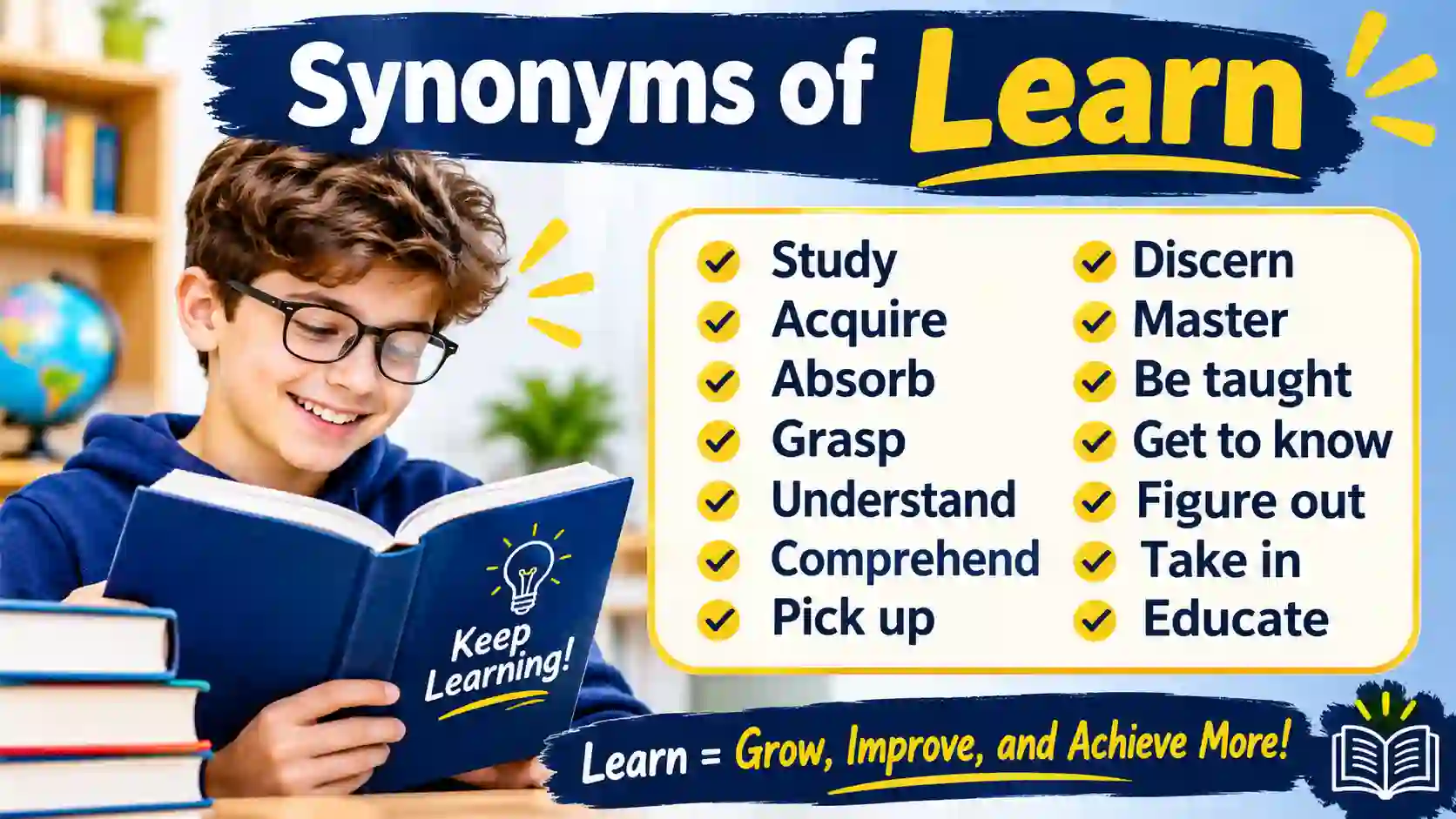
The best synonyms of learn include study, acquire, master, understand, grasp, comprehend, memorize, discover, absorb, and pick up. These words describe different ways of gaining knowledge, understanding information, developing skills, or finding out something new. The right synonym depends on the situation and the meaning you want to express.
Do you often use the word learn in your essays, emails, or everyday conversations? Although it is one of the most useful English verbs, repeating it too often can make your writing sound dull.
Fortunately, English offers many alternatives. You can study a subject, master a skill, grasp an idea, or discover new information. Each word adds a slightly different meaning to your sentence.
Understanding the differences between synonyms of learn helps you speak more naturally and write with greater confidence. This guide covers 30 useful alternatives, their meanings, pronunciation, examples, CEFR levels, common combinations, and practical usage tips.
Pronunciation of Learn
- IPA (American English): /lɝːn/
- IPA (British English): /lɜːn/
- Simple pronunciation: LURN
- Syllables: One
- Part of speech: Verb
American speakers pronounce the R sound, while speakers of standard British English generally do not pronounce it.
Part of Speech
The word learn is primarily a verb.
| Word | Part of speech | Example |
| Learn | Verb | I am learning English. |
| Learner | Noun | She is a fast learner. |
| Learning | Noun / verb | Learning takes patience. |
| Learned | Past tense / adjective | He learned a new skill. |
| Learnt | Past tense | She learnt French. |
| Learnable | Adjective | This skill is learnable. |
| Learnability | Noun | Learnability matters in education. |
Grammar Patterns
Use learn in these common sentence structures:
- Learn + noun: I want to learn English.
- Learn to + verb: He learned to swim.
- Learn how to + verb: She learned how to drive.
- Learn about + subject: We learned about science.
- Learn from + person or experience: I learned from my mistakes.
- Learn that + sentence: They learned that the school was closed.
- Learn of + information: We learned of the decision yesterday.
Remember that learn and teach have different meanings. A teacher teaches students, and students learn from the teacher.
Word Origin (Etymology) of Learn
The word learn comes from Old English leornian, which meant to gain knowledge, study, read, or think about something.
It developed through Middle English lernen. It also has related forms in other Germanic languages, including German lernen, which means to learn.
Historical records show that the sense of becoming informed or hearing about something was established around 1200. The modern verb continues to describe gaining knowledge or skill through study, instruction, and experience.
- Origin: Old English
- Old English form: Leornian
- Middle English form: Lernen
- First recorded period: Before 900
- Historical meaning: Gain knowledge, study, or become informed
- Modern meaning: Develop knowledge, understanding, or ability
Synonyms of Learn: Quick Comparison Table
| Synonym | Strength | Formality |
| Study | Strong | Neutral |
| Master | Strongest | Neutral |
| Acquire | Strong | Formal |
| Understand | Strong | Neutral |
| Grasp | Strong | Neutral |
| Comprehend | Strong | Formal |
| Pick up | Strong | Informal |
| Memorize | Strong | Neutral |
| Absorb | Strong | Neutral |
| Assimilate | Strong | Academic |
| Familiarize yourself | Strong | Formal |
| Get the hang of | Strong | Informal |
| Catch on | Strong | Informal |
| Figure out | Strong | Informal |
| Discover | Related | Neutral |
| Find out | Related | Neutral |
| Ascertain | Related | Formal |
| Determine | Related | Formal |
| Become aware | Related | Neutral |
| Hear about | Related | Neutral |
| Commit to memory | Strong | Formal |
| Learn by heart | Strong | Neutral |
| Take in | Strong | Neutral |
| Become proficient | Strong | Formal |
| Gain knowledge | Strong | Academic |
| Educate yourself | Strong | Neutral |
| Become acquainted | Related | Formal |
| Uncover | Related | Neutral |
| Unearth | Related | Literary |
| Discern | Related | Formal |
Strength describes how closely a word relates to learning in a particular context. Related words are not direct replacements in every sentence.
30 Best Synonyms of Learn with Examples and Explanations
1. Study
Meaning: To spend time reading, practicing, or working to gain knowledge.
Examples:
- I study English every morning to improve my vocabulary.
- Daniel studies mathematics at college.
- Best used when: Someone gains knowledge through planned reading, lessons, or research.
- Tone: Neutral, academic.
- CEFR: A1–A2.
- Frequency: Very common.
- Collocations: Study English, study history, study for an exam.
- When not to use: Do not use study when you simply hear unexpected news.
2. Master
Meaning: To learn something so well that you can do it with great skill.
Examples:
- She wants to master the art of graphic design.
- He mastered the new software after months of practice.
- Best used when: Someone develops a high level of skill or knowledge.
- Tone: Neutral, professional.
- CEFR: B2.
- Frequency: Common.
- Collocations: Master a language, master a skill, master a technique.
- When not to use: Avoid it when someone has only started learning something.
3. Acquire
Meaning: To gain knowledge, experience, or skills over time.
Examples:
- Students acquire new skills through regular practice.
- She acquired valuable experience during her internship.
- Best used when: Describing the gradual development of knowledge or abilities.
- Tone: Formal, academic, business.
- CEFR: B2.
- Frequency: Common.
- Collocations: Acquire knowledge, acquire skills, acquire experience.
- When not to use: Avoid it when a simple conversational word sounds more natural.
4. Understand
Meaning: To know what something means or how it works.
Examples:
- I finally understand the rules of the game.
- She understands why good communication matters.
- Best used when: Someone develops a clear idea of information.
- Tone: Neutral.
- CEFR: A2.
- Frequency: Very common.
- Collocations: Understand a concept, understand the rules, understand a problem.
- When not to use: Do not use it when someone has only memorized information without understanding it.
5. Grasp
Meaning: To understand an idea or concept clearly.
Examples:
- The students quickly grasped the main idea.
- It took me several days to grasp the new system.
- Best used when: Emphasizing mental understanding.
- Tone: Neutral, academic.
- CEFR: B2.
- Frequency: Common.
- Collocations: Grasp an idea, grasp a concept, grasp the meaning.
- When not to use: Avoid it when you mean remembering a list of facts.
6. Comprehend
Meaning: To understand information, language, or an idea fully.
Examples:
- Young readers can comprehend the story with practice.
- She struggled to comprehend the complicated instructions.
- Best used when: Describing careful or complete understanding.
- Tone: Formal, academic.
- CEFR: B2–C1.
- Frequency: Common.
- Collocations: Comprehend information, comprehend a text, fully comprehend.
- When not to use: Avoid it in casual conversations when understanding is simpler.
7. Pick Up
Meaning: To learn something naturally through experience or exposure.
Examples:
- I picked up a few Spanish phrases during my holiday.
- Children often pick up expressions from their friends.
- Best used when: Learning happens naturally without much formal instruction.
- Tone: Informal, spoken English.
- CEFR: B1.
- Frequency: Very common.
- Collocations: Pick up a language, pick up habits, pick up information.
- When not to use: Avoid it in highly formal academic writing.
8. Memorize
Meaning: To learn information so you can remember it.
Examples:
- I memorized ten new English words today.
- The actor memorized every line before the performance.
- Best used when: Someone needs to remember facts, words, or information.
- Tone: Neutral, academic.
- CEFR: B1.
- Frequency: Common.
- Collocations: Memorize facts, memorize a poem, memorize a speech.
- When not to use: Do not use it when you mean understanding an idea deeply.
9. Absorb
Meaning: To take in information and gradually understand or remember it.
Examples:
- Children absorb new vocabulary through conversations.
- She absorbed useful lessons from her first job.
- Best used when: Knowledge enters the mind through exposure or experience.
- Tone: Neutral, literary.
- CEFR: B2.
- Frequency: Common.
- Collocations: Absorb information, absorb knowledge, absorb new ideas.
- When not to use: Avoid it when describing a specific formal study process.
10. Assimilate
Meaning: To take in new information and make it part of your existing knowledge.
Examples:
- New employees need time to assimilate company procedures.
- The students assimilated the information after several lessons.
- Best used when: New knowledge becomes part of someone’s understanding.
- Tone: Formal, academic.
- CEFR: C1.
- Frequency: Uncommon.
- Collocations: Assimilate information, assimilate knowledge, assimilate new ideas.
- When not to use: Avoid it as a simple substitute for learning one basic fact.
11. Familiarize Yourself With
Meaning: To become familiar with a subject, system, or activity.
Examples:
- Please familiarize yourself with the company guidelines.
- I familiarized myself with the new editing software.
- Best used when: Someone becomes comfortable with something through study or exposure.
- Tone: Formal, business.
- CEFR: B2.
- Frequency: Common.
- Collocations: Familiarize yourself with rules, procedures, and software.
- When not to use: Do not use it when you mean achieving expert-level ability.
12. Get the Hang Of
Meaning: To learn how to do something after some practice.
Examples:
- I finally got the hang of using the new camera.
- She got the hang of driving after several lessons.
- Best used when: Someone becomes comfortable with a practical task.
- Tone: Informal, spoken.
- CEFR: B1.
- Frequency: Common.
- Collocations: Get the hang of driving, get the hang of software, get the hang of a task.
- When not to use: Avoid it in formal research papers.
13. Catch On
Meaning: To begin understanding something after some time.
Examples:
- It took him a while to catch on to the new rules.
- The children caught on quickly during the activity.
- Best used when: Understanding develops after an explanation or demonstration.
- Tone: Informal, conversational.
- CEFR: B2.
- Frequency: Common.
- Collocations: Catch on quickly, catch on to an idea, catch on to a method.
- When not to use: Avoid it in formal academic writing.
14. Figure Out
Meaning: To understand or solve something by thinking about it.
Examples:
- I figured out how to fix the computer.
- She figured out the answer after reading the question twice.
- Best used when: Someone reaches an answer through reasoning or problem-solving.
- Tone: Informal, spoken.
- CEFR: B1.
- Frequency: Very common.
- Collocations: Figure out a problem, figure out how, figure out the answer.
- When not to use: Do not use it as a replacement for memorizing information.
15. Discover
Meaning: To find something new or become aware of something previously unknown.
Examples:
- I discovered a useful way to improve my writing.
- Scientists discovered a new species of plant.
- Best used when: Someone finds new information, often unexpectedly or through exploration.
- Tone: Neutral, academic.
- CEFR: A2–B1.
- Frequency: Very common.
- Collocations: Discover a fact, discover a method, discover something new.
- When not to use: Do not use it for ordinary planned study when study is more accurate.
16. Find Out
Meaning: To get information about something you did not know before.
Examples:
- I need to find out how this website works.
- She found out the exam results yesterday.
- Best used when: Someone obtains specific information through questions or research.
- Tone: Neutral, conversational.
- CEFR: A2.
- Frequency: Very common.
- Collocations: Find out the truth, find out about something, find out how.
- When not to use: Do not use it to describe mastering a practical skill.
17. Ascertain
Meaning: To find out something with care and certainty.
Examples:
- The researchers tried to ascertain the cause of the problem.
- We contacted the office to ascertain the correct date.
- Best used when: Someone establishes a fact through investigation.
- Tone: Formal, academic, business.
- CEFR: C1.
- Frequency: Uncommon.
- Collocations: Ascertain the facts, ascertain the truth, ascertain whether.
- When not to use: Avoid it in everyday conversation when find out is more natural.
18. Determine
Meaning: To establish something through examination or reasoning.
Examples:
- The researchers determined how the plant responded to sunlight.
- We must determine which method works best.
- Best used when: Someone reaches a conclusion after checking facts.
- Tone: Formal, academic.
- CEFR: B2.
- Frequency: Common.
- Collocations: Determine the cause, determine the result, determine whether.
- When not to use: Do not use it to describe general studying.
19. Become Aware
Meaning: To start knowing or noticing something.
Examples:
- She became aware of the problem during the meeting.
- We became aware of the new rules last week.
- Best used when: Someone starts noticing or knowing something.
- Tone: Neutral, formal.
- CEFR: B1–B2.
- Frequency: Common.
- Collocations: Become aware of a problem, become aware of a fact, become aware of changes.
- When not to use: Avoid it when someone actively studies a subject for a long time.
20. Hear About
Meaning: To receive information about something through another person or source.
Examples:
- I heard about the new course from my teacher.
- They heard about the changes through an email.
- Best used when: Someone becomes informed through listening or communication.
- Tone: Neutral, spoken.
- CEFR: A1–A2.
- Frequency: Very common.
- Collocations: Hear about an event, hear about an opportunity, hear about the news.
- When not to use: Do not use it to describe developing a complex skill.
21. Commit to Memory
Meaning: To make information stay in your memory so you can recall it later.
Examples:
- The student committed the important dates to memory.
- She committed the speech to memory before the event.
- Best used when: Someone deliberately memorizes information.
- Tone: Formal, literary.
- CEFR: B2–C1.
- Frequency: Uncommon.
- Collocations: Commit facts to memory, commit a speech to memory, commit names to memory.
- When not to use: Do not use it when you mean understanding or applying a skill.
22. Learn by Heart
Meaning: To memorize something so you can repeat it without looking.
Examples:
- The children learned the poem by heart.
- I learned the important telephone numbers by heart.
- Best used when: Someone memorizes a poem, speech, song, or passage.
- Tone: Neutral, educational.
- CEFR: B1.
- Frequency: Common.
- Collocations: Learn a poem by heart, learn a song by heart, learn lines by heart.
- When not to use: Avoid it when you mean understanding a complex subject.
23. Take In
Meaning: To receive and mentally process information.
Examples:
- I needed time to take in all the new information.
- The students took in the teacher’s explanation.
- Best used when: Someone processes information mentally.
- Tone: Neutral, conversational.
- CEFR: B2.
- Frequency: Common.
- Collocations: Take in information, take in details, take in a lesson.
- When not to use: Avoid it when you mean completing a formal course.
24. Become Proficient
Meaning: To develop a good level of skill in an activity or subject.
Examples:
- She became proficient in English through daily practice.
- He became proficient at using design software.
- Best used when: Someone reaches a capable and practical level.
- Tone: Formal, academic, professional.
- CEFR: B2.
- Frequency: Common.
- Collocations: Become proficient in English, proficient at coding, proficient in a skill.
- When not to use: Do not use it for someone who has only started learning.
25. Gain Knowledge
Meaning: To increase what you know about a subject.
Examples:
- Students gain knowledge through reading and discussion.
- She gained knowledge of marketing during her internship.
- Best used when: You want to emphasize an increase in information or understanding.
- Tone: Neutral, academic.
- CEFR: B1.
- Frequency: Very common as a phrase.
- Collocations: Gain knowledge, gain knowledge of a subject, gain practical knowledge.
- When not to use: Avoid it when describing a single small discovery.
26. Educate Yourself
Meaning: To gain knowledge through your own study and research.
Examples:
- You should educate yourself about online safety.
- He educated himself about personal finance through books.
- Best used when: Someone takes responsibility for their own learning.
- Tone: Neutral, formal.
- CEFR: B1–B2.
- Frequency: Common.
- Collocations: Educate yourself about a topic, educate yourself on an issue, educate yourself through reading.
- When not to use: Do not use it when describing someone receiving a single piece of information.
27. Become Acquainted With
Meaning: To become familiar with a person, subject, or activity.
Examples:
- New employees should become acquainted with the workplace rules.
- She became acquainted with the history of the town.
- Best used when: Someone develops basic familiarity through experience or information.
- Tone: Formal, neutral.
- CEFR: B2.
- Frequency: Uncommon.
- Collocations: Become acquainted with a subject, become acquainted with a process, become acquainted with a person.
- When not to use: Avoid it when you mean achieving deep knowledge or expertise.
28. Uncover
Meaning: To find information that was hidden or unknown.
Examples:
- The journalist uncovered important details about the case.
- Researchers uncovered new evidence during the investigation.
- Best used when: Information becomes known through careful investigation.
- Tone: Neutral, journalistic.
- CEFR: B2.
- Frequency: Common.
- Collocations: Uncover evidence, uncover the truth, uncover details.
- When not to use: Do not use it for ordinary classroom learning.
29. Unearth
Meaning: To discover information that was hidden, forgotten, or difficult to find.
Examples:
- The historian unearthed old records about the village.
- The investigation unearthed several important facts.
- Best used when: Someone finds hidden information through detailed research.
- Tone: Literary, journalistic.
- CEFR: C1.
- Frequency: Uncommon.
- Collocations: Unearth evidence, unearth records, unearth the truth.
- When not to use: Avoid it for simple everyday learning.
30. Discern
Meaning: To notice, recognize, or understand a difference or detail.
Examples:
- Students must discern the difference between facts and opinions.
- She could discern a pattern in the research results.
- Best used when: Someone recognizes something through careful thought or observation.
- Tone: Formal, academic.
- CEFR: C1.
- Frequency: Uncommon.
- Collocations: Discern a difference, discern a pattern, discern the meaning.
- When not to use: Do not use it as a general substitute for studying a language.
Choose the Right Synonym: Side by Side Comparisons
Several alternatives have similar meanings, but they are not interchangeable in every sentence.
| Words | Main difference | Example |
| Study vs. Master | Study is the process; master describes a high level of ability. | I study English to master it. |
| Learn vs. Understand | Learn means gain knowledge; understand means know its meaning. | I learned the rule and understood it. |
| Memorize vs. Comprehend | Memorize means remember; comprehend means understand. | I memorized the formula but did not comprehend it. |
| Discover vs. Find out | Discover often suggests finding something new; find out is more general. | We discovered a new method. |
| Acquire vs. Absorb | Acquire means gain; absorb emphasizes taking information in. | She acquired new skills and absorbed new ideas. |
| Grasp vs. Figure out | Grasp emphasizes understanding; figure out emphasizes solving or reasoning. | I figured out the answer and grasped the concept. |
| Hear about vs. Study | Hearing gives you information; studying involves focused effort. | I heard about the course and then studied its subject. |
Which Synonym Should You Choose?
- For school subjects: Use study.
- For expert-level skills: Use master.
- For new information: Use discover or find out.
- For clear understanding: Use grasp or comprehend.
- For remembering facts: Use memorization.
- For natural everyday learning: Use pick up.
- For gradual skill development: Use acquire.
- For hidden information: Use uncover.
Strongest, Strong, and Related Synonyms
Strongest Synonyms
These are particularly useful when describing gaining knowledge or skills:
- Study
- Master
- Acquire
- Understand
- Grasp
- Comprehend
- Pick up
- Memorize
- Absorb
- Assimilate
Strong Synonyms
These work well in particular learning situations:
- Familiarize yourself with
- Get the hang of
- Catch on
- Figure out
- Commit to memory
- Learn by heart
- Take in
- Become proficient
- Gain knowledge
- Educate yourself
Related Words
These describe finding information, developing awareness, or becoming familiar with something:
- Discover
- Find out
- Ascertain
- Determine
- Become aware
- Hear about
- Become acquainted with
- Uncover
- Unearth
- Discern
Commonly Confused Words
| Word | Difference | Example |
| Learn vs. Teach | Learn means gain knowledge; teach means give knowledge. | Students learn from teachers. |
| Learn vs. Study | Learning is gaining knowledge; study is an activity used to gain it. | I am studying to learn English. |
| Learn vs. Know | Learn describes gaining knowledge; know describes having it. | I learned the answer, so now I know it. |
| Learn vs. Memorize | Learn can include understanding; memorization focuses on remembering. | I learned the concept instead of memorizing it. |
| Learn vs. Discover | Learn is broad; discover means finding something previously unknown. | I discovered a new fact while studying. |
Common Mistakes When Using Synonyms of Learn
Mistake 1: Confusing learn with teach
Incorrect: My teacher taught me English.
Correct: My teacher taught me English.
Explanation: Teachers teach, while students learn.
Mistake 2: Using memorize when you mean understand
Incorrect: I memorized how gravity works.
Correct: I understood how gravity works.
Explanation: Memorizing information does not always mean understanding it.
Mistake 3: Using master for basic knowledge
Incorrect: I mastered five new words today.
Better: I learned five new words today.
Explanation: Master usually suggests a high level of knowledge or skill.
Mistake 4: Using acquire with the wrong grammar
Incorrect: I learned how to ride a bicycle.
Correct: I learned how to ride a bicycle.
Explanation: Acquire normally takes a noun, such as knowledge, experience, or skills.
Mistake 5: Treating every related word as a direct synonym
Incorrect: I investigated English for an hour.
Better: I studied English for an hour.
Explanation: Investigate usually describes examining a question or problem. Study is the natural word for planned learning.
American vs. British English
The word learn has the same general meaning in American and British English. However, some spelling and pronunciation differences are worth knowing.
| Feature | American English | British English |
| Present form | Learn | Learn |
| Past form | Learned | Learned / Learnt |
| Past participle | Learned | Learned / Learnt |
| Pronunciation | /lɝːn/ | /lɜːn/ |
| Familiarize spelling | Familiarize | Familiarise |
| Memorize spelling | Memorize | Memorise |
| Practice as a verb | Practice | Practise |
| Common study revision term | Review | Revise |
Both learned and learnt are correct. American English generally prefers learned, while learnt is particularly common in British English.
Another important difference is practice and practise. American English uses practice for both the noun and verb. British English uses practice as a noun and practise as a verb.
Writing Tips: How to Use Synonyms Naturally
Different situations need different words.
| Situation | Recommended alternatives | Example |
| Essays | Acquire, comprehend, assimilate | Students acquire knowledge through research. |
| Emails | Understand, familiarize | Please familiarize yourself with the guidelines. |
| Blog posts | Discover, explore, understand | Discover new ways to improve your writing. |
| Stories | Discover, figure out, realize | He discovered the truth about his past. |
| Social media | Pick up, master | I picked up a new editing trick today. |
| Professional communication | Acquire, develop, master | Our team developed new technical skills. |
| Daily conversations | Learn, catch on, get the hang of | I finally got the hang of this app. |
Writing Tip: Do not replace every occurrence of learning with another word. First identify what the sentence means. Choose a synonym that expresses the same idea without changing the message.
Related Vocabulary
Antonyms of Learn
Antonyms describe actions or states that contrast with gaining knowledge.
- Forget
- Unlearn
- Ignore
- Overlook
- Misunderstand
- Neglect
Example: I learned the new rules, but I later forgot some of them.
Related Expressions
| Expression | Meaning | Example |
| Learn by heart | Memorize something | Learn the poem by heart. |
| Learn the hard way | Learn through a bad experience | He learned the hard way to save money. |
| Learn from mistakes | Improve after errors | We learn from our mistakes. |
| Learn on the job | Gain skills while working | She learned on the job. |
| Lifelong learning | Learning throughout life | Lifelong learning builds new skills. |
| Learn the ropes | Understand how a job works | He is learning the ropes at work. |
Word Family
| Word | Part of speech | Meaning |
| Learn | Verb | Gain knowledge |
| Learner | Noun | Someone who learns |
| Learning | Noun / verb | The process of gaining knowledge |
| Learned | Adjective | Having extensive knowledge |
| Learnable | Adjective | Able to be learned |
| Learnability | Noun | The quality of being learnable |
Frequently Asked Questions About Synonyms of Learn
1. What are the 10 best synonyms of learn?
The 10 useful synonyms of learn are study, understand, master, acquire, grasp, comprehend, discover, memorize, absorb, and pick up. Each word has a slightly different meaning. Choose one based on whether you mean gaining information, understanding an idea, or developing a practical skill.
2. What is a formal synonym for learn?
Formal alternatives include acquire, comprehend, assimilate, ascertain, and familiarize yourself. For example, instead of writing “Students learn new information,” you could write “Students acquire new knowledge.” The best choice depends on the sentence and its intended meaning.
3. What is an informal word for learning?
Informal alternatives include pick up, catch on, figure out, and get the hang of. These expressions are common in everyday conversations. For example, “I picked up some Spanish while traveling” sounds natural and friendly.
4. What is a synonym for learning quickly?
Useful expressions include pick up quickly, catch on quickly, grasp quickly, and master rapidly. For example, “She picked up the new software quickly.” Use master quickly when someone develops a high level of ability in a short time.
5. What is the difference between learn and acquire?
Learn is a general word for gaining knowledge or skills. Acquire often describes gradually gaining something valuable, such as knowledge, experience, or ability. For example, you learn a language and acquire communication skills through practice.
6. Is understanding a synonym for learning?
Yes, understanding can replace learning in some contexts, but the words have different meanings. Learn describes gaining knowledge, while understanding means knowing the meaning or reason behind something. You can learn a fact without fully understanding it.
7. What is the difference between learned and learnt?
Both are correct past-tense and past-participle forms of learning. American English usually prefers learned, while British English commonly accepts both learned and learnt. Their meanings are the same, so you can use either form according to your preferred variety of English.
8. What is a synonym for learning new skills?
Useful alternatives include acquiring skills, developing abilities, mastering techniques, and building expertise. For example, “He is developing his writing skills through daily practice.” The best expression depends on the skill and the level of progress.
Vocabulary Practice Exercises
Test your knowledge with these short activities.
Exercise 1: Fill in the Blanks
Choose the best word from the brackets.
- She wants to ________ the English language. (master / hear)
- I need to ________ the meaning of this difficult word. (understand / uncover)
- Children often ________ new expressions from their parents. (pick up / ascertain)
- The actor had to ________ the entire speech. (memorize / investigate)
- We must ________ the correct date before booking. (ascertain / master)
Exercise 2: Rewrite the Sentences
Replace the bold word with a suitable synonym without changing the meaning.
- I learned how to use the new software.
- She learned the poem for the competition.
- The students learned the main idea of the lesson.
- He learned some Spanish during his trip.
- The researchers learned the cause of the problem.
Exercise 3: Match the Words
Match each word with its correct meaning.
| Word | Meaning |
| 1. Master | A. To discover information |
| 2. Memorize | B. To understand an idea clearly |
| 3. Discover | C. To develop a high level of skill |
| 4. Grasp | D. To remember information |
| 5. Acquire | E. To gain knowledge or skills |
Answer Key
Exercise 1: 1. Master, 2. Understand, 3. Pick up, 4. Memorize, 5. Ascertain.
Exercise 2:
- I figured out how to use the new software.
- She memorized the poem for the competition.
- The students grasped the main idea of the lesson.
- He picked up some Spanish during his trip.
- The researchers determined the cause of the problem.
Exercise 3: 1-C, 2-D, 3-A, 4-B, 5-E.
Conclusion
Learning different synonyms can make your English more natural, clear, and interesting. Words like study, acquire, grasp, and master help you express different stages of gaining knowledge.
Practice these alternatives in your essays, emails, schoolwork, and everyday conversations. Do not just memorize them. Understand their meanings and use them in real sentences. Every new word brings you one step closer to better communication.
References
- Cambridge Dictionary: Learn – Definitions, pronunciation, grammar, and usage.
- Cambridge Thesaurus: Learn – Contextual synonyms and examples.
- Merriam-Webster: Learn – Definitions, verb forms, and word usage.
- Collins Dictionary: Learn – Definitions and contextual synonyms.
- Online Etymology Dictionary: Learn – Historical development and word origin.

Synonorm is a trusted English vocabulary resource created to help readers find the right words and understand the differences between similar terms. We provide clear explanations of synonyms, meanings, examples, usage, and alternatives. Our content makes vocabulary easier to learn and apply in everyday, academic, and professional English. Synonorm is designed for students, writers, ESL learners, professionals, and anyone who wants to improve their English vocabulary and communicate more clearly.