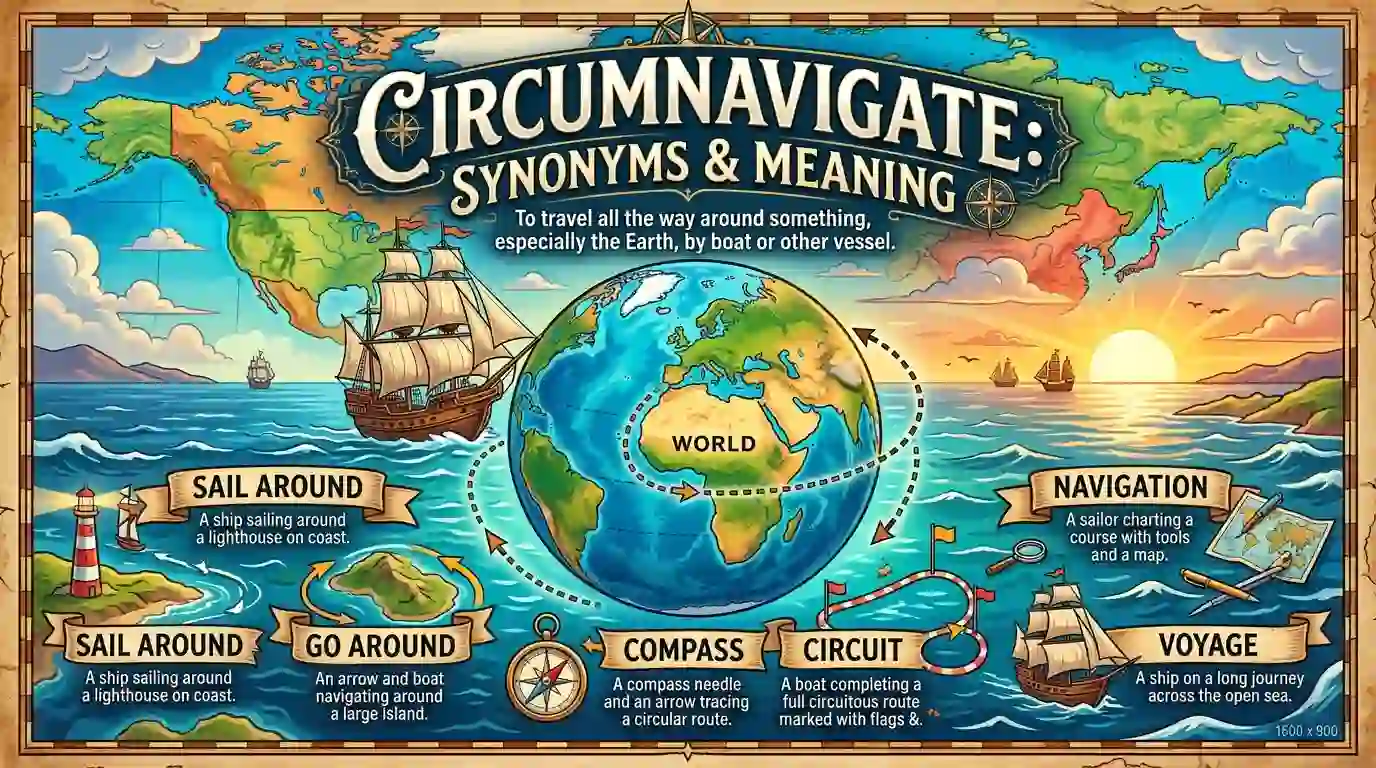
Quick Answer
The best synonyms of circumnavigate depend on the meaning. For traveling completely around a place, the closest choices are go around, travel around, sail around, circle, round, and make a circuit. When circumnavigate means avoiding something, better alternatives include bypass, circumvent, skirt, avoid, and maneuver around. Not every related word is an exact synonym.
What Does Circumnavigate Mean?
What word should you use when someone travels all the way around an island, the Earth, or another geographical feature?
The answer is often circumnavigated. It is a formal verb that means to travel completely around something, especially by sailing or flying. For example, The crew circumnavigated the island before returning to port. Oxford lists the core pattern as circumnavigating something, especially when talking about sailing around the world.
The word also has a second modern use. It can mean to go or maneuver around something to avoid it. For example, The driver circumnavigated the traffic jam. Cambridge and Collins both recognize this broader avoidance sense.
That distinction matters when choosing a synonym. Go around may work in both senses, while orbit is much more specific and normally belongs to astronomy. Likewise, traverse means traveling across or through something, so it is not a direct replacement in most sentences.
This guide separates the closest synonyms from related words so you can choose the right word instead of simply choosing a longer word.
Pronunciation of Circumnavigate
British English: /ˌsɜː.kəmˈnæv.ɪ.ɡeɪt/
American English: /ˌsɝː.kəmˈnæv.ə.ɡeɪt/
Easy pronunciation: SUR-kum-NAV-ih-gate
The spelling is the same in British and American English. The main difference is in the pronunciation of the middle vowel. Cambridge lists separate UK and US pronunciations.
Part of Speech
Circumnavigate is a verb.
Examples:
- They circumnavigated the island.
- She plans to circumnavigate the globe.
- The ship is circumnavigating the coast.
Word Forms
| Form | Word |
| Base verb | circumnavigate |
| Third person | circumnavigates |
| Past tense | circumnavigated |
| Past participle | circumnavigated |
| -ing form | circumnavigating |
| Noun | circumnavigation |
| Person | circumnavigator |
| Adjective | circumnavigable |
The noun circumnavigation refers to the act or process of traveling around something.
Grammar: How to Use Circumnavigate Correctly
The normal structure is:
subject + circumnavigate + object
Correct
- The sailors circumnavigated the island.
- The crew circumnavigated the globe.
- The aircraft circumnavigated the storm.
Common mistake
❌ They circumnavigated around the island.
Better
✅ They circumnavigated the island.
Why? The verb already contains the idea of moving around something.
However, real-world usage can occasionally show circumnavigate around, especially in less formal or automatically generated text. For careful vocabulary writing, circumnavigate + object is the cleaner pattern.
Word Origin and First Known Use
Circumnavigate comes from Latin circumnāvigāre, meaning to sail around. The word combines circum-, meaning “around,” with a form related to navigate.
Collins dates the English word to 1625–35 and traces it to Latin circumnāvigātus, the past participle of circumnāvigāre.
This origin explains why the word has such a strong connection with journeys around the Earth, islands, and other places.
CEFR Guidance
Approximate learner level: C1
It is a relatively advanced word. Beginners can usually express the same basic idea with:
- go around
- travel around
- sail around
- avoid
- bypass
The Two Main Meanings of Circumnavigate
Understanding these two meanings will help you choose a synonym accurately.
Meaning 1: Travel completely around
The explorers circumnavigated the globe.
Here, the journey goes around the entire object.
Meaning 2: Avoid by going around
The driver circumnavigated the traffic jam.
Here, the person avoids something by taking another route.
Cambridge explicitly recognizes both senses.
This is the biggest synonym-selection rule to remember.
Quick Synonym Comparison
| Synonym | Main Sense | Register | Frequency | Exactness |
| go around | move around | Neutral | Very common | Close |
| travel around | travel around | Neutral | Very common | Close |
| sail around | travel by water | Neutral | Common | Very close in nautical context |
| circle | move around in a circle | Neutral | Very common | Context-dependent |
| round | pass around | Formal/Literary | Common | Context-dependent |
| make a circuit | complete a route around | Formal | Uncommon | Close |
| bypass | avoid by another route | Neutral/Formal | Common | Close in avoidance sense |
| circumvent | get around an obstacle/rule | Formal | Common | Close in avoidance sense |
| skirt | pass along the edge | Neutral/Formal | Common | Partial |
| maneuver around | move carefully around | Neutral | Common | Partial |
| avoid | stay away from | Neutral | Very common | Broader |
| detour | take a different route | Neutral | Common | Partial |
| orbit | move around a celestial body | Scientific | Common | Not general |
| traverse | travel across | Formal | Common | Not a direct synonym |
Merriam-Webster divides its synonym results into two useful groups: words meaning “to travel completely around” and words meaning “to avoid by going around.” This distinction is much more useful than treating every listed word as interchangeable.
Closest Synonyms of Circumnavigate
1. Go Around
Meaning: To move around something instead of going directly through it.
Example:
We went around the lake before returning to the campsite.
Best used when: You want the most natural everyday alternative.
Register: Neutral, spoken English
CEFR: A1–A2
Frequency: Very common
Collocations:
- go around the lake
- go around the obstacle
- go around the city
Nuance: This is much less formal than circumnavigating.
When not to use it: Avoid it when precise geographical or historical writing requires the idea of a complete circumnavigation.
2. Travel Around
Meaning: To travel from one part of an area to another while going around it.
Examples:
- They traveled around the island for a week.
- She traveled around the country before returning home.
Best used when: The type of transport is not important.
Register: Neutral
CEFR: A2
Frequency: Very common
Collocations:
- travel around the world
- travel around an island
- travel around a country
Nuance: Broader than circumnavigate. It does not always promise that the traveler completed a full circle.
3. Sail Around
Meaning: To travel around something by boat or ship.
Examples:
- The sailors sailed around the island.
- The crew sailed around the southern coast.
Best used when: The journey takes place on water.
Register: Neutral
CEFR: A2
Frequency: Common
Collocations:
- sail around the island
- sail around the world
- sail around the coast
Nuance: More specific than go around because it identifies the method of travel.
4. Circle
Meaning: To move around something in a circular path.
Examples:
- The aircraft circled the island before landing.
- The boat circled the small harbor.
Best used when: The circular movement is important.
Register: Neutral
CEFR: A2
Frequency: Very common
Important difference: Circle does not always mean completing a major journey around an entire geographical area.
5. Round
Meaning: To travel around or pass around something.
Examples:
- The ship rounded the island before entering the bay.
- The boat rounded the rocky headland.
Best used when: Describing navigation around a specific geographical feature.
Register: Neutral/Formal, especially British English and nautical writing
CEFR: B2
Frequency: Common
Nuance: It often means passing around a particular point rather than completing an entire circumnavigation.
6. Make a Circuit
Meaning: To travel around an area and complete a route.
Examples:
- The cyclists made a circuit of the island.
- We made a circuit of the old city.
Best used when: You want a formal description of a complete route.
Register: Formal/Academic
CEFR: B2
Frequency: Uncommon
Nuance: This can describe a complete round or route, but it does not necessarily imply navigation by sea.
Synonyms for the “Avoid” Meaning
7. Bypass
Meaning: To avoid something by using another route or method.
Examples:
- We bypassed the city to save time.
- The driver bypassed the accident area.
Register: Neutral/Formal
CEFR: B2
Frequency: Common
Best used when: You are avoiding a road, city, obstacle, system, or process.
Collocations:
- bypass the traffic
- bypass the city
- bypass an obstacle
Merriam-Webster lists bypass prominently under the avoidance sense of circumnavigate.
8. Circumvent
Meaning: To find a way around an obstacle, restriction, rule, or difficulty.
Examples:
- The company tried to circumvent the restriction.
- The pilot circumvented the storm by changing course.
Register: Formal/Academic/Business
CEFR: C1
Frequency: Common
Best used when: The thing being avoided is abstract, such as a rule or restriction.
Collocations:
- circumvent a law
- circumvent restrictions
- circumvent an obstacle
Important nuance: This is one of the strongest alternatives when circumnavigate means avoid or get around, not when it means making a complete geographical journey. Cambridge’s thesaurus explicitly connects circumvent with circumnavigate.
9. Skirt
Meaning: To move along or around the edge of something.
Examples:
- The road skirts the edge of the lake.
- The expedition skirted the desert.
Register: Neutral/Formal
CEFR: B2
Frequency: Common
Best used when: The route follows an outer edge.
Collocations:
- skirt the coast
- skirt the border
- skirt the edge
When not to use it: Do not use a skirt if you need to say that someone traveled completely around the entire object.
10. Maneuver Around
Meaning: To move carefully around something, often with skill.
Examples:
- The driver maneuvered around the fallen tree.
- The captain maneuvered around the rocks.
Register: Neutral/Formal
CEFR: B2
Frequency: Common
Best used when: Careful control or skill is important.
11. Avoid
Meaning: To stay away from something or prevent contact with it.
Examples:
- The pilot changed course to avoid the storm.
- We avoided the busiest part of the city.
Register: Neutral
CEFR: A2
Frequency: Very common
Nuance: Avoid is much broader than circumnavigate. It does not necessarily involve traveling around something.
12. Detour
Meaning: To take a different or longer route to avoid something.
Examples:
- We had to detour around the flooded road.
- The bus detoured because of the accident.
Register: Neutral
CEFR: B1
Frequency: Common
Best used when: A normal route is blocked or inconvenient.
Related Words That Are NOT Exact Synonyms
This is where many online synonym lists become confusing.
Orbit
Orbit means to move around a central body, especially in astronomy.
- The Moon orbits Earth.
- The satellite orbits the planet.
It is not a general replacement for circumnavigating. Merriam-Webster lists it as related because both words involve circular movement, but their contexts are different.
Traverse
Traverse means to travel across, through, or along an area.
- They traversed the desert.
- The hikers traversed the valley.
It is not the normal choice to “travel completely around.”
Merriam-Webster places traverse among words associated with the complete-around sense, but the practical learner distinction remains important: traverse = across/through; circumnavigate = around.
Surround
Surround means to be or form an area around something.
- Trees surround the house.
- A wall surrounds the garden.
It describes position or enclosure rather than necessarily describing a journey.
Encircle
Encircle means to form a circle around something.
- A path encircles the lake.
This can overlap with circumnavigate, but the subject and focus are different. A path can encircle a lake, while a person can circumnavigate the lake.
Strongest Synonyms vs. Related Words
Strongest Synonyms
For traveling completely around:
- go around
- travel around
- sail around
- circle
- round
- make a circuit
For avoiding something:
- bypass
- circumvent
- skirt
- avoid
- maneuver around
Related Words
These are useful but should not replace circumnavigate automatically:
- orbit
- traverse
- surround
- encircle
- detour
- evade
- dodge
- escape
This classification gives readers a more accurate vocabulary map than a simple 30-word synonym list.
Choose the Right Synonym
| If you mean… | Best choice |
| Travel completely around the world | circumnavigate |
| Use simple everyday English | go around |
| Travel around by boat | sail around |
| Move in a circle | circle |
| Pass a geographical point | round |
| Complete a planned route | make a circuit |
| Avoid a road or city | bypass |
| Avoid a rule or restriction | circumvent |
| Follow the edge | skirt |
| Move carefully around an obstacle | maneuver around |
| Stay away from something | avoid |
| Move repeatedly around a planet | orbit |
| Travel across an area | traverse |
The simplest rule
Around = circumnavigate / go around
Across = traverse
Around a planet repeatedly = orbit
Around an obstacle to avoid it = bypass / circumvent
Common Collocations
Native speakers frequently circumnavigate with geographical and travel-related nouns.
Strong collocations
- circumnavigate the globe
- circumnavigate the world
- circumnavigate an island
- circumnavigate the Earth
- circumnavigate the coast
- circumnavigate a peninsula
- circumnavigate an obstacle
- circumnavigate traffic
Oxford specifically lists globe as a collocation with circumnavigate.
Corpus-style examples also show the word used with world, island, globe, park, property line, traffic, and obstacles, demonstrating that modern usage extends beyond traditional sea voyages.
American vs. British English
There is no major spelling difference:
British: circumnavigate
American: circumnavigate
The pronunciation differs slightly.
British:
/ˌsɜː.kəmˈnæv.ɪ.ɡeɪt/
American:
/ˌsɝː.kəmˈnæv.ə.ɡeɪt/
Both varieties use the word as a formal transitive verb. Oxford’s British and American entries confirm the same basic meaning and grammatical pattern.
Register and Tone Guide
| Word | Register | Feeling/Nuance |
| circumnavigate | Formal | Precise, geographical |
| go around | Neutral | Simple, everyday |
| travel around | Neutral | Broad, natural |
| sail around | Neutral | Nautical |
| circle | Neutral | Circular movement |
| round | Formal/Literary | Geographical/nautical |
| bypass | Neutral/Formal | Practical avoidance |
| circumvent | Formal/Academic | Strategic avoidance |
| skirt | Neutral/Formal | Edge or boundary |
| avoid | Neutral | General avoidance |
| orbit | Scientific | Repeated astronomical movement |
| traverse | Formal | Movement across an area |
Common Mistakes
Mistake 1: Adding “around” unnecessarily
Mistake:
They circumnavigated around the globe.
Better:
They circumnavigated the globe.
Why: The verb already expresses movement around the object.
Mistake 2: Using “orbit” for normal travel
Mistake:
The sailors orbited the island.
Better:
The sailors circumnavigated the island.
Why: Orbit has a specialized scientific meaning.
Mistake 3: Using “traverse” for a circular journey
Mistake:
They traversed the island when you mean they traveled all the way around its coastline.
Better:
They circumnavigated the island.
Why: Traverse usually emphasizes movement across or through an area.
Mistake 4: Using “circumvent” for every geographical journey
Mistake:
The explorers circumvented the globe.
Better:
The explorers circumnavigated the globe.
Why: Circumvent is especially useful when avoiding an obstacle, rule, restriction, or difficulty.
When Not to Use Circumnavigate
Although circumnavigate is accurate in many formal contexts, it can sound unnecessarily complicated in everyday English.
Instead of:
We circumnavigated the building to reach the entrance.
A natural speaker might say:
We went around the building to reach the entrance.
Instead of:
I circumnavigated the traffic.
A more natural everyday choice is:
I went around the traffic.
However, circumnavigate becomes useful when you want a precise or formal style, especially in geography, exploration, history, navigation, and academic writing.
Writing Tips
For essays
Use circumnavigate when writing about exploration, geography, navigation, or historical voyages.
For professional writing
Use bypass or circumvent when discussing systems, restrictions, procedures, or obstacles.
For blog posts
Use circumnavigate when precision matters, but explain it in simple language for general readers.
For emails
Choose to go around, avoid, or bypass unless the formal word adds useful precision.
For stories
Words such as skirt, round, and circle can create more vivid movement.
For daily conversation
Go around is usually the easiest and most natural choice.
Antonyms of Circumnavigate
The best opposite depends on the intended meaning.
For traveling around something:
- go through
- cross
- enter
- approach directly
For avoiding something:
- confront
- face
- meet
- go through
- deal with
For example:
Circumnavigate the obstacle = go around it.
Confront the obstacle = face it directly.
Word Family
Circumnavigate
Verb: They circumnavigated the island.
Circumnavigation
Noun: The circumnavigation took several months.
Circumnavigator
Noun: The famous circumnavigator wrote about the journey.
Circumnavigable
Adjective: The island is easily circumnavigable by boat.
These forms are useful when you want to avoid repeating the same verb in formal writing.
Mini Practice Exercises
Fill in the Blanks
Choose from:
circumnavigate | bypass | orbit | traverse | skirt
- The sailors plan to ______ the island.
- The Moon ______ Earth.
- We decided to ______ the city center.
- The hikers will ______ the mountain range.
- The road ______ the northern edge of the lake.
Answers
- circumnavigate
- orbit
- bypass
- traverse
- skirts
Rewrite the Sentences
Replace the underlined phrase with the most precise vocabulary word.
- They traveled completely around the globe.
- The driver avoided the city by taking another route.
- The satellite moves repeatedly around Earth.
- The explorers traveled across the desert.
- The road follows the edge of the lake.
Answers
- They circumnavigated the globe.
- The driver bypassed the city.
- The satellite orbits Earth.
- The explorers traversed the desert.
- The road skirts the lake.
Vocabulary Quiz
1. Which word best means “travel completely around”?
A. Traverse
B. Circumnavigate
C. Avoid
D. Cross
2. Which word is most appropriate for a satellite?
A. Skirt
B. Bypass
C. Orbit
D. Detour
3. Which word is strongest for avoiding a rule or restriction?
A. Circumvent
B. Sail
C. Circle
D. Round
4. Which sentence is grammatically best?
A. They circumnavigated around the island.
B. They circumnavigated the island.
C. They circumnavigated through the island.
D. They circumnavigated to the island.
5. Which word normally means “travel across”?
A. Orbit
B. Traverse
C. Circumvent
D. Skirt
Answer Key
- B
- C
- A
- B
- B
Frequently Asked Questions
What are the best synonyms of circumnavigate?
The closest alternatives depend on context. Go around, travel around, sail around, circle, round, and make a circuit work for the physical sense of traveling around something. For the avoidance sense, bypass, circumvent, skirt, and avoid are often better choices.
What is the easiest synonym for circumnavigate?
Go around is the easiest everyday synonym. It is much more common in casual English and works in many situations. However, it is less precise than circumnavigate when you want to describe completing a journey around the globe, an island, or another geographical feature.
Is circumvent a synonym for circumnavigate?
Yes, but mainly when circumnavigate means avoid or get around something. Circumvent is especially common with abstract obstacles such as rules, restrictions, laws, and procedures. It is not normally the best replacement for a literal voyage around the Earth.
Is orbit a synonym for circumnavigate?
Not in general. Orbit is a specialized word for movement around a central astronomical body or object. You can say The Moon orbits Earth, but you normally say The sailors circumnavigated the island. Merriam-Webster lists orbit as a related synonym because both involve circular movement.
What is the difference between circumnavigate and traverse?
Circumnavigate means to travel completely around something, while traverse generally means to travel across, through, or along an area. You might traverse a desert but circumnavigate an island. The two words overlap in broad travel contexts but are not interchangeable.
Is circumnavigate formal?
Yes. Cambridge and Oxford both identify circumnavigate as a formal verb. It is especially common in writing about navigation, exploration, geography, and travel. In everyday speech, go around or travel around will usually sound simpler and more natural.
What is the noun form of circumnavigate?
The noun is circumnavigation. It means the act or process of traveling all the way around something. For example, The circumnavigation of the globe took several months. Cambridge and Merriam-Webster both recognize this noun.
What is the opposite of circumnavigate?
There is no single opposite in every situation. For the physical sense, possible opposites include go through, cross, or approach directly. For the avoidance sense, face, confront, or deal with directly can work.
Final Takeaway
The best way to learn the synonyms of circumnavigate is to learn their differences, not simply memorize a long list. Use go around for everyday English, sail around for nautical travel, circle for circular movement, bypass for avoiding a route, and circumvent for avoiding a rule or difficulty.
Keep orbit for astronomy and traverse for movement across an area. Choosing the right synonym will make your essays, conversations, emails, and professional writing more accurate and natural.
Trusted References
- Cambridge Dictionary, circumnavigate and related thesaurus entries.
- Oxford Advanced Learner’s Dictionary, circumnavigate and collocations.
- Merriam-Webster Thesaurus, circumnavigate.
- Collins English Dictionary, circumnavigate and word origin.
- Thesaurus.com, circumnavigate synonyms.

Synonorm is a trusted English vocabulary resource created to help readers find the right words and understand the differences between similar terms. We provide clear explanations of synonyms, meanings, examples, usage, and alternatives. Our content makes vocabulary easier to learn and apply in everyday, academic, and professional English. Synonorm is designed for students, writers, ESL learners, professionals, and anyone who wants to improve their English vocabulary and communicate more clearly.