Quick Answer
The closest synonyms of frequency are recurrence, repetition, regularity, periodicity, constancy, and, in limited contexts, frequentness. However, they are not identical. Frequency asks how often something happens, while recurrence emphasizes happening again, regularity emphasizes a steady pattern, and periodicity emphasizes repeated intervals.
What can you say instead of frequency?
The answer depends on what you mean. If you are talking about how often someone calls you, frequency is the natural choice. If you mean that the same problem happens again, recurrence may fit better. If you mean that something follows a steady pattern, regularity can be more precise.
This difference matters for students, ESL learners, teachers, writers, bloggers, and professionals. A thesaurus may give you many related words, but a good synonym is not simply a word with a similar dictionary definition. It must also fit the sentence, tone, and meaning.
This guide explains the most useful synonyms of frequency, shows where each word works, and highlights words that look similar but should not normally replace frequency.
What Does Frequency Mean?
Frequency usually means how often something happens or the number of times it happens during a particular period. For example:
The frequency of the trains increased during rush hour.
Here, frequency tells us how often trains arrive.
Frequency also has a specialized scientific meaning. In physics, it refers to the number of cycles or vibrations of a wave in a given period, commonly one second. The unit is usually the hertz (Hz).
Two important meanings
| Meaning | Example |
| How often something happens | The frequency of meetings increased. |
| Wave or signal cycles per unit of time | The sound has a high frequency. |
This distinction is important because some words work well for the first meaning but not for the second.
Pronunciation
Frequency
- UK IPA: /ˈfriː.kwən.si/
- US IPA: /ˈfriː.kwən.si/
- Simple pronunciation: FREE-kwuhn-see
Cambridge gives the same basic IPA representation for British and American pronunciation. The accent and vowel quality may sound slightly different between speakers, but there is no British-versus-American spelling difference in frequency.
Part of Speech and Word Family
Frequency is a noun.
Word family
- frequency — noun
- frequent — adjective
- frequently — adverb
- infrequent — adjective
- infrequently — adverb
There is no ordinary modern verb to frequency for this meaning.
Examples
- The frequency of visits has increased.
- She is a frequent visitor.
- He frequently checks his email.
- Such problems are infrequent.
- The machine fails infrequently.
Grammar Patterns With Frequency
The most common structure is:
the frequency of + noun
The frequency of customer complaints has fallen.
Another useful structure is:
with increasing/greater frequency
The errors occurred with increasing frequency.
You can also use:
the frequency with which + clause
The study measured the frequency with which students used the app.
And:
at a frequency of + number
The device operates at a frequency of 50 hertz.
Cambridge records these patterns in general, business, and technical English.
Quick Tip: If you can replace frequency with how often, you are probably using the everyday meaning correctly.
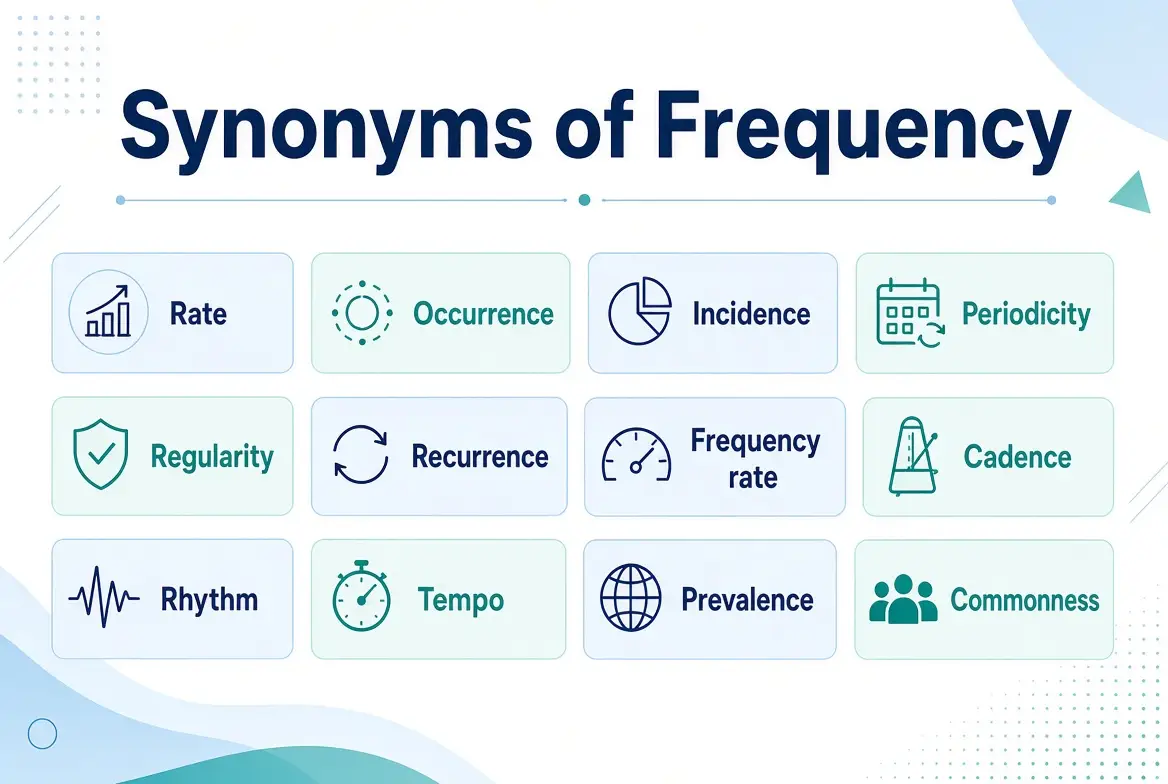
Synonyms of Frequency: Quick Comparison
| Word | How close? | Main idea | Register |
| Repetition | Very close in some contexts | Doing something again | Neutral |
| Recurrence | Very close in some contexts | Happening again | Neutral/Formal |
| Regularity | Close | A steady pattern | Neutral/Formal |
| Periodicity | Close in technical contexts | Repetition at intervals | Academic/Technical |
| Constancy | Related | Continuing steadily | Formal |
| Frequentness | Close but uncommon | Being frequent | Formal/Uncommon |
| Commonness | Contextual | Being common | Neutral |
| Incidence | Contextual | Occurrence of cases/events | Academic/Medical |
| Prevalence | Contextual | How widespread something is | Academic/Medical |
| Rate | Contextual | Measured occurrence or speed | Neutral/Formal |
| Occurrence | Related | An event happening | Neutral/Formal |
| Reiteration | Contextual | Saying or doing something again | Formal |
| Iteration | Technical | Repeated process/action | Technical |
| Rhythm | Related | Repeated pattern | Neutral |
| Cycle | Related | Repeating sequence | Neutral/Technical |
The Closest Synonyms
1. Repetition
Meaning: Repetition is the act of doing, saying, or experiencing something again.
Examples:
- Repetition helped the students remember the new vocabulary.
- The report contains unnecessary repetition.
Best used when: The focus is on something being repeated.
Tone: Neutral
CEFR guidance: B1–B2
Frequency: Very common
Common collocations:
- repetition of words
- repetition of mistakes
- constant repetition
When not to use: Do not use repetition when you need to describe a measured rate over time.
Difference: Frequency asks how often. Repetition focuses on doing it again.
2. Recurrence
Meaning: Recurrence means that something happens again after it has happened before.
Examples:
- The recurrence of the technical problem delayed the launch.
- Doctors monitored the patient for a recurrence of symptoms.
Best used when: Something returns or happens again.
Tone: Neutral/Formal
CEFR guidance: B2–C1
Frequency: Common
Common collocations:
- recurrence of symptoms
- recurrence of a problem
- recurrence rate
When not to use: Do not use recurrence simply to describe something that happens frequently.
A meeting happening every Monday has a frequency, not normally a “recurrence.”
3. Regularity
Meaning: Regularity means that something happens in a steady or predictable way.
Examples:
- She visits the library with impressive regularity.
- The machine operates with remarkable regularity.
Best used when: The pattern is consistent.
Tone: Neutral/Formal
CEFR guidance: B2
Frequency: Common
Common collocations:
- remarkable regularity
- clockwork regularity
- regularity of visits
When not to use: If you only want to count how many times something happens, use frequency.
4. Periodicity
Meaning: Periodicity means that something repeats at regular intervals.
Examples:
- Scientists observed the periodicity of the signal.
- The data show clear seasonal periodicity.
Best used when: Writing about science, mathematics, statistics, or repeating systems.
Tone: Academic/Technical
CEFR guidance: C1
Frequency: Uncommon in everyday English
Common collocations:
- periodicity of a signal
- seasonal periodicity
- periodicity of events
When not to use: Avoid it in casual conversation when frequency or how often would be clearer.
5. Constancy
Meaning: Constancy means continuing in a steady or unchanging way.
Examples:
- The constancy of the signal made the experiment easier.
- Her consistency helped the team through a difficult period.
Best used when: You want to emphasize steadiness rather than counting events.
Tone: Formal/Literary
CEFR guidance: C1
Frequency: Common
When not to use: It does not normally tell the reader exactly how often something happens.
6. Frequentness
Meaning: Frequentness means the quality of being frequent.
Examples:
- The frequentness of the interruptions affected the lesson.
- Researchers recorded the frequentness of certain behaviors.
Best used when: You specifically need a noun related to frequent.
Tone: Formal/Uncommon
CEFR guidance: C1
Frequency: Uncommon
When not to use: In most modern English, frequency sounds more natural.
Collins recognizes frequentness as related to frequency, but learners should treat it as a less common option.
Context Dependent Synonyms
7. Occurrence
Meaning: An occurrence is an event or instance of something happening.
Examples:
- The researchers recorded each occurrence of the error.
- The occurrence of heavy rain caused delays.
Best used when: You mean the event itself.
Tone: Neutral/Formal
CEFR guidance: B2
Frequency: Common
Key difference: One occurrence is one event. Frequency describes how often events occur.
8. Incidence
Meaning: Incidence describes the occurrence of something, especially cases of a disease, injury, or other event within a population or period.
Examples:
- The study examined the incidence of workplace injuries.
- Researchers reported a lower incidence of the condition.
Best used when: Writing about medicine, public health, statistics, or research.
Tone: Academic/Medical
CEFR guidance: C1
Frequency: Common in specialist writing
When not to use: Do not use incidence for ordinary things such as the frequency of meetings or phone calls.
9. Prevalence
Meaning: Prevalence describes how common or widespread something is within a group.
Examples:
- The researchers studied the prevalence of sleep problems.
- The survey measured the prevalence of online shopping.
Best used when: You mean how widespread, not simply how often.
Tone: Academic/Medical
CEFR guidance: C1
Frequency: Common in specialist writing
When not to use: Do not automatically replace frequency with prevalence.
Frequency: How often does it happen?
Prevalence: How widespread is it?
Collins places prevalence among the contextual senses associated with frequency rather than treating it as an unrestricted replacement.
10. Rate
Meaning: Rate describes a measured amount, speed, or occurrence over a particular basis.
Examples:
- The error rate fell after the update.
- The rate of complaints has increased.
Best used when: You are discussing a measurable quantity.
Tone: Neutral/Formal
CEFR guidance: B1–B2
Frequency: Very common
When not to use: Rate does not always mean frequency.
For example:
The company has a high growth rate.
Here, growth rate is not a synonym for frequency.
11. Commonness
Meaning: Commonness is the quality of being common or widespread.
Examples:
- The commonness of the expression varies by region.
- Researchers examined the commonness of the behavior.
Best used when: You mean how common something is.
Tone: Neutral
CEFR guidance: B2
Frequency: Uncommon
When not to use: Use frequency when you mean the number of times something occurs.
12. Reiteration
Meaning: Reiteration means saying or doing something again, usually to make a point clear.
Examples:
- The manager’s reiteration of the safety rules helped the staff.
- The article included a reiteration of its main argument.
Best used when: Something is deliberately repeated.
Tone: Formal
CEFR guidance: C1
Frequency: Uncommon
When not to use: It is not a general replacement for frequency.
13. Iteration
Meaning: Iteration means a repeated version or step in a process.
Examples:
- The team improved the design through several iterations.
- Each iteration made the software easier to use.
Best used when: Talking about design, software, mathematics, or repeated processes.
Tone: Technical/Professional
CEFR guidance: C1
Frequency: Common in specialist contexts
When not to use: Do not use it to mean ordinary frequency in daily conversation.
Related Words That Are NOT Direct Synonyms
Some words appear in thesauruses because they are semantically connected to frequency. They are useful, but learners should not treat them as interchangeable.
Rhythm
A rhythm is a repeated pattern.
The team developed a regular rhythm of weekly meetings.
It describes the pattern, not simply the number of meetings.
Cycle
A cycle is a sequence that repeats.
The machine completes one cycle every minute.
It describes the repeating sequence.
Pace
Pace means the speed at which something happens or develops.
The pace of production increased.
It answers how fast, not necessarily how often.
Cadence
Cadence can describe a regular pattern of speech, activity, or organized events.
The team established a monthly meeting cadence.
It is useful in professional contexts but is not a general replacement for frequency.
Ubiquity
Ubiquity means being present almost everywhere.
The ubiquity of smartphones has changed communication.
It describes widespread presence, not repeated occurrence.
Strongest, Strong, and Related Groups
Strongest Near-Synonyms
These are the words most useful when the meaning fits:
- repetition
- recurrence
- regularity
- periodicity
Strong Contextual Alternatives
Use these only when the specific meaning fits:
- occurrence
- incidence
- prevalence
- rate
- commonness
- reiteration
- iteration
Related Words
These should not normally replace frequency without changing the meaning:
- rhythm
- cycle
- pace
- cadence
- ubiquity
Frequency vs. Its Closest Alternatives
| Sentence | Best word | Why |
| The frequency of emails increased. | Frequency | Measures how often emails arrive. |
| The recurrence of the error worried us. | Recurrence | The error happened again. |
| The regularity of the visits impressed us. | Regularity | The visits followed a steady pattern. |
| The repetition of the phrase was annoying. | Repetition | The phrase was said again. |
| The periodicity of the signal was measured. | Periodicity | The signal repeated at intervals. |
| The incidence of injuries declined. | Incidence | Research context involving cases. |
| The prevalence of the condition increased. | Prevalence | Focuses on how widespread it is. |
| The error rate fell. | Rate | A measured rate is being reported. |
Commonly Confused Words
| Word | Main question | Example |
| Frequency | How often? | What is the frequency of the calls? |
| Regularity | How consistently? | She visits with regularity. |
| Recurrence | Did it happen again? | We are concerned about recurrence. |
| Incidence | How many cases/events occur in a population? | The incidence of injuries fell. |
| Prevalence | How widespread is it? | The prevalence of the condition is high. |
Common Mistakes
Common Mistake 1
Mistake: The prevalence of my phone calls increased.
Better: The frequency of my phone calls increased.
Why: You are talking about how often calls happen, not how widespread phone calls are.
Common Mistake 2
Mistake: The recurrence of our weekly meetings is high.
Better: The frequency of our weekly meetings is high.
Why: Recurrence emphasizes something happening again. A regular schedule is better described with frequency or regularity.
Common Mistake 3
Mistake: The pace of emails is high.
Better: The frequency of emails is high.
Why: Pace describes speed or rate of progress. Frequency describes how often something happens.
Common Mistake 4
Mistake: The periodicity of my visits to the dentist is high.
Better: The frequency of my dental visits is high.
Why: Periodicity is a technical word for repeated intervals. It is not normally used for an ordinary personal schedule.
American vs. British English
Frequency has the same spelling in American and British English.
Cambridge lists:
- UK: /ˈfriː.kwən.si/
- US: /ˈfriː.kwən.si/
There is therefore no important spelling difference to learn.
The same word is used in both varieties for ordinary frequency, statistics, and technical meanings.
Etymology and First Known Use
Frequency comes from Latin frequentia, meaning a crowd, multitude, or large gathering. Collins traces the English word to the 16th century and gives its origin as Latin frequentia, from frequēns, meaning numerous or crowded.
Dictionary.com gives the first recorded use as 1545–1555.
The word later developed its modern sense of something occurring often or repeatedly. Its scientific meaning developed as English vocabulary expanded around measurement of repeated waves and oscillations.
CEFR Guidance
CEFR labels for individual synonyms are not universal official classifications, so these levels are best treated as practical learner guidance.
| Word | Approximate learner level | Everyday usefulness |
| frequency | B1–B2 | Very high |
| repetition | B1–B2 | Very high |
| rate | B1–B2 | Very high |
| cycle | B1–B2 | High |
| regularity | B2 | High |
| recurrence | B2–C1 | Medium |
| occurrence | B2 | High |
| rhythm | B1–B2 | High |
| periodicity | C1 | Specialist |
| incidence | C1 | Specialist |
| prevalence | C1 | Specialist |
| constancy | C1 | Medium |
| iteration | C1 | Specialist |
| ubiquity | C1–C2 | Advanced |
| frequentness | C1 | Low |
For most learners, start with frequency, repetition, regularity, recurrence, occurrence, and rate.
Register and Connotation Guide
| Word | Register | Main nuance |
| Frequency | Neutral | How often something happens |
| Repetition | Neutral | Something happens or is said again |
| Recurrence | Formal/Neutral | Something returns |
| Regularity | Neutral/Formal | A consistent pattern |
| Periodicity | Academic | Repeated intervals |
| Incidence | Academic/Medical | Cases or events in a population |
| Prevalence | Academic/Medical | Widespread occurrence |
| Rate | Neutral/Formal | Measured occurrence |
| Reiteration | Formal | Deliberate repetition |
| Iteration | Technical | Repeated process/version |
| Rhythm | Neutral/Literary | Repeated flow or pattern |
| Ubiquity | Formal | Presence almost everywhere |
Natural Collocations With Frequency
Native and professional English commonly uses frequency in phrases such as:
- frequency of use
- frequency of occurrence
- frequency of visits
- frequency of calls
- frequency of errors
- frequency of meetings
- frequency of attacks
- frequency of inspections
- frequency of complaints
- frequency of use
- high frequency
- low frequency
- increasing frequency
- greater frequency
Cambridge’s corpus material includes combinations such as frequency of occurrence, frequency of use, and technical combinations involving signal and clock frequency.
How Native Speakers Often Say It
In everyday conversation, people do not always use the noun frequency.
Instead of:
What is the frequency of your gym visits?
A natural speaker may say:
How often do you go to the gym?
Instead of:
The frequency of his messages is low.
You might hear:
He doesn’t message very often.
This gives ESL learners an important lesson:
Frequency is correct, but how often is often more natural in everyday speech.
Writing Tips
In academic writing
Use precise terms.
The study examined the frequency of vocabulary errors among learners.
In professional writing
Use frequency when discussing schedules, communication, reports, or measurements.
We should review the frequency of system backups.
In essays
Do not replace every occurrence of frequency with a difficult synonym.
The frequency of online learning has increased.
This is often better than forcing periodicity or constancy into the sentence.
In everyday conversation
Prefer simple expressions such as:
- how often
- often
- regularly
- every week
- once a month
- from time to time
Antonyms and Contrasting Words
Useful opposites or contrasts include:
- infrequency
- irregularity
- rarity
- uncommonness
- occasional occurrence
Thesaurus.com lists infrequency, irregularity, and uncommonness among the antonyms associated with frequency.
Word Family
| Word | Part of speech | Example |
| frequency | noun | The frequency increased. |
| frequent | adjective | Frequent errors occurred. |
| frequently | adverb | He frequently visits. |
| infrequent | adjective | Infrequent updates cause problems. |
| infrequently | adverb | The system fails infrequently. |
Mini Practice
Exercise 1: Fill in the blanks
Choose frequency, recurrence, regularity, prevalence, or rate.
- The ______ of customer complaints has fallen.
- Doctors were concerned about the ______ of the symptoms.
- The ______ of the disease varies between regions.
- The machine works with impressive ______.
- The company wants to reduce the error ______.
Answers
- frequency
- recurrence
- prevalence
- regularity
- rate
Exercise 2: Rewrite the sentence
Replace the underlined idea with a more precise word.
The problem happened again.
Possible answer:
The problem recurred.
The problem happened many times.
Possible answer:
The problem occurred with high frequency.
Notice the difference: recurred means it happened again, while frequency focuses on how often it happened.
Exercise 3: Match the word
A. Frequency
B. Recurrence
C. Prevalence
D. Periodicity
E. Rate
- How widespread something is
- How often something happens
- Something happening again
- Repeated occurrence at intervals
- A measured amount per unit
Answers:
1-C
2-A
3-B
4-D
5-E
FAQ: Synonyms of Frequency
What are the best synonyms of frequency?
The closest useful alternatives are repetition, recurrence, regularity, periodicity, and constancy, depending on context. However, they do not have exactly the same meaning. Repetition focuses on something happening again, while regularity focuses on a steady pattern. For everyday writing, frequency is often the clearest choice.
What is another word for frequency?
Another word for frequency can be repetition, recurrence, regularity, or periodicity. The correct choice depends on the sentence. In ordinary conversation, how is often the most natural alternative. Words such as incidence and prevalence are more specialized and should not replace frequency automatically.
Is recurrence a synonym for frequency?
Recurrence is a near-synonym in some contexts, but the words have different meanings. Recurrence emphasizes that something happens again, while frequency describes how often something happens during a period. A problem may recur once without having a high frequency.
Is regularity the same as frequency?
No. Frequency measures or describes how often something happens. Regularity describes how consistent or predictable the pattern is. Something can happen frequently but irregularly, such as several unexpected alerts arriving in one day and none arriving the next day.
Is prevalence the same as frequency?
No. Prevalence usually describes how common or widespread something is within a population or group. Frequency describes how often something happens or how many times it occurs. These ideas can be related in research, but they are not interchangeable in general English.
What is the difference between frequency and rate?
Frequency describes how often something happens. Rate usually gives a measured amount or occurrence relative to a particular basis, such as time or population. For example, you can discuss the frequency of visits and the rate of accidents. The two words overlap but are not identical.
What is the simplest synonym for frequency?
For beginners, how often is usually the simplest alternative. Other useful words include repetition, regularity, and recurrence, but each has a slightly different meaning. In everyday conversation, “How often does it happen?” is often more natural than “What is its frequency?”
What is the opposite of frequency?
There is no single opposite that works in every context. Infrequency, rarity, irregularity, and uncommonness can express contrasting ideas. If you mean that something does not happen often, the most natural choices may simply be rarely, seldom, or infrequently.
Vocabulary Quiz
1. Which word best describes something happening again?
A. Prevalence
B. Recurrence
C. Pace
D. Ubiquity
2. Which word describes how widespread something is?
A. Prevalence
B. Repetition
C. Periodicity
D. Cadence
3. Which sentence uses frequency naturally?
A. The frequency of customer complaints increased.
B. The frequency person called yesterday.
C. She frequents the report every day.
D. The frequency was very blue.
4. Which word is most closely associated with repeated intervals?
A. Periodicity
B. Prevalence
C. Commonness
D. Ubiquity
5. Which word focuses on consistency rather than simply how often something happens?
A. Regularity
B. Recurrence
C. Incidence
D. Rate
Answer Key
- B. Recurrence
- A. Prevalence
- A. The frequency of customer complaints increased.
- A. Periodicity
- A. Regularity
Conclusion
Learning synonyms of frequency is more useful when you learn the difference between similar words instead of memorizing a long list. Use frequency for how often something happens, recurrence when something happens again, repetition for something repeated, and regularity for a consistent pattern.
Use specialized terms such as incidence and prevalence only when their specific meanings fit. Practice these distinctions in essays, emails, conversations, and professional writing to make your English clearer and more precise.
References
- Cambridge Dictionary: Frequency
- Collins Dictionary: Frequency
- Collins Thesaurus: Frequency
- Merriam-Webster: Frequency
- Dictionary.com: Frequency
- Etymonline: Frequency
- Thesaurus.com: Frequency Synonyms

Synonorm is a trusted English vocabulary resource created to help readers find the right words and understand the differences between similar terms. We provide clear explanations of synonyms, meanings, examples, usage, and alternatives. Our content makes vocabulary easier to learn and apply in everyday, academic, and professional English. Synonorm is designed for students, writers, ESL learners, professionals, and anyone who wants to improve their English vocabulary and communicate more clearly.