Quick Answer
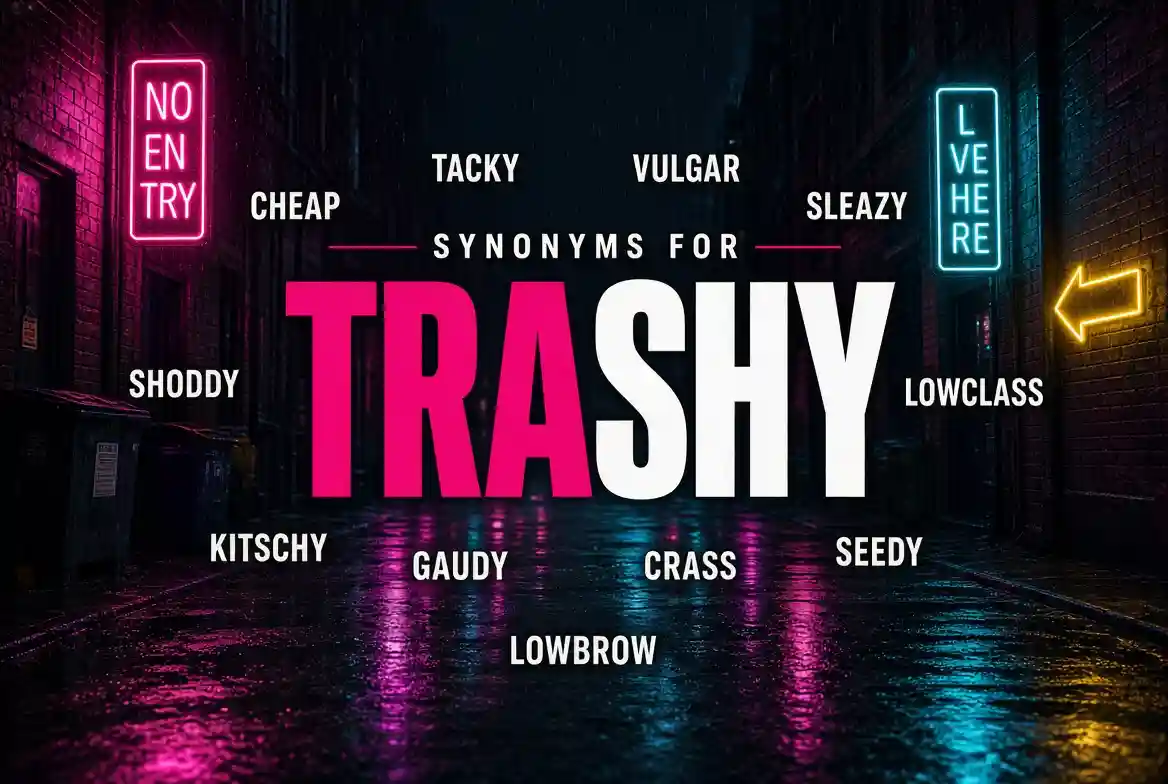
The best synonyms for trashy depend on what you mean. Use shoddy for poor workmanship, inferior or substandard for low quality, tacky for poor taste, gaudy for excessive decoration, vulgar for crude behavior or language, and schlocky for cheap, sensational entertainment. These words are related, but they are not interchangeable in every sentence.
What Does “Trashy” Mean?
Have you ever wanted to call something “trashy” but wondered if there was a more precise word?
Trashy is an informal adjective that usually describes something as cheap, low-quality, worthless, tasteless, or lacking refinement. The exact meaning depends on context. For example, a poorly made product may be called trashy, while a badly designed outfit may be called tacky. A cheap and sensational movie may be described as schlocky.
Major English thesauruses show that trashy overlaps with several different ideas, including cheap, inferior, flimsy, shabby, shoddy, sleazy, tawdry, and worthless.
This is why choosing a synonym requires more than finding another negative word. You need to identify what exactly is wrong with the person, object, writing, design, behavior, or entertainment you are describing.
Pronunciation
IPA: /ˈtræʃ.i/
Pronunciation: TRASH-ee
The pronunciation is essentially the same in American and British English.
Part of Speech
Trashy is an adjective.
Examples:
- That was a trashy movie.
- The decorations looked trashy.
- She dislikes trashy magazines.
Related forms include:
- trash: noun and verb
- trashy: adjective
- trashiness: noun
- trashily: adverb
- trashier: comparative
- trashiest: superlative
Grammar and Usage
The most common pattern is:
trashy + noun
Examples:
- trashy novel
- trashy television
- trashy magazine
- trashy entertainment
- trashy clothes
You can also use trashy after a linking verb:
- The show was trashy.
- The outfit looked trashy.
Important grammar point
Do not assume that trashy means exactly the same thing as cheap, tacky, or vulgar. Each word emphasizes a different feature.
For example:
The shirt is cheap.
The shirt is tacky.
The shirt is gaudy.
The shirt is trashy.
These sentences can describe the same shirt, but each gives the reader a different impression.
Quick Guide: Which Synonym Should You Choose?
| If you mean… | Best choice |
| Poor quality | inferior |
| Poor workmanship | shoddy |
| Below an expected standard | substandard |
| Poor taste | tacky |
| Excessively bright or showy | gaudy / garish |
| Crude or offensive | vulgar |
| Insensitive or rude | crass |
| Worn or neglected | shabby |
| Weak or poorly made | flimsy |
| Cheap entertainment | schlocky |
| Intellectually unsophisticated | lowbrow |
| Cheap and morally unpleasant | sleazy |
| Cheap-looking and showy | tawdry |
| Superficially attractive but without real value | meretricious |
This context-based approach is more accurate than treating every word in a thesaurus list as a perfect replacement.
25 Useful Synonyms for Trashy
1. Cheap
Meaning: Low in price, quality, or perceived value.
CEFR: A1–A2
Frequency: Very common
Register: Neutral
Examples:
- The table looked cheap despite its high price.
- The company used cheap materials to reduce costs.
Best used when: Something seems inexpensive or poorly made.
Collocations:
- cheap materials
- cheap imitation
- cheap-looking
When not to use: Do not use cheap if you only mean visually excessive or rude.
2. Inferior
Meaning: Lower in quality than something else.
CEFR: B1–B2
Frequency: Common
Register: Formal/Neutral
Examples:
- The replacement parts were inferior to the original ones.
- The report relied on inferior data.
Best used when: You want an objective word for lower quality.
Collocations:
- inferior quality
- inferior product
- inferior materials
When not to use: It does not specifically mean tasteless.
3. Shoddy
Meaning: Poorly made or completed with little care.
CEFR: B2
Frequency: Common
Register: Neutral/Professional
Examples:
- Customers complained about the company’s shoddy workmanship.
- The repair looked shoddy and unfinished.
Collocations:
- shoddy workmanship
- shoddy construction
- shoddy service
Best used when: Poor work or construction is the main problem.
4. Tacky
Meaning: Showing poor taste or style.
CEFR: B2
Frequency: Common
Register: Informal/Neutral
Examples:
- The enormous plastic flowers looked tacky.
- He thought the gold-colored furniture was tacky.
Collocations:
- tacky decoration
- tacky clothes
- tacky design
When not to use: Do not use it simply because something is badly manufactured.
5. Substandard
Meaning: Below the level of quality that is expected.
CEFR: B2–C1
Frequency: Common
Register: Formal/Business
Examples:
- The company was fined for selling substandard products.
- Customers reported substandard service.
Best used when: Writing reports, complaints, reviews, or professional documents.
6. Shabby
Meaning: Old, worn, or poorly maintained.
CEFR: B2
Frequency: Common
Register: Neutral
Examples:
- They lived in a shabby apartment near the station.
- His shabby jacket had clearly been worn for years.
Collocations:
- shabby furniture
- shabby clothes
- shabby room
7. Worthless
Meaning: Having little or no value.
CEFR: B1
Frequency: Common
Register: Neutral
Examples:
- The damaged device was almost worthless.
- The document provided worthless information.
Best used when: The main idea is lack of value.
When not to use: Do not use it merely to say something looks unattractive.
8. Second-rate
Meaning: Inferior to the best or expected level.
CEFR: B2
Frequency: Common
Register: Neutral
Examples:
- The hotel offered second-rate service.
- The article felt like a second-rate copy of a better work.
Collocations:
- second-rate service
- second-rate product
- second-rate performance
9. Flimsy
Meaning: Weak, thin, or poorly constructed.
CEFR: B2
Frequency: Common
Register: Neutral
Examples:
- The box was made from flimsy cardboard.
- The chair had flimsy legs.
Best used when: Something is physically weak.
When not to use: Do not use flimsy for bad taste.
10. Tawdry
Meaning: Cheap-looking, showy, and often lacking good taste.
CEFR: C1
Frequency: Uncommon
Register: Literary/Formal
Examples:
- The room was filled with tawdry decorations.
- The newspaper published a tawdry story about the celebrity.
Collocations:
- tawdry jewelry
- tawdry story
- tawdry affair
Best used when: You want a stronger and more literary alternative to trashy.
11. Vulgar
Meaning: Crude, offensive, or lacking refinement.
CEFR: B2
Frequency: Common
Register: Formal/Neutral
Examples:
- The comedian’s vulgar jokes offended several guests.
- The advertisement contained vulgar language.
Best used when: Language, jokes, behavior, or sexual references are the problem.
When not to use: It is not a synonym for poor manufacturing.
12. Crass
Meaning: Rude, insensitive, or lacking good judgment.
CEFR: C1
Frequency: Common
Register: Formal/Neutral
Examples:
- His crass comment made the situation worse.
- The advertisement was criticized as crass and insensitive.
Collocations:
- crass remark
- crass joke
- crass behavior
13. Gaudy
Meaning: Excessively bright, colorful, or decorated.
CEFR: C1
Frequency: Common
Register: Neutral
Examples:
- She disliked the gaudy curtains.
- The shop used gaudy colors to attract attention.
Best used when: Something is visually excessive.
14. Garish
Meaning: Very bright or showy in an unpleasant way.
CEFR: C1
Frequency: Common
Register: Neutral
Examples:
- The website used garish colors.
- The restaurant had garish neon signs.
Best used when: You want to criticize excessive visual brightness.
15. Sleazy
Meaning: Cheap, unpleasant, or morally questionable.
CEFR: C1
Frequency: Common
Register: Informal/Neutral
Examples:
- The advertisement used sleazy sales tactics.
- He refused to work for a sleazy company.
Best used when: Dishonesty, exploitation, or an unpleasant reputation is involved.
When not to use: Do not use it for an ordinary product that is simply low quality.
16. Schlocky
Meaning: Cheap, low-quality, and often sensational entertainment.
CEFR: C1
Frequency: Uncommon
Register: Informal
Examples:
- We watched a schlocky horror movie for fun.
- The channel specializes in old schlocky science-fiction films.
Best used when: Talking about movies, television, books, or other entertainment.
17. Lowbrow
Meaning: Lacking intellectual or cultural sophistication.
CEFR: C1
Frequency: Common
Register: Neutral
Examples:
- The show combines serious news with lowbrow humor.
- He enjoys lowbrow comedy after work.
Important: Lowbrow does not automatically mean badly made. It describes the level or type of cultural sophistication.
18. Cheesy
Meaning: Silly, overly sentimental, or lacking sophistication.
CEFR: B2
Frequency: Common
Register: Informal
Examples:
- The movie had a cheesy romantic ending.
- The commercial used cheesy background music.
Best used when: Something is amusingly sentimental or corny.
19. Tasteless
Meaning: Showing poor taste or a lack of sensitivity.
CEFR: B2
Frequency: Common
Register: Neutral/Formal
Examples:
- The joke was tasteless.
- Many readers considered the advertisement tasteless.
Best used when: Something is inappropriate or shows poor judgment.
20. Kitsch
Meaning: Art or decoration that is overly sentimental, decorative, or showy, often with an ironic or nostalgic appeal.
CEFR: C1
Frequency: Uncommon
Register: Cultural/Artistic
Examples:
- The shop sells colorful kitsch from the 1960s.
- Her apartment mixes modern furniture with tourist kitsch.
Important: Kitsch is not necessarily an insult. People can enjoy kitsch deliberately.
21. Rundown
Meaning: In poor physical condition because of age or neglect.
CEFR: B2
Frequency: Common
Register: Neutral
Examples:
- They renovated a rundown hotel.
- Several rundown buildings stood along the street.
Best used when: Describing buildings, neighborhoods, vehicles, or facilities.
22. Slapdash
Meaning: Done quickly and carelessly.
CEFR: C1
Frequency: Uncommon
Register: Neutral
Examples:
- The report contained several slapdash errors.
- The repairs looked slapdash.
Best used when: The problem is careless work rather than appearance.
23. Squalid
Meaning: Extremely dirty, neglected, or unpleasant.
CEFR: C1
Frequency: Common
Register: Formal
Examples:
- The animals were kept in squalid conditions.
- The abandoned building contained squalid rooms.
Best used when: Dirt and serious neglect are central to the description.
24. Gimcrack
Meaning: Showy but cheap, flimsy, or of little practical value.
CEFR: C2
Frequency: Rare
Register: Literary/Old-fashioned
Examples:
- The shelf was covered with gimcrack ornaments.
- The market sold gimcrack toys that broke easily.
Best used when: You want a rare literary word.
25. Meretricious
Meaning: Attractive or impressive on the surface but lacking real value.
CEFR: C2
Frequency: Rare
Register: Formal/Literary
Examples:
- The presentation was polished but meretricious.
- The argument sounded impressive but was ultimately meretricious.
Best used when: Surface appearance hides a lack of substance.
Synonyms by Meaning
Strongest Synonyms
These express a strong negative judgment:
- worthless
- shoddy
- substandard
- sleazy
- tawdry
- squalid
- meretricious
Everyday Synonyms
These are easier and more natural for most learners:
- cheap
- inferior
- tacky
- shabby
- flimsy
- second-rate
- tasteless
Context-Specific Alternatives
Use these when the context gives them their special meaning:
- gaudy = excessive visual decoration
- garish = unpleasantly bright
- vulgar = crude or offensive
- crass = insensitive or rude
- schlocky = cheap entertainment
- lowbrow = not intellectually sophisticated
- cheesy = silly or overly sentimental
- rundown = old and neglected
- slapdash = careless
- kitsch = deliberately or ironically sentimental/showy
Trashy vs. Tacky vs. Shoddy vs. Vulgar
| Word | Main focus | Example |
| Trashy | Broad negative judgment involving cheapness, low quality, or poor taste | The magazine was trashy. |
| Tacky | Poor taste or style | The decorations were tacky. |
| Shoddy | Poor workmanship | The repairs were shoddy. |
| Vulgar | Crude or offensive behavior/language | His joke was vulgar. |
Easy rule
Ask yourself:
Is it badly made? → shoddy
Does it show bad taste? → tacky
Is it crude or offensive? → vulgar
Is it excessively bright? → gaudy/garish
Is it generally cheap or low-quality? → trashy/inferior
American vs. British English
Trashy is used in both American and British English, with essentially the same spelling and pronunciation.
British English also has rubbishy, an informal alternative that is less common in American English. Collins lists rubbishy among British English alternatives.
British speakers may also use words such as:
- tatty
- naff
- rubbishy
depending on the context and level of informality.
American English commonly uses:
- trashy
- tacky
- cheap
- cheesy
- schlocky
Regional usage can vary, so learners should focus first on widely understood vocabulary.
Register and Frequency Guide
| Word | Register | Frequency | Approx. CEFR |
| Cheap | Neutral | Very common | A1–A2 |
| Inferior | Formal/Neutral | Common | B1–B2 |
| Shoddy | Neutral | Common | B2 |
| Tacky | Informal | Common | B2 |
| Shabby | Neutral | Common | B2 |
| Worthless | Neutral | Common | B1 |
| Substandard | Formal/Business | Common | B2–C1 |
| Second-rate | Neutral | Common | B2 |
| Flimsy | Neutral | Common | B2 |
| Vulgar | Formal/Neutral | Common | B2 |
| Gaudy | Neutral | Common | C1 |
| Crass | Formal/Neutral | Common | C1 |
| Sleazy | Informal | Common | C1 |
| Tawdry | Literary | Uncommon | C1 |
| Schlocky | Informal | Uncommon | C1 |
| Kitsch | Cultural | Uncommon | C1 |
| Meretricious | Literary | Rare | C2 |
| Gimcrack | Literary | Rare | C2 |
Note: CEFR levels here are approximate learner guidance, not official classifications for every individual word.
Word Origin and Etymology
Trashy is formed from trash + -y.
Historical dictionaries and etymological sources connect trashy with the older noun trash, which referred to things of little value or waste. Etymonline dates the adjective trashy to the early 17th century.
The basic idea remains clear today: something trashy is associated with low value, poor quality, or an undesirable appearance or character.
Because historical dating can vary slightly by source and surviving evidence, it is better to describe the word as an early 17th-century adjective rather than claim that one exact date represents its absolute first use.
Common Mistakes
Common Mistake Box
Mistake 1
Wrong:
The chair was tacky because it broke.
Better:
The chair was flimsy because it broke.
Why?
Tacky concerns taste or style. Flimsy concerns physical weakness.
Mistake 2
Wrong:
The report was vulgar because it had many errors.
Better:
The report was poorly written because it had many errors.
Why?
Vulgar describes crude or offensive content, not ordinary mistakes.
Mistake 3
Wrong:
The cheap product cost a lot of money.
This sentence can be confusing because cheap may mean inexpensive or low-quality.
Better:
The product looked cheap despite its high price.
Mistake 4
Wrong:
The website was gaudy because its information was inaccurate.
Better:
The website was inaccurate because its information was unreliable.
Why?
Gaudy describes appearance, especially excessive color or decoration.
When Should You Avoid “Trashy”?
Avoid trashy when you need neutral or professional language.
Instead of:
The company’s service is trashy.
Use:
The company’s service is substandard.
Instead of:
The product looks trashy.
Use:
The product looks cheaply made.
Instead of:
The building is trashy.
Use:
The building is rundown.
Instead of:
The article is trashy.
Use:
The article is sensationalistic and poorly researched.
Precise criticism is usually more useful than a broad insult.
Best Alternatives in Different Situations
For a bad product
Use:
- inferior
- substandard
- poorly made
- shoddy
For clothing
Use:
- tacky
- gaudy
- garish
- tasteless
- cheap-looking
For a movie
Use:
- schlocky
- cheesy
- lowbrow
- second-rate
- trashy
For behavior
Use:
- vulgar
- crass
- tasteless
- sleazy
For a building
Use:
- rundown
- shabby
- dilapidated
- squalid
For writing
Use:
- poorly written
- shallow
- second-rate
- sensationalistic
- superficial
Useful Collocations
Learning collocations helps you use these words naturally.
Trashy
- trashy novel
- trashy television
- trashy magazine
- trashy entertainment
Shoddy
- shoddy workmanship
- shoddy construction
- shoddy service
Tacky
- tacky decoration
- tacky outfit
- tacky design
Inferior
- inferior quality
- inferior materials
- inferior product
Vulgar
- vulgar language
- vulgar joke
- vulgar behavior
Gaudy
- gaudy jewelry
- gaudy colors
- gaudy decorations
Substandard
- substandard service
- substandard product
- substandard conditions
Writing Tips
Writing Tip Box
In academic writing
Avoid casual trashy. Use precise terms such as inferior, substandard, superficial, or poorly supported.
In business writing
Use objective language:
The delivered materials appear to be substandard.
This is more professional than:
The materials are trashy.
In reviews
Informal alternatives can sound natural:
It is a cheesy but entertaining movie.
In creative writing
More descriptive vocabulary can create a stronger image:
The room was filled with gaudy decorations and shabby furniture.
In everyday conversation
Simple words are often best:
- cheap
- tacky
- badly made
- low-quality
- tasteless
Antonyms of Trashy
The correct opposite depends on the context.
Quality
- high-quality
- superior
- excellent
- premium
- first-rate
Appearance
- elegant
- tasteful
- classy
- refined
- sophisticated
Construction
- sturdy
- durable
- well-made
- solid
Entertainment
- sophisticated
- substantial
- thought-provoking
- high-quality
Mini Practice
Fill in the Blanks
Choose from tacky, shoddy, gaudy, substandard.
- The company was criticized for its ______ products.
- The contractor provided ______ workmanship.
- The room was filled with ______ decorations.
- The plastic furniture looked ______.
Answers
- substandard
- shoddy
- gaudy
- tacky
Rewrite the Sentence
Replace trashy with a more precise word.
Original:
The hotel looked trashy because it was old and badly maintained.
Better:
The hotel looked shabby and rundown because it was old and badly maintained.
Matching Exercise
Match each word to its main meaning.
- Shoddy
- Vulgar
- Gaudy
- Schlocky
- Tacky
A. Cheap entertainment
B. Poor taste
C. Excessively showy
D. Poor workmanship
E. Crude or offensive
Answers:
1-D
2-E
3-C
4-A
5-B
Frequently Asked Questions
What is the best synonym for trashy?
There is no single best synonym because trashy has several related meanings. Shoddy is best for poor workmanship, tacky for poor taste, inferior for low quality, vulgar for crude behavior, and schlocky for cheap entertainment.
Is tacky the same as trashy?
No. Tacky mainly describes poor taste, style, decoration, or manners. Trashy is broader and can describe something cheap, low-quality, tasteless, or lacking refinement. The two words overlap, but tacky is more specific when poor taste is the main issue.
What is a formal synonym for trashy?
Useful formal alternatives include inferior, substandard, shoddy, and meretricious, depending on context. For professional writing, substandard works well for quality problems, while meretricious describes something that looks attractive but lacks real value.
What is a polite synonym for trashy?
The most polite alternative depends on the problem. Try low-quality, poorly made, inexpensive-looking, tasteless, or poorly designed. These phrases describe the specific problem without making a broad personal judgment.
What is a synonym for trashy when describing clothes?
Use tacky, gaudy, garish, tasteless, or cheap-looking. Tacky focuses on poor taste, while gaudy and garish focus more on excessive visual style.
What is a synonym for trashy when describing a movie?
Schlocky, cheesy, second-rate, lowbrow, or sensationalistic may work depending on the movie. Schlocky is especially useful for cheap, exaggerated entertainment.
Can trashy describe a person?
Yes, but it can be insulting. It is usually better to describe the specific behavior, clothing, language, or action rather than label a person as trashy. This makes communication more precise and less judgmental.
Can trashy have a positive meaning?
Sometimes. People may describe a movie, novel, or television show as trashy while enjoying it as a guilty pleasure. In these contexts, the word can suggest exaggerated, sensational, or lowbrow entertainment rather than complete dislike.
Vocabulary Quiz
1. Which word best describes poor workmanship?
A. Gaudy
B. Shoddy
C. Vulgar
D. Kitsch
2. Which word best describes excessive visual decoration?
A. Gaudy
B. Inferior
C. Substandard
D. Flimsy
3. Which word is most suitable in a professional quality report?
A. Trashy
B. Cheesy
C. Substandard
D. Tacky
4. Which word best describes crude or offensive language?
A. Shabby
B. Vulgar
C. Rundown
D. Flimsy
5. Which word is especially useful for cheap, sensational entertainment?
A. Schlocky
B. Superior
C. Sturdy
D. Refined
Answer Key
- B. Shoddy
- A. Gaudy
- C. Substandard
- B. Vulgar
- A. Schlocky
Conclusion
Learning synonyms for trashy is not simply about memorizing a long list of negative words. The real skill is choosing the word that explains the exact problem. Use shoddy for poor workmanship, tacky for poor taste, gaudy for excessive decoration, vulgar for crude language, and inferior for lower quality.
Practice these distinctions in essays, emails, reviews, and conversations. Precise vocabulary makes your English clearer, stronger, and more natural.
References
- Cambridge English Thesaurus, “trashy” and related semantic groups.
- Collins English Thesaurus, “trashy” and additional synonym senses.
- Thesaurus.com, “trashy synonyms and antonyms.”
- Dictionary.com, “trashy,” for definition, usage, and historical information.
- Etymonline, “trashy” and “trash,” for etymological background.

Synonorm is a trusted English vocabulary resource created to help readers find the right words and understand the differences between similar terms. We provide clear explanations of synonyms, meanings, examples, usage, and alternatives. Our content makes vocabulary easier to learn and apply in everyday, academic, and professional English. Synonorm is designed for students, writers, ESL learners, professionals, and anyone who wants to improve their English vocabulary and communicate more clearly.