Quick Answer
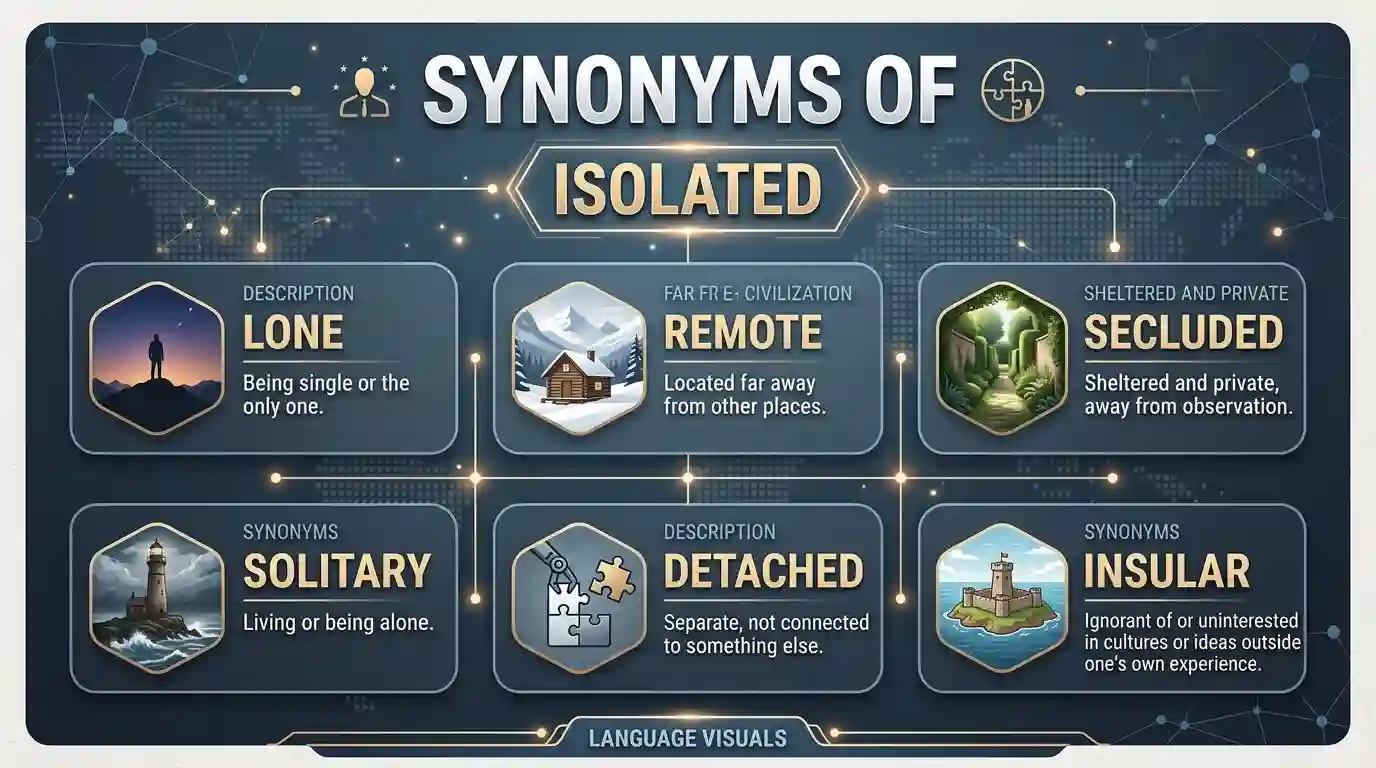
The best synonyms of isolated depend on what you mean. For a place, use remote, secluded, distant, out-of-the-way, or inaccessible. For a person, alone, lonely, solitary, withdrawn, or reclusive may fit. For a single or uncommon event, use single, individual, unusual, rare, or sporadic.
What Does Isolated Mean?
Have you ever wanted to replace isolated with a stronger word but were unsure which synonym was actually correct?
The problem is that isolated has more than one meaning. It can describe a place that is far from other places, a person who has little social contact, or an event that happens separately or rarely.
For example, an isolated village is usually a village that is far from towns or difficult to reach. An isolated person may have little contact with other people. An isolated incident is usually a single event that does not represent a larger pattern.
That difference matters. Students, ESL learners, bloggers, and professional writers should not choose a synonym simply because it appears in a thesaurus. The right word should match the exact meaning, tone, and situation.
This guide explains the most useful synonyms of isolated, including their meanings, CEFR levels, register, frequency, collocations, connotations, and common mistakes.
Pronunciation of Isolated
IPA:
- British English: /ˈaɪ.sə.leɪ.tɪd/
- American English: /ˈaɪ.sə.leɪ.t̬ɪd/
Pronunciation: eye-suh-LAY-tid
The main stress falls on LAY.
Part of Speech
Isolated is primarily an adjective.
Examples
- an isolated village
- an isolated person
- an isolated incident
- an isolated case
Its word family includes:
| Word | Part of Speech | Example |
| isolate | Verb | Doctors isolated the patient. |
| isolated | Adjective | The house is isolated. |
| isolation | Noun | Social isolation can be difficult. |
| isolating | Adjective | The experience was isolating. |
The 3 Main Meanings of Isolated
Before choosing a synonym, identify which meaning you need.
1. Physically separate
The cabin is in an isolated area.
Here, remote, distant, secluded, or out-of-the-way may work.
2. Socially separate
He felt isolated after moving to a new city.
Here, lonely, withdrawn, friendless, or cut off may work.
3. Single or uncommon
The police described it as an isolated incident.
Here, single, individual, unusual, or rare may work.
This three-part distinction is the most important rule for using synonyms correctly.
Quick Synonym Comparison
| Synonym | Main Meaning | Register | Frequency |
| Remote | Far away | Neutral | Very common |
| Secluded | Private and away | Neutral | Common |
| Distant | Far away or emotionally separate | Neutral | Very common |
| Out-of-the-way | Far from busy areas | Informal/Neutral | Common |
| Inaccessible | Difficult to reach | Formal | Common |
| Alone | Without other people | Neutral | Very common |
| Lonely | Emotionally unhappy without company | Neutral | Very common |
| Solitary | Alone or separate | Neutral/Formal | Common |
| Withdrawn | Avoiding social interaction | Neutral | Common |
| Reclusive | Deliberately avoiding people | Formal | Uncommon |
| Cut off | Unable to connect | Neutral/Informal | Very common |
| Friendless | Having no friends | Neutral | Uncommon |
| Detached | Separated or emotionally uninvolved | Neutral/Formal | Common |
| Sequestered | Kept away from others | Formal | Rare |
| Desolate | Empty and bleak | Literary | Uncommon |
| Lone | One alone | Neutral/Literary | Common |
| Single | One rather than several | Neutral | Very common |
| Individual | One particular case | Formal/Neutral | Very common |
| Unusual | Not normal or common | Neutral | Very common |
| Rare | Not common | Neutral | Very common |
| Sporadic | Irregularly occurring | Formal/Academic | Common |
Best Synonyms for a Remote Place
1. Remote
Meaning: Far away from towns, cities, or other populated places.
CEFR: B1
Frequency: Very common
Register: Neutral
Connotation: Usually neutral
Examples:
- The researchers reached a remote village after several hours of driving.
- She grew up in a remote part of northern Canada.
Common collocations:
- remote village
- remote area
- remote location
Best used when: Physical distance is the main idea.
When not to use: Do not use remote when you specifically mean that someone feels emotionally lonely.
2. Secluded
Meaning: Away from other people, often in a quiet or private place.
CEFR: B2
Frequency: Common
Register: Neutral
Connotation: Often positive
Examples:
- We found a secluded beach away from the main tourist area.
- The couple rented a secluded cottage for the weekend.
Common collocations:
- secluded beach
- secluded garden
- secluded location
Best used when: Privacy and quietness matter.
Important nuance: A secluded beach can sound attractive. An isolated beach may sound more difficult to reach.
When not to use: Avoid it when describing emotional loneliness.
3. Distant
Meaning: Far away in space, time, or relationship.
CEFR: A2
Frequency: Very common
Register: Neutral
Examples:
- A distant mountain appeared through the clouds.
- He became distant after the argument.
Best used when: You need a general word for physical or emotional separation.
When not to use: Do not use it when you specifically mean “difficult to reach.”
4. Out-of-the-Way
Meaning: Far from the places where most people go.
CEFR: B2
Frequency: Common
Register: Informal/Neutral
Examples:
- They found an out-of-the-way restaurant near the coast.
- We stayed in an out-of-the-way village.
Best used when: Writing or speaking in an everyday, descriptive style.
When not to use: Avoid it in very formal academic writing.
5. Inaccessible
Meaning: Difficult or impossible to reach.
CEFR: B2
Frequency: Common
Register: Formal
Examples:
- Several mountain roads become inaccessible during winter.
- The remote island is almost inaccessible by road.
Best used when: The difficulty of reaching a place matters.
Important nuance: A place can be isolated without being inaccessible.
Synonyms for a Socially Isolated Person
6. Alone
Meaning: Without other people.
CEFR: A1
Frequency: Very common
Register: Neutral
Examples:
- She stayed alone after her friends went home.
- He prefers to work alone.
Best used when: You simply mean that someone is without other people.
Important: Alone does not automatically mean unhappy.
When not to use: Do not use alone if you need to express sadness or lack of social connection.
7. Lonely
Meaning: Feeling unhappy because you lack company or meaningful connection.
CEFR: A2
Frequency: Very common
Register: Neutral
Connotation: Emotional/negative
Examples:
- She felt lonely after moving to another country.
- He became lonely when his closest friends moved away.
Best used when: You are describing an emotional state.
Remember
Alone = without other people.
Lonely = unhappy about being without connection.
Someone can be alone without being lonely.
8. Solitary
Meaning: Living or existing alone or apart from others.
CEFR: B2
Frequency: Common
Register: Neutral/Formal
Examples:
- He lived a solitary life in the countryside.
- A solitary figure stood beside the road.
Common collocations:
- solitary life
- solitary figure
- solitary existence
Best used when: Being alone is a lasting condition or defining feature.
When not to use: Use alone instead when you simply describe a short period without company.
9. Withdrawn
Meaning: Quiet and unwilling to communicate or socialize.
CEFR: B2
Frequency: Common
Register: Neutral
Examples:
- The student became withdrawn after changing schools.
- She seemed unusually withdrawn during the meeting.
Best used when: The person’s behavior shows social withdrawal.
When not to use: Do not use withdrawn simply because someone is physically far away.
10. Reclusive
Meaning: Avoiding other people and living a private life.
CEFR: C1
Frequency: Uncommon
Register: Formal
Examples:
- The famous writer became increasingly reclusive.
- The reclusive artist rarely appeared in public.
Best used when: Someone deliberately avoids social contact.
When not to use: A person who simply enjoys occasional privacy is not necessarily reclusive.
11. Cut Off
Meaning: Separated from people, places, services, or communication.
CEFR: B1
Frequency: Very common
Register: Spoken/Neutral
Examples:
- The village was cut off by heavy snow.
- She felt cut off from her old friends.
Best used when: Something prevents normal contact or access.
Common collocations:
- cut off from society
- cut off from the outside world
- cut off by floods
12. Friendless
Meaning: Having no friends.
CEFR: B2
Frequency: Uncommon
Register: Neutral
Examples:
- The new student worried that he would remain friendless.
- He felt friendless after losing contact with everyone he knew.
Best used when: Lack of friendship is specifically important.
When not to use: Do not use it when a person simply wants to spend time alone.
13. Detached
Meaning: Separate from something or emotionally uninvolved.
CEFR: B2
Frequency: Common
Register: Formal/Neutral
Examples:
- The garage is detached from the main house.
- She remained emotionally detached during the discussion.
Best used when: You mean physical separation or emotional distance.
Synonyms for a Single or Uncommon Event
14. Single
Meaning: One rather than several.
CEFR: A1
Frequency: Very common
Register: Neutral
Examples:
- It was a single mistake, not a repeated problem.
- The report mentioned a single isolated case.
Best used when: You mean one event or case.
When not to use: Do not use single as a replacement for isolated when describing a remote location.
15. Individual
Meaning: One particular person, thing, case, or event.
CEFR: B1
Frequency: Very common
Register: Neutral/Formal
Examples:
- Each individual case requires careful review.
- The researchers examined individual incidents.
Best used when: Talking about one case within a larger group.
16. Unusual
Meaning: Different from what normally happens.
CEFR: B1
Frequency: Very common
Register: Neutral
Examples:
- The doctor said the reaction was unusual.
- The police described the event as unusual.
Best used when: You want to emphasize that something is not typical.
When not to use: It does not mean physically separated.
17. Rare
Meaning: Not common or not happening often.
CEFR: B1
Frequency: Very common
Register: Neutral
Examples:
- Such mistakes are rare in this system.
- The doctor explained that the condition is rare.
Best used when: Frequency is the main idea.
When not to use: Do not use rare simply because something is physically isolated.
18. Sporadic
Meaning: Happening occasionally and irregularly.
CEFR: C1
Frequency: Common
Register: Formal/Academic
Examples:
- The region experienced sporadic power cuts.
- Sporadic reports of the problem continued throughout the year.
Best used when: Something occurs from time to time without a regular pattern.
When not to use: It does not mean “alone.”
19. Unique
Meaning: Being the only one of its kind or unlike others.
CEFR: B2
Frequency: Very common
Examples:
- The area has a unique cultural tradition.
- The museum contains a unique collection.
Best used when: The idea is one-of-a-kind.
Important: Unique is not a general synonym for isolated. It works only in certain contexts involving an individual or distinctive example.
More Advanced Alternatives
20. Sequestered
Meaning: Kept away from other people or activities.
CEFR: C1
Frequency: Rare
Register: Formal/Literary
Example:
The jury remained sequestered during the trial.
Best used when: Separation is deliberate and formal.
When not to use: Avoid it in ordinary conversation unless the context requires precision.
21. Desolate
Meaning: Empty, bleak, and lacking signs of life.
CEFR: C1
Frequency: Uncommon
Register: Literary/Formal
Example:
The streets looked desolate after the storm.
Best used when: You want to create a strong emotional image.
Nuance: Desolate is much more emotional than remote.
22. Forsaken
Meaning: Abandoned or left without care.
CEFR: C1
Frequency: Uncommon
Register: Literary
Example:
They discovered a forsaken building near the old railway line.
Best used when: Something appears abandoned and neglected.
When not to use: Do not use it simply to mean “far away.”
23. Lone
Meaning: One person or thing standing alone.
CEFR: B2
Frequency: Common
Register: Neutral/Literary
Examples:
- A lone traveler waited at the station.
- A lone tree stood in the field.
Best used when: One person or object stands apart from others.
24. Separate
Meaning: Apart from something or someone else.
CEFR: A2
Frequency: Very common
Register: Neutral
Examples:
- The two departments work in separate buildings.
- Keep the two documents in separate folders.
Best used when: You only need to show that things are not together.
When not to use: Separate does not automatically imply loneliness, distance, or difficulty of access.
25. Sheltered
Meaning: Protected or kept away from outside influences.
CEFR: B2
Frequency: Common
Register: Neutral
Examples:
- The children grew up in a sheltered environment.
- The garden sits in a sheltered corner of the property.
Best used when: Protection or limited exposure is the main idea.
Important: Sheltered and isolated can overlap, but they are not interchangeable in every sentence.
Strongest Synonyms by Meaning
If isolated means “far away”
Best choices:
- remote
- secluded
- distant
- out-of-the-way
- inaccessible
If isolated means “socially alone”
Best choices:
- lonely
- solitary
- withdrawn
- reclusive
- cut off
If isolated means “one unusual event”
Best choices:
- single
- individual
- unusual
- rare
- sporadic
Choose the Right Synonym
| If you mean… | Best word | Example |
| Far from towns | Remote | a remote village |
| Quiet and private | Secluded | a secluded beach |
| Without company | Alone | She stayed alone. |
| Emotionally unhappy | Lonely | He felt lonely. |
| Living apart | Solitary | a solitary life |
| Avoiding people | Reclusive | a reclusive writer |
| Socially withdrawn | Withdrawn | a withdrawn child |
| Unable to connect | Cut off | cut off from society |
| One event | Single | a single incident |
| Not common | Rare | a rare event |
| Irregular | Sporadic | sporadic reports |
| Difficult to reach | Inaccessible | an inaccessible area |
Commonly Confused Words
| Word | What it really means | Example |
| Alone | Without other people | She was alone at home. |
| Lonely | Sad because of lack of connection | She felt lonely. |
| Remote | Far away | They live in a remote village. |
| Secluded | Private and away from others | We found a secluded garden. |
| Solitary | Existing or living alone | He led a solitary life. |
| Reclusive | Deliberately avoiding people | The actor became reclusive. |
A simple memory trick
Remote = distance
Secluded = privacy
Alone = no company
Lonely = emotional pain
Solitary = living/existing alone
Reclusive = avoiding people
Common Mistakes
Common Mistake Box
Mistake 1
Wrong: The beach was lonely because it was far from town.
Better: The beach was remote.
Why: Remote describes physical distance. Lonely normally describes an emotional experience.
Mistake 2
Wrong: He was remote because he had no friends.
Better: He felt lonely or isolated because he had no friends.
Why: Remote can describe emotional distance, but it is less direct for a lack of social connection.
Mistake 3
Wrong: It was a remote incident.
Better: It was an isolated incident.
Why: Remote normally relates to distance. Isolated incident is a standard expression for a single or unusual event.
Mistake 4
Wrong: She was secluded and wanted to make new friends.
Better: She was lonely and wanted to make new friends.
Why: Secluded normally describes a place or deliberate privacy. Lonely expresses the person’s emotional state.
Common Collocations With Isolated
Native English speakers frequently use isolated in combinations such as:
- isolated incident
- isolated case
- isolated example
- isolated area
- isolated location
- isolated village
- isolated community
- isolated region
- isolated individual
- isolated event
- isolated population
- isolated system
Why collocations matter
Learning a word by itself is less useful than learning the combinations in which it naturally appears.
For example, an isolated incident is much more natural than trying to create unusual combinations such as “isolated happening.”
Writing Tips
For essays
Use precise words rather than forcing advanced vocabulary.
Instead of:
The isolated problem happened once.
Write:
The problem was an isolated incident.
For professional emails
Use direct language:
This appears to be an isolated case.
This sounds clearer than using a complicated synonym.
For travel writing
Words such as remote, secluded, out-of-the-way, and far-flung can add useful detail.
The hotel sits in a secluded valley.
For stories
Literary words can create atmosphere:
A lone figure walked across the desolate field.
For everyday conversation
Prefer common words such as:
- alone
- lonely
- far away
- separate
- remote
- cut off
Do not use sequestered when private or away from everyone sounds more natural.
American vs British English
Isolated has the same spelling in American and British English.
The pronunciation differs slightly:
- British: /ˈaɪ.sə.leɪ.tɪd/
- American: /ˈaɪ.sə.leɪ.t̬ɪd/
The core meanings are also the same.
One useful regional difference is lonesome, which is mainly associated with US and Canadian English. British and American speakers otherwise commonly use alone, lonely, remote, secluded, solitary, and isolated.
Word Origin and Etymology
The word isolated ultimately connects to the idea of an island.
Collins gives its origin as French isolé, from Italian isolato, related to isola, meaning “island,” and ultimately Latin insula. Collins dates the English word to 1755–65.
This history helps explain the modern meaning. An island is physically separated from surrounding land, and isolated developed the broader idea of something being set apart or separated.
CEFR Guide for Learners
| Word | Approx. Level | Learner Advice |
| Alone | A1 | Learn early |
| Single | A1 | Very useful |
| Separate | A2 | Everyday English |
| Lonely | A2 | Important emotional word |
| Distant | A2 | Very common |
| Remote | B1 | Useful for places |
| Unusual | B1 | Useful for events |
| Individual | B1 | Useful in formal writing |
| Secluded | B2 | Good descriptive word |
| Solitary | B2 | More precise than alone |
| Detached | B2 | Physical/emotional |
| Withdrawn | B2 | Mostly for people |
| Reclusive | C1 | Advanced |
| Sporadic | C1 | Formal/academic |
| Sequestered | C1 | Rare/formal |
| Desolate | C1 | Literary |
CEFR classifications are useful learning estimates, not absolute rules. Learners may encounter some words earlier or later depending on their course and reading exposure.
Antonyms of Isolated
The opposite depends on the context.
For a place
- accessible
- central
- nearby
- populated
- connected
For a person
- social
- connected
- accompanied
- included
- integrated
For an event
- common
- frequent
- widespread
- repeated
- regular
Mini Practice
Fill in the blanks
Choose from remote, lonely, secluded, rare, sporadic.
- The village is extremely ______ and difficult to reach.
- She felt ______ after moving away from her family.
- We found a ______ garden behind the hotel.
- Such cases are very ______.
- The region experienced ______ power failures.
Answers
- remote
- lonely
- secluded
- rare
- sporadic
Rewrite Practice
Replace isolated with the most precise alternative.
- The cabin was in an isolated location.
- She felt isolated after leaving school.
- The doctor described it as an isolated case.
- They discovered an isolated beach.
- He lived an isolated life.
Possible Answers
- The cabin was in a remote location.
- She felt lonely after leaving school.
- The doctor described it as a single case.
- They discovered a secluded beach.
- He lived a solitary life.
More than one answer can sometimes work, but the best choice depends on the intended nuance.
Vocabulary Quiz
1. Which word best describes a place far from civilization?
A. Lonely
B. Remote
C. Withdrawn
D. Friendless
2. Which word mainly describes emotional sadness caused by lack of connection?
A. Secluded
B. Remote
C. Lonely
D. Separate
3. Which word best describes irregular events?
A. Sporadic
B. Solitary
C. Reclusive
D. Detached
4. Which word suggests that a person deliberately avoids other people?
A. Rare
B. Reclusive
C. Single
D. Distant
5. Which phrase is most natural?
A. a remote incident
B. a lonely incident
C. an isolated incident
D. a secluded incident
Answer Key
- B
- C
- A
- B
- C
Frequently Asked Questions
What are the best synonyms of isolated?
The best synonym depends on context. Remote works best for physical distance, secluded for privacy, lonely for emotional separation, solitary for being alone, reclusive for deliberate social avoidance, and single or unusual for an individual event.
What is a synonym for isolated in an essay?
Useful choices include remote, separate, solitary, individual, detached, unusual, and sporadic. However, the best word depends on the sentence. In academic writing, choose the word that expresses the exact meaning rather than choosing a difficult synonym simply because it sounds more advanced.
Is lonely a synonym for isolated?
Sometimes, but not always. Lonely describes an emotional feeling caused by a lack of companionship or connection. Isolated can describe physical separation, social separation, or an uncommon event. Therefore, loneliness is only an accurate replacement in the social or emotional sense.
What is the difference between isolated and remote?
Remote mainly emphasizes physical distance. Isolated has a wider meaning and can describe physical separation, social disconnection, or an individual event. A remote village may be isolated, but an isolated incident is not necessarily remote.
What is the difference between isolated and secluded?
Secluded usually suggests that a place is private, sheltered, or away from other people. Isolated is broader and may suggest separation or difficulty of access. A secluded beach can sound peaceful, while an isolated area can sound difficult to reach.
What is the difference between alone and isolated?
Alone simply means without other people. Isolated often suggests separation from normal social contact or from surrounding places. Being alone can be a temporary choice, while being isolated may describe a longer or more difficult condition.
What is the synonym of isolated in “isolated incident”?
Good alternatives include single incident, individual incident, unusual incident, or rare incident. The most natural replacement is often single, because an isolated incident is usually an event that occurs separately rather than as part of a repeated pattern.
What is the opposite of isolated?
Possible opposites include connected, accessible, included, social, accompanied, integrated, and widespread. The correct opposite depends on the meaning. For a place, accessible may be the best opposite. For a person, socially connected may be more accurate.
Final Takeaway
The most important lesson is simple: do not treat every thesaurus entry as a direct replacement for isolation. Use remote for physical distance, secluded for privacy, alone for the absence of company, lonely for emotional sadness, solitary for a life or existence apart from others, reclusive for deliberate avoidance of people, and single or unusual for an individual event.
Learning these differences will make your essays, emails, stories, blog posts, and everyday conversations more precise. Instead of memorizing a huge list, learn each word with its meaning, collocations, tone, and typical context.
Trusted References
- Cambridge Dictionary and Cambridge Thesaurus for definitions, synonym groups, pronunciation, and usage distinctions.
- Collins English Dictionary and Collins Thesaurus for the three major meanings and detailed synonym categories.
- Thesaurus.com for synonym strength groupings and additional alternatives.

Synonorm is a trusted English vocabulary resource created to help readers find the right words and understand the differences between similar terms. We provide clear explanations of synonyms, meanings, examples, usage, and alternatives. Our content makes vocabulary easier to learn and apply in everyday, academic, and professional English. Synonorm is designed for students, writers, ESL learners, professionals, and anyone who wants to improve their English vocabulary and communicate more clearly.