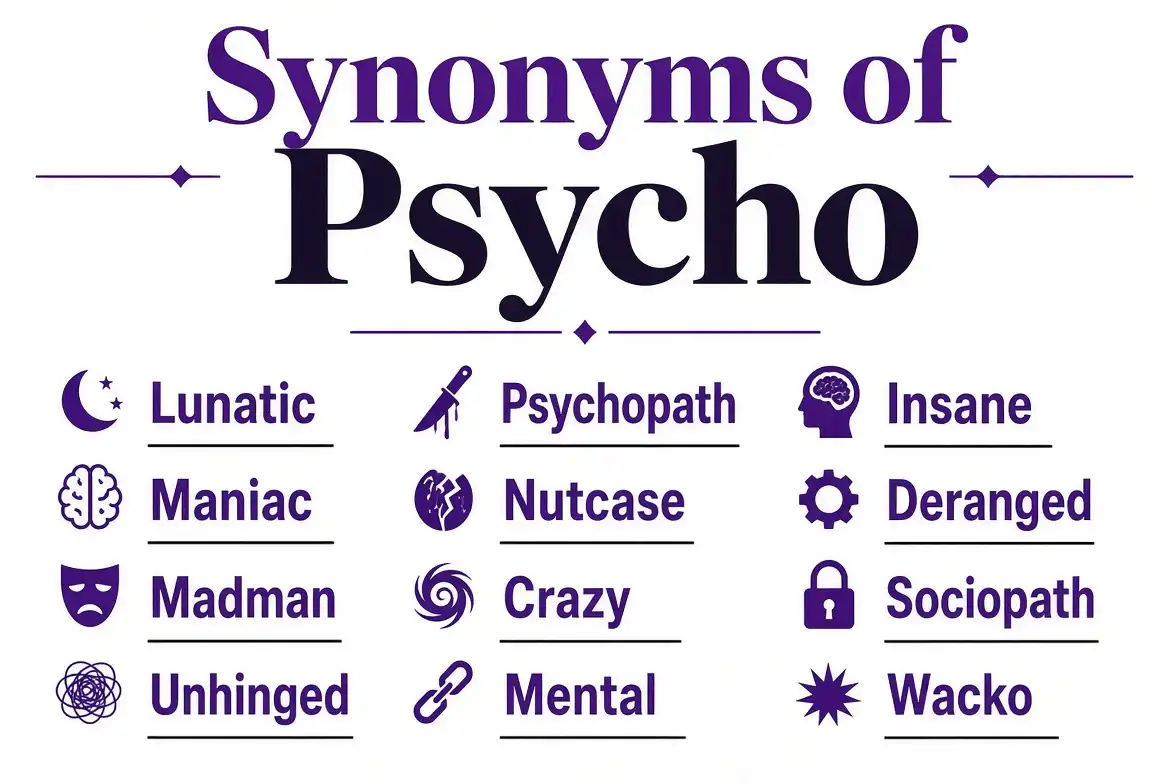
If you are searching for synonyms of psycho, the best replacement depends on what you actually mean. Psycho is an informal and often offensive word used for someone perceived as frightening, aggressive, mentally unstable, or extremely irrational. It can also describe behavior that seems wildly uncontrolled. It is not a clinical diagnosis.
The closest alternatives include psychopath, crazy, deranged, unhinged, disturbed, maniac, insane, mad, and psychotic, but these words are not interchangeable. For example, psychotic has a specific mental-health meaning, while erratic simply means unpredictable.
This guide explains the differences so you can choose a word that fits your exact meaning, tone, and audience.
Quick Answer: What Are the Best Synonyms of Psycho?
The best synonyms of psycho include psychopath, crazy, deranged, unhinged, disturbed, maniac, insane, mad, crazed, and unstable. However, each word has a different meaning and tone. For respectful or professional writing, it is usually better to describe the specific behavior instead of labeling someone as “psycho.”
What Does Psycho Mean?
Psycho is an informal noun and adjective.
As a noun, it can refer to a person who is perceived as aggressive, frightening, mentally unstable, or dangerous. As an adjective, it can describe behavior that seems extremely unstable or frightening. Collins labels the word informal and offensive, while Dictionary.com describes it as slang for a psychopathic, psychotic, crazy, or mentally unstable person.
Examples
- The movie features a psycho killer.
- He thought the stranger was a psycho.
- My dog went psycho when it saw the vacuum.
The third sentence shows an important point: in casual speech, psycho can be exaggerated or humorous. It does not necessarily describe a real mental-health condition.
Pronunciation
American English: /ˈsaɪkoʊ/
British English: /ˈsaɪkəʊ/
Pronounced: SYE-koh
The spelling is the same in American and British English, although the final vowel sound differs.
Part of Speech
| Word | Part of Speech | Example |
| psycho | Noun | He called the villain a psycho. |
| psycho | Adjective | The movie has a psycho villain. |
| psycho- | Combining form | psychology, psychosocial |
Do not confuse psycho with psycho-.
The combining form psycho- relates to the mind or mental processes and appears in words such as psychology and psychosocial.
Synonyms of Psycho: Quick Comparison
| Word | Main Idea | Register | Strength | Frequency |
| Psychopath | Person associated with psychopathy | Clinical / general | Strong | Common |
| Crazy | Extremely unreasonable or strange | Informal | Strong | Very common |
| Deranged | Extremely disturbed | Neutral / literary | Strong | Common |
| Unhinged | Lacking emotional control | Informal | Strong | Common |
| Disturbed | Emotionally or mentally troubled | Neutral | Medium | Common |
| Maniac | Extremely uncontrolled person | Informal | Strong | Common |
| Insane | Extremely irrational or mentally ill | Informal | Strong | Very common |
| Mad | Crazy or, especially in US English, angry | Informal | Strong | Very common |
| Crazed | Extremely uncontrolled | Literary / neutral | Strong | Uncommon |
| Unstable | Not emotionally steady | Neutral | Medium | Very common |
| Irrational | Not based on reason | Formal / neutral | Medium | Common |
| Erratic | Unpredictable | Neutral / formal | Medium | Common |
| Psychotic | Related to psychosis | Clinical | Strong | Common |
| Nutcase | Extremely strange person | Informal | Strong | Uncommon |
| Nutter | Crazy person | British informal | Strong | Uncommon |
| Lunatic | Insulting old-fashioned term | Informal / literary | Strong | Uncommon |
Important: A thesaurus may list words as related to psycho, but a related word is not always an exact substitute. Cambridge, for example, groups psychopath, psychotic, sociopath, and maniac under the noun sense while also listing crazy, insane, and disturbed for the adjective sense.
The Best Synonyms of Psycho by Meaning
This is the most useful way to choose the right word.
| If you mean… | Use… |
| A person associated with psychopathy | psychopath |
| Extremely strange behavior | crazy |
| Severe emotional disturbance | deranged |
| Loss of emotional control | unhinged |
| Mental or emotional trouble | disturbed |
| Wild or dangerous behavior | maniac |
| Unpredictable behavior | erratic |
| Illogical thinking | irrational |
| A clinical state involving psychosis | psychotic |
| British informal “crazy” | mad / nutter |
| A strange or foolish idea | crackpot |
| A person with unusual but harmless behavior | eccentric / quirky |
This distinction is where many simple synonym articles fall short.
1. Psychopath
Meaning: A person associated with psychopathy, especially traits such as severe lack of empathy or remorse.
Approximate CEFR: C1
Frequency: Common
Register: Clinical / general
Connotation: Very negative
Examples
- The detective believed the killer was a psychopath.
- The novel follows a manipulative psychopath.
Common collocations
- dangerous psychopath
- violent psychopath
- criminal psychopath
Best Used When
You specifically mean psychopathy, not simply strange or angry behavior.
When Not to Use It
Do not call someone a psychopath because they are rude, selfish, angry, or difficult.
2. Crazy
Meaning: Extremely strange, unreasonable, or uncontrolled.
Approximate CEFR: B1
Frequency: Very common
Register: Informal
Connotation: Strong and sometimes insensitive
Examples
- That was a crazy decision.
- The crowd went crazy after the team scored.
Common collocations
- crazy idea
- crazy behavior
- go crazy
Best Used When
You need a very common conversational alternative.
When Not to Use It
Avoid using crazy as a medical description of a person.
3. Deranged
Meaning: Extremely disturbed or irrational.
Approximate CEFR: C1
Frequency: Common
Register: Neutral / literary
Connotation: Very strong
Examples
- The novel’s villain has a deranged mind.
- The police received a message from a deranged man.
Common collocations
- deranged killer
- deranged mind
- deranged behavior
Best Used When
You want a strong word in fiction, journalism, or serious description.
When Not to Use It
Do not use it merely because someone makes an unusual choice.
4. Unhinged
Meaning: Acting without normal emotional control or sensible judgment.
Approximate CEFR: C1
Frequency: Common
Register: Informal
Connotation: Strong
Examples
- His online posts became increasingly unhinged.
- The character gives an unhinged speech.
Common collocations
- unhinged behavior
- unhinged rant
- completely unhinged
Best Used When
The main idea is loss of control.
When Not to Use It
Do not treat unhinged as a medical diagnosis.
5. Disturbed
Meaning: Emotionally or mentally troubled.
Approximate CEFR: B2
Frequency: Common
Register: Neutral / formal
Connotation: Serious but less slangy
Examples
- The story explores the mind of a disturbed character.
- He looked deeply disturbed by what happened.
Common collocations
- deeply disturbed
- emotionally disturbed
- disturbed individual
Best Used When
You want a less slang-heavy alternative to psycho.
When Not to Use It
Do not assume that someone who is disturbed is dangerous.
6. Maniac
Meaning: A person who behaves in an extremely uncontrolled or dangerous way.
Approximate CEFR: B2
Frequency: Common
Register: Informal
Connotation: Strong
Examples
- That driver was behaving like a maniac.
- The thriller follows a dangerous maniac.
Common collocations
- dangerous maniac
- homicidal maniac
- drive like a maniac
Best Used When
You want to emphasize wild or reckless behavior.
When Not to Use It
It can also describe someone who is extremely enthusiastic about something, so context matters.
7. Insane
Meaning: Extremely irrational, unreasonable, or mentally disturbed; also used informally to describe something extreme.
Approximate CEFR: B2
Frequency: Very common
Register: Informal
Examples
- That was an insane decision.
- The movie has an insane villain.
Common collocations
- insane idea
- insane amount
- drive someone insane
When Not to Use It
Avoid using it as a casual diagnosis of a person’s mental health.
8. Mad
Meaning: Crazy or unreasonable; in American English, it commonly means angry.
Approximate CEFR: B1
Frequency: Very common
Register: Informal
Examples
- He went mad after hearing the news.
- She was mad at her brother.
Best Used When
Use it carefully because mad has different common meanings across varieties of English.
American vs British English
In American English:
mad = angry
In British English:
mad = crazy or mentally disturbed
This regional difference makes mad less precise as a replacement for psycho.
9. Crazed
Meaning: Extremely excited, angry, or uncontrolled.
Approximate CEFR: C1
Frequency: Uncommon
Register: Neutral / literary
Examples
- A crazed fan rushed toward the stage.
- The story follows a crazed criminal.
Common collocations
- crazed fan
- crazed attacker
- crazed expression
When Not to Use It
It is too dramatic for ordinary professional communication.
10. Unstable
Meaning: Not emotionally steady or predictable.
Approximate CEFR: B2
Frequency: Very common
Register: Neutral
Examples
- His behavior became increasingly unstable.
- The character has an unstable personality.
Best Used When
You want to focus on lack of emotional stability.
When Not to Use It
Do not label real people without a reasonable basis.
11. Irrational
Meaning: Not based on reason or logic.
Approximate CEFR: B2
Frequency: Common
Register: Formal / neutral
Examples
- His irrational fear stopped him from traveling.
- The decision seemed completely irrational.
Common collocations
- irrational fear
- irrational behavior
- irrational decision
Best Used When
The problem is poor reasoning, not mental illness.
This is one of the most useful replacements when psycho is being used loosely to mean “not thinking sensibly.”
12. Erratic
Meaning: Changing suddenly and behaving in an unpredictable way.
Approximate CEFR: C1
Frequency: Common
Register: Neutral / formal
Examples
- His erratic behavior worried his coworkers.
- The player’s performance became erratic.
Common collocations
- erratic behavior
- erratic movement
- erratic performance
Best Used When
You mean unpredictable, not necessarily mentally ill.
13. Psychotic
Meaning: Relating to psychosis or a state involving a loss of contact with reality.
Approximate CEFR: C1
Frequency: Common
Register: Clinical / academic
Examples
- The patient experienced psychotic symptoms.
- The film depicts a psychotic episode.
Best Used When
You are discussing the clinical concept of psychosis.
When Not to Use It
Do not use psychotic simply to mean angry, violent, strange, or crazy.
This is one of the most important vocabulary distinctions in the entire topic.
14. Nutcase
Meaning: An informal and insulting word for someone considered very strange or irrational.
Approximate CEFR: C1
Frequency: Uncommon
Register: Informal
Example
The comedy portrays him as a lovable nutcase.
When Not to Use It
Avoid it in professional, academic, medical, and respectful communication.
15. Nutter
Meaning: An informal word, especially in British English, for a person considered crazy or unreasonable.
Approximate CEFR: C1
Frequency: Uncommon
Register: British informal
Example
The character is portrayed as a complete nutter.
When Not to Use It
It is slang and can sound insulting.
16. Lunatic
Meaning: An old-fashioned or insulting term for someone considered mentally unstable.
Approximate CEFR: C1
Frequency: Uncommon
Register: Informal / literary
Example
The novel describes him as a dangerous lunatic.
When Not to Use It
Avoid it in modern professional or medical writing.
17. Crazy
Meaning: Extremely unusual, unreasonable, or uncontrolled.
Register: Informal
Frequency: Very common
Because crazy is so common, it can replace psycho in some casual sentences, but not all.
Psycho: That guy is a psycho.
Crazy: That guy is crazy.
The second sentence is broader. It does not necessarily suggest violence or danger.
18. Crackpot
Meaning: A person with strange or foolish ideas.
Approximate CEFR: C1
Frequency: Uncommon
Register: Informal
Example
The story follows a crackpot inventor with a bizarre theory.
Best Used When
The unusual thing is someone’s ideas, not necessarily their behavior.
19. Wacko
Meaning: A very strange or eccentric person.
Approximate CEFR: C1
Frequency: Uncommon
Register: Informal
Example
The comedy introduces a wacko inventor.
Best Used When
You want humorous or exaggerated language.
20. Sicko
Meaning: An insulting word for someone considered morally disturbing or disgusting.
Approximate CEFR: C1
Frequency: Uncommon
Register: Informal
Example
The character calls the villain a sicko.
Best Used When
You are reproducing informal dialogue or emphasizing moral disgust.
21. Capricious
Meaning: Changing suddenly because of unpredictable ideas or moods.
Approximate CEFR: C1
Frequency: Uncommon
Register: Formal / literary
Example
The ruler was known for his capricious decisions.
Why It Is Useful
This is a good alternative when the intended meaning of psycho is actually unpredictable or changeable, rather than mentally disturbed.
Thesaurus.com specifically highlights capricious as a more precise alternative when describing unpredictable changes.
22. Quirky
Meaning: Noticeably unusual in an interesting or amusing way.
Approximate CEFR: B2
Frequency: Common
Register: Informal / neutral
Connotation: Usually positive
Example
She has a quirky sense of humor.
Why It Is Useful
If you mean strange but harmless, quirky is far better than psycho.
Thesaurus.com recommends quirky when the intended meaning is unusual or peculiar rather than mentally unstable.
23. Eccentric
Meaning: Behaving in an unusual but often harmless way.
Approximate CEFR: C1
Frequency: Common
Register: Neutral / formal
Example
The eccentric professor wore colorful suits every day.
Best Used When
You mean unusual, not dangerous.
24. Berserk
Meaning: Extremely angry or uncontrolled.
Approximate CEFR: C1
Frequency: Common
Register: Informal
Examples
- The fans went berserk after the final goal.
- He went berserk when he saw the damage.
Best Used When
The focus is on sudden extreme behavior.
25. Feral
Meaning: Wild, uncontrolled, or lacking normal restraint.
Approximate CEFR: C1
Frequency: Common
Register: Informal / figurative
Example
The crowd became almost feral after the announcement.
Best Used When
You want a vivid metaphor for wild behavior.
When Not to Use It
It is not a synonym for mental illness.
Strongest Synonyms of Psycho
If you need strong language for fiction or dramatic description, consider:
- Deranged
- Unhinged
- Crazed
- Maniac
- Psychopath
- Insane
- Psychotic
But remember: strongest does not mean most accurate.
For example:
The suspect was psychotic.
This should not be used simply because the suspect acted violently.
A more neutral description might be:
The suspect behaved violently and unpredictably.
That sentence describes what happened without making an unsupported mental-health claim.
Softer Alternatives to Psycho
Sometimes the writer does not actually mean “mentally disturbed.” They simply mean “strange.”
In that case, choose:
- quirky
- eccentric
- unusual
- unconventional
- unpredictable
- odd
- bizarre
- peculiar
Example
Instead of:
She has a psycho personality.
Use:
She has an eccentric personality.
That changes the tone from insulting to descriptive.
Words That Are NOT Exact Synonyms
This is an important learner section.
| Word | Why It Is Different |
| Psychotic | Specific clinical meaning |
| Psychopath | Specific personality construct |
| Antisocial | Has a specific psychological meaning; not simply “unsociable” |
| Irrational | Describes reasoning |
| Erratic | Describes unpredictability |
| Eccentric | Often harmless unusual behavior |
| Quirky | Usually mildly positive |
| Feral | Figurative description of wild behavior |
| Crackpot | Focuses on strange ideas |
| Berserk | Describes uncontrolled anger or excitement |
American vs British English
The word psycho is understood in both varieties.
| Feature | American English | British English |
| Spelling | psycho | psycho |
| Pronunciation | /ˈsaɪkoʊ/ | /ˈsaɪkəʊ/ |
| Register | Informal | Informal |
| Common meaning | Psychopathic / crazy person | Psychopath / mentally unstable person |
| Related British slang | crazy, mad | mad, nutter |
Dictionary.com records the American pronunciation as /ˈsaɪkoʊ/ and British pronunciation as /ˈsaɪkəʊ/.
Word Origin and Etymology
The slang word psycho is a shortened form connected with words such as psychotic and psychopathic. Dictionary.com records the slang noun/adjective as first recorded around 1935–40.
The combining form psycho- has a much older history. It comes from Greek psykhē, meaning “breath,” “spirit,” “soul,” or “mind.” It developed into a combining form referring to the mind and mental processes.
This explains why English has words such as:
- psychology
- psychological
- psychopath
- psychosis
- psychotic
- psychotherapy
The slang psycho and the technical combining form psycho- are therefore related, but they should not be treated as the same grammatical item.
Common Collocations
Native speakers commonly use psycho in combinations such as:
- psycho killer
- psycho villain
- psycho behavior
- psycho character
- complete psycho
- total psycho
- go psycho
- act psycho
However, these are mostly informal and dramatic expressions.
Common Grammar Mistakes
Mistake 1
Wrong: He is a psychotic.
Better: He is psychotic.
If you mean a person diagnosed with a specific condition, use the appropriate clinical terminology rather than turning psychotic into a casual label.
Mistake 2
Wrong: She is antisocial because she likes staying home.
Better: She is introverted and prefers staying home.
Antisocial does not simply mean “not social.”
Mistake 3
Wrong: He is psycho because he shouted once.
Better: He became extremely angry.
A single emotional reaction does not justify a broad label.
How to Choose the Right Synonym
Use this simple decision guide:
Is the person simply strange?
Use:
quirky, eccentric, odd, unusual
Is the behavior unpredictable?
Use:
erratic, unpredictable, capricious
Is the person behaving without emotional control?
Use:
unhinged, uncontrolled, berserk
Is the person making poor logical decisions?
Use:
irrational, unreasonable
Are you discussing psychosis?
Use:
psychotic
Are you specifically discussing psychopathy?
Use:
psychopath / psychopathic
Are you writing casual dialogue?
Use:
crazy, mad, nutter, wacko, nutcase
Are you writing professionally?
Avoid psycho and describe the actual behavior instead.
Writing Tips
For Essays
Instead of:
The character is psycho.
Write:
The character displays increasingly irrational and aggressive behavior.
This sounds more precise.
For Professional Emails
Avoid:
The customer went psycho.
Better:
The customer became extremely angry.
For Blog Posts
You can use psycho when discussing slang, movies, books, or popular culture.
For Fiction
Informal language can make dialogue sound natural:
“That guy is completely unhinged,” Mia whispered.
For Social Media
Casual words such as crazy or wild may fit the tone, but avoid using mental-health terms as casual insults.
Antonyms of Psycho
There is no single perfect opposite because psycho has several meanings.
Depending on context, possible antonyms include:
- sane
- rational
- calm
- reasonable
- stable
- sensible
- controlled
- balanced
Examples
Irrational → rational
Unstable → stable
Uncontrolled → controlled
Crazy → sane
Word Family
Related vocabulary includes:
- psyche
- psychology
- psychological
- psychologist
- psychopathy
- psychopath
- psychopathic
- psychosis
- psychotic
- psychiatry
- psychiatric
- psychotherapy
These words share historical connections, but their meanings are not interchangeable.
Mini Practice: Fill in the Blanks
Choose from:
psychopath, erratic, quirky, irrational, unhinged
- Her behavior became increasingly ______.
- His fear of elevators was completely ______.
- The detective believed the killer was a ______.
- My new teacher has a ______ sense of humor.
- His online posts became increasingly ______.
Answers
- erratic
- irrational
- psychopath
- quirky
- unhinged
Sentence Rewriting Practice
Replace psycho with a more accurate word.
1.
The driver was acting psycho.
Better:
The driver was behaving recklessly.
2.
My brother has a psycho idea.
Better:
My brother has a bizarre idea.
3.
She became psycho after the argument.
Better:
She became extremely angry after the argument.
4.
He is psycho because he likes strange clothes.
Better:
He has an eccentric style.
The key lesson is simple: describe the exact behavior instead of using a broad label.
FAQ: Synonyms of Psycho
What are the best synonyms of psycho?
Common alternatives include psychopath, crazy, deranged, unhinged, disturbed, maniac, insane, mad, and crazed. The best word depends on the intended meaning. For example, erratic works for unpredictable behavior, while irrational works for behavior that does not make logical sense.
What is a polite synonym for psycho?
There is no perfect polite synonym because psycho itself is informal and often offensive. More respectful alternatives include unusual, eccentric, unpredictable, emotionally distressed, irrational, or disturbed, depending on what you actually want to describe.
Is psychopath the same as psycho?
No. Psycho is a broad informal and derogatory label, while psychopath is more specific. A thesaurus may list psychopath as a related synonym, but the two words should not be treated as exact replacements in every sentence.
Is psychotic a synonym for psycho?
Not exactly. Psychotic has a specific clinical meaning related to psychosis. It should not casually mean “crazy,” “violent,” or “strange.” In professional or educational writing, use psychotic only when the clinical meaning is intended.
What is the British synonym for psycho?
British informal alternatives can include mad, nutter, lunatic, and maniac, depending on context. Nutter is particularly informal. In British English, mad can commonly mean “crazy,” while American English often uses mad to mean “angry.”
What is the opposite of psycho?
Possible opposites include sane, rational, calm, reasonable, stable, sensible, and controlled. The best antonym depends on which meaning of psycho is intended.
Can psycho be used in formal writing?
Usually, no. Psycho is informal and can be offensive. In academic, medical, workplace, or professional writing, describe the person’s actual behavior or use an accurate technical term when appropriate.
What word should I use instead of psycho for someone who is strange?
If the person is simply unusual and not dangerous, quirky, eccentric, unusual, odd, or unconventional are better choices. These words describe unusual behavior without automatically suggesting mental illness or violence.
Vocabulary Quiz
1. Which word specifically relates to psychopathy?
A. Quirky
B. Psychopath
C. Erratic
D. Berserk
2. Which word means “not based on reason”?
A. Irrational
B. Eccentric
C. Feral
D. Nutter
3. Which word is particularly associated with British informal English?
A. Nutter
B. Psychotic
C. Irrational
D. Disturbed
4. Which word best describes unpredictable behavior?
A. Psychopath
B. Erratic
C. Sane
D. Calm
5. Which word is usually a better choice for harmless unusual behavior?
A. Psycho
B. Psychotic
C. Quirky
D. Maniac
Answer Key
- B. Psychopath
- A. Irrational
- A. Nutter
- B. Erratic
- C. Quirky
Final Takeaway
The best synonyms of psycho depend on the meaning you want to express. Use psychopath for a specific reference to psychopathy, psychotic only for the clinical concept of psychosis, unhinged for a loss of emotional control, erratic for unpredictable behavior, and irrational for poor reasoning.
If someone is simply unusual, choose quirky or eccentric instead. Learning these differences will make your English more precise, natural, and respectful.
References
- Cambridge Dictionary, Psycho and its thesaurus entries.
- Collins English Dictionary, Psycho definition, usage, and word origin.
- Dictionary.com, Psycho definition, pronunciation, etymology, and usage.
- Merriam-Webster, Psycho usage examples.
- Thesaurus.com, Synonyms and better alternatives for psycho.

Synonorm is a trusted English vocabulary resource created to help readers find the right words and understand the differences between similar terms. We provide clear explanations of synonyms, meanings, examples, usage, and alternatives. Our content makes vocabulary easier to learn and apply in everyday, academic, and professional English. Synonorm is designed for students, writers, ESL learners, professionals, and anyone who wants to improve their English vocabulary and communicate more clearly.