Quick Answer: What Are the Best Synonyms of Reaching Out?
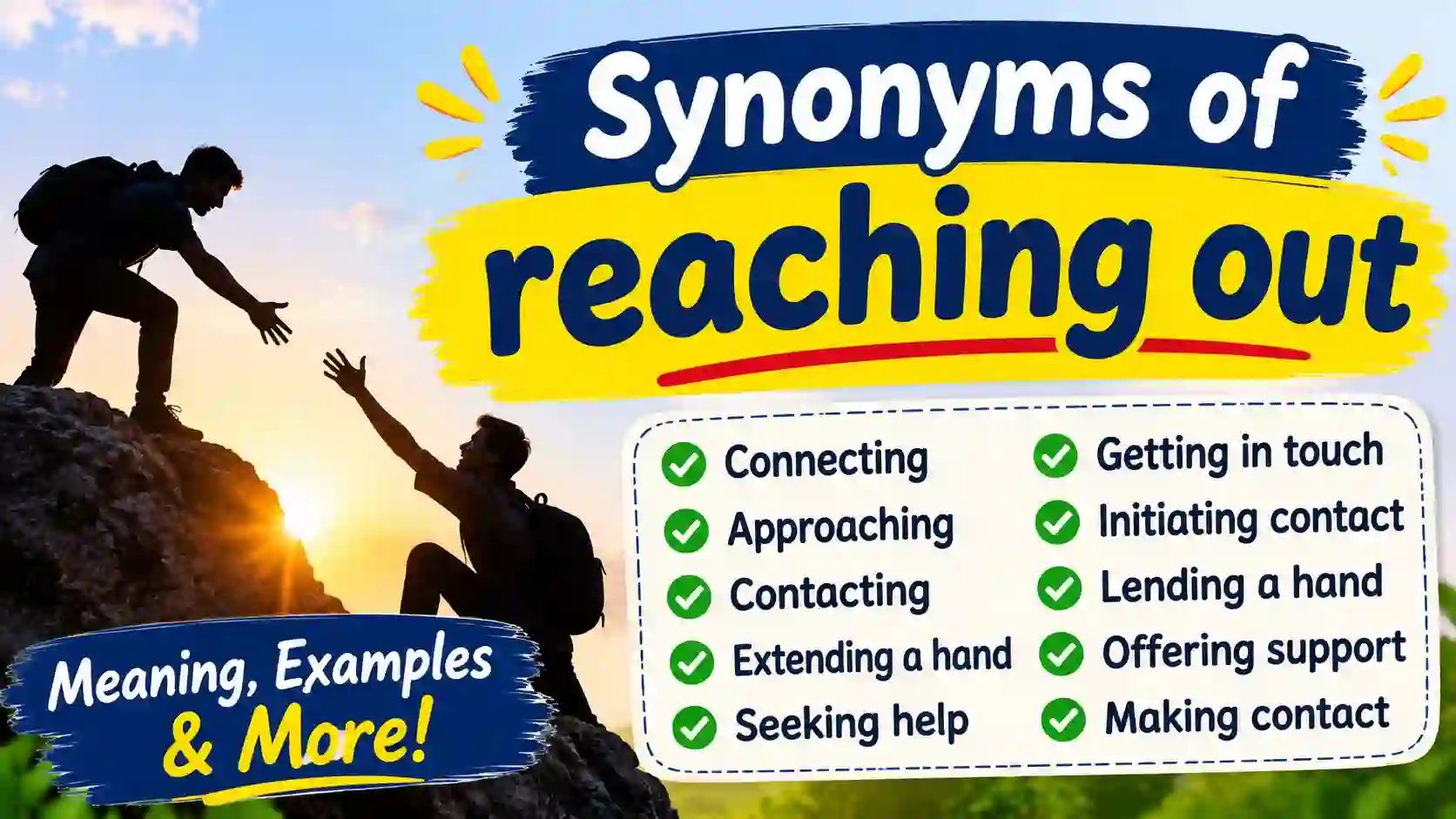
The best synonyms of reaching out include contacting, getting in touch, making contact, communicating, connecting, messaging, calling, emailing, and approaching. These expressions describe starting communication with someone. Other alternatives, such as checking in, following up, and offering support, work in more specific situations.
Have you ever written an email and used the phrase reaching out several times? It is a useful expression, but repeating it can make your writing sound less natural.
The phrase reaching out usually means making an effort to contact someone, start a conversation, offer help, or build a connection. You might reach out to a teacher for advice, contact a customer about an order, or message an old friend.
Learning synonyms of reaching out gives you more ways to express these actions. For example, instead of writing, “I am reaching out about the meeting,” you could write, “I am contacting you about the meeting.”
However, not every alternative works in every situation. Following up means contacting someone again, while offering help means providing support.
This guide explains 30 useful alternatives, their differences, natural examples, grammar patterns, and the best situations for using each expression.
Pronunciation of Reaching Out
- IPA: /ˌriːtʃɪŋ ˈaʊt/
- Pronunciation: REE-ching OWT
- Word type: Phrasal verb form
- Main stress: Out
American and British speakers pronounce the expression in broadly the same way, although individual accents may change vowel sounds and rhythm.
Part of Speech
Reach out is a phrasal verb made from the verb reach and the particle out.
The form reaching out has two main grammatical functions.
1. Present participle
It describes an action that is happening.
Example: The manager is reaching out to new customers.
2. Gerund
It acts like a noun in a sentence.
Example: Reaching out to people can create valuable friendships.
Other grammatical forms:
| Form | Example |
| Base verb | Reach out |
| Third-person singular | Reaches out |
| Past tense | Reached out |
| Present participle | Reaching out |
| Past participle | Reached out |
The expression is not normally an adjective or adverb.
Meaning and Different Uses of Reaching Out
The expression has several related meanings.
| Meaning | Explanation | Example |
| Making contact | Trying to communicate | I reached out to the manager. |
| Offering support | Trying to help someone | She reached out to a struggling student. |
| Requesting help | Asking someone for assistance | He reached out for advice. |
| Building connections | Establishing relationships | The organization is reaching out to local communities. |
| Physical movement | Extending an arm or hand | The baby was reaching out for the toy. |
Remember: A synonym for one meaning may not work for another. For example, contacting works for communication, but it does not always express the warmth of offering support.
Grammar Rules and Sentence Patterns
Use these patterns to write naturally.
| Pattern | Example |
| Reach out to + person | She reached out to her teacher. |
| Reach out for + help | He reached out for assistance. |
| Reach out about + topic | I reached out about the project. |
| Be reaching out to + person | We are reaching out to customers. |
| Appreciate + possessive/person + reaching out | I appreciate you reaching out. |
Important grammar rules
- Use it when identifying the person you contact.
- Use for when explaining the help or thing you want.
- Use about when introducing the subject.
- Use reached out for the simple past.
- Use reaching out after prepositions such as for and about when the phrase functions as a gerund.
Examples:
- Correct: Thank you for reaching out.
- Correct: I reached out to my professor.
- Correct: She reached out for emotional support.
- Incorrect: I reached out to my professor.
Overview: 30 Alternatives to Reaching Out
| Synonym | Strength | Formality |
| Contacting | Strongest | Neutral |
| Getting in touch | Strongest | Neutral |
| Making contact | Strongest | Formal |
| Communicating | Strong | Neutral |
| Connecting | Strong | Neutral |
| Messaging | Strong | Informal |
| Calling | Strong | Neutral |
| Emailing | Strong | Neutral |
| Speaking to | Strong | Neutral |
| Talking to | Strong | Informal |
| Approaching | Strong | Neutral |
| Writing to | Strong | Neutral |
| Getting hold of | Strong | Informal |
| Making an approach | Strong | Formal |
| Initiating contact | Strong | Formal |
| Corresponding | Related | Formal |
| Checking in with | Related | Neutral |
| Following up with | Related | Professional |
| Reconnecting with | Related | Neutral |
| Engaging with | Related | Formal |
| Touching base with | Related | Business |
| Sending a message to | Related | Neutral |
| Getting through to | Related | Neutral |
| Speaking with | Strong | Neutral |
| Having a conversation with | Related | Neutral |
| Asking for help | Related | Neutral |
| Seeking assistance | Related | Formal |
| Offering support | Related | Neutral |
| Lending a hand | Related | Informal |
| Extending a helping hand | Related | Neutral |
The table separates close alternatives from context-dependent expressions. The related entries are not exact replacements in every sentence.
1. Contacting
Meaning: Trying to communicate with someone.
Examples:
- I am contacting the admissions office about my application.
- The company is contacting its customers about the new service.
Best Used When: You need a direct and clear alternative in business, education, or everyday communication.
Tone: Neutral.
Register: Professional and spoken English.
Frequency: Very common.
Common Collocations:
- Contacting customers
- Contacting a company
- Contacting someone directly
Nuance: Direct and practical, without necessarily expressing emotional warmth.
When Not to Use: Avoid it when you specifically want to emphasize offering emotional support.
2. Getting in Touch
Meaning: Starting communication with another person.
Examples:
- I am getting in touch to discuss the new project.
- My former teacher got in touch after seeing my work.
Best Used When: You want a friendly alternative in emails, messages, and conversations.
Tone: Friendly and neutral.
Register: Spoken and informal writing.
Frequency: Very common.
Common Collocations:
- Get in touch with someone
- Get in touch soon
- Get in touch by email
Nuance: Sounds warmer and less direct than contacting.
When Not to Use: Avoid it in highly technical writing where a more precise expression is needed.
3. Making Contact
Meaning: Establishing communication with someone.
Examples:
- The research team is making contact with local organizations.
- We made contact with the supplier before the deadline.
Best Used When: You want to describe the beginning of communication.
Tone: Formal and neutral.
Register: Academic and business English.
Frequency: Common.
Common Collocations:
- Make initial contact
- Make direct contact
- Make contact with clients
Nuance: Emphasizes establishing communication rather than maintaining it.
When Not to Use: Avoid it when you are describing a long conversation.
4. Communicating
Meaning: Sharing information, thoughts, or feelings with someone.
Examples:
- I am communicating with the design team about the changes.
- Good teachers communicate with parents regularly.
Best Used When: You want to emphasize an exchange of information.
Tone: Neutral.
Register: Academic, professional, and spoken.
Frequency: Very common.
Common Collocations:
- Communicating effectively
- Communicating with colleagues
- Communicating clearly
Nuance: Focuses on the exchange of information, not simply the first contact.
When Not to Use: Avoid it when you only mean sending one initial message.
5. Connecting
Meaning: Establishing a relationship or communication with someone.
Examples:
- I am connecting with other writers to share ideas.
- The organization connects volunteers with local families.
Best Used When: You want to emphasize relationships and networking.
Tone: Friendly and neutral.
Register: Business and spoken English.
Frequency: Very common.
Common Collocations:
- Connecting with people
- Connecting with professionals
- Building connections
Nuance: Often suggests a meaningful relationship rather than a simple exchange of information.
When Not to Use: Avoid it when you only mean placing a quick phone call.
6. Messaging
Meaning: Sending a written electronic message to someone.
Examples:
- I am messaging my colleague about tomorrow’s meeting.
- She messaged the customer to confirm the delivery.
Best Used When: The communication happens through a messaging app or online platform.
Tone: Informal.
Register: Digital and spoken English.
Frequency: Very common.
Common Collocations:
- Messaging a friend
- Messaging someone online
- Messaging a customer
Nuance: Identifies the communication method.
When Not to Use: Avoid it when you are describing a telephone call or formal letter.
7. Calling
Meaning: Contacting someone by telephone.
Examples:
- I am calling the office to ask about the vacancy.
- She called her friend to check on him.
Best Used When: You specifically mean making a phone call.
Tone: Neutral.
Register: Spoken and professional.
Frequency: Very common.
Common Collocations:
- Calling a customer
- Calling someone back
- Calling for assistance
Nuance: More specific than reaching out because it identifies the communication method.
When Not to Use: Avoid it when you mean sending an email or text.
8. Emailing
Meaning: Sending an electronic message to someone.
Examples:
- I am emailing the manager about the interview.
- The student emailed her professor for clarification.
Best Used When: You want to identify email as the method of communication.
Tone: Neutral.
Register: Business and academic English.
Frequency: Very common.
Common Collocations:
- Emailing a client
- Emailing a professor
- Emailing about an issue
Nuance: Clear and specific.
When Not to Use: Avoid it when you do not know which communication method will be used.
9. Speaking To
Meaning: Talking directly with another person.
Examples:
- I am speaking to the director about the proposal.
- The student spoke to her teacher after class.
Best Used When: You want to describe a spoken conversation.
Tone: Neutral.
Register: Everyday and professional English.
Frequency: Very common.
Common Collocations:
- Speaking to a manager
- Speaking to a teacher
- Speaking to someone privately
Nuance: Focuses on spoken communication.
When Not to Use: Avoid it when you mean sending a written message.
10. Talking To
Meaning: Having a conversation with someone.
Examples:
- I am talking to a potential client about the project.
- He talked to his brother about the problem.
Best Used When: You want a natural expression for daily conversations.
Tone: Informal and neutral.
Register: Spoken English.
Frequency: Very common.
Common Collocations:
- Talking to friends
- Talking to customers
- Talking to someone about an issue
Nuance: More conversational than communicating.
When Not to Use: Avoid it in formal writing when contacting or discussing expresses your meaning better.
11. Approaching
Meaning: Going to someone to speak, ask, or offer something.
Examples:
- I am approaching the director about a possible partnership.
- She approached her teacher for advice.
Best Used When: You want to describe taking the first step toward a conversation or request.
Tone: Neutral to formal.
Register: Academic and professional.
Frequency: Common.
Common Collocations:
- Approaching a manager
- Approaching someone for advice
- Approaching potential clients
Nuance: Suggests a deliberate action or request.
When Not to Use: Avoid it when you mean maintaining regular contact.
12. Writing To
Meaning: Sending someone a written message or letter.
Examples:
- I am writing to the principal about the school event.
- She wrote to the university to request information.
Best Used When: You want to describe written communication.
Tone: Neutral and polite.
Register: Formal and everyday writing.
Frequency: Very common.
Common Collocations:
- Writing to a company
- Writing to a teacher
- Writing to request information
Nuance: Often sounds more natural than contacting when introducing a formal email.
When Not to Use: Avoid it when you are describing a spoken conversation.
13. Getting Hold Of
Meaning: Successfully contacting someone, often after trying several times.
Examples:
- I finally got hold of the technician.
- She could not get hold of her manager before the meeting.
Best Used When: You want to describe the effort involved in contacting someone.
Tone: Informal.
Register: Spoken English.
Frequency: Common.
Common Collocations:
- Get hold of someone
- Try to get hold of a manager
- Finally get hold of someone
Nuance: Emphasizes successful contact, sometimes after difficulty.
When Not to Use: Avoid it in formal reports or highly polished academic writing.
14. Making an Approach
Meaning: Taking an initial step toward someone to discuss or request something.
Examples:
- The agency made an approach to several potential partners.
- She made an approach to the school about a possible collaboration.
Best Used When: You describe a planned or formal attempt to start a discussion.
Tone: Formal.
Register: Business and academic English.
Frequency: Common in formal contexts.
Common Collocations:
- Make an initial approach
- Make a formal approach
- Make an approach to someone
Nuance: More formal than simply contacting someone.
When Not to Use: Avoid it in friendly messages or casual conversations.
15. Initiating Contact
Meaning: Taking the first step to communicate with someone.
Examples:
- The company is initiating contact with potential suppliers.
- I initiated contact with the university last month.
Best Used When: You need a precise alternative in professional or academic writing.
Tone: Formal.
Register: Academic and business English.
Frequency: Common in formal writing.
Common Collocations:
- Initiating contact
- Initial contact
- Initiate direct communication
Nuance: Emphasizes the beginning of communication.
When Not to Use: Avoid it in simple everyday conversations.
16. Corresponding
Meaning: Exchanging written messages with someone over time.
Examples:
- I am corresponding with the admissions department.
- The author has been corresponding with her editor for several months.
Best Used When: You describe an ongoing exchange of letters or emails.
Tone: Formal.
Register: Academic and professional.
Frequency: Common in formal writing.
Common Collocations:
- Corresponding by email
- Corresponding with clients
- Written correspondence
Nuance: Suggests an exchange rather than a single message.
When Not to Use: Avoid it for a quick text to a friend.
17. Checking In With
Meaning: Contacting someone to ask about their well-being or progress.
Examples:
- I am checking in with my colleague about the assignment.
- The teacher checked in with her students before the examination.
Best Used When: You want to show concern or request an update.
Tone: Friendly and professional.
Register: Spoken and business English.
Frequency: Very common.
Common Collocations:
- Checking in with a friend
- Checking in with customers
- Checking in about progress
Nuance: Often communicates care or interest.
When Not to Use: Avoid it when you are making initial contact with a stranger.
18. Following Up With
Meaning: Contacting someone again about an earlier discussion or action.
Examples:
- I am following up with the client about the proposal.
- The recruiter followed up with me after the interview.
Best Used When: You have already communicated and need an update or response.
Tone: Professional.
Register: Business and academic English.
Frequency: Very common.
Common Collocations:
- Following up with a client
- Following up on an email
- Following up after a meeting
Nuance: Requires an earlier event or interaction.
When Not to Use: Avoid it for first-time contact.
19. Reconnecting With
Meaning: Starting communication again after a period of separation.
Examples:
- I am reconnecting with an old school friend.
- The business is reconnecting with former customers.
Best Used When: You want to restore a previous relationship.
Tone: Friendly and neutral.
Register: Personal and professional.
Frequency: Common.
Common Collocations:
- Reconnecting with friends
- Reconnecting with colleagues
- Reconnecting after years
Nuance: Suggests an existing connection that has weakened or stopped.
When Not to Use: Avoid it when you have never communicated with the person.
20. Engaging With
Meaning: Interacting with someone in an active way.
Examples:
- Our business is engaging with customers on social media.
- The teacher is engaging with students during the lesson.
Best Used When: You want to describe meaningful interaction or participation.
Tone: Formal and professional.
Register: Business, academic, and public communication.
Frequency: Common.
Common Collocations:
- Engaging with customers
- Engaging with the community
- Engaging with an audience
Nuance: Implies active involvement rather than simply sending a message.
When Not to Use: Avoid it for a single short email.
21. Touching Base With
Meaning: Briefly contacting someone to exchange information or check progress.
Examples:
- I am touching base with the client about the deadline.
- Our manager touched base with the team before the presentation.
Best Used When: You want a brief, friendly business check-in.
Tone: Informal and professional.
Register: Business English.
Frequency: Common, especially in American workplaces.
Common Collocations:
- Touching base with a client
- Touching base about a project
- Touch base next week
Nuance: Often suggests a short interaction.
When Not to Use: Avoid it in formal academic writing.
22. Sending a Message To
Meaning: Communicating with someone through a written or digital message.
Examples:
- I am sending a message to the project manager.
- She sent a message to her friend about the event.
Best Used When: You want to describe a specific messaging action.
Tone: Neutral.
Register: Digital and everyday English.
Frequency: Very common.
Common Collocations:
- Sending a quick message
- Sending a private message
- Sending a message to someone
Nuance: Identifies the action rather than the purpose of communication.
When Not to Use: Avoid it when describing a longer conversation.
23. Getting Through To
Meaning: Successfully making contact with someone or making them understand something.
Examples:
- I finally got through to the customer service department.
- She tried to get through to her brother all afternoon.
Best Used When: You want to describe successfully reaching someone, especially when contact is difficult.
Tone: Neutral.
Register: Spoken and professional English.
Frequency: Common.
Common Collocations:
- Get through to someone
- Get through by phone
- Finally get through
Nuance: Can refer to successful telephone contact or making an idea understood.
When Not to Use: Avoid it when you simply mean starting a friendly conversation.
24. Speaking With
Meaning: Having a conversation with someone.
Examples:
- I am speaking with the department head about the schedule.
- She spoke with the customer before approving the request.
Best Used When: You want a neutral expression for a direct conversation.
Tone: Neutral.
Register: Professional and everyday English.
Frequency: Very common.
Common Collocations:
- Speaking with a client
- Speaking with a supervisor
- Speaking with someone privately
Nuance: Similar to speaking to, with a slight preference for emphasizing the interaction.
When Not to Use: Avoid it when you mean only sending a message.
25. Having a Conversation With
Meaning: Talking with someone about a subject.
Examples:
- I am having a conversation with the director about the new plan.
- The counselor had a conversation with the student about her goals.
Best Used When: You want to emphasize an actual discussion.
Tone: Neutral.
Register: Spoken and professional English.
Frequency: Very common.
Common Collocations:
- Have a conversation with someone
- Have an honest conversation
- Have a conversation about work
Nuance: Suggests an exchange rather than a one-way message.
When Not to Use: Avoid it when you only mean sending an initial email.
26. Asking for Help
Meaning: Requesting assistance from someone.
Examples:
- I am asking my teacher for help with the assignment.
- The family asked their neighbors for help after the storm.
Best Used When: Your reason for contacting someone is to request assistance.
Tone: Neutral.
Register: Everyday and professional English.
Frequency: Very common.
Common Collocations:
- Asking for help
- Asking for advice
- Asking for support
Nuance: Focuses on the request, not the act of contacting.
When Not to Use: Avoid it when you are contacting someone only to share information.
27. Seeking Assistance
Meaning: Looking for help or support from someone.
Examples:
- I am seeking assistance from the admissions office.
- The organization is seeking assistance from local volunteers.
Best Used When: You want a formal expression for requesting help.
Tone: Formal.
Register: Academic and professional English.
Frequency: Common.
Common Collocations:
- Seeking assistance
- Seeking professional assistance
- Seeking assistance from experts
Nuance: More formal than asking for help.
When Not to Use: Avoid it in relaxed conversations where simpler words sound more natural.
28. Offering Support
Meaning: Volunteering to help or encourage another person.
Examples:
- I am offering support to students who need extra guidance.
- The organization offered support to families affected by the storm.
Best Used When: You want to express a willingness to help someone.
Tone: Warm and neutral.
Register: Professional and everyday English.
Frequency: Very common.
Common Collocations:
- Offering support
- Offering emotional support
- Offering practical support
Nuance: Focuses on giving assistance rather than making contact.
When Not to Use: Avoid it when you are contacting someone for general information.
29. Lending a Hand
Meaning: Helping someone with a task or problem.
Examples:
- My neighbor is lending a hand with the garden.
- Volunteers lent a hand to families after the flood.
Best Used When: You want to describe practical help.
Tone: Informal and friendly.
Register: Spoken English.
Frequency: Common.
Common Collocations:
- Lend a helping hand
- Lend a hand with work
- Lend someone a hand
Nuance: Warm and helpful, often suggesting physical or practical assistance.
When Not to Use: Avoid it when you mean simply starting a conversation.
30. Extending a Helping Hand
Meaning: Offering kindness, help, or support to another person.
Examples:
- The community extended a helping hand to families in need.
- She extended a helping hand to a new employee who felt nervous.
Best Used When: You want a warm expression that emphasizes generosity and compassion.
Tone: Neutral and slightly literary.
Register: Descriptive and professional writing.
Frequency: Common.
Common Collocations:
- Extend a helping hand
- Extend a hand of friendship
- Extend a helping hand to someone
Nuance: More expressive and emotional than contacting.
When Not to Use: Avoid it as a direct replacement for a routine business email.
Synonym Categories: Strongest, Strong, and Related
To avoid confusing readers, it helps to group these alternatives according to their actual meaning.
Strongest Synonyms
These are the most useful replacements when the original phrase means making contact.
- Contacting
- Getting in touch
- Making contact
- Initiating contact
- Connecting
- Approaching
- Messaging
- Emailing
- Calling
- Speaking to
Strong Synonyms
These work in particular communication situations.
- Communicating
- Writing to
- Talking to
- Speaking with
- Getting hold of
- Getting through to
- Making an approach
- Corresponding
- Sending a message to
- Having a conversation with
Related Expressions
These communicate a more specific purpose.
- Checking in with
- Following up with
- Reconnecting with
- Engaging with
- Touching base with
- Asking for help
- Seeking assistance
- Offering support
- Lending a hand
- Extending a helping hand
Choose the Right Synonym: Side by Side Comparisons
The following comparisons help you choose an expression that fits your exact meaning.
| If you want to… | Choose this expression | Example |
| Contact someone professionally | Contacting | I am contacting you about the vacancy. |
| Sound friendly | Getting in touch | I wanted to get in touch with you. |
| Build relationships | Connecting | I am connecting with other writers. |
| Ask for assistance | Seeking assistance | I am seeking assistance with my application. |
| Show concern | Checking in | I am checking in to see how you feel. |
| Continue an earlier discussion | Following up | I am following up on my previous email. |
| Restore an old relationship | Reconnecting | I am reconnecting with an old friend. |
| Communicate by phone | Calling | I am calling to discuss the issue. |
| Exchange written messages | Corresponding | We are corresponding with the university. |
| Offer practical support | Lending a hand | I am lending a hand to my colleague. |
Five Important Differences
1. Contacting vs. Connecting
Contacting means communicating with someone. Connecting often suggests developing a relationship.
2. Reaching Out vs. Following Up
Reaching out can describe initial contact. Following up means contacting someone again about an earlier matter.
3. Reaching Out vs. Checking In
Checking in usually involves asking about someone’s condition, feelings, or progress.
4. Reaching Out vs. Reconnecting
Reconnecting means restoring communication that existed before.
5. Reaching Out vs. Offering Support
Reaching out describes making an effort to communicate. Offering support describes providing help or encouragement.
Commonly Confused Words
| Word | Difference | Example |
| Reach out | Make an effort to contact or support someone | I reached out to my teacher. |
| Reach | Successfully contact or arrive at someone | I finally reached the manager. |
| Outreach | An organized effort to contact or help people | The school launched an outreach program. |
| Follow up | Continue an earlier communication | I followed up on my application. |
| Check in | Ask about someone’s well-being or progress | I checked in with my colleague. |
Reach Out vs. Outreach
These expressions are closely related but have different grammatical uses.
- Reach out: A phrasal verb. Example: We reach out to local communities.
- Outreach: A noun. Example: The organization runs a community outreach program.
Common Mistakes to Avoid
Here are five mistakes that English learners should understand.
Mistake 1: Missing the preposition
- Incorrect: I am reaching out to you.
- Correct: I am reaching out to you.
2: Using following up for first-time contact
- Incorrect: I am following up with a company I have never contacted.
- Correct: I am contacting the company for the first time.
3: Confusing help with communication
- Incorrect: I am lending a hand to ask about the price.
- Correct: I am contacting you to ask about the price.
4: Using reconnecting for a new relationship
- Incorrect: I am reconnecting with someone I have never met.
- Correct: I am connecting with someone new.
5: Using contacting when you mean checking on someone
- Less suitable: I am contacting my friend to see how she feels.
- More natural: I am checking in with my friend to see how she feels.
Writing Tips: How to Use These Synonyms Naturally
In Essays
Use clear and precise alternatives.
- Contacting
- Communicating
- Initiating contact
- Seeking assistance
Example:
Original: Students should consider reaching out to their teachers.
Improved: Students should consider contacting their teachers for guidance.
In Professional Emails
Use polite and direct expressions.
- I am contacting you regarding…
- I am writing to ask about…
- I wanted to follow up on…
- I am getting in touch to discuss…
Example:
Original: I am reaching out about the job opportunity.
Improved: I am writing to ask about the job opportunity.
In Blog Posts
Avoid repeating the same phrase.
Use:
- Connecting with readers
- Communicating with customers
- Engaging with an audience
- Contacting industry experts
In Stories
Use expressive alternatives that suit the situation.
- Reconnecting
- Approaching
- Speaking to
- Extending a helping hand
On Social Media
Short expressions work well.
- Message me.
- Let’s connect.
- Get in touch.
- Send me a message.
- Drop me a line.
In Business Communication
Choose expressions that explain your purpose.
- Contacting a client
- Following up on a proposal
- Touching base with a colleague
- Corresponding with suppliers
Writing Tip: Avoid replacing every use of reaching out with a different phrase. Repeat it when it is the clearest option. Natural communication matters more than using complicated vocabulary.
Word Origin and Etymology of Reaching Out
The phrase reaching out comes from the phrasal verb reach out.
The word reach has roots in Old English rǣcan, which carried the idea of stretching or extending toward something.
The word out expresses movement away from an inside position.
Originally, reach out described physically extending an arm or hand toward a person or object.
Over time, the phrase developed a figurative meaning. It began to describe making an effort to communicate, establish relationships, or offer assistance.
The expression became particularly familiar in American popular culture through AT&T’s 1979 advertising campaign, which used the slogan “Reach Out and Touch Someone.”
ISO
First known use: The exact first recorded use of the modern communication-related meaning is not established by the sources used for this article. An unsupported historical date should not be presented as fact.
CEFR Levels: Synonyms for English Learners
CEFR stands for Common European Framework of Reference for Languages. It describes language proficiency from A1 (beginner) to C2 (proficient).
The following levels are approximate learning guides, not official CEFR classifications for individual expressions.
| Level | Recommended vocabulary |
| A1 | Calling, talking to, speaking to |
| A2 | Contacting, emailing, writing to |
| B1 | Getting in touch, connecting, approaching |
| B2 | Corresponding, reconnecting, following up |
| C1 | Initiating contact, engaging with, seeking assistance |
Learning Tip: Start with simple expressions and practice using them in complete sentences. Advanced vocabulary is useful only when you understand its meaning and context.
American vs. British English
The expression reaching out is understood in both American and British English. However, some alternative expressions differ in popularity and everyday use.
| Expression | American English | British English |
| Reaching out | Common | Understood and used |
| Contacting | Common | Common |
| Getting in touch | Common | Common |
| Messaging | Common | Common |
| Touching base | Common in business | Understood, less typical in casual speech |
| Giving someone a ring | Common | Common |
| Dropping someone a line | Understood | Common |
| Getting hold of someone | Common | Common |
Regional Expressions
American English:
- Give me a call.
- Let’s touch base.
- Get in touch.
- Shoot me a message.
British English:
- Give me a ring.
- Drop me a line.
- Get in touch.
- Give me a shout.
These are general usage tendencies, not strict regional rules.
Spelling Differences
There are no special American and British spelling differences among the main alternatives in this article.
For example:
- Contacting
- Communicating
- Messaging
- Corresponding
- Reconnecting
All use the same spelling in both varieties.
Related Vocabulary
Antonyms of Reaching Out
There is no single opposite that works in every situation. These expressions communicate contrasting ideas.
| Opposite expression | Meaning |
| Ignoring | Not paying attention to someone |
| Avoiding | Staying away from someone |
| Withdrawing | Moving away from interaction |
| Disconnecting | Ending a connection |
| Cutting off contact | Stopping communication |
| Staying silent | Not speaking or responding |
| Keeping your distance | Avoiding interaction |
| Refusing contact | Declining communication |
Related Expressions
- Keep in touch: Continue communicating.
- Stay connected: Maintain a relationship.
- Break the ice: Start a conversation.
- Open a dialogue: Begin a discussion.
- Make an introduction: Introduce people.
- Build a relationship: Develop a connection.
- Offer support: Provide help or encouragement.
- Get back to someone: Respond later.
Word Family
| Word | Part of speech | Meaning |
| Reach | Verb / noun | Extend toward or achieve |
| Reached | Past tense / participle | Made contact or arrived |
| Reaching | Verb form / gerund | Extending or contacting |
| Reachable | Adjective | Able to be contacted |
| Reachability | Noun | The ability to be reached |
| Outreach | Noun | An organized effort to contact or help people |
Frequently Asked Questions About Synonyms of Reaching Out
1. What is another word for reaching out?
Common alternatives include contacting, connecting, communicating, approaching, messaging, and getting in touch. The best choice depends on your purpose. Use contacting for direct communication, getting in touch for friendly conversations, and connecting when you want to establish a relationship.
2. What is a professional way to say reaching out?
Professional alternatives include contacting, making contact, initiating contact, corresponding, and getting in touch. For example, instead of writing, “I am reaching out about the position,” you can write, “I am contacting you regarding the position.” Both expressions are appropriate for professional emails.
3. What is a more polite way to say reaching out?
Getting in touch, writing to, and contacting are polite alternatives. You can also say, “I wanted to contact you” or “I am writing to ask about.” These expressions sound respectful without making your message unnecessarily complicated.
4. What does reaching out mean in a relationship?
In a relationship, reaching out means making an effort to communicate with another person. It may involve sending a message, starting a conversation, offering emotional support, or rebuilding a connection. For example, someone might reach out to an old friend after several years.
5. Is reaching out formal or informal?
Reaching out is a neutral expression that works in professional and casual situations. It is common in business emails, conversations, and social interactions. However, initiating contact sounds more formal, while messaging and giving someone a call sound more casual.
6. What is the difference between reaching out and contacting?
Reaching out often suggests making a friendly or helpful effort to establish communication. Contacting is more direct and neutral. For example, “I am reaching out to offer support” sounds warmer than “I am contacting you to provide information.”
7. What is the opposite of reaching out?
Possible opposites include ignoring, avoiding, withdrawing, disconnecting, and cutting off contact. The right expression depends on the meaning. If reaching out means starting a conversation, staying silent may be an appropriate contrast. If it means building a relationship, keeping your distance may work better.
8. How can I use reaching out in an email?
You can use reaching out to introduce the purpose of your email politely. For example, write, “I am reaching out to discuss a possible partnership.” Other natural options include “I am contacting you regarding…” and “I am writing to ask about…” Choose the phrase that best matches your message.
Vocabulary Quiz: Test Your Knowledge
Choose the correct answer for each question.
Five-question vocabulary test
0/5 completed
1. Which is the closest neutral alternative to reaching out?
A. Ignoring
B. Contacting
C. Withdrawing
D. Avoiding
2. Which expression describes contacting someone again about an earlier email?
A. Reconnecting
B. Lending a hand
C. Following up
D. Approaching
3. What does reconnecting mean?
A. Restoring an earlier relationship
B. Avoiding someone
C. Ending a conversation
D. Requesting money
4. Which phrase means offering practical assistance?
A. Corresponding
B. Lending a hand
C. Emailing
D. Touching base
5. Which sentence is grammatically correct?
A. I reached out to my teacher.
B. I reached out to my teacher.
C. I reached out to my teacher.
D. I reached out to my teacher.
Submit answers
Additional Mini Practice Exercises
Exercise 1: Fill in the Blanks
Choose from: reconnecting, contacting, following up, lending a hand.
- I am ______ the university about my admission.
- She is ______ with an old school friend.
- We are ______ with the customer about the earlier request.
- My neighbor is ______ with the house repairs.
Exercise 2: Rewrite the Sentences
Replace the bold expression with a more suitable alternative.
- I am reaching out to the company about its services.
- She is reaching out to an old friend.
- We are reaching out to the customer to check on the order.
Exercise 3: Match the Expressions
| Expression | Meaning |
| 1. Checking in | A. Offering practical help |
| 2. Reconnecting | B. Asking about progress |
| 3. Lending a hand | C. Restoring an old relationship |
| 4. Following up | D. Continuing an earlier discussion |
Answer key
- Exercise 1: 1. Contact; 2. Reconnecting; 3. Following up; 4. Lending a hand.
- Exercise 2: Possible answers: contacting, reconnecting, checking in.
- Exercise 3: 1-B, 2-C, 3-A, 4-D.
Conclusion
Learning synonyms of reaching out helps you express yourself more clearly in everyday conversations, professional emails, and academic writing.
Alternatives such as contacting, connecting, communicating, and getting in touch give you more flexibility. Remember that every expression has its own purpose. Practice these words in your emails, essays, and conversations to build stronger English communication skills.
References
- Cambridge Dictionary: Reach Out: Definition and Usage.
- Oxford Learner’s Dictionaries: Reach Out Phrasal Verb.
- Merriam-Webster: Definitions and word usage.
- Thesaurus.com: Reach Out Synonyms and Antonyms.
- Power Thesaurus: Reach Out Phrase Alternatives.

Synonorm is a trusted English vocabulary resource created to help readers find the right words and understand the differences between similar terms. We provide clear explanations of synonyms, meanings, examples, usage, and alternatives. Our content makes vocabulary easier to learn and apply in everyday, academic, and professional English. Synonorm is designed for students, writers, ESL learners, professionals, and anyone who wants to improve their English vocabulary and communicate more clearly.