Quick Answer: What Are the Synonyms of Transparency?
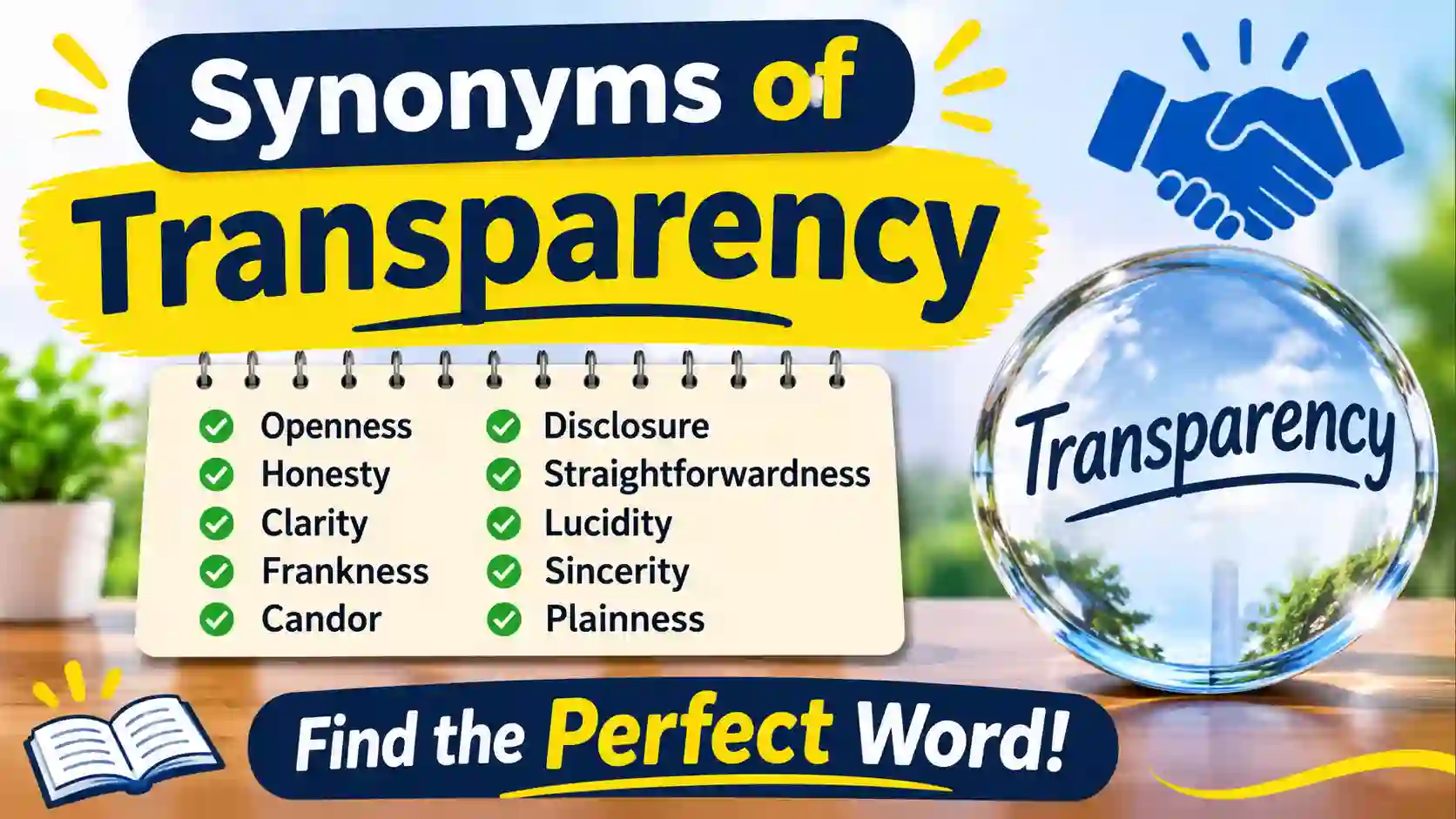
The best synonyms of transparency include openness, clarity, clearness, frankness, candor, honesty, straightforwardness, forthrightness, lucidity, and disclosure. The best alternative depends on context. Openness describes sharing information, honesty focuses on telling the truth, and clarity means making information easy to understand. For physical objects, translucence and transparency describe the passage of light.
Have you ever needed to explain something honestly without hiding important details? Perhaps you wanted to describe a business that shares its financial information or a person who speaks openly. The word transparency helps express these ideas.
Transparency has several meanings. It can describe honest communication, clear information, or a material that allows light to pass through it. Each meaning has different synonyms.
Learning synonyms of transparency can improve your essays, emails, reports, and everyday conversations. Students can express ideas more clearly, while professionals can choose more precise words for business communication.
In this guide, you will discover 25 useful alternatives, their meanings, examples, pronunciation, grammar, collocations, and differences. You will also learn which words work best in formal writing and which are better for everyday speech.
Pronunciation of Transparency
- IPA (American): /trænˈsper.ən.si/
- IPA (British): /trænˈspær.ən.si/
- Pronunciation: trans-PAIR-uhn-see (American), trans-PAR-uhn-see (British).
- Syllables: 4
- Part of speech: Noun
- Word stress: Third syllable.
Both American and British speakers use the same spelling: transparency. The main pronunciation difference is the vowel sound in the stressed syllable.
Meaning of Transparency
Transparency is the quality of being open, clear, honest, or easy to see through.
It has three important meanings:
- Openness: Sharing relevant information without hiding important details.
- Clarity: Making information, decisions, or processes easy to understand.
- Physical transparency: Allowing light to pass through a material so people can see through it.
Examples:
- The company promotes transparency in its financial decisions.
- The teacher explained the rules with complete transparency.
- The transparency of the glass makes it suitable for windows.
Part of Speech and Word Forms
Transparency is a noun. It usually works as an uncountable noun when discussing honesty, openness, or clarity.
| Word | Part of Speech | Meaning |
| Transparency | Noun | Openness or the quality of being see-through |
| Transparent | Adjective | Open, clear, or allowing light through |
| Transparently | Adverb | In an open or clear way |
| Transparence | Noun | The quality of being transparent |
Examples:
- Noun: Transparency builds public trust.
- Adjective: The organization follows transparent policies.
- Adverb: The manager communicated transparently.
Is Transparency Countable or Uncountable?
When transparency means openness or clarity, it is generally uncountable.
Correct: We need greater transparency in the organization.
Incorrect: We need many transparencies in the organization.
However, a transparency can mean a picture printed on transparent material for projection. Its plural form is transparencies.
Word Origin and Etymology
Transparency comes from Medieval Latin transparentia, based on transparent-. The Latin verb transparere combines trans- (through) and parere (to appear).
The word entered English in the late 16th century as a general term for something transparent. Its meaning later expanded to include openness, clear communication, and understandable information.
Its history connects the physical idea of seeing through something with the modern idea of seeing information clearly.
Grammar: How to Use Transparency in Sentences
Transparency commonly appears with the prepositions in, about, and between.
| Sentence Pattern | Example |
| Transparency in something | Transparency in education is important. |
| Transparency about something | We need transparency about the costs. |
| Transparency between people | Transparency between partners builds trust. |
| A lack of transparency | Customers complained about a lack of transparency. |
| Greater transparency | The new policy encourages greater transparency. |
| Full transparency | The company promised full transparency. |
Common Collocations
These combinations sound natural in everyday and professional English:
- Full transparency
- Complete transparency
- Greater transparency
- Corporate transparency
- Financial transparency
- Government transparency
- Transparency in communication
- Transparency and accountability
- Promote transparency
- Improve transparency
- Lack of transparency
- Transparency in decision-making
Synonyms Overview Table
The following table groups useful alternatives according to their meaning and suitability.
| Synonym | Strength | Formality |
| Openness | Strongest | Neutral |
| Clarity | Strongest | Neutral |
| Frankness | Strong | Neutral |
| Candor | Strong | Formal |
| Clearness | Strong | Neutral |
| Honesty | Strong | Neutral |
| Truthfulness | Strong | Neutral |
| Sincerity | Strong | Neutral |
| Directness | Strong | Neutral |
| Straightforwardness | Strong | Neutral |
| Forthrightness | Strong | Formal |
| Disclosure | Strong | Formal |
| Explicitness | Strong | Formal |
| Lucidity | Strong | Formal |
| Plainness | Related | Neutral |
| Perspicuity | Related | Formal |
| Intelligibility | Related | Formal |
| Understandability | Related | Neutral |
| Translucence | Physical sense | Technical |
| Translucency | Physical sense | Technical |
| Transparence | Physical sense | Literary |
| Pellucidity | Physical sense | Literary |
| Limpidity | Physical sense | Literary |
| Integrity | Related concept | Formal |
| Accountability | Related concept | Formal |
Strength refers to suitability in a particular context, not to a universal ranking.
25 Best Synonyms of Transparency With Meanings and Examples
The following words cover communication, information, understanding, and physical visibility. Each word has a specific meaning, so choose one that fits your sentence.
1. Openness
Meaning: Openness means sharing information and not hiding important details.
Examples:
- The school encourages openness between parents and teachers.
- Her openness about the problem helped the team find a solution.
Best Used When: You want to describe honest communication or a willingness to share information.
Tone: Neutral, professional.
Common Collocations: Complete openness, openness in communication, openness and trust.
CEFR: Approx. B1 | Frequency: Very common.
Connotation: Positive and welcoming.
When Not to Use: Do not use it for the physical ability of glass to let light pass through.
2. Clarity
Meaning: Clarity means that something is easy to understand.
Examples:
- The teacher explained the new rules with great clarity.
- We need more clarity about the project’s final cost.
Best Used When: You want to emphasize understandable information or instructions.
Tone: Neutral, academic, business.
Common Collocations: Greater clarity, clarity of purpose, clarity in writing.
CEFR: Approx. B1 | Frequency: Very common.
Connotation: Positive and informative.
When Not to Use: Do not use it as a complete replacement for honesty when the focus is telling the truth.
3. Frankness
Meaning: Frankness means speaking honestly and openly.
Examples:
- His frankness helped the team discuss its mistakes.
- I appreciated her frankness during the meeting.
Best Used When: Someone expresses their thoughts without hiding their real opinions.
Tone: Neutral, professional.
Common Collocations: Complete frankness, refreshing frankness, frankness about something.
CEFR: Approx. C1 | Frequency: Common.
Connotation: Honest, sometimes slightly blunt.
When Not to Use: Avoid it when discussing physical transparency.
4. Candor (British: Candour)
Meaning: Candor means speaking honestly and directly.
Examples:
- The director answered the employees’ questions with candor.
- Her candor made the difficult conversation easier.
Best Used When: You need a polished alternative to honesty in professional communication.
Tone: Formal, business.
Common Collocations: Complete candor, refreshing candor, speak with candor.
CEFR: Approx. C1 | Frequency: Common.
Connotation: Honest and direct.
When Not to Use: Do not use it to describe visual clarity.
5. Clearness
Meaning: Clearness means the quality of being easy to see or understand.
Examples:
- The clearness of the instructions helped new students.
- Everyone noticed the clearness of the water.
Best Used When: You want to describe understandable language or physical clarity.
Tone: Neutral.
Common Collocations: Clearness of expression, clearness of vision, remarkable clearness.
CEFR: Approx. B1 | Frequency: Common.
Connotation: Simple and understandable.
When Not to Use: Clarity is usually the more natural choice in modern professional writing.
6. Honesty
Meaning: Honesty means telling the truth and avoiding lies.
Examples:
- Honesty is important when handling customer complaints.
- The company earned public trust through honesty.
Best Used When: You want to emphasize truthful behavior and strong moral values.
Tone: Neutral, professional.
Common Collocations: Complete honesty, honesty and integrity, demonstrate honesty.
CEFR: Approx. A2 | Frequency: Very common.
Connotation: Strongly positive.
When Not to Use: Do not use it when you specifically mean that information is easy to understand.
7. Truthfulness
Meaning: Truthfulness means saying things that are true.
Examples:
- The journalist checked the truthfulness of the report.
- Truthfulness is essential when sharing research findings.
Best Used When: You want to emphasize factual accuracy and honest statements.
Tone: Neutral, academic.
Common Collocations: Truthfulness of information, commitment to truthfulness, demonstrating truthfulness.
CEFR: Approx. B2 | Frequency: Common.
Connotation: Reliable and trustworthy.
When Not to Use: Avoid it when the main issue is whether information has been made available to others.
8. Sincerity
Meaning: Sincerity means expressing genuine feelings without pretending.
Examples:
- Her sincerity impressed the interview panel.
- The manager apologized with sincerity.
Best Used When: You want to describe genuine intentions or honest emotions.
Tone: Neutral, formal.
Common Collocations: Genuine sincerity, speak with sincerity, sincerity of purpose.
CEFR: Approx. B2 | Frequency: Common.
Connotation: Warm and trustworthy.
When Not to Use: Sincerity does not mean sharing every relevant detail.
9. Directness
Meaning: Directness means communicating in a clear and straightforward way.
Examples:
- His directness helped resolve the disagreement.
- The report’s directness made its message easy to follow.
Best Used When: You want to describe communication without unnecessary details.
Tone: Neutral, business.
Common Collocations: Directness of speech, refreshing directness, directness in communication.
CEFR: Approx. B2 | Frequency: Common.
Connotation: Clear and sometimes blunt.
When Not to Use: Do not use it when you specifically mean full disclosure of information.
10. Straightforwardness
Meaning: Straightforwardness means being clear, honest, and easy to understand.
Examples:
- I admired the straightforwardness of her explanation.
- The straightforwardness of the agreement made it easier to review.
Best Used When: You want to describe simple and honest communication.
Tone: Neutral, professional.
Common Collocations: Refreshing straightforwardness, complete straightforwardness, straightforwardness in communication.
CEFR: Approx. B2 | Frequency: Common.
Connotation: Practical and trustworthy.
When Not to Use: Avoid it when discussing the passage of light through glass.
11. Forthrightness
Meaning: Forthrightness means speaking honestly and directly without hiding your opinions.
Examples:
- The manager’s forthrightness helped settle the dispute.
- She showed forthrightness when discussing the budget.
Best Used When: You want a formal word for open and direct communication.
Tone: Formal, professional.
Common Collocations: Remarkable forthrightness, refreshing forthrightness, speak with forthrightness.
CEFR: Approx. C1 | Frequency: Common.
Connotation: Confident and honest.
When Not to Use: Avoid it when describing simple instructions without a focus on direct communication.
12. Disclosure
Meaning: Disclosure means sharing information that was previously private, unknown, or hidden.
Examples:
- The company made a full disclosure of its financial records.
- Early disclosure of the problem prevented further confusion.
Best Used When: You mean the act of releasing important facts or information.
Tone: Formal, legal, business.
Common Collocations: Full disclosure, financial disclosure, public disclosure.
CEFR: Approx. C1 | Frequency: Common.
Connotation: Official and informative.
When Not to Use: Disclosure is an act of sharing information, while transparency is an ongoing quality or condition.
13. Explicitness
Meaning: Explicitness means expressing something clearly and leaving little room for confusion.
Examples:
- The explicitness of the instructions reduced mistakes.
- The contract needs greater explicitness about payment terms.
Best Used When: You want to emphasize precise and clearly stated information.
Tone: Formal, academic.
Common Collocations: Explicitness of language, greater explicitness, lack of explicitness.
CEFR: Approx. C1 | Frequency: Uncommon.
Connotation: Precise and detailed.
When Not to Use: Do not use it as a direct replacement for honesty.
14. Lucidity
Meaning: Lucidity means the quality of being clear and easy to understand.
Examples:
- The professor explained the theory with remarkable lucidity.
- The lucidity of the presentation impressed the audience.
Best Used When: You want to describe clear thinking, explanations, or writing.
Tone: Formal, academic.
Common Collocations: Lucidity of thought, remarkable lucidity, lucidity of expression.
CEFR: Approx. C1 | Frequency: Uncommon.
Connotation: Intelligent and clear.
When Not to Use: Avoid it when the main meaning is ethical honesty.
15. Plainness
Meaning: Plainness means being simple, clear, or free from unnecessary decoration.
Examples:
- The plainness of the language helped beginners understand the lesson.
- She preferred the plainness of the original report.
Best Used When: You want to describe simple language or an uncomplicated presentation.
Tone: Neutral, literary.
Common Collocations: Plainness of style, plainness of expression, plainness of language.
CEFR: Approx. B2 | Frequency: Common.
Connotation: Simple and direct.
When Not to Use: Avoid it when you mean complete openness about private information.
16. Perspicuity
Meaning: Perspicuity means the quality of being clearly expressed and easy to understand.
Examples:
- The writer’s perspicuity made the complex topic easier to follow.
- The report showed remarkable perspicuity in its explanations.
Best Used When: You need a formal word for exceptional clarity in writing or speech.
Tone: Formal, academic.
Common Collocations: Perspicuity of language, remarkable perspicuity, clarity and perspicuity.
CEFR: Approx. C2 | Frequency: Rare.
Connotation: Highly precise and scholarly.
When Not to Use: Prefer clarity in everyday conversation.
17. Intelligibility
Meaning: Intelligibility means the quality of being understandable or clear.
Examples:
- The speaker improved the intelligibility of his presentation.
- Intelligibility is important in technical writing.
Best Used When: You are discussing understandable speech, writing, or information.
Tone: Formal, academic.
Common Collocations: Intelligibility of speech, improve intelligibility, mutual intelligibility.
CEFR: Approx. C1 | Frequency: Uncommon.
Connotation: Clear and understandable.
When Not to Use: Avoid it when discussing whether someone shares private or hidden information.
18. Understandability
Meaning: Understandability means the quality of being easy to understand.
Examples:
- The writer improved the understandability of the guide.
- Understandability matters when explaining complex rules.
Best Used When: You want to focus on how easily readers understand information.
Tone: Neutral, academic.
Common Collocations: Improve understandability, understandability of instructions, ease of understanding.
CEFR: Approx. B2 | Frequency: Uncommon.
Connotation: Accessible and learner-friendly.
When Not to Use: Do not use it to describe honesty or full disclosure.
19. Translucence
Meaning: Translucence means the quality of allowing light to pass through a material without making objects behind it completely clear.
Examples:
- The translucence of the curtain created a soft glow.
- The artist used paper for its natural translucence.
Best Used When: You are describing a physical material that allows light through.
Tone: Technical, literary.
Common Collocations: Natural translucence, soft translucence, translucence of glass.
CEFR: Approx. C1 | Frequency: Uncommon.
Connotation: Delicate and light.
When Not to Use: Do not use it for honest business communication.
20. Translucency
Meaning: Translucency is the quality of allowing some light to pass through a material.
Examples:
- The translucency of the fabric gave the room a gentle appearance.
- Scientists measured the translucency of the sample.
Best Used When: You are discussing the optical properties of materials.
Tone: Technical, scientific.
Common Collocations: Material translucency, degree of translucency, translucency measurement.
CEFR: Approx. C1 | Frequency: Uncommon.
Connotation: Scientific and descriptive.
When Not to Use: Avoid it for honesty, openness, or public disclosure.
21. Transparence
Meaning: Transparence means the state or quality of being transparent.
Examples:
- The transparency of the material allowed light to enter the room.
- The artist valued transparency in the layered design.
Best Used When: You need a less common alternative for physical transparency.
Tone: Formal, literary.
Common Collocations: Optical transparence, remarkable transparence, transparence of a material.
CEFR: Approx. C2 | Frequency: Rare.
Connotation: Technical or literary.
When Not to Use: Prefer transparency in everyday writing and business communication.
22. Pellucidity
Meaning: Pellucidity means the quality of being extremely clear or allowing light to pass through.
Examples:
- The pellucidity of the crystal caught everyone’s attention.
- The essay’s pellucidity made its difficult ideas easier to follow.
Best Used When: You need a specialized or literary term for exceptional clarity.
Tone: Literary, formal.
Common Collocations: Pellucidity of language, remarkable pellucidity, optical pellucidity.
CEFR: Approx. C2 | Frequency: Rare.
Connotation: Highly refined and precise.
When Not to Use: Avoid it in ordinary conversations and simple business emails.
23. Limpidity
Meaning: Limpidity means the quality of being clear, pure, and easy to see through or understand.
Examples:
- The limpidity of the lake made its stones visible.
- The limpidity of his explanation impressed the students.
Best Used When: You want a literary word for physical clearness or unusually clear expression.
Tone: Literary, formal.
Common Collocations: Limpidity of water, remarkable limpidity, limpidity of expression.
CEFR: Approx. C2 | Frequency: Rare.
Connotation: Pure, calm, and clear.
When Not to Use: Use clarity instead in everyday communication.
24. Integrity
Meaning: Integrity means following strong moral principles and doing what is right.
Examples:
- The journalist maintained integrity while investigating the story.
- Her integrity earned the respect of her colleagues.
Best Used When: You want to describe strong ethical behavior and honesty.
Tone: Formal, professional.
Common Collocations: Personal integrity, professional integrity, honesty and integrity.
CEFR: Approx. B2 | Frequency: Very common.
Connotation: Strongly positive.
When Not to Use: Integrity describes moral character, not the amount of information someone shares.
25. Accountability
Meaning: Accountability means accepting responsibility for your actions and decisions.
Examples:
- The new policy improves accountability among managers.
- Public accountability helps people trust government institutions.
Best Used When: You want to describe responsibility supported by openness.
Tone: Formal, business, academic.
Common Collocations: Public accountability, financial accountability, accountability and transparency.
CEFR: Approx. C1 | Frequency: Very common.
Connotation: Responsible and trustworthy.
When Not to Use: Accountability is not the same as transparency. A person can accept responsibility without sharing every detail.
Synonym Categories: Which Words Are the Best Matches?
Understanding the different meanings helps you select the right alternative.
Strongest Synonyms
These are useful when transparency refers to openness, honesty, or clear communication:
- Openness
- Clarity
- Frankness
- Candor
- Clearness
- Honesty
- Truthfulness
- Straightforwardness
Strong Synonyms
These words fit more specific situations:
- Sincerity
- Directness
- Forthrightness
- Disclosure
- Explicitness
- Lucidity
- Plainness
- Intelligibility
Physical Transparency Words
These describe materials that allow light to pass through:
- Translucence
- Translucency
- Transparence
- Pellucidity
- Limpidity
Related Concepts
These words are connected to transparency but are not exact replacements:
- Integrity
- Accountability
- Authenticity
- Accessibility
- Visibility
Choose the Right Synonym: Side by Side Comparisons
The best synonym depends on the point you want to make.
| Word | Main Focus | Best Context |
| Transparency | Openness and visibility | Business and public decisions |
| Openness | Sharing information | Personal communication |
| Honesty | Telling the truth | Character and behavior |
| Clarity | Easy understanding | Writing and explanations |
| Candor | Honest, direct speech | Professional discussions |
| Disclosure | Releasing information | Legal and financial documents |
| Accountability | Taking responsibility | Management and government |
| Integrity | Strong moral principles | Professional ethics |
| Visibility | Being easy to observe | Projects and operations |
| Lucidity | Clear expression | Academic writing |
Compare These Sentences
Original: The company needs more transparency.
- The company needs more openness. This focuses on sharing information.
- The company needs greater honesty. This focuses on truthful behavior.
- The company needs better disclosure. This focuses on releasing information.
- The company needs greater accountability. This focuses on responsibility.
These sentences are all grammatical, but their meanings are different.
Practical Word Selection Guide
| Your Intended Meaning | Best Word |
| Sharing information freely | Openness |
| Telling the truth | Honesty |
| Explaining something clearly | Clarity |
| Speaking directly | Candor |
| Releasing private information | Disclosure |
| Taking responsibility | Accountability |
| Following moral principles | Integrity |
| Making details understandable | Lucidity |
| Allowing light through | Translucence |
Commonly Confused Words
| Word | Difference | Example |
| Transparency | Openness, clarity, or the quality of being see-through | The organization values transparency. |
| Translucency | Allows light through but does not show clear details | The glass has translucency. |
| Opacity | Blocks light or makes something difficult to understand | The opacity of the material prevents clear viewing. |
| Honesty | The quality of telling the truth | Honesty is important in friendship. |
| Clarity | The quality of being easy to understand | The explanation needs more clarity. |
Transparency vs. Translucency
Transparency allows you to see clearly through a material. Translucency allows light to pass through, but objects behind the material may look blurred.
For example, a clear glass window is transparent, while frosted glass is translucent.
Transparency vs. Opacity
These words have opposite meanings in the physical sense.
- Transparency allows light to pass through.
- Opacity prevents light from passing through.
In communication, opacity can also describe information that is difficult to understand or decisions that are hidden from public view.
American vs. British English
Most synonyms of transparency have the same spelling in American and British English. A few differences are worth learning.
| Word | American English | British English |
| Transparency | Transparency | Transparency |
| Candor | Candor | Candour |
| Frankness | Frankness | Frankness |
| Clarity | Clarity | Clarity |
| Openness | Openness | Openness |
| Disclosure | Disclosure | Disclosure |
Remember: Candor is the American spelling, while candour is the British spelling. Both have the same meaning.
Common Mistakes When Using Transparency Synonyms
Mistake 1
Incorrect: The company showed great translucency in its financial reports.
Correct: The company showed great transparency in its financial reports.
Explanation: Translucency describes how materials allow light through. Transparency describes openness in business communication.
Mistake 2
Incorrect: We need more honesty in the instructions.
Correct: We need more clarity in the instructions.
Explanation: Clarity means easy understanding. Honesty means telling the truth.
Mistake 3
Incorrect: The manager provided many transparencies about the project.
Correct: The manager provided more transparency about the project.
Explanation: Transparency is normally uncountable when it means openness.
Mistake 4
Incorrect: The company promised accountability about its financial records.
Correct: The company promised transparency about its financial records.
Explanation: Transparency focuses on sharing information. Accountability focuses on accepting responsibility.
Mistake 5
Incorrect: She explained the issue with complete candor of information.
Correct: She explained the issue with complete candor.
Explanation: Candor already describes honest and direct communication. The extra phrase is unnecessary.
Writing Tips: How to Use Transparency Synonyms Naturally
1. In Essays
Use clarity, honesty, integrity, and openness when discussing education, society, or ethical issues.
Example:
“Transparency in public institutions builds trust and improves accountability.”
Alternative:
“Openness in public institutions builds trust and improves accountability.”
2. In Professional Emails
Use clarity, openness, disclosure, and directness.
Example:
“We appreciate your transparency regarding the project expenses.”
Alternative:
“Thank you for your openness about the project expenses.”
3. In Blog Posts
Use simple words that readers understand quickly.
Example:
“Financial transparency helps customers understand how a business manages its money.”
Alternative:
“Clear financial disclosure helps customers understand how a business manages its money.”
4. In Stories
Use frankness, sincerity, and honesty to describe characters and conversations.
Example:
“Her honesty helped rebuild their friendship.”
5. In Social Media
Use simple and natural expressions:
- Honesty builds trust.
- Openness creates stronger relationships.
- Clear communication prevents misunderstandings.
- Be genuine and speak the truth.
6. In Business Communication
Use accountability, disclosure, integrity, and clarity when discussing organizational practices.
Example:
“Our company believes in transparency and accountability.”
Alternative:
“Our company values open communication and professional integrity.”
7. In Daily Conversations
Choose familiar words instead of complicated vocabulary.
Instead of: “I appreciate your transparency.”
You can say: “I appreciate your honesty.”
Both sentences sound natural, but the second focuses more directly on telling the truth.
Writing Tip: Do not replace every occurrence of transparency with a different word. Use the original word when it expresses your meaning best. Choose a synonym only when it adds a more precise meaning.
Related Vocabulary: Antonyms and Similar Expressions
Antonyms of Transparency
| Antonym | Meaning | Example |
| Opacity | The state of blocking light or being unclear | The opacity of the glass reduced visibility. |
| Secrecy | Keeping information hidden | Secrecy damages public trust. |
| Concealment | Hiding something | The concealment of important facts caused concern. |
| Deception | Making someone believe something false | Deception can destroy relationships. |
| Dishonesty | Lack of honesty | Dishonesty harmed the company’s reputation. |
| Ambiguity | Having more than one possible meaning | Ambiguity created confusion in the agreement. |
| Vagueness | Lack of clear details | The report contained too much vagueness. |
| Obscurity | Being unclear or difficult to understand | The wording created unnecessary obscurity. |
Similar Vocabulary
These words are closely connected to transparency:
- Trust
- Communication
- Truth
- Ethics
- Fairness
- Disclosure
- Reliability
- Accountability
- Openness
- Accuracy
- Simplicity
- Consistency
Useful Expressions
These expressions help communicate similar ideas naturally:
| Expression | Meaning |
| Be transparent about something | Share information honestly |
| Come clean | Admit the truth about something |
| Lay everything on the table | Share all relevant facts |
| Keep someone informed | Regularly provide information |
| Open the books | Allow financial records to be examined |
| No hidden agenda | Have no secret purpose |
Examples:
- The manager decided to be transparent about the delay.
- The director came clean about the financial problem.
- We should lay everything on the table before making a decision.
Frequently Asked Questions
1. What are the best synonyms of transparency?
The best synonyms of transparency include openness, clarity, honesty, frankness, candor, truthfulness, and straightforwardness. These words work well when discussing communication, business practices, or personal behavior. However, clarity focuses on understanding, while honesty focuses on telling the truth.
2. What is another word for transparency in business?
In business, useful alternatives include openness, disclosure, accountability, and clarity. The best choice depends on context. Disclosure means releasing information, accountability means accepting responsibility, and openness means sharing information without hiding important details.
3. What is a professional synonym for transparency?
Professional alternatives include disclosure, openness, candor, accountability, and clarity. Use disclosure when discussing the release of information, accountability when discussing responsibility, and openness when describing honest communication between people or organizations.
4. Is honesty the same as transparency?
Honesty and transparency are closely related, but they are not identical. Honesty means telling the truth and avoiding lies. Transparency goes further by making relevant information, decisions, and processes accessible to others. Someone can be honest while still choosing not to share every detail.
5. What is the opposite of transparency?
Common antonyms of transparency include opacity, secrecy, concealment, dishonesty, and ambiguity. Their meanings depend on context. Opacity describes something that blocks light or hides information, while secrecy means keeping information away from others.
6. What is the difference between transparency and clarity?
Transparency means openness and freedom from hidden information. Clarity means that something is easy to understand. For example, a business can show transparency by sharing its financial records, while clarity means presenting those records in a simple and understandable format.
7. What are some simple words for transparency?
Simple alternatives include openness, honesty, clarity, and truthfulness. These words are useful for beginners because they appear frequently in everyday conversations, schoolwork, and professional communication. Choose openness when discussing shared information and honesty when discussing truthful behavior.
8. What does transparency mean in communication?
Transparency in communication means sharing relevant information openly, honestly, and clearly. It involves explaining decisions, avoiding misleading statements, and making important details available. Transparent communication helps people understand situations, reduces confusion, and builds trust.
Vocabulary Quiz: Test Your Knowledge
Choose the correct answer for each question.
1. Which word is closest to transparency when discussing honest communication?
A. Opacity
B. Openness
C. Secrecy
D. Confusion
2. Which word describes information that is easy to understand?
A. Clarity
B. Concealment
C. Dishonesty
D. Opacity
3. What does candor mean?
A. Physical brightness
B. Hidden information
C. Honest and direct speech
D. Taking responsibility
4. Which word describes a material that allows light through but does not show clear details?
A. Transparent
B. Opaque
C. Translucent
D. Visible
5. Which word means accepting responsibility for your actions?
A. Lucidity
B. Accountability
C. Translucence
D. Explicitness
Answer Key
- B. Openness
- A. Clarity
- C. Honest and direct speech
- C. Translucent
- B. Accountability
Conclusion
Learning synonyms of transparency helps you become a better writer, speaker, and communicator. Words such as openness, honesty, clarity, candor, and truthfulness allow you to express ideas more precisely.
Remember that each alternative has its own meaning and context. Practice these words in your essays, emails, schoolwork, and everyday conversations. The more you use them, the more naturally your English vocabulary will grow.
References
- Oxford Learner’s Dictionaries – Transparency: https://www.oxfordlearnersdictionaries.com/definition/english/transparency
- Cambridge Dictionary – Transparency: https://dictionary.cambridge.org/dictionary/english/transparency
- Cambridge Thesaurus – Transparency: https://dictionary.cambridge.org/thesaurus/transparency
- Thesaurus.com – Transparency: https://www.thesaurus.com/browse/transparency
- Collins English Thesaurus – Transparency: https://www.collinsdictionary.com/dictionary/english-thesaurus/transparency

The Synonorm Editorial Team helps readers improve their English vocabulary with clear synonyms, antonyms, word meanings, and practical examples. Our goal is to make learning new words simple, useful, and enjoyable for students, writers, and English learners.