Quick Answer
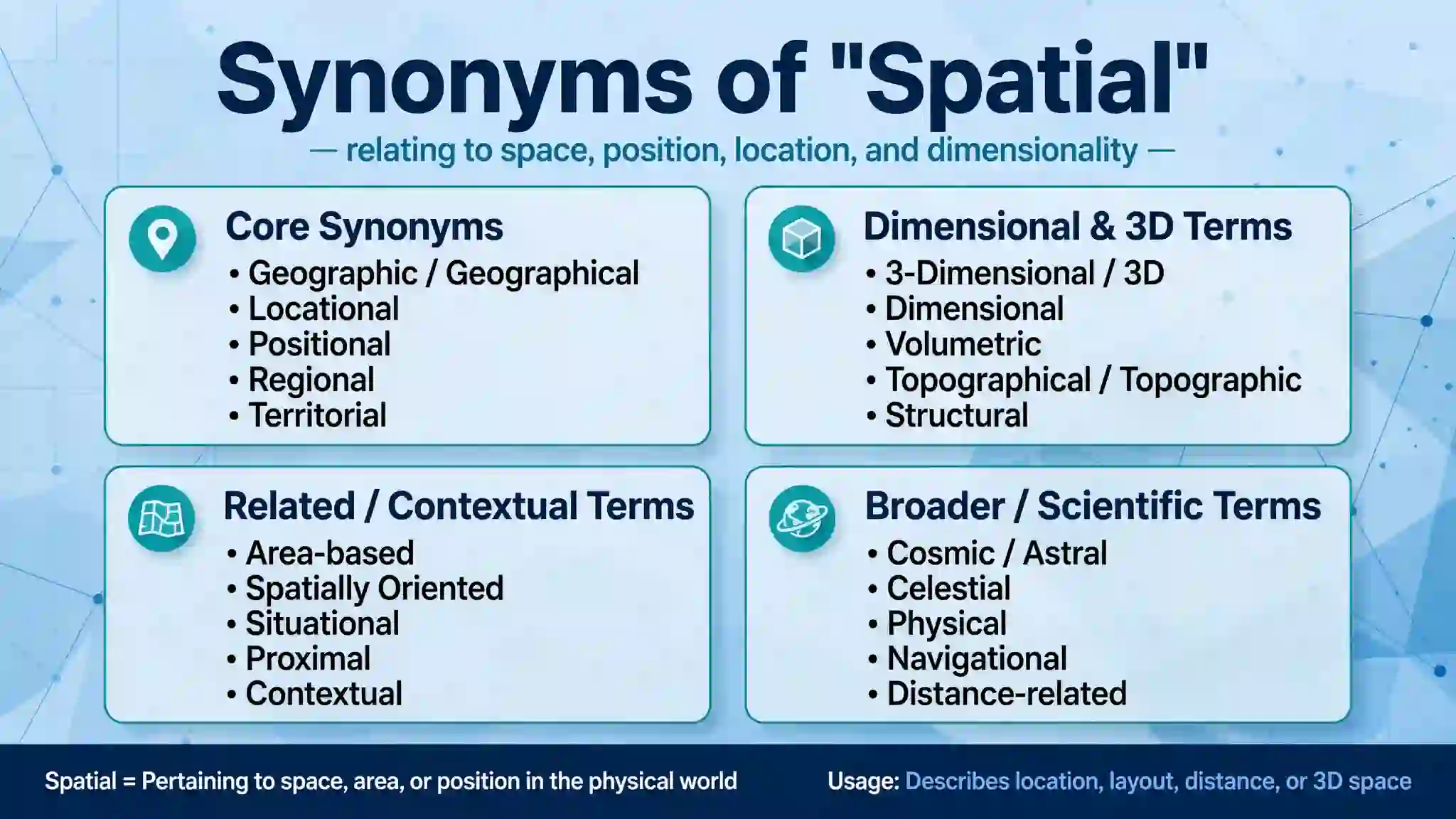
The closest synonyms for spatial are dimensional, positional, locational, geographic, geographical, and space-related. However, they are not interchangeable in every sentence. Spatial broadly refers to space, position, area, size, or relationships between things, while geographic focuses on places, geometric on shapes, and positional on exact location.
Looking for the right synonym for spatial can be harder than it seems. You may find a long thesaurus list, but many of the words on it do not work naturally in every sentence.
Spatial is an adjective used for things connected with space, position, area, size, or the way objects relate to one another. For example, spatial awareness means understanding where things are in relation to each other. Cambridge gives this same core meaning and uses examples such as spatial awareness, spatial memory, and spatial organization.
The best replacement depends on your context. If you mean a place on Earth, geographic may be better. If you mean exact position, choose positional. If you mean measurements or dimensions, dimensional may fit.
This guide explains the closest synonyms of spatial, their differences, common collocations, formality, learner level, and situations where you should not use each word.
Pronunciation of Spatial
IPA: /ˈspeɪ.ʃəl/
Pronunciation: SPAY-shuhl
The pronunciation is essentially the same in American and British English. Dictionary.com gives the American pronunciation /ˈspeɪʃəl/, while Cambridge lists /ˈspeɪ.ʃəl/.
What Part of Speech Is Spatial?
Spatial is an adjective.
It describes something connected with space or with the position, size, area, or arrangement of things.
Examples
- The game tests spatial awareness.
- The map shows the spatial distribution of rainfall.
- The children developed better spatial reasoning.
Related forms
- Spatial — adjective
- Spatially — adverb
- Spatiality — noun
Collins lists spatiality and spatially as derived forms.
There is no normal English verb spatial.
What Does Spatial Mean?
Spatial means related to space or to the position, area, size, and arrangement of things.
In simple English, think:
Spatial = connected with where things are, how much space they occupy, or how they relate to other things in space.
For example:
- spatial awareness = understanding where objects are
- spatial relationship = how objects are positioned in relation to each other
- spatial distribution = how something is spread across an area
- spatial arrangement = how things are organized in space
Dictionary definitions support this broad meaning. Cambridge focuses on position, area, and size, while Collins also describes things that exist or happen in space.
The Best Synonyms of Spatial at a Glance
| Word | How close is it? | Best context | Register |
| Space-related | Very close | General meaning | Neutral |
| Dimensional | Close | Size and dimensions | Formal |
| Positional | Close in some contexts | Exact position | Formal |
| Locational | Close in some contexts | Location | Academic |
| Geographic | Contextual | Earth’s places and regions | Neutral |
| Geographical | Contextual | Geography and regions | Formal |
| Geometric | Contextual | Shapes and mathematics | Academic |
| Three-dimensional | Contextual | Length, width, height | Neutral |
| Geospatial | Contextual | Geographic data and technology | Technical |
| Structural | Related | Arrangement or structure | Formal |
| Territorial | Related | Land and boundaries | Formal |
| Topographic | Related | Terrain and landforms | Technical |
| Cartographic | Related | Maps and mapmaking | Technical |
| Volumetric | Related | Volume and 3-D measurement | Technical |
| Regional | Related | Regions and areas | Neutral |
Important: The table deliberately separates close synonyms from contextual alternatives. A thesaurus may group many of these words together, but that does not mean you can substitute them freely.
Choose the Right Synonym for Spatial
The easiest way to choose a synonym is to ask what you really mean.
If you mean space in general
Use space-related or keep spatial.
Example:
The researchers examined spatial relationships between objects.
If you mean size or dimensions
Use dimensional.
Example:
The engineer checked the object’s dimensional accuracy.
If you mean exact position
Use positional.
Example:
The camera requires precise positional control.
If you mean a location
Use locational.
Example:
The business considered several locational factors.
If you mean places on Earth
Use geographic or geographical.
Example:
The study found major geographic differences.
If you mean mathematical shapes
Use geometric.
Example:
The designer used simple geometric shapes.
If you mean mapping technology
Use geospatial.
Example:
The company analyzes geospatial data.
1. Space Related
Meaning: Connected with physical or conceptual space.
Examples:
- The researchers studied space-related changes in the environment.
- The lesson introduces several space-related concepts.
Best used when: You need a plain-English replacement for the broad idea of spatial.
Tone: Neutral
CEFR: B1–B2, approximate
Frequency: Common phrase
Common collocations:
- space-related problems
- space-related information
- space-related concepts
When not to use it
Do not use space-related when a more precise term such as geographic or positional explains your meaning better.
2. Dimensional
Meaning: Related to the size or dimensions of something.
Examples:
- The software checks the dimensional accuracy of each part.
- The designer created a detailed dimensional model.
Best used when: You are discussing measurements, size, length, width, height, or dimensions.
Tone: Formal / Technical
CEFR: B2–C1, approximate
Frequency: Common
Common collocations:
- dimensional accuracy
- dimensional analysis
- dimensional model
When not to use it
Do not replace spatial with dimensional when you mean location or arrangement rather than size.
3. Positional
Meaning: Related to the position of something.
Examples:
- The diagram shows the positional relationship between the two objects.
- The coach made a positional change during the match.
Best used when: The main idea is where something is placed.
Tone: Neutral / Formal
CEFR: B2, approximate
Frequency: Common
Common collocations:
- positional change
- positional accuracy
- positional relationship
When not to use it
Do not use it for every meaning of spatial. Spatial relationships can involve distance, size, shape, and arrangement as well as position.
4. Locational
Meaning: Related to the location of something.
Examples:
- The company studied several locational factors before opening the store.
- The report compares the locational advantages of different sites.
Best used when: You specifically mean location or site selection.
Tone: Academic / Business
CEFR: C1, approximate
Frequency: Uncommon
Common collocations:
- locational factors
- locational advantage
- locational decision
When not to use it
Avoid it in casual conversation. Location-based or simply location may sound more natural.
5. Geographic
Meaning: Related to places, regions, or features on Earth.
Examples:
- The report identifies major geographic differences in population.
- The company serves customers in several geographic regions.
Best used when: You are talking about places or patterns across Earth’s surface.
Tone: Neutral / Academic
CEFR: B2, approximate
Frequency: Very common
Common collocations:
- geographic location
- geographic region
- geographic distribution
- geographic area
When not to use it
Do not use geographic for the arrangement of objects inside a room.
Natural: The furniture has a spatial arrangement.
Unnatural: The furniture has a geographic arrangement.
6. Geographical
Meaning: Connected with geography, places, or regions.
Examples:
- The research examines geographical differences in rainfall.
- Several geographical factors affect the local climate.
Best used when: You are discussing geography or regional differences.
Tone: Formal / Academic
CEFR: B2, approximate
Frequency: Common
American vs. British English
Both geographic and geographical are used in American and British English. Geographic is especially common in American usage, while geographical is also widely used.
When not to use it
It is not a general replacement for spatial in phrases such as spatial awareness.
7. Geometric
Meaning: Related to shapes, lines, angles, measurements, or geometry.
Examples:
- The building has a striking geometric design.
- Students practiced identifying geometric relationships.
Best used when: Space is being discussed through mathematical shapes or forms.
Tone: Academic / Technical
CEFR: B2, approximate
Frequency: Common
Common collocations:
- geometric shape
- geometric pattern
- geometric relationship
When not to use it
Do not use geometric when you simply mean location.
8. Three Dimensional
Meaning: Having length, width, and height.
Examples:
- The artist created a three-dimensional model.
- The game uses detailed three-dimensional environments.
Best used when: You specifically mean depth or three-dimensional form.
Tone: Neutral / Technical
CEFR: B2, approximate
Frequency: Common
When not to use it
Not every spatial relationship is three-dimensional. Maps and diagrams can show spatial relationships in two dimensions.
9. Geospatial
Meaning: Connected with geographic location and information about locations.
Examples:
- Scientists analyzed geospatial data from several regions.
- The software creates detailed geospatial maps.
Best used when: Discussing GIS, mapping systems, geographic databases, or location-based technology.
Tone: Technical / Professional
CEFR: C1, approximate
Frequency: Uncommon in everyday English
When not to use it
Avoid geospatial in simple everyday writing when geographic or location-based is enough.
10. Structural
Meaning: Related to the way parts are arranged or organized.
Examples:
- The engineer examined the building’s structural design.
- The researchers found major structural differences between the two systems.
Best used when: You mean organization, construction, or the relationship between parts.
Tone: Formal / Academic
CEFR: B2, approximate
Frequency: Very common
When not to use it
Structural does not necessarily involve physical space. It can also describe abstract systems, arguments, or organizations.
11. Territorial
Meaning: Related to a territory, area of land, control, or boundaries.
Examples:
- The animals displayed territorial behavior.
- The countries reached an agreement about their territorial boundaries.
Best used when: Land, borders, ownership, or control is important.
Tone: Formal
CEFR: C1, approximate
Frequency: Common
When not to use it
Do not use territorial simply because something involves space.
12. Regional
Meaning: Related to a particular region or area.
Examples:
- The report compares regional differences in employment.
- The company has a strong regional presence.
Best used when: You are discussing larger geographic areas.
Tone: Neutral / Formal
CEFR: B2, approximate
Frequency: Very common
When not to use it
It does not describe every type of spatial relationship.
13. Topographic
Meaning: Related to the physical features and shape of land.
Examples:
- Engineers studied the area’s topographic features.
- The hikers used a topographic map.
Best used when: You are discussing terrain, elevation, hills, valleys, or landforms.
Tone: Technical
CEFR: C1, approximate
Frequency: Uncommon
When not to use it
Do not use it for ordinary spatial relationships between objects.
14. Cartographic
Meaning: Related to maps or mapmaking.
Examples:
- The project requires advanced cartographic skills.
- Researchers checked the map’s cartographic accuracy.
Best used when: Maps and mapmaking are central to the discussion.
Tone: Technical / Academic
CEFR: C1–C2, approximate
Frequency: Uncommon
When not to use it
It does not mean spatial in general.
15. Volumetric
Meaning: Related to the measurement of volume or three-dimensional space.
Examples:
- The engineers calculated the tank’s volumetric capacity.
- The scan provides detailed volumetric information.
Best used when: Volume or three-dimensional measurement is the main concern.
Tone: Technical
CEFR: C1–C2, approximate
Frequency: Uncommon
When not to use it
Do not use volumetric simply to mean physical or spatial.
Spatial vs. Geographic vs. Dimensional vs. Positional
This is one of the most important distinctions for learners.
| Word | Main idea | Example |
| Spatial | Space and relationships in space | spatial arrangement |
| Geographic | Places on Earth | geographic location |
| Dimensional | Size or dimensions | dimensional accuracy |
| Positional | Exact position | positional relationship |
| Geometric | Shapes and mathematical space | geometric pattern |
| Locational | Location or site | locational factors |
| Geospatial | Geographic location + data | geospatial analysis |
Easy memory trick
Spatial = space
Geographic = place
Dimensional = size
Positional = position
Geometric = shape
Locational = location
Common Collocations With Spatial
Some combinations are much more natural than others. Cambridge’s dictionary examples include spatial awareness, spatial memory, spatial organization, spatial distribution, spatial perception, and spatial relationships.
Common examples include:
- spatial awareness
- spatial reasoning
- spatial ability
- spatial relationship
- spatial arrangement
- spatial distribution
- spatial organization
- spatial memory
- spatial perception
- spatial planning
- spatial data
- spatial analysis
- spatial pattern
- spatial dimension
Corpus-style usage insight
Notice that spatial often appears before nouns describing relationships, abilities, patterns, distributions, or mental processes.
That is why phrases such as spatial awareness and spatial reasoning sound natural, while replacing spatial with geographic would often change the meaning.
Common Mistakes With Spatial
Common Mistake Box
Mistake 1
The child has special awareness.
Correction
The child has spatial awareness.
Why: Spatial relates to space. Special means unusual, important, or different.
Mistake 2
The map shows the spatial location of every city.
Better
The map shows the geographic location of every city.
Why: Geographic is more specific when discussing locations on Earth.
Mistake 3
The furniture has a geographic arrangement.
Better
The furniture has a spatial arrangement.
Why: Furniture inside a room has a spatial relationship, not a geographic one.
Mistake 4
Spatial means three-dimensional.
Correction
Spatial can include three-dimensional space, but it has a broader meaning. It can also describe two-dimensional position, distribution, arrangement, and relationships.
Is Spacial a Correct Spelling?
Yes, spacial is recognized as a variant spelling of spatial.
However, spatial is the safer and more widely recognized spelling for modern general, academic, and professional writing. Cambridge and Collins both list spacial as an alternative form.
Recommended: spatial awareness
Variant: spacial awareness
For learners, writers, and students, I recommend spatial.
Spatial Word Origin and First Known Use
The word spatial comes from Latin spatium, meaning “space,” combined with the English adjective-forming ending -al.
Dictionary.com gives the first recorded use as 1840–1850. Collins also traces the American English form to Latin spatium.
Word family
Latin: spatium → space → spatial
This history explains why the modern word remains closely connected with physical or conceptual space.
CEFR and Learner Guidance
CEFR labels for individual vocabulary items can vary by learning resource. The levels below are therefore approximate guidance, not official universal classifications.
| Word | Approx. level | Frequency | Best for |
| Space-related | B1–B2 | Common | Everyday English |
| Geographic | B2 | Very common | General/academic |
| Dimensional | B2–C1 | Common | Technical writing |
| Positional | B2 | Common | Academic/professional |
| Geometric | B2 | Common | Education/science |
| Regional | B2 | Very common | General writing |
| Locational | C1 | Uncommon | Academic/business |
| Territorial | C1 | Common | Politics/geography |
| Geospatial | C1 | Uncommon | Technology/GIS |
| Topographic | C1 | Uncommon | Geography |
| Cartographic | C1–C2 | Uncommon | Mapping |
| Volumetric | C1–C2 | Uncommon | Science/engineering |
Good learner strategy
Do not memorize all of these words.
For most learners, start with:
spatial → geographic → positional → dimensional → geometric
Then learn the specialist terms only when your subject requires them.
American vs. British English
Spatial has the same standard spelling in American and British English.
The pronunciation is also essentially the same.
One spelling difference worth knowing
Geographic and geographical are both used in both varieties.
The important difference is not usually American versus British spelling. The more important issue is context.
For example:
- geographic location = location on Earth
- spatial location = position within a broader spatial context
When Should You Keep the Word Spatial?
Sometimes replacing a word simply for variety makes writing worse.
Keep spatial when it is the most accurate choice.
For example:
- spatial awareness
- spatial reasoning
- spatial memory
- spatial relationship
- spatial distribution
- spatial organization
Changing spatial awareness to geographic awareness would change the meaning.
Good to Know: Strong writing does not avoid repetition at all costs. It uses the most accurate word.
Writing Tips: How to Use Spatial Naturally
In essays
Use spatial when discussing geography, architecture, psychology, design, science, or physical relationships.
Example:
The study examines the spatial distribution of schools in urban areas.
In academic writing
Use specialist alternatives when they provide more precision.
Example:
The researchers analyzed geospatial data from satellite images.
In business writing
Use locational when discussing where a company should operate.
Example:
The company evaluated several locational factors before opening a new branch.
In everyday conversation
A simpler word may sound more natural.
Instead of:
The spatial arrangement of the chairs is uncomfortable.
You might say:
The way the chairs are arranged is uncomfortable.
In creative writing
Use concrete language when possible.
Instead of:
The spatial relationship between the characters changed.
You might write:
The characters moved closer together.
Antonyms and Contrasting Words
The most direct opposite is nonspatial, meaning not related to space.
Depending on the context, other contrasting words may include:
- nonspatial
- temporal
- abstract
- intangible
- immaterial
But these are not universal antonyms.
For example, temporal means related to time, so it contrasts with spatial in discussions of space and time. It is not the opposite of spatial in every sentence.
Related Vocabulary
Space
The area or extent in which things exist.
Position
The place where something is located.
Location
A particular place.
Arrangement
The way things are organized or positioned.
Dimension
A measurable aspect such as length, width, or height.
Distribution
The way something is spread across an area.
Geometry
The branch of mathematics dealing with shapes, sizes, lines, angles, and space.
Geography
The study of Earth’s places, environments, and spatial relationships.
Mini Practice Exercises
Exercise 1: Choose the Best Word
1. The map shows the ______ distribution of population.
A. geometric
B. geographic
C. volumetric
D. structural
Answer: B. geographic
2. The puzzle tests children’s ______ awareness.
A. geographic
B. territorial
C. spatial
D. regional
Answer: C. spatial
3. The engineer checked the ______ accuracy of the machine parts.
A. dimensional
B. territorial
C. geographic
D. cartographic
Answer: A. dimensional
4. The researchers used ______ data from satellite images.
A. geometric
B. geospatial
C. territorial
D. regional
Answer: B. geospatial
5. The diagram shows the ______ relationship between the two objects.
A. positional
B. geographic
C. territorial
D. regional
Answer: A. positional
Exercise 2: Rewrite the Sentence
Replace spatial with a more precise word.
Sentence 1
The study examined spatial differences between cities.
Possible answer:
The study examined geographic differences between cities.
Sentence 2
The engineer examined spatial measurements.
Possible answer:
The engineer examined dimensional measurements.
Sentence 3
The researchers examined spatial data from GIS software.
Possible answer:
The researchers examined geospatial data from GIS software.
FAQ About Synonyms of Spatial
What is the best synonym for spatial?
There is no single synonym that works in every context. Dimensional, positional, locational, geographic, and space-related can replace spatial in certain sentences. The best choice depends on whether you mean space, size, position, location, or geography.
What is a simple synonym for spatial?
For everyday English, space-related, physical, location-based, or positional may work depending on the sentence. However, spatial is often the most precise word when you are describing relationships, arrangements, or patterns in space.
Is geographic a synonym for spatial?
Geographic can be a contextual synonym, but it is not a perfect replacement. Geographic normally relates to places, regions, or features on Earth. Spatial has a broader meaning that includes position, area, size, arrangement, and relationships between objects.
Is positional a synonym for spatial?
Sometimes. Positional specifically describes the position of something, while spatial covers a wider range of ideas involving space. Therefore, positional works well when location is the main point but may not replace spatial in every phrase.
What is the difference between spatial and dimensional?
Spatial refers broadly to space and relationships within space. Dimensional focuses on measurable dimensions such as length, width, height, or size. A three-dimensional model is spatial, but not every spatial relationship needs to involve three dimensions.
What is the difference between spatial and geometric?
Spatial is broader. Geometric specifically relates to geometry, including shapes, lines, angles, and mathematical relationships. A geometric pattern can be spatial, but something can be spatial without being geometric.
Is spacial a correct spelling?
Yes. Spacial is recognized as a variant spelling of spatial. However, spatial is the recommended spelling for most modern academic, professional, and general writing. Cambridge and Collins both recognize the alternative form.
What is the opposite of spatial?
The most direct opposite is nonspatial. In a space-versus-time comparison, temporal can act as a contrast. Other words such as abstract or intangible may contrast with physical space in particular contexts, but they are not exact opposites.
Vocabulary Quiz
1. Which word best describes locations and patterns across Earth’s surface?
A. Geometric
B. Geographic
C. Volumetric
D. Positional
2. Which word focuses on exact position?
A. Regional
B. Positional
C. Territorial
D. Cartographic
3. Which word is most closely connected with shapes and angles?
A. Geometric
B. Locational
C. Geographic
D. Territorial
4. Which word is most appropriate for geographic data used in GIS?
A. Structural
B. Geospatial
C. Dimensional
D. Regional
5. Which sentence uses spatial naturally?
A. The child has spatial awareness.
B. She bought a spatial jacket.
C. The food tasted spatial.
D. He made a spatial appointment.
Answer Key
- B. Geographic
- B. Positional
- A. Geometric
- B. Geospatial
- A. The child has spatial awareness.
Conclusion
Learning the synonyms of spatial is not about memorizing the biggest possible list. It is about understanding small differences in meaning. Use geographic for places on Earth, dimensional for size and measurement, positional for exact position, geometric for shapes, and geospatial for geographic data.
Keep spatial when it is the clearest choice. Practice these distinctions in essays, emails, schoolwork, and everyday conversations to make your English more precise and natural.
References
- Cambridge Dictionary, spatial.
- Cambridge Learner’s Dictionary, spatial.
- Collins English Dictionary, spatial.
- Dictionary.com, spatial.
- Synonyms.com, spatial synonyms.

Synonorm is a trusted English vocabulary resource created to help readers find the right words and understand the differences between similar terms. We provide clear explanations of synonyms, meanings, examples, usage, and alternatives. Our content makes vocabulary easier to learn and apply in everyday, academic, and professional English. Synonorm is designed for students, writers, ESL learners, professionals, and anyone who wants to improve their English vocabulary and communicate more clearly.