Quick Answer
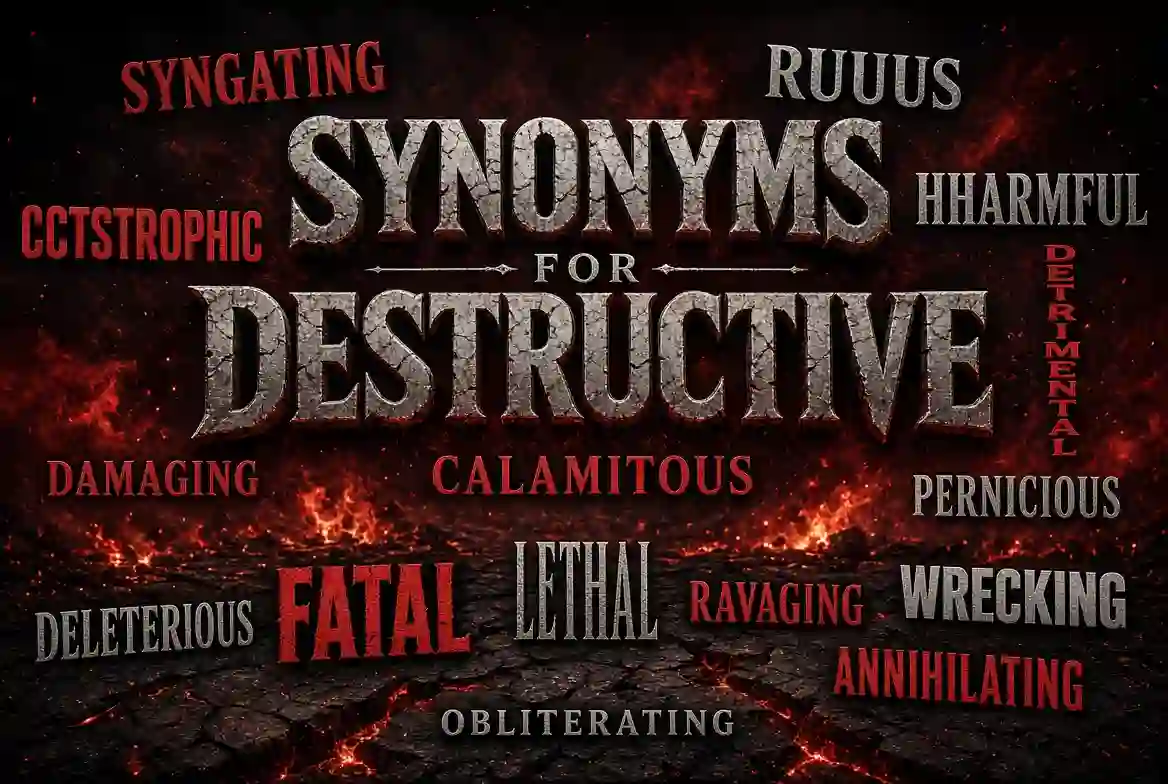
The best synonyms for destructive depend on what kind of damage you mean. Damaging and harmful are the closest everyday choices. Devastating, ruinous, catastrophic, and disastrous describe more severe effects. Detrimental and deleterious work well in formal writing, while pernicious suggests serious harm that develops gradually. Some related words, such as deadly or lethal, should only be used when death is involved.
Introduction
Have you ever used the word destructive in an essay and then realized you used it several times? Finding the right alternative can make your writing more precise and natural.
The adjective destructive describes something that causes, or can cause, damage, harm, or destruction. It can describe a storm, fire, war, habit, argument, criticism, relationship, policy, or force. Cambridge gives examples involving destructive power, destructive effects, and destructive behavior, showing that the word works in both physical and figurative contexts.
For example, a hurricane can be destructive, but a particularly severe hurricane may be devastating. A habit may be harmful, while a policy may be detrimental to a business.
This guide explains the most useful synonyms for destructive, but it does something more important than simply listing words. It shows which synonym fits which situation, how strong each word sounds, what register it belongs to, and when you should avoid it.
What Does Destructive Mean?
Destructive means causing or capable of causing damage, harm, or destruction.
It can describe physical damage:
The wildfire was highly destructive.
It can also describe figurative harm:
Constant criticism can be destructive to a person’s confidence.
The word does not always mean complete destruction. It can describe anything with a serious tendency to damage or undermine something. Cambridge and Collins both recognize physical and figurative uses.
Pronunciation
Destructive
IPA: /dɪˈstrʌk.tɪv/
Simple pronunciation:
dih-STRUK-tiv
Cambridge gives the same basic phonemic transcription for British and American English.
Part of Speech
Destructive is an adjective.
Related forms
- destroy — verb
- destruction — noun
- destructive — adjective
- destructively — adverb
- destructiveness — noun
- indestructible — adjective
Examples
- The storm destroyed several homes.
- The storm caused widespread destruction.
- It was a highly destructive storm.
- The force acted destructively.
- The weapon’s destructiveness concerned officials.
Grammar and Common Patterns
The most useful patterns are:
Destructive + noun
- destructive behavior
- destructive criticism
- destructive force
- destructive habits
- destructive storm
- destructive power
Destructive to + noun
The policy was destructive to the local economy.
Destructive of + noun
The decision was destructive of public trust.
The destructive pattern is especially common in everyday and professional English.
Do not confuse destructive with destroy
❌ The storm destructive the village.
✅ The storm destroyed the village.
Destructive is an adjective. Destroyed comes from the verb destroy.
The Best Synonyms for Destructive at a Glance
| Synonym | Strength | Register | Frequency | Best Context |
| Damaging | Strong | Neutral | Very common | General harm |
| Harmful | Strong | Neutral | Very common | Health, habits, effects |
| Detrimental | Strong | Formal | Common | Academic/business |
| Injurious | Strong | Formal | Uncommon | Physical or health harm |
| Devastating | Very strong | Neutral | Common | Severe damage/loss |
| Ruinous | Very strong | Formal/literary | Uncommon | Severe financial or practical loss |
| Disastrous | Very strong | Neutral | Common | Bad results or decisions |
| Catastrophic | Extreme | Formal/neutral | Common | Large-scale disaster |
| Calamitous | Extreme | Formal/literary | Uncommon | Major disaster |
| Pernicious | Strong | Formal | Uncommon | Gradual hidden harm |
| Deleterious | Strong | Academic/formal | Uncommon | Health/effects |
| Noxious | Strong | Formal/technical | Uncommon | Harmful substances/fumes |
| Hurtful | Moderate | Neutral | Common | Emotional pain |
| Adverse | Moderate/strong | Formal | Common | Unfavorable effects |
| Deadly | Extreme | Neutral | Common | Death |
| Fatal | Extreme | Neutral/formal | Common | Death or irreversible failure |
| Lethal | Extreme | Technical/formal | Common | Ability to cause death |
| Toxic | Strong | Neutral | Very common | Poisonous or unhealthy |
| Vicious | Strong | Neutral | Common | Cruel/aggressive behavior |
| Negative | Mild/moderate | Neutral | Very common | Broad unfavorable effect |
Important: This table shows related vocabulary, not 20 perfect substitutes. A good synonym preserves the meaning of the original sentence.
Detailed Synonyms for Destructive
1. Damaging
Meaning: Causing harm, loss, or a worse condition.
CEFR: Approx. B1–B2
Register: Neutral
Frequency: Very common
Nuance: Broad and practical
Examples:
- The false report was damaging to the company’s reputation.
- Too much sunlight can be damaging to some materials.
Best used when: You need the closest everyday alternative to destructive without making the situation sound more serious than it is.
Common collocations:
- damaging effects
- damaging behavior
- damaging consequences
When not to use: Avoid it when you specifically need to express total destruction or death.
2. Harmful
Meaning: Causing harm or a bad effect.
CEFR: Approx. B1
Register: Neutral
Frequency: Very common
Nuance: Often focuses on health, habits, substances, or general effects.
Examples:
- Smoking is harmful to your health.
- The chemical can be harmful to marine life.
Best used when: Discussing health, behavior, substances, or general negative effects.
Common collocations:
- harmful effects
- harmful chemicals
- harmful behavior
When not to use: Do not use it when you need to emphasize physical destruction.
3. Detrimental
Meaning: Causing harm or making a situation worse.
CEFR: Approx. B2–C1
Register: Formal, academic, business
Frequency: Common
Examples:
- Poor communication can be detrimental to teamwork.
- The policy could be detrimental to small businesses.
Best used when: Writing essays, reports, research-based content, or professional communication.
Common collocations:
- detrimental effect
- detrimental impact
- detrimental to health
When not to use: In casual conversation, harmful or damaging often sounds more natural.
4. Injurious
Meaning: Causing physical or other harm.
CEFR: Approx. C1
Register: Formal/technical
Frequency: Uncommon
Examples:
- Repeated strain can be injurious to the joints.
- The substance may be injurious to human health.
Best used when: You need formal language for injury or physical harm.
When not to use: Avoid it in simple everyday conversation where harmful sounds clearer.
5. Devastating
Meaning: Causing extremely serious damage, loss, or emotional pain.
CEFR: Approx. B2
Register: Neutral
Frequency: Common
Examples:
- The earthquake had a devastating effect on the region.
- The loss was devastating for the family.
Best used when: The consequences are extremely serious.
Nuance: This word is usually stronger than damaging.
Common collocations:
- devastating effects
- devastating impact
- devastating loss
When not to use: Avoid it for minor problems. Calling a small mistake “devastating” can sound exaggerated.
6. Ruinous
Meaning: Causing severe damage, loss, or ruin.
CEFR: Approx. C1
Register: Formal/literary
Frequency: Uncommon
Examples:
- The company faced ruinous financial losses.
- The conflict had ruinous consequences for the region.
Best used when: Something threatens financial success, stability, or survival.
Common collocations:
- ruinous costs
- ruinous losses
- ruinous consequences
When not to use: It is usually too strong for a small financial problem.
7. Disastrous
Meaning: Causing extremely bad results or failure.
CEFR: Approx. B2
Register: Neutral
Frequency: Common
Examples:
- The company made a disastrous decision.
- Poor planning had disastrous consequences.
Best used when: Talking about decisions, plans, events, or outcomes that produce terrible results.
Nuance: Disastrous often describes the result, while destructive often describes the force, action, behavior, or thing causing damage.
When not to use: Do not automatically use it for every physical form of damage.
8. Catastrophic
Meaning: Causing extremely serious and widespread damage.
CEFR: Approx. C1
Register: Formal/neutral
Frequency: Common
Examples:
- The flood caused catastrophic damage.
- A failure in the system could have catastrophic consequences.
Best used when: The scale of damage is exceptionally large.
Common collocations:
- catastrophic damage
- catastrophic failure
- catastrophic consequences
When not to use: Avoid it for ordinary problems.
9. Calamitous
Meaning: Causing or involving a major disaster.
CEFR: Approx. C2
Register: Formal/literary
Frequency: Uncommon
Examples:
- The country suffered a calamitous economic crisis.
- The decision produced calamitous results.
Best used when: You want a formal or literary way to describe a major disaster.
When not to use: It can sound overly dramatic in everyday speech.
10. Pernicious
Meaning: Causing serious harm, often gradually or in a less obvious way.
CEFR: Approx. C2
Register: Formal/academic
Frequency: Uncommon
Examples:
- The study examined the pernicious effects of misinformation.
- Such attitudes can have a pernicious influence on young people.
Best used when: Harm develops over time through an idea, influence, habit, or system.
Key nuance: Pernicious is not simply a fancy version of destructive. It often carries the idea of gradual, persistent, or difficult-to-see harm.
When not to use: Do not use it for a sudden storm destroying buildings.
11. Deleterious
Meaning: Having a harmful effect.
CEFR: Approx. C1–C2
Register: Academic/formal
Frequency: Uncommon
Examples:
- Sleep deprivation can have deleterious effects on concentration.
- The researchers examined the deleterious effects of pollution.
Best used when: You are writing academic, scientific, medical, or formal material.
Common collocations:
- deleterious effects
- deleterious impact
- deleterious consequences
When not to use: In ordinary conversation, harmful is usually more natural.
12. Noxious
Meaning: Harmful, poisonous, or unpleasant.
CEFR: Approx. C1
Register: Formal/technical
Frequency: Uncommon
Examples:
- Workers were exposed to noxious fumes.
- The factory released noxious gases.
Best used when: Talking about fumes, gases, chemicals, substances, or environmental hazards.
When not to use: It is not a natural replacement for destructive in most social or emotional contexts.
13. Hurtful
Meaning: Causing emotional pain.
CEFR: Approx. B1–B2
Register: Neutral
Frequency: Common
Examples:
- His hurtful comments damaged their friendship.
- She apologized for making a hurtful remark.
Best used when: The damage is mainly emotional.
When not to use: A hurricane can be destructive, but it would normally not be called hurtful.
14. Adverse
Meaning: Unfavorable or harmful.
CEFR: Approx. B2–C1
Register: Formal/business/academic
Frequency: Common
Examples:
- The treatment caused adverse effects.
- Bad weather had an adverse impact on sales.
Best used when: You want to describe an unfavorable effect or condition in formal writing.
Common collocations:
- adverse effects
- adverse conditions
- adverse impact
When not to use: Adverse does not normally express physical destruction as strongly as destructive.
15. Toxic
Meaning: Poisonous or seriously harmful; also unhealthy in a figurative sense.
CEFR: Approx. B2
Register: Neutral/informal
Frequency: Very common
Examples:
- The workers were exposed to toxic chemicals.
- They eventually left the toxic work environment.
Best used when: Talking about poisonous substances or seriously unhealthy relationships, workplaces, or social environments.
When not to use: Do not use toxic simply because something is bad. It needs a suitable physical or figurative context.
16. Vicious
Meaning: Cruel, violent, or aggressively harmful.
CEFR: Approx. B2
Register: Neutral
Frequency: Common
Examples:
- The article contained a vicious personal attack.
- The animals became involved in a vicious fight.
Best used when: Harm involves cruelty, aggression, or extreme hostility.
When not to use: A destructive building fire is not normally vicious.
17. Deadly
Meaning: Able to cause death.
CEFR: Approx. B1–B2
Register: Neutral
Frequency: Very common
Examples:
- The snake has a deadly bite.
- The combination of chemicals can be deadly.
Best used when: The possibility of death is central.
When not to use: Do not use deadly merely to mean “very damaging.”
18. Fatal
Meaning: Causing death or producing a result that cannot be recovered from.
CEFR: Approx. B2
Register: Neutral/formal
Frequency: Common
Examples:
- The injury proved fatal.
- One error was fatal to the company’s plans.
Best used when: Something causes death or completely ends an opportunity.
Important nuance: Fatal can have a figurative meaning, but it is still much more specific than destructive.
19. Lethal
Meaning: Capable of causing death.
CEFR: Approx. C1
Register: Formal/technical
Frequency: Common
Examples:
- The substance can become lethal at high concentrations.
- The laboratory follows strict procedures for lethal chemicals.
Best used when: Scientific, medical, legal, or technical precision matters.
When not to use: Do not use it as a general synonym for “harmful.”
20. Negative
Meaning: Unfavorable, undesirable, or lacking a positive effect.
CEFR: Approx. A2–B1
Register: Neutral
Frequency: Very common
Examples:
- The experience had a negative effect on his confidence.
- The decision produced negative results.
Best used when: You need a broad and simple word.
Nuance: Negative is much broader and usually weaker than destructive.
When not to use: Do not use it when you need to communicate serious physical destruction.
Strongest Synonyms vs. Closest Synonyms
This distinction is important.
Closest everyday synonyms
- Damaging
- Harmful
- Detrimental
- Injurious
These preserve the central idea of harm most closely. Cambridge specifically lists damaging, detrimental, harmful, and injurious among its core synonyms.
Stronger alternatives
- Devastating
- Ruinous
- Disastrous
- Catastrophic
- Calamitous
These add greater intensity or a stronger sense of disaster.
Context-specific alternatives
- Hurtful → emotional harm
- Pernicious → gradual or hidden harm
- Noxious → harmful substances
- Toxic → poisonous or seriously unhealthy
- Vicious → cruel or aggressive harm
- Deadly → capable of causing death
- Fatal → causing death or an irreversible result
- Lethal → capable of causing death
Choose the Right Synonym
| If you mean… | Best choice |
| General damage | damaging |
| General harm | harmful |
| Formal harmful effect | detrimental |
| Physical injury | injurious |
| Extremely serious damage | devastating |
| Financial ruin | ruinous |
| Terrible result | disastrous |
| Massive disaster | catastrophic |
| Gradual hidden harm | pernicious |
| Harmful gas or substance | noxious |
| Emotional pain | hurtful |
| Unfavorable effect | adverse |
| Poisonous or unhealthy | toxic |
| Death-related danger | deadly/lethal |
| Cruel aggression | vicious |
A simple decision rule
If you are unsure, start with damaging.
Then ask:
Is it about health? → harmful
Is it formal or academic? → detrimental
Is the damage extreme? → devastating
Is there a large-scale disaster? → catastrophic
Is the harm gradual or hidden? → pernicious
Is death involved? → deadly, fatal, or lethal
This produces much more accurate writing than replacing destructive with a random thesaurus word.
Commonly Confused Words
| Word | Main idea | Example |
| Destructive | Causes damage | The storm was destructive. |
| Damaging | Causes harm or loss | The rumor was damaging. |
| Dangerous | Creates a risk | The road is dangerous. |
| Harmful | Causes harm | The chemical is harmful. |
| Devastating | Causes extreme damage | The earthquake was devastating. |
| Constructive | Helps improve something | She gave constructive criticism. |
Destructive vs. dangerous
These are not the same.
Dangerous focuses on risk.
Destructive focuses on damage or the capacity to cause damage.
The machine is dangerous.
This means the machine creates a risk.
The machine is destructive.
This emphasizes its damaging effect.
Destructive vs. Harmful
Harmful is usually broader and less forceful.
Too much sugar can be harmful.
The sentence does not suggest destruction.
The explosion was destructive.
This describes serious physical damage.
So, use harmful for health, habits, substances, and general effects. Use destructive when damage or destruction itself is central.
Destructive vs. Devastating
Devastating normally carries greater emotional or physical intensity.
The storm was destructive.
This says the storm caused damage.
The storm was devastating.
This suggests exceptionally severe damage or loss.
Do not automatically replace destructive with devastating. The stronger word can exaggerate a mild situation.
Common Mistakes
Common Mistake Box
Mistake 1
❌ “The small delay was catastrophic.”
If the delay caused only a minor problem, serious, damaging, or unfortunate may fit better.
Mistake 2
❌ “The office has a destructive atmosphere.”
If you mean an unhealthy workplace, toxic may be more precise.
Mistake 3
❌ “The chemical is destructive to humans.”
If you specifically mean that it can cause death, lethal may be more precise. If it simply causes harm, harmful may be better.
Mistake 4
❌ “She gave destructive advice.”
If the advice was simply bad, poor, harmful, or unhelpful may fit better.
Mistake 5
❌ “His criticism was destructive because it helped me improve.”
If criticism helps someone improve, call it constructive, not destructive.
Word Origin and Etymology
Destructive entered English in the late 15th century. Collins dates the word to approximately 1480–90 and traces it through Middle French to Late Latin destructivus, from Latin destruere, meaning to destroy or tear down.
The deeper Latin connection helps explain the central idea behind the modern English word: breaking down or undoing something that exists.
The related word destroy comes from the same historical family. Vocabulary.com also connects destructive with Latin destruere, explaining the basic idea as “to unbuild.”
American vs. British English
There is no standard spelling difference between American and British English.
Both use:
destructive
The core pronunciation is also represented similarly:
UK: /dɪˈstrʌk.tɪv/
US: /dɪˈstrʌk.tɪv/
Cambridge provides the same IPA representation for both varieties.
The differences you may hear come mainly from accent rather than spelling.
The major synonyms in this article also generally work in both American and British English.
One useful difference appears in broader vocabulary choices around the word. For example, British English resources may show additional formal or literary alternatives such as calamitous, baleful, baneful, and cataclysmic, while American thesaurus entries also commonly foreground words such as catastrophic, devastating, harmful, and ruinous. Collins lists overlapping sets for both varieties.
CEFR Guidance for Learners
CEFR levels are best treated as approximate learning guidance, because dictionaries do not assign an official CEFR level to every synonym.
| Word | Approximate level | Learner priority |
| Negative | A2–B1 | High |
| Dangerous | A2–B1 | High |
| Harmful | B1 | High |
| Damaging | B1–B2 | High |
| Destructive | B1–B2 | High |
| Hurtful | B1–B2 | High |
| Deadly | B1–B2 | Medium |
| Disastrous | B2 | High |
| Devastating | B2 | High |
| Toxic | B2 | High |
| Adverse | B2–C1 | Medium |
| Detrimental | B2–C1 | High for academic writing |
| Hostile | B2 | Medium |
| Catastrophic | C1 | Medium |
| Injurious | C1 | Medium |
| Lethal | C1 | Medium |
| Noxious | C1 | Low |
| Pernicious | C1–C2 | Low |
| Deleterious | C1–C2 | Low |
| Calamitous | C2 | Low |
Learner tip: Do not try to memorize all 20 words at once. Learn damaging, harmful, detrimental, devastating, disastrous, and catastrophic first. Add the more specialized words as your reading level grows.
Frequency and Register Guide
Very common
- harmful
- damaging
- negative
- dangerous
- deadly
- toxic
Common
- destructive
- detrimental
- devastating
- disastrous
- catastrophic
- fatal
- lethal
- adverse
- vicious
Uncommon
- injurious
- ruinous
- pernicious
- deleterious
- noxious
- calamitous
Mainly formal or academic
- detrimental
- deleterious
- injurious
- pernicious
- adverse
Literary or highly formal
- calamitous
- ruinous
Natural Collocations
Learning words through collocations is often more useful than memorizing isolated synonyms.
Destructive
- destructive behavior
- destructive criticism
- destructive force
- destructive power
- destructive effects
- destructive habits
- destructive tendencies
Damaging
- damaging effects
- damaging allegations
- damaging consequences
- damaging behavior
Harmful
- harmful effects
- harmful chemicals
- harmful habits
- harmful behavior
Devastating
- devastating impact
- devastating loss
- devastating effects
- devastating consequences
Detrimental
- detrimental effect
- detrimental impact
- detrimental consequences
- detrimental to health
Catastrophic
- catastrophic damage
- catastrophic failure
- catastrophic consequences
- catastrophic event
Pernicious
- pernicious influence
- pernicious effects
- pernicious habit
- pernicious ideology
These patterns are important because native speakers do not choose synonyms randomly. The noun that follows a word often helps determine which adjective sounds natural.
How to Use Synonyms in Different Types of Writing
Essays
Use precise formal words such as:
- detrimental
- adverse
- deleterious
- pernicious
Example:
Excessive screen use may have detrimental effects on students’ concentration.
Professional Emails
Choose clear words rather than unnecessarily complex vocabulary.
The delay could have a damaging effect on the project.
Blog Posts
Mix common vocabulary with stronger terms when the evidence supports them.
The wildfire caused devastating damage across the region.
Stories
Stronger and literary vocabulary can create atmosphere.
The calamitous storm left the coastal village isolated.
Social Media
Simple, natural words usually work best.
That kind of behavior is toxic and damaging.
Academic Writing
Precision matters more than sounding sophisticated.
The researchers identified several adverse effects.
Do not use deleterious simply because it sounds advanced. If harmful communicates the idea more clearly, use harmful.
Antonyms of Destructive
The main opposites include:
- constructive
- beneficial
- helpful
- creative
- restorative
- productive
- harmless
- positive
- preservative
Cambridge lists beneficial, constructive, creative, restorative, and preservative among the main antonyms of destructive.
The most useful opposite
Constructive is especially important.
destructive criticism
means criticism that damages or undermines.
constructive criticism
means criticism intended to help someone improve.
Word Family
| Word | Part of speech | Meaning |
| Destroy | Verb | Cause serious damage |
| Destruction | Noun | The act/result of destroying |
| Destructive | Adjective | Causing damage |
| Destructively | Adverb | In a destructive way |
| Destructiveness | Noun | Quality of causing destruction |
| Indestructible | Adjective | Impossible or very difficult to destroy |
Mini Practice Quiz
1. Which word is best for a harmful effect on health?
A. Calamitous
B. Harmful
C. Hostile
D. Vicious
Answer: B. Harmful
2. Which word suggests extremely serious and widespread damage?
A. Catastrophic
B. Negative
C. Hurtful
D. Adverse
Answer: A. Catastrophic
3. Which word is best for gradual or hidden serious harm?
A. Deadly
B. Pernicious
C. Dangerous
D. Negative
Answer: B. Pernicious
4. Choose the best word:
“Her feedback helped the employee improve.”
A. Destructive
B. Devastating
C. Constructive
D. Ruinous
Answer: C. Constructive
5. Which word specifically focuses on the ability to cause death?
A. Damaging
B. Lethal
C. Detrimental
D. Hurtful
Answer: B. Lethal
Sentence Rewriting Practice
Replace destructive with a more precise word.
1. The earthquake was destructive.
Possible answer:
The earthquake was devastating.
2. Smoking is destructive to health.
Possible answer:
Smoking is harmful to health.
3. The policy was destructive to the economy.
Possible answer:
The policy was detrimental to the economy.
4. The fumes were destructive to the workers’ health.
Possible answer:
The fumes were harmful to the workers’ health.
5. The decision had destructive consequences.
Possible answer:
The decision had disastrous consequences.
There can be more than one correct answer. The best choice depends on the exact meaning and strength you want.
Matching Exercise
Match each word to the context where it fits best.
| Word | Context |
| 1. Noxious | A. Emotional pain |
| 2. Hurtful | B. Harmful gas |
| 3. Ruinous | C. Severe financial loss |
| 4. Lethal | D. Capable of causing death |
| 5. Detrimental | E. Formal harmful effect |
Answer Key
1-B, 2-A, 3-C, 4-D, 5-E
Frequently Asked Questions
What is the best synonym for destructive?
Damaging is one of the closest everyday synonyms for destructive. However, the best choice depends on context. Use harmful for general harm, detrimental for formal writing, devastating for extreme damage, and catastrophic for very large-scale disaster.
What is a simple synonym for destructive?
The simplest useful alternatives are damaging and harmful. Both are common in everyday English and easy for ESL learners to understand. Damaging focuses on causing damage, while harmful has a broader focus on causing harm or a bad effect.
What is a stronger word than destructive?
Devastating, catastrophic, ruinous, and calamitous can express greater severity. The best choice depends on the situation. Devastating often describes extreme damage or loss, while catastrophic usually suggests a major disaster with widespread consequences.
Is harmful a synonym for destructive?
Yes, but it is not an exact replacement in every sentence. Harmful means causing harm, while destructive often emphasizes serious damage or the ability to destroy. A habit may be harmful, while a hurricane may be destructive.
What is the opposite of destructive?
The most useful opposite is constructive. Other antonyms include beneficial, helpful, creative, productive, restorative, and harmless. In particular, constructive criticism is commonly contrasted with destructive criticism.
What is the formal synonym of destructive?
Common formal alternatives include detrimental, deleterious, injurious, adverse, and pernicious. These words have different nuances. Detrimental means harmful, deleterious often appears in academic or scientific writing, and pernicious suggests serious harm that may develop gradually.
What is the difference between destructive and devastating?
Destructive means causing or capable of causing damage. Devastating usually indicates a much more severe effect. A storm can be destructive, but a storm that destroys homes and causes enormous loss may be described as devastating.
Can destructive describe a person?
Yes, but context matters. You can describe someone’s destructive behavior, destructive habits, destructive anger, or destructive criticism. Calling a person simply “destructive” can sound like a broad judgment, so it is often clearer to describe the specific behavior.
Conclusion
Learning synonyms for destructive is not simply about finding different words. It is about choosing the word that communicates the exact kind of harm you mean. Use damaging or harmful for everyday situations, detrimental for formal writing, devastating for severe damage, and catastrophic for large-scale disaster.
More specialized words such as pernicious, deleterious, and noxious are useful when their specific meanings fit. Practice these words in essays, emails, conversations, and professional writing, and your vocabulary will become more precise and natural.
References
- Cambridge Dictionary, Destructive and Cambridge English Thesaurus.
- Collins English Dictionary and Thesaurus, Destructive.
- Thesaurus.com, Destructive Synonyms & Antonyms.
- Vocabulary.com, Destructive: Definition, Meaning & Synonyms.
- Dictionary.com / Thesaurus.com, synonym and usage references for destructive.

Synonorm is a trusted English vocabulary resource created to help readers find the right words and understand the differences between similar terms. We provide clear explanations of synonyms, meanings, examples, usage, and alternatives. Our content makes vocabulary easier to learn and apply in everyday, academic, and professional English. Synonorm is designed for students, writers, ESL learners, professionals, and anyone who wants to improve their English vocabulary and communicate more clearly.