Quick Answer
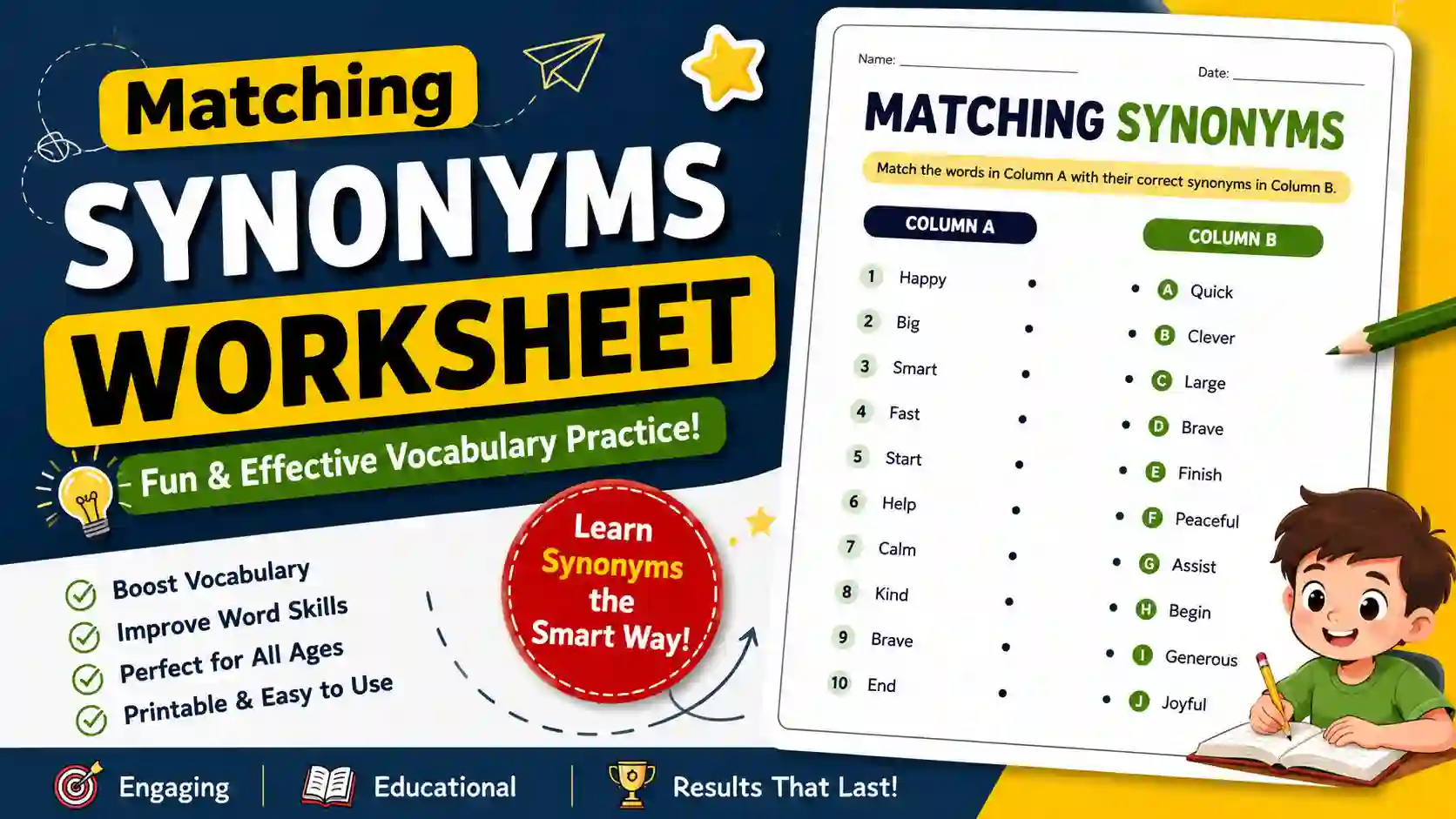
A matching synonyms worksheet is a vocabulary exercise where students connect each word with another word that has the same or a very similar meaning. For example, happy → glad and begin → start. These activities help learners recognize word meanings, build vocabulary, improve reading skills, and use more varied language.
What Is a Matching Synonyms Worksheet?
Have you ever known what a word means but struggled to think of another word with a similar meaning?
A synonym matching activity can help.
In this type of worksheet, you usually see two groups of words. Your job is to find the words that have similar meanings and match them. For example:
| Word | Synonym |
| happy | glad |
| large | big |
| quick | fast |
| quiet | silent |
The words are often mixed up so that students have to think about meaning instead of simply reading across the page.
This type of activity is common in elementary English classes, ESL lessons, vocabulary review, homework, and independent practice. Current educational resources also use matching, word banks, sentence replacement, and other activities to help learners understand synonyms.
The important thing to remember is that synonyms usually have similar, not necessarily identical, meanings. Two words may work in one sentence but not another.
Why Are Synonym Matching Worksheets Useful?
A matching exercise may look simple, but it develops several useful language skills.
1. They build vocabulary
Students learn that one idea can often be expressed in different ways.
For example:
- happy → cheerful
- small → little
- angry → mad
- smart → clever
2. They improve reading comprehension
Knowing synonyms helps students understand unfamiliar words when reading.
If a story says someone was furious, a learner who knows angry may understand the sentence more easily.
3. They improve writing
A larger vocabulary gives students more choices when writing essays, stories, emails, and school assignments.
4. They strengthen word recognition
Matching requires students to connect a written word with its meaning.
5. They make vocabulary practice active
Instead of simply reading a definition, students must recall and apply what they know.
Quick Tip: After matching the words, use each pair in a sentence. This helps move vocabulary from recognition to real use.
How to Complete a Synonym Matching Worksheet
Use this simple method.
Step 1: Read every word
Do not immediately choose the first answer that looks familiar.
Step 2: Think about the meaning
Ask yourself:
What does this word mean?
Step 3: Look for the closest match
Find the word with the same or nearly the same meaning.
Step 4: Check the context
If the worksheet includes sentences, put the possible synonym into the sentence and see whether it sounds natural.
Step 5: Check your answers
Use the answer key after you finish rather than looking at it first.
Easy Synonym Matching Worksheet
Directions: Match each word in Column A with its synonym in Column B.
| Column A | Column B |
| 1. Happy | A. Quick |
| 2. Big | B. Silent |
| 3. Fast | C. Glad |
| 4. Small | D. Large |
| 5. Quiet | E. Little |
| 6. Begin | F. Simple |
| 7. Easy | G. End |
| 8. Finish | H. Start |
| 9. Angry | I. Smart |
| 10. Clever | J. Mad |
Answer Key
- C
- D
- A
- E
- B
- H
- F
- G
- J
- I
Intermediate Matching Synonyms Worksheet
The next activity uses slightly more advanced vocabulary.
Directions: Match each word with its closest synonym.
| Word | Possible Synonym |
| 1. Ancient | A. Honest |
| 2. Brave | B. Strange |
| 3. Honest | C. Old |
| 4. Strange | D. Dangerous |
| 5. Dangerous | E. Fearless |
| 6. Rapid | F. Quiet |
| 7. Silent | G. Fast |
| 8. Difficult | H. Hard |
| 9. Purchase | I. Help |
| 10. Assist | J. Buy |
Answer Key
- C
- E
- A
- B
- D
- G
- F
- H
- J
- I
Synonym Matching for ESL Learners
ESL students can benefit from starting with common everyday words.
Here are some useful pairs:
| Basic Word | Common Synonym |
| happy | glad |
| sad | unhappy |
| big | large |
| small | little |
| fast | quick |
| smart | clever |
| angry | mad |
| quiet | silent |
| easy | simple |
| hard | difficult |
| start | begin |
| finish | end |
| help | assist |
| buy | purchase |
| answer | reply |
| idea | thought |
| home | house |
| job | work |
| gift | present |
| sick | ill |
A note for learners
Some pairs are stronger than others.
For example, big and large can often replace each other:
They live in a big house.
They live in a large house.
But house and home are not always interchangeable.
I went home after school.
I went home after school. ❌
This is why learning synonyms is not just about memorizing pairs. You also need to learn how each word behaves in a sentence.
Matching Synonyms in Sentences
A good vocabulary exercise should eventually move beyond individual words.
Choose the synonym that best replaces the bold word.
1.
The puppy was tiny.
A. huge
B. small
C. noisy
D. heavy
Answer: B. small
2.
The road was dangerous.
A. risky
B. quiet
C. empty
D. smooth
Answer: A. risky
3.
Maria was delighted with her gift.
A. angry
B. pleased
C. worried
D. tired
Answer: B. pleased
4.
The teacher gave us a difficult question.
A. simple
B. easy
C. hard
D. short
Answer: C. hard
5.
The runner moved rapidly.
A. slowly
B. quickly
C. quietly
D. carefully
Answer: B. quickly
Strong Synonyms vs. Exact Synonyms
One of the most important lessons for English learners is that synonyms are not always exact replacements.
Consider these words:
look → stare → glance → watch
They are related, but they describe different actions.
- look = direct your eyes toward something
- stare = look for a long time, often intensely
- glance = look quickly
- watch = look at something for a period of time
So a worksheet should not simply teach learners that all four words mean “look.”
It is better to teach the difference in meaning and use.
Remember: The best synonym is the one that fits the sentence, not necessarily the one that looks most similar in a dictionary.
Common Mistakes When Matching Synonyms
Mistake 1: Choosing an Antonym
A synonym has a similar meaning.
An antonym has an opposite meaning.
For example:
- hot → warm = similar
- hot → cold = opposite
Do not match opposites just because both words describe the same topic.
Mistake 2: Assuming Similar Words Are Always Interchangeable
Consider:
job and work
They are related, but their grammar differs.
I found a new job. ✅
I found a new job. ❌
The word work can be used in many other ways:
I have a lot of work today.
Learning the word in context prevents this mistake.
Mistake 3: Ignoring Part of Speech
The words must usually fit the same grammatical role.
For example:
Beautiful and pretty are adjectives.
But beauty is a noun.
So:
She is beautiful.
She is pretty.
Both work.
But:
She is beautiful. ❌
Mistake 4: Choosing a Rare Word Just to Sound Smart
Students sometimes believe that a more difficult synonym always makes writing better.
It does not.
A simple word that fits naturally is usually better than an unusual word that sounds forced.
Choose the Best Synonym
Sometimes more than one word has a similar meaning. In these cases, context helps you choose.
Example:
The child was very ______ after winning the race.
Possible answers:
- happy
- pleased
- delighted
- excited
All can relate to positive feelings, but they do not communicate exactly the same idea.
This is called a shade of meaning.
Words can be close in meaning while differing in strength or feeling. Vocabulary activities that ask students to order or compare these shades can develop deeper understanding.
Synonym Categories
Common Everyday Synonyms
These are useful for beginners and everyday communication.
- big → large
- small → little
- fast → quick
- happy → glad
- smart → clever
- angry → mad
- easy → simple
- begin → start
More Formal Alternatives
These may be useful in academic or professional writing.
- help → assist
- buy → purchase
- show → demonstrate
- explain → clarify
- use → utilize
However, formal does not automatically mean better. In many situations, the simpler word sounds more natural.
Stronger or More Specific Alternatives
These words may express a stronger or more specific idea.
- angry → furious
- tired → exhausted
- happy → delighted
- scared → terrified
- big → enormous
These should not be treated as perfect synonyms because their intensity can differ.
A Better Way to Teach Synonyms
A useful lesson can follow four stages.
1. Recognize
Students identify two words with similar meanings.
happy → glad
2. Understand
Students explain the meaning.
Both words describe a positive feeling.
3. Compare
Students discuss the difference.
delighted is usually stronger than pleased.
4. Use
Students write a sentence.
I was delighted when my team won.
This approach gives students more than a memorized answer.
Mini Practice: Fill in the Blanks
Choose the best word from the box.
quick | silent | glad | difficult | purchase
- The exam was very ______.
- She was ______ to see her old friend.
- Please remain ______ during the test.
- He gave a ______ reply.
- I want to ______ a new notebook.
Answers
- difficult
- glad
- silent
- quick
- purchase
Mini Practice: Rewrite the Sentences
Replace the bold word with a suitable synonym.
1.
The movie was funny.
Possible answer:
The movie was humorous.
2.
The room was large.
Possible answer:
The room was big.
3.
He was angry about the mistake.
Possible answer:
He was mad about the mistake.
4.
The instructions were simple.
Possible answer:
The instructions were easy.
5.
She began her homework after dinner.
Possible answer:
She started her homework after dinner.
Good to Know: In some sentences, more than one answer can be correct. A good synonym exercise should accept reasonable alternatives when the meaning and grammar remain correct.
Printable-Style Matching Activity
Here is another short activity that teachers can copy into a classroom worksheet.
Directions: Write the letter of the synonym next to each word.
Words
- wealthy
- noisy
- begin
- friendly
- afraid
- correct
- tired
- beautiful
- difficult
- empty
Synonyms
A. hard
B. rich
C. scared
D. vacant
E. right
F. attractive
G. start
H. exhausted
I. kind
J. loud
Answer Key
- B
- J
- G
- I
- C
- E
- H
- F
- A
- D
How Teachers Can Make the Activity More Effective
A matching task works best when the vocabulary matches the learner’s level.
For younger students, use familiar words and clear pairs. Resources for early learners commonly use simple pairs such as big/large, fast/quick, angry/mad, and friend/buddy.
For older students, increase the challenge by adding:
- sentence context
- less common vocabulary
- near-synonyms
- shades of meaning
- word families
- short writing tasks
- multiple-choice questions
Some resources designed for grades 3–6 use larger matching sets, while other activities combine matching with sentence writing.
A simple classroom sequence
Warm-up: Introduce five synonym pairs.
Practice: Complete a matching activity.
Discussion: Ask students why each pair matches.
Writing: Ask students to use five new words in sentences.
Review: Check answers together.
This turns a short worksheet into a useful vocabulary lesson.
Frequently Asked Questions
What is a matching synonyms worksheet?
It is a vocabulary activity in which students connect words with other words that have the same or similar meanings. A typical page has two columns, with the answers mixed up. Students match the pairs by understanding the meaning of each word.
How do you match synonyms correctly?
Read the target word, think about its meaning, and then compare the available choices. Choose the closest word, not simply a word that is related to the same topic. If possible, put the synonym into a sentence to make sure it sounds natural.
Are synonyms exactly the same?
No. Synonyms usually share a similar meaning, but they can differ in strength, tone, grammar, or context. For example, angry and furious are related, but furious normally expresses a stronger emotion.
Why should students learn synonyms?
Synonyms give students more vocabulary choices. They can support reading comprehension, improve writing variety, and help learners express ideas more precisely. Matching activities also give students a simple way to review new vocabulary.
What is the difference between a synonym and an antonym?
A synonym has a similar meaning, while an antonym has an opposite meaning. For example, begin and start are synonyms, while begin and finish are antonyms.
What age is suitable for synonym matching worksheets?
The activity can be adapted for many ages. Young learners can work with simple pairs such as big/large, while older students can practice less common words, sentence context, and shades of meaning. Current worksheet resources cover early elementary through middle-school levels.
Can ESL students use synonym worksheets?
Yes. They are especially useful when learners start with familiar vocabulary and gradually move to more advanced words. Teachers can add pictures, definitions, example sentences, and word banks to make the task easier.
Can one word have more than one synonym?
Yes. Many English words have several related synonyms. For example, happy can connect with glad, cheerful, pleased, or delighted, although these words can differ in strength and usage.
Final Vocabulary Quiz
1. Which word is the closest synonym for happy?
A. Angry
B. Glad
C. Tired
D. Afraid
2. Which word is closest in meaning to rapid?
A. Slow
B. Quick
C. Quiet
D. Weak
3. Which pair contains antonyms rather than synonyms?
A. Begin / start
B. Big / large
C. Happy / glad
D. Hot / cold
4. Which word best completes the sentence?
“Please ______ each word with its synonym.”
A. match
B. sleep
C. break
D. forget
5. Which statement about synonyms is correct?
A. They always have exactly the same meaning.
B. They always have opposite meanings.
C. They usually have similar meanings but may differ in use.
D. They can only be nouns.
Answer Key
- B. Glad
- B. Quick
- D. Hot / cold
- A. Match
- C. They usually have similar meanings but may differ in use.
Conclusion
A matching synonyms worksheet is a simple but effective way to strengthen vocabulary. It helps learners recognize similar meanings, understand new words, improve reading comprehension, and make better choices in writing. The best practice goes beyond memorizing pairs. After matching the words, read them in sentences, compare their meanings, and use them in your own writing.
Whether you are a student, ESL learner, parent, or teacher, a few minutes of regular synonym practice can make your English more flexible and confident.
References
- Cambridge Dictionary, Synonym and related vocabulary guidance. Cambridge Dictionary
- Merriam-Webster Dictionary, Synonym. Merriam-Webster
- K5 Learning, Synonyms and Antonyms Worksheets.
- Englishlinx, Matching Synonyms Worksheets.
- Have Fun Teaching, Synonym Matching Worksheet.

Synonorm is a trusted English vocabulary resource created to help readers find the right words and understand the differences between similar terms. We provide clear explanations of synonyms, meanings, examples, usage, and alternatives. Our content makes vocabulary easier to learn and apply in everyday, academic, and professional English. Synonorm is designed for students, writers, ESL learners, professionals, and anyone who wants to improve their English vocabulary and communicate more clearly.