Quick Answer: What Are Synonyms for Said?
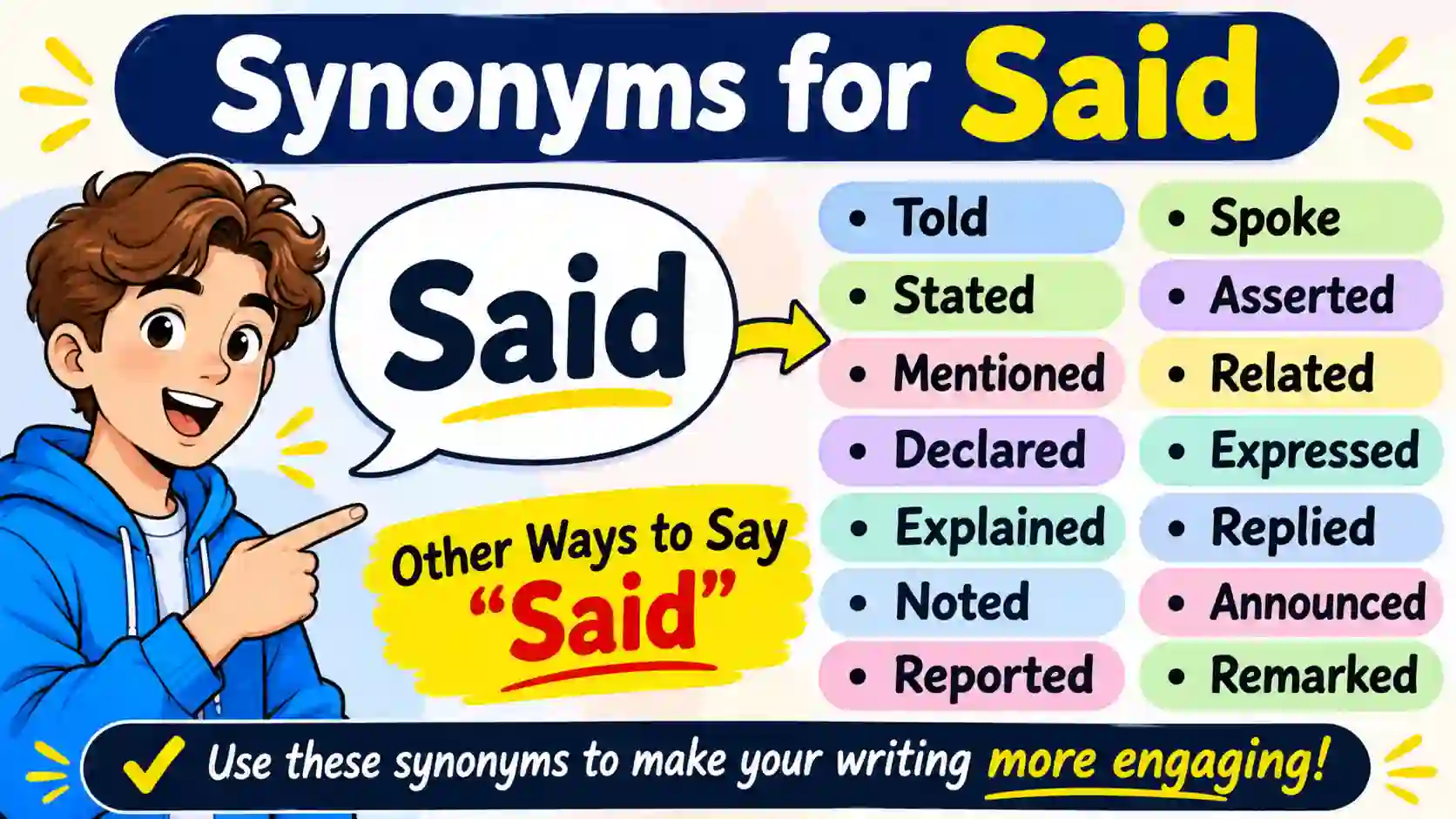
Synonyms for said are words that describe how someone expresses information, answers a question, shares an opinion, or communicates a feeling. Useful alternatives include stated, replied, answered, remarked, explained, whispered, announced, and admitted. The right word depends on the speaker’s message, tone, and purpose.
Do you often use the word said when writing stories, essays, or everyday messages? There is nothing wrong with this common word, but using it in every sentence can make your writing feel repetitive.
Learning synonyms for said gives you more ways to describe conversations. For example, “She said the answer” can become “She explained the answer” when she provides details.
However, these words do not all mean the same thing. Some describe quiet speech, while others show confidence, surprise, disagreement, or a response to a question.
This guide covers 30 useful alternatives with simple meanings, original examples, pronunciation, CEFR estimates, common collocations, and practical writing advice. You will also learn which words work in everyday English, academic writing, business communication, and creative stories.
Pronunciation of Said
- IPA: /sed/
- Pronounced as: SED
- Syllables: One
- Rhymes with: Bed, head, red.
Both American and British English use the same standard pronunciation /sed/. Regional accents may create small differences, but the basic sound remains the same.
Part of Speech and Meaning
1. Said as a Verb
Said is the simple past tense and past participle of say.
- Simple present: I say hello.
- Third-person present: She says hello.
- Simple past: She said hello.
- Past participle: She has said hello.
2. Said as an Adjective
In legal and formal English, said can mean previously mentioned.
Example: The said agreement must remain confidential.
In everyday writing, the agreement or the previously mentioned agreement usually sounds more natural.
Word Origin and Etymology
The verb say comes from Old English secgan, meaning to speak, tell, or communicate something. It has Germanic roots and is related to Dutch zeggen and German sagen.
The past-tense form is said to have developed from Old English segde. The adjective meaning previously mentioned dates to around 1300.
The word say was recorded before 900, making it a very old part of English vocabulary.
Grammar: How to Use Said Correctly
Use these common sentence patterns:
- Subject + said + something: She said hello.
- Subject + said + that + clause: He said that he was busy.
- Subject + said + something + to + person: I said goodbye to my friend.
- Subject + told + person + something: She told me the news.
- Subject + reporting verb + direct speech: “Come here,” he whispered.
Said vs. Told
This is one of the most important grammar differences for English learners.
| Said | Told |
| She said she was tired. | She told me she was tired. |
| He said hello to Ali. | He told Ali the truth. |
| I said that I agreed. | I told them that I agreed. |
Remember: Use said when focusing on the words. Use told when identifying the person who receives the information.
Quick Comparison: 30 Synonyms for Said
| Word | Main use | Register | CEFR estimate |
| Stated | Clear information | Formal | B1 |
| Replied | Response | Neutral | A2 |
| Answered | Direct answer | Neutral | A1 |
| Remarked | Comment | Neutral | B2 |
| Mentioned | Brief reference | Neutral | B1 |
| Explained | Clarification | Neutral | A2 |
| Announced | Public news | Formal | B1 |
| Declared | Firm statement | Formal | B2 |
| Whispered | Quiet speech | Neutral | B1 |
| Shouted | Loud speech | Informal | A2 |
| Exclaimed | Strong emotion | Literary | B2 |
| Murmured | Soft speech | Literary | B2 |
| Muttered | Quiet complaint | Informal | B2 |
| Mumbled | Unclear speech | Informal | B2 |
| Commented | Opinion | Neutral | B1 |
| Added | Extra information | Neutral | A2 |
| Suggested | Proposal | Neutral | B1 |
| Claimed | Unverified assertion | Formal | B2 |
| Asserted | Firm position | Academic | C1 |
| Admitted | Accepted a fact | Neutral | B1 |
| Confessed | Revealed something | Neutral | B2 |
| Insisted | Strong position | Neutral | B2 |
| Argued | Gave reasons | Academic | B1 |
| Reported | Shared information | Formal | B1 |
| Observed | Made an observation | Academic | C1 |
| Noted | Pointed out | Formal | B1 |
| Promised | Made a commitment | Neutral | B1 |
| Warned | Alerted someone | Neutral | B1 |
| Questioned | Asked or challenged | Neutral | B1 |
| Responded | Reacted verbally | Neutral | B1 |
CEFR levels are approximate editorial learning estimates, not official classifications of individual synonyms.
30 Synonyms for Said With Examples and Explanations
The words below are grouped by their speaking function. A word may be useful as a replacement in one situation but incorrect in another.
1. Stated
Meaning: Expressed something clearly and directly.
Examples:
- The principal stated that classes would begin on Monday.
- The report stated the main reasons for the delay.
Best used when: Someone presents facts, opinions, or official information.
Tone: Formal, business, academic.
CEFR: B1 | Frequency: Common.
Collocations: Clearly stated, officially stated, stated opinion.
When not to use: Avoid it for emotional or casual conversations where it sounds stiff.
2. Replied
Meaning: Answered someone after they spoke or asked a question.
Examples:
- “Friday works for me,” Sara replied.
- He replied to the customer’s message within an hour.
Best used when: Someone responds to an earlier statement or question.
Tone: Neutral, spoken, professional.
CEFR: A2 | Frequency: Very common.
Collocations: Replied politely, replied immediately, replied to a question.
When not to use: Do not use it when nobody has spoken before.
3. Answered
Meaning: Gave a response to a question or request.
Examples:
- “The office is on the second floor,” the receptionist answered.
- She answered every question during the interview.
Best used when: A speaker gives a direct answer.
Tone: Neutral, everyday.
CEFR: A1 | Frequency: Very common.
Collocations: Answered correctly, answered the question, answered calmly.
When not to use: Avoid it for statements that do not answer anything.
4. Remarked
Meaning: Made a comment or observation.
Examples:
- “The weather feels different today,” Omar remarked.
- The teacher remarked that the class had improved.
Best used when: Someone shares an observation or personal comment.
Tone: Neutral, literary.
CEFR: B2 | Frequency: Common.
Collocations: Casually remarked, dryly remarked, remarked that.
When not to use: Do not use it as a replacement for every ordinary statement.
5. Mentioned
Meaning: Referred to something briefly.
Examples:
- Nadia mentioned her new business during lunch.
- The author mentioned three helpful books.
Best used when: Someone brings up a topic without discussing it deeply.
Tone: Neutral, spoken, professional.
CEFR: B1 | Frequency: Very common.
Collocations: Briefly mentioned, previously mentioned, mentioned in passing.
When not to use: Avoid it when someone gives a complete explanation.
6. Explained
Meaning: Made something easier to understand.
Examples:
- The instructor explained the difficult grammar rule.
- He explained why the delivery was late.
Best used when: A speaker gives reasons, instructions, or details.
Tone: Neutral, academic, business.
CEFR: A2 | Frequency: Very common.
Collocations: Clearly explained, explained the reason, explained how.
When not to use: Do not use it for a short statement without an explanation.
7. Announced
Meaning: Made information known to a group or the public.
Examples:
- The school announced its winter schedule.
- The company announced a new service.
Best used when: Sharing important news, decisions, or public information.
Tone: Formal, business, neutral.
CEFR: B1 | Frequency: Common.
Collocations: Officially announced, announced the results, announced a decision.
When not to use: Avoid it for small private comments.
8. Declared
Meaning: Stated something firmly or publicly.
Examples:
- “I am ready for the challenge,” she declared.
- The organization declared its support for the project.
Best used when: Someone makes a strong or official statement.
Tone: Formal, literary, dramatic.
CEFR: B2 | Frequency: Common.
Collocations: Publicly declared, declared victory, officially declared.
When not to use: Avoid it in ordinary conversations about minor details.
9. Whispered
Meaning: Spoke very quietly.
Examples:
- “Please do not wake the baby,” she whispered.
- He whispered the answer to his friend.
Best used when: Someone speaks softly to avoid being heard.
Tone: Neutral, literary.
CEFR: B1 | Frequency: Common.
Collocations: Whispered softly, whispered a secret, whispered quietly.
When not to use: Do not use it for normal-volume speech.
10. Shouted
Meaning: Spoke very loudly.
Examples:
- “Watch the road!” the passenger shouted.
- The crowd shouted the team’s name.
Best used when: Someone needs to be heard over noise or speaks loudly with emotion.
Tone: Informal, expressive.
CEFR: A2 | Frequency: Very common.
Collocations: Shouted loudly, shouted for help, shouted angrily.
When not to use: Avoid it for quiet or calm speech.
11. Exclaimed
Meaning: Spoke suddenly with strong emotion.
Examples:
- “We finally won!” Ayesha exclaimed.
- “What a beautiful surprise!” he exclaimed.
Best used when: Someone expresses excitement, shock, or joy.
Tone: Literary, expressive.
CEFR: B2 | Frequency: Common.
Collocations: Exclaimed excitedly, exclaimed in surprise, exclaimed with joy.
When not to use: Avoid it for ordinary statements without strong emotion.
12. Murmured
Meaning: Spoke in a soft, low voice.
Examples:
- “I think we should wait,” he murmured.
- She murmured a few words before leaving.
Best used when: Someone speaks gently or quietly.
Tone: Literary, gentle.
CEFR: B2 | Frequency: Common.
Collocations: Murmured softly, murmured a reply, murmured something.
When not to use: Do not use it for loud, clear announcements.
13. Muttered
Meaning: Spoke quietly, often with annoyance.
Examples:
- “This computer is so slow,” he muttered.
- She muttered a complaint while waiting.
Best used when: Someone expresses frustration in a low voice.
Tone: Informal, literary.
CEFR: B2 | Frequency: Common.
Collocations: Muttered angrily, muttered under his breath, muttered a complaint.
When not to use: Avoid it for cheerful public announcements.
14. Mumbled
Meaning: Spoke unclearly or too quietly.
Examples:
- The nervous student mumbled his answer.
- He mumbled an apology before leaving.
Best used when: The speaker’s words are difficult to understand.
Tone: Informal, descriptive.
CEFR: B2 | Frequency: Common.
Collocations: Mumbled an apology, mumbled something, mumbled under his breath.
When not to use: Do not use it when someone speaks clearly.
15. Commented
Meaning: Expressed an opinion or observation.
Examples:
- “The new design looks much better,” she commented.
- The coach commented on the team’s progress.
Best used when: Someone gives an opinion about a subject.
Tone: Neutral, professional.
CEFR: B1 | Frequency: Common.
Collocations: Commented on, publicly commented, commented that.
When not to use: Avoid it for a simple factual answer.
16. Added
Meaning: Provided extra information after an earlier statement.
Examples:
- “We also need more time,” the manager added.
- She added that the second option was cheaper.
Best used when: Someone introduces another point in a conversation.
Tone: Neutral, everyday.
CEFR: A2 | Frequency: Very common.
Collocations: Added that, added a comment, added further details.
When not to use: Do not use it when someone makes the first statement.
17. Suggested
Meaning: Offering an idea or possible action.
Examples:
- “We could try again tomorrow,” Ali suggested.
- The teacher suggested reading every day.
Best used when: Someone recommends an idea without forcing it.
Tone: Neutral, polite, professional.
CEFR: B1 | Frequency: Very common.
Collocations: Suggested a solution, suggested that, suggested doing something.
When not to use: Do not use it when someone simply reports a fact.
18. Claimed
Meaning: Said that something was true, although it might need proof.
Examples:
- The seller claimed that the phone was brand-new.
- He claimed that he had completed the assignment.
Best used when: Reporting an assertion without confirming its truth.
Tone: Neutral, formal, sometimes skeptical.
CEFR: B2 | Frequency: Common.
Collocations: Falsely claimed, claimed responsibility, claimed that.
When not to use: Avoid it when you want to show that information has been verified.
19. Asserted
Meaning: Express an opinion or belief firmly.
Examples:
- The researcher asserted that more evidence was needed.
- She asserted her right to make the final decision.
Best used when: Someone strongly expresses a position.
Tone: Formal, academic.
CEFR: C1 | Frequency: Less common.
Collocations: Asserted firmly, asserted that, asserted a right.
When not to use: Avoid it in relaxed everyday conversations.
20. Admitted
Meaning: Accepted that something was true, often a mistake or difficult fact.
Examples:
- He admitted that he had missed the deadline.
- “I was wrong,” she admitted.
Best used when: Someone accepts responsibility or acknowledges something.
Tone: Neutral, emotional.
CEFR: B1 | Frequency: Very common.
Collocations: Admitted a mistake, openly admitted, admitted that.
When not to use: Do not use it for ordinary information that requires no acknowledgment.
21. Confessed
Meaning: Revealed a secret or admitted something personal or wrong.
Examples:
- He confessed that he had broken the window.
- She confessed her feelings to her closest friend.
Best used when: Someone reveals hidden information or wrongdoing.
Tone: Emotional, serious, literary.
CEFR: B2 | Frequency: Common.
Collocations: Confessed a crime, confessed his feelings, confessed that.
When not to use: Avoid it for simple everyday facts.
22. Insisted
Meaning: Expressed something firmly and refused to change one’s position.
Examples:
- “I can finish this work today,” she insisted.
- He insisted that the figures were correct.
Best used when: Someone strongly repeats or defends an opinion.
Tone: Neutral, forceful.
CEFR: B2 | Frequency: Common.
Collocations: Insisted firmly, insisted on doing, insisted that.
When not to use: Do not use it for a casual comment.
23. Argued
Meaning: Presented reasons to support or challenge an idea.
Examples:
- The lawyer argued that the evidence was incomplete.
- She argued that schools needed better libraries.
Best used when: Someone gives reasons during a debate or discussion.
Tone: Academic, professional.
CEFR: B1 | Frequency: Very common.
Collocations: Argued that, strongly argued, argued against.
When not to use: Avoid it for a simple statement without reasoning.
24. Reported
Meaning: Gave information about something that happened or was discovered.
Examples:
- The journalist reported that the roads were closed.
- She reported the issue to her supervisor.
Best used when: Sharing information from an event, source, or investigation.
Tone: Formal, journalistic, business.
CEFR: B1 | Frequency: Very common.
Collocations: Reported an incident, officially reported, reported that.
When not to use: Do not use it for an ordinary personal comment.
25. Observed
Meaning: Made a comment based on something noticed.
Examples:
- The professor observed that the results were unusual.
- “You seem happier today,” her friend observed.
Best used when: Someone makes a thoughtful observation.
Tone: Academic, formal, literary.
CEFR: C1 | Frequency: Common.
Collocations: Carefully observed, observed that, observed a change.
When not to use: Avoid it for a simple answer.
26. Noted
Meaning: Pointed out or mentioned an important detail.
Examples:
- The manager noted that sales had increased.
- She noted a small change in the schedule.
Best used when: Someone highlights a fact or detail.
Tone: Formal, academic, professional.
CEFR: B1 | Frequency: Very common.
Collocations: Noted that, noted carefully, noted an improvement.
When not to use: Do not use it for a loud emotional outburst.
27. Promised
Meaning: Gave someone a commitment that something would be done.
Examples:
- “I will help you tomorrow,” he promised.
- She promised to return the borrowed book.
Best used when: Someone makes an assurance or commitment.
Tone: Neutral, personal.
CEFR: B1 | Frequency: Very common.
Collocations: Promised to help, promised that, kept a promise.
When not to use: Avoid it when no commitment is being made.
28. Warned
Meaning: Told someone about possible danger or trouble.
Examples:
- “Be careful near the wet floor,” the guard warned.
- The doctor warned him about the risks.
Best used when: Someone tries to prevent danger or a mistake.
Tone: Neutral, serious.
CEFR: B1 | Frequency: Very common.
Collocations: Warned against, warned about, warned that.
When not to use: Do not use it for ordinary advice without a risk.
29. Questioned
Meaning: Asked someone something or expressed doubt about an idea.
Examples:
- “Are you sure this is the right address?” she questioned.
- The journalist questioned the official’s explanation.
Best used when: Someone asks for information or challenges a statement.
Tone: Neutral, formal.
CEFR: B1 | Frequency: Common.
Collocations: Questioned the decision, questioned his motives, questioned closely.
When not to use: Avoid it for a straightforward statement without a question or doubt.
30. Responded
Meaning: Gave an answer or reaction to something someone said or did.
Examples:
- “That sounds like a fair plan,” she responded.
- The company responded to the customer’s complaint.
Best used when: Someone reacts to a message, question, or situation.
Tone: Neutral, professional.
CEFR: B1 | Frequency: Very common.
Collocations: Responded quickly, responded politely, responded to a question.
When not to use: Do not use it for a statement that does not react to anything earlier.
Choose the Right Synonym: Side by Side Comparisons
The best synonym depends on the exact meaning of the sentence.
| Word pair | Difference | Example |
| Said vs. Stated | Stated is more formal and direct. | The notice stated the deadline. |
| Said vs. Told | Told identifies the listener. | He told me the truth. |
| Said vs. Replied | Replies respond to an earlier statement. | “Yes,” she replied. |
| Said vs. Mentioned | Mentioned refers to something briefly. | He mentioned the delay. |
| Said vs. Explained | Explanation provides details. | She explained the process. |
| Said vs. Claimed | Claimed may suggest doubt. | He claimed he was innocent. |
| Said vs. Admitted | Admittedly accepts a fact. | She admitted her mistake. |
| Said vs. Whispered | Whispered describes quiet speech. | He whispered a secret. |
| Said vs. Announced | Announced shared news. | They announced the winner. |
| Said vs. Insisted | Insisted shows firmness. | He insisted on staying. |
Strongest Synonyms, Strong Synonyms, and Related Words
Strongest Everyday Alternatives
These are useful choices for ordinary communication:
- Replied
- Answered
- Stated
- Mentioned
- Remarked
- Explained
- Added
- Responded
Strong Contextual Alternatives
These add specific information about tone or intention:
- Whispered
- Shouted
- Exclaimed
- Murmured
- Muttered
- Mumbled
- Declared
- Admitted
- Confessed
- Insisted
Related Reporting Verbs
These describe a particular purpose rather than simply reporting speech:
- Suggested
- Claimed
- Asserted
- Argued
- Reported
- Observed
- Noted
- Promised
- Warned
- Questioned
American vs. British English
The spelling and basic meaning of these words are the same in American and British English.
| Feature | American English | British English |
| Said | Said | Said |
| Pronunciation | /sed/ | /sed/ |
| Stated | Same spelling | Same spelling |
| Replied | Same spelling | Same spelling |
| Announced | Same spelling | Same spelling |
| Whispered | Same spelling | Same spelling |
There are no important standard spelling differences among these 30 words. Some regional accents may affect pronunciation, but learners do not need separate American and British synonym lists.
Register, Frequency, and Connotation Guide
| Register | Useful words |
| Everyday spoken English | Said, told, replied, answered |
| Formal writing | Stated, declared, reported, noted |
| Academic writing | Argued, asserted, observed, explained |
| Business English | Announced, confirmed, reported, stated |
| Creative writing | Whispered, murmured, exclaimed, muttered |
| Informal conversations | Mentioned, joked, shouted, added |
Understanding Connotation
A reporting verb can change how a reader views the speaker.
- Claimed: May suggest that a statement needs proof.
- Admitted: Often suggests that the speaker accepts an uncomfortable truth.
- Confessed: Suggests revealing a secret or wrongdoing.
- Insisted: Shows firmness or determination.
- Warned: Suggests possible danger.
- Whispered: Creates a quiet or private feeling.
- Declared: Creates a strong or official impression.
Frequency labels in this guide are practical learner estimates, not measured word-count statistics.
Commonly Confused Words
| Word | Difference | Example |
| Said | Reports words generally. | He said he was busy. |
| Told | Gives information to someone. | He told me he was busy. |
| Spoke | Focuses on the act of speaking. | She spoke about her plans. |
| Talked | Usually describes a conversation. | They talked about school. |
| Asked | Requests information. | She asked about the price. |
Common Mistakes to Avoid
Mistake 1: Using Told Without a Listener
Incorrect: She told me that she was tired.
Correct: She said that she was tired.
Explanation: Told usually needs a person receiving the information.
Mistake 2: Confusing Said With Told
Incorrect: He told me the truth.
Correct: He told me the truth.
Explanation: Use told me, not said me.
Mistake 3: Using Shouted for Normal Speech
Incorrect: “Good morning,” she shouted politely.
Better: “Good morning,” she said politely.
Explanation: Shouted describes loud speech.
Mistake 4: Using Admitted for Neutral Information
Incorrect: She admitted her favorite color was blue.
Better: She mentioned that her favorite color was blue.
Explanation: Admitted suggests acceptance of a fact, often a difficult or previously hidden one.
Mistake 5: Treating Claimed and Confirmed as Identical
Incorrect: The report claimed the verified results.
Better: The report confirmed the results.
Explanation: Claimed reports an assertion. Confirmed indicates that information was verified.
Mistake 6: Replacing Every Said With a Dramatic Verb
Weak: “I have a pen,” he exclaimed.
Better: “I have a pen,” he said.
Explanation: Exclaimed suggests strong emotion. Do not add emotion that does not exist.
How to Avoid Repeating Said in Your Writing
Essays
Use reporting verbs that accurately introduce an author’s ideas.
- The researcher argued that education improves society.
- The study reported positive results.
- The writer noted an important difference.
Emails
Choose professional and natural alternatives.
- I wanted to mention an important detail.
- The manager confirmed the meeting time.
- She explained the new process.
Blog Posts
Make explanations clear.
- The expert explained the benefits.
- The report noted three changes.
- The company announced a new service.
Stories
Use expressive verbs when they add meaning.
- “Don’t leave!” she whispered.
- “I won!” he exclaimed.
- “This is ridiculous,” the boy muttered.
Social Media
Use short, natural words.
- She mentioned her new project.
- He joked about the situation.
- They shared their experience.
Professional Communication
Use precise reporting verbs.
- The client requested an update.
- The director confirmed the decision.
- The employee reported the issue.
Daily Conversations
Simple words often sound best.
- “Really?” he asked.
- “That’s great,” she replied.
- “I agree,” she added.
Dialogue Tags vs. Action Beats
A dialogue tag identifies who speaks.
Example:
“Let’s leave now,” Maria said.
An action beat describes what a character does.
Example:
“Let’s leave now.” Maria picked up her bag.
An action beat can make a scene more vivid without adding another reporting verb.
Important grammar rule: Do not use a physical action as if it were a speaking verb.
Incorrect: “I agree,” he smiled.
Better: “I agree,” he said with a smile.
Or:
“I agree.” He smiled.
Natural Collocations With Said and Its Alternatives
| Word | Natural combinations |
| Said | Said quietly, said clearly |
| Stated | Clearly stated, officially stated |
| Replied | Replied politely, replied immediately |
| Mentioned | Briefly mentioned, previously mentioned |
| Explained | Clearly explained, explained why |
| Whispered | Whispered softly, whispered a secret |
| Announced | Officially announced, announced the results |
| Claimed | Claimed that, falsely claimed |
| Admitted | Admitted a mistake, openly admitted |
| Insisted | Insisted firmly, insisted that |
| Reported | Reported an incident, officially reported |
| Warned | Warned about, warned against |
These examples show common English usage patterns. They are not presented as numerical corpus rankings.
Related Vocabulary
Opposites and Contrasting Expressions
There is no single perfect antonym for said. However, these expressions describe actions that contrast with speaking:
- Remained silent
- Kept quiet
- Withheld information
- Concealed a fact
- Stayed quiet
- Suppressed a comment
Related Expressions
| Expression | Meaning |
| Speak up | Speak louder or express an opinion |
| Point out | Draw attention to something |
| Bring up | Introduce a subject |
| Let someone know | Give someone information |
| Speak your mind | Express an honest opinion |
| Get across | Communicate an idea successfully |
| Make a statement | Express an official position |
| Put into words | Express an idea verbally |
Word Family
| Word | Part of speech | Example |
| Say | Verb | I say hello. |
| Says | Verb | She says goodbye. |
| Said | Verb | He said goodbye. |
| Saying | Noun or verb form | That is a popular saying. |
| Sayable | Adjective | A rare word meaning capable of being said. |
Frequently Asked Questions
1. What are the best synonyms for said?
Some useful synonyms for said include stated, replied, answered, remarked, mentioned, explained, announced, and declared. The best choice depends on the situation. User replied for an answer, explained for clarification, and stated for formal information.
2. What is a more professional word for said?
Professional alternatives include stated, reported, noted, explained, confirmed, and declared. For example, instead of writing “The manager said the results were ready,” you could write “The manager confirmed that the results were ready.” Choose the word that matches the original meaning.
3. What are some emotional synonyms for said?
Emotional alternatives include exclaimed, whispered, shouted, confessed, muttered, and pleaded. Each word creates a different impression. Exclaimed suggests excitement or surprise, whispered describes quiet speech, and pleaded communicates an urgent request.
4. What words can replace said in a story?
Useful alternatives include whispered, murmured, shouted, exclaimed, replied, muttered, and remarked. These words can help readers understand how characters speak. However, ordinary speech is also useful because it keeps dialogue simple and lets the character’s actual words express emotion.
5. Is told a synonym for said?
Yes, told is a related alternative, but the two verbs follow different grammar patterns. You usually say something to someone, while you tell someone something. For example, write “She told me the truth,” not “She told me the truth.”
6. What is the difference between said and stated?
Said is a general verb for expressing words, while stated usually describes a clear or direct expression of information. Said works well in everyday conversations and stories. Stated is more common in formal reports, professional messages, and academic writing.
7. Should I always replace said in my writing?
No. Said is a natural and useful reporting verb. Replacing it in every sentence can make your writing sound forced. Use another word only when it adds information about the speaker’s intention, emotion, attitude, or way of speaking.
8. What are formal alternatives to said in academic writing?
Useful academic alternatives include argued, asserted, observed, reported, noted, and stated. Use argued when an author presents reasons, asserted when someone expresses a firm position, and observed when a writer makes an observation. Always choose a verb that accurately describes the source.
Mini Vocabulary Practice
Test what you have learned with these exercises.
Exercise 1: Fill in the Blanks
Choose from: admitted, explained, warned, suggested, replied.
- The teacher ______ the difficult question.
- “I made a mistake,” he ______.
- “Watch out for the broken glass!” she ______.
- “Let’s try another solution,” Ali ______.
- “I will come tomorrow,” Sara ______.
Exercise 2: Rewrite the Sentences
Replace said with a more suitable word.
- “I cannot believe it!” she said excitedly.
- The manager said that the company needed more workers.
- “Please speak quietly,” he said softly.
- She said that she had made a mistake.
- “I will help you tomorrow,” he said.
Exercise 3: Match the Words
| Word | Meaning |
| 1. Whispered | A. Expressed a strong position |
| 2. Insisted | B. Spoke very quietly |
| 3. Mentioned | C. Gave extra information |
| 4. Added | D. Referred to something briefly |
| 5. Claimed | E. Said something was true without necessarily proving it |
Answer Key
Exercise 1:
- Explained
- Admitted
- Warned
- Suggested
- Replied
2:
- “I cannot believe it!” she exclaimed.
- The manager announced that the company needed more workers.
- “Please speak quietly,” he whispered.
- She admitted that she had made a mistake.
- “I will help you tomorrow,” he promised.
3:
- B
- A
- D
- C
- E
Conclusion
Learning synonyms for said helps you express ideas with greater accuracy and confidence. Words such as stated, replied, explained, whispered, and announced make your writing more precise when you use them in the right situations.
Practice these alternatives in essays, emails, stories, and everyday conversations. Remember that good writing is not about using difficult words. It is about choosing the right words for your meaning.
References
- Cambridge Dictionary: Said
- Cambridge Dictionary: Say
- Oxford Learner’s Dictionaries: Say
- Merriam-Webster: Say
- Online Etymology Dictionary: Said

Synonorm is a trusted English vocabulary resource created to help readers find the right words and understand the differences between similar terms. We provide clear explanations of synonyms, meanings, examples, usage, and alternatives. Our content makes vocabulary easier to learn and apply in everyday, academic, and professional English. Synonorm is designed for students, writers, ESL learners, professionals, and anyone who wants to improve their English vocabulary and communicate more clearly.