Quick Answer
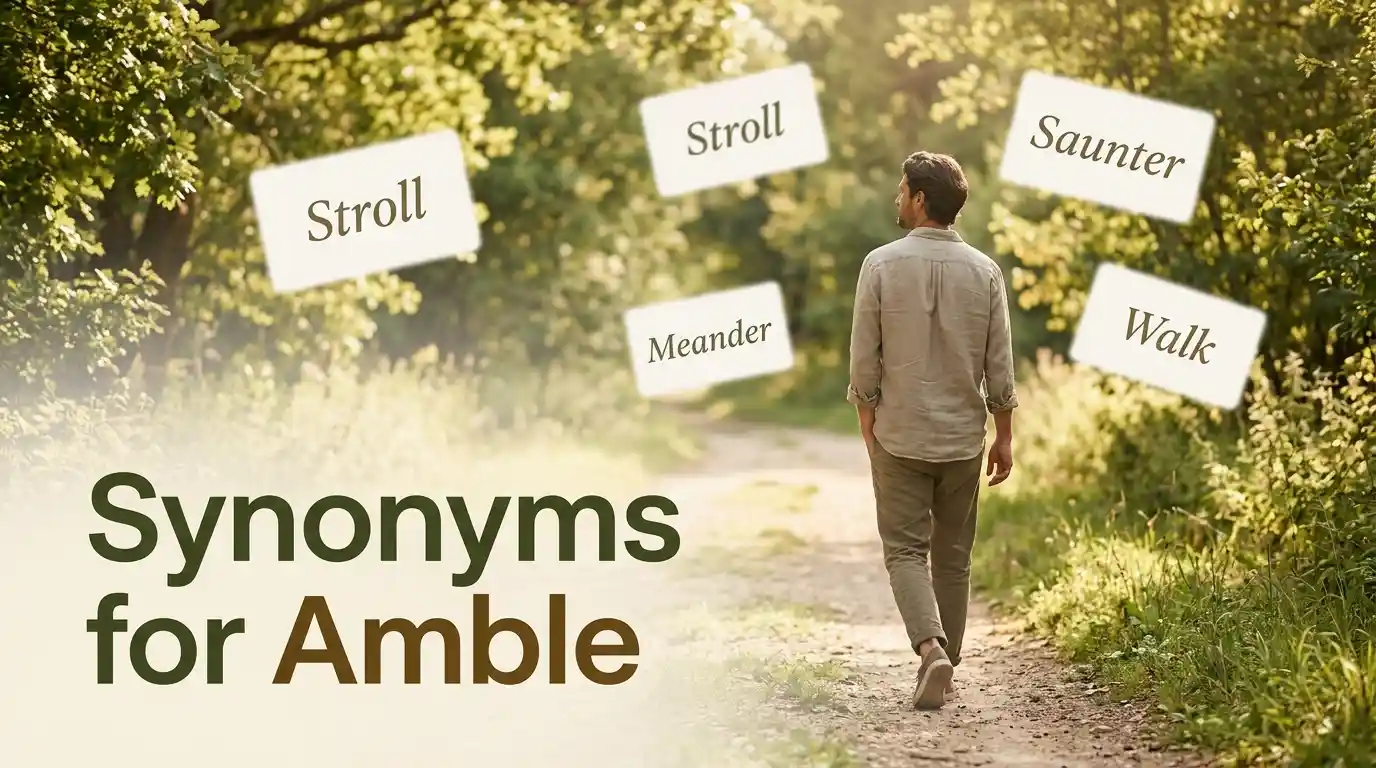
The closest everyday alternatives to amble are stroll, saunter, wander, mosey, and ramble. Amble means to walk in a slow, relaxed way. The best replacement depends on the situation: stroll is usually the closest choice, while wander suggests little direction and saunter can suggest a relaxed, confident manner.
What Does Amble Mean?
Imagine finishing dinner and walking home without checking the time. You are not rushing, and you are not trying to get anywhere quickly. You are simply enjoying the walk.
That is the feeling behind amble.
As a verb, amble means to walk slowly and comfortably. As a noun, it means a slow, relaxed walk. Cambridge gives examples of the verb used with phrases such as amble along and amble down the street, while the noun refers to a slow, relaxed walk.
The closest everyday alternative is usually a stroll. Other choices include saunter, wander, mosey, and ramble, but each one brings a slightly different meaning.
That difference matters. If you are a student, ESL learner, writer, blogger, or professional, knowing the nuance behind a synonym helps you choose the word that actually fits your sentence.
Amble Pronunciation
IPA: /ˈæm.bəl/
Say it like: AM-buhl
The pronunciation is essentially the same in American and British English. Cambridge lists the word with both UK and US pronunciation information.
Part of Speech
Amble can function as both a verb and a noun.
As a verb
It describes the action of walking slowly and comfortably.
- We ambled along the quiet road.
- She ambled through the garden.
As a noun
It describes a slow, relaxed walk.
- We went for an amble after lunch.
- He enjoyed a quiet ambush around the village.
The verb is generally more useful for learners because it appears naturally in descriptive sentences.
Grammar and Common Patterns
Amble is usually an intransitive verb, so it commonly appears with an adverb or preposition that explains where the person is moving.
Common patterns include:
- amble along the path
- amble through the park
- amble down the street
- amble around the town
- amble toward the door
- amble over to the table
- amble back home
Examples
- The couple ambled along the riverbank.
- He ambled over to his friend.
- We ambled through the market before lunch.
Quick Tip: If you want to describe a destination or route, adding a preposition often makes the sentence sound more natural.
The Closest Synonyms at a Glance
| Word | Main idea | Tone | Best use |
| Stroll | Slow, relaxed walking | Pleasant | Everyday English |
| Saunter | Slow, relaxed walking | Casual/confident | Descriptive writing |
| Mosey | Slow, casual movement | Informal | Casual speech |
| Wander | Walking without a clear direction | Neutral | Exploring |
| Ramble | Walking for pleasure | Relaxed | Countryside or longer walks |
| Meander | Following an indirect route | Descriptive | Winding paths |
| Promenade | Leisurely public walking | Formal/literary | Elegant or historical settings |
| Dawdle | Moving slowly and wasting time | Negative | When someone should hurry |
Important: These are not interchangeable in every sentence. The small differences are what make good vocabulary useful.
The Best Synonyms for Amble
1. Stroll
Meaning: To walk slowly and comfortably, often because you are enjoying the walk.
Examples:
- We strolled through the park after dinner.
- She strolled along the waterfront while talking with her friend.
Best used when: You want the most natural everyday alternative.
Register: Neutral
Frequency: Very common
Learner level: Upper-intermediate
Common collocations:
- take a stroll
- stroll through the park
- stroll along the beach
Cambridge defines stroll as walking in a slow, relaxed way, especially for pleasure, making it one of the closest matches for amble.
When not to use it
Do not use stroll when the person is moving because of urgency, exhaustion, or difficulty.
- ❌ He strolled to catch the last train.
- ✅ He hurried to catch the last train.
2. Saunter
Meaning: To walk slowly and casually, often with a relaxed or confident manner.
Examples:
- He sauntered into the café as though he had all afternoon.
- She sauntered across the room and took a seat.
Best used when: The person’s attitude or confidence matters.
Register: Neutral to informal
Frequency: Common
Learner level: Upper-intermediate
Common collocations:
- saunter into
- saunter over
- saunter down the street
Nuance
Saunter is close to amble, but it can make the person sound more self-assured. Cambridge specifically lists amble and stroll among its synonyms.
3. Mosey
Meaning: To move or walk slowly in a relaxed, casual way.
Examples:
- Mosey over when you are ready.
- We moseyed around the town for most of the afternoon.
Best used when: You want an informal, conversational expression.
Register: Informal
Frequency: Common in informal usage
Learner level: Upper-intermediate
Nuance
Mosey sounds more casual than amble. It can work especially well in dialogue.
Cambridge lists mosey as an informal synonym of amble.
When not to use it
Avoid it in formal academic writing unless you deliberately want an informal voice.
4. Wander
Meaning: To walk around without a clear direction, purpose, or destination.
Examples:
- We wandered around the old town for hours.
- She wandered through the market looking at the stalls.
Best used when: The person is exploring freely rather than following a specific route.
Register: Neutral
Frequency: Very common
Learner level: Intermediate
Common collocations:
- wander around
- wander through
- wander off
Nuance
Wander overlaps with amble, but direction is the important difference. Someone can wander quickly, slowly, happily, or even accidentally. Cambridge defines the movement sense as walking around slowly or without a clear purpose or direction.
5. Ramble
Meaning: To walk for pleasure, especially in the countryside or over a relatively long route.
Examples:
- We rambled through the hills on Sunday morning.
- They went for a ramble along the country lanes.
Best used when: You are talking about recreational walking.
Register: Neutral
Frequency: Common
Learner level: Upper-intermediate
Common collocations:
- go for a ramble
- ramble through the countryside
- ramble along a trail
Nuance
Ramble can also describe speech or writing that goes on without a clear structure. Context tells the reader which meaning you intend.
6. Meander
Meaning: To move along a slow, indirect, or winding route.
Examples:
- We meandered through the narrow streets.
- The hikers meandered along the forest trail.
Best used when: The route itself is winding or indirect.
Register: Neutral to literary
Frequency: Common
Learner level: Advanced
Nuance
Meander is not simply a fancy word for walking. It often emphasizes the shape or direction of movement.
7. Promenade
Meaning: To walk leisurely, especially in a public or attractive place.
Examples:
- Visitors strolled along the waterfront.
- Couples promenaded through the gardens.
Best used when: You want a formal, elegant, or literary tone.
Register: Formal/literary
Frequency: Less common
Learner level: Advanced
When not to use it
In ordinary conversation, walk or stroll will usually sound more natural.
8. Dawdle
Meaning: To move slowly because you are wasting time or failing to hurry.
Examples:
- Stop dawdling or we will miss the bus.
- The children dawdled on their way home.
Best used when: Slow movement causes a delay.
Register: Informal to neutral
Frequency: Common
Learner level: Upper-intermediate
Nuance
This is an important distinction.
Amble: slow and relaxed
Dawdle: slow and unnecessarily delayed
So dawdle often has a negative feeling.
9. Roam
Meaning: To move freely around an area without a fixed route.
Examples:
- We roamed around the city until sunset.
- The children were allowed to roam freely in the garden.
Best used when: Freedom of movement matters more than the exact speed.
Register: Neutral
Frequency: Common
Learner level: Upper-intermediate
Nuance
Roam does not necessarily mean slow walking. That is why it is a related word rather than a perfect replacement.
10. Drift
Meaning: To move slowly and without a strong sense of direction or purpose.
Examples:
- She drifted through the quiet streets.
- The visitors gradually drifted toward the exit.
Best used when: Movement feels passive or natural.
Register: Neutral/literary
Frequency: Common
Learner level: Upper-intermediate
Nuance
Drift can describe people, crowds, objects, thoughts, and even smells. It is therefore broader than amble.
Related Words That Are Not Exact Synonyms
Some words appear near amble in a thesaurus because they describe walking or slow movement. That does not mean they can replace it in every sentence.
| Word | Why it is related | Why it is not an exact synonym |
| Trudge | Slow walking | Suggests effort or tiredness |
| Plod | Slow walking | Often suggests heavy, tiring steps |
| Pace | Walking | Usually means walking repeatedly back and forth |
| Loiter | Staying or moving around | Suggests remaining without a clear purpose |
| Toddle | Slow walking | Usually describes a young child’s steps |
| Ambulate | Walking | Mostly formal or medical |
| Sashay | Walking | Emphasizes a noticeable style or manner |
| Traipse | Walking | Often suggests inconvenience or effort |
This distinction is important if you are learning English. A thesaurus gives you related vocabulary, not a promise that every word can be swapped into the same sentence.
Amble vs. Stroll vs. Wander vs. Saunter
These four are easy to confuse.
Amble
Focuses on slow, relaxed movement.
The old man ambled down the lane.
Stroll
Focuses on relaxed walking, often for pleasure.
We strolled through the park.
Wander
Focuses on lack of direction or a fixed destination.
We wandered around the city.
Saunter
Focuses on slow, casual movement, sometimes with confidence.
He sauntered into the room.
Easy rule
If you are unsure, choose:
stroll for a pleasant walk
wander for exploring
saunter for a confident or casual manner
amble for a slow, easy pace
Common Mistakes Learners Make
Common Mistake Box
Mistake 1
❌ She ambled quickly across the road.
Better:
✅ She hurried across the road.
Why?
Amble describes slow, relaxed movement, so quickly creates a strong contradiction.
Mistake 2
❌ He ambled the park.
Better:
✅ He ambled through the park.
Why?
Use a suitable preposition to show the route.
Mistake 3
❌ The emergency worker ambled toward the accident.
Better:
✅ The emergency worker rushed toward the accident.
Why?
The situation requires urgency.
Mistake 4
❌ Using amble and dawdle as exact equivalents.
Better:
Use amble for relaxed movement and dawdle when someone is moving too slowly or wasting time.
American and British English
Amble is standard in both American and British English. The spelling is the same, and the core meaning does not change. Cambridge provides both UK and US pronunciation information.
Some related expressions have stronger regional associations.
- Mosey: informal and especially familiar in American English.
- Pootle: informal British English.
- Stroll: natural in both varieties.
- Saunter: natural in both varieties.
- Wander: natural in both varieties.
For international learners, stroll is one of the safest general alternatives.
Word Origin and Etymology
The word has a long history in English. Merriam-Webster traces amble to Middle English amblen, from Anglo-French and ultimately Latin ambulare, meaning “to walk.”
The word has also been associated historically with a particular easy gait of a horse. Modern English commonly uses the verb for slow, relaxed human movement as well.
For a vocabulary learner, the useful point is that the word has long been connected with walking or moving in an easy manner.
How Formal Is Amble?
Amble is best described as a neutral descriptive word.
It is suitable for:
- everyday writing
- stories
- travel writing
- descriptive essays
- blogs
- general conversation
- literary writing
It is less useful when the situation requires a technical or highly precise description.
For example:
General:
The visitors ambled through the garden.
Medical:
The patient was able to ambulate independently.
The second sentence uses ambulate, but it does not carry the relaxed feeling of amble.
Natural Collocations
Learning words together is often more useful than memorizing isolated definitions.
Common patterns include:
- amble along
- amble down the road
- amble through the park
- amble around town
- amble over to the table
- amble toward the door
- amble back home
- amble into the room
- amble away
- amble across the field
Cambridge’s learner dictionary specifically shows patterns such as amble along, amble around, and amble through.
Good to Know: Native speakers often understand amble from the combination of the verb and the surrounding phrase. Learning these patterns can make your English sound much more natural.
Using the Word in Different Types of Writing
Essays
Use amble when describing movement in a narrative or descriptive essay.
Example:
After class, the students ambled across the quiet campus.
For a purely academic argument, however, amble may not add much value.
Blog Posts
It works especially well in travel, lifestyle, and outdoor writing.
Visitors can amble through the historic district before stopping for coffee.
Stories
It creates a relaxed visual image.
Grandpa ambled toward the garden gate with a basket in his hand.
Emails
It can work in a friendly personal email.
We spent the afternoon ambling around the old town.
It may sound too literary for a short professional email.
Everyday Conversation
You can use amble, but walk and stroll are often more common choices.
Antonyms of Amble
The opposite idea is fast or urgent movement.
Useful antonyms include:
- hurry
- rush
- race
- dash
- sprint
- run
- speed
- hasten
The exact choice depends on the situation.
Hurry means moving faster because there is limited time.
Sprint means running at very high speed for a short distance.
Rush suggests urgency.
A Simple Word Choice Guide
| If you mean… | Choose… |
| Slow and relaxed | Amble |
| Relaxed walk for pleasure | Stroll |
| Casual, confident walk | Saunter |
| Walking without a destination | Wander |
| Informal slow movement | Mosey |
| Recreational country walking | Ramble |
| Winding or indirect movement | Meander |
| Wasting time by moving slowly | Dawdle |
| Difficult, tiring walking | Trudge |
| Repeated walking back and forth | Pace |
| Technical/medical walking | Ambulate |
Practice: Can You Choose the Right Word?
Fill in the blanks
Choose from amble, stroll, wander, dawdle, trudge.
- We decided to ______ along the beach after dinner.
- Stop ______ or we will be late for school.
- The hikers had to ______ through the deep snow.
- We spent the afternoon ______ around the old town.
- After lunch, they ______ through the park.
Answers
- stroll
- dawdle
- trudge
- wandering
- ambled
Rewrite the Sentence
Replace amble with a better word based on the meaning.
1. We ambled through the park because we wanted to enjoy the afternoon.
Answer: We strolled through the park because we wanted to enjoy the afternoon.
2. He ambled into the room with a confident smile.
Answer: He sauntered into the room with a confident smile.
3. They ambled around the city without deciding where to go.
Answer: They wandered around the city without deciding where to go.
4. The hikers ambled through the heavy snow after several hours on the trail.
Answer: The hikers trudged through the heavy snow.
Frequently Asked Questions
What is the closest synonym for amble?
Stroll is usually the closest everyday synonym. Both words describe walking in a slow and relaxed way. However, stroll often suggests walking for pleasure, while amble focuses more directly on the easy, unhurried pace. The right choice depends on the context.
Is stroll the same as amble?
They are very close, but they are not identical in every situation. Both describe slow, relaxed walking. Stroll often carries the idea of enjoying the walk, while amble mainly describes an easy, unhurried manner of walking. In many everyday sentences, either word can work naturally.
What is the difference between amble and wander?
Amble emphasizes a slow and relaxed pace. Wander emphasizes moving without a clear direction or purpose. You can wander slowly, but you can also wander quickly. If the important idea is that someone is taking their time, amble is usually more precise.
Is saunter a synonym for amble?
Yes. Saunter is a close synonym because it describes slow, relaxed walking. It can also suggest a casual or confident manner. For example, He sauntered into the room can make him sound more self-assured than He ambled into the room.
Is mosey a synonym for amble?
Yes. Mosey can mean to walk or move slowly and casually, and Cambridge lists it as an informal synonym of amble. It is best suited to casual speech and informal writing rather than formal academic work.
What is the opposite of amble?
Common opposites include rush, hurry, race, dash, sprint, and hasten. They all describe faster movement, but their meanings differ. Rush suggests urgency, while sprint specifically describes very fast running. Choose the antonym that matches the situation.
Can amble be a noun?
Yes. As a noun, amble means a slow, relaxed walk. For example: We went for an amble after lunch. The noun is less common than the verb, but it is a standard English use. Cambridge lists both noun and verb forms.
Is amble formal English?
Amble is a neutral English word. It is not slang, but it is also not highly formal. It works well in descriptive writing, stories, travel articles, and everyday English. In medical contexts, ambulation may be preferred when the writer needs a technical term rather than a relaxed description.
Final Thoughts
The best way to learn synonyms for amble is not to memorize a huge list. Instead, learn what each word adds to a sentence. Use stroll for a pleasant walk, saunter for a relaxed or confident manner, wander when direction is unclear, and dawdle when someone is moving too slowly. Once you understand these small differences, your writing and speaking become more precise.
Try these words in your next essay, story, conversation, or blog post. The more you use them in real sentences, the easier they become to remember.
Trusted References
- Cambridge Dictionary, Amble: definition, pronunciation, grammar, examples, and related vocabulary.
- Cambridge Dictionary, Stroll: definition, usage, pronunciation, and related words.
- Cambridge Dictionary, Saunter: definition, examples, and synonym relationship with amble.
- Cambridge Dictionary, Wander: meaning and distinction involving direction and purpose.
- Merriam-Webster Dictionary, Amble: etymology, word history, and dictionary information.

Synonorm is a trusted English vocabulary resource created to help readers find the right words and understand the differences between similar terms. We provide clear explanations of synonyms, meanings, examples, usage, and alternatives. Our content makes vocabulary easier to learn and apply in everyday, academic, and professional English. Synonorm is designed for students, writers, ESL learners, professionals, and anyone who wants to improve their English vocabulary and communicate more clearly.