Sometimes, forbidden is exactly the word you need. Other times, it may sound too strong, too formal, or simply not fit the situation.
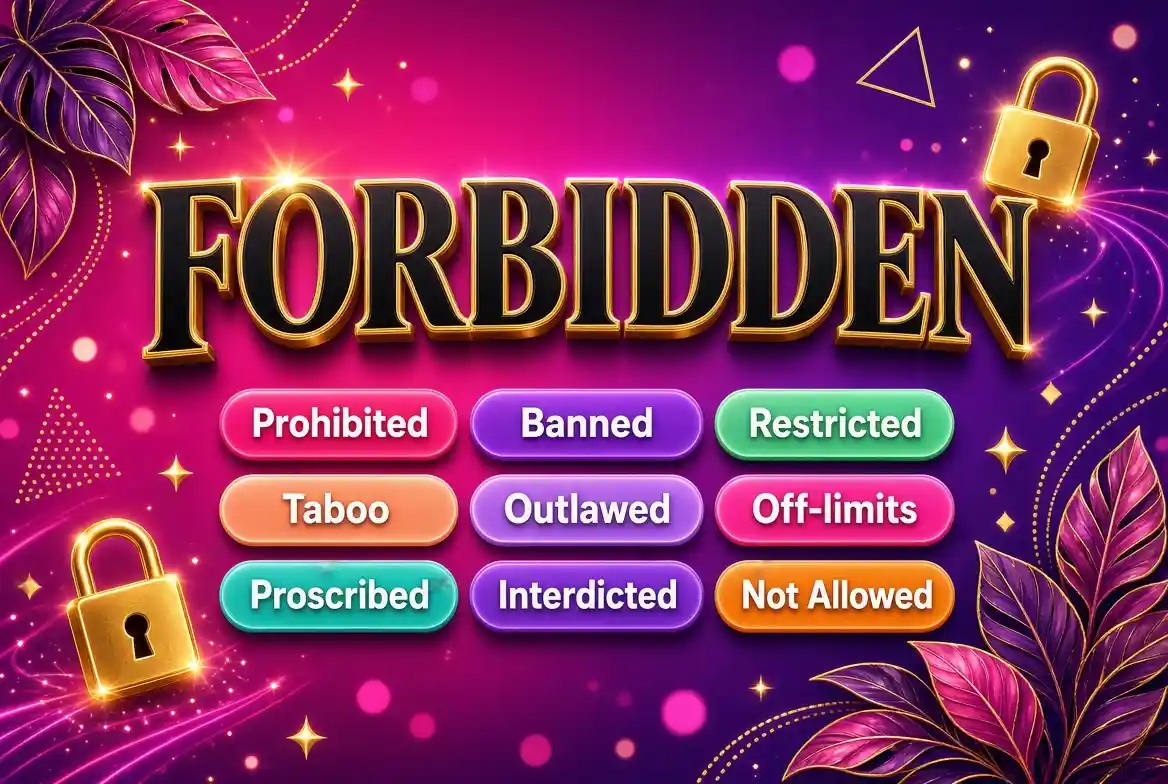
If you are looking for synonyms for forbidden, the closest choices are prohibited, banned, disallowed, not allowed, and not permitted. Other words, such as restricted, illegal, taboo, barred, and off-limits, can express a similar idea but have more specific meanings.
The important thing is not to replace forbidden with any word from a thesaurus. Good vocabulary means choosing a word that matches the meaning, tone, and situation.
This guide will help you do exactly that, with simple definitions, examples, common collocations, usage notes, and comparisons.
Quick Answer
The closest synonyms for forbidden are prohibited, banned, disallowed, not allowed, and not permitted. Depending on the context, barred, off-limits, restricted, illegal, taboo, and outlawed may also work, but each has a slightly different meaning.
What Does Forbidden Mean?
Forbidden means not allowed or not permitted.
It usually tells us that a person, action, place, or thing is subject to a rule or restriction.
For example:
- Smoking is forbidden inside the building.
- Visitors are forbidden from entering the room.
- The students were forbidden to use their phones during the exam.
The word can describe restrictions created by a law, school rule, workplace policy, family rule, social custom, or personal authority.
That is why context matters when choosing an alternative.
Simple meaning
Forbidden = not allowed
Example
Photography is forbidden in the museum.
Possible alternatives include:
Photography is prohibited in the museum.
Photography is not allowed in the museum.
Photography is not permitted in the museum.
All three work, although their tone is slightly different.
Forbidden: Part of Speech
Forbidden is mainly used as an adjective and as the past participle of the verb forbid.
As an adjective
This is a forbidden area.
As a past participle
Visitors are forbidden from entering.
The verb forms are:
- forbid: present
- forbade: past
- forbidden: past participle
- forbidding: -ing form
Common grammar patterns
be forbidden to + verb
Students are forbidden to leave early.
be forbidden from + -ing
Students are forbidden from leaving early.
A common learner mistake is:
❌ Students are forbidden to leaving.
Correct:
✅ Students are forbidden to leave.
Or:
✅ Students are forbidden from leaving.
Pronunciation
British English: /fəˈbɪdn/
American English: /fərˈbɪdn/
A simple pronunciation guide is:
fuh-BID-n
There is no major spelling difference between American and British English. Both are forbidden.
The pronunciation can sound slightly different because of regional accents, but the word itself is the same.
Word Origin
Forbidden comes from the verb forbid, which has roots in Old English.
The Old English verb forbēodan carried the idea of prohibiting or ordering someone not to do something.
The modern word developed over many centuries and remains one of the common ways to express the idea of something being not allowed.
The word has been used in English since the Middle English period.
The Best Synonyms for Forbidden
Not all alternatives have exactly the same meaning. The following are the most useful choices.
| Word or phrase | How close is it? | Best context | Register |
| Prohibited | Very close | Rules and official notices | Formal |
| Banned | Very close | Official decisions | Neutral |
| Not allowed | Exact everyday equivalent | Daily English | Neutral |
| Not permitted | Very close | Rules and instructions | Formal/Neutral |
| Disallowed | Close | Rules, sports, systems | Formal/Neutral |
| Barred | Context-dependent | Access or participation | Formal/Neutral |
| Off-limits | Context-dependent | Places and subjects | Informal/Neutral |
| Restricted | Related | Limited access or use | Formal/Neutral |
| Illegal | Context-dependent | Law | Neutral/Formal |
| Outlawed | Context-dependent | Made illegal | Formal |
| Taboo | Context-dependent | Social or cultural rules | Neutral |
| Illicit | Context-dependent | Secret or unlawful activity | Formal |
Key point: The first five are the safest replacements. The others should be chosen according to the exact meaning of your sentence.
1. Prohibited
Prohibited is probably the best formal synonym for forbidden.
It means that something is officially not allowed, usually because of a rule, regulation, policy, or law.
Examples
- Smoking is prohibited inside the hospital.
- The use of cameras is prohibited during the examination.
Best used when
You are talking about official rules or regulations.
Tone
Formal and official
Common collocations
- strictly prohibited
- prohibited by law
- prohibited activities
- prohibited items
When not to use it
Avoid it when you are talking about a very casual personal rule.
My brother prohibited me from eating his cookies.
This sounds overly formal. My brother wouldn’t let me eat his cookies, which sounds more natural.
2. Banned
Banned means officially stopped or not allowed.
It is very common in everyday English and news writing.
Examples
- The school banned mobile phones during exams.
- The government banned the product.
Best used when
An authority has officially decided that something cannot be used, sold, done, or participated in.
Tone
Neutral and direct
Common collocations
- banned from school
- banned product
- banned substance
- officially banned
- recently banned
When not to use it
Don’t use banned when something is merely discouraged.
If a teacher says:
Please avoid talking during the test.
Talking is discouraged, but it may not be formally banned.
3. Not Allowed
For everyday English, not allowed is one of the easiest alternatives.
Examples
- You are not allowed to park here.
- Children are not allowed to enter this room.
Best used when
You want to communicate clearly and simply.
Tone
Neutral and conversational
Why learners should know it
This phrase is much more common in ordinary conversation than words such as proscribed or interdicted.
Instead of trying to sound sophisticated, choose the phrase that sounds natural.
You are not allowed to smoke here.
This is perfectly good English.
4. Not Permitted
Not permitted has almost the same meaning as not allowed, but it often sounds more formal.
Examples
- Food is not permitted in the laboratory.
- Visitors are not permitted beyond this point.
Best used when
Writing signs, instructions, workplace policies, or formal messages.
Tone
Formal but clear
Common collocations
- not permitted to enter
- not permitted inside
- not permitted by policy
When not to use it
It may sound too formal in relaxed conversation.
5. Disallowed
Disallowed means that something is not accepted under a particular rule or system.
Examples
- The referee disallowed the goal.
- The website automatically rejects disallowed content.
Best used when
A rule, system, competition, or authority rejects something.
Tone
Neutral/Formal
Common collocations
- disallowed goal
- disallowed action
- disallowed expense
- disallowed content
Important nuance
Disallowed often focuses on a specific rule or decision.
That makes it especially useful in sports, finance, technology, and formal procedures.
6. Barred
Barred means prevented from entering, participating, or doing something.
Examples
- He was barred from entering the building.
- The player was barred from participating in the competition.
Best used when
The emphasis is on exclusion.
Tone
Formal/Neutral
Common collocations
- barred from entry
- barred from participating
- barred from the competition
Important difference
If something is forbidden, the action itself may be prohibited.
If someone is barred, the focus is often on the person being prevented from access or participation.
7. Off-Limits
Off-limits means that a place, subject, or activity is not available or permitted.
Examples
- The basement is off-limits to visitors.
- Personal questions were off-limits during the interview.
Best used when
Talking about restricted places or subjects in everyday English.
Tone
Informal/Neutral
Common collocations
- off-limits area
- off-limits topic
- completely off-limits
When not to use it
Avoid it in highly formal legal writing.
8. Restricted
Restricted is related to forbidden, but it does not always mean completely prohibited.
This distinction is important.
Examples
- Access to the laboratory is restricted.
- This information is restricted to authorized employees.
Someone with permission may still be able to enter a restricted area.
Best used when
Access, use, or availability is limited.
Tone
Formal/Neutral
Remember
Forbidden = not allowed
Restricted = allowed only under certain conditions
That is why they are not always interchangeable.
9. Illegal
Illegal means against the law.
Examples
- It is illegal to drive without a valid license.
- The police investigated an illegal business operation.
Best used when
A law specifically prohibits the action.
Important difference
Something can be forbidden without being illegal.
For example:
Students are forbidden to use phones during the exam.
That does not mean using a phone during an exam is necessarily illegal.
It may simply violate school rules.
10. Outlawed
Outlawed means officially made illegal.
Examples
- The government outlawed the practice.
- The law outlawed the sale of the product.
Best used when
You want to emphasize that a law has made something illegal.
Tone
Formal
Difference from forbidden
Forbidden is broad.
Outlawing specifically connects the restriction to the law.
11. Taboo
Taboo describes something that a society, culture, or group considers unacceptable or inappropriate.
Examples
- In some families, talking about money is taboo.
- The writer explored a taboo subject.
Best used when
The restriction comes from social or cultural expectations.
Important difference
A taboo is not necessarily illegal.
Something can be:
- socially taboo but legal
- legally forbidden but not socially taboo
This makes taboo a related word rather than a universal replacement for forbidden.
12. Illicit
Illicit means illegal, unauthorized, or not legally permitted.
It often carries an additional sense of secrecy or wrongdoing.
Examples
- The investigation uncovered an illicit trade.
- Police discovered an illicit financial operation.
Best used when
Writing about illegal or secret activities.
Common collocations
- illicit trade
- illicit activity
- illicit funds
- illicit relationship
When not to use it
Do not use it for ordinary rules.
❌ Illicit food is not allowed in the classroom.
Better:
✅ Food is not allowed in the classroom.
Strongest Choices vs. Everyday Choices
If you want a quick answer, use this guide.
For everyday English
Use:
- not allowed
- banned
- off-limits
For formal writing
Use:
- prohibited
- not permitted
- disallowed
For legal contexts
Use:
- prohibited
- illegal
- unlawful
- outlawed
For social or cultural contexts
Use:
- taboo
- off-limits
For restricted access
Use:
- barred
- restricted
- off-limits
Forbidden vs. Prohibited
These two words are very close.
| Forbidden | Prohibited |
| Broad and flexible | More official |
| Common in everyday and literary English | Common in rules and regulations |
| Can describe social or personal restrictions | Often describes official restrictions |
| The area is forbidden | Entry is prohibited |
Example
Visitors are forbidden from entering.
Visitors are prohibited from entering.
Both are correct. The second sounds more official.
Forbidden vs. Banned
Banning usually suggests an official decision to stop something.
The school banned phones.
Forbidden can be broader.
My parents forbade me from going there.
So banned often sounds like an authority has made a formal decision, while forbidden can describe many kinds of restrictions.
Forbidden vs. Restricted
This is one of the most important differences.
Forbidden means no permission.
Restricted means limited permission.
Compare:
Entry is forbidden.
No one is supposed to enter.
Entry is restricted to employees.
Employees can enter, but other people cannot.
Forbidden vs. Illegal
These words should not be treated as exact synonyms.
Forbidden means not allowed.
Illegal means against the law.
A school rule, company policy, or family rule can forbid something without making it illegal.
Example
Wearing headphones during the exam is forbidden.
This does not automatically mean:
Wearing headphones during the exam is illegal.
Forbidden vs. Taboo
Forbidden can refer to an actual rule.
Taboo usually refers to social or cultural expectations.
Compare:
Smoking is forbidden inside the building.
Talking openly about the subject is taboo in that community.
The first concerns a rule. The second concerns social attitudes.
Common Collocations with Forbidden
Native speakers commonly use forbidden with phrases such as:
- strictly forbidden
- absolutely forbidden
- completely forbidden
- forbidden area
- forbidden territory
- forbidden activity
- forbidden practice
- forbidden subject
- forbidden fruit
- forbidden knowledge
Examples
Smoking is strictly forbidden.
The hikers entered forbidden territory.
The novel deals with a forbidden subject.
The phrase forbidden fruit has a special figurative meaning. It describes something that seems especially attractive because it is not allowed.
Common Mistakes
Common Mistake Box
Mistake 1
❌ This activity is illegal by school rules.
Better
✅ This activity is forbidden by school rules.
Why? School rules are not necessarily laws.
Mistake 2
❌ Visitors are forbidden to entering the room.
Correct
✅ Visitors are forbidden to enter the room.
Or:
✅ Visitors are forbidden from entering the room.
Mistake 3
❌ The area is restricted, so nobody can enter.
Better
✅ The area is restricted, so only authorized people can enter.
Why? Restricted does not always mean completely closed.
Mistake 4
❌ Talking about salaries is illegal in our office.
Better
✅ Talking about salaries is not allowed in our office.
Why? A workplace rule does not automatically create a law.
How to Use These Words in Your Writing
Essays
Formal alternatives often work best.
The government prohibited the practice.
The policy restricted access to the information.
Avoid using rare vocabulary simply to make your essay sound advanced.
Emails
Choose polite, clear language.
Please note that outside food is not permitted in the meeting room.
This sounds more professional than:
Outside food is forbidden!
Blog Posts
Use familiar vocabulary first.
Good choices include:
- banned
- prohibited
- not allowed
- off-limits
Readers should understand the sentence immediately.
Professional Communication
Use prohibited, restricted, and not permitted when appropriate.
Access to confidential files is restricted to authorized staff.
This is clearer than using an obscure synonym.
Stories and Creative Writing
Forbidden can create a stronger emotional or mysterious feeling.
She knew she was entering forbidden territory.
Here, forbidden does more than communicate a rule. It adds a sense of danger, curiosity, or mystery.
Register and Frequency Guide
| Word | Frequency | Register | Main Nuance |
| Forbidden | Very common | Neutral | General prohibition |
| Prohibited | Very common | Formal | Official restriction |
| Banned | Very common | Neutral | Officially stopped |
| Not allowed | Very common | Spoken/Neutral | Simple prohibition |
| Not permitted | Very common | Formal/Neutral | Official permission |
| Disallowed | Common | Formal/Neutral | Rejected under a rule |
| Barred | Common | Formal/Neutral | Prevented from access |
| Restricted | Very common | Formal/Neutral | Limited access |
| Illegal | Very common | Legal/Neutral | Against the law |
| Taboo | Common | Neutral | Socially unacceptable |
| Off-limits | Common | Informal/Neutral | Closed or unavailable |
| Outlawed | Common | Formal | Made illegal |
| Illicit | Common | Formal | Illegal or unauthorized |
A Simple Synonym Selection Rule
Before replacing forbidden, ask one question:
Why is it not allowed?
If the answer is:
Because of an official rule:
Use prohibited or not permitted.
Because an authority stopped it:
Use banned.
Because a rule rejected it:
Use disallowed.
Because someone cannot enter or participate:
Use barred.
Because access is limited:
Use restricted.
Because the law says no:
Use illegal or outlawed.
Because society considers it unacceptable:
Use taboo.
Because a place or subject is closed to someone:
Use off-limits.
This simple question will help you choose a better word than a basic thesaurus search.
Mini Practice
Fill in the blanks
Choose from:
prohibited | banned | restricted | illegal | taboo
- Smoking is strictly ________ inside the hospital.
- The government ________ the product last year.
- Access to the database is ________.
- The activity is ________ under national law.
- In that culture, the subject is considered ________.
Answers
- prohibited
- banned
- restricted
- illegal
- taboo
Rewrite the Sentences
Replace forbidden with the most natural alternative.
1.
Parking is forbidden here.
Possible answer:
Parking is prohibited here.
2.
Students are forbidden from using phones.
Possible answer:
Students are not allowed to use phones.
3.
Visitors are forbidden from entering the private area.
Possible answer:
Visitors are barred from entering the private area.
4.
The subject was forbidden to discuss.
Possible answer:
The subject was considered taboo.
Notice that the best replacement changes according to the intended meaning.
Frequently Asked Questions
What are the best synonyms for forbidden?
The closest alternatives are prohibited, banned, disallowed, not allowed, and not permitted. Other words, including restricted, barred, illegal, taboo, and off-limits, may work in specific situations but do not have exactly the same meaning.
What is a simple synonym for forbidden?
The simplest everyday synonym is not allowed. It is clear, natural, and easy for English learners to use. For example, “You are not allowed to park here” means almost the same thing as “Parking is forbidden here.”
Is prohibited stronger than forbidden?
Not necessarily. Both can describe something that is not allowed. However, prohibited often sounds more official because it is common in laws, regulations, policies, signs, and formal instructions.
Is banned the same as forbidden?
They are very similar, but banned often suggests an official decision to stop something. Forbidden is broader and can describe rules made by governments, schools, parents, organizations, or social groups.
What is the difference between forbidden and restricted?
Forbidden normally means something is not allowed. Restricted means something is limited or controlled. A restricted area may be open to authorized people, while a forbidden area may be closed to everyone.
What is the difference between forbidden and illegal?
Forbidden means not allowed, while illegal means against the law. Something can be forbidden by a school, company, or parent without being illegal under government law.
Is taboo a synonym for forbidden?
Taboo is a related word, but it usually refers to something considered socially or culturally unacceptable. It does not necessarily mean that the action is against the law or formally prohibited.
What is the opposite of forbidden?
Common opposites include allowed, permitted, acceptable, authorized, approved, legal, and unrestricted. The best opposite depends on the sentence and the type of restriction being discussed.
Final Takeaway
The best synonyms for forbidden depend on the reason something is not allowed.
Use not allowed for simple everyday English. Choose prohibited for formal rules, banned for official decisions, restricted for limited access, illegal for actions against the law, and taboo for social or cultural restrictions.
You do not need to memorize every word in a thesaurus. Learn the small differences between common choices, then practice using them in real sentences. That will make your writing more natural, precise, and confident.
Sources for Verification
- Oxford Learner’s Dictionaries
- Merriam-Webster Dictionary
- Cambridge Dictionary
- Collins Dictionary
- Britannica Dictionary

Synonorm is a trusted English vocabulary resource created to help readers find the right words and understand the differences between similar terms. We provide clear explanations of synonyms, meanings, examples, usage, and alternatives. Our content makes vocabulary easier to learn and apply in everyday, academic, and professional English. Synonorm is designed for students, writers, ESL learners, professionals, and anyone who wants to improve their English vocabulary and communicate more clearly.