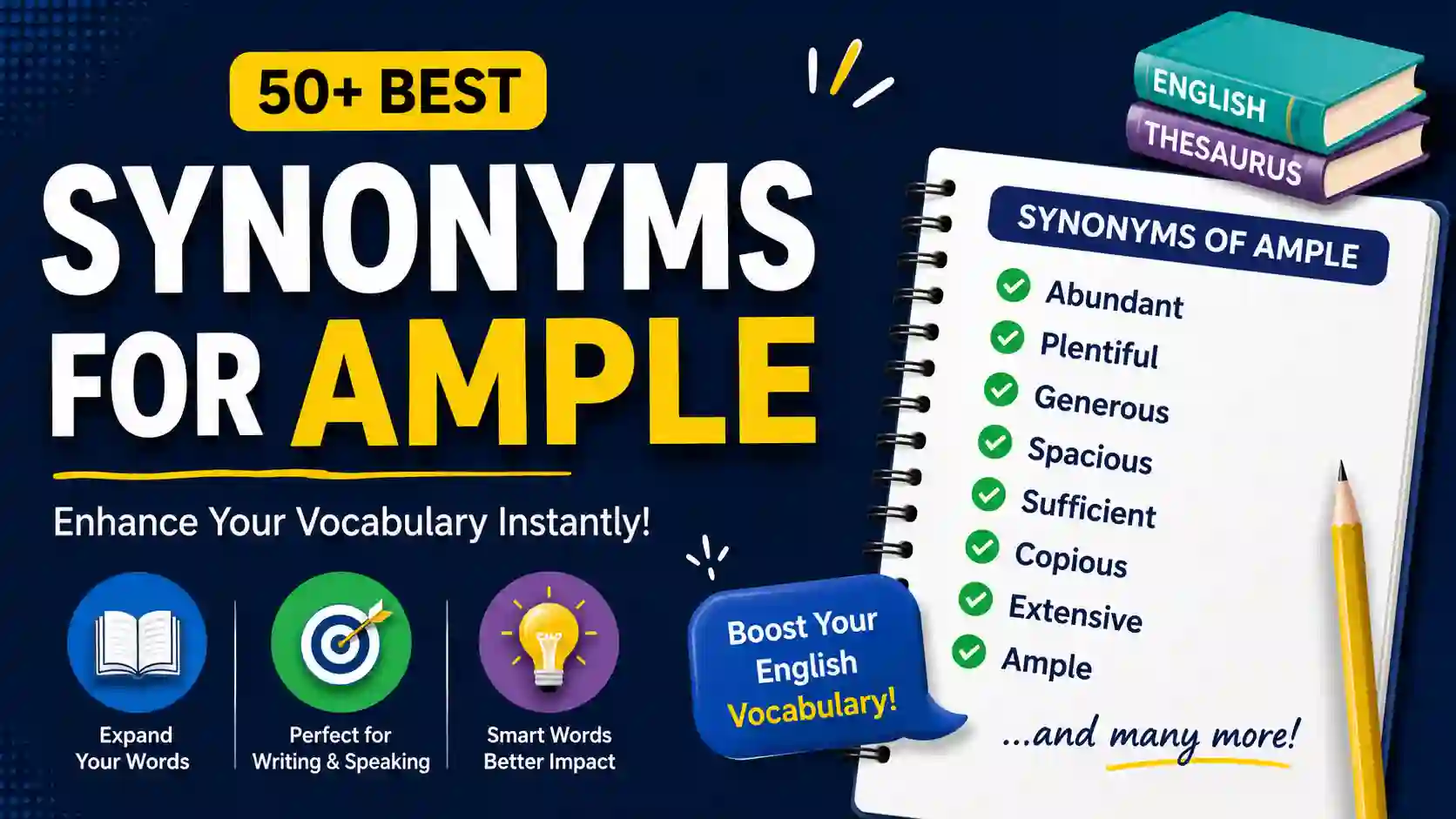
Looking for the best synonyms for example? The closest choices are plentiful, abundant, sufficient, enough, generous, substantial, copious, bountiful, and plenty of. However, they are not perfect substitutes in every sentence.
Ample usually means enough or more than enough for a particular need or purpose. For example, We have ample time means we have enough time, with a comfortable amount left over. For physical space, words such as spacious, roomy, and capacious may be better choices. For a very large supply, abundant or copious may be stronger.
This guide explains the closest synonyms for example, their differences, formality, natural collocations, common mistakes, and the best word to choose in different situations.
Quick Answer
The closest general synonyms for ample are plentiful, sufficient, enough, abundant, generous, and plenty of. Choose sufficient when you mean “enough to meet a requirement,” abundant when you mean “a very large supply,” and spacious when you are describing physical space.
What Does Ample Mean?
Ample is an adjective meaning enough or more than enough. It can describe time, space, money, evidence, resources, opportunity, food, supplies, and other things that can exist in a measurable amount.
Examples
- We have ample time to finish the work.
- The report contains ample evidence.
- There is ample space for another table.
- The students had ample opportunity to practice.
- The company has ample resources for the project.
The important idea is not simply “large.”
It is large enough for the purpose, often with some extra.
Compare:
We have enough time.
This says the time meets the need.
We have ample time.
This sounds more reassuring. It suggests that there is enough time, probably with room to spare.
Cambridge, Collins, and Merriam-Webster all emphasize this idea of sufficiency plus additional room or quantity.
Ample Pronunciation
IPA: /ˈæm.pəl/
Pronunciation: AM-puhl
The pronunciation is essentially the same in American and British English.
Part of Speech
Ample is mainly an adjective.
Adjective
We have ample evidence.
Adverb: Amply
The project was amply funded.
Noun: Ampleness
The ampleness of the space made the room comfortable.
Comparative and Superlative
- ampler
- amplest
These forms exist, although everyday writers often choose phrases such as more ample or simply use a different adjective.
The Two Main Meanings of Ample
This is an important point that many synonym articles overlook.
1. Enough or More Than Enough
This is the most common meaning.
There is ample evidence to support the conclusion.
2. Large in Size or Figure
Ample can also describe someone’s body or figure, especially in literary or humorous contexts.
The character was described as having an ample figure.
Cambridge marks this use as humorous, while Oxford notes that it can describe a person’s figure as large, often in an attractive way.
Do not automatically replace this meaning with “abundant.”
The correct synonym depends on the context.
Grammar: How to Use Ample Correctly
The most common pattern is:
ample + noun
Examples:
- ample time
- ample space
- ample evidence
- ample opportunity
- ample resources
- ample money
- ample room
- ample warning
Correct
We have ample time.
Incorrect
We have ample time.
In this meaning, time is uncountable, so an is unnecessary.
Another Common Error
❌ There is ample of space.
✅ There is ample space.
However:
✅ There is plenty of space.
This distinction is important because plenty of examples follow different grammatical patterns.
Quick Comparison: The Best Synonyms for Ample
| Word | Basic Meaning | Best Context | Register |
| Enough | Meets the need | Everyday English | Neutral |
| Sufficient | Meets a requirement | Academic/business | Formal |
| Plentiful | Available in large supply | Resources/supplies | Neutral |
| Abundant | Available in very large supply | Resources/nature | Formal/neutral |
| Generous | More than normally expected | Amounts/portions/time | Neutral |
| Substantial | Large or significant | Money/evidence/investment | Formal |
| Plenty of | More than enough | Everyday speech | Neutral/informal |
| Copious | Very large quantity | Writing/data/notes | Formal |
| Bountiful | Rich and abundant | Harvest/food/nature | Literary |
| Spacious | Lots of physical room | Buildings/rooms | Neutral |
| Roomy | More physical room | Cars/rooms | Informal |
| Capacious | Able to hold a lot | Containers/spaces | Formal |
| Vast | Extremely large | Areas/amounts | Formal/literary |
| Extensive | Large in range or scope | Experience/research | Formal |
| Replete | Filled with something | Books/articles | Formal |
25 Useful Synonyms and Near-Synonyms for Ample
1. Enough
Meaning: As much as is needed.
Example:
We have enough food for everyone.
Best used when: You want the simplest everyday alternative.
Register: Neutral
Frequency: Very common
Learner level: A1–A2
Nuance: Unlike ample, enough does not necessarily imply extra.
2. Sufficient
Meaning: Enough to meet a particular need or requirement.
Examples:
- We have sufficient evidence to continue.
- The students received sufficient training.
Best used when: Writing academically, professionally, or formally.
Register: Formal
Frequency: Very common
Learner level: B2
Nuance: More requirement-focused than ample.
Common collocations:
- sufficient evidence
- sufficient funds
- sufficient time
3. Plentiful
Meaning: Available in a large supply.
Examples:
- Fresh fruit is plentiful during summer.
- The region has plentiful water supplies.
Best used when: Talking about supplies, resources, food, or natural things.
Register: Neutral
Frequency: Common
Learner level: B2
Nuance: Focuses on quantity rather than whether a particular requirement has been met.
4. Abundant
Meaning: Existing in a very large or rich supply.
Examples:
- The country has abundant natural resources.
- The forest provides abundant food for wildlife.
Best used when: You want stronger emphasis than ample.
Register: Formal/neutral
Frequency: Common
Learner level: B2
Merriam-Webster describes abundance as suggesting an even greater or richer supply than plentiful.
5. Generous
Meaning: Larger than normally expected or required.
Examples:
- The company gave employees a generous amount of time.
- Add a generous portion of rice to the bowl.
Best used when: Talking about amounts, portions, offers, time, or support.
Register: Neutral
Frequency: Very common
Learner level: B1
Nuance: Often carries a positive feeling of generosity.
6. Plenty of
Meaning: More than enough.
Examples:
- We have plenty of time.
- There are plenty of restaurants nearby.
Best used when: Speaking naturally and casually.
Register: Neutral/informal
Frequency: Very common
Learner level: A2
Important Grammar
✅ plenty of time
❌ plenty time
Unlike ample, plenty normally takes off before a noun.
7. Substantial
Meaning: Large, important, or significant in amount.
Examples:
- The company made a substantial investment.
- Researchers found substantial evidence.
Best used when: Discussing money, evidence, change, investment, or impact.
Register: Formal/business
Frequency: Common
Learner level: B2
Nuance: It focuses on size or significance, not simply sufficiency.
8. Copious
Meaning: Existing in a very large amount.
Examples:
- The researcher took copious notes.
- The report contains copious data.
Best used when: Writing about notes, information, writing, evidence, or quantities.
Register: Formal/academic
Frequency: Uncommon
Learner level: C1
Nuance: It emphasizes a large quantity, sometimes to the point of excess.
9. Bountiful
Meaning: Rich, plentiful, and generous.
Examples:
- The farmers celebrated a bountiful harvest.
- The region has bountiful agricultural land.
Best used when: Discussing harvests, nature, food, or blessings.
Register: Literary
Frequency: Uncommon
Learner level: C1
10. Spacious
Meaning: Having plenty of physical room.
Examples:
- The apartment has a spacious kitchen.
- We booked a spacious conference room.
Best used when: Describing rooms, houses, offices, cars, or other physical areas.
Register: Neutral
Frequency: Common
Learner level: B1–B2
Do Not Use It Like This
❌ spacious evidence
❌ spacious time
Use ample instead:
✅ ample evidence
✅ ample time
11. Roomy
Meaning: Having plenty of physical space.
Examples:
- The car is surprisingly roomy.
- We found a roomy apartment.
Best used when: Speaking about rooms, cars, bags, or physical spaces.
Register: Informal
Frequency: Common
Learner level: B2
Nuance: More conversational than spacious.
12. Capacious
Meaning: Able to contain a large amount.
Examples:
- She carried everything in a capacious bag.
- The archive has a capacious storage facility.
Best used when: Talking about containers, storage, or physical capacity.
Register: Formal
Frequency: Rare
Learner level: C1–C2
Merriam-Webster specifically distinguishes capacious from spacious: capacious emphasizes the ability to hold or contain more than average.
13. Extensive
Meaning: Large in range, area, or scope.
Examples:
- She has extensive teaching experience.
- The researchers conducted extensive testing.
Best used when: Discussing research, experience, knowledge, damage, or coverage.
Register: Formal
Frequency: Common
Learner level: B2
14. Vast
Meaning: Extremely large.
Examples:
- The internet contains a vast amount of information.
- They crossed a vast area of desert.
Best used when: The size is extremely large.
Important: Vast is not a direct replacement for ample in many sentences.
ample time ≠ vast time
15. Rich
Meaning: Containing a large amount of something valuable or useful.
Examples:
- The soil is rich in nutrients.
- The book provides a rich source of information.
Best used when: Talking about nutrients, information, culture, experience, or resources.
Register: Neutral
Frequency: Very common
16. Lavish
Meaning: More generous or plentiful than necessary or expected.
Examples:
- The guests received lavish praise.
- The hotel offered lavish accommodations.
Best used when: Describing spending, praise, decoration, hospitality, or generosity.
Nuance: Can imply extravagance, so it is not always a neutral synonym for ample.
17. Profuse
Meaning: Existing in a very large or excessive amount.
Examples:
- The author received profuse praise.
- The plant produced profuse flowers.
Register: Formal/literary
Frequency: Uncommon
Nuance: Often stronger than ample and may suggest excess.
18. Replete
Meaning: Full of something.
Examples:
- The article is replete with useful examples.
- The museum is replete with historical artifacts.
Best used when: Something contains many features, details, examples, or references.
Register: Formal/literary
Frequency: Uncommon
19. Voluminous
Meaning: Very large in amount, size, or volume.
Examples:
- The lawyer reviewed voluminous records.
- The author left behind voluminous correspondence.
Best used when: Talking about documents, records, writing, or physical volume.
Register: Formal
Frequency: Uncommon
20. Commodious
Meaning: Large, comfortable, and providing plenty of room.
Example:
They moved into a commodious house.
Best used when: Describing comfortable physical spaces in formal or literary writing.
Register: Literary/formal
Frequency: Rare
Merriam-Webster notes that commodious stresses roominess and comfort, which makes it different from ample.
The Best Synonym Depends on the Noun
This is one of the most useful rules to remember.
| Original Phrase | Best Alternative | Why |
| ample time | plenty of time | Natural everyday English |
| ample time | sufficient time | Formal requirement |
| ample evidence | sufficient evidence | Meets evidential requirement |
| ample evidence | substantial evidence | Strong/significant evidence |
| ample resources | abundant resources | Large supply |
| ample food | plentiful food | Large supply |
| ample space | spacious | Physical room |
| ample room | roomy | Casual physical description |
| ample storage | capacious storage | Holding capacity |
| ample experience | extensive experience | Broad experience |
| ample opportunity | plenty of opportunities | Natural conversational style |
| ample funding | substantial funding | Significant financial amount |
Ample vs Enough vs Sufficient vs Adequate
These four words are among the most important to understand.
Enough
Means the amount meets the need.
We have enough money.
Sufficient
Means enough to meet a particular requirement.
We have sufficient funds to complete the project.
Adequate
Means satisfactory or sufficient for a particular purpose.
The room has adequate lighting.
Ample
Means enough, usually with some extra.
We have ample funding for the project.
Easy Memory Rule
Enough = meets the need
Sufficient = meets the requirement
Adequate = acceptable for the purpose
Ample = enough with comfortable extra
Ample vs Plentiful vs Abundant vs Copious
These words are close, but their emphasis differs.
Ample
Focus: sufficient amount
We have ample supplies.
Plentiful
Focus: large supply
Supplies are plentiful.
Abundant
Focus: very rich or large supply
The region has abundant resources.
Copious
Focus: very large quantity
The researcher took copious notes.
Merriam-Webster explicitly distinguishes these degrees of abundance, with ample emphasizing generous sufficiency, plentiful a rich supply, abundant an even greater/richer supply, and copious the largeness of the supply.
Ample vs Spacious vs Roomy vs Capacious
These words are particularly easy to confuse.
Ample space
Enough or more than enough space.
Spacious room
A room that feels large and open.
Roomy car
A car with comfortable interior space.
Capacious bag
A bag capable of holding a lot.
So:
The office has ample space.
The office is spacious.
Both can be correct, but they emphasize slightly different things.
Common Mistakes With Ample
Common Mistake
Mistake 1
❌ We have an ample time.
✅ We have ample time.
Mistake 2
❌ There is ample of evidence.
✅ There is ample evidence.
Mistake 3
❌ The report has spacious evidence.
✅ The report has ample evidence.
Mistake 4
❌ We have plenty time.
✅ We have plenty of time.
Mistake 5
❌ The room has abundant space.
This is grammatically possible, but ample space or plenty of space is usually more natural when the intended meaning is simply “more than enough space.”
Natural Collocations With Ample
Native and professional English frequently uses ample with certain nouns.
Very Natural
- ample time
- ample opportunity
- ample evidence
- ample space
- ample room
- ample resources
- ample supply
- ample warning
- ample support
- ample funding
- ample experience
- ample information
Cambridge’s dictionary and corpus examples show recurring combinations including ample evidence, ample opportunity, ample space, ample time, ample warning, ample supply, and ample resources.
Writing Tip: Learning collocations is often more useful than memorizing isolated synonyms. Instead of memorizing “ample = plentiful,” learn phrases such as ample time, ample evidence, and ample opportunity.
When Not to Use Ample
Do not use ample simply because something is physically large.
For example:
The mountain is ample.
This is unnatural if you simply mean “large.”
Use:
The mountain is huge.
Similarly:
The building is ample.
may sound unusual when you simply want to describe its size.
Better:
The building is spacious.
Use ample when sufficiency or generous quantity is part of the meaning.
Formality and Frequency Guide
| Word | Register | Frequency | Main Idea |
| enough | Neutral | Very common | Meets need |
| plenty | Spoken/neutral | Very common | More than enough |
| ample | Formal/neutral | Common | Generously sufficient |
| sufficient | Formal | Very common | Meets requirement |
| adequate | Formal | Common | Satisfactory enough |
| plentiful | Neutral | Common | Large supply |
| abundant | Formal/neutral | Common | Very large supply |
| generous | Neutral | Very common | More than expected |
| substantial | Formal/business | Common | Large/significant |
| extensive | Formal | Common | Large scope |
| spacious | Neutral | Common | Lots of physical room |
| copious | Formal/academic | Uncommon | Very large quantity |
| bountiful | Literary | Uncommon | Rich abundance |
| profuse | Formal/literary | Uncommon | Excessive abundance |
| capacious | Formal | Rare | Large holding capacity |
| commodious | Literary | Rare | Spacious and comfortable |
CEFR Learner Guide
CEFR levels can vary by vocabulary list and learning resource, so treat these as approximate learner guidance, not official classifications.
A1–A2
Start with:
- enough
- plenty
B1
Add:
- generous
- large
- spacious
B2
Learn:
- ample
- sufficient
- adequate
- plentiful
- abundant
- substantial
- extensive
C1–C2
Explore:
- copious
- profuse
- bountiful
- capacious
- replete
- commodious
- voluminous
American vs British English
Ample is used in both American and British English.
There is no major spelling difference:
American: ample
British: ample
The pronunciation is also essentially the same.
The main difference is often the choice of register, not spelling.
For casual conversation, speakers in both varieties may prefer:
We have plenty of time.
In formal writing, this may become:
We have ample time.
Oxford, Cambridge, and Collins all recognize ample in standard English usage.
Word Origin and First Known Use
Ample comes from Middle English through French from Latin amplus, meaning large, wide, or abundant. Oxford traces it through French to Latin amplus, while Merriam-Webster records the first known English use in the 15th century.
This history connects naturally with the modern meanings of:
- large
- extensive
- abundant
- sufficient
- more than enough
The modern word therefore carries both ideas of size and sufficiency.
Synonym Decision Guide
When you want to replace ample, ask yourself one question:
What exactly am I trying to emphasize?
If you mean “enough”
Use:
enough / sufficient
If you mean “more than enough”
Use:
plenty of / ample
If you mean “a large supply”
Use:
plentiful
If you mean “a very large supply”
Use:
abundant
If you mean “a very large quantity”
Use:
copious
If you mean “large and significant”
Use:
substantial
If you mean “large physical space”
Use:
spacious
If you mean “comfortable physical space”
Use:
roomy
If you mean “able to hold a lot”
Use:
capacious
If you mean “large range or scope”
Use:
extensive
This decision system is more useful than simply memorizing a long thesaurus list.
Mini Practice: Choose the Right Word
Exercise 1: Fill in the Blank
Choose from:
ample, sufficient, spacious, abundant, copious
- The hotel room was large and ______.
- We have ______ evidence to support the claim.
- The country has ______ natural resources.
- The researcher made ______ notes.
- There is ______ time to finish the assignment.
Answers
- spacious
- sufficient
- abundant
- copious
- ample
Exercise 2: Rewrite the Sentence
Replace ample with the best natural alternative.
1.
We have ample time.
Possible answer:
We have plenty of time.
2.
The company has ample resources.
Possible answer:
The company has abundant resources.
3.
The room has ample space.
Possible answer:
The room is spacious.
4.
We have ample evidence.
Possible answer:
We have sufficient evidence.
Notice that several answers may work depending on the intended nuance.
Exercise 3: Match the Word
| Word | Best Description |
| 1. Sufficient | A. Very large quantity |
| 2. Spacious | B. Enough for a requirement |
| 3. Abundant | C. Large physical space |
| 4. Capacious | D. Able to hold a lot |
| 5. Copious | E. Very rich supply |
Answer Key
- B
- C
- E
- D
- A
Vocabulary Quiz
1. Which word is closest to the core meaning of ample?
A. Scarce
B. Sufficient
C. Tiny
D. Limited
2. Which word is best for a large physical room?
A. Copious
B. Spacious
C. Sufficient
D. Abundant
3. Which sentence is grammatically correct?
A. We have ample time.
B. We have ample time.
C. We have ample time.
D. We have a lot of spare time.
4. Which word usually suggests a richer or greater supply than plentiful?
A. Enough
B. Abundant
C. Adequate
D. Roomy
5. Which word best describes a bag that can hold a lot?
A. Capacious
B. Sufficient
C. Extensive
D. Adequate
Answer Key
- B
- B
- C
- B
- A
Frequently Asked Questions
What is the best synonym for ample?
The best general synonyms are plentiful, sufficient, abundant, enough, generous, and plenty of. However, the correct choice depends on context. Use spacious for physical space, substantial for significant amounts, and copious for very large quantities.
Is ample the same as enough?
Not exactly. Enough means that the amount meets the need. Ample usually means enough or more than enough, often suggesting a comfortable amount of extra time, space, evidence, money, or resources.
Is abundant stronger than ample?
Usually, yes. Abundant emphasizes a very large or rich supply, while ample emphasizes generous sufficiency. For example, ample food means enough food, while abundant food emphasizes a very large supply.
What is the difference between ample and sufficient?
Sufficient means enough to meet a particular requirement. Ample generally means enough with some additional room or quantity. “Sufficient evidence” focuses on meeting the evidential requirement, while “ample evidence” sounds more reassuring and generous.
What is the opposite of ample?
Common opposites include insufficient, inadequate, limited, scarce, scant, sparse, meager, and restricted. The best antonym depends on context. For example, ample resources can contrast with limited resources.
Is plenty of a synonym for ample?
Yes. Plenty of is a natural conversational alternative to ample. For example, “We have ample time” and “We have plenty of time” have very similar meanings. The main difference is register: plenty of is more conversational.
Is spacious a synonym for ample?
Only in certain contexts. Spacious describes a place with plenty of physical room, while ample can describe time, evidence, money, opportunity, resources, and space. Therefore, spacious is a context-specific alternative rather than a universal synonym.
Is there ample formal English?
Yes. Ample is common in formal, academic, professional, and written English. It can also appear in everyday speech, but speakers often choose enough or plenty in casual conversation.
Final Takeaway
The most important thing about synonyms for example is that a thesaurus list alone is not enough. The right word depends on what you want to communicate. Use enough for simple everyday English, sufficient for requirements, plentiful for large supplies, abundant for very rich supplies, substantial for significant amounts, and spacious for physical room.
Use ample when you want to communicate a particularly useful idea: there is enough, and there is comfortably more than the minimum. Practice these distinctions in essays, emails, reports, conversations, and professional writing. Once you learn the difference between the words, your vocabulary becomes not just larger, but much more precise.
References
- Cambridge Dictionary: Ample
- Merriam-Webster: Ample
- Merriam-Webster Thesaurus: Ample
- Collins Dictionary: Ample
- Oxford Learner’s Dictionaries: Ample

Synonorm is a trusted English vocabulary resource created to help readers find the right words and understand the differences between similar terms. We provide clear explanations of synonyms, meanings, examples, usage, and alternatives. Our content makes vocabulary easier to learn and apply in everyday, academic, and professional English. Synonorm is designed for students, writers, ESL learners, professionals, and anyone who wants to improve their English vocabulary and communicate more clearly.