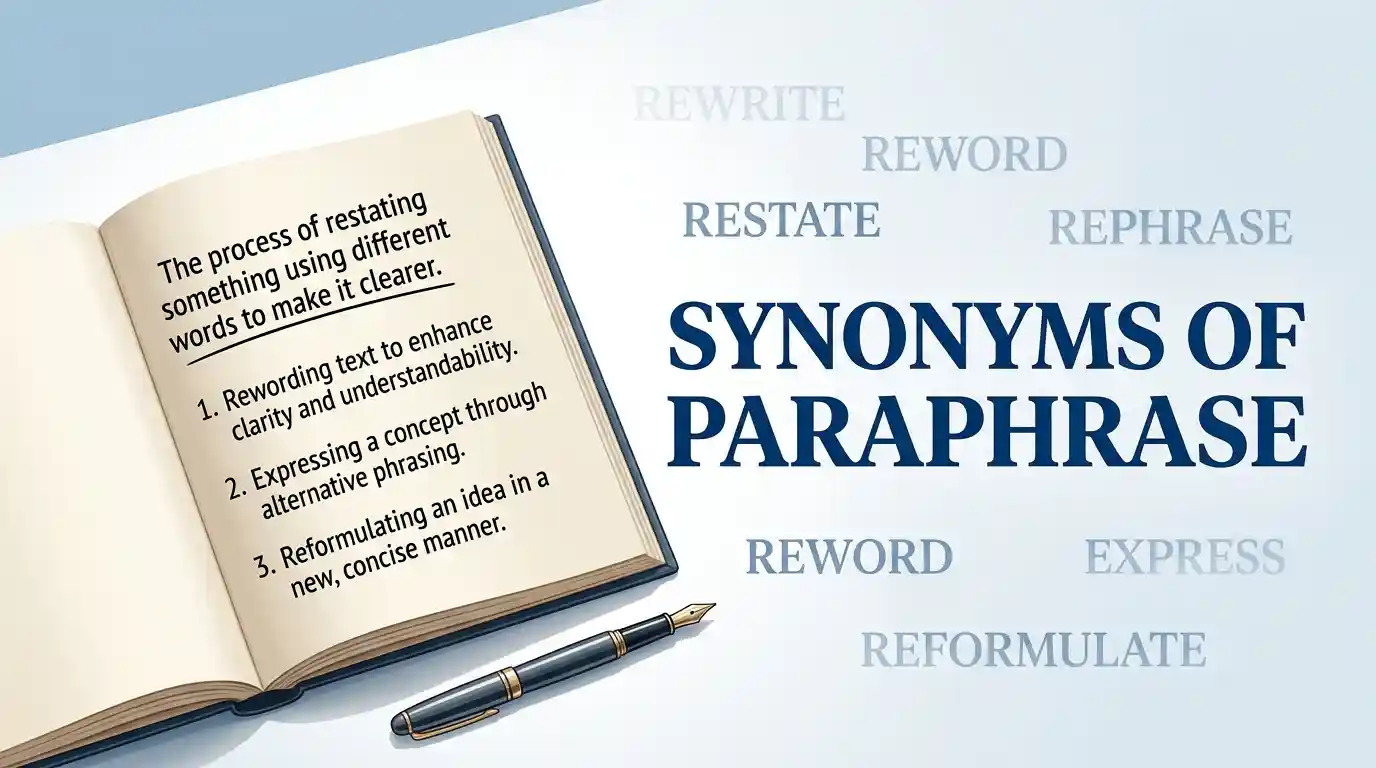
What are the best synonyms of paraphrase? The closest synonyms are rephrase, reword, restate, state in other words, and express in your own words. These words describe changing the wording while keeping the original idea. Other words, such as summarize, simplify, interpret, and translate, are related but have different meanings and should not always replace paraphrase.
Whether you are a student, teacher, blogger, content writer, or English learner, choosing the right alternative can make your writing clearer and more natural.
Quick Answer: What Is Another Word for Paraphrase?
The best everyday synonyms for paraphrase are rephrase, reword, restate, state in other words, and express in your own words. Use summarize when you want to shorten information, simplify when you want to make it easier to understand, and interpret when you are explaining meaning. These related words are not exact substitutes in every sentence.
What Does Paraphrase Mean?
To paraphrase means to express something that someone has written or said using different words while keeping its original meaning.
For example:
Original:
The store closed early because of severe weather.
Paraphrase:
The shop shut earlier than usual because the weather was very bad.
The wording changed, but the basic idea stayed the same.
Paraphrasing is especially useful in academic writing, teaching, journalism, blogging, and everyday conversation. When you tell a friend what another person said without repeating the exact words, you are usually paraphrasing.
Merriam-Webster defines paraphrase as a restatement that gives the meaning of a text or passage in another form. Collins similarly defines the verb as expressing something someone said or wrote in a different way.
Remember: A good paraphrase changes the language without changing the original idea.
Pronunciation of Paraphrase
American English: /ˈper.əˌfreɪz/
British English: /ˈpær.əˌfreɪz/
Easy pronunciation: PAIR-uh-frayz
The noun and verb have the same pronunciation.
There is no major American-British spelling difference. The word is spelled paraphrase in both varieties.
Part of Speech
Paraphrase can function as both a noun and a verb.
As a noun
It means a statement that expresses an original idea in different words.
This paragraph is a clear paraphrase of the author’s argument.
As a verb
It means to express something differently while preserving its meaning.
Please paraphrase the sentence in your own words.
Word family
- paraphrase: noun and verb
- paraphrased: past tense
- paraphrasing: present participle
- paraphraser: someone who paraphrases
- paraphrastic: relating to paraphrase
Grammar and Usage of Paraphrase
The verb is normally followed by the thing being expressed differently.
Common patterns
- paraphrase a sentence
- paraphrase a passage
- paraphrase an argument
- paraphrase what someone said
- paraphrase something in your own words
- paraphrase something for clarity
Examples
Can you paraphrase this paragraph?
The teacher asked us to paraphrase the article.
She paraphrased his explanation in simpler language.
A useful pattern is:
paraphrase + object + in your own words
Paraphrase the statement in your own words.
Synonyms of Paraphrase at a Glance
| Synonym | How Close? | Main Use | Register |
|---|---|---|---|
| Rephrase | Exact/very close | Change wording | Neutral |
| Reword | Exact/very close | Change words | Neutral |
| Restate | Exact/very close | State again differently | Formal/Neutral |
| State in other words | Exact/very close | Explain differently | Neutral |
| Express in your own words | Exact/very close | Student/academic writing | Neutral |
| Put differently | Very close | Clarification | Neutral |
| Rewrite | Close | Change written text | Neutral |
| Reformulate | Close | Change form or wording | Formal |
| Recast | Close/related | Present in a new form | Formal |
| Summarize | Related | Make shorter | Neutral |
| Simplify | Related | Make easier | Neutral |
| Explain | Related | Make meaning clear | Neutral |
| Interpret | Related | Explain meaning | Formal/Neutral |
| Translate | Related | Change language | Neutral |
| Recap | Related | Give main points briefly | Informal |
| Reiterate | Related | Repeat for emphasis | Formal |
| Rehash | Related | Repeat old material | Informal/Negative |
Merriam-Webster and Cambridge both identify reword, rephrase, and restate among the closest alternatives, while also listing related terms such as summarize, recap, and reiterate.
1. Rephrase
Meaning: To express something again using different words.
Examples:
- Could you rephrase the question for the younger students?
- I rephrased the email to make it sound more polite.
Best used when: You want to change wording, especially to make an idea clearer.
Tone: Neutral
Register: Spoken, academic, professional
Frequency: Very common
Learner level: Around B1-B2
Common collocations:
- rephrase a question
- rephrase a sentence
- rephrase an idea
When not to use it: Do not use rephrase when your main goal is to remove most of the original information. Use summarize instead.
2. Reword
Meaning: To change the words used to express an idea.
Examples:
- Please reword this sentence before you publish the article.
- The teacher reworded the instructions for the class.
Best used when: You are focusing on the actual wording.
Tone: Neutral
Register: Everyday, academic, business
Frequency: Very common
Learner level: Around B1
Common collocations:
- reword a sentence
- reword an email
- reword a question
Nuance: Reword is often slightly more focused on changing vocabulary than changing the whole structure.
3. Restate
Meaning: To say or write something again in a different way.
Examples:
- Let me restate the main point.
- The conclusion restates the author’s central argument.
Best used when: You want a clear and somewhat formal alternative to rephrase.
Tone: Neutral/Formal
Register: Academic, business, formal speech
Frequency: Common
Learner level: Around B2
Common collocations:
- restate an argument
- restate the question
- restate the main point
Nuance: Restate emphasizes saying something again, while rephrase often emphasizes changing the wording.
4. State in Other Words
Meaning: To express the same idea differently.
Examples:
- Can you state the rule in other words?
- The teacher stated the difficult concept in other words.
Best used when: Teaching or explaining language to learners.
Tone: Neutral
Register: Educational, spoken, academic
Frequency: Common phrase
Why learners should know it: It is simple, natural, and easy to understand.
Cambridge specifically includes state in other words and state in one’s own words among its alternatives for paraphrase.
5. Express in Your Own Words
Meaning: To communicate an idea without copying the original wording.
Examples:
- Explain the passage in your own words.
- The students expressed the author’s idea in their own words.
Best used when: Giving instructions to students or discussing academic writing.
Tone: Neutral
Register: Academic, educational
Frequency: Common phrase
Important academic point: Putting something “in your own words” does not automatically make it your own original idea. When you use another person’s ideas in academic work, you generally still need to acknowledge the source. University writing guides emphasize this point.
6. Put Differently
Meaning: To introduce the same idea in another way.
Examples:
- Put differently, the company needs more time.
- Put differently, the rule applies only to new members.
Best used when: Clarifying something you have just said.
Tone: Neutral
Register: Academic, professional, spoken
Frequency: Common
Useful pattern:
Put differently, + explanation
This phrase is especially useful in essays and presentations.
7. Rewrite
Meaning: To write something again, often with significant changes.
Examples:
- I rewrote the introduction after receiving feedback.
- The editor asked the writer to rewrite the paragraph.
Best used when: More than simple word changes are needed.
Tone: Neutral
Register: All common registers
Frequency: Very common
Paraphrase vs. rewrite
A paraphrase should stay close to the original meaning. A rewrite can change structure, style, tone, organization, and sometimes content.
8. Reformulate
Meaning: To express an idea in a different form.
Examples:
- The researcher reformulated the question.
- The lawyer reformulated the argument to make it more precise.
Best used when: The context is academic, scientific, technical, or formal.
Tone: Formal
Register: Academic, technical
Frequency: Uncommon
When not to use it: It may sound unnecessarily technical in casual conversation.
9. Recast
Meaning: To present something in a new form or structure.
Examples:
- The editor recast the article for a younger audience.
- The author recast the argument in simpler terms.
Best used when: The presentation or structure changes, not just individual words.
Tone: Formal
Register: Academic, literary, professional
Frequency: Uncommon
Nuance: Recast is broader and more structural than reword.
10. Summarize
Meaning: To give the main points of something in a shorter form.
Examples:
- Please summarize the article in 100 words.
- She summarized the report before the meeting.
Best used when: You need a shorter version.
Tone: Neutral
Register: Academic, professional, everyday
Frequency: Very common
Is summarize an exact synonym of paraphrase?
No.
This is one of the most important distinctions for students.
A paraphrase usually keeps the important details of a particular passage while changing the wording.
A summary reduces the material and focuses on its main ideas.
The University of Minnesota, University of Toronto, and other academic writing guides make this distinction clearly.
11. Simplify
Meaning: To make something easier to understand.
Examples:
- The teacher simplified the scientific explanation.
- The website simplifies complicated legal information.
Best used when: Your main goal is clarity.
Tone: Neutral
Register: Educational, professional, everyday
Frequency: Very common
Nuance: A simplified version may change wording and remove complexity. It is therefore related to paraphrasing but not always identical to it.
12. Explain
Meaning: To make an idea or subject easier to understand.
Examples:
- Can you explain this paragraph in simple English?
- The guide explains the concept with an example.
Best used when: You need to add clarification.
Tone: Neutral
Register: All registers
Frequency: Very common
Learner level: A2+
Important: An explanation can add information, examples, opinions, or interpretation. A strict paraphrase should preserve the original meaning more closely.
13. Interpret
Meaning: To explain the meaning or significance of something.
Examples:
- Different readers may interpret the poem differently.
- The professor interpreted the statement in a new way.
Best used when: Meaning or significance needs analysis.
Tone: Neutral/Formal
Register: Academic, literary, professional
Frequency: Common
When not to use it: Do not use interpret simply because you changed the wording. Interpretation can involve analysis or judgment.
14. Translate
Meaning: To express something in another language.
Examples:
- She translated the article from Spanish into English.
- The guide translated the technical terms into plain English.
Best used when: Moving between languages or converting specialist language into accessible language.
Tone: Neutral
Register: All registers
Frequency: Very common
Paraphrase vs. translate
Paraphrase: English → different English wording
Translate: English → another language
The two concepts can overlap in some dictionary definitions, which explains why thesauruses sometimes list translate near paraphrase. But they are not interchangeable in ordinary usage. Merriam-Webster and Collins both show this broader dictionary relationship.
15. Recap
Meaning: To give a short review of the main points.
Examples:
- Let’s recap what we learned today.
- Can you recap the meeting for me?
Best used when: You want a brief review.
Tone: Informal
Register: Spoken, casual business
Frequency: Common
Nuance: A recap is usually shorter than a paraphrase.
16. Reiterate
Meaning: To say something again, usually to emphasize it.
Examples:
- The manager reiterated the company’s safety rules.
- She reiterated her concerns about the deadline.
Best used when: Repetition and emphasis matter.
Tone: Formal
Register: Business, academic, formal
Frequency: Common
Important: Reiterate does not necessarily mean that you changed the wording.
17. Rehash
Meaning: To present an old idea again, often without adding anything new.
Examples:
- The article simply rehashes an argument readers already know.
- The meeting became a rehash of last week’s discussion.
Best used when: You want to criticize repetitive or unoriginal material.
Tone: Informal, negative
Register: Spoken, informal writing
When not to use it: Never use rehash as a neutral replacement for paraphrase. It can suggest boredom, repetition, or lack of originality.
Cambridge labels rehash as slang in its synonym list.
The Closest Synonyms of Paraphrase
If you need a true, natural replacement, use:
1. Rephrase
Best all-purpose choice.
2. Reword
Best when you are focusing on wording.
3. Restate
Best for formal and academic writing.
4. State in other words
Best for learners and explanations.
5. Express in your own words
Best for educational and academic instructions.
6. Put differently
Best for clarifying an argument.
These choices are also strongly supported by major thesaurus resources.
Paraphrase vs. Its Related Words
| Word | Keeps Meaning? | Changes Length? | Main Purpose |
|---|---|---|---|
| Paraphrase | Yes | Usually similar | Change wording |
| Rephrase | Yes | Usually similar | Change wording/clarify |
| Reword | Yes | Usually similar | Change words |
| Restate | Yes | Usually similar | State again |
| Rewrite | Usually | May change | Improve or alter text |
| Summarize | Yes | Much shorter | Give main points |
| Simplify | Usually | May shorten | Make easier |
| Interpret | Not necessarily | May vary | Explain meaning |
| Translate | Yes, ideally | May vary | Change language |
| Reiterate | Yes | Usually similar | Repeat for emphasis |
| Recap | Main points | Shorter | Review |
This distinction is particularly important in academic writing. Academic writing centers consistently explain that paraphrases and summaries serve different purposes: a paraphrase generally preserves more detail, while a summary condenses the source to its essential ideas.
Common Mistakes With Paraphrase
Common Mistake Box
Mistake 1: Changing only a few words
Mistake:
Replacing several words with synonyms while keeping the same sentence structure.
Correction:
Read the original, understand the idea, put it aside, and write the idea naturally in a new structure.
Academic writing guidance specifically warns against simply using a thesaurus to replace individual words.
Mistake 2: Thinking paraphrasing removes the need for citation
Mistake:
I used my own words, so I don’t need to cite the source.
Correction:
If the idea comes from another source, acknowledge that source according to the citation style you are using.
Paraphrasing changes the wording, not ownership of the underlying idea.
Mistake 3: Calling every shorter version a paraphrase
If you remove most of the details and keep only the central message, you are probably summarizing.
Mistake 4: Using “interpret” when you only mean “reword”
Interpretation can involve analysis. If you simply changed the wording, rephrase or reword is usually better.
How to Choose the Right Synonym
Ask yourself one question:
What exactly am I trying to change?
Change the wording?
Use rephrase or reword.
Repeat the idea formally?
Use restate.
Make it shorter?
Use summarize.
Make it easier?
Use simplify.
Explain what it means?
Use interpret or explain.
Change the language?
Use translate.
Repeat a point for emphasis?
Use reiterate.
Review the main points?
Use recap.
Criticize repetitive material?
Use rehash.
Paraphrase Synonyms for Different Writing Situations
For Essays
Best choices:
- paraphrase
- restate
- rephrase
- put differently
- express in your own words
Example:
The researcher restates the problem from a different perspective.
For Emails
Best choices:
- rephrase
- reword
- clarify
- explain
Example:
Could you rephrase your request so I can understand exactly what you need?
For Blog Posts
Best choices:
- rephrase
- simplify
- explain
- put differently
Example:
Put differently, the new rule affects only first-time users.
For Business Writing
Best choices:
- restate
- rephrase
- reformulate
- clarify
For Conversations
Natural choices include:
- Say that another way.
- Can you rephrase that?
- What do you mean?
- Can you explain that?
- In other words…
Connotation and Nuance
Not all synonyms feel the same.
Rephrase sounds helpful and neutral.
Reword sounds practical and direct.
Restate sounds more formal.
Simplify suggests that the original was difficult.
Interpret suggests analysis.
Recap sounds casual.
Reiterate sounds formal and often emphasizes importance.
Rehash usually has a negative meaning.
Understanding these differences is more useful than memorizing a long list of interchangeable words.
Frequency and Register Guide
| Word | Frequency | Register | Connotation |
|---|---|---|---|
| Rephrase | Very common | Neutral | Helpful |
| Reword | Very common | Neutral | Practical |
| Restate | Common | Formal/Neutral | Precise |
| Rewrite | Very common | Neutral | Broad |
| Simplify | Very common | Neutral | Accessible |
| Explain | Very common | Neutral | Helpful |
| Summarize | Very common | Academic/Neutral | Informative |
| Interpret | Common | Formal/Neutral | Analytical |
| Reiterate | Common | Formal | Emphatic |
| Recap | Common | Informal | Casual |
| Reformulate | Uncommon | Formal | Technical |
| Recast | Uncommon | Formal | Structural |
| Rehash | Uncommon | Informal | Negative |
Word Origin and First Known Use
Paraphrase comes from a long linguistic history involving Greek, Latin, and French before entering English.
Merriam-Webster gives the word’s first known use as 1548 for the noun. Its dictionary history also records the verb from the sixteenth century. The word ultimately connects to Greek forms associated with expressing something through different wording.
This history fits the modern meaning well: the central idea has always involved expressing existing content in another form.
American vs. British English
There is no important spelling difference:
American: paraphrase
British: paraphrase
Pronunciation differs slightly:
American: /ˈper.əˌfreɪz/
British: /ˈpær.əˌfreɪz/
The main vocabulary choices discussed in this article are also widely understood in both varieties of English.
CEFR Learner Guide
CEFR levels are approximate because vocabulary resources do not always assign exactly the same level to every word.
| Word | Approximate Level | Difficulty |
|---|---|---|
| Explain | A2 | Easy |
| Translate | A2-B1 | Easy/Intermediate |
| Rewrite | B1 | Intermediate |
| Reword | B1 | Intermediate |
| Rephrase | B1-B2 | Intermediate |
| Summarize | B1-B2 | Intermediate |
| Restate | B2 | Upper-intermediate |
| Interpret | B2 | Upper-intermediate |
| Reiterate | C1 | Advanced |
| Reformulate | C1 | Advanced |
| Recast | C1 | Advanced |
| Recapitulate | C1-C2 | Advanced |
For most English learners, rephrase, reword, restate, summarize, and simplify are the most useful words to learn first.
Useful Collocations
Native speakers commonly use paraphrase with:
- paraphrase a sentence
- paraphrase a passage
- paraphrase an argument
- paraphrase an idea
- paraphrase a statement
- paraphrase a question
- paraphrase what someone said
- paraphrase in your own words
- paraphrase for clarity
- paraphrase a source
These combinations are more useful for learners than memorizing isolated synonyms.
Mini Practice: Fill in the Blanks
Choose from:
rephrase | summarize | restate | translate | simplify
- Please ______ the paragraph in your own words.
- Can you ______ this question? I don’t understand it.
- Please ______ the report into three sentences.
- The teacher asked me to ______ the rule in simpler language.
- She had to ______ the document from French into English.
Answers
- restate / rephrase
- rephrase
- summarize
- simplify
- translate
Sentence Rewriting Practice
Replace the underlined idea with the word in parentheses.
1.
Can you say this sentence in a different way?
(rephrase)
2.
The student gave the main points of the article.
(summarize)
3.
The manager said the main rule again.
(restate)
4.
The teacher made the technical explanation easier.
(simplify)
Answers
- Can you rephrase this sentence?
- The student summarized the article.
- The manager restated the main rule.
- The teacher simplified the technical explanation.
Matching Activity
Match each word to its best description.
| Word | Description |
|---|---|
| 1. Rephrase | A. Make shorter |
| 2. Summarize | B. Change wording |
| 3. Translate | C. Change language |
| 4. Reiterate | D. Repeat for emphasis |
| 5. Simplify | E. Make easier |
Answer Key
1-B, 2-A, 3-C, 4-D, 5-E
FAQ: Synonyms of Paraphrase
What is the closest synonym for paraphrase?
The closest everyday synonyms are rephrase, reword, and restate. All three describe expressing an existing idea in different words. Rephrase is especially natural when the goal is clarity, reword focuses on changing wording, and restate often sounds more formal.
Is rephrase the same as paraphrase?
They are very close and can often be used interchangeably. Both involve expressing an idea differently while preserving its meaning. However, rephrase often highlights a change in wording or clarity, while paraphrase is commonly used for restating a passage, statement, or source in your own language.
Is summarize a synonym for paraphrase?
Summarize is a related term, but it is not an exact synonym. A summary reduces material to its main points, while a paraphrase normally preserves more of the original detail while changing its wording. Academic writing guides consistently make this distinction.
What is a formal synonym for paraphrase?
Restate is one of the best formal alternatives. Reformulate and recast can also work in academic or professional contexts, although they can suggest a broader change in structure or form. For most essays, restate is more natural than these advanced alternatives.
What is a simple synonym for paraphrase?
For beginners, say in other words, rephrase, and express in your own words are excellent choices. They clearly communicate the basic idea without using advanced vocabulary.
What is the difference between paraphrase and reword?
Both mean changing the wording of an idea. Reword focuses strongly on changing the actual words, while paraphrase usually means expressing the meaning of a passage or statement in a different form. In many everyday sentences, the two can be interchangeable.
What is the difference between paraphrase and rewrite?
A paraphrase normally keeps the original meaning and stays relatively close to the source. A rewrite can make broader changes to structure, style, tone, organization, and wording. Therefore, rewrite is a wider term.
Does paraphrasing prevent plagiarism?
Not automatically. A proper academic paraphrase must genuinely express the source’s idea in new language and structure, and the original source normally still needs to be acknowledged. Simply replacing a few words with synonyms can remain too close to the source.
Final Takeaway
The best synonyms of paraphrase are rephrase, reword, restate, state in other words, and express in your own words. Related terms such as summarize, simplify, interpret, translate, and reiterate can be useful, but they describe different goals.
Do not choose a synonym simply because it appears in a thesaurus. Choose the word that matches your purpose. If you are changing wording, use rephrase or reword. If you are shortening information, summarize is better. If you are making an idea easier, use simplify. Good vocabulary is not about using the biggest word. It is about choosing the right word.
Trusted References
- Merriam-Webster, Paraphrase and Synonyms of Paraphrase
- Cambridge Dictionary, Paraphrase and Thesaurus
- Collins English Dictionary, Paraphrase
- University of Minnesota, Identifying Quoting, Paraphrasing and Summarizing
- University of Toronto Writing Advice, Paraphrase and Summary

Synonorm is a trusted English vocabulary resource created to help readers find the right words and understand the differences between similar terms. We provide clear explanations of synonyms, meanings, examples, usage, and alternatives. Our content makes vocabulary easier to learn and apply in everyday, academic, and professional English. Synonorm is designed for students, writers, ESL learners, professionals, and anyone who wants to improve their English vocabulary and communicate more clearly.