Have you ever written anyway and then wondered, “Is there a better word I can use here?” The answer is yes, but there is one important catch: anyway does not have one perfect synonym for every situation.
You might use it to mean despite that, in any case, besides, or to move a conversation back to an earlier point. The best replacement depends on the meaning you want.
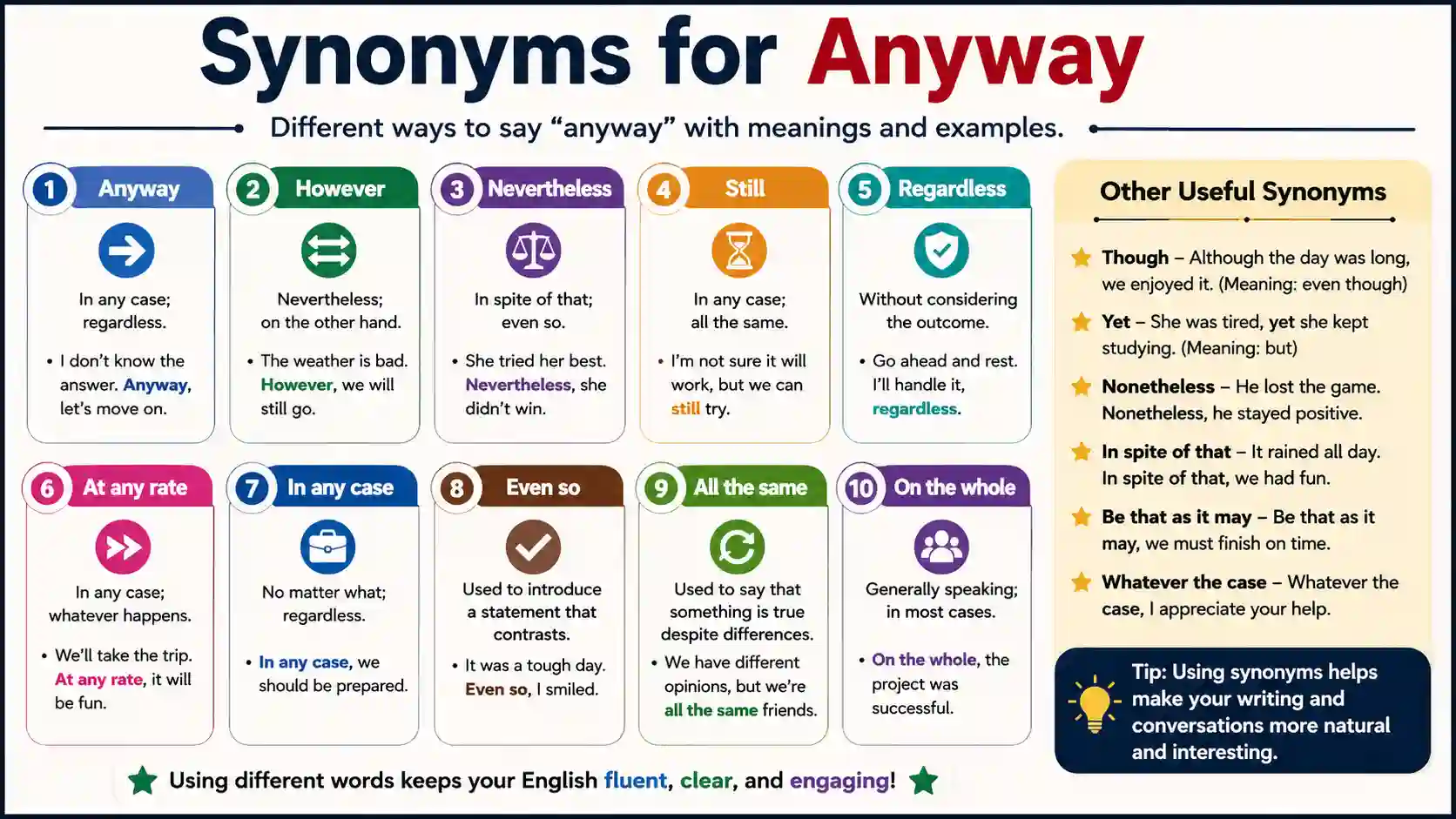
The most useful alternatives include regardless, nevertheless, nonetheless, anyhow, in any case, in any event, at any rate, even so, and just the same. Some words work mainly in formal writing, while others sound much more natural in conversation.
This guide explains the differences with simple examples so you can choose the right word instead of simply replacing it with another word.
Quick Answer: What Are the Best Synonyms for Anyway?
The best synonym for anyway depends on context. Use regardless when you mean “despite that,” in any case or in any event when you mean “whatever the situation,” nevertheless or nonetheless for formal contrast, and anyhow for a close everyday alternative. When anyway introduces an additional reason, besides may be more appropriate.
Pronunciation
Anyway
- IPA: /ˈeniweɪ/
- Pronunciation: EN-ee-way
- Part of speech: Adverb
Both British and American English use the same standard spelling, anyway, and the pronunciation is essentially the same. Cambridge gives /ˈen.i.weɪ/ for both varieties.
What Does Anyway Mean?
Anyway has several meanings, which explains why there is no single replacement that works everywhere.
1. Despite something
The road was difficult, but we continued anyway.
Here, anyway means despite the difficulty.
Possible alternatives include:
- regardless
- nevertheless
- nonetheless
- even so
- just the same
2. In any case
We might be late, but we’ll go anyway.
Here, the idea is that the result will not change.
Possible alternatives include:
- in any case
- in any event
- at any rate
- regardless
3. Adding another reason
I don’t want to buy it. It’s too expensive anyway.
Here, anyway, adds another point or reason.
Besides, I can often work in this situation.
4. Changing or returning to a topic
Anyway, what were you saying?
Here, anyway is not really being used to mean “regardless.” It is a discourse marker that helps organize conversation.
This use is especially common in spoken English. Cambridge and Oxford both identify this conversational function.
5. Limiting or correcting a statement
I think she lives in Boston, anyway.
Here, the speaker is limiting the statement to what they believe is correct.
This is another reason why simply replacing anyway with regardless can create an unnatural sentence. Oxford specifically lists this use.
The Closest Synonyms for Anyway
The following are the most useful alternatives, but remember that they are context-based synonyms, not interchangeable words.
1. Regardless
Meaning: Despite a particular fact or condition.
The weather looked terrible, but we went regardless.
She knew the job would be difficult and applied regardless.
Register: Neutral
Frequency: Very common
Best for: “Despite that”
Common patterns:
- regardless of the cost
- regardless of the result
- regardless of what happens
When not to use it
Do not use regardless when anyway is simply changing the subject.
Anyway, let’s talk about tomorrow.
You cannot naturally replace this with:
Regardless, let’s talk about tomorrow.
The meaning changes.
2. Nevertheless
Meaning: Despite what has just been said.
The plan was expensive. Nevertheless, the company approved it.
He was nervous. Nevertheless, he gave an excellent presentation.
Register: Formal
Frequency: Common
Best for: Essays, reports, academic and professional writing
Nuance: It creates a clear contrast and often sounds more polished than anyway.
When not to use it
It can sound overly formal in relaxed conversation.
Instead of:
I was tired. Nevertheless, I went to the store.
In casual speech, this may sound more natural:
I was tired, but I went anyway.
3. Nonetheless
Meaning: Despite that; nevertheless.
The evidence was limited. Nonetheless, the researchers continued.
The task was difficult, but she nonetheless completed it.
Register: Formal
Frequency: Common
Best for: Formal and academic writing
Nuance: Nonetheless and nevertheless are very close in meaning. Both emphasize that something remains true or happens despite an earlier fact.
When not to use it
Do not use it merely because you want a more complicated word. In everyday conversation, still, even so, or anyway may sound more natural.
4. Anyhow
Meaning: In any case or despite something.
The instructions were confusing, but we managed to finish anyhow.
Anyhow, let’s get back to the main question.
Register: Neutral to informal
Frequency: Common
Best for: Conversation and general English
Oxford lists anyhow as an alternative to anyway for several of the same uses.
When not to use it
Anyhow also has another meaning: in a careless or disorganized way.
He threw the papers together anyhow.
That meaning is different anyway.
5. In Any Case
Meaning: Whatever the situation; regardless.
We may not have enough time, but we’ll try in any case.
In any case, the decision has already been made.
Register: Neutral
Frequency: Common
Best for: General and professional English
This is one of the most useful alternatives because it works in both conversation and writing.
When not to use it
It may not work when anyway is being used only to return to a conversation topic.
6. In Any Event
Meaning: Whatever happens or whatever the circumstances are.
In any event, we need to finish the project today.
The plan may change. In any event, I’ll keep you informed.
Register: Formal/neutral
Frequency: Common
Best for: Professional and formal writing
Nuance
It is very close in any case, but it can sound slightly more formal.
7. At Any Rate
Meaning: In any case; whatever the situation may be.
The journey was long, but at any rate, we arrived safely.
At any rate, we need to make a decision.
Register: Neutral to formal
Frequency: Common
Best for: Moving from details to the main point
When not to use it
It can sound a little old-fashioned in very casual conversation. Anyway it is usually more natural there.
8. Even So
Meaning: Despite that.
The restaurant was expensive. Even so, we enjoyed the meal.
She had very little experience. Even so, she handled the task well.
Register: Neutral
Frequency: Common
Best for: Natural contrast
Nuance
Even so is especially useful when the previous sentence creates an expectation that the next event will not happen.
9. Just the Same
Meaning: Despite that; nevertheless.
The instructions were confusing. Just the same, we managed to finish.
I disagree with his decision. I respect him just the same.
Register: Neutral
Frequency: Less common than anyway or regardless
Nuance
This expression often has a conversational or slightly old-fashioned feel.
10. Besides
Meaning: In addition; also; as another reason.
I don’t want to go. Besides, it’s getting late.
We shouldn’t buy the car. Besides, we don’t need one.
Register: Neutral
Frequency: Very common
Important difference
Besides is not a universal synonym anyway.
It works when you add another reason or consideration. Oxford identifies this particular meaning as synonymous with besides.
Synonyms for Anyway by Meaning
Instead of memorizing a long list, learn the words by function.
| Meaning of anyway | Best alternatives |
| Despite that | regardless, nevertheless, nonetheless |
| In spite of the situation | even so, just the same |
| Whatever happens | in any event, in any case |
| Whatever the circumstances | regardless, in any case |
| Adding another reason | besides |
| Returning to a topic | anyhow |
| Moving to another topic | anyway, anyhow |
This approach is more useful for ESL learners because it teaches when to use a word, not just what it supposedly means.
Strongest, Common, and Related Alternatives
Closest alternatives
These are the most useful words and phrases to learn first:
- Regardless
- Anyhow
- In any case
- In any event
- Nevertheless
- Nonetheless
- Even so
- At any rate
- Just the same
Context-dependent alternatives
These can work in specific meanings:
- besides
- still
- however
- after all
- yet
These should not be treated as universal replacements.
Which Synonym Should You Choose?
Here is a simple decision guide.
If you mean “despite that”
Choose:
regardless
It was difficult, but we continued regardless.
If you need formal contrast
Choose:
nevertheless or nonetheless
The evidence was weak. Nevertheless, the claim received attention.
If you mean “whatever happens”
Choose:
in any case or in any event
In any case, we need to finish today.
If you are speaking casually
Choose:
anyway, anyhow, or even so
Anyway, let’s leave now.
If you are adding another reason
Choose:
besides
I don’t want to go. Besides, it’s too late.
Anyway vs Anyhow
These words are very close.
| Anyway | Anyhow |
| Very common | Common |
| Neutral | Neutral to informal |
| Used in speech and writing | Often more conversational |
| Can change a topic | Can change a topic |
| Can show contrast | Can show contrast |
Examples:
I was tired, but I went anyway.
I was tired, but I went anyway.
Both are possible.
However, anyhow has an additional meaning:
He arranged the books anyhow.
Here it means carelessly or without order, not “despite that.” Oxford records this separate meaning.
Anyway vs Regardless
These words overlap, but they are not identical.
I didn’t feel well, but I went anyway.
I didn’t feel well, but I went regardless.
Both work.
But:
Anyway, what happened next?
This is a conversational transition.
You normally would not use regardless in the same way.
Bottom line: Anyway has more conversational functions. Regardless is more specific.
Anyway vs Nevertheless
It was raining, but we went anyway.
This sounds natural in everyday English.
It was raining. Nevertheless, we went.
This sounds more formal and deliberate.
Nevertheless it is excellent for essays and formal writing, but it is not a replacement for every use anyway.
Anyway vs However
These words are often confused.
However usually introduces contrast:
The plan looks good. However, it is too expensive.
Anyway can show contrast:
It was expensive, but we bought it anyway.
But anyway can also change the subject:
Anyway, what are we having for dinner?
However, I cannot normally perform that conversational job.
Anyway vs Besides
This difference is especially important for learners.
I don’t want to go. Besides, I’m tired.
Here, besides introducing another reason.
Compare:
I was tired, but I went anyway.
Here, anyway means “despite being tired.”
The two words can sometimes appear in similar sentences, but their functions are different.
Common Mistakes With Anyway
Mistake 1: Treating every synonym as interchangeable
Wrong approach:
I will nevertheless use it everywhere I would use it anyway.
Better approach:
First identify the meaning.
Is anyway showing:
- contrast?
- an additional reason?
- a topic change?
- “in any case”?
- a correction?
Then choose the appropriate alternative.
Mistake 2: Confusing anyway with any way
These are different.
Anyway
One word. It is an adverb.
I was tired, but I went anyway.
Any way
Two words. It usually means any method or manner.
Is there any way to solve this problem?
I’ll help in any way I can.
This distinction is especially important in writing. Scribbr also identifies any way and anyway as different grammatical constructions.
Mistake 3: Assuming anyways is always wrong
Anyways, it does exist.
It is used informally, especially in North American English.
Anyways, let’s move on.
However, anyway is the safer choice in formal writing. Oxford labels anyways as North American informal usage.
Mistake 4: Using “regardless what”
A common learner pattern is:
Regardless of what happens, I’ll help.
A more standard construction is:
Regardless of what happens, I’ll help.
The phrase regardless of is particularly useful before a noun phrase or clause.
Mistake 5: Adding a synonym just to avoid repetition
You do not need to replace it every time it appears.
Sometimes the original word is the most natural choice.
Anyway, let’s get started.
Trying to replace it with a formal phrase can make a simple sentence sound unnatural.
American vs British English
The standard form in both varieties is:
anyway
Pronunciation is essentially the same in American and British English.
The main usage point learners should know is anyways.
Oxford describes anyways as North American English, informal.
So for school essays, professional reports, academic writing, and formal emails, choose:
Anyway
rather than:
Anyways
In casual speech, you may hear anyways, particularly in North American English.
CEFR and Learner Level
Anyway is an important word for English learners because it appears in several everyday functions.
Cambridge places basic uses at A2 and its use for introducing a more important reason at B1.
For practical learning:
- A2: Learn “despite that” and conversational uses.
- B1: Learn the additional-reason use.
- B2+: Focus on subtle differences between anyway, regardless, nevertheless, nonetheless, and other discourse markers.
Word Origin
Anyway developed from the combination of any + way.
The word has a long history in English, and modern anyway developed from earlier expressions meaning “in any manner” or “in any way.”
Merriam-Webster records the word’s first known use in the 14th century.
The historical development also helps explain why the word has several related meanings today.
Register and Tone Guide
| Word | Register | Natural in conversation? | Good for formal writing? |
| Anyway | Neutral | Yes | Yes |
| Anyhow | Neutral/informal | Yes | Sometimes |
| Regardless | Neutral | Yes | Yes |
| Nevertheless | Formal | Sometimes | Yes |
| Nonetheless | Formal | Sometimes | Yes |
| In any case | Neutral | Yes | Yes |
| In any event | Formal/neutral | Sometimes | Yes |
| At any rate | Neutral/formal | Yes | Yes |
| Even so | Neutral | Yes | Yes |
| Just the same | Neutral | Yes | Yes |
| Besides | Neutral | Yes | Yes |
How Native Speakers Naturally Use Anyway
Native speakers often use anyway for conversation management, not just as a synonym for regardless.
For example:
Anyway, what were you saying?
This tells the listener that the speaker wants to return to the earlier topic.
Another common use is ending a conversation:
Anyway, I’d better get going.
Cambridge’s grammar guidance specifically describes it as a discourse marker for returning to a subject, moving to a new part of a conversation, and bringing a conversation toward an ending.
This is an important point for learners because a thesaurus list alone does not teach this conversational function.
Collocations and Natural Patterns
Some common patterns are worth learning as complete phrases.
Common patterns
- anyway, let’s…
- anyway, I think…
- I did it anyway
- it doesn’t matter anyway
- thanks anyway
- I’ll go anyway
- not anyway
- anyway, what…
- Anyway, let’s get back to…
- too late anyway
Learning these patterns can make your spoken English sound more natural than memorizing isolated synonyms.
Writing Tips
For essays
Prefer precise formal connectors when the meaning requires them:
- nevertheless
- nonetheless
- however
- in any event
Do not replace it anyway automatically. First decide what relationship you want to show between the ideas.
For professional emails
In any case can be useful:
In any case, please let me know if the schedule changes.
Regardless also works:
We will proceed regardless of the final result.
For everyday conversation
Keep it simple.
Anyway, what are you doing tonight?
There is no prize for replacing a perfectly natural word with a more complicated one.
For blog writing
Avoid starting every paragraph anyway. If you need a transition, sometimes a more precise phrase will improve the flow.
Instead of:
Anyway, the next step is…
Try:
The next step is…
Good writing often comes from removing unnecessary words, not replacing them.
Quick Practice
Fill in the blanks
Choose the best answer.
1. It was raining, but we went ______.
A. moreover
B. anyway
C. besides
D. furthermore
2. The evidence was limited. ______, the researchers continued.
A. Nevertheless
B. Anyway only
C. Besides
D. Either way
3. I don’t want to buy it. ______, I don’t have enough money.
A. Regardless
B. Besides
C. Nevertheless
D. Even so
4. ______, let’s get back to the main topic.
A. Regardless
B. Anyway
C. Nevertheless
D. In any event
5. We may choose the first plan or the second. ______, we need to decide today.
A. Either way
B. Besides
C. Nevertheless
D. Anyhow
Answers
- B. anyway
- A. nevertheless
- B. besides
- B. anyway
- A. either way
Sentence Rewriting Practice
Rewrite each sentence using the word in parentheses.
1. The task was difficult, but she finished it anyway.
Use regardless.
Answer: The task was difficult, but she finished it regardless.
2. The plan was expensive, but we approved it anyway.
Use nevertheless.
Answer: The plan was expensive. Nevertheless, we approved it.
3. I don’t want to leave. Anyway, it’s too late.
Use besides for the second idea.
Answer: I don’t want to leave. Besides, it’s too late.
4. Anyway, let’s continue with the lesson.
Use anyhow.
Answer: Anyhow, let’s continue with the lesson.
FAQ
What are the closest synonyms for anyway?
The closest alternatives include anyhow, regardless, in any case, in any event, nevertheless, nonetheless, at any rate, and even so. However, each one fits a slightly different meaning or tone, so you should choose based on the sentence rather than treating them as exact replacements.
What is a formal synonym for anyway?
For formal writing, nevertheless, nonetheless, regardless, and in any event are useful choices. The best word depends on the intended meaning. Nevertheless and nonetheless are especially useful when you want to show that something happened or remains true despite an earlier fact.
Is anyhow a synonym for anyway?
Yes. Anyhow shares several meanings anyway, including “despite that,” “in any case,” and certain conversational uses. However, anyhow can also mean “in a careless or disorganized way,” which is a separate meaning.
Is it one word or two?
Anyway is one word when it means “despite that,” “in any case,” or functions as a conversational marker. Any way is two words when any modifies the noun way, as in “Is there any way to fix this?”
Is this correct?
Anyways is an established informal form, particularly in North American English. It is common in casual speech but is generally less suitable for formal writing. Anyway is the safer standard form for academic and professional contexts.
Can nevertheless be replaced anyway?
Sometimes. If it means “despite that,” it can often replace it. However, it cannot replace conversational uses such as “Anyway, what were you saying?” because that use organizes the conversation rather than expressing contrast.
What is the difference between anyway and regardless?
Anyway has several functions, including contrast, adding a reason, changing a topic, and returning to an earlier subject. Regardless mainly means “despite something” or “without being affected by something.” Therefore, regardless is a narrower alternative.
What is the best synonym for anyway in an essay?
There is no single best choice. For contrast, try nevertheless or nonetheless. For “whatever the situation,” use in any case or in any event. For an additional reason, it may be better. Always choose according to meaning rather than formality alone.
Final Takeaway
The best way to learn synonyms for anyway is to learn the different jobs the word performs. Use regardless for “despite that,” nevertheless or nonetheless for formal contrast, in any case for “whatever the situation,” anyhow for a close conversational alternative, and besides when you are adding another reason.
Most importantly, do not replace it anyway simply because you want variety. If the original word is natural and accurate, keep it. Strong vocabulary is not about using the biggest word. It is about choosing the right word for the right meaning.
References
- Cambridge Dictionary: anyway
- Cambridge Grammar: Anyway
- Oxford Learner’s Dictionaries: anyway
- Merriam-Webster: anyway
- Cambridge Thesaurus: anyway

Synonorm is a trusted English vocabulary resource created to help readers find the right words and understand the differences between similar terms. We provide clear explanations of synonyms, meanings, examples, usage, and alternatives. Our content makes vocabulary easier to learn and apply in everyday, academic, and professional English. Synonorm is designed for students, writers, ESL learners, professionals, and anyone who wants to improve their English vocabulary and communicate more clearly.