Quick Answer
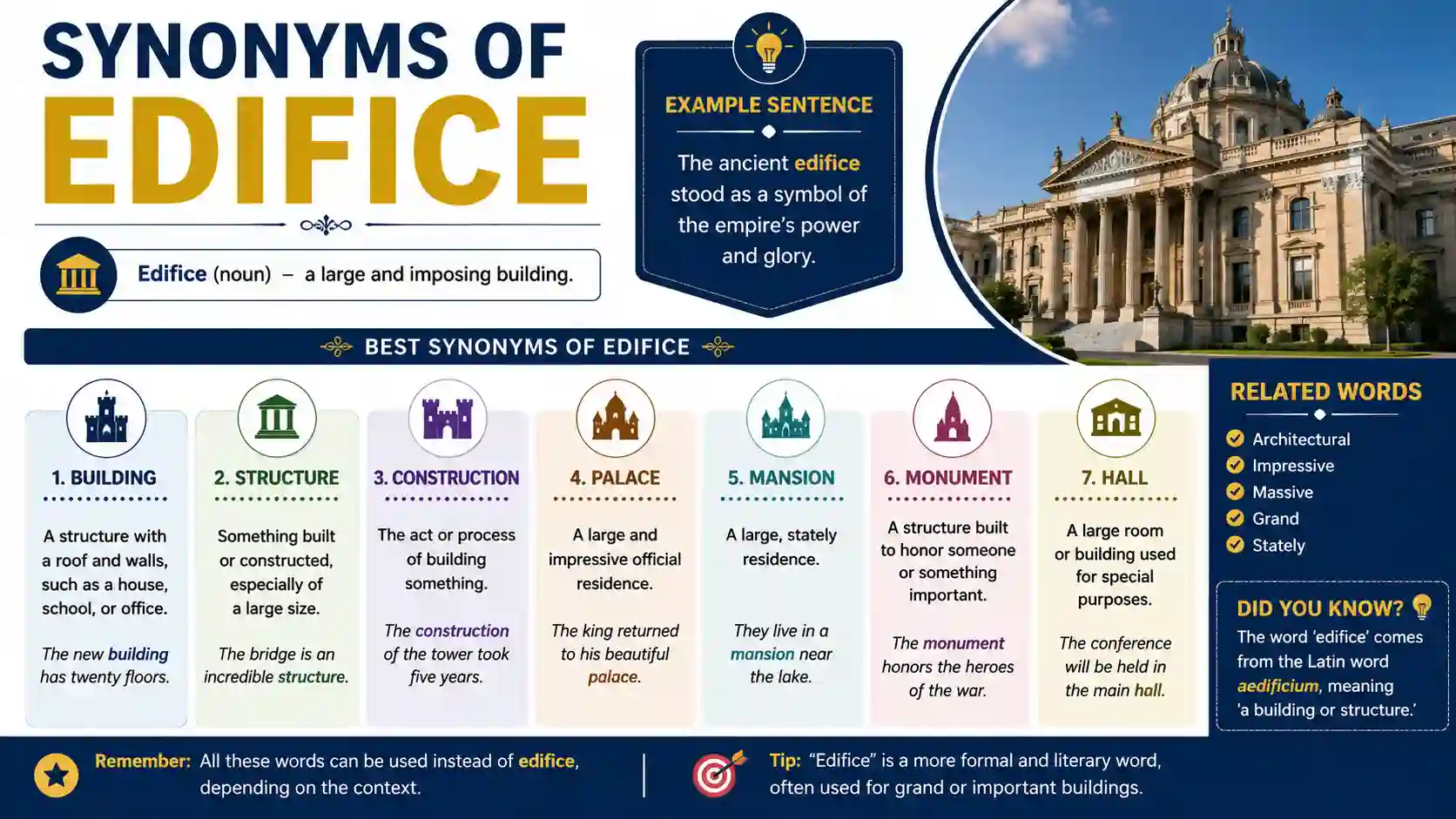
The closest everyday alternatives to edifice are building and structure. Depending on context, words such as monument, palace, mansion, tower, hall, and construction may also work. However, these are not interchangeable in every sentence. Edifice is a formal noun that usually refers to a large or impressive building, and it can also describe a large abstract system.
What Does Edifice Mean?
Have you ever read a sentence that uses the word edifice and wondered why the writer did not simply say building?
That is a good question. Edifice is a formal word for a building, especially one that is large, impressive, important, or visually striking. Cambridge defines it as a large building, especially an impressive one, while Merriam-Webster also gives it a figurative meaning: a large abstract structure.
For example:
The old courthouse is an impressive edifice.
You could replace edifice with building, but you would lose some of the formal and grand feeling.
The word can also be used figuratively:
The entire political edifice began to collapse.
Here, edifice does not mean a physical building. It refers to a large, established system.
That distinction is important when choosing alternatives. Building is usually the safest general choice, while words such as palace, mansion, and monument add a specific meaning.
Pronunciation of Edifice
Edifice is pronounced slightly differently in American and British English.
- American English: /ˈed.ə.fɪs/
- British English: /ˈed.ɪ.fɪs/
A simple pronunciation guide is:
US: ED-uh-fiss
UK: ED-ih-fiss
Cambridge lists both US and UK pronunciations.
Part of Speech
Edifice is a countable noun.
Singular
The museum is an impressive edifice.
Plural
Several historic edifices line the square.
The plural form is edifices.
The word itself is not normally used as a verb, adjective, or adverb.
Useful Related Words
The following words are historically related to edifice, but they do not mean the same thing:
- edify: to instruct or improve someone
- edification: instruction or improvement
- edifying: morally or intellectually beneficial
Do not confuse these words simply because they share the same historical root.
The Closest Synonyms of Edifice
Not every word associated with edifice is a perfect substitute. The most useful alternatives depend on what you want to emphasize.
| Word | How close is it? | Best context | Register |
| Building | Very close | General building | Neutral |
| Structure | Very close | Physical construction | Neutral |
| Construction | Contextual | Something built or its construction | Neutral/Formal |
| House | Contextual | Residential building | Neutral |
| Monument | Contextual | Memorial or commemorative structure | Formal |
| Tower | Contextual | Tall structure | Neutral |
| Palace | Contextual | Royal or grand residence | Neutral/Formal |
| Mansion | Contextual | Large private home | Neutral |
| Hall | Contextual | Public or event building | Neutral |
| Cathedral | Specific | Major Christian church | Formal/Neutral |
| Castle | Specific | Fortified historic building | Neutral |
| Framework | Figurative | Abstract system | Formal |
| Architecture | Figurative | Design or organization of a system | Formal |
| System | Figurative | Established abstract structure | Neutral/Formal |
Merriam-Webster lists tower, cathedral, structure, palace, hall, monument, mansion, and several other context-specific terms in its thesaurus. Cambridge identifies building, structure, and construction as key synonyms.
1. Building
Building is the best general alternative to edifice.
Meaning
A building is a structure made for people to live, work, meet, worship, study, or carry out other activities.
Examples
- The old building has been carefully restored.
- A new office building opened downtown.
Best used when
You want a clear, natural word without emphasizing grandeur.
Tone and register
Neutral | Everyday | Academic | Business
Frequency
Very common
Learner level
A1–A2
Common collocations
- office building
- historic building
- public building
- school building
When not to use it
Do not choose building if your main goal is to create a sense of grandeur or importance.
Compare:
The building stands near the river.
The magnificent edifice stands near the river.
The second sentence sounds more formal and impressive.
2. Structure
Structure is another very close alternative.
Meaning
A structure is something that has been built, especially when you are focusing on its physical form or construction.
Examples
- The stone structure survived the earthquake.
- Engineers examined the structure for signs of damage.
Best used when
You want to focus on the physical construction rather than the building’s social purpose.
Tone and register
Neutral | Technical | Academic
Frequency
Very common
Learner level
A2–B1
Common collocations
- stone structure
- wooden structure
- massive structure
- supporting structure
When not to use it
Structure has a much wider meaning than edifice. It can refer to physical objects, organizations, arguments, and systems.
So it does not always carry the sense of a grand building.
3. Construction
Construction can overlap with edifice, but it requires care.
Meaning
It can refer to something that has been built, but it commonly refers to the process or method of building.
Examples
- The pavilion is an unusual steel construction.
- The bridge remained closed during construction.
Best used when
You are talking about how something was built or the resulting built form.
Tone and register
Neutral | Technical | Professional
Frequency
Very common
Learner level
B1
Common collocations
- construction work
- building construction
- steel construction
When not to use it
Do not automatically replace every occurrence of building with construction.
The construction is next to the library.
This can sound unnatural if you simply mean a building. In many situations, building or structure is clearer.
4. House
A house is a useful alternative only when the building is used as a home.
Meaning
A house is a building where people live.
Examples
- The old house has been in the family for generations.
- They restored the stone house near the village.
Best used when
The building is specifically residential.
Tone and register
Neutral | Everyday | Spoken
Frequency
Very common
Learner level
A1
When not to use it
A courthouse, cathedral, museum, or monument is not normally called a house.
5. Monument
A monument is a structure or place created to remember a person, event, or important idea.
Examples
- The marble monument honors the country’s founders.
- Visitors gathered around the war monument.
Best used when
The structure has a commemorative purpose.
Tone and register
Formal | Historical | Public
Frequency
Common
Learner level
B1
Important nuance
A monument may be an edifice, but an edifice is not necessarily a monument.
That is why these words should not be treated as exact equivalents.
6. Tower
A tower is a tall structure that rises above the surrounding area.
Examples
- The ancient tower overlooks the valley.
- A clock tower stands beside the town hall.
Best used when
Height is one of the most noticeable features.
Tone and register
Neutral | Architectural
Frequency
Very common
Learner level
A2
When not to use it
A large building is not automatically a tower.
7. Palace
A palace is a large and usually impressive residence associated with royalty, rulers, or very high social status.
Examples
- The royal palace attracts thousands of visitors.
- The ancient palace contains beautifully decorated rooms.
Best used when
The building has a royal or exceptionally grand residential character.
Tone and register
Neutral/Formal | Historical
Frequency
Common
Learner level
A2–B1
When not to use it
Do not call an ordinary public building a palace simply because it is large.
8. Mansion
A mansion is a very large and usually expensive private house.
Examples
- The wealthy family lives in a large mansion.
- The historic mansion has been converted into a hotel.
Best used when
You want to emphasize a luxurious private residence.
Tone and register
Neutral | Descriptive
Frequency
Common
Learner level
B1
When not to use it
A palace, church, or public monument is not a mansion.
9. Hall
Hall can refer to a large public building or a building used for meetings, performances, or events.
Examples
- The concert hall was packed with visitors.
- Students gathered in the main hall.
Best used when
The building is associated with public gatherings or events.
Tone and register
Neutral | Everyday
Frequency
Very common
Learner level
A2
Common collocations
- concert hall
- town hall
- sports hall
- assembly hall
10. Cathedral
A cathedral is the principal church of a bishop and is often a large, architecturally important building.
Examples
- The Gothic cathedral dominates the old city.
- Visitors admired the cathedral’s huge stained-glass windows.
Best used when
You are specifically talking about a cathedral.
Tone and register
Neutral/Formal | Religious | Historical
Frequency
Common
Learner level
B1
Important nuance
Cathedral is much more specific than edifice. It cannot replace edifice unless the building is actually a cathedral.
11. Castle
A castle is a fortified building or group of buildings, traditionally associated with defense and residence.
Examples
- The medieval castle sits on a hill.
- Tourists explored the castle’s ancient walls.
Best used when
The building has a historical, defensive, or royal character.
Tone and register
Neutral | Historical
Frequency
Common
Learner level
A2
12. Residence
A residence is a place where someone lives. It often sounds more formal than home or house.
Examples
- The ambassador’s official residence is heavily protected.
- The historic residence is open to visitors.
Best used when
You want to emphasize someone’s official or formal home.
Tone and register
Formal | Business | Official
Frequency
Common
Learner level
B1
Common collocations
- official residence
- private residence
- permanent residence
When not to use it
In casual conversation, home usually sounds more natural.
13. Dwelling
A dwelling is a place where someone lives.
Examples
- Archaeologists discovered an ancient dwelling.
- The small dwelling was built from local stone.
Best used when
Writing about homes in historical, academic, or descriptive contexts.
Tone and register
Formal | Literary | Academic
Frequency
Common but less conversational
Learner level
B2
When not to use it
It can sound unnecessarily formal when talking about your everyday home.
14. Abode
Abode means a place where someone lives.
Examples
- The writer described the cottage as his peaceful abode.
- They returned to their mountain abode before sunset.
Best used when
You want a literary, poetic, humorous, or old-fashioned effect.
Tone and register
Literary | Old-fashioned
Frequency
Uncommon
Learner level
C1
When not to use it
Avoid it in ordinary business emails and most casual conversations.
15. Domicile
Domicile means a person’s permanent or official home, especially in legal contexts.
Examples
- The document asks for your legal domicile.
- The court examined his permanent domicile.
Best used when
The context is legal, financial, administrative, or official.
Tone and register
Formal | Legal
Frequency
Uncommon
Learner level
C1–C2
When not to use it
Do not use domicile simply to make everyday English sound more sophisticated.
My domicile is in Boston.
This sounds unnecessarily formal in normal conversation.
I live in Boston.
is much more natural.
16. Manor
A manor traditionally refers to a large country house and the land associated with it.
Examples
- The old manor overlooks the lake.
- The historic manor was restored by a local foundation.
Best used when
Discussing historic country houses, estates, or British history.
Tone and register
Historical | Literary | Formal
Frequency
Uncommon
Learner level
B2–C1
17. Villa
A villa is a large, comfortable house, often associated with warm climates or Mediterranean settings. It can also refer to a large Roman country house in historical contexts.
Examples
- They rented a villa overlooking the sea.
- The Roman villa contains beautifully preserved mosaics.
Best used when
Talking about a particular type of private residence.
Tone and register
Neutral | Travel | Historical
Frequency
Common
Learner level
B1
Figurative Alternatives
The word edifice has a second important meaning. It can describe a large, established system made up of connected ideas, institutions, or beliefs. Cambridge gives political edifice as an example, while Merriam-Webster defines the figurative sense as a large abstract structure.
For this meaning, different alternatives are more appropriate.
18. Framework
A framework is the basic structure that supports an idea, system, organization, or plan.
Example
The agreement provides a framework for future cooperation.
Best used when
You are describing the supporting structure of an abstract system.
Register: Academic, business, professional
Frequency: Very common
Learner level: B2
19. Architecture
Architecture can describe the design of buildings, but it can also refer to the organization of a complex system.
Example
The reform changed the architecture of the financial system.
Best used when
You want to emphasize how different parts of a system are arranged.
Register: Academic, professional
Frequency: Common
Learner level: B2
20. System
A system is an organized set of connected parts, rules, or institutions.
Example
The political system has changed dramatically.
Best used when
Edifice is being used figuratively to describe an established organization or system.
Register: Neutral/Formal
Frequency: Very common
Learner level: A2–B1
Which Synonym Should You Choose?
The easiest way to choose correctly is to ask yourself what you want the word to emphasize.
| What you mean | Best choice |
| A normal building | building |
| Physical form or construction | structure |
| A residential building | house |
| A large private home | mansion |
| A royal residence | palace |
| A tall structure | tower |
| A historic fortified building | castle |
| A commemorative structure | monument |
| A formal home | residence |
| A public event building | hall |
| A major Christian church | cathedral |
| A historic country house | manor |
| An abstract supporting structure | framework |
| Organization of a complex system | architecture |
| An organized abstract arrangement | system |
Quick Tip: If you are unsure, building is usually the safest choice. Use edifice when you want a more formal sense of size, importance, or grandeur.
Edifice vs. Building vs. Structure
These three words are easy to confuse.
Edifice
Usually sounds formal and can suggest a large or impressive building.
The courthouse is an imposing edifice.
Building
The normal everyday term.
The courthouse is an old building.
Structure
Focuses more on the physical construction or form.
Engineers inspected the courthouse structure.
The three words may describe the same place, but the emphasis changes.
Edifice vs. Monument
These words overlap, but they are not interchangeable.
A monument exists mainly to commemorate a person, event, or idea.
An edifice is primarily a building, often one that is large or impressive.
For example:
The national monument honors fallen soldiers.
But:
The government edifice contains several public offices.
A monument can be an impressive edifice, but not every impressive edifice is a monument.
Edifice vs. Mansion
A mansion is specifically a very large private home.
An edifice can be a courthouse, museum, church, government building, or other large structure.
The museum is an impressive edifice.
The wealthy family owns a huge mansion.
The second word tells the reader that the building is a private home.
Common Mistakes to Avoid
Common Mistake Box
Mistake 1: Using edifice for every building
Incorrect idea: Every small house can be called an edifice.
Better: Use house or building for ordinary structures.
Why: Edifice is formal and often suggests something substantial or impressive.
Mistake 2: Treating every related word as an exact synonym
Mistake: Assuming palace, cathedral, and mansion can replace edifice in any sentence.
Correction: Choose them only when their specific meaning fits.
Mistake 3: Using domicile in casual English
Less natural:
I returned to my domicile after work.
Natural:
I went home after work.
Mistake 4: Using construction when you mean building
Less natural:
I work in that construction.
Natural:
I work in that building.
Construction often refers to the process of building, not simply a finished place.
Mistake 5: Using erection without considering its other meaning
Important: Erection appears in some traditional thesaurus entries for edifice, especially in the sense of something constructed. However, modern English also uses erection as a sexual term. For ESL writing, building or structure is normally a much safer and clearer choice.
Register and Frequency Guide
Not all alternatives are equally useful in everyday English.
| Word | Frequency | Register |
| Building | Very common | Neutral |
| Structure | Very common | Neutral/Technical |
| House | Very common | Neutral |
| System | Very common | Neutral/Formal |
| Construction | Very common | Neutral/Professional |
| Tower | Common | Neutral |
| Palace | Common | Neutral/Formal |
| Mansion | Common | Neutral |
| Monument | Common | Formal/Neutral |
| Residence | Common | Formal |
| Hall | Very common | Neutral |
| Cathedral | Common | Neutral/Formal |
| Castle | Common | Neutral |
| Villa | Common | Neutral |
| Framework | Very common | Formal/Academic |
| Dwelling | Less common | Formal/Literary |
| Manor | Less common | Historical |
| Abode | Uncommon | Literary |
| Domicile | Uncommon | Legal/Formal |
These frequency labels are practical learner guidance rather than official corpus rankings.
CEFR Guidance for English Learners
There is no single universal CEFR rating that applies to every dictionary synonym, so these levels should be treated as approximate learning guidance, not official classifications.
Beginner-friendly
- house
- building
- tower
Intermediate
- structure
- palace
- mansion
- monument
- residence
- castle
- villa
Upper-intermediate
- dwelling
- framework
- architecture
- manor
Advanced
- edifice
- abode
- domicile
Good to Know: Advanced vocabulary is not automatically better vocabulary. A simple word that communicates your meaning clearly is often the strongest choice.
American and British English
The spelling edifice is the same in both American and British English.
The pronunciation differs slightly:
American: /ˈed.ə.fɪs/
British: /ˈed.ɪ.fɪs/
Cambridge records both forms.
One interesting difference appears with pile. In British English, a stately pile can refer to a large country house. This usage is much less useful for American English learners. Collins includes pile among British synonyms in the relevant building sense.
For most learners, however, building and structure are safer choices on both sides of the Atlantic.
Word Origin and Etymology
The history of edifice goes back to Latin aedificium, meaning “building.” It came into English through Anglo-French and Middle English. Merriam-Webster dates its first known English use to the 14th century.
The Latin verb aedificare meant “to erect a building.” It was formed from elements associated with a building or dwelling and the idea of making or doing.
First known use
14th century
This long history helps explain why the word has a formal, literary feel today.
Natural Collocations With Edifice
Native English writers often pair edifice with adjectives that describe size, appearance, age, or importance.
Useful combinations include:
- impressive edifice
- grand edifice
- imposing edifice
- massive edifice
- historic edifice
- ancient edifice
- magnificent edifice
- marble edifice
- political edifice
- institutional edifice
For example:
The imposing edifice dominates the city square.
Years of reform have changed the country’s political edifice.
Modern dictionary examples also show edifice used naturally for impressive physical buildings and for abstract systems.
How to Use Edifice in Different Types of Writing
In Academic Writing
Edifice can work well when discussing architecture, history, politics, institutions, or social systems.
The colonial edifice reflects several architectural influences.
In Essays
Use it when a more formal tone is appropriate.
The ancient edifice became an important symbol of the city.
In Blog Writing
For general readers, building is usually clearer.
The historic building attracts thousands of visitors every year.
Use edifice when the formal tone adds something useful.
In Professional Writing
Choose building, structure, or facility when clarity is more important than style.
In Creative Writing
Edifice can create a sense of grandeur.
Beyond the narrow street stood a vast stone edifice.
Here, the word helps create a visual impression rather than simply naming a building.
What Not to Use Instead of Edifice
Some words may appear in large thesaurus lists but are poor choices for ordinary learners.
Erection
Technically connected to building in some dictionary contexts, but modern readers may notice its other meaning first.
Rockpile
Too specific and unnatural for most contexts.
Abode
Correct in some contexts but literary and uncommon.
Domicile
Useful in legal writing but unnecessarily formal in everyday English.
Cathedral
Only appropriate when the building is a cathedral.
Palace
Only appropriate when the building has the relevant royal or grand-residential meaning.
This is why a short, accurate synonym list is often more useful than a huge list of loosely related words.
Mini Practice: Fill in the Blanks
Choose the most natural word.
1. The ancient ______ dominates the city skyline.
A. domicile
B. edifice
C. house
D. abode
2. Engineers inspected the bridge’s ______ after the storm.
A. structure
B. palace
C. mansion
D. residence
3. The king lived in a magnificent ______.
A. tower
B. framework
C. palace
D. system
4. The agreement created a ______ for future cooperation.
A. mansion
B. framework
C. cathedral
D. tower
5. The memorial was built to honor the soldiers.
A. monument
B. house
C. domicile
D. villa
Answers
- B. edifice
- A. structure
- C. palace
- B. framework
- A. monument
Sentence Rewriting Exercise
Replace the bold word with a more suitable alternative.
1.
The building was enormous and beautifully designed.
Possible answer:
The edifice was enormous and beautifully designed.
2.
The family owns a very large house.
Possible answer:
The family owns a large mansion.
3.
The government created a new structure for cooperation.
Possible answer:
The government created a new framework for cooperation.
Remember that the best answer depends on the intended meaning.
Matching Exercise
Match each word with the correct description.
| Word | Description |
| 1. Mansion | A. Tall structure |
| 2. Monument | B. Large private home |
| 3. Tower | C. Commemorative structure |
| 4. Residence | D. Place where someone lives |
| 5. Cathedral | E. Major Christian church |
Answers
1-B, 2-C, 3-A, 4-D, 5-E
Frequently Asked Questions
What is the closest synonym of edifice?
The closest everyday synonym is building. Structure is another strong alternative, especially when you want to emphasize the physical construction. The exact choice depends on context because edifice can suggest a large or impressive building rather than an ordinary one.
Is building a synonym for edifice?
Yes. Building is one of the closest synonyms. The main difference is tone. Building is a common everyday word, while edifice is formal and often gives the impression of something large, impressive, or important.
Is structure another word for edifice?
Yes, in many physical-building contexts. Structure focuses more on the thing that has been built and its physical form. Unlike edifice, however, structure can describe many non-building objects and abstract arrangements.
What is the difference between edifice and building?
A building is the normal general word for a constructed place. Edifice is more formal and often suggests size, grandeur, or importance. You can call an ordinary office a building, but edifice would sound more deliberate and formal.
Can edifice describe something abstract?
Yes. Edifice can describe a large, established abstract system. Expressions such as political edifice use the idea of a physical building as a metaphor for a system made from connected parts. Cambridge and Merriam-Webster both recognize this figurative meaning.
Is edifice a common word?
It is a recognized English word, but it is less common in everyday conversation than building or structure. It appears more naturally in formal, literary, historical, architectural, and academic writing.
What is a good synonym for edifice in an essay?
Structure or building is usually a safe choice. If the building is specifically a monument, palace, mansion, or cathedral, use the more precise word. In an abstract discussion, framework or system may work better.
What is the opposite of edifice?
There is no single exact antonym. Depending on the context, words such as ruin, rubble, demolition, or open space can express an opposite idea. For the figurative meaning, words such as breakdown or disorder may provide a contrast.
Vocabulary Quiz
1. Which is the safest general synonym for edifice?
A. Palace
B. Building
C. Cathedral
D. Mansion
2. Which word specifically means a large private home?
A. Structure
B. Framework
C. Mansion
D. Monument
3. Which word is most appropriate for a legal context involving someone’s permanent home?
A. Domicile
B. Castle
C. Tower
D. Hall
4. Which word works best for an abstract supporting system?
A. Mansion
B. Framework
C. Cathedral
D. Villa
5. Which sentence uses edifice naturally?
A. I bought milk from the edifice.
B. The imposing edifice dominates the square.
C. Please put the book inside the edifice.
D. My edifice is five minutes away.
Answer Key
- B
- C
- A
- B
- B
Final Takeaway
The best way to learn alternatives to edifice is to learn the difference between them rather than memorize a long list. Use building for everyday situations and structure when you want to focus on physical form. Choose a mansion, palace, cathedral, castle, monument, or tower when the building has a specific identity. For the figurative sense, framework, architecture, or system may be more natural.
Good vocabulary is not about choosing the hardest word. It is about choosing the right word for the meaning, audience, and situation. Once you understand that difference, your writing becomes clearer, more natural, and more precise.
Trusted References
- Merriam-Webster Dictionary: definition, synonyms, pronunciation, word history, and first known use.
- Cambridge Dictionary: definition, US/UK pronunciation, formal usage, and core synonyms.
- Collins English Thesaurus: British and American synonym distinctions and context-specific alternatives.
- Online Etymology Dictionary: historical origin and development of edifice.

Synonorm is a trusted English vocabulary resource created to help readers find the right words and understand the differences between similar terms. We provide clear explanations of synonyms, meanings, examples, usage, and alternatives. Our content makes vocabulary easier to learn and apply in everyday, academic, and professional English. Synonorm is designed for students, writers, ESL learners, professionals, and anyone who wants to improve their English vocabulary and communicate more clearly.