Have you ever used the word archaeology several times in an essay and wondered if there is a better word to use instead?
The answer is a little more complicated than it looks. Archeology is the closest true synonym because it is simply an accepted spelling variant of archaeology. Other words, such as prehistory, antiquarianism, excavation, anthropology, and paleontology, are connected to archaeology, but they do not have exactly the same meaning.
That distinction matters. A good synonym should fit the meaning of the original word, not just belong to the same topic.
This guide explains the closest alternatives, related terms, differences, examples, collocations, common mistakes, and useful vocabulary so you can choose the right word with confidence.
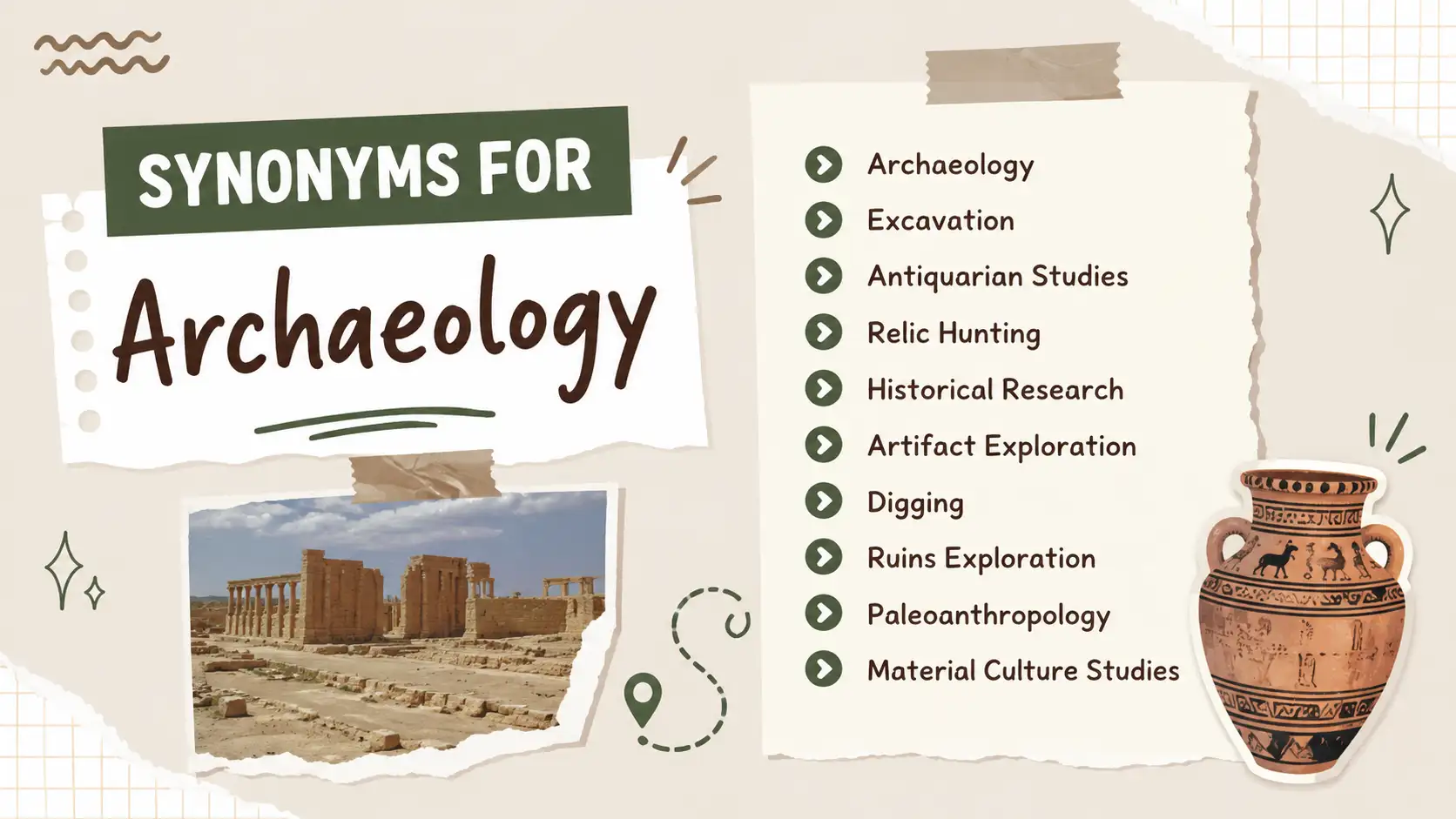
Quick Answer: What Is a Synonym for Archaeology?
The closest synonym for archaeology is archeology, which is an accepted spelling variant, especially in North American English. There are few true one-word synonyms because archaeology names a specific academic discipline. Words such as prehistory and excavation are related, but they describe different concepts.
What Does Archaeology Mean?
Archaeology is the study of past human cultures and societies through physical evidence such as buildings, tools, objects, and other remains.
For example:
Archaeology has helped researchers understand how ancient communities lived.
Oxford defines archaeology as the study of past cultures and periods of history through buildings and objects found in the ground. It also lists archeology as a North American spelling variant.
The word is normally an uncountable noun:
- She studies archaeology.
- He is interested in archaeology.
- Archaeology can reveal details about ancient communities.
You would normally not say:
She studies archaeology.
The Closest Synonym: Archeology
Archeology
Meaning: Archeology has the same meaning as archaeology.
Example:
She became interested in archeology after visiting an ancient settlement.
The university offers courses in archeology.
Register: Academic, neutral
Frequency: Common
CEFR: Advanced academic vocabulary
American English: Commonly accepted
British English: Archaeology is generally preferred
Oxford lists archeology as a North American English form and gives the same definition as archaeology.
Which spelling should you choose?
If you are writing for a British audience, archaeology is the safest choice.
If you are writing for an American audience, both archaeology and archeology are accepted. However, there is no need to change the spelling simply to sound more American.
Best general choice: archaeology
Are There Really Many Synonyms for Archaeology?
Not really, and that is an important point.
Many online synonym lists include words that are related to archaeology rather than true synonyms. For example:
- excavation is a method used in archaeological work.
- prehistory refers to a period of the past.
- paleontology studies ancient life and fossils.
- anthropology is a broader field concerning humans and cultures.
- paleography focuses on old writing.
- epigraphy focuses on inscriptions.
These words can appear in the same article or sentence as archaeology, but replacing archaeology with them can change the meaning.
The National Library of Medicine describes archaeology as the study of the human or animal past through material remains, while UNESCO treats archaeological excavation as a narrower concept under archaeology.
So, instead of giving you a long list of inaccurate “synonyms,” it is more useful to separate true alternatives from nearby vocabulary.
Best Alternatives to Archaeology
1. Archeology
Meaning: The same academic discipline as archaeology.
Example:
He decided to study archeology at college.
Best used when: You are following North American spelling.
Register: Academic, neutral
Frequency: Common
Nuance: No meaningful difference in meaning.
When not to use it: Do not use it if a specific style guide or publisher requires archaeology.
2. Archaeological Study
Meaning: A study or investigation based on archaeological evidence.
Example:
The archaeological study revealed evidence of an early settlement.
Best used when: You want to avoid repeating archaeology in formal writing.
Register: Academic, professional
Frequency: Common
Nuance: This is not a one-word synonym. It describes a particular study within the field.
3. Archaeological Research
Meaning: Systematic research into the human past using archaeological evidence.
Example:
Recent archaeological research has changed our understanding of the site.
Best used when: Writing essays, reports, research papers, and professional content.
Register: Academic, professional
Frequency: Very common
Natural collocations:
- archaeological research
- new archaeological research
- archaeological research methods
4. Study of Ancient Cultures
Meaning: Research into the cultures and societies of ancient peoples.
Example:
Archaeology is an important part of the study of ancient cultures.
Best used when: Explaining the subject to beginners.
Register: Neutral, educational
Frequency: Common
Nuance: This phrase is broader than archaeology because ancient cultures can also be studied through history, literature, art, and other disciplines.
5. Study of the Past
Meaning: A broad phrase for learning about earlier times.
Example:
Archaeology gives us another way to study the past.
Best used when: Writing for children, beginners, or general readers.
Register: Neutral
Frequency: Very common
Important: It is not a precise replacement for archaeology because history and other fields also study the past.
Related Words You Should Not Treat as Exact Synonyms
Prehistory
Meaning: The period before written historical records were available or widely used.
Example:
Archaeologists have discovered important evidence from European prehistory.
Register: Academic, neutral
Frequency: Common
Archaeology vs. prehistory
Archaeology is a field of study.
Prehistory is a period of the past.
So this is correct:
Archaeology helps us understand prehistory.
But this changes the meaning:
Prehistory helps us understand archaeology.
The second sentence can be grammatical, but it does not mean the same thing.
Antiquarianism
Meaning: The study, collection, and interest in old objects, documents, and historical remains.
Example:
His interest in antiquarianism began with a collection of old manuscripts.
Register: Formal, historical, academic
Frequency: Uncommon
Archaeology vs. antiquarianism
The two fields have historical connections, but they are not interchangeable. Archaeology developed into a systematic professional discipline concerned with interpreting material remains. Oxford Academic notes the historical shift from antiquarianism toward archaeology as the professional field developed.
Best tip: Use antiquarianism only when you specifically mean the tradition or practice associated with antiquities and historical objects.
Excavation
Meaning: The careful removal of soil or other material to uncover buried remains.
Example:
The excavation uncovered the remains of several buildings.
Register: Academic, professional
Frequency: Common
Why it is not a synonym
Excavation is one archaeological method.
UNESCO places archaeological excavations as a narrower concept under the broader concept of archaeology.
Think of it this way:
Archaeology → field of study
Excavation → one method used in that field
Dig
Meaning: An informal term for an excavation or archaeological excavation project.
Example:
The students joined an archaeological dig during the summer.
Register: Informal, spoken
Frequency: Common
Nuance: Dig sounds natural in everyday conversation, but excavation is usually better in formal academic writing.
Paleontology
Meaning: The scientific study of ancient life, especially through fossils.
Example:
Paleontology can tell us about animals that lived millions of years ago.
Register: Scientific, academic
Frequency: Common
Archaeology vs. paleontology
These fields both investigate the past, but they ask different questions.
Archaeology: mainly investigates human societies through material evidence.
Paleontology: investigates ancient life through fossils and related evidence.
Do not write:
Paleontology is another word for archaeology.
That statement is inaccurate.
Anthropology
Meaning: The broad study of humans, human societies, and cultures.
Example:
Archaeology is closely connected to anthropology in many academic programs.
Register: Academic
Frequency: Common
Why they are different
Anthropology is broader. Depending on the academic tradition, archaeology may be treated as a branch or subfield of anthropology, while in other settings it is treated as a distinct discipline.
The key point for learners is simple:
Anthropology is broader than archaeology.
Paleography
Meaning: The study of old handwriting and historical writing systems.
Example:
The researcher used paleography to interpret the handwritten document.
Register: Academic, technical
Frequency: Uncommon
When not to use it: Do not use paleography as a general replacement for archaeology.
Epigraphy
Meaning: The study and interpretation of inscriptions.
Example:
Epigraphy helped researchers understand the inscription on the stone.
Register: Academic, technical
Frequency: Uncommon
When not to use it: Use epigraphy only when inscriptions are the specific subject.
Archaeology Synonyms by Context
Sometimes the best alternative depends on what you are actually trying to say.
| What you mean | Best word or phrase |
| The discipline itself | Archaeology |
| North American spelling variant | Archeology |
| Research within the discipline | Archaeological research |
| A specific investigation | Archaeological study |
| Fieldwork involving buried remains | Excavation |
| Informal term for excavation | Dig |
| Ancient period before written records | Prehistory |
| Study of ancient life and fossils | Paleontology |
| Broad study of humans and cultures | Anthropology |
| Study of old handwriting | Paleography |
| Study of inscriptions | Epigraphy |
| Interest in old objects and antiquities | Antiquarianism |
This table is more useful than a simple list because it helps you choose a word according to meaning and context.
Strong, Related, and Contextual Alternatives
Closest Match
Archeology
This is the only straightforward one-word alternative with the same meaning.
Useful Rewordings
- archaeological research
- archaeological study
- study of ancient cultures
- study of the past
- study of ancient societies
These phrases can reduce repetition without pretending to be exact synonyms.
Related Technical Terms
- excavation
- prehistory
- paleontology
- anthropology
- paleography
- epigraphy
- antiquarianism
Use these only when their specific meanings fit your sentence.
Common Collocations with Archaeology
If you want your English to sound natural, learning collocations is often more useful than memorizing long synonym lists.
Common combinations include:
- archaeological site
- archaeological evidence
- archaeological discovery
- archaeological research
- archaeological excavation
- archaeological remains
- archaeological record
- archaeological survey
- archaeological findings
- archaeological investigation
- ancient archaeology
- classical archaeology
- historical archaeology
- underwater archaeology
- experimental archaeology
Oxford gives examples such as classical archaeology, medieval archaeology, and archaeological excavations.
Natural example
Archaeological evidence suggests that the settlement was occupied for several centuries.
This sounds much more natural than trying to replace archaeological with an unrelated synonym.
How to Use Synonyms Naturally in Writing
One common mistake in SEO writing is believing that every repeated word needs a synonym.
That is not true.
If archaeology is the correct word, use it.
For example:
Archaeology helps us understand ancient communities. Archaeological evidence can show how people lived, worked, and traded.
There is no problem with using archaeology and archaeological in the same paragraph. They perform different grammatical jobs.
For essays
Use:
- archaeology
- archaeological evidence
- archaeological research
- material remains
- ancient societies
For blog posts
You can use simpler phrases:
- study of ancient cultures
- study of the past
- ancient remains
- archaeological discoveries
For professional writing
Prefer precise terms such as:
- archaeological assessment
- archaeological investigation
- archaeological survey
- archaeological research
For everyday conversation
Use archaeology or archaeological dig.
Avoid rare technical terms unless the listener already knows the subject.
Common Mistakes Learners Make
Mistake 1: Treating Every Related Word as a Synonym
Incorrect idea:
Archaeology = excavation = paleontology = anthropology
Better understanding:
These words describe different but connected ideas.
Remember: Related does not mean interchangeable.
Mistake 2: Calling Paleontology Archaeology
Incorrect:
My brother studies archaeology because he studies dinosaur fossils.
Better:
My brother studies paleontology because he studies dinosaur fossils.
If his research focuses on human artifacts or ancient human communities, archaeology may be the correct term.
Mistake 3: Using “Digging” in Formal Academic Writing
Informal:
The team did a lot of digging at the site.
More formal:
The team conducted an archaeological excavation at the site.
Both can be correct, but the second is better suited to a research report.
Mistake 4: Thinking Archeology Is Wrong
Incorrect belief:
Archeology is a spelling mistake.
Correction:
Archeology is an accepted North American spelling variant. Oxford lists it as such.
Word Forms
Understanding the word family helps you write naturally.
Archaeology
Noun
Archaeology is fascinating.
Archaeologist
Noun
The archaeologist examined the artifact.
Archaeological
Adjective
The team found archaeological evidence.
Archaeologically
Adverb
The area is archaeologically significant.
American variants
American English also accepts:
- archeology
- archeologist
- archeological
Oxford specifically lists archeological as a North American variant.
Pronunciation
Archaeology
British English:
/ˌɑːkiˈɒlədʒi/
Easy version:
ar-kee-OL-uh-jee
American English:
/ˌɑːrkiˈɑːlədʒi/
Easy version:
ar-kee-AH-luh-jee
Oxford lists both British and North American pronunciations.
Etymology: Where Does Archaeology Come From?
The history of this word goes back much further than the modern academic discipline.
Oxford traces archaeology to the early 17th century, when it had the sense of “ancient history.” The word came through Modern Latin archaeologia from Greek arkhaiologia, related to arkhaios, meaning “ancient.” Oxford says the modern sense developed in the mid-19th century.
Etymonline similarly traces the word to Greek roots meaning the study of ancient things and records the scientific-study sense in the 19th century.
This history explains why the word feels closely connected to ideas such as:
- ancient
- antiquity
- history
- past
- remains
American vs. British English
The spelling difference is the main point learners need to know.
| British English | American English |
| archaeology | archaeology / archeology |
| archaeologist | archaeologist / archeologist |
| archaeological | archaeological / archeological |
For a general international audience, archaeology is a safe choice.
For American content, archeology is acceptable, but archaeology is not wrong in American English either. Oxford’s American dictionary lists both forms.
Register and Frequency Guide
| Word | Register | Frequency | Best context |
| Archaeology | Neutral/academic | Common | General and academic writing |
| Archeology | Neutral/academic | Common | North American spelling |
| Archaeological research | Academic | Common | Research and essays |
| Archaeological study | Academic | Common | Reports and articles |
| Prehistory | Academic/neutral | Common | Ancient periods |
| Excavation | Academic/professional | Common | Fieldwork |
| Dig | Informal/spoken | Common | Conversation |
| Anthropology | Academic | Common | Human cultures broadly |
| Paleontology | Scientific | Common | Fossils and ancient life |
| Paleography | Technical | Uncommon | Historical writing |
| Epigraphy | Technical | Uncommon | Inscriptions |
| Antiquarianism | Formal/historical | Uncommon | Antiquities and scholarship |
CEFR note
CEFR levels are most reliable for common learner vocabulary. Highly specialized academic terms such as epigraphy and paleography do not have universally agreed everyday CEFR classifications. For that reason, it is better to describe them as advanced specialist vocabulary rather than inventing an exact A1–C2 level.
Connotation and Nuance
Words can share a topic without creating the same feeling or meaning.
Archaeology sounds neutral and professional.
Antiquarianism can suggest an older tradition of collecting or studying antiquities.
Excavation creates a more physical, fieldwork-focused image.
Dig sounds informal and practical.
Prehistory emphasizes a period rather than a research discipline.
Paleontology sounds strongly scientific and is associated with fossils and ancient life.
Paleography immediately suggests manuscripts, handwriting, and historical documents.
Choosing the right word therefore depends on both meaning and context.
A Simple Rule for Choosing the Right Word
When you are unsure, ask yourself one question:
What exactly am I talking about?
If you mean the academic discipline, choose:
archaeology
If you mean the North American spelling variant, choose:
archeology
If you mean digging to uncover remains, choose:
excavation
If you mean the period before written records, choose:
prehistory
If you mean ancient fossils and life, choose:
paleontology
If you mean old handwriting, choose:
paleography
If you mean inscriptions, choose:
epigraphy
If you mean the broad study of humans and cultures, choose:
anthropology
This simple distinction will prevent most synonym mistakes.
Mini Practice: Fill in the Blanks
Choose the best word: archaeology, excavation, prehistory, paleontology, or paleography.
- The team began an ________ after discovering pottery beneath the soil.
- ________ studies ancient life and fossils.
- The museum has a section devoted to European ________.
- She used ________ to study the old handwritten manuscript.
- He decided to study ________ at university.
Answers
- excavation
- paleontology
- prehistory
- paleography
- archaeology
Rewrite the Sentence
Original
The archaeology team did archaeology work at an archaeology site.
Better
The archaeological team conducted fieldwork at an ancient site.
Notice what happened here. We did not search for three random synonyms. We simply changed the sentence structure.
That is often the best way to avoid repetition.
Quick Matching Exercise
Match each word with its meaning.
| Word | Meaning |
| 1. Archaeology | A. Study of ancient life |
| 2. Excavation | B. Study of past human cultures |
| 3. Paleontology | C. Removal of soil to uncover remains |
| 4. Paleography | D. Study of old handwriting |
Answer
1-B, 2-C, 3-A, 4-D
Frequently Asked Questions
What is the closest synonym for archaeology?
The closest synonym is archeology, because it is an accepted spelling variant of the same word. Other terms such as prehistory and excavation are related but do not have the same meaning. For accurate writing, use archaeology when you mean the academic discipline itself.
Is archeology the same as archaeology?
Yes. Archeology is an accepted spelling variant of archaeology. Oxford identifies it as a North American English form. Both words refer to the study of past cultures through material evidence.
What are some related words for archaeology?
Useful related words include excavation, prehistory, antiquarianism, anthropology, paleontology, paleography, epigraphy, artifacts, ruins, material culture, and archaeological research. However, these are not all direct synonyms. Each has its own meaning and should be used according to context.
Is excavation another word for archaeology?
No. Excavation is a method used in archaeological research. It involves carefully removing soil or other material to uncover buried remains. Archaeology is the wider discipline that includes methods such as excavation, survey, analysis, and interpretation. UNESCO classifies archaeological excavations as a narrower concept within archaeology.
Is paleontology a synonym for archaeology?
No. Paleontology focuses mainly on ancient life and fossils, while archaeology focuses primarily on human societies and material remains. The two fields can overlap in some research, but they are separate disciplines. Using paleontology as a direct replacement for archaeology can change the meaning of a sentence.
What is the difference between archaeology and prehistory?
Archaeology is a field of study, while prehistory describes a period before written historical records were available or widely used. Archaeologists often study prehistoric societies, but archaeology also covers periods for which written records exist.
What is the adjective form of archaeology?
The adjective is archaeological. Common phrases include archaeological evidence, archaeological site, archaeological research, and archaeological excavation. In North American English, archeological is also an accepted variant.
Can I use history instead of archaeology?
Usually, no. History is much broader and often focuses on written records and documented events. Archaeology is specifically concerned with interpreting material evidence from the past. The two fields overlap, but they should not normally be treated as interchangeable.
Final Takeaway
The biggest lesson is simple: not every related word is a synonym. If you need an exact alternative to archaeology, use archeology. If you want to make your writing less repetitive, change the sentence or use a precise phrase such as archaeological research, archaeological study, or study of ancient cultures. Words such as excavation, prehistory, paleontology, anthropology, paleography, and epigraphy are useful too, but only when their specific meanings match your sentence.
Good vocabulary is not about using the biggest number of synonyms. It is about choosing the right word for the right idea.
Trusted References
- Oxford Advanced Learner’s Dictionary, archaeology
- Oxford Advanced American Dictionary, archaeology
- Oxford Advanced Learner’s Dictionary, archaeological
- National Library of Medicine, MeSH, Archaeology
- UNESCO Thesaurus, Archaeology and Archaeological Excavations

Synonorm is a trusted English vocabulary resource created to help readers find the right words and understand the differences between similar terms. We provide clear explanations of synonyms, meanings, examples, usage, and alternatives. Our content makes vocabulary easier to learn and apply in everyday, academic, and professional English. Synonorm is designed for students, writers, ESL learners, professionals, and anyone who wants to improve their English vocabulary and communicate more clearly.