Quick Answer
There is no long list of exact synonyms for autistic. The closest natural alternatives are autistic person, autistic individual, person with autism, person on the autism spectrum, person with ASD, and person diagnosed with autism. Terms such as neurodivergent are related but broader, while autist and autie are uncommon or informal nouns. Always choose the most accurate term for your context and respect an individual’s language preference.
What Does “Autistic” Mean?
Have you ever searched for another word for autistic and found a thesaurus listing words that do not really mean the same thing? This happens because autistic is a specific term, so ordinary thesaurus replacements can easily change the meaning.
Autistic is an adjective meaning “having autism” or “connected with autism.” Oxford lists it as a C1 adjective and gives examples such as autistic children, autistic traits, and Our son is autistic.
For students, ESL learners, teachers, writers, and professionals, accuracy matters more than having a long synonym list. Autistic person and a person with autism can both refer to an autistic person, but they reflect different styles of language. Neurodivergent, however, has a broader meaning and should not automatically replace autistic. Research with 654 English-speaking autistic adults found substantial variation in language preferences, with autistic persons receiving particularly strong support.
So, this guide does not pretend that every related word is an exact synonym. Instead, it shows you which alternatives work, which ones only work in certain contexts, and which ones you should avoid.
Pronunciation of Autistic
British English: /ɔːˈtɪs.tɪk/
American English: /ɑːˈtɪs.tɪk/
Simple pronunciation: aw-TIS-tik or ah-TIS-tik
Cambridge gives separate UK and US pronunciations.
Part of Speech
Autistic as an adjective
This is the normal modern use.
- She is autistic.
- He is an autistic student.
- The researchers interviewed autistic adults.
- The article discusses autistic traits.
Autistic as a noun
You may sometimes see forms such as an autistic or autistics, but this use is less suitable for general writing. Research on language preferences found that some participants objected to autistic when used as a noun, while strongly supporting it as an adjective or in autistic person.
Better:
She is autistic.
Usually better for general readers:
She is an autistic person.
Word Origin and Etymology
The word autistic comes from autism, with the suffix -istic used to form an adjective.
The deeper history of autism goes back to Greek autos, meaning “self.” The modern medical and psychological use developed in the early 20th century.
It is important not to confuse historical definitions with current English usage. Modern dictionaries define autistic in relation to autism, rather than using older ideas about social behavior or personality.
CEFR Level and Learner Information
Oxford Learner’s Dictionaries lists autistic at approximately C1 in its learner vocabulary system.
| Feature | Information |
| Part of speech | Adjective |
| CEFR | C1 |
| British spelling | autistic |
| American spelling | autistic |
| UK pronunciation | /ɔːˈtɪs.tɪk/ |
| US pronunciation | /ɑːˈtɪs.tɪk/ |
| Main register | Neutral, medical, academic |
| Frequency | Common in autism-related contexts |
There is no spelling difference between American and British English.
Quick Synonym and Alternative Table
| Word or phrase | Exact synonym? | Register | Frequency |
| autistic person | Very close | Neutral | Very common |
| autistic individual | Very close | Formal | Common |
| person with autism | Direct alternative | Neutral/Formal | Very common |
| person on the autism spectrum | Direct contextual alternative | Neutral | Common |
| person on the spectrum | Contextual alternative | Neutral/Spoken | Common |
| person with ASD | Clinical alternative | Medical | Common |
| person diagnosed with autism | Context-specific | Formal | Common |
| person with an autism diagnosis | Context-specific | Formal | Common |
| person with autism spectrum disorder | Clinical alternative | Medical | Common |
| on the autism spectrum | Descriptive phrase | Neutral | Very common |
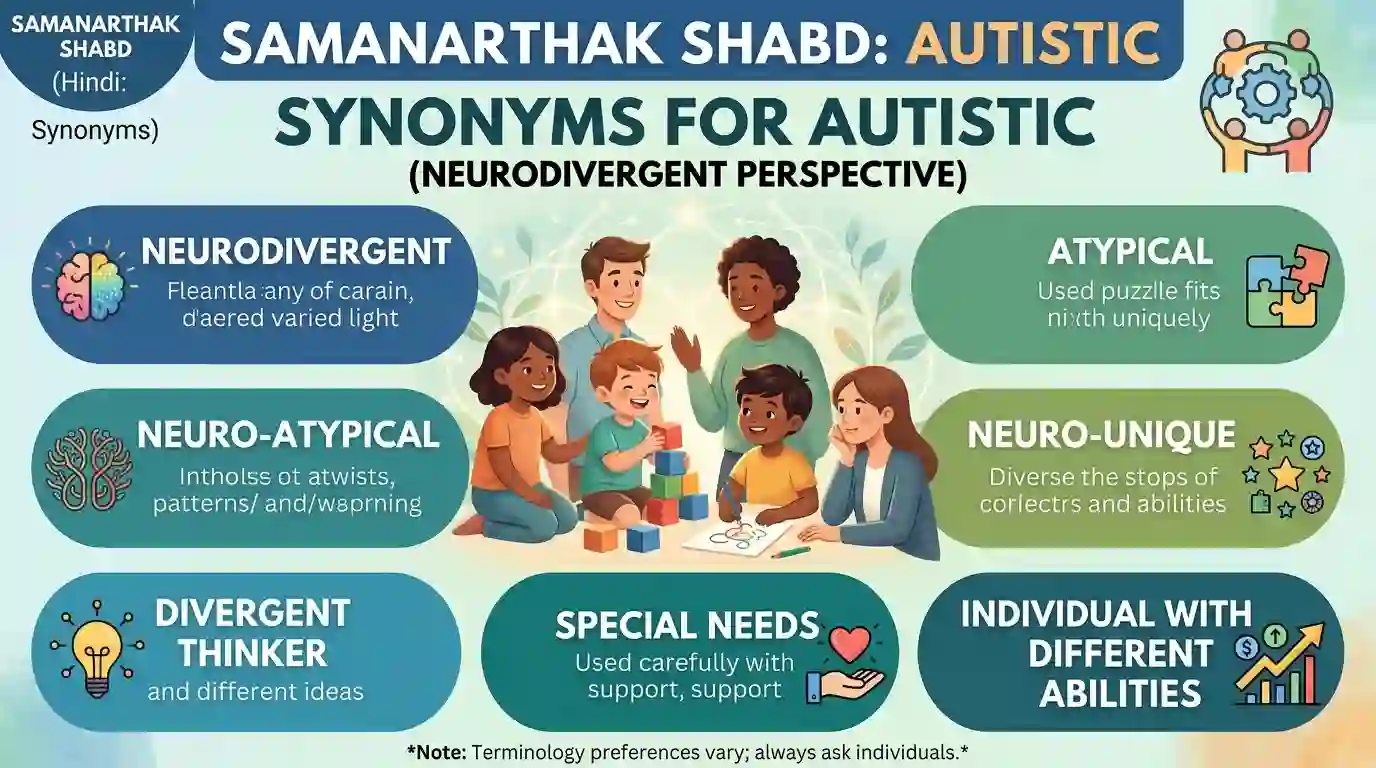
| neurodivergent person | Broader term | Neutral/Formal | Common |
| neurodivergent individual | Broader term | Formal | Common |
| autism-related | Related adjective | Academic | Common |
| autist | Noun, not direct adjective substitute | Uncommon | Rare |
| autie | Informal noun | Informal | Rare |
| Aspie | Community-specific term | Informal | Uncommon |
Important: The table deliberately separates exact alternatives from broader or related terms. This is more accurate than presenting every word as a true synonym.
The Most Useful Alternatives to “Autistic”
1. Autistic Person
Meaning: A person who is autistic.
Examples:
- The school created a quiet study area for autistic students.
- The article describes the experiences of autistic adults.
Best used when: You want a direct, natural description.
Tone: Neutral
CEFR: B2–C1
Frequency: Very common
Common collocations:
- autistic person
- autistic child
- autistic adult
When not to use: Do not assume every person prefers this wording. Ask about personal preference when possible.
2. Autistic Individual
Meaning: A formal way to refer to an autistic person.
Examples:
- The research included autistic individuals from several age groups.
- Each autistic individual may have different communication preferences.
Best used when: Writing academically or professionally.
Tone: Formal/Academic
CEFR: C1
Frequency: Common
Common collocations:
- autistic individuals
- autistic individual
- autistic participants
When not to use: It can sound stiff in everyday conversation.
3. Person With Autism
Meaning: A person who has autism.
Examples:
- The program supports people with autism.
- She works with children with autism.
Best used when: Person-first language is appropriate.
Tone: Neutral/Formal
CEFR: B1–B2
Frequency: Very common
When not to use: Do not assume that person-first language is always preferred. Research shows considerable variation in individual preferences.
4. Person on the Autism Spectrum
Meaning: A person who is on the autism spectrum.
Examples:
- He is a person on the autism spectrum.
- The service was designed for people on the autism spectrum.
Best used when: You want a neutral descriptive phrase.
Tone: Neutral
CEFR: B2
Frequency: Common
Common collocations:
- people on the autism spectrum
- child on the autism spectrum
- adults on the autism spectrum
When not to use: Avoid changing a person’s preferred wording simply to sound more indirect.
5. Person on the Spectrum
Meaning: A shorter form of person on the autism spectrum.
Examples:
- She is a person on the spectrum.
- The teacher has experience supporting students on the spectrum.
Best used when: The conversation already clearly concerns autism.
Tone: Neutral/Spoken
CEFR: B2
Frequency: Common
When not to use: Avoid it when the reader may not know which spectrum you mean.
6. Person With ASD
Meaning: A person with autism spectrum disorder.
Examples:
- The clinic supports children with ASD.
- The study included adults with ASD.
Best used when: Writing for a medical or research audience.
Tone: Medical/Academic
CEFR: C1
Frequency: Common
When not to use: Do not use ASD without explaining it when writing for a general audience.
7. Person Diagnosed With Autism
Meaning: A person who has received an autism diagnosis.
Examples:
- The study examined adults diagnosed with autism.
- He was diagnosed with autism as a child.
Best used when: The diagnosis itself is relevant.
Tone: Formal/Medical
CEFR: B2–C1
Frequency: Common
When not to use: It is unnecessary when diagnosis has nothing to do with your point.
8. Person With an Autism Diagnosis
Meaning: A person who has an autism diagnosis.
Examples:
- The service is available to people with an autism diagnosis.
- The survey included people with an autism diagnosis.
Best used when: Administrative, educational, or professional precision matters.
Tone: Formal
CEFR: C1
Frequency: Common
When not to use: It can sound bureaucratic in everyday speech.
9. Person With Autism Spectrum Disorder
Meaning: A person who has been diagnosed with autism spectrum disorder.
Examples:
- The clinic provides support for people with autism spectrum disorder.
- Researchers studied communication among people with autism spectrum disorder.
Best used when: Clinical terminology is required.
Tone: Medical/Academic
CEFR: C1–C2
Frequency: Common in specialist writing
When not to use: Use simpler wording for general readers when possible.
10. On the Autism Spectrum
Meaning: Having autism or being described as part of the autism spectrum.
Examples:
- Her son is on the autism spectrum.
- The organization supports people on the autism spectrum.
Best used when: You want a widely understood descriptive phrase.
Tone: Neutral
CEFR: B2
Frequency: Very common
When not to use: Do not use it as a forced euphemism if the person prefers autistic.
Related Terms That Are NOT Exact Synonyms
This is where many online synonym pages become inaccurate.
11. Neurodivergent Person
Meaning: A person whose neurological functioning differs from dominant or typical patterns.
Examples:
- The company provides flexible support for neurodivergent employees.
- She describes herself as neurodivergent.
Tone: Neutral/Formal
CEFR: C1
Frequency: Common
Important: Neurodivergent is broader than autistic. It can include autistic people and people with other forms of neurodivergence. Research specifically found that autistic participants viewed neurodivergent as related but not synonymous with autistic.
When not to use: Do not use it when you specifically need to identify autism.
12. Neurodivergent Individual
Meaning: A formal term for a neurodivergent person.
Examples:
- The program supports neurodivergent individuals.
- The researchers interviewed neurodivergent individuals.
Tone: Formal/Academic
CEFR: C1
Frequency: Common
When not to use: Do not use it as a direct substitute for autistic individuals.
13. Autism-Related
Meaning: Connected with autism.
Examples:
- The website contains autism-related information.
- The researchers examined autism-related communication patterns.
Tone: Academic/Formal
CEFR: B2–C1
Frequency: Common
When not to use: This describes a topic, issue, or thing. It does not normally describe a person.
Incorrect:
She is autism-related.
Better:
She is autistic.
14. Autist
Meaning: A noun referring to an autistic person.
Examples:
- The article discusses the historical use of the noun autist.
- Some writers use autism as a self-description.
Tone: Uncommon
CEFR: C2
Frequency: Rare
When not to use: Do not use it as an ordinary replacement for the adjective autistic. It is not the natural choice for most general writing.
15. Autie
Meaning: An informal term sometimes used by autistic people.
Examples:
- The writer uses autie as a personal community term.
- The article explains several informal autism-related labels.
Tone: Informal
CEFR: C1–C2
Frequency: Rare
When not to use: Do not use it for someone unless you know they use or accept the term.
16. Aspie
Meaning: An informal term historically associated with Asperger syndrome.
Examples:
- Some people use Aspie as part of their personal identity.
- The writer explains why she prefers the term Aspie.
Tone: Informal
CEFR: C1
Frequency: Uncommon
When not to use: Do not use Aspie as a universal synonym for autistic. It is a specific identity term and preferences vary.
Strongest Alternatives vs Related Words
Strongest Direct Alternatives
If you simply need another natural way to refer to an autistic person, consider:
- autistic person
- autistic individual
- person with autism
- person on the autism spectrum
- person on the spectrum
Clinical Alternatives
Use these when diagnosis or medical terminology matters:
- person with ASD
- person with autism spectrum disorder
- person diagnosed with autism
- person with an autism diagnosis
Broader or Related Terms
These should not be treated as exact synonyms:
- neurodivergent person
- neurodivergent individual
- autism-related
- autist
- autie
- Aspie
Choose the Right Synonym
| Situation | Natural choice | Reason |
| Everyday writing | autistic person | Direct and clear |
| Academic writing | autistic individuals | Formal |
| Person-first style | person with autism | Puts “person” first |
| General audience | person on the autism spectrum | Clear and descriptive |
| Medical report | person with ASD | Clinical |
| Research about diagnosis | person diagnosed with autism | Diagnosis is relevant |
| Wider neurological discussion | neurodivergent person | Broader category |
| Discussing community terminology | autie/Aspie | Informal and identity-specific |
Remember
Do not choose a synonym only because it sounds softer. Choose it because it means what you actually want to say.
A major international study found that autistic adults had different language preferences, but also strongly emphasized being accurate, specific, and respectful of individual preferences.
Commonly Confused Words
| Word | What it means | Example |
| Autistic | Specifically related to autism | She is autistic. |
| Neurodivergent | Broader term for neurological differences | She is neurodivergent. |
| Neurotypical | Generally describes typical neurological functioning | He is neurotypical. |
| Non-autistic | Simply means not autistic | The study included autistic and non-autistic adults. |
| Neurodiverse | Usually describes diversity within a group or population | The workplace has a neurodiverse team. |
Key difference
A person can be non-autistic but neurodivergent. For example, someone may have another form of neurodivergence without being autistic. Therefore, neurotypical and non-autistic are not exact opposites in every context.
Grammar: How to Use “Autistic” Correctly
Pattern 1: Be + autistic
She is autistic.
Pattern 2: Autistic + noun
He is an autistic student.
Pattern 3: Autistic + plural noun
The program supports autistic adults.
Common Mistake
Mistake:
She has autistic.
Correction:
She is autistic.
Why?
Autistic is an adjective. The noun is autism.
Another mistake
Mistake:
He has autism.
Correction:
He is autistic.
Or:
He has autism.
Natural Collocations
Native and professional English commonly uses combinations such as:
- autistic person
- autistic people
- autistic child
- autistic adult
- autistic student
- autistic employee
- autistic community
- autistic traits
- autistic identity
- autistic experience
- autistic communication
These natural combinations are often more useful to ESL learners than rare thesaurus words.
Common Mistakes to Avoid
Common Mistake Box
Mistake 1: Using “ill” as a synonym
Some thesaurus pages list ill as a synonym for autistic. This is inaccurate for modern learner usage.
Better:
autistic
person with autism
Do not replace autistic with illness simply because a thesaurus lists it.
Mistake 2: Treating “neurodivergent” as exact
Wrong idea:
neurodivergent = autistic
Better:
Autism is one form of neurodivergence, but neurodivergence is broader.
Research directly supports this distinction.
Mistake 3: Calling “Aspie” a universal synonym
Better: Use Aspie only when discussing the term itself or when it reflects someone’s chosen identity.
Mistake 4: Using unnatural phrases
Avoid expressions such as:
- autism spectrum person
- autism spectrum individual
- autism spectrum synonym
These may be understandable, but they are not the natural choices most learners need.
Writing Tips
For Essays
Use specific language:
The essay examines the experiences of autistic students.
Do not repeatedly replace autistic with unrelated words just to avoid repetition.
For Professional Emails
Keep the language simple:
We provide support for autistic employees.
For Blog Posts
Define specialist terms:
ASD means autism spectrum disorder.
Then use the shorter form consistently.
For Social Media
Natural language is usually best:
Many autistic people have different sensory experiences.
For Academic Writing
Use the term that matches the research population.
For example:
The researchers recruited autistic adults.
If diagnosis is central:
The researchers recruited adults with an autism diagnosis.
When Should You NOT Replace “Autistic”?
Sometimes the best synonym is no synonym at all.
If your sentence is:
The study examined autistic adults.
Replacing autistic with neurodivergent adults changes the population because the second phrase can include people who are not autistic.
Likewise:
The clinic supports autistic children.
should not automatically become:
The clinic supports children with neurological differences.
The second sentence is much broader.
Good writing does not avoid repetition at the cost of accuracy.
American vs British English
The spelling is the same in both varieties:
British: autistic
American: autistic
The main difference is pronunciation.
| Variety | IPA |
| British English | /ɔːˈtɪs.tɪk/ |
| American English | /ɑːˈtɪs.tɪk/ |
Cambridge records both forms.
There is no standard British/American spelling change such as colour/color for this word.
Register Guide
| Term | Register |
| autistic person | Neutral |
| autistic individual | Formal |
| person with autism | Neutral/Formal |
| person on the spectrum | Neutral/Spoken |
| person with ASD | Medical |
| autism spectrum disorder | Medical/Academic |
| person diagnosed with autism | Formal |
| neurodivergent person | Neutral/Academic |
| autist | Uncommon |
| autie | Informal |
| Aspie | Informal/Community |
Mini Practice
Fill in the Blanks
- Maria ______ autistic.
- The clinic supports children ______ autism.
- The researchers studied adults ______ ASD.
- Neurodivergent is a ______ term than autistic.
Answers
- is
- with
- with
- broader
Rewrite the Sentence
Original:
Tom is autistic.
Rewrite it using person-first language.
Possible answer:
Tom is a person with autism.
Both forms can be grammatically correct. The appropriate choice can depend on the person’s preference and the context.
Matching Exercise
Match each term with its meaning.
A. Autistic
B. Neurodivergent
C. Non-autistic
D. Neurotypical
- A broader neurological category
- Specifically related to autism
- Not autistic
- Generally describing typical neurological functioning
Answers: A-2, B-1, C-3, D-4
FAQ: Synonyms for Autistic
What is another word for autistic?
The closest alternatives include autistic person, autistic individual, person with autism, person on the autism spectrum, and person with ASD. These expressions are not identical in style or context, so choose the one that accurately matches your meaning and the terminology preferred by the person you are describing.
Is neurodivergent a synonym for autistic?
No. Neurodivergent is broader than autistic. It can describe autistic people as well as people with other forms of neurological difference. Therefore, use neurodivergent when the broader category is relevant, not simply as a replacement for autistic.
Is “person with autism” correct?
Yes. A person with autism is grammatically correct and widely used. However, language preferences vary. Research involving English-speaking autistic adults found stronger overall support for identity-first wording such as autistic person, while some people still prefer person-first language.
What is the formal word for autistic?
There is no single “formal synonym.” In clinical contexts, you may see a person with autism spectrum disorder or a person with ASD. In general professional writing, autistic people are often clearer and more natural.
Can I say “on the spectrum” instead of autistic?
Yes, on the autism spectrum is a common phrase. However, it is a descriptive alternative rather than a perfect synonym. If you know someone’s preferred terminology, follow it.
Is “autist” a synonym for autistic?
Autist is a noun referring to an autistic person, but it is uncommon. It should not automatically replace the adjective autistic. In most general writing, autistic person is clearer.
Is “Aspie” the same as autistic?
Not exactly. Aspie is an informal term historically associated with Asperger syndrome. Some people use it as a self-description, but it should not be applied automatically to every autistic person.
Is “ill” another word for autistic?
No. Although some online thesaurus pages list ill as a synonym, it is not an accurate modern replacement for autistic. Autism and illness are not interchangeable concepts, so ESL learners should not use ill as a synonym in ordinary writing.
Vocabulary Quiz
1. Which is the closest direct alternative?
A. Ill
B. Autistic person
C. Normal
D. Dreamy
Answer: B
2. Which term is broader than autistic?
A. Neurodivergent
B. Autistic
C. Person with autism
D. Person with ASD
Answer: A
3. Which sentence is grammatically correct?
A. She has autistic.
B. She has autism.
C. She is autistic.
D. She is autistic.
Answer: C
4. Which expression is most clearly clinical?
A. Autie
B. Aspie
C. Person with ASD
D. Person on the spectrum
Answer: C
5. Why should “ill” not be used as a synonym for autistic?
A. It is too long.
B. It changes the meaning.
C. It is only British English.
D. It is a noun.
Answer: B
Answer Key
- B
- A
- C
- C
- B
Final Takeaway: Choose Accuracy Over a Long Synonym List
The best synonyms for autistic are not a random collection of words from a thesaurus. Autistic person, autistic individual, a person with autism, a person on the autism spectrum, and a person with ASD can all be useful in the right context.
Words such as neurodivergent, Aspie, autist, and autie need more care because they have broader, informal, historical, or community-specific meanings. For strong English writing, remember one simple rule: do not change a precise word just to avoid repetition. Use the term that says exactly what you mean, and when you are describing a particular person, respect their preferred language.
Trusted References
- Cambridge Dictionary, autistic and autism.
- Oxford Learner’s Dictionaries, autistic.
- Keating et al., Autism-related language preferences of English-speaking individuals across the globe.
- WordHippo, another word for autistic. Used here to identify competitor content and its limitations.
- Synonym.com, autistic synonyms. Used here to identify competitor content and its limitations.

Synonorm is a trusted English vocabulary resource created to help readers find the right words and understand the differences between similar terms. We provide clear explanations of synonyms, meanings, examples, usage, and alternatives. Our content makes vocabulary easier to learn and apply in everyday, academic, and professional English. Synonorm is designed for students, writers, ESL learners, professionals, and anyone who wants to improve their English vocabulary and communicate more clearly.