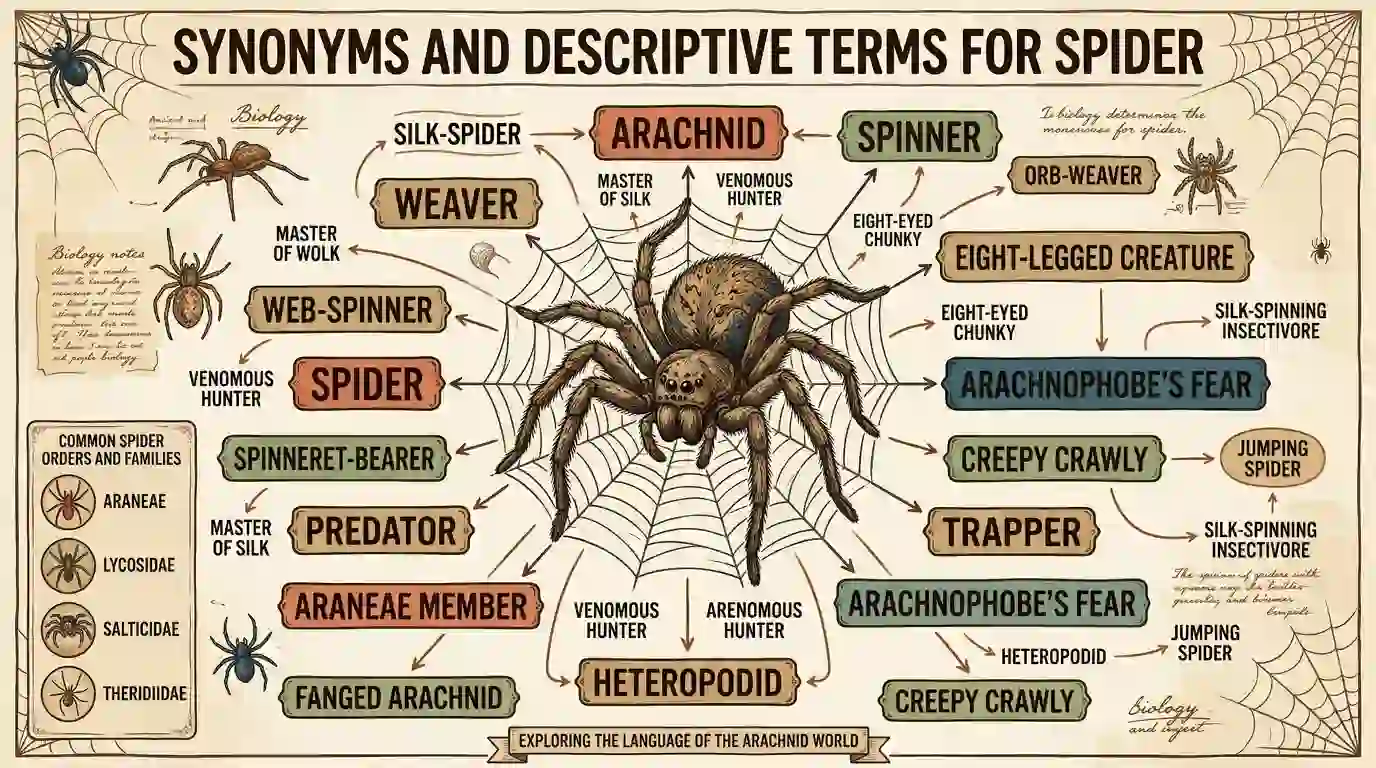
Quick Answer: The closest useful alternative to spider is arachnid, but it is a broader term, not an exact synonym. Other words such as tarantula, jumping spider, wolf spider, orb-weaver, and black widow name specific kinds of spiders. For most everyday writing, spider remains the clearest and most natural word.
What Are the Best Synonyms for Spider?
Have you ever searched for another word for spider because you did not want to repeat the same word in an essay, story, or article?
There is an important point to understand first: English does not have many exact synonyms for spiders. Some words describe a larger animal group, while others name specific types of spiders.
The most useful broader term is arachnid. A spider belongs to the arachnid group, but scorpions, ticks, and mites are also arachnids. Therefore, arachnid cannot replace spider in every sentence.
Other useful related terms include tarantula, jumping spider, wolf spider, orb-weaver, house spider, and black widow. These are more specific because they identify particular kinds of spiders.
For students and English learners, the best strategy is simple: use spider when you mean a spider in general, and choose a more specific term only when its meaning fits.
Spider Meaning
A spider is an eight-legged animal belonging to the order Araneae. Spiders are arachnids, and many species produce silk that they use to build webs, shelters, egg sacs, or other structures.
Cambridge lists spider as a B1 noun and gives the UK pronunciation /ˈspaɪ.də(r)/ and US pronunciation /ˈspaɪ.dɚ/.
Example:
I found a small spider near the window.
Pronunciation
British English: /ˈspaɪ.də(r)/
American English: /ˈspaɪ.dɚ/
Easy pronunciation: SPY-duh in British English and roughly SPY-der in American English.
Part of Speech
Spider is mainly a countable noun.
Singular
There is a spider on the wall.
Plural
There are several spiders in the garden.
Possessive
The spider’s web was covered with morning dew.
Verb
In specialized English, spider can also refer to a program systematically following links on the internet. This is especially common in computing and search-engine contexts.
Quick Synonym Comparison
| Word or phrase | Relationship to spider | Register | Frequency |
| Arachnid | Broader category | Scientific / formal | Common |
| Araneid | Specialist spider term | Scientific | Rare |
| Tarantula | Specific type | Neutral | Common |
| Wolf spider | Specific type | Neutral / scientific | Uncommon |
| Jumping spider | Specific type | Neutral / scientific | Uncommon |
| Orb-weaver | Specific type | Scientific / nature | Uncommon |
| Huntsman spider | Specific type | Neutral / scientific | Uncommon |
| House spider | Descriptive type | Neutral | Common |
| Garden spider | Descriptive type | Neutral | Common |
| Black widow | Specific group | Neutral / scientific | Common |
| Brown recluse | Specific type | Scientific / US usage | Uncommon |
| Trapdoor spider | Specific type | Scientific | Uncommon |
| Daddy longlegs | Regional/ambiguous term | Informal | Common in some regions |
| Harvestman | Different arachnid | Scientific | Uncommon |
| Eight-legged arachnid | Descriptive phrase | Neutral | Uncommon |
Remember: Most of these are not exact synonyms. They are broader terms, specific types, or related expressions.
The Best Alternatives to Spider
1. Arachnid
Meaning: An arachnid is an animal group that includes spiders, scorpions, ticks, and mites.
CEFR: Approximately C1 for general learners
Register: Scientific / formal
Frequency: Common in science writing
Examples:
- A spider is a type of arachnid.
- The museum has an exhibit about different arachnids.
Best used when: You are discussing animal classification.
Common collocations:
- arachnid species
- arachnid group
- arachnid family
Connotation: Neutral and scientific.
When not to use: Do not use arachnid when you specifically need to identify a spider.
Important distinction:
Spider → one type of arachnid
Arachnid → larger category
2. Araneid
Meaning: An araneid is a specialist term relating to spiders in the order Araneae.
CEFR: C2 / specialist
Register: Scientific
Frequency: Rare
Examples:
- The researcher examined an araneid specimen.
- The paper discusses several araneid species.
Best used when: Writing for a zoology or scientific audience.
When not to use: Do not use araneid as a fancy replacement for spider in ordinary conversation.
Connotation: Highly technical.
3. Tarantula
Meaning: A tarantula is a particular group of large, hairy spiders.
CEFR: B2
Register: Neutral
Frequency: Common
Examples:
- The tarantula slowly climbed over the branch.
- She saw a large tarantula at the wildlife center.
Best used when: You know the spider is a tarantula.
Collocations:
- large tarantula
- hairy tarantula
- pet tarantula
When not to use: A normal small house spider should not be called a tarantula.
4. Wolf Spider
Meaning: A wolf spider is a type of spider that actively hunts prey.
CEFR: B2-C1
Register: Neutral / scientific
Frequency: Uncommon
Examples:
- A wolf spider moved across the dry leaves.
- The researcher photographed a wolf spider at night.
Best used when: You are identifying this particular spider group.
When not to use: Do not use it as a general synonym for every spider.
5. Jumping Spider
Meaning: A jumping spider is a type of spider known for jumping when moving or hunting.
CEFR: B2-C1
Register: Neutral / scientific
Frequency: Uncommon
Examples:
- A tiny jumping spider landed on my notebook.
- The jumping spider watched the fly from the leaf.
Collocations:
- tiny jumping spider
- colorful jumping spider
- jumping spider species
Best used when: The spider belongs to this group.
6. Orb-Weaver
Meaning: An orb-weaver is a spider that commonly creates a circular, wheel-like web.
CEFR: C1
Register: Scientific / nature writing
Frequency: Uncommon
Examples:
- An orb-weaver built a web between two branches.
- The photographer found an orb-weaver early in the morning.
Best used when: The spider’s round web is relevant.
When not to use: Do not call every spider an orb-weaver.
7. Huntsman Spider
Meaning: A huntsman spider is a large spider known for its long legs and quick movement.
CEFR: C1
Register: Neutral / scientific
Frequency: Uncommon
Examples:
- A huntsman spider was resting on the wall.
- The large huntsman spider moved quickly across the floor.
Best used when: You mean this specific group.
8. House Spider
Meaning: A house spider is a spider commonly found in or around buildings.
CEFR: B1-B2
Register: Neutral
Frequency: Common
Examples:
- A house spider was hiding behind the cupboard.
- We noticed a small house spider near the window.
Collocations:
- common house spider
- small house spider
- house spider web
Best used when: The spider’s indoor habitat matters.
9. Garden Spider
Meaning: A garden spider is a spider commonly associated with gardens and vegetation.
CEFR: B1-B2
Register: Neutral
Frequency: Common
Examples:
- A garden spider built a web between the flowers.
- We watched the garden spider from a safe distance.
Best used when: You are describing a spider found in a garden or similar outdoor setting.
10. Black Widow
Meaning: Black widow is a common name for spiders in the genus Latrodectus.
CEFR: B2
Register: Neutral / scientific
Frequency: Common
Examples:
- The guide showed us how to recognize a black widow.
- The article discusses black widow spiders and their habitats.
Best used when: You specifically mean a black widow.
When not to use: Never use black widow simply as another word for an ordinary spider.
11. Brown Recluse
Meaning: A brown recluse is a particular type of spider associated mainly with parts of the United States.
CEFR: B2-C1
Register: Scientific / neutral
Frequency: Uncommon
Examples:
- The pest expert explained how to identify a brown recluse.
- The article describes the brown recluse’s natural habitat.
Best used when: You are specifically discussing this species group.
12. Recluse Spider
Meaning: A recluse spider belongs to the recluse group of spiders.
CEFR: C1
Register: Scientific
Frequency: Uncommon
Examples:
- The researcher identified the specimen as a recluse spider.
- The guide includes several pictures of recluse spiders.
When not to use: It should not replace spider in general sentences.
13. Trapdoor Spider
Meaning: A trapdoor spider is a spider that lives in a burrow and can use a door-like covering at the entrance.
CEFR: C1
Register: Scientific / nature writing
Frequency: Uncommon
Examples:
- The trapdoor spider disappeared into its burrow.
- The researcher searched the soil for trapdoor spiders.
Best used when: Discussing a particular spider group and its habitat.
14. Daddy Longlegs
Meaning: Daddy longlegs is a common informal name that can refer to different long-legged creatures depending on the region.
CEFR: B2
Register: Informal / regional
Frequency: Common in some varieties of English
Example:
There were daddy longlegs on the ceiling.
Important: The term is not precise worldwide. It may refer to a harvestman rather than a true spider.
When not to use: Avoid it in scientific writing when precise identification matters.
15. Harvestman
Meaning: A harvestman is a long-legged arachnid, but it is not a true spider.
CEFR: C1
Register: Scientific
Frequency: Uncommon
Examples:
- The child thought the harvestman was a spider.
- The biology guide explains how harvestmen differ from spiders.
Best used when: You mean this separate group of arachnids.
Important: Harvestman should be treated as a related term, not a synonym.
Strongest Alternatives vs Related Words
Closest Useful Alternative
Arachnid
This is the closest broadly useful term, but it is broader than spider.
Specialist Alternative
Araneid
Useful in scientific contexts, but too technical for everyday English.
Specific Spider Names
- tarantula
- wolf spider
- jumping spider
- orb-weaver
- huntsman spider
- house spider
- garden spider
- black widow
- brown recluse
- trapdoor spider
Related but Not Synonyms
- harvestman
- daddy longlegs
- arthropod
- insect
- bug
- scorpion
- tick
- mite
Which Word Should You Choose?
| Your meaning | Best word |
| Any spider | spider |
| Scientific animal group | arachnid |
| Specialist spider classification | araneid |
| Large hairy spider | tarantula |
| Active hunting spider | wolf spider |
| Jumping species | jumping spider |
| Circular-web builder | orb-weaver |
| Indoor spider | house spider |
| Garden species | garden spider |
| Specific venomous group | black widow |
| Long-legged non-spider arachnid | harvestman |
The simple rule
Do not replace a general word with a specific word unless you know the specific meaning is correct.
For example:
❌ A tarantula was sitting on the kitchen wall.
If you only know it was a spider, write:
✅ A spider was sitting on the kitchen wall.
Spider in American and British English
The spelling spider is the same in British and American English.
The pronunciation differs slightly:
| Variety | IPA |
| British English | /ˈspaɪ.də(r)/ |
| American English | /ˈspaɪ.dɚ/ |
Cambridge gives both pronunciations and lists spider as a B1 noun.
Some related terms can vary by region. Daddy longlegs, in particular, can refer to different animals in different English-speaking communities.
For international English, spider is usually the safest and clearest choice.
Spider: Word Origin and Etymology
The word spider has a long history in English.
Its history is connected with Old English and the verb spin, reflecting the animal’s ability to produce silk and spin webs. Historical forms include Middle English forms related to spithre.
This connection is especially interesting for learners because English also uses spin in phrases such as:
- spin a web
- spinning silk
- spider web
- web-spinning spider
The history shows how words can develop around a noticeable feature or action associated with an animal.
Spider Has More Than One Meaning
This is an important point that many simple synonym articles miss.
1. Spider: The Animal
I saw a spider in the bathroom.
This is the normal everyday meaning.
2. Spider: Search-Engine Program
In computing, a spider can refer to a program that automatically explores web pages and follows links.
Example:
The search engine uses a spider to discover new pages.
This meaning is highly relevant to bloggers, SEO professionals, and web developers.
3. Spider: Cooking Pan
In some historical or dictionary usage, spider can refer to a type of cast-iron cooking pan.
This is why a giant thesaurus list may contain words such as frying pan, frypan, or skillet. Those words relate to a different sense of spider, not to the animal.
This distinction explains why some online synonym pages appear to give strange results. Synonym.com, for example, lists both animal-related terms and cooking-pan terms under separate senses.
Common Collocations With Spider
Native speakers commonly combine spider with words that describe its appearance, type, behavior, or habitat.
Appearance
- giant spider
- tiny spider
- hairy spider
- large spider
Type
- jumping spider
- wolf spider
- house spider
- garden spider
Behavior
- spider spins
- spider crawls
- spider hunts
- spider bites
Web and silk
- spider web
- spider silk
- spider’s web
- web-spinning spider
Cambridge’s corpus and collocation information includes combinations such as female spider, male spider, and giant spider.
Common Mistakes
Common Mistake Box
Mistake 1
❌ A spider is an insect.
✅ A spider is an arachnid.
Spiders and insects are both arthropods, but they belong to different groups.
Mistake 2
❌ Every arachnid is a spider.
✅ Every spider is an arachnid.
The second sentence correctly describes the relationship.
Mistake 3
❌ I saw a tarantula, when you only know that it was a spider.
✅ I saw a spider.
Tarantula is more specific.
Mistake 4
❌ The spider was a harvestman.
✅ The creature was a harvestman.
A harvestman is an arachnid but is not a true spider.
Mistake 5
❌ I used “arachnid” in every sentence to avoid repetition.
✅ Use spider naturally and use arachnid only when the broader category is relevant.
Writing Tips: How to Avoid Repeating Spider
Synonyms should make writing clearer, not simply different.
In an Essay
Instead of forcing a synonym:
The spider entered the garden. The arachnid climbed the plant. The creature moved toward the wall.
Write naturally:
The spider entered the garden and climbed a plant before disappearing behind the wall.
In a Story
A specific word can create a stronger image:
A hairy tarantula slowly emerged from the dark corner.
In a Science Article
A broader scientific term may be useful:
The spider belongs to a large group of arachnids.
In SEO Writing
If you are writing about spiders, use related terms naturally:
- spider species
- spider web
- arachnid
- jumping spider
- wolf spider
- spider habitat
- spider behavior
Do not repeatedly replace spider with unrelated words simply to increase keyword variation.
When Should You Keep the Word “Spider”?
Sometimes the best synonym is no synonym at all.
Use spider when:
- The animal’s exact type is unknown.
- You are writing for children or beginner English learners.
- You need simple everyday English.
- The exact species does not matter.
- Replacing it would make the sentence less accurate.
Natural repetition is better than an inaccurate synonym.
Writing Tip: Accuracy comes before vocabulary variety.
Antonyms and Related Vocabulary
Antonyms
There is no direct antonym for spider because it is the name of an animal.
Related Vocabulary
- arachnid
- arthropod
- web
- silk
- spinneret
- prey
- predator
- venom
- fang
- habitat
- burrow
- insect
- crawling
- hunting
These words are related to spiders but are not synonyms.
Mini Practice: Fill in the Blanks
Choose spider, arachnid, tarantula, harvestman, or jumping spider.
- A ______ has eight legs and belongs to the arachnid group.
- A ______ is a large, often hairy type of spider.
- A ______ is not a true spider even though it is an arachnid.
- A ______ can jump while hunting.
- A spider belongs to the larger group called an ______.
Answers
- spider
- tarantula
- harvestman
- jumping spider
- arachnid
Sentence Rewriting Practice
Rewrite each sentence using the word in brackets.
1.
A spider was crawling across the leaf.
Use: arachnid
Possible answer:
An arachnid was crawling across the leaf.
This changes the level of specificity because arachnids are broader.
2.
We saw a large, hairy spider at the zoo.
Use: tarantula
Possible answer:
We saw a large, hairy tarantula at the zoo.
Only use this version if the animal is actually a tarantula.
FAQ About Synonyms for Spider
What is the closest synonym for spider?
Arachnid is the closest broadly useful alternative, but it is not an exact synonym. A spider is an arachnid, while scorpions, ticks, and mites also belong to the arachnid group. Use arachnid when the broader scientific category is appropriate.
What is another word for spider?
The safest alternative depends on the context. Arachnid is a broader scientific term. Tarantula, jumping spider, wolf spider, and black widow are names for specific types of spiders, so they should not be used for a spider of unknown type.
Is arachnid another name for a spider?
Not exactly. Arachnid is a broader category that includes spiders. A spider is an arachnid, but an arachnid may also be a scorpion, tick, mite, or another member of the group. Therefore, the two words are related but not fully interchangeable.
What is the scientific word for spider?
Araneid is a specialist term associated with spiders in the order Araneae. Arachnid is also scientific but broader. For ordinary English, however, spider is the most natural word.
Is a tarantula a synonym for spider?
No. A tarantula is a type of spider. You should use tarantula only when you are referring to a tarantula. Calling every spider a tarantula would make the sentence inaccurate.
Is a harvestman a spider?
No. A harvestman is an arachnid but is not a true spider. The confusion comes from its eight legs and spider-like appearance. In scientific or educational writing, keeping the two groups separate is important.
What is a formal word for spider?
Arachnid can sound more formal or scientific, while araneid is more technical. However, neither should automatically replace spiders. The correct word depends on what you are trying to say.
What is the British English word for spider?
The normal British English word is spider. The spelling is the same as American English. The pronunciation differs slightly, with British English commonly using /ˈspaɪ.də(r)/ and American English using /ˈspaɪ.dɚ/.
Vocabulary Quiz
1. Which word is a broader category that includes spiders?
A. Tarantula
B. Arachnid
C. Jumping spider
D. Black widow
2. Which word refers to a specific type of spider?
A. Arthropod
B. Arachnid
C. Tarantula
D. Insect
3. Which statement is correct?
A. Every arachnid is a spider.
B. Every spider is an insect.
C. Every spider is an arachnid.
D. Every insect is an arachnid.
4. Which word should you avoid using as a general synonym for spider?
A. Spider
B. Arachnid
C. Tarantula
D. None of these can always replace spiders.
5. Which animal is an arachnid but not a true spider?
A. Harvestman
B. Tarantula
C. Jumping spider
D. Wolf spider
Answer Key
- B. Arachnid
- C. Tarantula
- C. Every spider is an arachnid.
- D. None of these can always replace spiders.
- A. Harvestman
Final Takeaway
There are not many true synonyms for spider, and that is exactly why accuracy matters. Arachnid is the most useful broader term, while tarantula, wolf spider, jumping spider, orb-weaver, and black widow describe particular types.
Words such as harvestman, insect, and arthropod are related but should not be treated as interchangeable synonyms. For everyday English, spider is usually the clearest choice. Learning the difference helps you write more naturally, speak more precisely, and avoid common vocabulary mistakes.
Trusted References
- Cambridge Dictionary: spider and its pronunciation, learner level, related vocabulary, and corpus examples.
- Oxford Learner’s Dictionaries: useful learner-focused vocabulary and usage reference.
- Merriam-Webster: useful for historical and specialist word information.
- Thesaurus.com: useful for examining how major thesaurus databases organize different senses of spider.
- Power Thesaurus and Synonym.com: useful for competitor-gap research, while their broad related-word lists should be interpreted carefully rather than treated as lists of exact synonyms.

Synonorm is a trusted English vocabulary resource created to help readers find the right words and understand the differences between similar terms. We provide clear explanations of synonyms, meanings, examples, usage, and alternatives. Our content makes vocabulary easier to learn and apply in everyday, academic, and professional English. Synonorm is designed for students, writers, ESL learners, professionals, and anyone who wants to improve their English vocabulary and communicate more clearly.