Quick Answer
The best synonyms for forlorn depend on what you mean. Use lonely for sadness caused by being alone, forsaken for someone who feels abandoned, desolate for deep emotional or physical emptiness, and dejected for sadness after disappointment. For a place, deserted or abandoned may fit better. For an unlikely plan, use hopeless, unfeasible, or unachievable.
What Does Forlorn Mean?
Have you ever wanted to describe someone who looks more than simply sad or lonely? Forlorn is a useful word when a person, place, or situation seems lonely, unhappy, abandoned, or without hope.
For example:
The child looked forlorn after his parents left.
Here, forlorn suggests more than ordinary sadness. It can create a picture of someone who feels alone, uncared for, and unsure of what will happen next.
The word also has another important use:
It was a forlorn attempt to save the old building.
In this sentence, forlorn does not describe someone’s feelings. It means the attempt was very unlikely to succeed.
That second meaning is easy to miss. This guide explains both meanings and shows which synonyms work in each situation.
Pronunciation
British English: /fəˈlɔːn/
American English: /fɚˈlɔːrn/
Pronunciation: fer-LORN
The spelling forlorn is the same in American and British English. The main pronunciation difference is the treatment of the r sound. Cambridge labels the main emotional sense as literary.
Part of Speech
Forlorn is an adjective.
Examples:
- She looked forlorn.
- The house seemed forlorn.
- It was a forlorn attempt.
Related forms include:
- forlornly: adverb
- forlornness: noun
Do not treat forlorn itself as a noun or verb in normal modern English.
The Three Main Meanings of Forlorn
Understanding these meanings makes choosing a synonym much easier.
1. Lonely and unhappy
He looked forlorn after his friends left.
Closest alternatives include:
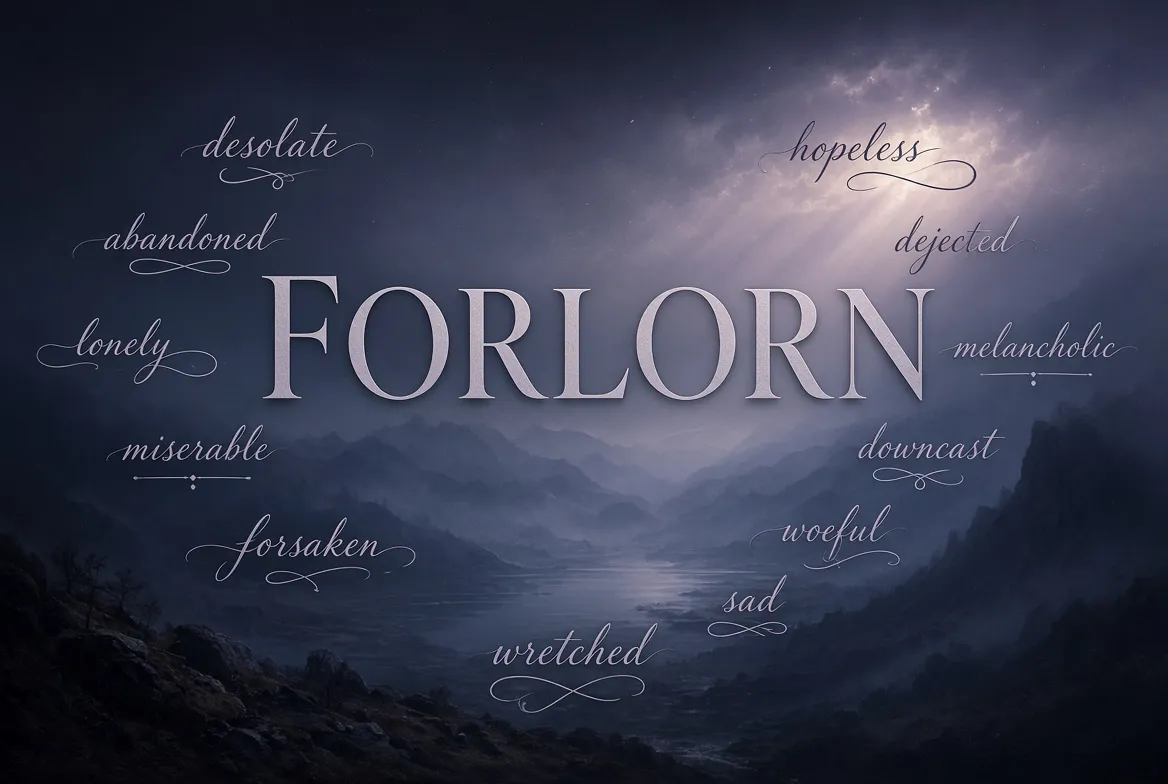
lonely, lonesome, isolated, dejected, disconsolate
2. Empty, neglected, or abandoned
The old station looked forlorn.
Closest alternatives include:
desolate, deserted, abandoned, neglected, bleak
3. Very unlikely to succeed
It was a forlorn attempt to change the decision.
Closest alternatives include:
hopeless, unfeasible, unachievable, impracticable, impossible
Cambridge explicitly gives this third sense for phrases such as forlorn hope and forlorn attempt. Collins also separates forlorn into several semantic uses rather than treating all synonyms as interchangeable.
Quick Synonym Comparison
| Synonym | Main sense | Strength | Register | Approx. CEFR |
| lonely | sad because alone | Strong | Neutral | A2–B1 |
| lonesome | lonely | Strong | Spoken/US | B1 |
| abandoned | left behind | Strong | Neutral | B1 |
| isolated | separated from others | Related | Neutral/Formal | B1–B2 |
| desolate | deeply empty or bleak | Strongest | Literary | B2 |
| forsaken | abandoned and uncared for | Strongest | Literary | B2–C1 |
| deserted | empty of people | Strong | Neutral | B1 |
| neglected | not properly cared for | Related | Neutral | B1–B2 |
| dejected | sad after disappointment | Strong | Neutral/Formal | B2 |
| despondent | deeply discouraged | Strong | Formal | C1 |
| disconsolate | too sad to be comforted | Strongest | Literary | C1 |
| miserable | very unhappy | Strong | Neutral | B1 |
| hopeless | without hope | Strong | Neutral | B1 |
| despairing | showing loss of hope | Strong | Formal/Literary | C1 |
| bereft | deprived through loss | Strong | Formal/Literary | C1 |
| bleak | lacking hope or warmth | Strong | Neutral/Literary | B2 |
| solitary | alone | Related | Neutral/Formal | B2 |
| friendless | having no friends | Related | Neutral | B2 |
| cheerless | lacking happiness | Related | Literary | B2 |
| woebegone | visibly very sad | Strong | Literary | C2 |
| unfeasible | impossible to carry out | Strong | Formal | B2–C1 |
| unachievable | impossible to achieve | Strong | Formal | B2 |
| impracticable | not workable in practice | Strong | Formal | C1 |
| impossible | unable to happen or succeed | Strong | Neutral | A2–B1 |
Note: CEFR levels are approximate learner guidance, not official universal CEFR classifications.
The Most Useful Synonyms for Forlorn
1. Lonely
Meaning: Sad because you are alone or do not have enough companionship.
Examples:
- She felt lonely after moving to another city.
- The child looked lonely at the party.
Best used when: The central idea is emotional loneliness.
Register: Neutral
Frequency: Very common
Collocations: feel lonely, lonely person, lonely evening
Nuance: Lonely is usually less dramatic than forlorn.
When not to use it: Do not use it simply because someone is physically alone. A person can be alone without feeling lonely.
2. Lonesome
Meaning: Lonely, especially when you want company.
Examples:
- He felt lonesome during the long winter.
- The traveler became lonesome after months away from home.
Best used when: You want a conversational or slightly old-fashioned alternative to lonely.
Register: Spoken/Neutral
Frequency: Common
Regional note: Cambridge marks this use as US. Collins also identifies lonesome as US/Canadian.
Collocations: feel lonesome, lonesome road, lonesome night
When not to use it: Avoid it in formal academic writing unless the tone specifically calls for it.
3. Abandoned
Meaning: Left behind without care, use, or support.
Examples:
- They found an abandoned house near the highway.
- The abandoned dog needed immediate help.
Best used when: The fact of being left behind matters.
Register: Neutral
Frequency: Very common
Collocations: abandoned house, abandoned building, abandoned child
Nuance: Abandoned does not automatically mean emotionally sad.
When not to use it: Do not use it for every lonely person. It suggests that someone or something has been left.
4. Forsaken
Meaning: Abandoned or left without care, support, or companionship.
Examples:
- She felt forsaken after everyone turned away.
- The forsaken village had almost no residents.
Best used when: You want to emphasize abandonment.
Register: Literary/Formal
Frequency: Uncommon
Collocations: forsaken place, forsaken village, feel forsaken
Nuance: Forsaken often sounds more dramatic than abandoned.
5. Desolate
Meaning: Extremely empty, lonely, bleak, or unhappy.
Examples:
- The desert looked desolate under the gray sky.
- He felt desolate after losing his closest friend.
Best used when: You want to express deep emptiness in a person or place.
Register: Literary
Frequency: Common
Collocations: desolate place, desolate landscape, feel desolate
Nuance: This is one of the closest choices when forlorn means emotionally or physically empty.
6. Deserted
Meaning: Empty because people have left or do not go there.
Examples:
- The streets were deserted after midnight.
- We discovered a deserted train station.
Best used when: Describing an empty location.
Register: Neutral
Frequency: Common
Collocations: deserted street, deserted village, deserted beach
When not to use it: It usually does not describe someone’s emotional state.
7. Isolated
Meaning: Separated from other people, places, or groups.
Examples:
- The family lived in an isolated mountain village.
- She felt isolated from her classmates.
Best used when: Separation is more important than sadness.
Register: Neutral/Formal
Frequency: Very common
Collocations: isolated community, isolated area, socially isolated
Nuance: Someone can be isolated without being unhappy.
8. Dejected
Meaning: Very unhappy because something has gone wrong.
Examples:
- The dejected player walked off the field.
- She looked dejected after the interview.
Best used when: Sadness follows failure, rejection, or disappointment.
Register: Neutral/Formal
Frequency: Common
Collocations: look dejected, feel dejected, dejected expression
Nuance: Dejected focuses on disappointment more than loneliness.
9. Despondent
Meaning: Very discouraged and without much hope.
Examples:
- He became despondent after several failed applications.
- The team felt despondent after the defeat.
Best used when: You want a formal word for deep discouragement.
Register: Formal
Frequency: Uncommon
Collocations: become despondent, feel despondent, despondent mood
When not to use it: It is usually too formal for simple everyday conversation.
10. Disconsolate
Meaning: Extremely unhappy and difficult to comfort.
Examples:
- The disconsolate child sat quietly in the corner.
- She looked disconsolate after hearing the news.
Best used when: The sadness is deep and comfort does not seem to help.
Register: Literary/Formal
Frequency: Uncommon
Collocations: disconsolate figure, look disconsolate, disconsolate mood
11. Miserable
Meaning: Very unhappy or uncomfortable.
Examples:
- He felt miserable after the argument.
- The cold rain made the campers miserable.
Best used when: You need a common word for strong unhappiness.
Register: Neutral
Frequency: Very common
Collocations: feel miserable, miserable day, miserable condition
Nuance: Miserable does not specifically suggest loneliness.
12. Hopeless
Meaning: Having little or no hope of success or improvement.
Examples:
- The situation seemed hopeless.
- Their attempt to repair the machine looked hopeless.
Best used when: The main idea is a lack of hope.
Register: Neutral
Frequency: Very common
Collocations: hopeless situation, hopeless case, hopeless attempt
Important: This is especially useful for the “unlikely to succeed” sense of forlorn.
13. Despairing
Meaning: Showing or feeling a complete loss of hope.
Examples:
- She gave him a despairing look.
- His despairing voice revealed his fear.
Best used when: You are describing an expression, voice, action, or attitude that shows lost hope.
Register: Formal/Literary
Frequency: Uncommon
Collocations: despairing look, despairing voice, despairing cry
14. Bereft
Meaning: Deprived of something important, especially through loss.
Examples:
- She was bereft after her father’s death.
- The village was bereft of basic services.
Best used when: Loss or deprivation is central.
Register: Formal/Literary
Frequency: Uncommon
Collocations: bereft of hope, bereft of support, emotionally bereft
Grammar: The pattern bereft of + noun is common.
15. Bleak
Meaning: Lacking hope, warmth, or encouraging signs.
Examples:
- The economic outlook looked bleak.
- The landscape appeared bleak in the winter rain.
Best used when: Describing a situation, future, or atmosphere.
Register: Neutral/Literary
Frequency: Common
Collocations: bleak outlook, bleak future, bleak landscape
Nuance: Bleak is often better for circumstances or settings than for a person’s loneliness.
16. Solitary
Meaning: Alone or separate from others.
Examples:
- He lived a solitary life.
- She took a solitary walk through the park.
Best used when: You want to emphasize being alone without necessarily suggesting sadness.
Register: Neutral/Formal
Frequency: Common
Collocations: solitary life, solitary figure, solitary walk
Important distinction:
Solitary can be peaceful.
Forlorn usually sounds sad or neglected.
17. Neglected
Meaning: Not properly cared for or maintained.
Examples:
- The neglected garden was full of weeds.
- The old building looked neglected.
Best used when: Lack of care is the main idea.
Register: Neutral
Frequency: Common
Collocations: neglected building, neglected child, neglected garden
Nuance: Neglected explains why something may look forlorn, but it is not always an emotional synonym.
18. Friendless
Meaning: Having no friends.
Examples:
- The new student feared becoming friendless.
- He felt friendless after moving away.
Best used when: Lack of friendship is the exact issue.
Register: Neutral
Frequency: Uncommon
Collocations: completely friendless, feel friendless, friendless child
19. Cheerless
Meaning: Without happiness, warmth, or pleasure.
Examples:
- The room had a cold, cheerless atmosphere.
- It was a cheerless afternoon.
Best used when: You are describing an unpleasant emotional atmosphere.
Register: Literary
Frequency: Uncommon
Collocations: cheerless room, cheerless atmosphere, cheerless day
20. Woebegone
Meaning: Looking extremely sad or miserable.
Examples:
- The puppy had a woebegone expression.
- He arrived with a woebegone face after the defeat.
Best used when: You want a vivid literary description.
Register: Literary
Frequency: Rare
Approx. CEFR: C2
When not to use it: Avoid it in normal business emails and simple everyday conversation.
Synonyms for the “Unlikely to Succeed” Meaning
This is the most important improvement over the previous article.
In:
It was a forlorn attempt to change the policy.
You cannot naturally replace forlorn with lonely or friendless.
Better alternatives include:
Hopeless
It was a hopeless attempt to change the policy.
Unachievable
The target seemed unachievable within one week.
Unfeasible
The proposed schedule was unfeasible.
Impracticable
The plan was impracticable without additional funding.
Impossible
Their goal seemed impossible under the circumstances.
Collins specifically lists unfeasible, impossible, unworkable, unattainable, and unachievable under its “impracticable” sense of forlorn.
Strongest Synonyms by Meaning
For a sad person
disconsolate → despondent → dejected → miserable → lonely
These are not a strict strength scale. They emphasize different causes of sadness.
For an abandoned person or place
forsaken → desolate → abandoned → deserted → isolated
Again, the distinction matters. Deserted focuses on the absence of people, while forsaken adds a stronger feeling of abandonment.
For a hopeless plan
hopeless → unachievable → unfeasible → impracticable → impossible
Choose according to context rather than simply choosing the strongest-looking word.
Which Synonym Should You Choose?
| Sentence idea | Best choice | Why |
| She felt sad because she had no company. | lonely | Direct and natural |
| She felt abandoned and uncared for. | forsaken | Emphasizes abandonment |
| The empty town looked bleak. | desolate | Fits physical emptiness |
| The street had no people. | deserted | Natural for places |
| He was sad after losing. | dejected | Focuses on disappointment |
| He had almost no hope. | despondent | Focuses on discouragement |
| The plan had almost no chance. | hopeless | Fits lack of success |
| The plan could not realistically work. | unfeasible | Focuses on practicality |
| He was alone but happy. | solitary | Does not imply sadness |
| The building received no care. | neglected | Focuses on poor maintenance |
Best rule: Do not ask, “Which synonym sounds strongest?” Ask, “What part of the meaning do I need?”
Commonly Confused Words
| Word | Main idea | Example |
| lonely | unhappy because alone | She felt lonely at college. |
| solitary | alone, not necessarily unhappy | He enjoys solitary walks. |
| isolated | separated from others | The village is isolated. |
| abandoned | left without care | They found an abandoned house. |
| deserted | empty of people | The street was deserted. |
| hopeless | little chance of success | The plan seemed hopeless. |
| desolate | deeply empty or bleak | The landscape looked desolate. |
Common Mistakes
Common Mistake 1
Mistake: The happy man lived a forlorn life alone.
Better: The happy man lived a solitary life.
Why: Solitary can be neutral. Forlorn normally adds sadness, abandonment, or bleakness.
Common Mistake 2
Mistake: The lonely street was full of people.
Better: The crowded street felt lonely.
Why: A physical place can be lonely in a figurative sense, but deserted is better when you simply mean there are no people.
Common Mistake 3
Mistake: The forlorn plan made the team feel alone.
Better: The hopeless plan gave the team little reason to expect success.
Why: Here forlorn describes an unlikely attempt, not loneliness.
Word Origin and Etymology
Forlorn comes from Old English forloren, the past participle of forlēosan, meaning “to lose, abandon, let go, destroy, or ruin.” Etymonline traces the modern word to the mid-12th century and notes that the sense of “forsaken, abandoned” appeared in the 1530s, while the sense of “wretched, miserable” was recorded in the 1580s.
Collins gives the older form as Middle English foreloren and traces it to Old English forloren.
This history helps explain the word’s modern emotional force: the idea of being lost or abandoned lies close to its historical roots.
First Known Use
Dictionary sources give slightly different historical dating conventions. Collins records the word as existing before 1150, while Etymonline describes its recorded history from the mid-12th century.
For an educational article, it is safer to say that forlorn is a Middle English-era word with Old English roots rather than claim one exact “first use” date without qualification.
American vs. British English
There is no spelling difference:
- American: forlorn
- British: forlorn
Pronunciation differs:
- British: /fəˈlɔːn/
- American: /fɚˈlɔːrn/
The word itself works in both varieties.
Lonesome is more regionally marked. Cambridge labels the relevant use US, while Collins identifies it as US and Canadian.
Register Guide
| Word | Register |
| lonely | Everyday |
| abandoned | Everyday |
| deserted | Everyday |
| isolated | Everyday/Formal |
| miserable | Everyday |
| forlorn | Literary/Expressive |
| desolate | Literary |
| forsaken | Literary |
| dejected | Neutral/Formal |
| despondent | Formal |
| disconsolate | Literary/Formal |
| woebegone | Strongly Literary |
| unfeasible | Formal/Business |
| impracticable | Formal/Academic |
Natural Collocations
Instead of memorizing isolated synonyms, learn common word combinations.
Forlorn person
- forlorn figure
- forlorn expression
- forlorn look
- forlorn child
- forlorn face
Forlorn place
- forlorn house
- forlorn village
- forlorn landscape
- forlorn road
- forlorn town
Forlorn attempt or hope
- forlorn attempt
- forlorn hope
- increasingly forlorn hope
- forlorn effort
Cambridge’s examples include forlorn figure, forlorn hope, and forlorn attempt, while Collins gives examples involving a forlorn figure and forlorn places.
Forlorn vs. Lonely
These two words are close, but not identical.
Lonely:
I feel lonely when my friends are away.
This simply describes sadness caused by a lack of company.
Forlorn:
The child looked forlorn as he waited alone.
This can suggest loneliness plus sadness, vulnerability, abandonment, or lack of hope.
Easy test
If “sad because alone” is enough, choose lonely.
If the sentence also suggests abandonment, neglect, helplessness, or bleakness, forlorn may be more precise.
Forlorn vs. Desolate
Desolate is especially useful for places:
The village looked desolate after the factory closed.
It can also describe emotions:
She felt desolate after the loss.
So desolate overlaps strongly with forlorn, but it often creates a stronger image of emptiness.
Forlorn vs. Forsaken
Forsaken strongly emphasizes being abandoned.
He felt forsaken by everyone he trusted.
Forlorn can suggest abandonment, but it does not always say that someone deliberately left you.
Forlorn vs. Hopeless
This distinction is essential.
She looked forlorn.
This describes her emotional appearance.
The plan looked hopeless.
This describes the chance of success.
Both words can appear in related contexts, but they do different jobs.
Antonyms of Forlorn
Depending on the intended meaning, possible opposites include:
- happy
- cheerful
- hopeful
- supported
- cared for
- loved
- connected
- lively
- thriving
- successful
For example:
Forlorn: The abandoned house looked forlorn.
Opposite idea: The renovated house looked lively and welcoming.
Mini Practice
Fill in the blanks
Choose from lonely, deserted, dejected, forlorn, hopeless.
- The player looked ______ after missing the final shot.
- The beach was completely ______ before sunrise.
- She felt ______ after moving far from her family.
- The old cabin looked cold and ______.
- Their attempt to repair the machine seemed ______.
Rewrite the Sentence
Replace the phrase in bold with one precise synonym.
- The student was sad after failing the exam.
- The building was left without care.
- The village was empty of people.
- The man was sad because he had no company.
Matching
| Word | Meaning |
| 1. forsaken | A. disappointed and unhappy |
| 2. dejected | B. abandoned |
| 3. solitary | C. alone but not necessarily unhappy |
| 4. hopeless | D. without a realistic chance |
Answers: 1-B, 2-A, 3-C, 4-D
FAQ: Synonyms for Forlorn
What is the closest synonym for forlorn?
There is no single synonym that works in every sentence. Lonely is close when forlorn means sad and alone. Forsaken is closer when abandonment matters, while desolate works well for deep emotional or physical emptiness.
What is another word for feeling forlorn?
Useful alternatives include lonely, lonesome, desolate, dejected, disconsolate, despondent, and forsaken. The best choice depends on the reason for the feeling. Use dejected for disappointment and forsaken when someone feels abandoned.
Is forlorn a synonym for lonely?
Yes, in some contexts. Both can describe sadness caused by being alone. However, forlorn often carries extra ideas of abandonment, neglect, vulnerability, or hopelessness. Lonely is more common and usually simpler for everyday English.
What is the opposite of forlorn?
Possible opposites include happy, cheerful, hopeful, supported, connected, cared for, and thriving. The correct opposite depends on the sense. For a lack of hope, hopeful is a natural opposite. For loneliness, connected or accompanied may fit.
Is forlorn a formal word?
Forlorn is best described as literary or expressive, rather than simply formal. Cambridge labels it literary. It appears naturally in descriptive writing, fiction, journalism, and expressive speech, but lonely or sad may be more common in everyday conversation.
Can forlorn describe a place?
Yes. A place can look forlorn when it appears empty, neglected, lonely, or bleak. For example: “The old station looked forlorn.” Depending on the exact meaning, deserted, abandoned, or desolate may be more precise.
What does “forlorn hope” mean?
A forlorn hope is a hope or expectation that is very unlikely to succeed. Similarly, a forlorn attempt is an attempt that has little chance of success. This is a distinct meaning from the emotional sense of forlorn.
Is forlorn a negative word?
Yes. Forlorn normally carries a negative emotional or descriptive meaning. It can suggest loneliness, sadness, abandonment, neglect, bleakness, or lack of hope. The exact nuance comes from the noun it modifies and the surrounding context.
Vocabulary Quiz
1. Which word best describes sadness caused by being alone?
A. Lonely
B. Successful
C. Cheerful
D. Practical
2. Which word is most suitable for an empty street?
A. Dejected
B. Deserted
C. Bereft
D. Despondent
3. Which word focuses on disappointment after failure?
A. Dejected
B. Solitary
C. Abandoned
D. Cheerless
4. Which word best describes a plan with almost no chance of success?
A. Friendless
B. Lonely
C. Hopeless
D. Solitary
5. Which word strongly emphasizes abandonment?
A. Forsaken
B. Cheerful
C. Successful
D. Busy
6. Which sentence uses “solitary” correctly?
A. She was solitary because she was heartbroken.
B. He enjoyed a solitary walk through the park.
C. The abandoned dog was solitary and hopeless.
D. The hopeless plan was solitary.
Answer Key:
- A
- B
- A
- C
- A
- B
Final Takeaway
The best synonyms for forlorn depend on the exact meaning you want.
Choose loneliness for sadness caused by being alone, forsaken for abandonment, desolate for deep emptiness, dejected for disappointment, and hopeless for a plan with little chance of success.
Do not choose a synonym simply because it appears in a thesaurus list. Look at the meaning, tone, register, and context first.
That small habit will make your English more precise and natural.
References
- Cambridge Dictionary, forlorn.
- Cambridge English Thesaurus, forlorn synonyms and antonyms.
- Collins English Dictionary, forlorn.
- Collins English Thesaurus, forlorn.
- Etymonline, forlorn: Etymology, Origin & Meaning.

Synonorm is a trusted English vocabulary resource created to help readers find the right words and understand the differences between similar terms. We provide clear explanations of synonyms, meanings, examples, usage, and alternatives. Our content makes vocabulary easier to learn and apply in everyday, academic, and professional English. Synonorm is designed for students, writers, ESL learners, professionals, and anyone who wants to improve their English vocabulary and communicate more clearly.