Quick Answer
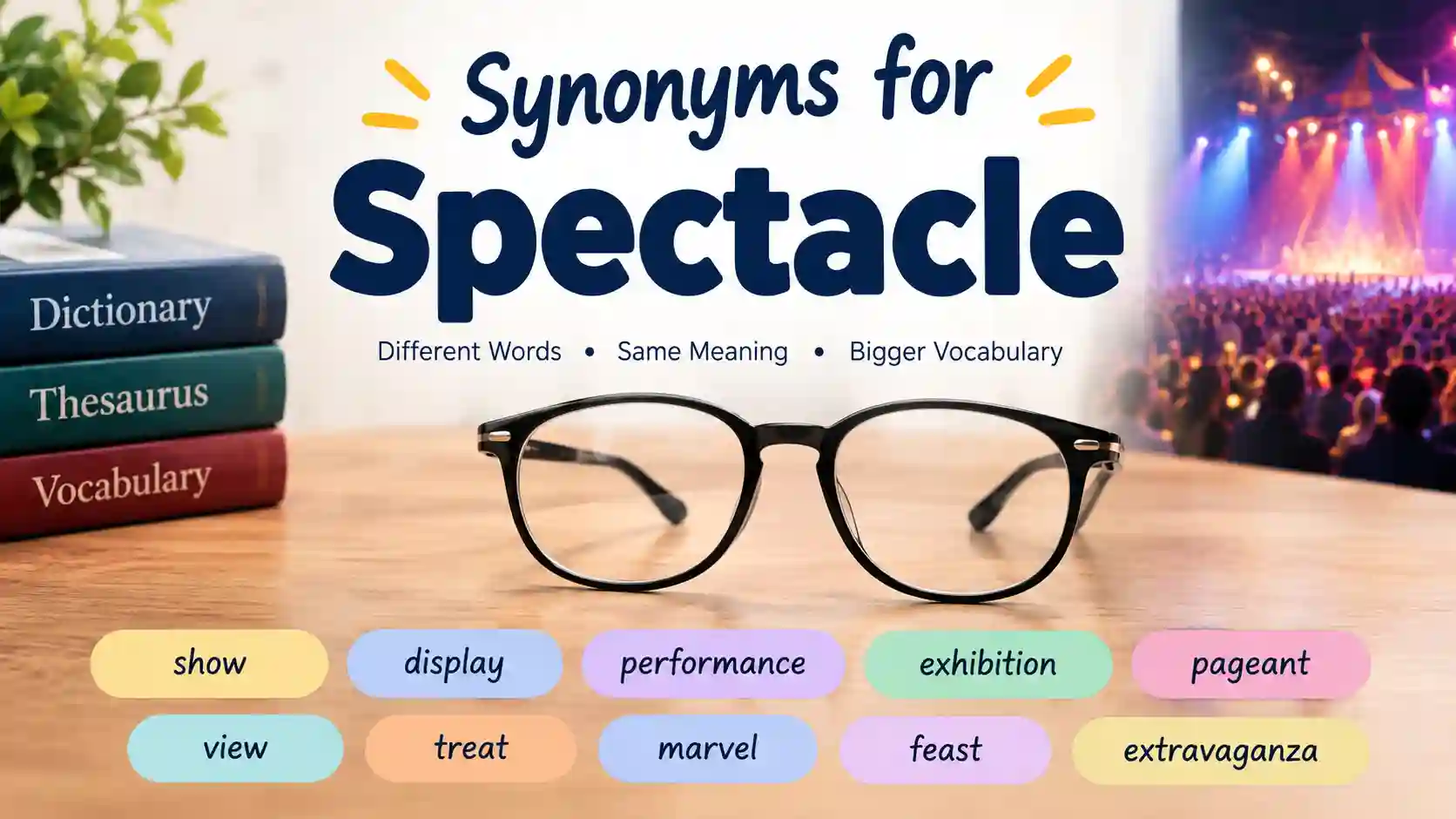
The best synonyms for spectacle depend on what you mean. If you mean an impressive public show, use show, display, performance, exhibition, pageant, parade, or extravaganza. If you mean an unusual or impressive sight, use sight, scene, phenomenon, marvel, wonder, curiosity, or rarity. These words are related, but they are not interchangeable in every context.
What Does “Spectacle” Mean?
Have you ever seen something so unusual or impressive that everyone stopped to watch it? English speakers often use spectacle for exactly this kind of situation.
A spectacle can mean a large, impressive public show or event:
The fireworks were a magnificent spectacle.
It can also mean an unusual, strange, interesting, ridiculous, or attention-grabbing sight:
The argument became a public spectacle.
Cambridge recognizes both of these major meanings, while Collins also separates the senses of an unusual sight and a grand public event or performance.
This distinction matters when choosing synonyms for spectacle. A performance may replace spectacle when you mean a show, but it cannot naturally replace spectacle when you mean an unusual natural sight.
Pronunciation
Spectacle
IPA: /ˈspek.tə.kəl/
Simple pronunciation:
SPEK-tuh-kuhl
The stress falls on the first syllable.
Collins gives slightly different vowel transcriptions for British and American English, but the overall pronunciation pattern remains very similar.
Part of Speech
Spectacle is a noun.
Singular
The parade was a wonderful spectacle.
Plural
The city has hosted many spectacular spectacles.
The plural spectacles can also have a completely different meaning: eyeglasses.
He wore a pair of spectacles.
In modern American English, glasses is much more common for this meaning. Collins marks spectacles as formal in its British entry.
Is “spectacle” an adjective?
No. In a phrase such as spectacle case, spectacle is a noun used before another noun. It is not an ordinary adjective.
The related adjective is spectacular:
The fireworks were a spectacle.
The fireworks were spectacular.
Do not treat spectacular as a direct noun synonym for spectacle.
Grammar Patterns
Here are some natural patterns:
- a spectacle
- a public spectacle
- a magnificent spectacle
- a strange spectacle
- a spectacular spectacle
- the spectacle of + noun/gerund
- make a spectacle of yourself
Examples
The opening ceremony was a magnificent spectacle.
We watched the spectacle of hundreds of birds flying across the lake.
He made a spectacle of himself by shouting at the waiter.
Common prepositions
You may see:
- spectacle of something
- spectacle for an audience
- spectacle in a particular place
For example:
The spectacle of the storm attracted many photographers.
Is “Spectacle” a Common Word?
Spectacle is less common in everyday conversation than words such as show, sight, event, and display. Oxford lists spectacle as a C1 word in the Oxford 3000/5000 CEFR material.
This does not mean learners should avoid it. It is particularly useful in descriptive writing, journalism, literature, formal discussion, and situations where something is visually striking.
Learner Guide
| Word | Practical learner guidance |
| show | Very common, everyday |
| sight | Very common, everyday |
| event | Very common, broad meaning |
| display | Common, useful in writing |
| performance | Common, especially arts |
| parade | Common, specific meaning |
| exhibition | Common, especially art/museums |
| wonder | Common, often emotional |
| phenomenon | Advanced, academic/formal |
| extravaganza | Less common, vivid |
| spectacle | Advanced, C1 according to Oxford |
The CEFR information should be treated as learner guidance rather than a claim that every synonym has a universally fixed CEFR level.
The Best Synonyms for Spectacle
The following words are grouped by meaning rather than simply placed in one long thesaurus list.
1. Show
Meaning: Something presented for people to watch or enjoy.
Strength: Very close in the public-show sense
Register: Neutral
Frequency: Very common
Learner level: Basic/common
Examples:
- The fireworks put on an amazing show.
- Thousands came to watch the evening show.
Best used when: You mean a public performance or entertaining display.
Common collocations:
- put on a show
- live show
- television show
Nuance: Show is broader and more everyday than spectacle.
When not to use it: Do not use show if your main meaning is an unusual natural phenomenon.
2. Display
Meaning: Something presented so people can see it.
Strength: Very close
Register: Neutral
Frequency: Common
Examples:
- The fireworks created a brilliant display.
- The museum has a large display of ancient coins.
Best used when: The visual presentation matters.
Common collocations:
- impressive display
- colorful display
- public display
Nuance: Display focuses on what is being shown rather than the whole event.
When not to use it: A theatrical performance may be better called a show or performance.
3. Sight
Meaning: Something that is interesting, impressive, or unusual to see.
Strength: Very close for the “thing seen” sense
Register: Neutral
Frequency: Very common
Examples:
- The snow-covered mountains were an incredible sight.
- Hundreds of balloons filled the sky, creating a beautiful sight.
Best used when: You are describing something visually impressive.
Common collocations:
- amazing sight
- beautiful sight
- rare sight
Nuance: Sight is usually simpler and more natural than spectacle in everyday conversation.
When not to use it: Use performance for an organized stage act.
4. Performance
Meaning: An act of entertaining or presenting something to an audience.
Strength: Strong in entertainment contexts
Register: Neutral
Frequency: Very common
Examples:
- The dancers gave an impressive performance.
- Her final performance received a standing ovation.
Best used when: Talking about music, dance, theater, or live entertainment.
Common collocations:
- live performance
- stage performance
- musical performance
Nuance: Performance focuses on what performers do. Spectacle focuses more on the impressive visual effect.
When not to use it: Do not call a mountain or sunset a performance in literal English.
5. Exhibition
Meaning: A public display of art, objects, or information.
Strength: Strong in organized-display contexts
Register: Formal/Neutral
Frequency: Common
Examples:
- We visited an exhibition of modern paintings.
- The museum opened a new exhibition about ancient Egypt.
Best used when: Talking about museums, galleries, art, or organized displays.
Common collocations:
- art exhibition
- public exhibition
- temporary exhibition
Nuance: An exhibition is normally planned and organized.
When not to use it: A spontaneous natural event is not normally an exhibition.
6. Pageant
Meaning: A public show or procession, often involving costumes, ceremony, history, or tradition.
Strength: Strong but narrow
Register: Formal/Literary
Frequency: Less common
Examples:
- The town organized a historical pageant.
- Children performed in the Christmas pageant.
Best used when: The event has ceremony, costumes, tradition, or historical themes.
Common collocations:
- historical pageant
- Christmas pageant
- beauty pageant
Nuance: Pageant has a more specific cultural meaning than spectacle.
When not to use it: Do not use pageant as a general word for every exciting event.
7. Parade
Meaning: An organized public procession involving people, vehicles, music, or performances.
Strength: Strong in procession contexts
Register: Neutral
Frequency: Very common
Examples:
- The annual parade attracted thousands of visitors.
- We watched the colorful parade from the sidewalk.
Best used when: People or vehicles move through a public area.
Common collocations:
- street parade
- military parade
- holiday parade
Nuance: A parade can create a spectacle, but it is not itself a synonym in every context.
When not to use it: A concert or museum display is not a parade.
8. Extravaganza
Meaning: A large, elaborate, and exciting show or event.
Strength: Strong
Register: Informal/Neutral
Frequency: Uncommon
Examples:
- The festival became a three-day music extravaganza.
- The company organized a holiday extravaganza.
Best used when: You want to emphasize size, excitement, and excess.
Common collocations:
- musical extravaganza
- holiday extravaganza
- sporting extravaganza
Nuance: This word often sounds enthusiastic or playful.
When not to use it: It may sound too colorful for a serious academic report.
9. Phenomenon
Meaning: An unusual or notable event, fact, or natural occurrence.
Strength: Strong for unusual events
Register: Academic/Neutral
Frequency: Common
Examples:
- The eclipse was a rare natural phenomenon.
- The glowing waves became a fascinating phenomenon.
Best used when: The event is unusual, observable, or scientifically interesting.
Common collocations:
- natural phenomenon
- social phenomenon
- rare phenomenon
Nuance: Phenomenon sounds more analytical than spectacle.
When not to use it: Do not use it simply because something is entertaining.
10. Marvel
Meaning: Something that causes great surprise and admiration.
Strength: Strong
Register: Neutral/Literary
Frequency: Common
Examples:
- The bridge is an engineering marvel.
- The ancient building remains an architectural marvel.
Best used when: You want to emphasize admiration.
Common collocations:
- engineering marvel
- technological marvel
- architectural marvel
Nuance: Marvel focuses on admiration rather than public entertainment.
When not to use it: An ordinary public event is not automatically a marvel.
11. Wonder
Meaning: Something that causes amazement or admiration.
Strength: Strong
Register: Neutral/Literary
Frequency: Very common
Examples:
- The canyon is one of nature’s great wonders.
- The children watched the magician in wonder.
Best used when: The emotional reaction of amazement matters.
Common collocations:
- natural wonder
- modern wonder
- wonder of the world
Nuance: Wonder is more emotional than display.
When not to use it: Do not use it simply for a routine public event.
12. Scene
Meaning: Something happening in a particular place that people can see.
Strength: Related/strong in certain contexts
Register: Neutral
Frequency: Very common
Examples:
- The argument created an uncomfortable scene.
- The rescue became a dramatic scene.
Best used when: Describing a visible situation, especially a dramatic or unusual one.
Common collocations:
- dramatic scene
- public scene
- chaotic scene
Nuance: Scene can have a negative meaning, especially when people behave badly in public.
When not to use it: A planned theatrical production is usually a performance or show.
13. Curiosity
Meaning: Something unusual or interesting that attracts attention.
Strength: Related
Register: Neutral
Frequency: Common
Examples:
- The strange object became a local curiosity.
- His unusual collection was a curiosity for visitors.
Best used when: Something attracts attention because it is unusual.
Common collocations:
- local curiosity
- object of curiosity
- historical curiosity
When not to use it: A large public performance is not automatically a curiosity.
14. Rarity
Meaning: Something uncommon or seldom seen.
Strength: Related
Register: Neutral/Formal
Frequency: Common
Examples:
- Snow is a rarity in this part of the country.
- The painting is a rarity from that period.
Best used when: The unusual or uncommon nature of something matters.
Common collocations:
- great rarity
- rare sight
- historical rarity
When not to use it: Do not use rarity merely because something is impressive.
15. Demonstration
Meaning: An act of showing how something works or is done.
Strength: Context-dependent
Register: Formal/Neutral
Frequency: Common
Examples:
- The chef gave a demonstration of the new cooking method.
- The science show included a dramatic demonstration.
Best used when: Something is being shown for instructional purposes.
Common collocations:
- live demonstration
- practical demonstration
- product demonstration
When not to use it: A beautiful sunset is not a demonstration.
16. Production
Meaning: A staged work such as a play, musical, or theatrical performance.
Strength: Context-dependent
Register: Neutral
Frequency: Common
Examples:
- The theater presented a new production of the classic play.
- The musical was a large-scale production.
Best used when: Talking about theater, film, or organized creative work.
Nuance: Production focuses on the work being produced rather than the visual excitement.
When not to use it: Do not use it as a general replacement for spectacle.
17. Exposition
Meaning: A large organized exhibition or presentation.
Strength: Context-dependent
Register: Formal/Academic
Frequency: Uncommon
Examples:
- The city hosted an international technology exposition.
- Visitors explored the industrial exposition throughout the day.
Best used when: Referring to a formal, large-scale exhibition.
When not to use it: In everyday conversation, show or exhibition is usually more natural.
18. Showcase
Meaning: An event or setting designed to display something impressive.
Strength: Related/strong
Register: Business/Neutral
Frequency: Common
Examples:
- The conference became a showcase for new technology.
- The festival was a showcase for local musicians.
Best used when: The purpose is to demonstrate talent, quality, products, or achievements.
Nuance: A showcase has a promotional purpose that spectacle does not necessarily have.
When not to use it: An accidental natural sight is not normally a showcase.
19. Panorama
Meaning: A wide and continuous view of a place.
Strength: Related
Register: Literary/Descriptive
Frequency: Less common
Examples:
- The mountain offered a breathtaking panorama.
- From the tower, we enjoyed a panorama of the city.
Best used when: Describing a broad landscape or visual view.
When not to use it: A concert, parade, or theatrical show is not a panorama.
20. Tableau
Meaning: A carefully arranged scene that looks like a picture.
Strength: Related
Register: Literary/Artistic
Frequency: Rare
Examples:
- The performers formed a striking tableau on stage.
- The final scene created a beautiful tableau.
Best used when: Describing a carefully arranged, almost picture-like scene.
When not to use it: Do not use tableau for every impressive event.
Strongest Synonyms vs. Related Words
This distinction is one of the most important improvements for learners.
Closest to “public show”
- show
- display
- performance
- exhibition
- pageant
- parade
- extravaganza
Closest to “impressive or unusual sight”
- sight
- scene
- phenomenon
- marvel
- wonder
- curiosity
- rarity
Related but not interchangeable
- presentation
- demonstration
- production
- showcase
- exposition
- panorama
- tableau
- event
- view
- array
Choose the Right Synonym
| Meaning | Best choice | Why |
| General public entertainment | show | Broad and natural |
| Visual presentation | display | Focuses on what is shown |
| Live arts | performance | Focuses on performers |
| Art or museum collection | exhibition | Organized public display |
| Traditional ceremonial show | pageant | Has a specific cultural sense |
| Moving public procession | parade | People/vehicles move together |
| Huge elaborate event | extravaganza | Suggests scale and excitement |
| Impressive thing you see | sight | Natural everyday choice |
| Unusual natural event | phenomenon | Analytical and precise |
| Something admired greatly | marvel | Emphasizes admiration |
| Something that inspires amazement | wonder | Emphasizes emotional response |
| Unusual attention-grabbing situation | scene | Often describes visible behavior |
Commonly Confused Words
| Word | Meaning | Example |
| Spectacle | An impressive show or unusual sight | The ceremony was a spectacle. |
| Spectacular | Very impressive or dramatic | The ceremony was spectacular. |
| Spectator | A person watching an event | Every spectator cheered. |
| Spectacles | Eyeglasses | He wore spectacles. |
| Show | Something presented for people to watch | We watched the show. |
Remember
Spectacle = thing/event
Spectacular = describing word
Spectator = person watching
Spectacles = eyeglasses
American vs. British English
There is no major spelling difference:
- American: spectacle
- British: spectacle
The pronunciation is also very similar. Collins gives /ˈspɛktəkəl/ for American English and a closely related British pronunciation.
The larger difference concerns spectacles.
In British English, spectacles is an established term for eyeglasses and may sound formal:
He looked over his spectacles.
In American English, glasses are generally the more natural everyday choice, although spectacles are understood. Collins lists spectacles as formal in its British definition.
Word Origin and First Known Use
Spectacle comes through Middle English and Old French from Latin spectāculum, meaning a sight, spectacle, or public show. The Latin word is related to spectāre, meaning “to watch” or “to look at.”
Dictionary.com dates the English word to 1300–1350.
The OED gives historical evidence for the public-display sense from approximately 1340, while other senses were recorded in later medieval sources.
The history makes the modern meanings easy to understand. A spectacle is fundamentally something presented to be seen.
The eyeglasses’ meaning developed separately from this same historical family. Etymonline dates the vision-aid sense to the late 14th century and the plural spectacles meaning eyeglasses to the early 15th century.
Connotation and Nuance
One reason spectacle is more interesting than a simple synonym such as show is that it can carry different emotional tones.
Positive
The fireworks were a magnificent spectacle.
Here, spectacle suggests beauty, excitement, and admiration.
Neutral
The migration was an extraordinary spectacle.
The word simply describes something remarkable to observe.
Negative
The argument became an embarrassing public spectacle.
Here, spectacle suggests unwanted attention and embarrassment.
Ridiculous
He made a spectacle of himself.
This phrase is strongly negative. It describes behavior that makes someone look foolish or attracts unwanted public attention. Cambridge specifically identifies this idiom.
Common Collocations
Native-like vocabulary depends heavily on collocations. These combinations are especially useful:
- magnificent spectacle
- spectacular spectacle
- public spectacle
- grand spectacle
- impressive spectacle
- strange spectacle
- unusual spectacle
- visual spectacle
- natural spectacle
- sporting spectacle
- theatrical spectacle
- breathtaking spectacle
Useful verbs
- watch a spectacle
- witness a spectacle
- create a spectacle
- stage a spectacle
- turn something into a spectacle
- make a spectacle of yourself
Common Mistakes
Mistake 1
Wrong: The mountain was a performance.
Correct: The mountain was an impressive sight.
Why: A performance normally involves an act presented to an audience.
Mistake 2
Wrong: The fireworks were very spectacular.
Correct: The fireworks were a spectacular spectacle.
Or simply:
The fireworks were spectacular.
Why: Spectacle is a noun; spectacular is an adjective.
Mistake 3
Wrong: She bought a spectacle.
Better: She bought a pair of spectacles.
More natural in everyday American English: She bought a pair of glasses.
Mistake 4
Wrong: The sunset was an exhibition.
Correct: The sunset was a beautiful sight.
Why: An exhibition is normally an organized display.
Mistake 5
Wrong: Every impressive event is a spectacle.
Better: Use spectacle when the event or sight is especially striking, unusual, dramatic, or visually impressive.
Writing Tips
For essays
Choose phenomenon when discussing a natural or social occurrence.
The eclipse was a rare natural phenomenon.
Choose spectacle when you want to emphasize the visual or dramatic effect.
The ceremony became a remarkable spectacle.
For professional writing
Use display, exhibition, presentation, showcase, or demonstration when these words describe the exact function.
The conference provided a showcase for new technology.
For blogs
Use spectacle when you want a vivid but still natural description.
The annual festival is a colorful spectacle of music, food, and dance.
For stories
Use sight, scene, spectacle, wonder, or marvel according to the emotion you want to create.
The travelers stopped in silence at the strange spectacle before them.
For everyday speech
Prefer simpler words when appropriate.
Instead of:
What an incredible spectacle!
You can say:
What an amazing sight!
Both are correct. The second sounds more casual.
When Should You NOT Use “Spectacle”?
Avoid spectacle when you only mean:
- an ordinary event
- a normal meeting
- a simple view
- a small collection
- any performance without a striking quality
- any situation where the word would sound unnecessarily dramatic
For example:
We had a meeting at 10 a.m.
Do not write:
We had a spectacle at 10 a.m.
But:
The opening ceremony was a spectacular event.
Here, the dramatic meaning is appropriate.
Mini Practice
Fill in the blanks
Choose from sight, performance, phenomenon, parade, display.
- The eclipse was a rare natural ________.
- The dancers gave an excellent ________.
- The waterfall was unforgettable ________.
- Thousands watched the military ________.
- The fireworks created a colorful ________.
Answers
- phenomenon
- performance
- sight
- parade
- display
Rewrite the sentence
Replace spectacle with the most natural synonym.
1. The waterfall was a magnificent spectacle.
Possible answer:
The waterfall was a magnificent sight.
2. The dancers created a wonderful spectacle.
Possible answer:
The dancers gave a wonderful performance.
3. The eclipse was an extraordinary spectacle.
Possible answer:
The eclipse was an extraordinary phenomenon.
FAQ
What is the best synonym for spectacle?
There is no single synonym that works in every sentence. Show and display are strong choices for a public presentation, while sight, phenomenon, marvel, and wonder work better when spectacle means something impressive or unusual to see.
What is another word for spectacle?
Common alternatives include show, display, sight, performance, exhibition, pageant, parade, extravaganza, phenomenon, marvel, wonder, scene, and curiosity. The best word depends on whether you mean a public show or an unusual sight.
Is “show” a synonym for spectacle?
Yes, especially when spectacle means a public show or performance. However, the show is broader and more common. A small television program can be a show without being a spectacle, while a huge opening ceremony may be both.
Is “sight” a synonym for spectacle?
Yes. Sight is one of the closest choices when spectacle means something impressive, unusual, or interesting to see. For example, The waterfall was an amazing spectacle and can naturally become The waterfall was an amazing sight.
What is the difference between spectacle and spectacular?
Spectacle is a noun meaning an impressive show, event, or sight. Spectacular is an adjective meaning very impressive or dramatic. You can say, The fireworks were a spectacular spectacle or simply, The fireworks were spectacular.
What is the difference between spectacle and spectacles?
Spectacle normally refers to an impressive sight, show, or unusual situation. Spectacles can mean eyeglasses. In everyday American English, glasses are generally more common.
What does “make a spectacle of yourself” mean?
It means to behave in a way that attracts unwanted attention and makes you appear foolish or embarrassing. For example, someone who loudly argues with a waiter in a restaurant may be said to have made a spectacle of himself.
Is spectacle formal English?
Spectacle is perfectly normal English, but it is less common in casual conversation than words such as show and sight. It is especially useful in descriptive, journalistic, literary, and formal contexts. Oxford lists the noun at C1 level in its Oxford 3000/5000 CEFR material.
Vocabulary Quiz
1. Which word best replaces “spectacle”?
The waterfall was an incredible spectacle.
A. Performance
B. Sight
C. Parade
D. Exhibition
2. Which word describes a public procession?
A. Wonder
B. Panorama
C. Parade
D. Phenomenon
3. Choose the correct sentence.
A. The singer gave an excellent sight.
B. The singer gave an excellent performance.
C. The singer gave an excellent rarity.
D. The singer gave an excellent performance.
4. Which word best describes an unusual natural occurrence?
A. Phenomenon
B. Production
C. Presentation
D. Pageant
5. Which sentence correctly uses “spectacles” to mean eyeglasses?
A. The fireworks were spectacular.
B. She wore a pair of spectacles.
C. The parade was very spectacular.
D. He spectacles the concert.
Answers
- B. Sight
- C. Parade
- B. Performance
- A. Phenomenon
- B. She wore a pair of spectacles.
Conclusion
The best synonyms for spectacle depend on the meaning you need. Use show, display, performance, exhibition, or pageant for public presentations. Use sight, phenomenon, marvel, wonder, or scene for impressive or unusual things that people see.
Learning these differences will make your essays, emails, blog posts, stories, and conversations more precise. Do not simply replace spectacle with any thesaurus word. Choose the synonym that matches the exact meaning, tone, and situation.
References
- Cambridge Dictionary, spectacle
- Cambridge English Thesaurus, spectacle synonyms
- Collins English Dictionary, spectacle
- Collins English Thesaurus, spectacle synonyms
- Dictionary.com, spectacle
- Oxford English Dictionary, spectacle historical entry
- Oxford Learner’s Dictionaries, Oxford 3000/5000 CEFR list

Synonorm is a trusted English vocabulary resource created to help readers find the right words and understand the differences between similar terms. We provide clear explanations of synonyms, meanings, examples, usage, and alternatives. Our content makes vocabulary easier to learn and apply in everyday, academic, and professional English. Synonorm is designed for students, writers, ESL learners, professionals, and anyone who wants to improve their English vocabulary and communicate more clearly.