Quick Answer
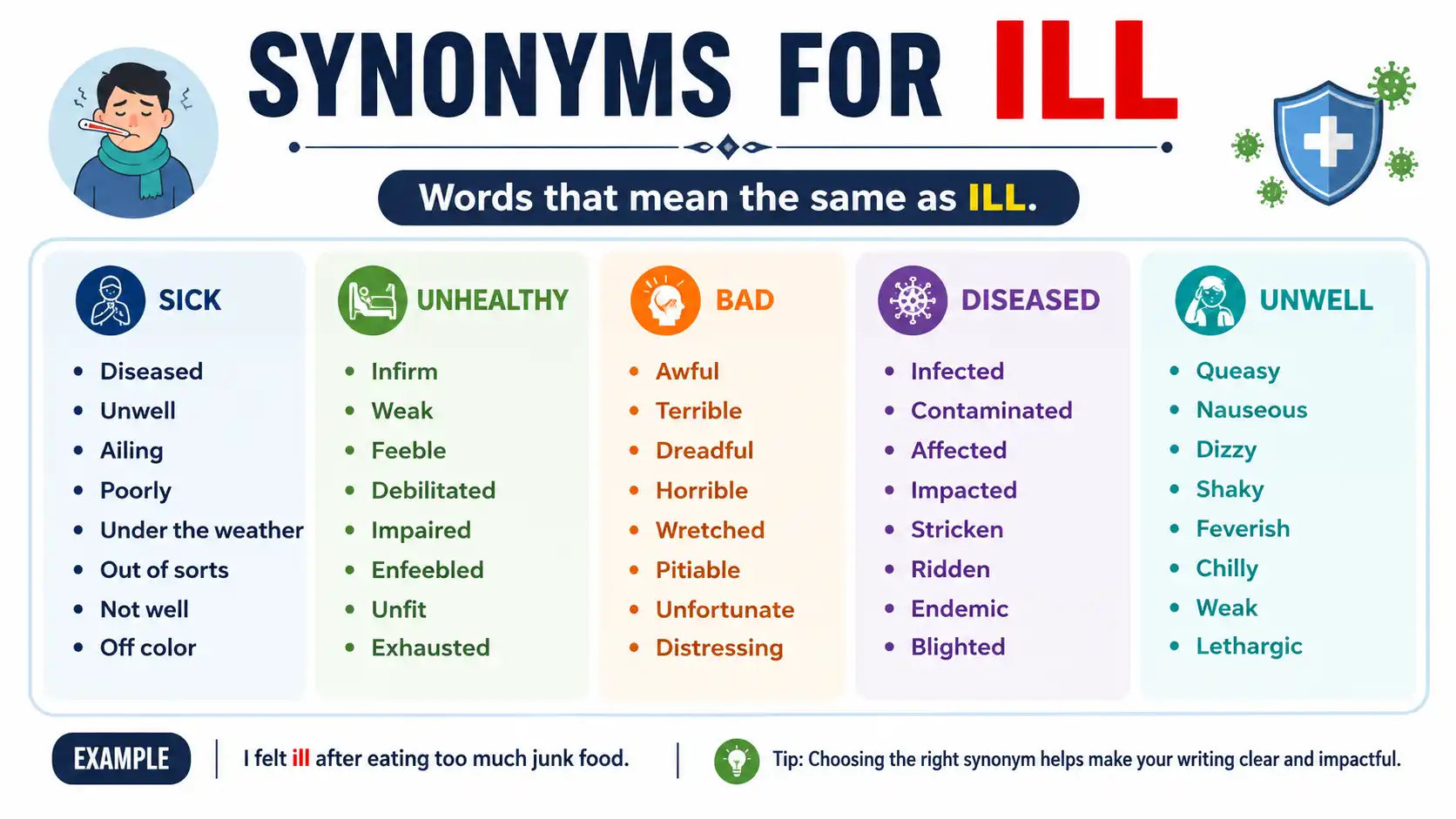
The most common synonyms for ill are sick, unwell, ailing, poorly, unhealthy, sickly, diseased, afflicted, indisposed, and under the weather. The best choice depends on context. Sick is very common in American English, while ill and unwell can sound more formal. In British English, poorly is also common in informal speech.
Introduction
Have you ever wanted to say someone is ill without using the same word again and again? Maybe you are writing an essay, sending an email, creating a story, or simply trying to improve your English vocabulary.
The word ill usually means that someone is not healthy or does not feel well. For example, you can say, “My brother is ill,” or “She became ill after the trip.” Cambridge lists sick, unwell, poorly, ailing, sickly, and under the weather among words related to this meaning.
If you are searching for synonyms for ill, this guide will help you choose the right word instead of simply giving you a long list. This matters because synonyms are not always exact replacements. Some sound formal, some are casual, and some describe a particular type or degree of poor health.
Whether you are a student, ESL learner, teacher, writer, blogger, or professional, learning these differences can make your English more natural and precise.
Pronunciation
IPA: /ɪl/
Pronounced as: ill
The pronunciation is the same in standard British and American English. Cambridge and Oxford both give /ɪl/.
Part of Speech
Ill can have several grammatical uses.
- Adjective: She is ill.
- Noun: The government is trying to address social ills.
- Adverb: The machine was ill-prepared for the task.
For this article, the main focus is the adjective ill, meaning not healthy or feeling unwell.
The noun has broader meanings such as sickness, trouble, or harm, while the adverb can mean badly or poorly in certain expressions.
Grammar Usage of Ill
One important point for learners is that ill is usually not used before a noun when it means sick.
Natural
- She is ill.
- He became ill suddenly.
- The patient is seriously ill.
- She was ill with pneumonia.
Less natural
- an ill woman
For this meaning, English usually prefers a sick woman, an ill woman in some contexts, or a phrase such as a woman who is ill depending on the sentence.
Common patterns include:
- feel ill
- be ill
- fall ill
- become ill
- seriously ill
- critically ill
- ill with a disease
- taken ill
Oxford specifically notes expressions such as “fall ill,” “be taken ill,” and “ill with something.”
Remember: In American English, sickness is usually the more natural everyday choice. In British English, illness is very common.
Synonyms for Ill: Quick Overview
| Synonym | Strength | Formality |
| Sick | Strong | Neutral |
| Unwell | Strong | Formal/Neutral |
| Ailing | Strong | Neutral |
| Poorly | Related | Informal, mainly British |
| Sickly | Related | Neutral |
| Unhealthy | Related | Neutral |
| Diseased | Strong | Formal/Medical |
| Afflicted | Strong | Formal |
| Indisposed | Related | Formal |
| Infirm | Strong | Formal/Literary |
| Debilitated | Strongest | Formal/Medical |
| Incapacitated | Strongest | Formal |
| Under the weather | Related | Informal |
| Under par | Related | Informal |
| Nauseated | Related | Medical/Neutral |
| Nauseous | Related | Neutral |
| Queasy | Related | Informal/Neutral |
| Sickish | Related | Informal |
| Peaky | Related | Informal, mainly British |
| Failing | Strong | Neutral/Formal |
Detailed Synonyms for Ill
1. Sick
Meaning: Not feeling well or suffering from an illness.
CEFR: A2
Frequency: Very common
Register: Neutral, everyday English
Examples:
- I stayed home because I was sick.
- Her son became sick during the night.
Best Used When: You need the most common everyday alternative to ill, especially in American English.
Tone: Neutral
Common collocations:
- feel sick
- get sick
- sick with the flu
Connotation: Broad and flexible. In British English, sickness can also suggest nausea or vomiting, while American English commonly uses it for general illness.
When not to use it: Avoid assuming sick always means nausea. Context matters.
2. Unwell
Meaning: Not feeling healthy or well.
CEFR: B1
Frequency: Common
Register: Formal/Neutral
Examples:
- She felt unwell after skipping lunch.
- Please stay home if you are feeling unwell.
Best Used When: You want a polite or slightly formal alternative to sickness.
Tone: Neutral, gentle
Common collocations:
- feel unwell
- become unwell
- seriously unwell
Connotation: Softer than sick and useful when you do not want to describe a specific illness.
When not to use it: It may sound unnecessarily formal in very casual American conversation.
3. Ailing
Meaning: Suffering from poor health, often for some time.
CEFR: B2
Frequency: Common
Register: Neutral/Formal
Examples:
- He returned home to care for his ailing father.
- The charity helps older people and ailing people.
Best Used When: Someone has ongoing or noticeable health problems.
Tone: Sympathetic
Common collocations:
- ailing parent
- ailing patient
- ailing health
Connotation: Often suggests continuing or serious health problems.
When not to use it: Do not use it for every minor headache or short cold.
4. Poorly
Meaning: Ill or not feeling well.
CEFR: B1
Frequency: Common
Register: Informal, mainly British English
Examples:
- The child has been feeling poorly today.
- She stayed home because she was poorly.
Best Used When: Speaking informally, especially in British English.
Tone: Casual, gentle
Common collocations:
- feel poorly
- look poorly
- become poorly
Connotation: Often sounds softer than ill.
When not to use it: It can sound unusual in American English when used simply to mean sick.
Cambridge labels this use as UK informal.
5. Sickly
Meaning: Often ill or having weak health.
CEFR: B2
Frequency: Common
Register: Neutral
Examples:
- The sickly child needed extra care.
- The plant looked sickly after the long drought.
Best Used When: Describing someone or something that appears weak or frequently unhealthy.
Tone: Descriptive
Common collocations:
- sickly child
- sickly appearance
- sickly plant
Connotation: Often suggests weakness or repeated poor health.
When not to use it: Do not use sickly as a simple replacement for ill in every sentence.
6. Unhealthy
Meaning: Not healthy or likely to harm health.
CEFR: B1
Frequency: Very common
Register: Neutral
Examples:
- He became unhealthy after years of poor eating habits.
- The doctor warned her about an unhealthy lifestyle.
Best Used When: Talking about poor health, habits, conditions, or environments.
Tone: Neutral
Common collocations:
- unhealthy lifestyle
- unhealthy habits
- unhealthy diet
Connotation: Often focuses on a condition or lifestyle rather than a temporary illness.
When not to use it: “I am unhealthy today” is usually less natural than “I am sick” or “I feel unwell.”
7. Diseased
Meaning: Affected by a disease.
CEFR: B2
Frequency: Common
Register: Medical/Formal
Examples:
- The doctor examined the diseased tissue.
- The disease can damage diseased organs over time.
Best Used When: Referring specifically to disease or affected body parts.
Tone: Clinical
Common collocations:
- diseased tissue
- diseased organ
- diseased cells
Connotation: More clinical and specific than ill.
When not to use it: Avoid calling a person “a diseased person” in ordinary conversation because it can sound harsh or dehumanizing.
8. Afflicted
Meaning: Suffering from a disease, condition, or serious problem.
CEFR: C1
Frequency: Common
Register: Formal
Examples:
- The program supports families afflicted by serious disease.
- Many people are afflicted by chronic pain.
Best Used When: Writing formally about people experiencing serious health problems.
Tone: Serious, sympathetic
Common collocations:
- afflicted by disease
- afflicted with illness
- disease-afflicted communities
Connotation: Often emphasizes suffering.
When not to use it: It can sound too dramatic for a minor cold.
9. Indisposed
Meaning: Slightly ill or unable to do something because of poor health.
CEFR: C1
Frequency: Uncommon
Register: Formal
Examples:
- The manager is indisposed and cannot attend the meeting.
- She was temporarily indisposed after the long journey.
Best Used When: You need a polite and formal way to say someone is unavailable because of illness.
Tone: Polite, formal
Common collocations:
- temporarily indisposed
- feel indisposed
- medically indisposed
Connotation: Often focuses on temporary inability rather than the illness itself.
When not to use it: Avoid it in casual conversation because it may sound old-fashioned or overly formal.
10. Infirm
Meaning: Weak or unhealthy, especially because of age or long-term health problems.
CEFR: C1
Frequency: Uncommon
Register: Formal/Literary
Examples:
- The home provides care for older and infirm residents.
- The organization offers assistance to infirm people.
Best Used When: Describing physical weakness or poor health, particularly among older people.
Tone: Formal
Common collocations:
- older people and infirm
- physically infirm
- infirm person
Connotation: Focuses more on weakness than a temporary sickness.
When not to use it: Do not use it casually for someone with a simple cold.
11. Debilitated
Meaning: Made weak by illness, injury, or another condition.
CEFR: C1
Frequency: Uncommon
Register: Formal/Medical
Examples:
- The long illness left him debilitated.
- She felt debilitated after several weeks of treatment.
Best Used When: An illness has caused significant weakness.
Tone: Serious, clinical
Common collocations:
- severely debilitated
- physically debilitated
- debilitated by illness
Connotation: Stronger than ill because it highlights loss of strength.
When not to use it: It is too strong for a mild headache or cold.
12. Incapacitated
Meaning: Unable to work or function normally because of illness or injury.
CEFR: C1
Frequency: Common
Register: Formal/Professional
Examples:
- The injury left him temporarily incapacitated.
- She was incapacitated by a severe illness.
Best Used When: The person’s condition prevents normal activity.
Tone: Formal
Common collocations:
- temporarily incapacitated
- seriously incapacitated
- incapacitated by injury
Connotation: Emphasizes inability rather than simply being sick.
When not to use it: Do not use it when someone is only mildly unwell.
13. Under the Weather
Meaning: Feeling slightly ill or tired.
CEFR: B2
Frequency: Common
Register: Informal/Spoken
Examples:
- I am feeling a little under the weather today.
- She stayed home because she was under the weather.
Best Used When: Talking casually about minor illness.
Tone: Friendly, informal
Common collocations:
- feel under the weather
- a little under the weather
- slightly under the weather
Connotation: Softens the idea of being sick.
When not to use it: Avoid it in highly formal medical writing.
Cambridge includes under the weather among related expressions for ill.
14. Under Par
Meaning: Not feeling as healthy or energetic as usual.
CEFR: B2
Frequency: Uncommon
Register: Informal
Examples:
- I have been feeling under par since Monday.
- He seemed under par during the match.
Best Used When: Describing a mild decline in health or energy.
Tone: Informal
Common collocations:
- feel under par
- slightly under par
- below par
Connotation: Usually suggests that someone is not at their normal level rather than seriously ill.
When not to use it: Avoid it when describing a severe disease.
15. Nauseated
Meaning: Feeling as if you are going to vomit.
CEFR: B2
Frequency: Common
Register: Neutral/Medical
Examples:
- The boat ride made me nauseated.
- She felt nauseated after taking the medicine.
Best Used When: The illness specifically involves nausea.
Tone: Neutral
Common collocations:
- feel nauseated
- become nauseated
- severely nauseated
Connotation: Much narrower than ill.
When not to use it: Do not use it as a synonym for every type of sickness.
16. Nauseous
Meaning: Feeling sick or associated with nausea.
CEFR: B2
Frequency: Common
Register: Neutral
Examples:
- I felt nauseous after the spinning ride.
- The smell made him nauseous.
Best Used When: Talking about a feeling of nausea.
Tone: Neutral
Common collocations:
- feel nauseous
- become nauseous
- nauseous feeling
Connotation: Strongly connected with stomach discomfort.
When not to use it: It is not a full replacement for ill when someone has a fever, infection, or another illness.
17. Queasy
Meaning: Feeling slightly sick, especially in the stomach.
CEFR: B2
Frequency: Common
Register: Informal/Neutral
Examples:
- I felt queasy during the flight.
- The smell of the medicine made her queasy.
Best Used When: Describing mild nausea.
Tone: Informal
Common collocations:
- feel queasy
- slightly queasy
- make someone queasy
Connotation: Usually mild and connected with the stomach.
When not to use it: Do not use queasy for serious illness.
18. Sickish
Meaning: Slightly sick or somewhat unwell.
CEFR: C1
Frequency: Uncommon
Register: Informal
Examples:
- I felt a little sickish after lunch.
- He looked sickish but decided to continue working.
Best Used When: You want to describe mild or uncertain sickness.
Tone: Casual
Common collocations:
- feel sickish
- look sickish
- slightly sickish
Connotation: Suggests that the person is only somewhat unwell.
When not to use it: It is less natural than sick or unwell in most situations.
19. Peaky
Meaning: Looking pale, weak, or slightly ill.
CEFR: C1
Frequency: Uncommon
Register: Informal, mainly British
Examples:
- The child looked a little peaky this morning.
- You seem peaky today. Are you feeling all right?
Best Used When: Describing someone’s appearance.
Tone: Informal, British
Common collocations:
- look peaky
- seem peaky
- a little peaky
Connotation: Usually suggests a person looks unwell rather than confirming that they have a disease.
When not to use it: It is not a standard everyday choice in American English.
20. Failing
Meaning: Becoming weaker or less healthy.
CEFR: B2
Frequency: Common
Register: Neutral/Formal
Examples:
- His failing health worried the family.
- The doctor was concerned about her failing condition.
Best Used When: Talking about health that is gradually getting worse.
Tone: Serious
Common collocations:
- failing health
- failing condition
- failing eyesight
Connotation: Suggests decline rather than a short-term illness.
When not to use it: Do not use failing to describe an ordinary cold.
Choosing the Right Synonym for Ill
The best synonym depends on what you want to say.
| If you mean… | Best choice | Why |
| General sickness | Sick | Very common and natural |
| Polite sickness | Unwell | Gentle and formal |
| Long-term poor health | Ailing | Suggests continuing problems |
| Informal British sickness | Poorly | Natural in UK speech |
| Weak health | Infirm | Focuses on weakness |
| Serious weakness | Debilitated | Stronger than ill |
| Unable to function | Incapacitated | Focuses on inability |
| Mild nausea | Queasy | Specific to stomach discomfort |
| Strong nausea | Nauseated | More precise |
| Mild illness | Under the weather | Friendly and informal |
| Declining health | Failing | Shows worsening condition |
Quick Tip: Do not choose a synonym just because it appears in a thesaurus. Ask what exact meaning you need.
American vs. British English
There is an important regional difference between ill and sick.
In American English, sick is extremely common for general illness:
- I am sick.
- She got sick yesterday.
- He is sick with the flu.
Ill is also understood and used, but it can sound more formal.
In British English, ill is very common for general poor health. Oxford marks ill as especially British and notes that North American English usually prefers sick.
British English is also commonly used poorly in informal speech.
Another difference is that sickness can refer particularly to vomiting or nausea in some British contexts, although usage varies. For precise writing, nauseated, queasy, or vomiting can remove ambiguity.
Pronunciation
Both British and American English normally pronounce ill as /ɪl/.
There is no major spelling difference between American and British English for ill.
Commonly Confused Words
| Word | Difference | Example |
| Ill | General poor health | She is seriously ill. |
| Sick | General illness, especially common in US English | He is sick today. |
| Unwell | Polite or formal way to describe poor health | She felt unwell. |
| Nauseated | Specifically feeling like vomiting | I felt nauseated after the ride. |
| Unhealthy | Poor health or something harmful to health | His diet is unhealthy. |
Common Mistakes
Common Mistake Box
Mistake: She is ill with a headache.
Correction: She is ill with a virus. / She has a headache.
Explanation: Ill with is normally followed by an illness or disease, while a headache is usually described separately.
Mistake: I am feeling poorly. (for all varieties of English)
Correction: I am feeling unwell. / I am feeling sick.
Explanation: Poorly is natural in British informal English but may sound unusual in American English.
Mistake: He is nauseated with the flu.
Correction: He is ill with the flu. / He feels nauseated because of the flu.
Explanation: Nauseated describes a specific feeling of nausea, not general illness.
Writing Tips: How to Avoid Repeating Ill
In Essays
Use precise vocabulary:
- The patient was seriously ill.
- The disease left him debilitated.
- Her failing health affected her studies.
In Emails
Choose polite language:
- I am feeling unwell today.
- Unfortunately, I have become ill and cannot attend the meeting.
In Blog Posts
Use natural, accessible words:
- sick
- unwell
- under the weather
Avoid rare words unless their meaning adds something useful.
In Stories
Choose words based on character and mood:
- He looked peaky. → casual British flavor
- She was seriously ill. → direct and serious
- He had become debilitated. → formal and dramatic
In Professional Communication
Unwell, ill, and indisposed may work better than slang or idioms.
Word Origin and Etymology
The word ill comes from Middle English. Oxford traces the word to Old Norse illr, meaning ideas such as “evil,” “difficult,” or “harmful.” The exact origin of the Old Norse word is uncertain.
The word originally had meanings connected with evil, harm, and difficulty before developing its health-related sense.
Oxford records ill as a Middle English word and gives its Old Norse origin. A precise single “first use” year is not provided in the Oxford Learner’s Dictionary source, so it is safer to describe its earliest recorded stage as Middle English rather than inventing an exact date.
Connotation and Nuance
Synonyms for ill are not interchangeable in every sentence.
Sickness is broad and everyday.
Unwell sounds softer and more polite.
Ailing often suggests a continuing health problem.
Debilitated suggests serious weakness.
Nauseated and queasy focus on the stomach.
Unhealthy often describes a condition, habit, or lifestyle rather than a temporary illness.
Under the weather makes a minor illness sound casual and less serious.
Understanding these differences is more useful than memorizing a large list.
Related Vocabulary
Antonyms
- healthy
- well
- fit
- strong
- healthy-minded
- robust
Related Expressions
- feel sick
- feel unwell
- fall ill
- become ill
- recover from an illness
- suffer from an illness
- seriously ill
- critically ill
- chronic illness
- poor health
Word Family
- illness — the condition of being ill
- illnesses — plural form
- illness-related — connected with illness
- ill health — poor health
Mini Practice Exercises
Fill in the Blanks
Choose the best word: sick, unwell, queasy, ailing, debilitated
- I felt ______ after the boat began moving quickly.
- Her ______ father needs regular care.
- I cannot come to work because I am ______.
- The patient was severely ______ after the long illness.
- She felt ______ after skipping breakfast.
Sentence Rewriting
Replace ill with a more precise synonym.
- He is ill and very weak.
- She is ill after the boat ride.
- His father has been ill for many years.
- I feel slightly ill today.
- She cannot work because she is ill.
Matching Activity
Match each word with its meaning.
A. Nauseated
B. Ailing
C. Unwell
D. Incapacitated
E. Under the weather
- Mildly sick
- Unable to function normally
- Feeling like vomiting
- Having continuing health problems
- Not feeling healthy
Vocabulary Quiz
1. Which word is most common in everyday American English?
A. Infirm
B. Sick
C. Indisposed
D. Debilitated
2. Which word specifically relates to feeling like you may vomit?
A. Ailing
B. Unwell
C. Nauseated
D. Infirm
3. Which expression is informal?
A. Debilitated
B. Indisposed
C. Under the weather
D. Diseased
4. Which word suggests long-term poor health?
A. Ailing
B. Queasy
C. Sickish
D. Nauseated
5. Which word focuses on being unable to function because of illness or injury?
A. Sickly
B. Incapacitated
C. Unhealthy
D. Poorly
Answer Key
- B. Sick
- C. Nauseated
- C. Under the weather
- A. Ailing
- B. Incapacitated
FAQ: Synonyms for Ill
What is the best synonym for ill?
The best general synonym for ill is sick. It is especially common in American English. Unwell is another useful choice when you want a polite or slightly formal expression. The best word depends on the sentence and the type of health problem you want to describe.
What is a polite word for ill?
Unwell is one of the best polite alternatives to ill. It sounds gentle and respectful and does not require you to explain the exact illness. For example, “She is feeling unwell today” is a natural and polite sentence.
What is a formal synonym for ill?
Unwell, indisposed, afflicted, debilitated, and infirm can be formal alternatives, but they have different meanings. Unwell is the safest general choice. The others describe specific situations such as weakness, suffering, or inability to function.
What is the difference between ill and sick?
Both words can mean not healthy. Sick is especially common in American English, while ill is very common in British English and can sound more formal in American English. In some British contexts, sick can also refer specifically to vomiting or nausea.
What is a synonym for slightly ill?
Good choices include unwell, under the weather, poorly, sickish, and under par. The best choice depends on the variety of English and context. Under the weather is especially useful in informal conversation.
What is a synonym for seriously ill?
Possible choices include gravely ill, critically ill, severely ill, and debilitated, although these words are not exact synonyms. Critically ill usually indicates a very serious medical condition, while debilitated focuses on weakness caused by illness.
Is unhealthy the same as ill?
Not exactly. Ill normally describes someone who is currently suffering from an illness or feeling unwell. Unhealthy can describe a person, lifestyle, habit, environment, or condition that is not good for health. For example, “an unhealthy diet” is natural, but “an ill diet” is not.
Is ailing a synonym for ill?
Yes, ailing can mean suffering from poor health, but it often suggests continuing or long-term health problems. Saying “his ailing mother” may suggest that his mother has ongoing health difficulties. It is less suitable for a brief headache or minor cold.
Conclusion
Learning synonyms for ill is not simply about memorizing a long vocabulary list. The real skill is knowing which word fits the situation. Use sick for everyday English, unwell for a polite alternative, ailing for continuing health problems, and nauseated or queasy when you specifically mean nausea. Words such as debilitated and incapacitated are stronger and more formal.
Practice these words in emails, essays, conversations, and everyday writing. The more you notice their differences, the more natural and precise your English will become.
References
- Cambridge Dictionary: ill
- Cambridge English Thesaurus: ill
- Oxford Learner’s Dictionary: ill
- Merriam-Webster: ill
- Merriam-Webster Thesaurus: ill

Synonorm is a trusted English vocabulary resource created to help readers find the right words and understand the differences between similar terms. We provide clear explanations of synonyms, meanings, examples, usage, and alternatives. Our content makes vocabulary easier to learn and apply in everyday, academic, and professional English. Synonorm is designed for students, writers, ESL learners, professionals, and anyone who wants to improve their English vocabulary and communicate more clearly.