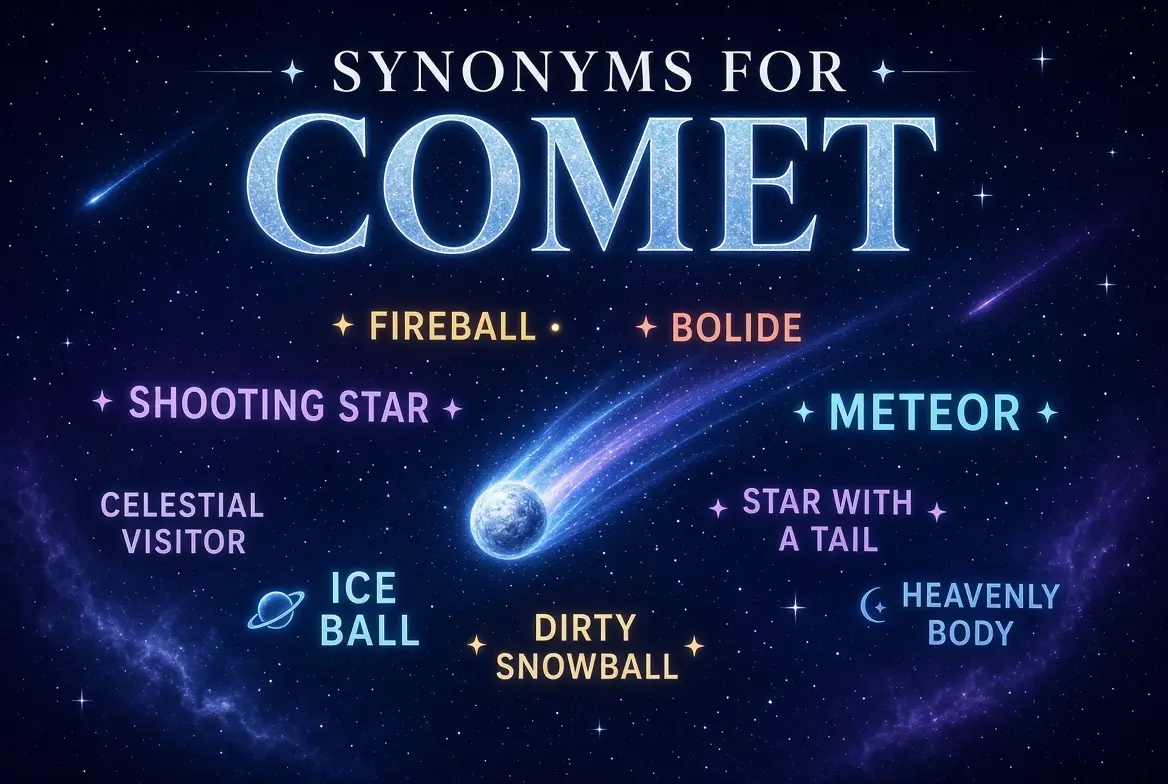
Quick Answer: What Are the Synonyms for Comet?
The word comet has very few exact synonyms because it names a specific type of object in space. Useful close alternatives include celestial body, heavenly body, astronomical object, icy body, cometary body, and tailed celestial body. Words such as asteroid, meteor, meteoroid, planet, and satellite are related astronomical terms, but they are not exact synonyms.
Introduction
Have you ever looked up at the night sky and wondered what else you could call a comet? If you are searching for synonyms for comet, the answer needs a little care.
A comet is a natural object that travels around the Sun and is made largely of ice and dust. When it gets close enough to the Sun, heat can produce a visible coma and tail.
For example, you might write, “The comet appeared above the horizon.” In another context, you could describe it as a celestial body or icy astronomical object.
This guide explains the best alternatives, related words, differences in meaning, pronunciation, grammar, collocations, and common mistakes. It is useful for students, ESL learners, teachers, bloggers, writers, and anyone who wants to use astronomical vocabulary more accurately.
Pronunciation of Comet
IPA:
- British English: /ˈkɒm.ɪt/
- American English: /ˈkɑː.mɪt/
Pronounced as:
KOM-it
Cambridge gives /ˈkɒm.ɪt/ for British English and /ˈkɑː.mɪt/ for American English.
American vs. British English
The spelling comet is the same in American and British English.
The main difference is pronunciation:
- British: the first vowel sounds closer to the vowel in hot.
- American: the first vowel is generally broader, closer to the sound in father.
There is no major difference in everyday usage or meaning.
Part of Speech
Comet is primarily a countable noun.
Noun
A comet is an object in space that travels around the Sun.
Example:
The astronomers observed a bright comet.
Related adjective
The adjective is cometary.
Example:
Scientists studied the cometary material released by the object.
There is no standard verb or adverb form of comet in ordinary English.
Grammar Usage
Because comet is countable, you can use:
- a comet
- the comet
- one comet
- two comets
- many comets
Common sentence patterns
A comet + verb
A comet appeared in the evening sky.
The + comet + verb
The comet passed close to the Sun.
Comet + noun
comet tail
comet nucleus
comet orbit
comet activity
Common mistake
Do not normally say:
I saw a comet.
Say:
I saw a comet.
The singular countable noun usually needs an article or another determiner.
Synonyms for Comet: Quick Overview
| Word or Term | Strength | Formality |
| Celestial body | Strong | Formal |
| Heavenly body | Strong | Neutral |
| Astronomical object | Strong | Academic |
| Cometary body | Strong | Academic |
| Icy body | Related | Academic |
| Space object | Related | Neutral |
| Tailed celestial body | Descriptive | Literary |
| Icy space body | Descriptive | Neutral |
| Small Solar System body | Related | Academic |
| Periodic comet | Specific type | Academic |
| Long-period comet | Specific type | Academic |
| Short-period comet | Specific type | Academic |
| Sungrazer | Related type | Academic |
| Asteroid | Related, not synonymous | Neutral |
| Meteoroid | Related, not synonymous | Academic |
| Meteor | Related, not synonymous | Neutral |
| Planet | Related, not synonymous | Neutral |
| Satellite | Related, not synonymous | Academic |
| Star | Related, not synonymous | Neutral |
| Nebula | Related, not synonymous | Academic |
Remember: The first group contains useful descriptive substitutes. The second group contains related astronomical terms, not true synonyms.
Detailed Synonyms and Related Terms for Comet
1. Celestial Body
Meaning: A natural object that exists in space.
Examples:
- The comet is a fascinating celestial body.
- Scientists continue to study this distant celestial body.
Best Used When: You want a broad scientific term without repeating comets.
Tone: Formal, academic
CEFR: B1–B2
Frequency: Common in science writing
Collocations: celestial body, distant celestial body, natural celestial body
Connotation: Broad and scientific. It does not specifically mean a comet.
When Not to Use: Do not use it when your sentence must clearly identify the object as a comet.
2. Heavenly Body
Meaning: A natural object seen or existing in the sky or outer space.
Examples:
- The ancient people watched the heavenly body move across the sky.
- The comet became a remarkable heavenly body above the city.
Best Used When: Writing for a general audience or using slightly poetic language.
Tone: Neutral, literary
CEFR: B2
Frequency: Common
Collocations: heavenly body, bright heavenly body, distant heavenly body
Connotation: More traditional and poetic than celestial body.
When Not to Use: Avoid it in highly technical scientific writing when a more precise term is available.
3. Astronomical Object
Meaning: An object or structure studied in astronomy.
Examples:
- The telescope detected an unusual astronomical object.
- Researchers recorded the movement of the astronomical object.
Best Used When: You need a technical umbrella term.
Tone: Academic, scientific
CEFR: B2–C1
Frequency: Common in academic writing
Collocations: distant astronomical object, unusual astronomical object, observed astronomical object
Connotation: Precise but broad.
When Not to Use: Do not use it as a direct replacement when the reader needs to know that the object is specifically a comet.
4. Cometary Body
Meaning: A body associated with or having the nature of a comet.
Examples:
- The spacecraft collected information about the cometary body.
- The cometary body showed signs of activity near the Sun.
Best Used When: Writing about comets in scientific contexts.
Tone: Academic
CEFR: C1
Frequency: Uncommon
Collocations: cometary body, cometary material, cometary activity
Connotation: Strongly scientific.
When Not to Use: Avoid it in simple everyday conversation.
5. Icy Body
Meaning: A space object containing significant amounts of ice.
Examples:
- The researchers studied the icy body from a safe distance.
- The icy body became more active as it approached the Sun.
Best Used When: You want to highlight a comet’s icy composition.
Tone: Academic, neutral
CEFR: B2
Frequency: Common in astronomy contexts
Collocations: icy body, distant icy body, icy object
Connotation: Focuses on physical composition rather than identity.
When Not to Use: Not every icy body is a comet.
6. Space Object
Meaning: A broad term for an object found in outer space.
Examples:
- Scientists tracked the space object for several weeks.
- The space object appeared brighter as it approached the Sun.
Best Used When: The exact identity is unknown or not important.
Tone: Neutral
CEFR: B1–B2
Frequency: Common
Collocations: distant space object, moving space object, unidentified space object
When Not to Use: Avoid using it when scientific precision matters.
7. Tailed Celestial Body
Meaning: A descriptive phrase for a celestial object that develops a visible tail.
Examples:
- The tailed celestial body became visible after sunset.
- Ancient observers recorded the appearance of the mysterious tailed celestial body.
Best Used When: Writing creatively or explaining what a comet looks like.
Tone: Literary, descriptive
CEFR: C1
Frequency: Rare
Collocations: bright tailed celestial body, mysterious tailed body
Connotation: Visual and poetic.
When Not to Use: It is not a standard scientific synonym for comet.
8. Icy Space Body
Meaning: A descriptive term for an icy object traveling through space.
Examples:
- The telescope captured images of the icy space body.
- The icy space body moved through the outer Solar System.
Best Used When: Explaining comets to beginners.
Tone: Neutral
CEFR: B1–B2
Frequency: Uncommon
Collocations: distant icy space body, icy space object
When Not to Use: Avoid it in formal scientific classification.
9. Small Solar System Body
Meaning: A broad scientific category used for smaller natural objects in the Solar System.
Examples:
- The comet is a fascinating small Solar System body.
- Researchers compared the object with other small Solar System bodies.
Best Used When: Discussing astronomy scientifically.
Tone: Academic
CEFR: C1
Frequency: Uncommon outside science
Collocations: small Solar System body, distant small body
Connotation: Technical and broad.
When Not to Use: It does not identify a comet specifically.
10. Periodic Comet
Meaning: A comet that returns to the inner Solar System at predictable intervals.
Examples:
- The periodic comet returned according to its predicted orbit.
- Astronomers calculated when the periodic comet would become visible again.
Best Used When: Discussing a particular class of comet.
Tone: Academic
CEFR: C1
Frequency: Common in astronomy
Collocations: periodic comet, comet period, predicted return
When Not to Use: Do not use this term for every comet.
11. Long-Period Comet
Meaning: A comet with a very long orbital period.
Examples:
- The astronomers identified the object as a long-period comet.
- A long-period comet may take many years to return.
Best Used When: Discussing orbital behavior.
Tone: Academic
CEFR: C1
Frequency: Uncommon in general English
When Not to Use: It is not a general synonym for every comet.
12. Short-Period Comet
Meaning: A comet that completes its orbit around the Sun relatively quickly.
Examples:
- Scientists tracked the short-period comet for decades.
- The short-period comet has a predictable return.
Best Used When: Writing about comet classification and orbital periods.
Tone: Academic
CEFR: C1
Frequency: Uncommon in everyday English
When Not to Use: Do not use it for a comet simply because it is currently visible.
13. Sungrazer
Meaning: A comet that passes extremely close to the Sun.
Examples:
- The astronomers watched the sungrazer approach the Sun.
- The sungrazer became difficult to observe near the bright solar disk.
Best Used When: Describing a particular kind of comet.
Tone: Scientific, neutral
CEFR: C1
Frequency: Rare
Connotation: Specific and technical.
When Not to Use: Most comets are not sungrazers.
14. Asteroid
Meaning: A rocky or metallic object that orbits the Sun.
Examples:
- The asteroid followed a different orbit from the comet.
- Scientists compared the asteroid with the nearby comet.
Best Used When: Comparing different Solar System objects.
Tone: Neutral, scientific
CEFR: B1–B2
Frequency: Common
Important: Asteroid is not a synonym for comet.
A comet is typically rich in ice and dust, while asteroids are generally rocky or metallic.
15. Meteoroid
Meaning: A relatively small natural object moving through space.
Examples:
- The meteoroid entered Earth’s atmosphere.
- Researchers examined the difference between a meteoroid and a comet.
Best Used When: Discussing small space debris scientifically.
Tone: Academic
CEFR: B2–C1
Frequency: Uncommon
Important: A meteoroid is not a comet.
16. Meteor
Meaning: The visible streak of light produced when a meteoroid enters an atmosphere and heats up.
Examples:
- We saw a bright meteor during the meteor shower.
- The meteor disappeared within seconds.
Best Used When: Talking about a streak of light in Earth’s sky.
Tone: Neutral
CEFR: B1
Frequency: Very common
Important: Meteor and comet are not synonyms.
A comet is an object in space. A meteor is the visible phenomenon caused by a meteoroid entering an atmosphere.
17. Planet
Meaning: A large celestial body that orbits a star and meets specific astronomical criteria.
Examples:
- Earth is a planet, while Halley’s object is a comet.
- The researchers compared the planet with the passing comet.
Best Used When: Making astronomical comparisons.
Tone: Neutral
CEFR: A2–B1
Frequency: Very common
Important: A planet is not a synonym for comet.
18. Satellite
Meaning: An object that orbits a planet or another larger body.
Examples:
- The satellite observed the comet from space.
- Scientists used a satellite to collect images of the comet.
Best Used When: Discussing objects that orbit planets or spacecraft used for observation.
Tone: Neutral, academic
CEFR: B1
Frequency: Very common
Important: A satellite and a comet have different meanings.
19. Star
Meaning: A huge, hot astronomical object that produces its own light and energy.
Examples:
- The star remained visible after the comet disappeared.
- The comet passed near a bright star in the night sky.
Best Used When: Comparing different objects in the sky.
Tone: Neutral
CEFR: A1–A2
Frequency: Very common
Important: A comet is not a star, even though old descriptions sometimes used star-related language.
20. Nebula
Meaning: A large cloud of gas and dust in space.
Examples:
- The telescope captured both the comet and a distant nebula.
- The nebula appeared as a faint cloud of light.
Best Used When: Discussing large structures in space.
Tone: Academic, neutral
CEFR: B2
Frequency: Uncommon
Important: A nebula is not a synonym for comet.
Strongest Synonyms vs. Related Words
Strongest Synonyms
There is no perfect everyday synonym for comet.
The closest useful alternatives are:
- Celestial body
- Heavenly body
- Astronomical object
- Cometary body
These can replace comets in some contexts, but they may lose important information.
Strong Synonyms and Descriptive Alternatives
- Icy body
- Space object
- Icy space body
- Tailed celestial body
These work well when describing the object rather than naming it precisely.
Related Words
- Asteroid
- Meteoroid
- Meteor
- Planet
- Satellite
- Star
- Nebula
These belong to the same broad topic of astronomy but should not be treated as exact synonyms.
Choose the Right Synonym: Side-by-Side Comparison
| Word | What It Means | Can Replace “Comet”? | Best Context |
| Comet | Icy Solar System object | Yes | General and scientific |
| Celestial body | Natural object in space | Sometimes | General science |
| Heavenly body | Object in the sky or space | Sometimes | General/literary |
| Astronomical object | Object studied in astronomy | Sometimes | Academic |
| Icy body | Ice-rich space object | Sometimes | Scientific |
| Asteroid | Mainly rocky space object | No | Comparison |
| Meteor | Streak of light in atmosphere | No | Night-sky descriptions |
| Meteoroid | Small object traveling through space | No | Astronomy |
| Planet | Large body orbiting a star | No | Astronomy |
| Satellite | Object orbiting another body | No | Astronomy |
Best rule: If you mean a comet, use comet. Use a broader alternative only when you want to avoid repetition or highlight a particular feature.
Commonly Confused Words
| Word | Difference | Example |
| Comet | Icy object orbiting the Sun | The comet developed a bright tail. |
| Asteroid | Usually rocky or metallic object orbiting the Sun | The asteroid passed near Earth. |
| Meteoroid | Small object traveling through space | The meteoroid entered Earth’s atmosphere. |
| Meteor | Visible streak caused by a meteoroid in an atmosphere | We saw a meteor last night. |
| Meteorite | A meteoroid that survives passage through an atmosphere and reaches the ground | The meteorite was found in the desert. |
Quick Memory Trick
Think of the sequence:
Meteoroid → Meteor → Meteorite
- Meteoroid: in space
- Meteor: glowing streak in the atmosphere
- Meteorite: reaches the ground
A comet is a different type of space object.
Word Origin and Etymology of Comet
The history of comets is especially interesting.
Merriam-Webster traces the word through Middle English comete and Old English cometa to Latin and then Greek komētēs, meaning “long-haired.” The Greek word was connected with komē, meaning hair.
The name makes sense because the glowing material around a comet and its tail can look like long hair streaming behind it.
First Known Use
Merriam-Webster records the first known English use of comet as before the 12th century.
A useful dictionary note is that “first known use” means the earliest documented written evidence available to scholars. It does not necessarily prove the exact moment when a word was first spoken or created.
CEFR Level and Learner Guidance
Comet is generally a useful vocabulary word for learners at approximately A2–B1, especially because it appears in general science and educational texts.
This CEFR estimate is practical learner guidance rather than an official CEFR classification.
Easier related words
- star
- planet
- sky
- space
- moon
More advanced terms
- celestial body
- astronomical object
- meteoroid
- cometary
- periodic comet
American vs. British English
There is no spelling difference:
- American English: comet
- British English: comet
The main difference is pronunciation.
British: /ˈkɒm.ɪt/
American: /ˈkɑː.mɪt/
Usage is essentially the same in both varieties.
Common Collocations With Comet
Native speakers frequently use comet with words such as:
- bright comet
- famous comet
- distant comet
- icy comet
- comet tail
- comet nucleus
- comet orbit
- comet activity
- comet fragments
- comet observation
- comet mission
- periodic comet
Example sentences
The telescope detected a distant comet.
Scientists measured the comet’s orbit.
The spacecraft photographed the comet nucleus.
The bright comet attracted thousands of observers.
Common Mistakes
Common Mistake Box
Mistake: A comet is the same as a meteor.
Correction: A comet is a space object, while a meteor is a streak of light produced when a meteoroid enters an atmosphere.
Explanation: These terms are connected to astronomy, but they describe different things.
Mistake: Asteroid is an exact synonym for comet.
Correction: An asteroid is a different type of Solar System object.
Explanation: Some thesauruses group the words because they belong to the same subject area, but they are not interchangeable. Cambridge also presents terms such as asteroid, meteoroid, and meteor as loose or related terms rather than exact equivalents.
Mistake: Every bright object with a tail is a comet.
Correction: Use the scientific context before identifying an object as a comet.
Explanation: A visible streak, glowing object, or atmospheric phenomenon can have a different cause.
Writing Tips: How to Avoid Repeating “Comet”
If you are writing an essay or article, repeating a comet many times can make your writing sound dull.
Instead, vary your wording carefully.
Essays
Use:
The comet entered the inner Solar System. This celestial body became brighter as it approached the Sun.
Blog Posts
Use:
The comet was easy to spot. The icy object appeared brighter each evening.
Stories
A more creative style works well:
A mysterious tailed celestial body appeared above the village.
Professional Writing
Use precise scientific terms:
The astronomical object was identified as a long-period comet.
Daily Conversation
Keep it simple:
Did you see the comet last night?
Do not replace a familiar word with a difficult term just to sound advanced.
Writing Tip: Good vocabulary means choosing the right word, not the most complicated word.
Related Vocabulary
Antonyms
Comet has no true antonym because it names a type of astronomical object.
However, words that contrast with its characteristics may include:
- terrestrial object
- ground-based object
- non-celestial object
These are contextual opposites, not dictionary antonyms.
Related Expressions
- comet tail
- comet nucleus
- comet orbit
- comet shower
- comet fragment
- cometary activity
- comet observation
- comet mission
Word Family
Comet → noun
Cometary → adjective
Example:
Scientists studied the comet.
Scientists studied the cometary material.
Mini Practice Exercises
Fill in the Blanks
Choose a comet, asteroid, meteor, meteoroid, or meteorite.
- The bright object developed a long tail as it approached the Sun. It was a ______.
- A ______ is the visible streak of light produced in an atmosphere.
- Scientists found a ______ on the ground after the atmospheric event.
- The rocky object was classified as an ______.
- A small natural object traveling through space is called a ______.
Sentence Rewriting
Replace the repeated word without changing the main idea.
Original:
The comet was visible at sunset. The comet became brighter later.
Possible answer:
The comet was visible at sunset. The celestial body became brighter later.
Remember that the second version is broader than the original.
Matching Activity
Match each term with its meaning.
- Comet
- Meteor
- Meteorite
- Asteroid
- Nebula
A. A cloud of gas and dust in space
B. A rocky or metallic Solar System object
C. An icy object that orbits the Sun
D. A streak of light in an atmosphere
E. Material from space that reaches the ground
Answers:
1-C
2-D
3-E
4-B
5-A
Vocabulary Quiz
1. Which word is closest in meaning to comet?
A. Celestial body
B. Chair
C. River
D. Building
Answer: A
2. Which term describes a streak of light caused by a meteoroid entering an atmosphere?
A. Planet
B. Meteor
C. Comet
D. Nebula
Answer: B
3. Which word is NOT an exact synonym for comet?
A. Astronomical object
B. Cometary body
C. Asteroid
D. Icy body
Answer: C
4. What is the adjective related to comet?
A. Cometic
B. Cometary
C. Cometish
D. Cometed
Answer: B
5. What does the Greek origin of comet relate to?
A. Fire
B. Water
C. Long hair
D. Stone
Answer: C
Frequently Asked Questions
What is another word for comet?
There is no perfect everyday synonym for comet. Depending on context, you can use celestial body, heavenly body, astronomical object, icy body, or cometary body. These terms are broader or more descriptive, so they may not preserve the exact meaning of comet.
What are the closest synonyms for comet?
The closest practical alternatives are celestial body, heavenly body, astronomical object, cometary body, and icy body. However, each term has a broader or slightly different meaning. For precise scientific writing, a comet is usually the best choice.
Is asteroid a synonym for comet?
No. An asteroid is not a synonym for comet. Asteroids and comets are different types of Solar System objects. They can be discussed together because both travel through space and orbit the Sun, but their physical characteristics and classifications differ.
Is meteor another word for comet?
No. A meteor is the visible streak of light produced when a meteoroid enters an atmosphere and heats up. A comet is a space object that travels around the Sun and can develop a visible coma and tail near the Sun.
What is a formal word for comet?
For formal or academic writing, astronomical objects, celestial bodies, and cometary bodies can sometimes work. However, these terms are broader than comets. If scientific accuracy matters, simply using a comet is often the strongest choice.
What is the opposite of a comet?
There is no standard antonym for comet because the word names a specific kind of astronomical object. Words such as terrestrial object can contrast with a celestial object in some contexts, but they are not true dictionary antonyms.
How do you pronounce comet?
Comet is pronounced roughly KOM-it. Cambridge gives /ˈkɒm.ɪt/ in British English and /ˈkɑː.mɪt/ in American English. The spelling is the same in both varieties of English.
What is the origin of the word comet?
The English word comet comes through Middle English and Old English from Latin and Greek. The Greek komētēs literally relates to being long-haired, referring to the appearance of a comet’s tail. Merriam-Webster records its first known English use as before the 12th century.
Conclusion
Learning synonyms for comet is useful, but accuracy matters more than simply collecting a long list of related words. Celestial body, astronomical object, heavenly body, and icy body can help you vary your writing, while words such as asteroid, meteor, and meteoroid should be treated as related terms rather than synonyms.
For essays, emails, schoolwork, articles, and everyday conversations, choose the word that gives your reader the clearest meaning. A strong vocabulary is not about using difficult words. It is about choosing the right word at the right time. Keep practicing these terms in your own sentences, and your English vocabulary will become more precise and flexible.
References
- Merriam-Webster Dictionary, “Comet” for definition, etymology, pronunciation, and first known use.
- Cambridge Dictionary, “Comet” for British and American pronunciation, meaning, and usage examples.
- Cambridge English Thesaurus, “Comet” for related and loosely associated astronomical terms.
- Merriam-Webster, “First Known Use” guidance for understanding historical dictionary dates.
- Collins Dictionary Thesaurus, “Comet” for related vocabulary.

Synonorm is a trusted English vocabulary resource created to help readers find the right words and understand the differences between similar terms. We provide clear explanations of synonyms, meanings, examples, usage, and alternatives. Our content makes vocabulary easier to learn and apply in everyday, academic, and professional English. Synonorm is designed for students, writers, ESL learners, professionals, and anyone who wants to improve their English vocabulary and communicate more clearly.