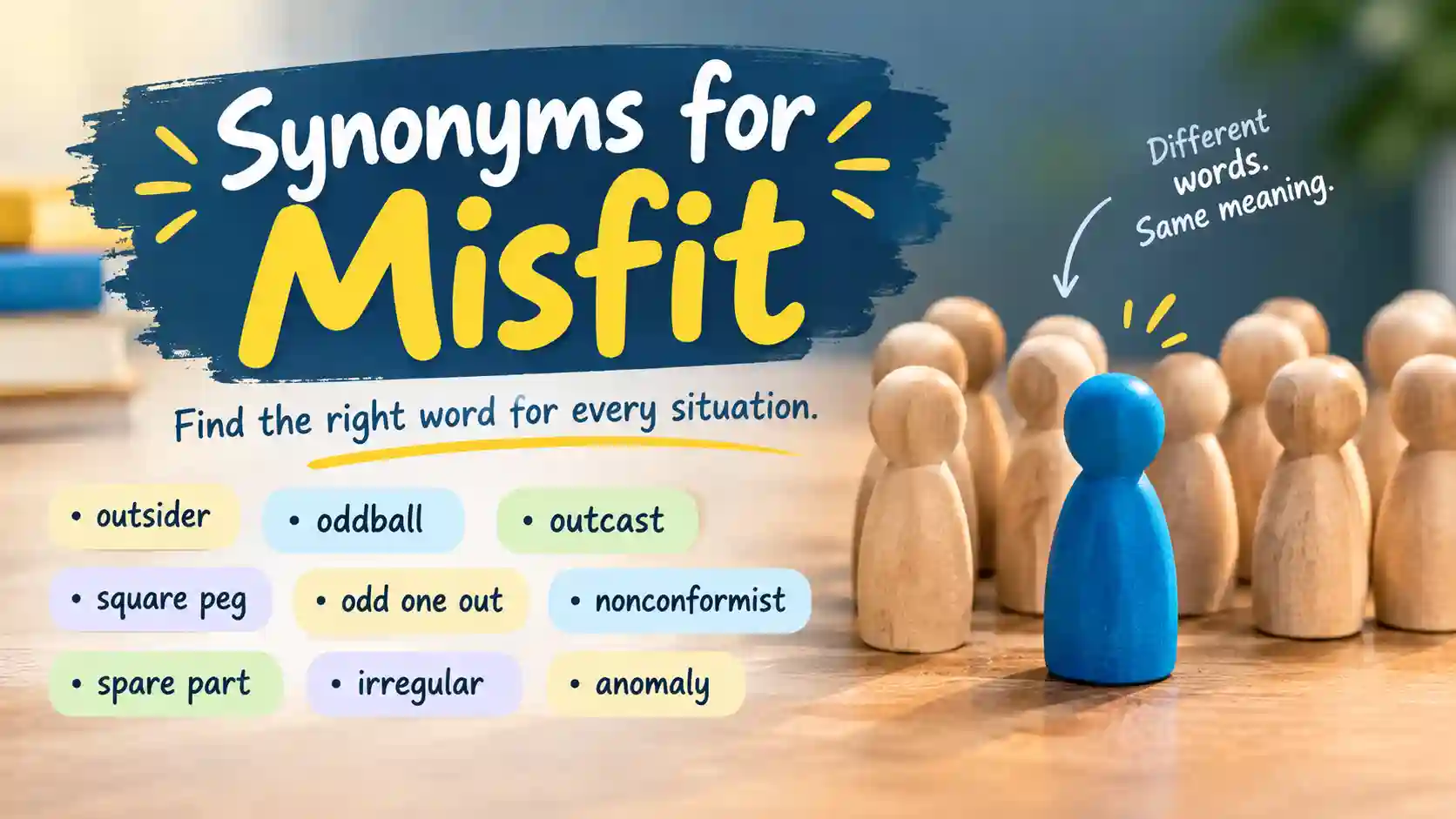
Quick Answer
The best synonyms for misfit depend on what you mean. Use outsider for someone who does not belong, outcast for someone who has been rejected, eccentric for someone who behaves unusually, and nonconformist for someone who does not follow conventions. Oddball and weirdo are informal, while individualism is often more positive.
What Does Misfit Mean?
Have you ever joined a group and felt that you did not really belong? You may have felt like a misfit.
A misfit is a person who does not fit comfortably into a particular group, situation, or social environment. The word can refer to someone whose behavior or ideas are unusual, or to someone who is not accepted by other people.
For example:
Daniel felt like a misfit at his new school because his interests were very different from those of his classmates.
The important idea is lack of fit. A misfit does not necessarily do anything wrong. The person may simply be different from the people around them.
This matters when choosing synonyms for misfit. If you mean “someone who does not belong,” an outsider may be better. If you mean “someone with unusual behavior,” eccentric may be more accurate. If you mean “someone rejected by a group,” outcast is stronger.
That small difference can make your English much more precise.
Pronunciation
Misfit
IPA: /ˈmɪs.fɪt/
Pronounced: MIS-fit
Cambridge gives essentially the same pronunciation for British and American English.
Part of Speech
Misfit is most useful to learners as a countable noun.
- Singular: a misfit
- Plural: misfits
Examples
- He felt like a misfit in the group.
- The movie follows a group of misfits.
- She was considered a social misfit.
The word can also function as a verb, although this use is much less common in everyday learner English.
- The jacket misfitted him.
- The parts were misfitting.
Dictionary.com and Collins both record verb forms including misfitted and misfitting.
Common grammar patterns
- feel like a misfit
- be a social misfit
- regard someone as a misfit
- a group of misfits
- a misfit in society
- a misfit at school
- a misfit in the workplace
Word Origin and First Known Use
The word misfit combines mis-, meaning “wrong” or “bad,” with fit.
Etymonline records misfit as a noun from 1823, originally referring to a garment or suit that did not fit the person it was intended for. The meaning referring to a person who does not fit their environment is attested from about 1880.
Dictionary.com gives the first-recorded period as 1815–25, so historical sources do not give exactly the same date.
The development is easy to understand:
something that does not fit → a person who does not fit their environment
Synonyms for Misfit at a Glance
| Word | Main meaning | Tone | Approx. CEFR* |
| Outsider | Person who does not belong | Neutral | B1 |
| Outcast | Person rejected by a group | Negative | B2 |
| Eccentric | Person with unusual behavior | Neutral/Positive | B2 |
| Oddball | Unusual or strange person | Informal | B2 |
| Weirdo | Very strange person | Informal/Negative | B2 |
| Nonconformist | Person who rejects conventions | Neutral/Positive | C1 |
| Individualist | Independent person | Positive/Neutral | B2 |
| Loner | Person who spends or prefers time alone | Neutral | B2 |
| Unconventional person | Person unlike the usual pattern | Neutral | B2 |
| Odd one out | Person different from the rest | Neutral | B1 |
| Fish out of water | Person uncomfortable in a setting | Idiomatic | B2 |
| Maverick | Independent person who ignores usual methods | Often Positive | C1 |
| Lone wolf | Strongly independent person | Informal | B2 |
| Dissenter | Person who disagrees with an accepted view | Formal | C1 |
| Dissident | Person opposing an established authority/system | Formal | C1 |
| Bohemian | Person with an unconventional artistic lifestyle | Literary/Neutral | C1 |
| Oddity | Unusual person or thing | Neutral | C1 |
| Freak | Extremely unusual person or thing | Informal/Offensive | B2 |
| Square peg in a round hole | Person poorly suited to a role | Idiomatic | C1 |
*CEFR levels here are approximate learner guidance, not official CEFR assignments for every word.
The Best Synonyms for Misfit
1. Outsider
Meaning: Someone who does not belong to a particular group.
Example 1:
Aisha felt like an outsider during her first week at college.
Example 2:
As an outsider, he found it difficult to understand the team’s traditions.
Best used when: The main idea is not belonging.
Tone: Neutral
Register: General, academic, professional
Frequency: Very common
Approx. CEFR: B1
Common collocations:
- social outsider
- political outsider
- feel like an outsider
Nuance: This is one of the safest alternatives to misfit. It does not automatically say that the person is strange.
When not to use it: Do not use it if the main point is unusual behavior rather than lack of membership.
2. Outcast
Meaning: Someone who has been rejected or excluded by a group.
Example 1:
After the argument, he felt like an outcast.
Example 2:
The novel tells the story of an outcast who finds a new community.
Best used when: Rejection is the central idea.
Tone: Negative, sometimes sympathetic
Register: General, literary
Frequency: Common
Approx. CEFR: B2
Common collocations:
- social outcast
- become an outcast
- treat someone as an outcast
Nuance: Outcast is usually stronger than outsider because it suggests exclusion.
When not to use it: Do not use it merely because someone is new to a group.
3. Eccentric
Meaning: Someone whose behavior, appearance, or ideas are unusual.
Example 1:
The eccentric artist wore bright clothes every day.
Example 2:
Her eccentric ideas often surprised her colleagues.
Best used when: You want to emphasize unusual behavior or ideas.
Tone: Neutral to positive
Register: General, literary, professional
Frequency: Common
Approx. CEFR: B2
Common collocations:
- eccentric artist
- eccentric behavior
- eccentric character
Nuance: An eccentric person does not have to be rejected. They may be popular and respected.
When not to use it: Do not use eccentric simply to mean someone who does not belong.
4. Oddball
Meaning: An informal word for someone who seems unusual or strange.
Example 1:
Everyone thought Mark was an oddball because of his unusual hobbies.
Example 2:
The comedy centers on a group of lovable oddballs.
Best used when: You want a casual, conversational word.
Tone: Informal
Register: Spoken English, casual writing
Frequency: Common
Approx. CEFR: B2
Common collocations:
- lovable oddball
- complete oddball
- local oddball
Nuance: It can be insulting, but it can also sound playful or affectionate.
When not to use it: Avoid it in formal business or academic writing.
5. Weirdo
Meaning: An informal word for someone considered very strange.
Example 1:
His classmates unfairly called him a weirdo.
Example 2:
She jokingly described herself as a harmless weirdo.
Best used when: The setting is very informal.
Tone: Informal, often negative
Register: Casual speech
Frequency: Common
Approx. CEFR: B2
Nuance: The word can be playful among friends but insulting when directed at another person.
When not to use it: Avoid it in professional communication.
6. Nonconformist
Meaning: Someone who does not follow accepted customs, rules, or ideas.
Example 1:
The designer was a nonconformist who rejected traditional styles.
Example 2:
Her nonconformist approach made the project stand out.
Best used when: The person chooses not to follow convention.
Tone: Neutral to positive
Register: Academic, professional, general
Frequency: Common
Approx. CEFR: C1
Common collocations:
- social nonconformist
- nonconformist attitude
- nonconformist thinker
Nuance: This is often more positive than misfit.
When not to use it: Do not use it when someone simply cannot fit into a group without intentionally rejecting its rules.
7. Individualist
Meaning: Someone who values independence and personal choice.
Example 1:
He is an individualist who prefers to solve problems alone.
Example 2:
Her individualist style made her different from the rest of the team.
Best used when: You want a positive or neutral description of independence.
Tone: Neutral/Positive
Register: General, academic, professional
Frequency: Common
Approx. CEFR: B2
Nuance: An individualist may fit into society perfectly well, so this is a related synonym, not an exact replacement in every sentence.
8. Loner
Meaning: Someone who prefers to spend a lot of time alone.
Example 1:
Tom is a quiet loner who enjoys reading at home.
Example 2:
The film follows a loner living in a small mountain town.
Best used when: Solitude is the main idea.
Tone: Neutral to slightly negative
Register: General, informal
Frequency: Common
Approx. CEFR: B2
Nuance: A loner may choose to be alone. A misfit may want to belong but feel unable to fit in.
When not to use it: Do not call someone a loner simply because they are rejected by a group.
9. Unconventional Person
Meaning: Someone whose behavior or choices differ from what is usual.
Example 1:
She is an unconventional person who dislikes traditional routines.
Example 2:
His unconventional teaching style attracted many students.
Best used when: You want a polite, neutral alternative.
Tone: Neutral
Register: Professional, academic, general
Frequency: Common phrase
Approx. CEFR: B2
Nuance: This description avoids the negative judgment sometimes carried by misfit.
10. Odd One Out
Meaning: A person or thing that is different from the others in a group.
Example 1:
I felt like the odd one out because everyone else knew each other.
Example 2:
The red chair is the odd one out among all the black chairs.
Best used when: One person or thing clearly differs from a group.
Tone: Neutral
Register: General
Frequency: Very common
Approx. CEFR: B1
When not to use it: It does not necessarily suggest strange behavior.
11. Fish Out of Water
Meaning: Someone who feels uncomfortable in an unfamiliar situation.
Example 1:
I felt like a fish out of water at the formal dinner.
Example 2:
He was a fish out of water during his first week in the new office.
Best used when: The environment causes discomfort.
Tone: Informal/Idiomatic
Register: Spoken English, informal writing
Frequency: Common
Approx. CEFR: B2
Nuance: This expression describes a situation, not necessarily a person’s personality.
12. Maverick
Meaning: Someone who acts independently and does not follow conventional methods.
Example 1:
The maverick entrepreneur ignored the industry’s usual approach.
Example 2:
She became known as a maverick designer.
Best used when: Independence and unconventional thinking are important.
Tone: Often positive
Register: Business, journalism, general
Frequency: Common
Approx. CEFR: C1
When not to use it: Do not use it merely for someone who is socially excluded.
13. Lone Wolf
Meaning: A person who prefers to act independently rather than work with others.
Example 1:
The detective is portrayed as a lone wolf.
Example 2:
He is a lone wolf who rarely joins group projects.
Best used when: Independence or isolation is important.
Tone: Informal
Register: Spoken English, stories, journalism
Frequency: Common
Approx. CEFR: B2
14. Dissenter
Meaning: Someone who openly disagrees with an accepted opinion or authority.
Example 1:
She became a leading dissenter during the debate.
Example 2:
The dissenter refused to support the proposal.
Best used when: The difference involves disagreement.
Tone: Formal
Register: Academic, political, formal writing
Frequency: Common in formal contexts
Approx. CEFR: C1
When not to use it: A person can be a misfit without disagreeing with anyone.
15. Dissident
Meaning: Someone who strongly opposes an established political or organizational system.
Example 1:
The writer became known as a dissident voice.
Example 2:
The dissident criticized the established leadership.
Best used when: Opposition to an established system is central.
Tone: Formal
Register: Political, academic, journalism
Frequency: Common in formal contexts
Approx. CEFR: C1
When not to use it: Do not use dissident simply to mean “different.”
16. Bohemian
Meaning: A person associated with an unconventional artistic or cultural lifestyle.
Example 1:
The neighborhood attracted a bohemian community of artists.
Example 2:
She enjoyed a bohemian lifestyle filled with music and art.
Best used when: Art, culture, and unconventional living are relevant.
Tone: Literary/Neutral
Register: Cultural, literary
Frequency: Less common
Approx. CEFR: C1
When not to use it: It is not a general replacement for misfit.
17. Oddity
Meaning: A person or thing that is unusual or different.
Example 1:
His unusual habits made him an oddity in the village.
Example 2:
The building became an oddity among the modern offices.
Best used when: You want to emphasize unusualness.
Tone: Neutral, sometimes negative
Register: General/literary
Frequency: Common
Approx. CEFR: C1
When not to use it: It can sound impersonal or judgmental when used for a real person.
18. Freak
Meaning: An informal word for someone considered extremely unusual.
Example 1:
The character was treated as a freak because of his strange appearance.
Example 2:
He jokingly called himself a fitness freak.
Best used when: The context is informal or the word appears in an established expression.
Tone: Informal; potentially offensive
Register: Casual
Frequency: Common
When not to use it: Do not casually label another person a freak. It can be strongly insulting.
19. Square Peg in a Round Hole
Meaning: A person who does not fit well into a particular role or environment.
Example 1:
She felt like a square peg in a round hole in the highly formal office.
Example 2:
He was a square peg in a round hole because the job required skills he did not enjoy using.
Best used when: The problem is a poor match between a person and an environment.
Tone: Idiomatic
Register: General, informal
Frequency: Common expression
Approx. CEFR: C1
Nuance: This is an idiom, not a direct one-word synonym.
Strongest Direct Matches vs. Related Alternatives
A better way to learn this vocabulary is to separate close matches from words that only overlap in certain situations.
Closest matches
- outsider
- outcast
- eccentric
- oddball
- nonconformist
Context-dependent alternatives
- individualist
- loner
- odd one out
- unconventional person
- fish out of water
Related but not direct synonyms
- maverick
- lone wolf
- dissenter
- dissident
- bohemian
- oddity
- freak
This distinction is important because a thesaurus can show semantic relationships without meaning that every listed word can replace the original word in the same sentence.
Choose the Right Synonym
| If you mean… | Best choice | Why |
| Does not belong | Outsider | Neutral focus on membership |
| Has been rejected | Outcast | Strong focus on exclusion |
| Acts unusually | Eccentric | Focuses on behavior |
| Seems strange | Oddball | Casual and conversational |
| Very strange | Weirdo | Strong informal description |
| Rejects convention | Nonconformist | Focuses on social norms |
| Values independence | Individualist | More positive |
| Prefers solitude | Loner | Focuses on being alone |
| Feels uncomfortable somewhere | Fish out of water | Focuses on situation |
| Acts independently | Maverick | Often positive |
| Disagrees with authority | Dissenter | Focuses on disagreement |
| Opposes an established system | Dissident | Formal and specific |
| Has an artistic unconventional lifestyle | Bohemian | Cultural meaning |
| Is different from a group | Odd one out | Simple group comparison |
Quick Tip: Before choosing a synonym, ask yourself: “Is the person different, rejected, independent, alone, or simply uncomfortable?” Your answer will usually reveal the right word.
Commonly Confused Words
| Word | What it really emphasizes | Example |
| Misfit | Poor social or situational fit | He felt like a misfit at school. |
| Outsider | Lack of belonging | She was an outsider in the group. |
| Outcast | Rejection by others | He became an outcast. |
| Eccentric | Unusual behavior | She is an eccentric artist. |
| Loner | Preference for solitude | He is a quiet loner. |
| Nonconformist | Rejection of convention | She is a nonconformist thinker. |
The easiest way to remember them
Misfit = does not fit
Outsider = does not belong
Outcast = has been rejected
Eccentric = behaves unusually
Loner = stays alone
Nonconformist = does not follow convention
Connotation: Positive, Neutral, or Negative?
Not all synonyms for misfit have the same emotional effect.
More neutral
- outsider
- odd one out
- unconventional person
- eccentric
Often positive
- individualist
- nonconformist
- maverick
- original
Often negative
- outcast
- weirdo
- freak
The context can change the feeling. For example, maverick often praises independence, while weirdo can insult someone.
Common Mistakes
Common Mistake Box
Mistake 1
Wrong:
“She is a loner because everyone rejected her.”
Better:
“She is an outcast because everyone rejected her.”
Why: Loner focuses on being alone, while outcast focuses on rejection.
Mistake 2
Wrong:
“He is a dissident because he dresses differently.”
Better:
“He is unconventional because he dresses differently.”
Why: Dissident normally involves opposition to an established authority or system.
Mistake 3
Wrong:
“My new classmate is a weirdo.”
Better in polite English:
“My new classmate is unconventional.”
Why: Weirdo can sound insulting.
Mistake 4
Wrong:
“She is a misfit because she likes working alone.”
Better:
“She is a loner because she prefers working alone.”
Why: A person can enjoy solitude without being socially rejected.
American vs. British English
Misfit has no major spelling difference between American and British English.
- British English: misfit
- American English: misfit
Cambridge gives the same basic pronunciation, /ˈmɪs.fɪt/, for both varieties.
Collins also records the noun in both British and American English. It records additional differences in the verb’s pronunciation and use.
For everyday learners, the important point is simple:
You can use misfit in both American and British English without changing the spelling.
British and American usage examples
British:
He felt like a misfit at the new school.
American:
He felt like a misfit at the new school.
The sentence works naturally in both varieties.
Natural Collocations
Learning words in combinations is often more useful than memorizing isolated definitions.
Common combinations with misfit include:
- social misfit
- complete misfit
- total misfit
- feel like a misfit
- a group of misfits
- a misfit in society
- a misfit at school
- a misfit in the workplace
- misfit character
- lovable misfits
Modern published examples also show misfit being used with groups of unusual characters and people who feel different from those around them.
How to Use Synonyms for Misfit in Writing
In essays
Use neutral and precise vocabulary.
The character feels like an outsider because he cannot connect with his classmates.
Avoid casual words such as weirdo unless you are analyzing dialogue or characterization.
In professional emails
Prefer neutral descriptions.
He has an unconventional approach to solving problems.
This is safer than:
He is an oddball.
In blog posts
Informal words can work when the tone is friendly.
These lovable oddballs turned their unusual ideas into a successful business.
In stories
Stronger words can build character.
The village treated him as an outcast, but he refused to leave.
In everyday conversation
Outsider, loner, odd one out, and eccentric can sound natural, depending on the context.
Related Vocabulary
Antonyms
Possible opposites of misfit include:
- insider
- member
- conformist
- participant
- team player
- socializer
The exact opposite depends on the meaning. Insider contrasts with outsider, while conformist contrasts with nonconformist.
Related expressions
- feel out of place
- not fit in
- feel like an outsider
- stand apart
- go against the grain
- march to the beat of your own drum
- not belong
- feel uncomfortable in a group
Mini Practice
Fill in the blanks
Choose from:
outsider · outcast · eccentric · loner · nonconformist
- Maria prefers to work alone, so her classmates call her a ______.
- After the group rejected him, he felt like an ______.
- The artist was famous for his ______ behavior.
- She refused to follow traditional rules and became known as a ______.
- As a new student, Ahmed sometimes felt like an ______.
Answers
- loner
- outcast
- eccentric
- nonconformist
- outsider
Sentence Rewriting
Replace misfit with the most accurate word.
“The young designer rejected traditional styles and was considered a misfit.”
Possible answer:
“The young designer rejected traditional styles and was considered a nonconformist.”
Why? The sentence emphasizes rejection of traditional styles, not social rejection.
Matching Exercise
Match the word with its main idea.
- Outsider
- Eccentric
- Loner
- Outcast
- Maverick
A. Prefers solitude
B. Does not belong
C. Has been rejected
D. Behaves unusually
E. Acts independently
Answers:
1-B
2-D
3-A
4-C
5-E
FAQ
What is another word for misfit?
Common alternatives include outsider, outcast, eccentric, oddball, and nonconformist. The best choice depends on context. Outsider focuses on belonging, outcast focuses on rejection, eccentric focuses on unusual behavior, and nonconformist focuses on rejecting accepted conventions.
What is a positive synonym for misfit?
Individualist, nonconformist, and maverick can provide a more positive description. These words can present difference as independence or originality. They are not exact synonyms in every context, though. A person can be an individualist without feeling excluded from society.
Is outsider a synonym for misfit?
Yes, outsider can be a close synonym when misfit means someone who does not belong to a particular group. However, outsider is more neutral. Someone may be an outsider simply because they are new to a group, while a misfit often suggests a deeper difference.
Is eccentric the same as misfit?
No. Eccentric means unusual in behavior, appearance, or ideas. Misfit focuses on not fitting into a group, situation, or environment. An eccentric person can be accepted and popular, so eccentric should not automatically replace misfit.
What is a synonym for social misfit?
Depending on the context, you can use outsider, outcast, eccentric, nonconformist, or oddball. Use outcast when rejection is important, outsider when belonging is the issue, and eccentric when unusual behavior is the main point.
Is misfit a negative word?
Misfit often has a negative or sympathetic meaning because it can suggest that someone does not belong. However, people also use it positively to celebrate individuality. For example, a group may proudly describe itself as a “group of misfits.”
What is the opposite of misfit?
Possible opposites include insider, member, conformist, and team player. The correct opposite depends on context. Insider means someone who belongs to a group, while conformist describes someone who follows accepted conventions.
What is a polite way to say misfit?
Use outsider, unconventional person, individualist, independent thinker, or nonconformist, depending on your meaning. These expressions are usually safer in professional and academic communication because they avoid strongly negative labels such as weirdo or freak.
Vocabulary Quiz
1. Which word best describes someone who has been rejected by a group?
A. Loner
B. Outcast
C. Maverick
D. Eccentric
2. Which word best describes someone who behaves in an unusual way?
A. Eccentric
B. Insider
C. Member
D. Participant
3. Which word is usually more positive than misfit?
A. Freak
B. Weirdo
C. Individualist
D. Outcast
4. Which word describes someone who prefers being alone?
A. Dissident
B. Loner
C. Outcast
D. Outsider
5. Which expression means that someone does not fit comfortably into a particular environment?
A. A square peg in a round hole
B. A team player
C. An insider
D. A conformist
Answer Key
- B. Outcast
- A. Eccentric
- C. Individualist
- B. Loner
- A. A square peg in a round hole
Conclusion
The best synonyms for misfit depend on the exact idea you want to express. Choose outsider for lack of belonging, outcast for rejection, eccentric for unusual behavior, and nonconformist for rejecting conventions.
Use individualist or maverick when the difference has a positive sense. Learning these distinctions will make your essays, emails, conversations, and creative writing clearer and more natural.
References
- Cambridge Dictionary, Misfit
- Oxford Learner’s Dictionaries, Misfit
- Collins English Dictionary, Misfit
- Dictionary.com, Misfit
- Etymonline, Misfit: Etymology and History
Synonyms for Misfit: 20+ Alternatives With Meanings, Examples & Usage
Quick Answer
The best synonyms for misfit depend on what you mean. Use outsider for someone who does not belong, outcast for someone who has been rejected, eccentric for someone who behaves unusually, and nonconformist for someone who does not follow conventions. Oddball and weirdo are informal, while individualist is often more positive.
What Does Misfit Mean?
Have you ever joined a group and felt that you did not really belong? You may have felt like a misfit.
A misfit is a person who does not fit comfortably into a particular group, situation, or social environment. The word can refer to someone whose behavior or ideas are unusual, or to someone who is not accepted by other people.
For example:
Daniel felt like a misfit at his new school because his interests were very different from those of his classmates.
The important idea is lack of fit. A misfit does not necessarily do anything wrong. The person may simply be different from the people around them.
This matters when choosing synonyms for misfit. If you mean “someone who does not belong,” outsider may be better. If you mean “someone with unusual behavior,” eccentric may be more accurate. If you mean “someone rejected by a group,” outcast is stronger.
That small difference can make your English much more precise.
Pronunciation
Misfit
IPA: /ˈmɪs.fɪt/
Pronounced: MIS-fit
Cambridge gives essentially the same pronunciation for British and American English.
Part of Speech
Misfit is most useful to learners as a countable noun.
- Singular: a misfit
- Plural: misfits
Examples
- He felt like a misfit in the group.
- The movie follows a group of misfits.
- She was considered a social misfit.
The word can also function as a verb, although this use is much less common in everyday learner English.
- The jacket misfitted him.
- The parts were misfitting.
Dictionary.com and Collins both record verb forms including misfitted and misfitting.
Common grammar patterns
- feel like a misfit
- be a social misfit
- regard someone as a misfit
- a group of misfits
- a misfit in society
- a misfit at school
- a misfit in the workplace
Word Origin and First Known Use
The word misfit combines mis-, meaning “wrong” or “bad,” with fit.
Etymonline records misfit as a noun from 1823, originally referring to a garment or suit that did not fit the person it was intended for. The meaning referring to a person who does not fit their environment is attested from about 1880.
Dictionary.com gives the first-recorded period as 1815–25, so historical sources do not give exactly the same date.
The development is easy to understand:
something that does not fit → a person who does not fit their environment
Synonyms for Misfit at a Glance
| Word | Main meaning | Tone | Approx. CEFR* |
| Outsider | Person who does not belong | Neutral | B1 |
| Outcast | Person rejected by a group | Negative | B2 |
| Eccentric | Person with unusual behavior | Neutral/Positive | B2 |
| Oddball | Unusual or strange person | Informal | B2 |
| Weirdo | Very strange person | Informal/Negative | B2 |
| Nonconformist | Person who rejects conventions | Neutral/Positive | C1 |
| Individualist | Independent person | Positive/Neutral | B2 |
| Loner | Person who spends or prefers time alone | Neutral | B2 |
| Unconventional person | Person unlike the usual pattern | Neutral | B2 |
| Odd one out | Person different from the rest | Neutral | B1 |
| Fish out of water | Person uncomfortable in a setting | Idiomatic | B2 |
| Maverick | Independent person who ignores usual methods | Often Positive | C1 |
| Lone wolf | Strongly independent person | Informal | B2 |
| Dissenter | Person who disagrees with an accepted view | Formal | C1 |
| Dissident | Person opposing an established authority/system | Formal | C1 |
| Bohemian | Person with an unconventional artistic lifestyle | Literary/Neutral | C1 |
| Oddity | Unusual person or thing | Neutral | C1 |
| Freak | Extremely unusual person or thing | Informal/Offensive | B2 |
| Square peg in a round hole | Person poorly suited to a role | Idiomatic | C1 |
*CEFR levels here are approximate learner guidance, not official CEFR assignments for every word.
The Best Synonyms for Misfit
1. Outsider
Meaning: Someone who does not belong to a particular group.
Example 1:
Aisha felt like an outsider during her first week at college.
Example 2:
As an outsider, he found it difficult to understand the team’s traditions.
Best used when: The main idea is not belonging.
Tone: Neutral
Register: General, academic, professional
Frequency: Very common
Approx. CEFR: B1
Common collocations:
- social outsider
- political outsider
- feel like an outsider
Nuance: This is one of the safest alternatives to misfit. It does not automatically say that the person is strange.
When not to use it: Do not use it if the main point is unusual behavior rather than lack of membership.
2. Outcast
Meaning: Someone who has been rejected or excluded by a group.
Example 1:
After the argument, he felt like an outcast.
Example 2:
The novel tells the story of an outcast who finds a new community.
Best used when: Rejection is the central idea.
Tone: Negative, sometimes sympathetic
Register: General, literary
Frequency: Common
Approx. CEFR: B2
Common collocations:
- social outcast
- become an outcast
- treat someone as an outcast
Nuance: Outcast is usually stronger than outsider because it suggests exclusion.
When not to use it: Do not use it merely because someone is new to a group.
3. Eccentric
Meaning: Someone whose behavior, appearance, or ideas are unusual.
Example 1:
The eccentric artist wore bright clothes every day.
Example 2:
Her eccentric ideas often surprised her colleagues.
Best used when: You want to emphasize unusual behavior or ideas.
Tone: Neutral to positive
Register: General, literary, professional
Frequency: Common
Approx. CEFR: B2
Common collocations:
- eccentric artist
- eccentric behavior
- eccentric character
Nuance: An eccentric person does not have to be rejected. They may be popular and respected.
When not to use it: Do not use eccentric simply to mean someone who does not belong.
4. Oddball
Meaning: An informal word for someone who seems unusual or strange.
Example 1:
Everyone thought Mark was an oddball because of his unusual hobbies.
Example 2:
The comedy centers on a group of lovable oddballs.
Best used when: You want a casual, conversational word.
Tone: Informal
Register: Spoken English, casual writing
Frequency: Common
Approx. CEFR: B2
Common collocations:
- lovable oddball
- complete oddball
- local oddball
Nuance: It can be insulting, but it can also sound playful or affectionate.
When not to use it: Avoid it in formal business or academic writing.
5. Weirdo
Meaning: An informal word for someone considered very strange.
Example 1:
His classmates unfairly called him a weirdo.
Example 2:
She jokingly described herself as a harmless weirdo.
Best used when: The setting is very informal.
Tone: Informal, often negative
Register: Casual speech
Frequency: Common
Approx. CEFR: B2
Nuance: The word can be playful among friends but insulting when directed at another person.
When not to use it: Avoid it in professional communication.
6. Nonconformist
Meaning: Someone who does not follow accepted customs, rules, or ideas.
Example 1:
The designer was a nonconformist who rejected traditional styles.
Example 2:
Her nonconformist approach made the project stand out.
Best used when: The person chooses not to follow convention.
Tone: Neutral to positive
Register: Academic, professional, general
Frequency: Common
Approx. CEFR: C1
Common collocations:
- social nonconformist
- nonconformist attitude
- nonconformist thinker
Nuance: This is often more positive than misfit.
When not to use it: Do not use it when someone simply cannot fit into a group without intentionally rejecting its rules.
7. Individualist
Meaning: Someone who values independence and personal choice.
Example 1:
He is an individualist who prefers to solve problems alone.
Example 2:
Her individualist style made her different from the rest of the team.
Best used when: You want a positive or neutral description of independence.
Tone: Neutral/Positive
Register: General, academic, professional
Frequency: Common
Approx. CEFR: B2
Nuance: An individualist may fit into society perfectly well, so this is a related synonym, not an exact replacement in every sentence.
8. Loner
Meaning: Someone who prefers to spend a lot of time alone.
Example 1:
Tom is a quiet loner who enjoys reading at home.
Example 2:
The film follows a loner living in a small mountain town.
Best used when: Solitude is the main idea.
Tone: Neutral to slightly negative
Register: General, informal
Frequency: Common
Approx. CEFR: B2
Nuance: A loner may choose to be alone. A misfit may want to belong but feel unable to fit in.
When not to use it: Do not call someone a loner simply because they are rejected by a group.
9. Unconventional Person
Meaning: Someone whose behavior or choices differ from what is usual.
Example 1:
She is an unconventional person who dislikes traditional routines.
Example 2:
His unconventional teaching style attracted many students.
Best used when: You want a polite, neutral alternative.
Tone: Neutral
Register: Professional, academic, general
Frequency: Common phrase
Approx. CEFR: B2
Nuance: This description avoids the negative judgment sometimes carried by misfit.
10. Odd One Out
Meaning: A person or thing that is different from the others in a group.
Example 1:
I felt like the odd one out because everyone else knew each other.
Example 2:
The red chair is the odd one out among all the black chairs.
Best used when: One person or thing clearly differs from a group.
Tone: Neutral
Register: General
Frequency: Very common
Approx. CEFR: B1
When not to use it: It does not necessarily suggest strange behavior.
11. Fish Out of Water
Meaning: Someone who feels uncomfortable in an unfamiliar situation.
Example 1:
I felt like a fish out of water at the formal dinner.
Example 2:
He was a fish out of water during his first week in the new office.
Best used when: The environment causes the discomfort.
Tone: Informal/Idiomatic
Register: Spoken English, informal writing
Frequency: Common
Approx. CEFR: B2
Nuance: This expression describes a situation, not necessarily a person’s personality.
12. Maverick
Meaning: Someone who acts independently and does not follow conventional methods.
Example 1:
The maverick entrepreneur ignored the industry’s usual approach.
Example 2:
She became known as a maverick designer.
Best used when: Independence and unconventional thinking are important.
Tone: Often positive
Register: Business, journalism, general
Frequency: Common
Approx. CEFR: C1
When not to use it: Do not use it merely for someone who is socially excluded.
13. Lone Wolf
Meaning: A person who prefers to act independently rather than work with others.
Example 1:
The detective is portrayed as a lone wolf.
Example 2:
He is a lone wolf who rarely joins group projects.
Best used when: Independence or isolation is important.
Tone: Informal
Register: Spoken English, stories, journalism
Frequency: Common
Approx. CEFR: B2
14. Dissenter
Meaning: Someone who openly disagrees with an accepted opinion or authority.
Example 1:
She became a leading dissenter during the debate.
Example 2:
The dissenter refused to support the proposal.
Best used when: The difference involves disagreement.
Tone: Formal
Register: Academic, political, formal writing
Frequency: Common in formal contexts
Approx. CEFR: C1
When not to use it: A person can be a misfit without disagreeing with anyone.
15. Dissident
Meaning: Someone who strongly opposes an established political or organizational system.
Example 1:
The writer became known as a dissident voice.
Example 2:
The dissident criticized the established leadership.
Best used when: Opposition to an established system is central.
Tone: Formal
Register: Political, academic, journalism
Frequency: Common in formal contexts
Approx. CEFR: C1
When not to use it: Do not use dissident simply to mean “different.”
16. Bohemian
Meaning: A person associated with an unconventional artistic or cultural lifestyle.
Example 1:
The neighborhood attracted a bohemian community of artists.
Example 2:
She enjoyed a bohemian lifestyle filled with music and art.
Best used when: Art, culture, and unconventional living are relevant.
Tone: Literary/Neutral
Register: Cultural, literary
Frequency: Less common
Approx. CEFR: C1
When not to use it: It is not a general replacement for misfit.
17. Oddity
Meaning: A person or thing that is unusual or different.
Example 1:
His unusual habits made him an oddity in the village.
Example 2:
The building became an oddity among the modern offices.
Best used when: You want to emphasize unusualness.
Tone: Neutral, sometimes negative
Register: General/literary
Frequency: Common
Approx. CEFR: C1
When not to use it: It can sound impersonal or judgmental when used for a real person.
18. Freak
Meaning: An informal word for someone considered extremely unusual.
Example 1:
The character was treated as a freak because of his strange appearance.
Example 2:
He jokingly called himself a fitness freak.
Best used when: The context is informal or the word appears in an established expression.
Tone: Informal; potentially offensive
Register: Casual
Frequency: Common
When not to use it: Do not casually label another person a freak. It can be strongly insulting.
19. Square Peg in a Round Hole
Meaning: A person who does not fit well into a particular role or environment.
Example 1:
She felt like a square peg in a round hole in the highly formal office.
Example 2:
He was a square peg in a round hole because the job required skills he did not enjoy using.
Best used when: The problem is a poor match between a person and an environment.
Tone: Idiomatic
Register: General, informal
Frequency: Common expression
Approx. CEFR: C1
Nuance: This is an idiom, not a direct one-word synonym.
Strongest Direct Matches vs. Related Alternatives
A better way to learn this vocabulary is to separate close matches from words that only overlap in certain situations.
Closest matches
- outsider
- outcast
- eccentric
- oddball
- nonconformist
Context-dependent alternatives
- individualist
- loner
- odd one out
- unconventional person
- fish out of water
Related but not direct synonyms
- maverick
- lone wolf
- dissenter
- dissident
- bohemian
- oddity
- freak
This distinction is important because a thesaurus can show semantic relationships without meaning that every listed word can replace the original word in the same sentence.
Choose the Right Synonym
| If you mean… | Best choice | Why |
| Does not belong | Outsider | Neutral focus on membership |
| Has been rejected | Outcast | Strong focus on exclusion |
| Acts unusually | Eccentric | Focuses on behavior |
| Seems strange | Oddball | Casual and conversational |
| Very strange | Weirdo | Strong informal description |
| Rejects convention | Nonconformist | Focuses on social norms |
| Values independence | Individualist | More positive |
| Prefers solitude | Loner | Focuses on being alone |
| Feels uncomfortable somewhere | Fish out of water | Focuses on situation |
| Acts independently | Maverick | Often positive |
| Disagrees with authority | Dissenter | Focuses on disagreement |
| Opposes an established system | Dissident | Formal and specific |
| Has an artistic unconventional lifestyle | Bohemian | Cultural meaning |
| Is different from a group | Odd one out | Simple group comparison |
Quick Tip: Before choosing a synonym, ask yourself: “Is the person different, rejected, independent, alone, or simply uncomfortable?” Your answer will usually reveal the right word.
Commonly Confused Words
| Word | What it really emphasizes | Example |
| Misfit | Poor social or situational fit | He felt like a misfit at school. |
| Outsider | Lack of belonging | She was an outsider in the group. |
| Outcast | Rejection by others | He became an outcast. |
| Eccentric | Unusual behavior | She is an eccentric artist. |
| Loner | Preference for solitude | He is a quiet loner. |
| Nonconformist | Rejection of convention | She is a nonconformist thinker. |
The easiest way to remember them
Misfit = does not fit
Outsider = does not belong
Outcast = has been rejected
Eccentric = behaves unusually
Loner = stays alone
Nonconformist = does not follow convention
Connotation: Positive, Neutral, or Negative?
Not all synonyms for misfit have the same emotional effect.
More neutral
- outsider
- odd one out
- unconventional person
- eccentric
Often positive
- individualist
- nonconformist
- maverick
- original
Often negative
- outcast
- weirdo
- freak
The context can change the feeling. For example, a maverick often praises independence, while a weirdo can insult someone.
Common Mistakes
Common Mistake Box
Mistake 1
Wrong:
“She is a loner because everyone rejected her.”
Better:
“She is an outcast because everyone rejected her.”
Why: Loner focuses on being alone, while outcast focuses on rejection.
Mistake 2
Wrong:
“He is a dissident because he dresses differently.”
Better:
“He is unconventional because he dresses differently.”
Why: Dissident normally involves opposition to an established authority or system.
Mistake 3
Wrong:
“My new classmate is a weirdo.”
Better in polite English:
“My new classmate is unconventional.”
Why: Weirdo can sound insulting.
Mistake 4
Wrong:
“She is a misfit because she likes working alone.”
Better:
“She is a loner because she prefers working alone.”
Why: A person can enjoy solitude without being socially rejected.
American vs. British English
Misfit has no major spelling difference between American and British English.
- British English: misfit
- American English: misfit
Cambridge gives the same basic pronunciation, /ˈmɪs.fɪt/, for both varieties.
Collins also records the noun in both British and American English. It records additional differences in the verb’s pronunciation and use.
For everyday learners, the important point is simple:
You can use misfit in both American and British English without changing the spelling.
British and American usage examples
British:
He felt like a misfit at the new school.
American:
He felt like a misfit at the new school.
The sentence works naturally in both varieties.
Natural Collocations
Learning words in combinations is often more useful than memorizing isolated definitions.
Common combinations with misfit include:
- social misfit
- complete misfit
- total misfit
- feel like a misfit
- a group of misfits
- a misfit in society
- a misfit at school
- a misfit in the workplace
- misfit character
- lovable misfits
Modern published examples also show misfit being used with groups of unusual characters and people who feel different from those around them.
How to Use Synonyms for Misfit in Writing
In essays
Use neutral and precise vocabulary.
The character feels like an outsider because he cannot connect with his classmates.
Avoid casual words such as weirdo unless you are analyzing dialogue or characterization.
In professional emails
Prefer neutral descriptions.
He has an unconventional approach to solving problems.
This is safer than:
He is an oddball.
In blog posts
Informal words can work when the tone is friendly.
These lovable oddballs turned their unusual ideas into a successful business.
In stories
Stronger words can build character.
The village treated him as an outcast, but he refused to leave.
In everyday conversation
Outsider, loner, odd one out, and eccentric can sound natural, depending on the context.
Related Vocabulary
Antonyms
Possible opposites of misfit include:
- insider
- member
- conformist
- participant
- team player
- socializer
The exact opposite depends on the meaning. Insider contrasts with outsider, while conformist contrasts with nonconformist.
Related expressions
- feel out of place
- not fit in
- feel like an outsider
- stand apart
- go against the grain
- march to the beat of your own drum
- not belong
- feel uncomfortable in a group
Mini Practice
Fill in the blanks
Choose from:
outsider · outcast · eccentric · loner · nonconformist
- Maria prefers to work alone, so her classmates call her a ______.
- After the group rejected him, he felt like an ______.
- The artist was famous for his ______ behavior.
- She refused to follow traditional rules and became known as a ______.
- As a new student, Ahmed sometimes felt like an ______.
Answers
- loner
- outcast
- eccentric
- nonconformist
- outsider
Sentence Rewriting
Replace misfit with the most accurate word.
“The young designer rejected traditional styles and was considered a misfit.”
Possible answer:
“The young designer rejected traditional styles and was considered a nonconformist.”
Why? The sentence emphasizes rejection of traditional styles, not social rejection.
Matching Exercise
Match the word with its main idea.
- Outsider
- Eccentric
- Loner
- Outcast
- Maverick
A. Prefers solitude
B. Does not belong
C. Has been rejected
D. Behaves unusually
E. Acts independently
Answers:
1-B
2-D
3-A
4-C
5-E
FAQ
What is another word for misfit?
Common alternatives include outsider, outcast, eccentric, oddball, and nonconformist. The best choice depends on context. Outsider focuses on belonging, outcast focuses on rejection, eccentric focuses on unusual behavior, and nonconformist focuses on rejecting accepted conventions.
What is a positive synonym for misfit?
Individualist, nonconformist, and maverick can provide a more positive description. These words can present differences as independence or originality. They are not exact synonyms in every context, though. A person can be an individualist without feeling excluded from society.
Is outsider a synonym for misfit?
Yes, outsider can be a close synonym when misfit means someone who does not belong to a particular group. However, an outsider is more neutral. Someone may be an outsider simply because they are new to a group, while a misfit often suggests a deeper difference.
Is eccentric the same as misfit?
No. Eccentric means unusual in behavior, appearance, or ideas. Misfit focuses on not fitting into a group, situation, or environment. An eccentric person can be accepted and popular, so eccentric should not automatically replace misfit.
What is a synonym for social misfit?
Depending on the context, you can use outsider, outcast, eccentric, nonconformist, or oddball. Use outcast when rejection is important, outsider when belonging is the issue, and eccentric when unusual behavior is the main point.
Is misfit a negative word?
Misfit often has a negative or sympathetic meaning because it can suggest that someone does not belong. However, people also use it positively to celebrate individuality. For example, a group may proudly describe itself as a “group of misfits.”
What is the opposite of misfit?
Possible opposites include insider, member, conformist, and team player. The correct opposite depends on context. Insider means someone who belongs to a group, while conformist describes someone who follows accepted conventions.
What is a polite way to say misfit?
Use an outsider, unconventional person, individualist, independent thinker, or nonconformist, depending on your meaning. These expressions are usually safer in professional and academic communication because they avoid strongly negative labels such as weirdo or freak.
Vocabulary Quiz
1. Which word best describes someone who has been rejected by a group?
A. Loner
B. Outcast
C. Maverick
D. Eccentric
2. Which word best describes someone who behaves in an unusual way?
A. Eccentric
B. Insider
C. Member
D. Participant
3. Which word is usually more positive than misfit?
A. Freak
B. Weirdo
C. Individualist
D. Outcast
4. Which word describes someone who prefers being alone?
A. Dissident
B. Loner
C. Outcast
D. Outsider
5. Which expression means that someone does not fit comfortably into a particular environment?
A. A square peg in a round hole
B. A team player
C. An insider
D. A conformist
Answer Key
- B. Outcast
- A. Eccentric
- C. Individualist
- B. Loner
- A. A square peg in a round hole
Conclusion
The best synonyms for misfit depend on the exact idea you want to express. Choose outsider for lack of belonging, outcast for rejection, eccentric for unusual behavior, and nonconformist for rejecting conventions. Use individualist or maverick when the difference has a positive sense. Learning these distinctions will make your essays, emails, conversations, and creative writing clearer and more natural.
References
- Cambridge Dictionary, Misfit
- Oxford Learner’s Dictionaries, Misfit
- Collins English Dictionary, Misfit
- Dictionary.com, Misfit
- Etymonline, Misfit: Etymology and History

Synonorm is a trusted English vocabulary resource created to help readers find the right words and understand the differences between similar terms. We provide clear explanations of synonyms, meanings, examples, usage, and alternatives. Our content makes vocabulary easier to learn and apply in everyday, academic, and professional English. Synonorm is designed for students, writers, ESL learners, professionals, and anyone who wants to improve their English vocabulary and communicate more clearly.