Quick Answer
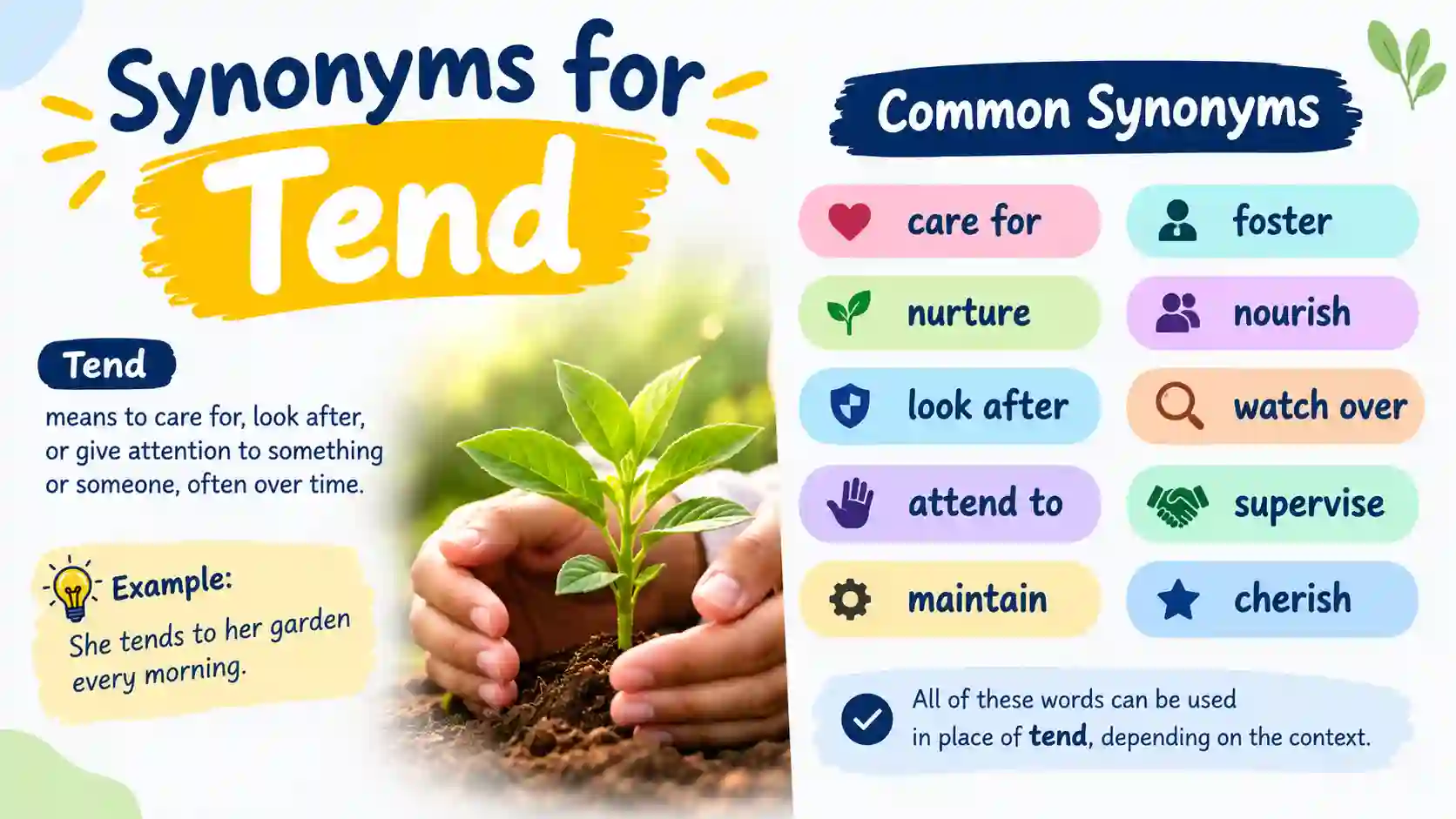
The best synonyms for tend depend on its meaning. If tend to means “usually be likely to,” use be likely to, be inclined to, have a tendency to, or be prone to. If tend means “take care of,” use care for, look after, take care of, or attend to. For direction, words such as lead, point, head, and extend may fit.
Introduction
Have you ever written “people tend to…” several times and wanted a more natural alternative?
The word tend is common and useful, but it has more than one meaning. In “Children tend to ask many questions,” it means that children are usually likely to behave that way. In “She tends her garden,” it means that she takes care of it. In “The road tends north,” it describes direction.
This makes synonyms for tend slightly tricky. You cannot simply choose any word from a thesaurus. The replacement must match the meaning, grammar, tone, and context.
This guide explains the main meanings of tend, the best alternatives for each one, natural collocations, learner mistakes, CEFR guidance, American and British usage, and practical exercises.
Pronunciation
Tend: /tend/
IPA: /tɛnd/
Pronounced: tend
The spelling and pronunciation are essentially the same in American and British English. Oxford gives the pronunciation as /tend/.
Part of Speech
Tend is a verb.
It has three important modern uses.
1. Tend to + verb
It means to be likely to do something or to show a usual pattern.
People tend to remember stories better than lists.
2. Tend + noun
It can mean to take care of someone or something.
She tends the plants every morning.
3. Tend toward + noun or direction
It can describe a general movement, direction, or inclination.
The discussion tended toward practical solutions.
Cambridge and Oxford both clearly distinguish the “be likely” and “care” uses.
Learner level: B2 for the core verb tend, according to Oxford’s learner classification.
Grammar: How to Use Tend Correctly
The most common pattern is:
Tend + to + base verb
- I tend to wake up early.
- People tend to forget small details.
- Prices tend to increase during busy periods.
Do not use the gerund after tense in this structure.
❌ I tend doing that.
✅ I tend to do that.
Tend + object
Use this structure when “tend ” means “take care of.”
- She tends the garden.
- The nurse tended the wound.
Tend to + person or thing
Here, tend can mean give care or attention to.
- The nurse tended to the patient.
- He tended to the injured animal.
This is different from:
He tends to worry.
The first means care for. The second means usually behaves in this way.
Quick Synonym Comparison
| Synonym | Meaning | Register | Approx. learner level |
| Be likely to | probable | Neutral | B1 |
| Be inclined to | naturally prefer or usually do | Neutral/Formal | B2 |
| Have a tendency to | show a repeated pattern | Academic | B2 |
| Be prone to | be likely, often negatively | Neutral | B2/C1 |
| Lean toward | favor an option | Neutral | B2 |
| Gravitate toward | naturally prefer | Neutral | C1 |
| Care for | look after | Neutral | B1 |
| Look after | take care of | Spoken/Neutral | A2/B1 |
| Take care of | care for or handle | Neutral | A2 |
| Attend to | give care or attention | Formal | B2 |
| Nurse | care for a sick person | Neutral | B2 |
| Mind | look after | Informal, especially UK | B1 |
| Watch over | watch and protect | Neutral | B1 |
| Nurture | encourage growth | Formal | C1 |
| Supervise | monitor and direct | Business/Formal | B2 |
| Oversee | supervise | Business/Formal | C1 |
| Manage | run or control | Neutral/Business | B1 |
| Lead | go toward | Neutral | A2/B1 |
| Point | face toward | Neutral | A2 |
| Head | move toward | Spoken/Neutral | B1 |
| Extend | stretch or continue toward | Formal/Neutral | B2 |
| Aim | direct toward a goal | Neutral | B1 |
| Incline | lean or favor | Formal/Literary | C1 |
| Be disposed to | be inclined | Formal | C1/C2 |
| Be apt to | be likely to | Formal | C1 |
Note: CEFR levels above are learner guidance, not claims that every dictionary assigns an official CEFR level to each synonym.
Synonyms for Tend Meaning “Be Likely”
1. Be Likely To
Meaning: To have a good chance of doing or experiencing something.
Examples:
- People are likely to remember information they use often.
- The road is likely to be busy after five o’clock.
Best used when: You want a clear and direct expression of probability.
Tone: Neutral
Register: Everyday, academic, professional
Frequency: Very common
CEFR: B1
Collocations:
- likely to happen
- likely to increase
- likely to cause
When not to use: Do not use it when it means “take care of.”
2. Be Inclined To
Meaning: To be likely or naturally willing to do something.
Examples:
- I am inclined to agree with your explanation.
- She is inclined to avoid large crowds.
Best used when: You are describing a preference, opinion, or natural behavior.
Tone: Neutral to formal
Frequency: Common
CEFR: B2
Nuance: Inclined to can suggest a personal preference, while likely to focus more directly on probability.
Collocations:
- inclined to agree
- inclined to believe
- inclined to think
3. Have a Tendency To
Meaning: To show a repeated pattern.
Examples:
- New writers have a tendency to use long sentences.
- Some materials have a tendency to absorb water.
Best used when: You are explaining a pattern in academic, analytical, or formal writing.
Tone: Academic/Formal
Frequency: Common
CEFR: B2
Collocations:
- tendency to increase
- tendency to repeat
- tendency to avoid
When not to use: It can sound unnecessarily formal in casual conversation.
4. Be Prone To
Meaning: To be likely to experience or do something, often something undesirable.
Examples:
- Some older machines are prone to overheating.
- He is prone to making small spelling mistakes.
Best used when: The tendency has a negative, risky, or unwanted result.
Tone: Neutral
Frequency: Common
CEFR: B2/C1
Nuance: This is not a perfect replacement for trend. Prone too often carries a negative feeling.
5. Lean Toward
Meaning: To prefer one choice, idea, or position.
Examples:
- I lean toward the simpler design.
- The team leans toward a practical solution.
Best used when: Someone favors one option without making a final decision.
Tone: Neutral
Frequency: Common
CEFR: B2
Collocations:
- lean toward an option
- lean toward a solution
- lean toward a view
6. Gravitate Toward
Meaning: To naturally move toward or prefer something.
Examples:
- Many readers gravitate toward short articles.
- She naturally gravitates toward creative work.
Best used when: A preference develops naturally.
Tone: Neutral
Frequency: Common
CEFR: C1
Nuance: It suggests natural attraction rather than a carefully planned choice.
7. Incline
Meaning: To have a tendency or preference for something.
Examples:
- The evidence inclines me to accept the explanation.
- She inclined toward a more cautious approach.
Best used when: You need a more formal or literary alternative.
Tone: Formal/Literary
Frequency: Uncommon
CEFR: C1
When not to use: It may sound unnatural in simple everyday conversation.
8. Be Apt To
Meaning: To be likely to do or experience something.
Examples:
- Young children are apt to become bored quickly.
- People are apt to remember dramatic events.
Best used when: Writing formal or literary English.
Tone: Formal/Literary
Frequency: Uncommon
CEFR: C1
When not to use: For everyday learners English, likely to be usually simpler.
9. Be Disposed To
Meaning: To be inclined or willing to do something.
Examples:
- She was disposed to accept the proposal.
- He was not disposed to discuss the matter.
Best used when: Formal writing requires a precise word for inclination.
Tone: Formal
Frequency: Rare to uncommon
CEFR: C1/C2
When not to use: Avoid it in casual speech unless the formal tone is intentional.
Synonyms for Tend Meaning “Take Care Of”
10. Care For
Meaning: To look after someone or something.
Examples:
- She cares for her older father.
- The gardener cares for hundreds of plants.
Best used when: Someone’s health, safety, or well-being is involved.
Tone: Neutral
Frequency: Very common
CEFR: B1
Collocations:
- care for a child
- care for a patient
- care for an animal
Nuance: Care for can also mean “like” in some contexts, especially in negative constructions.
11. Look After
Meaning: To take responsibility for someone or something.
Examples:
- Can you look after my dog this weekend?
- She looks after her younger brother.
Best used when: Talking about ordinary daily care.
Tone: Spoken/Neutral
Frequency: Very common
CEFR: A2/B1
Regional note: This expression is particularly common in British English. American English often uses take care instead.
12. Take Care Of
Meaning: To care for, protect, or deal with something.
Examples:
- Please take care of the plants while I am away.
- I will take care of the customer request.
Best used when: You mean either physical care or responsibility for a task.
Tone: Neutral
Frequency: Very common
CEFR: A2
Nuance: It is broader than care for because it can also mean handling a problem or task.
13. Attend To
Meaning: To give attention or care to someone or something.
Examples:
- The nurse attended to the injured patient.
- Please attend to the customer’s request.
Best used when: You need a formal alternative for giving care or attention.
Tone: Formal/Business
Frequency: Common
CEFR: B2
When not to use: It cannot normally replace tend to when that phrase means “usually do.”
14. Nurse
Meaning: To care for someone who is sick or injured.
Examples:
- She nursed her mother during her recovery.
- The rescue team nursed the injured animal back to health.
Best used when: Illness, injury, or recovery is central to the sentence.
Tone: Neutral
Frequency: Common
CEFR: B2
Nuance: Nurse is more specific than tends.
15. Mind
Meaning: To look after or watch someone or something.
Examples:
- Could you mind my bag for a minute?
- She minded the children while their parents were away.
Best used when: Talking about temporary watching or care.
Tone: Informal
Frequency: Common
CEFR: B1
Regional note: Cambridge marks this care-related use as UK.
16. Watch Over
Meaning: To watch and protect someone or something.
Examples:
- The older brother watched over the children.
- Security staff watch over the building at night.
Best used when: Protection or monitoring is important.
Tone: Neutral
Frequency: Common
CEFR: B1
Collocations:
- watch over children
- watch over a house
- watch over someone
17. Nurture
Meaning: To help a person, ability, or living thing grow and develop.
Examples:
- Good teachers nurture curiosity.
- The gardener carefully nurtured the young plants.
Best used when: Growth and development matter more than simple maintenance.
Tone: Formal/Academic
Frequency: Common
CEFR: C1
Nuance: Nurture is about helping something develop, not simply watching it.
18. Supervise
Meaning: To watch and direct someone’s work or activity.
Examples:
- The manager supervises new employees.
- Adults should supervise children near a swimming pool.
Best used when: Someone has official responsibility for monitoring others.
Tone: Formal/Business
Frequency: Common
CEFR: B2
When not to use: Do not use it as a general replacement for personal care.
19. Oversee
Meaning: To supervise an activity, project, or process.
Examples:
- She oversees the company’s training program.
- An engineer oversees the construction project.
Best used when: Describing professional responsibility.
Tone: Formal/Business
Frequency: Common
CEFR: C1
Collocations:
- oversee a project
- oversee operations
- oversee development
20. Manage
Meaning: To organize, control, or run something.
Examples:
- She manages a small online business.
- He manages the team’s daily schedule.
Best used when: Tend involves handling or running an activity.
Tone: Neutral/Business
Frequency: Very common
CEFR: B1
Nuance: Manage focuses on control and organization. Tend can focus more on care or attention.
Synonyms for Tend Meaning “Move or Point in a Direction”
21. Lead
Meaning: To go toward or connect with a particular place.
Examples:
- This path leads toward the river.
- The road leads to the old town.
Best used when: Describing roads, paths, routes, or results.
Tone: Neutral
Frequency: Very common
CEFR: A2/B1
22. Point
Meaning: To face or direct toward something.
Examples:
- The arrow points toward the exit.
- The sign points north.
Best used when: Describing physical direction or orientation.
Tone: Neutral
Frequency: Very common
CEFR: A2
23. Head
Meaning: To move toward a place or direction.
Examples:
- We headed toward the station.
- The storm is heading east.
Best used when: The subject is actively moving.
Tone: Spoken/Neutral
Frequency: Very common
CEFR: B1
Nuance: Head normally suggests active movement, while tend can simply describe a general direction.
24. Extend
Meaning: To continue or stretch toward a place.
Examples:
- The forest extends toward the northern hills.
- The road extends beyond the village.
Best used when: Talking about physical length, range, or continuation.
Tone: Formal/Neutral
Frequency: Common
CEFR: B2
25. Aim
Meaning: To direct something toward a goal or target.
Examples:
- The program aims to improve reading skills.
- The project aims at reducing waste.
Best used when: A deliberate goal or target exists.
Tone: Neutral/Academic
Frequency: Very common
CEFR: B1
Important: Aim is not a general synonym for tend to. It normally expresses intention, while tends to usually describe a pattern or likelihood.
Strongest Synonyms
There is no single strongest synonym for every use of tend. Choose according to meaning.
When “tend” means “be likely”
- be likely to
- be inclined to
- have a tendency to
- be prone to
When “tend” means “take care of”
- care for
- look after
- take care of
- attend to
When “tend” means direction
- lead
- point
- head
- extend
Related Words That Are Not Exact Synonyms
Large thesaurus pages sometimes provide many related words. Thesaurus.com, for example, includes words such as influence, favor, lead, aim, trend, and move among its results.
These can be useful in specific contexts, but they should not be treated as universal replacements.
| Word | Why it is related | Why it is not always a synonym |
| Aim | Can express direction | Usually implies intention |
| Manage | Can involve care | Emphasizes control or organization |
| Supervise | Can involve watching | Usually implies official responsibility |
| Influence | Can cause an outcome | Means affect, not simply tend |
| Favor | Can show preference | Does not mean “usually happen” |
| Trend | Can describe a general direction | Often refers to a broader pattern or development |
| Move | Can describe direction | Does not express general tendency by itself |
This distinction is one of the most important points for English learners.
Choose the Right Synonym
“People tend to spend more money during holidays.”
Use:
People are likely to spend more money during holidays.
This focuses on probability.
“She tends her garden every morning.”
Use:
She takes care of her garden every morning.
This focuses on care.
“The road tends north.”
Use:
The road leads north.
This focuses on direction.
“I tend to agree with him.”
Use:
I am inclined to agree with him.
This focuses on opinion or inclination.
“Some machines tend to overheat.”
Use:
Some machines are prone to overheating.
This works because the tendency has an undesirable result.
Commonly Confused Words
| Word | Main meaning | Example |
| Tend | show a usual pattern or care for something | I tend to work late. |
| Intend | plan or mean to do something | I intend to finish today. |
| Attend | be present or give attention | She attended the meeting. |
| Attempt | try to do something | He attempted to solve it. |
| Pretend | act as if something is true | The child pretended to sleep. |
Tend vs. Intend
I tend to wake up early.
This describes a habit.
I intend to wake up early tomorrow.
This describes a plan.
Tend vs. Attend
The nurse tended to the patient.
This means cared for.
The nurse attended the meeting.
This means I was present at the meeting.
Common Mistakes
Common Mistake Box
Mistake 1
❌ I tend doing my homework at night.
✅ I tend to do my homework at night.
Why: The probability or habit structure is tend + to + base verb.
Mistake 2
❌ I tend to the gym every day.
✅ I go to the gym every day.
Why: Tend to does not mean “go to.”
Mistake 3
❌ She tends to her garden every morning.
Meaning intended: She usually gardens.
This sentence can be misunderstood because “tend to her garden” means “take care of her garden.”
Better:
✅ She tends her garden every morning.
Or:
✅ She works in her garden every morning.
Mistake 4
❌ People tend always to make mistakes.
This is possible in some formal structures, but learners usually write it more naturally as:
✅ People always tend to make mistakes.
However, if the idea is simply frequency, usually may be clearer:
✅ People usually make mistakes.
American vs. British English
The spelling of tend is the same in both varieties:
- American English: tend
- British English: tend
The pronunciation is also essentially the same.
The more useful regional difference concerns related expressions.
British English:
I look after my younger brother.
American English:
I take care of my younger brother.
Both are understood in both varieties.
Another example is mind in the sense of looking after someone or something. Cambridge labels this use as UK.
So learners should not assume that a British expression is incorrect in American English. It may simply be less common there.
Register and Connotation Guide
| Word | Register | Main nuance |
| tend to | Neutral | usual pattern |
| be likely to | Neutral | probability |
| be inclined to | Neutral/Formal | preference or inclination |
| be prone to | Neutral | often negative tendency |
| have a tendency to | Academic | repeated pattern |
| care for | Neutral | personal care |
| look after | Spoken | everyday care |
| take care of | Neutral | care or responsibility |
| attend to | Formal | attention or service |
| nurse | Neutral | illness or recovery |
| nurture | Formal | development |
| supervise | Business | monitoring |
| oversee | Business | professional control |
| gravitate toward | Neutral | natural attraction |
| be disposed to | Formal | willingness or inclination |
| head toward | Spoken | active movement |
Natural Collocations With Tend
Learning common combinations can help you use tend naturally.
Tend to + verb
- tend to agree
- tend to think
- tend to forget
- tend to increase
- tend to decrease
- tend to happen
- tend to change
- tend to become
Tend toward + noun
- tend toward optimism
- tend toward simplicity
- tend toward agreement
- tend toward violence
- tend toward stability
Tend + object
- tend a garden
- tend plants
- tend animals
- tend a patient
- tend wounds
- tend crops
Cambridge’s examples show the importance of the tend to + infinitive structure and also use tend for caring for plants and wounds.
Writing Tips for Different Situations
In Essays
Use tend to for general patterns.
Students tend to learn vocabulary more effectively when they use new words in context.
Use have a tendency to when a more academic tone is appropriate.
In Emails
Use simple expressions.
I will take care of the issue today.
This usually sounds more natural than an unnecessarily formal synonym.
In Blog Posts
Use tend to, usually, or are likely to depending on the exact meaning.
In Professional Writing
Use attend to, manage, supervise, or oversee only when their specific meanings fit.
In Stories
Words such as nurse, care for, watch over, and nurture can give a more precise picture of care.
Writing Tip: Do not change tend simply to avoid repetition. Change it when the alternative gives the reader a clearer or more precise meaning.
Word Origin and Etymology
Modern English tend comes from more than one historical source.
The “be inclined” and directional senses developed through Middle English tenden, from Old French tendre, ultimately from Latin tendere, meaning “to stretch.” American Heritage connects this verb with the idea of having a tendency, being inclined, or moving in a direction.
The care-related verb has a different history. American Heritage traces it through Middle English tenden, shortened from attenden, with the older sense of waiting on or attending to someone.
This explains why modern English uses the same spelling tend for meanings that can feel quite different.
Historical dictionaries date the English verb to the Middle English period. The exact first-use date can vary depending on which sense and historical source a dictionary is recording.
First Known Use
Dictionary.com places the recorded first use of tend in English around 1300–1350.
Because the modern verb represents more than one historical development, “first known use” should be treated as a historical dictionary estimate rather than as the exact date when every modern meaning appeared.
CEFR Guide for English Learners
The core verb tend is listed by Oxford as B2.
For learners, this gives a useful progression:
A2–B1
Start with:
- take care of
- look after
- lead
- point
- head
- be likely to
B2
Add:
- tend to
- be inclined to
- have a tendency to
- attend to
- supervise
- extend
C1 and above
Learn:
- gravitate toward
- nurture
- incline
- oversee
- be disposed to
- be apt to
Remember: A higher-level word is not automatically a better word. The best word is the one that expresses your meaning clearly.
Antonyms of Tend
The opposite depends on the sense.
For the care meaning:
- neglect
- ignore
- abandon
For the likelihood meaning:
- be unlikely to
- avoid
- resist
Cambridge identifies neglect as an antonym in the care-related sense.
Word Family
Tend
The base verb.
Tended
Past tense and past participle.
She tended the garden yesterday.
Tending
Present participle or gerund.
He is tending the plants.
Tendency
A noun meaning a usual pattern or inclination.
She has a tendency to worry.
Tendentious
A much less common adjective meaning strongly favoring a particular viewpoint. It should not be treated as a normal synonym for tend.
Mini Practice Exercises
Fill in the Blanks
Choose from:
tend, likely, prone, care for, oversee
- People ______ to remember information they use often.
- The old machine is ______ to overheating.
- She has to ______ her elderly father.
- The manager will ______ the project.
- They are ______ to arrive after six.
Answers
- tend
- prone
- care for
- oversee
- likely
Rewrite the Sentences
Replace the highlighted phrase with a suitable alternative.
1.
People tend to forget new vocabulary.
Possible answer:
People are likely to forget new vocabulary.
2.
She takes care of the plants.
Possible answer:
She cares for the plants.
3.
The road goes toward the coast.
Possible answer:
The road leads toward the coast.
4.
I usually agree with this idea.
Possible answer:
I tend to agree with this idea.
Matching Exercise
Match each word with its best meaning.
| Word | Meaning |
| 1. Prone | A. Supervise |
| 2. Nurse | B. Move toward |
| 3. Oversee | C. Often likely to experience something |
| 4. Head | D. Care for a sick person |
| 5. Nurture | E. Help something develop |
Answers: 1-C, 2-D, 3-A, 4-B, 5-E
FAQ: Synonyms for Tend
What is the best synonym for tend?
There is no single synonym that works in every sentence. For tend to, use be likely to, be inclined to, or have a tendency to. For the care meaning, use care for, look after, or take care of.
What is an easy synonym for tend?
For beginners, be likely to, look after, and take care of are useful alternatives. The correct choice depends on the meaning. Tend can describe likelihood, care, or direction, so context matters.
What is another word for tend to?
Common alternatives include be likely to, be inclined to, have a tendency to, and be prone to. They are not identical. Be prone to often suggests something negative, while be likely to is more neutral.
Is tend to the same as usually?
They are similar, but they are not exactly the same. Usually focuses on frequency, while tend to describes a general pattern or likelihood. “I usually walk home” states a habit directly; “I tend to walk home” presents it as a general tendency.
What is the difference between tend and intend?
Tend describes a usual pattern or likelihood, while intend describes a plan or purpose. “I tend to wake early” describes a habit. “I intend to wake early tomorrow” describes something you plan to do.
What is the difference between tend and attend?
Tend can mean “take care of,” while attend can mean “be present” or “give attention.” For example, “The nurse tended to the patient” means the nurse cared for the patient. “She attended the meeting” means she was present.
Can tend mean take care of?
Yes. Tend can mean to care for or look after someone or something. For example, “He tends his garden” means that he takes care of his garden. This use is different from “He tends to work late,” which means he is usually likely to work late.
Can tend mean move in a direction?
Yes. In formal or descriptive English, tend can describe a general direction. For example, “The road tends north” means that the road generally goes north. Depending on the context, lead, point, or head may sound more natural.
Vocabulary Quiz
1. Which sentence is correct?
A. I tend going to work early.
B. I tend to go to work early.
C. I tend went to work early.
D. I tending to go to work early.
2. Which word best fits a negative tendency?
A. Gravitate
B. Prone
C. Nurture
D. Lead
3. Which word means “take care of a sick person”?
A. Head
B. Point
C. Nurse
D. Incline
4. Which sentence correctly uses “oversee”?
A. She oversees the construction project.
B. She oversees to work early.
C. She oversees toward the station.
D. She oversees the meeting yesterday to attend.
5. What does “I tend to agree” mean?
A. I always agree.
B. I am usually inclined to agree.
C. I refuse to agree.
D. I plan to agree tomorrow.
Answer Key
- B
- B
- C
- A
- B
Final Takeaway
The most important lesson is that synonyms for tend depend on meaning. Use be likely to for probability, be inclined to for preference, be prone to for an often-negative tendency, care for or look after for personal care, and lead or head when describing direction.
Learning these differences will help you write clearer essays, more natural emails, and stronger everyday English. Do not choose a difficult synonym just to sound advanced. Choose the word that says exactly what you mean.
References
- Cambridge Dictionary, tend.
- Cambridge English Thesaurus, tend.
- Oxford Learner’s Dictionaries, tend.
- Collins English Thesaurus, tend.
- American Heritage Dictionary, tend.

Synonorm is a trusted English vocabulary resource created to help readers find the right words and understand the differences between similar terms. We provide clear explanations of synonyms, meanings, examples, usage, and alternatives. Our content makes vocabulary easier to learn and apply in everyday, academic, and professional English. Synonorm is designed for students, writers, ESL learners, professionals, and anyone who wants to improve their English vocabulary and communicate more clearly.