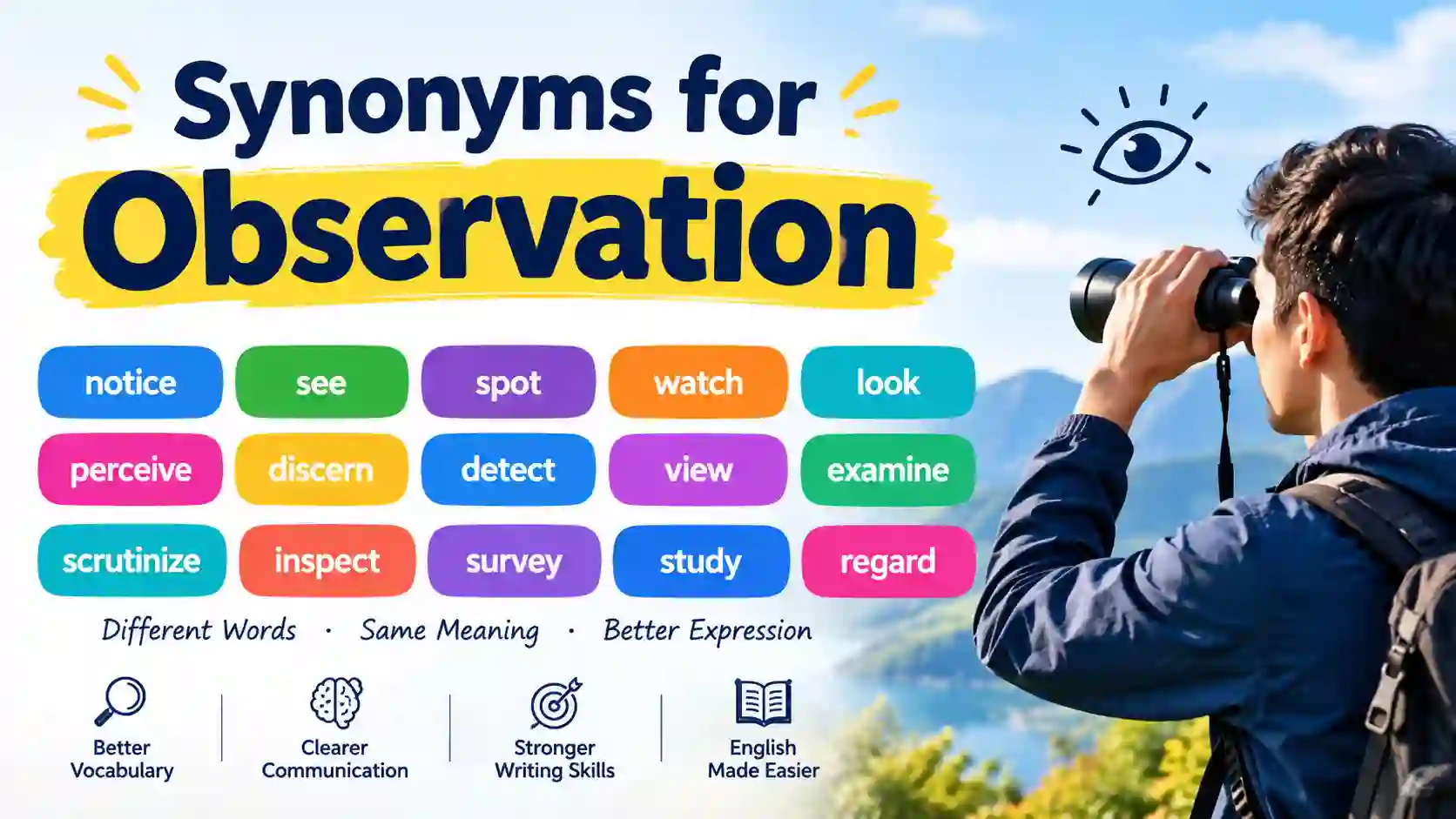
Quick Answer
The best synonyms for observation depend on what you mean. Use watching for looking at something, notice for becoming aware of something, monitoring for checking it over time, examination for careful study, and scrutiny for very close examination. When observation means a comment, use remark, comment, or note.
Introduction
What is another word for observation? The answer depends on the sentence.
You might use observation to describe watching a patient, noticing a small mistake, recording a scientific result, or making a comment about something you noticed. These meanings are related, but they are not exactly the same.
That is why replacing observation with any word from a thesaurus can sometimes make your sentence sound wrong. For example, monitoring works well for something checked over time, while remark works when observation means a comment.
This guide explains the most useful synonyms for observation with simple meanings, original examples, collocations, CEFR guidance, register, frequency, and usage warnings. It is designed for students, ESL learners, teachers, writers, bloggers, and professionals who want to choose the right word instead of simply choosing a similar-looking word.
What Does Observation Mean?
Observation is a noun with several important meanings.
1. Watching
It can mean the act of watching someone or something carefully.
The patient remained under observation.
2. Noticing
It can mean noticing or seeing something.
Her powers of observation helped her find the hidden clue.
3. A comment
It can mean a remark based on something you noticed.
He made an interesting observation about the novel.
4. Scientific information
In science, an observation can refer to information recorded while studying an event or phenomenon.
The researchers recorded their observations during the experiment.
Cambridge identifies these different senses and gives B2 for the watching and noticing meanings and C1 for the formal “remark” sense.
Pronunciation
Observation
British English: /ˌɒb.zəˈveɪ.ʃən/
American English: /ˌɑːb.zɚˈveɪ.ʃən/
Say it like: ob-zuh-VAY-shun
The spelling is the same in British and American English. The pronunciation of the first vowel differs.
Part of Speech
Observation is a noun.
Related forms include:
- observe — verb
- observer — noun
- observant — adjective
- observational — adjective
- observationally — adverb
Examples:
Scientists observe changes in the environment.
She is very observant.
The researchers used an observational study.
Grammar and Common Patterns
Common structures include:
- observation of something
- observation about something
- observation on something
- under observation
- close observation
- careful observation
- direct observation
- make an observation
- record an observation
- powers of observation
Examples:
The doctor kept him under observation.
She made an interesting observation about the painting.
The researchers recorded their observations of animal behavior.
He has excellent powers of observation.
Cambridge specifically gives examples with close observation, under observation, observation about, and observation on.
Word Origin and Etymology
Observation comes through Middle English from Latin observatio, related to observare, meaning to watch, attend to, or pay attention.
The word has long been associated with careful attention and watching. Its modern meanings developed around the ideas of watching, noticing, and commenting on what has been noticed.
Quick Synonym Comparison
| Word | Main meaning | Register | Frequency |
| Watching | Looking at something | Neutral | Very common |
| Notice | Become aware | Neutral | Very common |
| Monitoring | Checking over time | Professional | Common |
| Examination | Detailed checking | Formal/Academic | Common |
| Inspection | Official or careful checking | Formal | Common |
| Scrutiny | Very close examination | Formal | Common |
| Surveillance | Systematic watching | Formal | Common |
| Study | Careful investigation | Neutral/Academic | Very common |
| Remark | Comment about something noticed | Neutral/Formal | Common |
| Comment | Spoken or written response | Neutral | Very common |
| Note | Short record or comment | Neutral | Very common |
| Finding | Result discovered through research | Academic | Common |
| Reflection | Thought about something | Formal/Literary | Common |
| Perception | Way something is noticed or understood | Academic | Common |
| Attention | Mental focus | Neutral | Very common |
Important: These are not all exact synonyms. Their meanings overlap with different senses of observation.
25 Useful Synonyms and Contextual Alternatives
1. Watching
Meaning: Looking at someone or something for a period of time.
Example 1: Watching the birds helped the students understand their behavior.
Example 2: She spent the afternoon watching the workers repair the road.
Best used when: You mean the simple act of looking at something over time.
Tone: Neutral, spoken English
CEFR: A2
Frequency: Very common
Collocations: watching closely, careful watching, watching wildlife
When not to use: Do not use it when observation means a written comment or scientific result.
2. Notice
Meaning: To become aware of something.
Example 1: Did you notice the change in his voice?
Example 2: She noticed a small mark on the wall.
Best used when: The main idea is becoming aware of something.
Tone: Neutral
CEFR: A2
Frequency: Very common
Collocations: notice a change, notice a difference, notice something unusual
When not to use: Notice does not normally suggest a long or systematic study.
3. Monitoring
Meaning: Checking something regularly over time.
Example 1: Nurses continued monitoring the patient’s temperature.
Example 2: The company is monitoring website traffic each day.
Best used when: Something is being watched repeatedly or continuously.
Tone: Formal/Professional
CEFR: B2
Frequency: Common
Collocations: monitoring progress, monitoring activity, continuous monitoring
When not to use: Do not use it for one quick look.
4. Examination
Meaning: A careful look at something to understand or assess it.
Example 1: Close examination revealed a small crack.
Example 2: The document needs further examination.
Best used when: You want to emphasize detailed study.
Tone: Formal/Academic
CEFR: B2
Frequency: Common
Collocations: close examination, careful examination, detailed examination
When not to use: It can sound too formal for simple everyday noticing.
5. Inspection
Meaning: A careful or official check.
Example 1: The building passed its safety inspection.
Example 2: The mechanic completed an inspection of the engine.
Best used when: Someone checks a place, object, system, or document carefully.
Tone: Formal/Business
CEFR: B2
Frequency: Common
Collocations: safety inspection, routine inspection, inspection report
When not to use: Do not use it for casual watching.
6. Scrutiny
Meaning: Very close and careful examination.
Example 1: The proposal came under close scrutiny.
Example 2: Every detail of the agreement received public scrutiny.
Best used when: You want to show that something is being examined intensely.
Tone: Formal/Academic/Business
CEFR: C1
Frequency: Common in formal writing
Collocations: close scrutiny, public scrutiny, under scrutiny
When not to use: It is too strong for ordinary casual observation.
7. Surveillance
Meaning: Systematic watching, often for security or investigation.
Example 1: The building is protected by video surveillance.
Example 2: The area was placed under surveillance.
Best used when: Someone watches a person, place, or activity for security or investigative reasons.
Tone: Formal
CEFR: C1
Frequency: Common
Collocations: under surveillance, video surveillance, security surveillance
When not to use: Do not use it for ordinary scientific observation unless the context involves systematic monitoring.
8. Study
Meaning: Careful examination intended to learn about something.
Example 1: The scientist conducted a study of local bird populations.
Example 2: Her study of language development produced useful results.
Best used when: Observation is part of learning or research.
Tone: Neutral/Academic
CEFR: A2–B1
Frequency: Very common
Collocations: scientific study, detailed study, study of behavior
When not to use: A study can describe a whole research project, while an observation may be only one part of it.
9. Remark
Meaning: Something said or written about something that has been noticed.
Example 1: She made an interesting remark about the ending.
Example 2: His remark about the results started a useful discussion.
Best used when: Observation means a comment.
Tone: Neutral/Formal
CEFR: B1
Frequency: Common
Collocations: make a remark, brief remark, personal remark
When not to use: It cannot replace observation when the meaning is watching.
10. Comment
Meaning: Something said or written in response to something.
Example 1: The teacher made a helpful comment about my essay.
Example 2: She added a short comment about the results.
Best used when: You need a common word for a spoken or written observation.
Tone: Neutral
CEFR: A2
Frequency: Very common
Collocations: make a comment, comment on, helpful comment
When not to use: A comment does not necessarily come from careful observation.
11. Note
Meaning: A short written record or brief point about something.
Example 1: The researcher made a note of the unusual result.
Example 2: Please make a note of the new deadline.
Best used when: You want to emphasize a brief record.
Tone: Neutral/Formal
CEFR: A2
Frequency: Very common
Collocations: make a note, take note, note of
When not to use: A note is not necessarily a detailed observation.
12. Finding
Meaning: A fact or result discovered through research or examination.
Example 1: The researchers published their findings.
Example 2: One important finding was the change in water quality.
Best used when: Observation has produced a research result.
Tone: Academic/Professional
CEFR: B2
Frequency: Common
Collocations: research findings, key finding, major finding
When not to use: A finding is usually the result of research, not the simple act of observing.
13. Reflection
Meaning: A thought formed after careful consideration.
Example 1: Her reflection on the experience was thoughtful.
Example 2: The article contains several reflections on modern education.
Best used when: An observation includes personal thought or interpretation.
Tone: Formal/Literary
CEFR: B2
Frequency: Common
Collocations: personal reflection, reflection on, thoughtful reflection
When not to use: Do not use it for simple physical watching.
14. Perception
Meaning: The way someone notices, understands, or interprets something.
Example 1: His perception of the problem changed after the meeting.
Example 2: Good visual perception helps artists notice small differences.
Best used when: The focus is on how something is understood or interpreted.
Tone: Academic/Formal
CEFR: B2–C1
Frequency: Common
Collocations: public perception, visual perception, perception of
When not to use: Observation may record something without interpreting it.
15. Attention
Meaning: Mental focus on something.
Example 1: Careful attention helped her find the error.
Example 2: Please pay attention to the final instructions.
Best used when: You mean focused awareness.
Tone: Neutral
CEFR: A2
Frequency: Very common
Collocations: close attention, careful attention, pay attention
When not to use: Attention does not necessarily mean that you recorded an observation.
16. Awareness
Meaning: Knowledge or understanding that something exists or is happening.
Example 1: The campaign increased awareness of online safety.
Example 2: His awareness of small details helped him solve the puzzle.
Best used when: You mean consciousness or knowledge rather than active watching.
Tone: Neutral/Formal
CEFR: B2
Frequency: Common
Collocations: public awareness, greater awareness, awareness of
When not to use: It is not a direct replacement for observation in scientific contexts.
17. Detection
Meaning: The discovery of something that may be difficult to notice.
Example 1: Early detection helped doctors identify the problem.
Example 2: The device allows detection of tiny changes.
Best used when: The important idea is discovering something.
Tone: Formal/Technical
CEFR: B2
Frequency: Common
Collocations: early detection, detection system, detection of
When not to use: Detection emphasizes discovery, not simply watching.
18. Review
Meaning: A careful examination or evaluation.
Example 1: The manager requested a review of the report.
Example 2: The policy is currently under review.
Best used when: Existing information or work is being examined.
Tone: Neutral/Formal
CEFR: B1
Frequency: Very common
Collocations: annual review, detailed review, review of
When not to use: A review usually includes evaluation, while observation may not.
19. Assessment
Meaning: A judgment about something after examining it.
Example 1: The teacher completed an assessment of the student’s progress.
Example 2: The doctor gave an initial assessment of the injury.
Best used when: Observation leads to evaluation.
Tone: Formal/Professional
CEFR: B2
Frequency: Common
Collocations: risk assessment, initial assessment, assessment of
When not to use: Do not use it if you only mean watching.
20. Investigation
Meaning: A systematic search for facts or information.
Example 1: The investigation revealed several problems.
Example 2: The company began an investigation into the complaint.
Best used when: Observation forms part of a larger search for facts.
Tone: Formal
CEFR: B2
Frequency: Common
Collocations: criminal investigation, detailed investigation, investigation into
When not to use: A simple observation is not necessarily an investigation.
21. Supervision
Meaning: Watching or managing people or activities to make sure they are done properly.
Example 1: The children worked under adult supervision.
Example 2: The experiment was completed under the supervision of a professor.
Best used when: Watching includes responsibility or management.
Tone: Formal/Business
CEFR: B2
Frequency: Common
Collocations: under supervision, close supervision, direct supervision
When not to use: Supervision implies responsibility, not simply looking.
22. Consideration
Meaning: Careful thought about something.
Example 1: The decision requires careful consideration.
Example 2: The evidence deserves further consideration.
Best used when: Observation has developed into thoughtful thinking.
Tone: Formal
CEFR: B2
Frequency: Common
Collocations: careful consideration, consideration of, take into consideration
When not to use: It does not mean simply seeing or watching.
23. View
Meaning: An opinion or way of thinking about something.
Example 1: She expressed her view on the issue.
Example 2: His view of the problem changed after more research.
Best used when: Observation means an opinion or perspective.
Tone: Neutral
CEFR: A2–B1
Frequency: Very common
Collocations: personal view, different view, point of view
When not to use: View has many meanings, so it should not replace observation automatically.
24. Commentary
Meaning: Spoken or written discussion that explains or reacts to something.
Example 1: The report provides useful commentary on the results.
Example 2: Her commentary helped readers understand the issue.
Best used when: A simple observation has developed into explanation or discussion.
Tone: Formal/Neutral
CEFR: B2
Frequency: Common
Collocations: social commentary, political commentary, running commentary
When not to use: Do not use it for one simple act of noticing.
25. Survey
Meaning: A systematic examination or collection of information.
Example 1: The researchers conducted a survey of local businesses.
Example 2: A quick survey of the room showed that most seats were occupied.
Best used when: Observation involves systematic information gathering.
Tone: Neutral/Formal/Academic
CEFR: B1–B2
Frequency: Common
Collocations: conduct a survey, survey results, customer survey
When not to use: A survey is usually broader or more systematic than one observation.
Synonym Categories
Strongest Direct Alternatives
These are the most useful choices when the meaning fits:
- watching
- notice
- monitoring
- examination
- inspection
- scrutiny
- remark
- comment
Contextual Alternatives
These can replace observation in particular contexts:
- study
- note
- finding
- reflection
- review
- survey
- detection
Related Words, Not Exact Synonyms
Use these carefully:
- awareness
- attention
- perception
- assessment
- investigation
- supervision
- consideration
- view
- commentary
This classification is more useful than simply presenting a long thesaurus list because Cambridge and Thesaurus.com both show that observation has multiple semantic groups rather than one single meaning.
Observation by Context
| Context | Natural choice |
| Watching an animal | watching / observation |
| Checking a patient | monitoring / observation |
| Checking a building | inspection |
| Examining evidence closely | scrutiny |
| Security watching | surveillance |
| Academic research | observation / study |
| Research result | finding |
| A spoken point | remark / comment |
| A short written point | note |
| Personal thought | reflection |
| Mental focus | attention |
| Becoming aware | notice |
| Scientific record | observation / recorded data |
Observation vs Observance
These two words look similar but have different meanings.
Observation
Usually means watching, noticing, or making a comment.
The scientist recorded her observations.
Observance
Usually means following or honoring a rule, custom, tradition, or religious practice.
The observance of the holiday began at sunset.
Easy memory trick:
Observation = noticing or watching.
Observance = following or honoring.
This distinction is especially important because thesaurus results for observations can surface the separate observance sense.
Commonly Confused Words
| Word | Main difference | Example |
| Observation | Watching, noticing, or a comment | Her observation was accurate. |
| Observance | Following a rule or tradition | The observance of the custom continued. |
| Inspection | Careful or official checking | The building passed inspection. |
| Monitoring | Repeated checking over time | Doctors are monitoring him. |
| Scrutiny | Very close or critical examination | The plan came under scrutiny. |
Common Mistakes
Common Mistake 1
Wrong: The nurse made a monitoring of the patient.
Better: The nurse monitored the patient.
Why: Monitoring is normally used as a noun or verb in different structures. We say monitoring of the patient in formal contexts, but “made a monitoring” is unnatural.
Common Mistake 2
Wrong: The scientist made a scrutiny of the data.
Better: The scientist scrutinized the data.
Or:
The data came under scrutiny.
Why: English normally uses scrutiny of or under scrutiny, not “make a scrutiny.”
Common Mistake 3
Wrong: I made an observation that the room was empty.
Better: I observed that the room was empty.
The original sentence is not impossible, but the verb observed is often more direct.
Common Mistake 4
Wrong: The company put the machine under surveillance.
Better: The company put the machine under monitoring.
Why: Surveillance usually carries a security, investigative, or watchful sense. A machine is more naturally monitored unless surveillance has a specific security purpose.
Writing Tips
For Academic Writing
Prefer:
- observation
- examination
- finding
- scrutiny
- analysis
- assessment
Example:
The researchers recorded several important observations during the experiment.
For Business Writing
Prefer:
- observation
- monitoring
- review
- assessment
- inspection
Example:
Our review identified several areas that need improvement.
For Emails
Use simpler words:
- comment
- note
- observation
- point
Example:
I have one observation about the proposed schedule.
For Blog Posts
Use natural words rather than forcing advanced vocabulary.
Instead of:
My scrutiny of this trend reveals…
You could write:
A closer look at this trend shows…
This usually sounds more natural for a general audience.
For Everyday Conversation
Prefer:
- notice
- watch
- comment
- see
- point
Example:
Did you notice how quickly the weather changed?
Real Corpus Style Collocations
Common combinations found in dictionary and corpus material include:
- close observation
- careful observation
- direct observation
- accurate observation
- scientific observation
- classroom observation
- clinical observation
- observation of behavior
- observation of nature
- under observation
- for observation
- powers of observation
- make an observation
- record observations
Cambridge’s corpus material includes combinations such as accurate observation, astronomical observation, and other specialized uses.
Useful Collocation Patterns
Observation of
observation of animal behavior
Observation + about
observation about modern society
Observation + on
observations on human nature
Verb + observation
make an observation
record an observation
base something on observation
Adjective + observation
careful observation
close observation
scientific observation
direct observation
Scientific Use of Observation
In science, observation has a more precise role than simply “looking.”
An observation is information obtained through watching, measuring, or studying an event or phenomenon.
For example:
The researchers observed that the plants grew faster under natural light.
The recorded result may then become part of the research evidence.
This gives us an important distinction:
Observation → what was observed
Finding → what the research discovered
Assessment → judgment based on information
Investigation → systematic search for information
Analysis → detailed interpretation of information
These concepts can overlap, but they are not identical.
American vs British English
Observation is standard in both American and British English.
The spelling does not change:
- American: observation
- British: observation
The main difference is pronunciation. Cambridge gives /ˌɑːb.zɚˈveɪ.ʃən/ for American English and /ˌɒb.zəˈveɪ.ʃən/ for British English.
The main synonyms in this article are also widely understood in both varieties.
Frequency and Learner Priority
For an ESL learner, not every synonym deserves equal study time.
Learn first
- notice
- watch/watching
- comment
- study
- note
- attention
Learn next
- monitoring
- examination
- inspection
- remark
- review
- finding
- awareness
Learn for advanced writing
- scrutiny
- surveillance
- perception
- commentary
- assessment
- investigation
This approach gives learners useful vocabulary without encouraging them to replace common words with unnecessarily complicated ones.
Antonyms
There is no single opposite of observation for every sense.
Depending on context, possible opposites include:
- inattention
- ignorance
- neglect
- unawareness
- disregard
- heedlessness
For example:
Careful observation helped her identify the problem.
Inattention caused her to miss it.
Word Family
| Word | Part of speech | Meaning |
| observe | Verb | Watch or notice |
| observer | Noun | Person who observes |
| observation | Noun | Act, result, or comment |
| observant | Adjective | Good at noticing things |
| observational | Adjective | Related to observation |
| observatory | Noun | Place or building for observation |
Mini Practice
Fill in the Blanks
Choose from:
notice, monitoring, inspection, scrutiny, remark
- Did you ______ the change in the design?
- The building needs safety ______.
- The proposal came under close ______.
- Doctors are ______ the patient’s condition.
- She made an interesting ______ about the book.
Answers
- notice
- inspection
- scrutiny
- monitoring
- remark
Rewrite the Sentence
Replace observation with the most natural alternative.
1. The doctor continued observation of the patient’s condition.
Answer: The doctor continued monitoring the patient’s condition.
2. She made an observation about the painting.
Answer: She made a remark about the painting.
3. The researchers’ observation produced a new research result.
Answer: The researchers’ finding produced a new research result.
Match the Words
| Word | Meaning |
| A. Scrutiny | 1. Becoming aware |
| B. Notice | 2. Systematic watching |
| C. Surveillance | 3. Very close examination |
| D. Remark | 4. Comment |
Answers: A–3, B–1, C–2, D–4.
FAQ`s
What is the best synonym for observation?
There is no single best synonym because observation has several meanings. Use watching for looking, notice for becoming aware, monitoring for repeated checking, examination for careful study, and remark or comment when observation means something said or written.
What is a simple synonym for observation?
Notice is one of the simplest alternatives when observation means becoming aware of something. Watching is also simple when you mean looking at something over time. For a spoken or written point, comment is usually easier than more formal words such as scrutiny.
What is a formal synonym for observation?
Useful formal alternatives include examination, inspection, scrutiny, monitoring, surveillance, and assessment. However, they have different meanings. Scrutiny suggests very close examination, while surveillance usually suggests systematic watching for security or investigative purposes.
Is remark a synonym for observation?
Yes, but only for one important sense. When observation means a comment based on something noticed, remark can be a natural replacement. It cannot replace observation when the word means the act of watching or a scientific record.
Is comment a synonym for observation?
Yes, when observation means a spoken or written comment. Cambridge places comment and remark among the alternatives for this sense. However, a comment does not necessarily come from careful observation, so the two words are not identical in every situation.
What is the difference between observation and monitoring?
Observation can describe a single act of watching or noticing. Monitoring normally suggests checking something repeatedly or continuously. A doctor might make an observation during an examination but monitor a patient’s condition for several hours.
What is the difference between observation and scrutiny?
Scrutiny is stronger than ordinary observation. It means very close, careful, and often critical examination. You can observe a document without scrutinizing it. If every detail is being examined carefully, scrutiny may be the better word.
What is the difference between observation and observance?
Observation usually means watching, noticing, or making a comment. Observance usually means following or honoring a rule, tradition, custom, or religious practice. For example, scientists make observations, while communities may observe or practice the observance of a tradition.
Vocabulary Quiz
1. Which word means very close examination?
A. Notice
B. Scrutiny
C. Remark
D. View
Answer: B
2. Which word best describes regular checking over time?
A. Monitoring
B. Remark
C. Reflection
D. View
Answer: A
3. Which word can replace observation when it means a comment?
A. Surveillance
B. Inspection
C. Remark
D. Watching
Answer: C
4. Which word means becoming aware of something?
A. Notice
B. Assessment
C. Investigation
D. Supervision
Answer: A
5. Which word usually suggests an official or careful check?
A. Watching
B. Inspection
C. Comment
D. Awareness
Answer: B
Conclusion
Learning synonyms for observation is not about memorizing the biggest possible list. It is about understanding the small differences between words. Use notice for awareness, monitoring for repeated checking, inspection for careful checking, scrutiny for intense examination, and remark or comment for an observation expressed in words.
Practice these choices in essays, emails, schoolwork, professional writing, and daily conversations. Choosing the precise word will make your English clearer, more natural, and more confident.
Sources used for verification
- Cambridge Dictionary: Observation
- Cambridge Thesaurus: Observation
- Thesaurus.com: Observation Synonyms & Antonyms
- Merriam-Webster Thesaurus: Observations
- Power Thesaurus: Observation Synonyms

Synonorm is a trusted English vocabulary resource created to help readers find the right words and understand the differences between similar terms. We provide clear explanations of synonyms, meanings, examples, usage, and alternatives. Our content makes vocabulary easier to learn and apply in everyday, academic, and professional English. Synonorm is designed for students, writers, ESL learners, professionals, and anyone who wants to improve their English vocabulary and communicate more clearly.