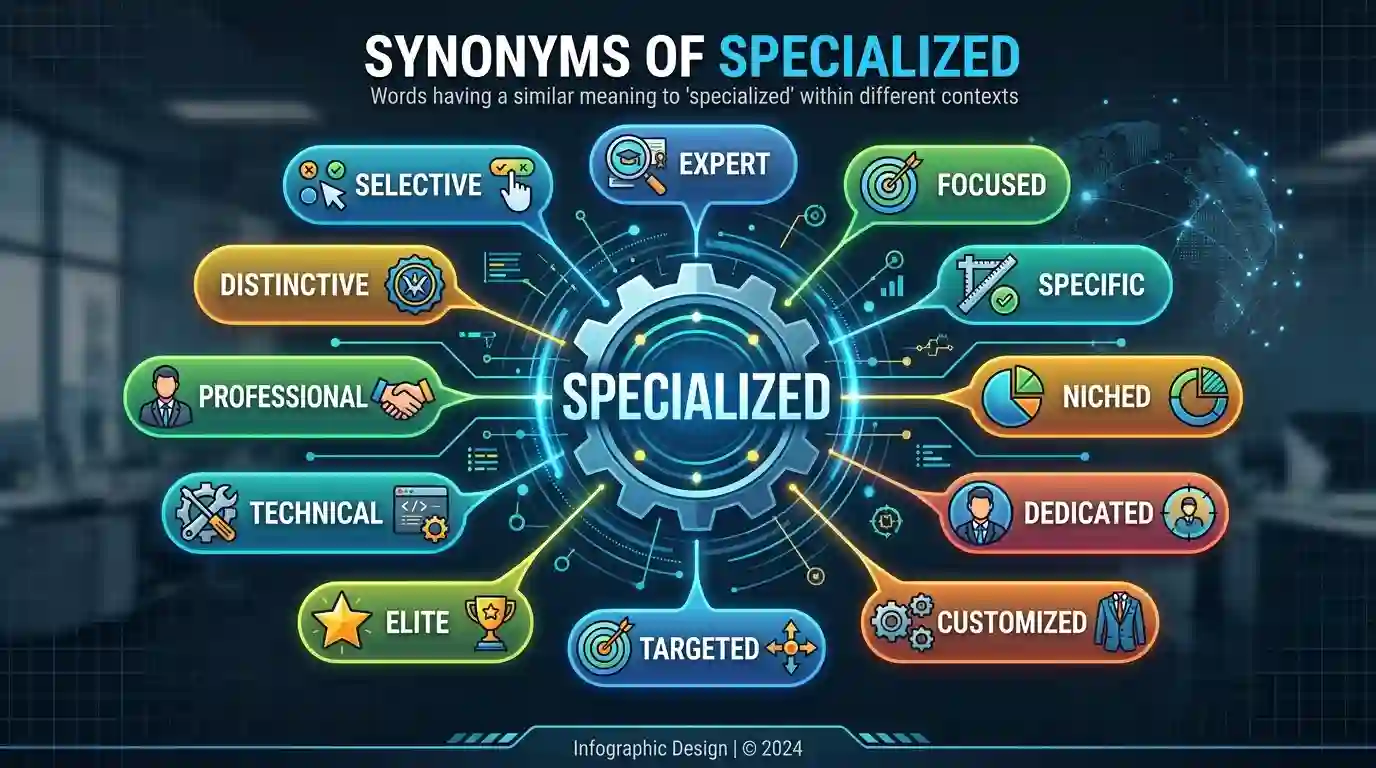
Quick Answer: The best synonyms of specialized depend on what you mean. Use specific for something exact, technical for technical knowledge or language, specialist for expert knowledge in one field, dedicated for one intended purpose, tailored for something adapted to a need, and purpose-built for something designed for one particular function.
What Does Specialized Mean?
Have you ever used the word specialized several times in an essay, report, article, or professional email and wanted a more natural alternative?
Specialized means designed, developed, used, or connected with a particular purpose or area of knowledge. For example, a hospital may offer specialized care, a company may use specialized equipment, and a student may receive specialized training. Oxford defines the adjective around a particular purpose or area of knowledge.
The best synonym depends on the sentence. Specific, technical, professional, specialist, focused, dedicated, tailored, and purpose-built can all work in certain contexts, but they do not mean exactly the same thing.
This guide explains the differences so you can choose the right word instead of simply replacing one word with another.
Specialized Pronunciation and Grammar
IPA: /ˈspeʃəlaɪzd/
Pronounced: SPESH-uh-lyzd
Part of speech: Adjective
Examples:
- specialized equipment
- specialized training
- specialized knowledge
- specialized services
Specialized can also be the past tense and past participle of the verb specialize.
- She specialized in criminal law.
- The company specializes in medical software.
Oxford gives the common verb pattern specialize in something.
American vs. British English
| American English | British English |
| specialized | specialised |
| specialize | specialise |
| specialization | specialisation |
The pronunciation is essentially the same. Oxford and Cambridge both identify as the usual British spelling.
The Core Meaning of Specialized
Think of specialized as having three main ideas:
- Made for a particular purpose
- specialized equipment
- Connected with a particular field
- specialized medical knowledge
- Requiring knowledge of one particular subject
- specialized training
Cambridge also specializes in work, knowledge, skills, services, and terminology connected with one particular subject.
This is why there is no single synonym that works in every sentence.
Quick Synonym Guide
| Synonym | Main idea | Register | Frequency |
| specific | exact or clearly identified | Neutral | Very common |
| particular | one certain area or thing | Neutral | Very common |
| technical | related to technical knowledge | Formal/Academic | Very common |
| professional | related to skilled work | Neutral/Formal | Very common |
| specialist | expert in one field | Formal | Common |
| focused | concentrated on one area | Neutral | Very common |
| dedicated | intended for one purpose | Neutral/Business | Very common |
| tailored | adapted to a particular need | Business | Common |
| targeted | directed toward a specific group | Business | Common |
| purpose-built | designed for one function | Technical | Common |
| customized | changed for particular needs | Business | Common |
| bespoke | made for a particular customer | Formal/British | Common |
| niche | aimed at a small market | Business | Common |
| advanced | highly developed | Academic/Neutral | Very common |
| sophisticated | complex or highly developed | Formal | Common |
| restricted | limited to a group or purpose | Formal | Common |
| narrow | limited in scope | Neutral | Very common |
| in-depth | thorough and detailed | Academic | Common |
| comprehensive | broad and complete | Formal | Common |
| detailed | containing many details | Neutral | Very common |
Important: These are not all perfect synonyms. Some are contextual alternatives. Choosing the right word means matching the exact idea you want to express.
The Best Synonyms of Specialized
1. Specific
Meaning: Exact or clearly identified.
CEFR: B1
Register: Neutral
Frequency: Very common
Examples:
- The machine was designed for a specific medical purpose.
- Please give me a specific example.
Best used when: You mean one exact thing, purpose, requirement, or situation.
Common collocations:
- specific purpose
- specific needs
- specific requirements
Nuance: Specific focuses on exactness. Specialized focuses more on a particular field or function.
When not to use it: Do not say specific doctor when you mean specialist doctor.
2. Particular
Meaning: One certain person, thing, area, or purpose.
CEFR: B1
Register: Neutral
Frequency: Very common
Examples:
- The course focuses on a particular area of science.
- This tool was created for a particular type of work.
Best used when: You want to identify one distinct area or purpose.
Common collocations:
- particular field
- particular purpose
- particular need
Nuance: Particular is broad and natural. It does not necessarily suggest expert knowledge.
3. Technical
Meaning: Related to a particular technical subject, method, or skill.
CEFR: B1–B2
Register: Formal/Academic
Frequency: Very common
Examples:
- The manual contains technical information about the engine.
- New workers receive technical training.
Best used when: The specialization involves technology, systems, methods, or technical knowledge.
Common collocations:
- technical knowledge
- technical skills
- technical language
Nuance: Technical is narrower than specialized in many situations.
Cambridge lists technical among the words related to the technical sense of specialized.
4. Professional
Meaning: Related to a skilled occupation or professional activity.
CEFR: B1
Register: Neutral/Formal
Frequency: Very common
Examples:
- The company provides professional training.
- We need professional advice before making a decision.
Best used when: You are talking about trained workers, occupations, or professional services.
Common collocations:
- professional training
- professional services
- professional advice
Nuance: Professional emphasizes occupation or skill level, while specialized emphasizes a particular field or purpose.
5. Specialist
Meaning: Having or involving expert knowledge of one particular area.
CEFR: B2
Register: Formal
Frequency: Common
Examples:
- The hospital has a specialist unit for heart conditions.
- We need specialist advice on this issue.
Best used when: You want to emphasize expertise in a specific field.
Common collocations:
- specialist knowledge
- specialist care
- specialist equipment
Oxford specifically uses specialists for expert knowledge in a particular area of work, study, or medicine.
When not to use it: Specialist is not always interchangeable with specialized. For example, specialized equipment is natural, while specialist equipment has a slightly different focus on specialist users or fields.
6. Focused
Meaning: Concentrated on one subject, goal, or activity.
CEFR: B2
Register: Neutral
Frequency: Very common
Examples:
- The course provides focused training in business writing.
- The researchers conducted focused studies on water pollution.
Best used when: You want to emphasize concentration rather than technical expertise.
Common collocations:
- focused research
- focused training
- focused approach
7. Dedicated
Meaning: Intended or designed for one particular purpose.
CEFR: B2
Register: Neutral/Business
Frequency: Very common
Examples:
- The company has a dedicated support team.
- The laboratory contains a dedicated testing area.
Best used when: Something exists specifically for one function or purpose.
Common collocations:
- dedicated team
- dedicated system
- dedicated equipment
Nuance: Dedicated often suggests that something is set aside exclusively for a particular use.
8. Tailored
Meaning: Adapted to fit a particular person, need, or situation.
CEFR: B2
Register: Neutral/Business
Frequency: Common
Examples:
- The school offers tailored support for adult learners.
- We created a tailored training program for new employees.
Best used when: Something has been adjusted to meet specific needs.
Common collocations:
- tailored solution
- tailored advice
- tailored training
Nuance: Tailored emphasizes customization rather than expertise.
9. Targeted
Meaning: Directed toward a particular group, goal, or result.
CEFR: B2
Register: Business/Neutral
Frequency: Common
Examples:
- The program provides targeted support for small businesses.
- The campaign uses targeted advertising.
Best used when: The focus is on a particular audience or objective.
Common collocations:
- targeted support
- targeted training
- targeted advertising
10. Purpose Built
Meaning: Designed and made for one particular purpose.
CEFR: B2–C1
Register: Technical/Neutral
Frequency: Common
Examples:
- The laboratory uses purpose-built equipment.
- They opened a purpose-built training center.
Best used when: Something was deliberately designed for a particular function.
Nuance: This is one of the closest alternatives to specialized when discussing equipment, buildings, machines, or systems.
11. Customized
Meaning: Changed or designed to meet particular needs.
CEFR: B2
Register: Business/Neutral
Frequency: Common
Examples:
- The company offers customized software solutions.
- Each student receives a customized learning plan.
Best used when: Something is modified for a specific user or group.
12. Bespoke
Meaning: Made for a particular customer or purpose.
CEFR: C1
Register: Formal, especially British English
Frequency: Common in business
Examples:
- The firm provides bespoke consulting services.
- They developed a bespoke training package.
Nuance: Bespoke often sounds more formal and is particularly common in British business English.
13. Niche
Meaning: Designed for or aimed at a small, specialized market or group.
CEFR: B2–C1
Register: Business/Neutral
Frequency: Common
Examples:
- The company serves a niche market.
- She writes for a niche audience of engineers.
Best used when: Talking about markets, audiences, products, or interests.
When not to use it: Do not use niche as a general synonym for every use of specialized.
14. Advanced
Meaning: Highly developed or involving a high level of knowledge or skill.
CEFR: B1
Register: Neutral/Academic
Frequency: Very common
Examples:
- The university offers advanced courses in chemistry.
- The device uses advanced technology.
Nuance: Something can be advanced without being specialized.
15. Sophisticated
Meaning: Highly developed, complex, or technically advanced.
CEFR: C1
Register: Formal
Frequency: Common
Examples:
- The laboratory uses sophisticated equipment.
- The software has sophisticated security features.
Best used when: You want to emphasize complexity or development.
When not to use it: Sophisticated does not automatically mean specialized.
16. Restricted
Meaning: Limited to a particular group, purpose, or area.
CEFR: B2
Register: Formal
Frequency: Common
Examples:
- Access to the database is restricted.
- The course is restricted to qualified professionals.
Nuance: Restricted emphasizes limitation, not specialization.
17. Narrow
Meaning: Limited to a small subject, area, or range.
CEFR: B1
Register: Neutral
Frequency: Very common
Examples:
- His research focuses on a narrow area of biology.
- The article examines a narrow technical problem.
Nuance: Narrow can sound negative because it may suggest limited scope.
18. In Depth
Meaning: Covering a subject carefully and thoroughly.
CEFR: B2
Register: Academic/Neutral
Frequency: Common
Examples:
- The course provides in-depth training.
- We need an in-depth analysis of the results.
Nuance: In-depth describes how thoroughly something is studied. It does not automatically mean specialized.
Collins places in-depth among alternatives for a particular sense of specialized, especially when discussing specialized knowledge.
19. Comprehensive
Meaning: Including most or all important parts of a subject.
CEFR: C1
Register: Formal/Academic
Frequency: Common
Examples:
- The guide provides comprehensive information about the industry.
- Researchers conducted a comprehensive review.
Nuance: Comprehensive emphasizes breadth and completeness, not specialization.
20. Detailed
Meaning: Containing many facts, parts, or pieces of information.
CEFR: B1
Register: Neutral
Frequency: Very common
Examples:
- The report gives a detailed explanation of the process.
- The teacher provided detailed instructions.
Nuance: A report can be detailed without being specialized.
Which Synonym Should You Choose?
Here is the simplest way to decide:
| If you mean… | Choose… |
| An exact thing | specific |
| One certain area | particular |
| Technical knowledge | technical |
| Skilled occupational work | professional |
| Expert knowledge in one field | specialist |
| Concentration on one area | focused |
| One intended function | dedicated |
| Adapted to someone’s needs | tailored |
| Directed at a certain group | targeted |
| Made for one function | purpose-built |
| Modified for a user | customized |
| Small specialized market | niche |
| High level of development | advanced |
| Complex technology | sophisticated |
| Limited access | restricted |
| Small scope | narrow |
| Thorough treatment | in-depth |
| Broad and complete | comprehensive |
| Many details | detailed |
Commonly Confused Words
| Word | Main difference | Example |
| specialized | Designed or connected with a particular field or purpose | specialized equipment |
| specific | Exact or clearly identified | a specific requirement |
| technical | Related to technical knowledge or methods | technical information |
| specialist | Expert in a particular field | a specialist doctor |
| professional | Connected with a skilled occupation | professional training |
Compare these sentences
Specialized equipment
= equipment designed for a particular field or function.
Specific equipment
= particular equipment that has been identified.
Technical equipment
= equipment connected with technical work or technology.
Specialist equipment
= equipment associated with specialist work or users.
Professional equipment
= equipment intended for professional-level work or users.
These differences may look small, but they can change the meaning of a sentence.
Common Mistakes With Specialized
Common Mistake Box
Mistake 1
❌ She is specialized in medicine.
✅ She specializes in medicine.
Why? Use specialize when describing a person’s or company’s area of work or study. Oxford gives this as the standard verb pattern.
Mistake 2
❌ He is a specialized doctor.
✅ He is a specialist doctor.
Why? Specialists can describe a doctor with expert knowledge in a particular field. Specialized normally describes the type of care, equipment, training, or knowledge.
Mistake 3
❌ This is a specialized problem.
✅ This is a specific problem.
Why? If you mean one exact problem, specific is usually better.
Mistake 4
❌ We need an expert equipment.
✅ We need specialized equipment.
Why? An expert normally describes a person, knowledge, advice, or skill. It does not normally modify equipment in this way.
Mistake 5
❌ The company offers technical-specific services.
✅ The company offers specialized technical services.
Why? Technical-specific is not a natural standard synonym. Use established combinations instead.
Natural Collocations With Specialized
Native speakers commonly use specialized with nouns such as:
- specialized equipment
- specialized training
- specialized knowledge
- specialized skills
- specialized care
- specialized services
- specialized software
- specialized tools
- specialized language
- specialized research
- specialized support
- specialized treatment
Oxford’s examples include specialized equipment, highly specialized skills, and narrowly specialized subjects.
Natural patterns
highly specialized + noun
The hospital provides highly specialized care.
specialized + noun + for + purpose
The company produces specialized tools for laboratory work.
specialized knowledge of + subject
The job requires specialized knowledge of financial law.
Word Origin and Etymology
The word specialized comes from specialize.
Oxford traces specialize to the early 17th century. It came through French spécialiser, from spécial, meaning “special.”
The related noun specialization describes the process of becoming an expert in a particular area or concentrating on one area of work, study, or business.
Word family
- special — adjective
- specialize — verb
- specialized — adjective / verb form
- specialist — noun/adjective
- specialization — noun
- speciality/specialty — noun
CEFR Guide for Learners
CEFR levels can vary between learning resources, so these are useful approximate learning guides, not absolute labels.
Easier choices
- specific — B1
- particular — B1
- professional — B1
- technical — B1–B2
- advanced — B1
Intermediate choices
- specialist — B2
- focused — B2
- dedicated — B2
- tailored — B2
- targeted — B2
- customized — B2
- niche — B2–C1
More advanced choices
- comprehensive — C1
- sophisticated — C1
- bespoke — C1
- professional-grade — C1
For ESL learners, specific, particular, technical, professional, and focused are especially useful because they work across many everyday and academic contexts.
American vs. British English
The main spelling difference is:
American English: specialized
British English: specialised
Likewise:
American: specialize
British: specialise
And:
American: specialization
British: specialisation
Oxford and Cambridge both document the -ized / -ised difference.
The meaning does not change.
Pronunciation
Both varieties use essentially the same pronunciation:
specialized: /ˈspeʃəlaɪzd/
The main difference is spelling rather than meaning.
How to Use Specialized in Different Types of Writing
Academic writing
Use specialized when discussing fields, knowledge, training, or terminology.
The research requires specialized knowledge of marine biology.
Business writing
Use specialized, tailored, targeted, or professional depending on the meaning.
We provide specialized services for small businesses.
Blog writing
Prefer clear alternatives when they make the sentence easier to understand.
This guide explains a specific problem faced by new writers.
Professional emails
Use a specialist when asking for expert help.
We may need specialist advice before continuing.
Everyday conversation
Simple words usually sound more natural.
Instead of:
I need specialized information.
You might say:
I need information about this particular problem.
Antonyms of Specialized
Depending on the context, useful opposites include:
- general
- ordinary
- standard
- all-purpose
- broad
- common
- unspecialized
Cambridge lists ordinary, all-purpose, general, standard, and unspecialized as antonyms.
Example
Specialized equipment
vs.
general-purpose equipment
Specialized training
vs.
general training
Mini Practice Exercises
Exercise 1: Fill in the blanks
Choose specific, technical, specialist, tailored, or dedicated.
- The hospital provides ______ care for seriously ill babies.
- Please give me a ______ example.
- The manual contains ______ information.
- The company provides ______ training for each employee.
- We need ______ advice from a medical professional.
Answers
- specialist
- specific
- technical
- tailored
- specialist
Exercise 2: Choose the Best Synonym
The company created equipment designed for underwater research.
Which alternative is best?
A. detailed
B. purpose-built
C. comprehensive
D. narrow
Answer: B. purpose-built
Exercise 3: Correct the Sentence
❌ She is specialized in children’s education.
Correct:
✅ She specializes in children’s education.
Exercise 4: Match the Words
- specific
- niche
- tailored
- technical
- comprehensive
A. adapted to particular needs
B. exact or clearly identified
C. broad and complete
D. related to technical knowledge
E. aimed at a small specialized market
Answers
1-B
2-E
3-A
4-D
5-C
Frequently Asked Questions
What is the best synonym for specialized?
There is no single best synonym for every sentence. Specific, technical, specialist, professional, dedicated, tailored, and purpose-built are strong alternatives in different contexts. The correct choice depends on whether you mean an exact thing, expert knowledge, technical work, a particular purpose, or a customized solution.
What is an easy synonym for specialized?
Specific and particular are two simple alternatives. However, they are not exact replacements in every sentence. Specific usually means exact or clearly identified, while specialized often describes something connected with a particular field, purpose, skill, or type of knowledge.
Is technical a synonym for specialized?
Sometimes. Technical works when specialized refers to technical knowledge, language, skills, equipment, or methods. It is not a universal replacement. For example, specialized medical care is not always the same as technical medical care.
Is specialist the same as specialized?
No. Specialist commonly refers to a person with expert knowledge, although it can also function as an adjective. Specialized is mainly an adjective describing something connected with a particular purpose or field.
What is the opposite of specialized?
Common opposites include general, standard, ordinary, all-purpose, broad, and unspecialized. The best opposite depends on context. General-purpose is especially useful when contrasting equipment or systems with specialized equipment.
What is the difference between specific and specialized?
Specific means exact or clearly identified. Specialized means connected with or designed for a particular field or purpose. A specific requirement is an exact requirement, while specialized training is training for a particular field or skill.
Is there specialized formal English?
No. Specialized is used in everyday, academic, medical, technical, and professional English. It is a normal standard English word. The surrounding vocabulary determines how formal the sentence sounds.
How do you use specialized words correctly?
Use specialized before a noun when you mean something designed, developed, used, or connected with a particular field or purpose. Common examples include specialized equipment, specialized training, specialized knowledge, specialized care, and specialized services.
Final Takeaway
The best way to learn the synonyms of specialized is to learn the difference between them, not simply memorize a long list. Use specific when you mean exact. Choose technical for technical knowledge or language. Use a specialist for expert knowledge in one field, dedicated for one intended purpose, tailored for something adapted to a need, and purpose-built for something deliberately designed for one function.
When you understand these small differences, your writing becomes more precise and natural. Practice them in essays, emails, schoolwork, professional communication, and everyday conversations, and you will build a stronger vocabulary without using difficult words unnecessarily.
References
- Oxford Learner’s Dictionaries — specialized / specialize / specialist
Oxford Learner’s Dictionaries - Cambridge Dictionary — specialized and thesaurus entries
Cambridge Dictionary - Collins Dictionary — specialized thesaurus and usage information
Collins Dictionary - Merriam-Webster — definitions, usage, and word history
Merriam-Webster - Dictionary.com — definitions, synonyms, antonyms, and usage
Dictionary.com