Quick Answer
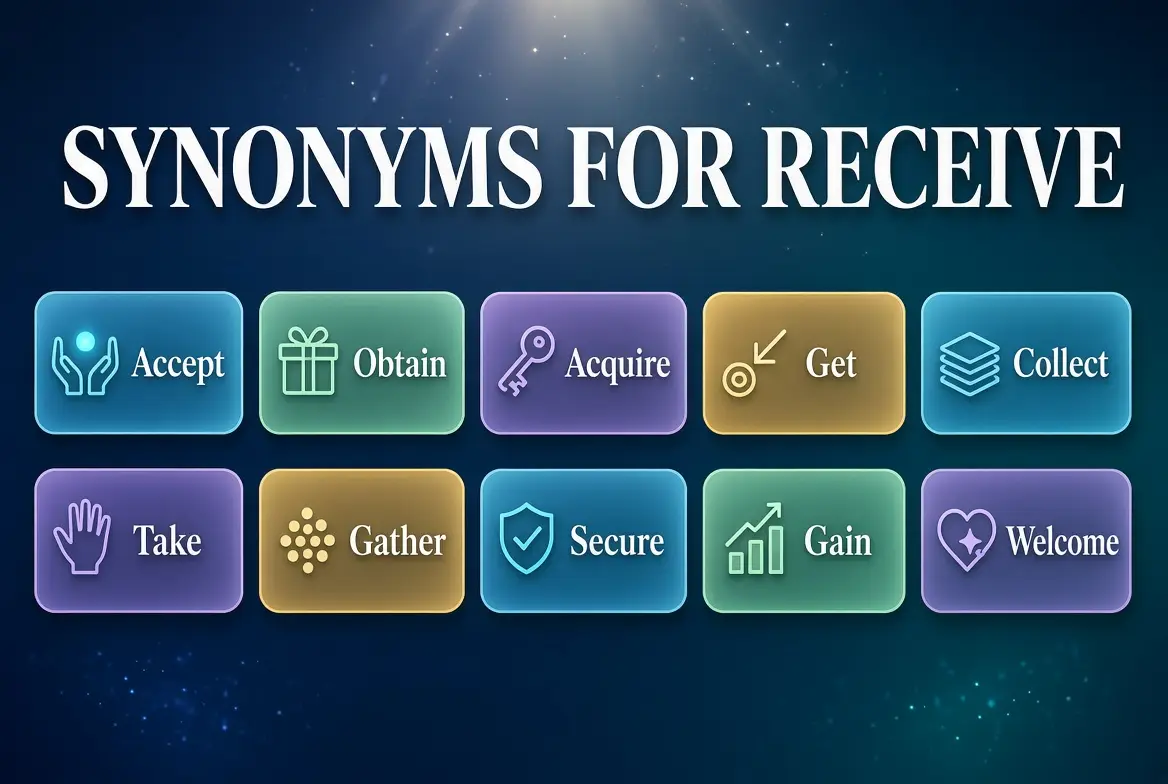
The best synonyms for receive depend on what you mean. Use get for everyday situations, accept when someone willingly takes something, obtain for formal acquisition, collect when picking something up, acquire for gaining something over time, and experience when something happens to you. Other useful alternatives include gain, earn, secure, undergo, suffer, welcome, greet, admit, and pick up.
What Does Receive Mean?
Receive usually means to get something that someone gives, sends, or provides to you.
For example:
I received your email this morning.
But receive has several other meanings. You can receive an injury, receive criticism, receive guests, receive a signal, or say that a movie was well received.
That is why choosing a synonym requires more than looking at a thesaurus list. The replacement must match the exact meaning.
Cambridge labels the basic “get or be given something” sense of “receive ” as A2 and also records uses involving welcoming guests and reacting to something.
Receive Pronunciation
IPA: /rɪˈsiːv/
Pronounced: ri-SEEV
The stress falls on the second syllable.
British and American English use the same basic pronunciation. Cambridge gives /rɪˈsiːv/ for both varieties.
Spelling Tip
The correct spelling is:
receive
Not:
recieve ❌
A useful memory trick is:
i before e, except after c
So:
re + cei + ve = receive
Part of Speech
Receive is a verb.
Main Forms
| Form | Example |
| Base form | receive |
| Third person | receives |
| Past tense | received |
| Past participle | received |
| -ing form | receiving |
Word Family
- receive — verb
- receiver — noun
- receipt — noun
- reception — noun
- receivable — adjective
The Main Meanings of Receive
Before learning synonyms, understand these major uses.
1. Get Something
I received a package.
Meaning: The package was sent or given to me.
2. Experience Something
He received a serious injury.
Meaning: The injury happened to him.
3. Welcome Someone
The host received the guests warmly.
Meaning: The host welcomed them.
4. React to Something
Her idea was well received.
Meaning: People reacted positively to it.
5. Receive a Signal
The phone cannot receive a signal here.
Meaning: The device picks up a transmitted signal.
6. Receive Something in Sports
The player received the ball near the goal.
Meaning: The player caught or controlled the ball.
These different meanings explain why there is no single perfect synonym for receive. Cambridge and Collins both separate these senses in their dictionary and thesaurus entries.
Synonyms for Receive at a Glance
| Word | Best meaning | Register | Frequency |
| get | receive something generally | Neutral / spoken | Very common |
| accept | willingly take something | Neutral | Very common |
| obtain | get through effort or process | Formal | Common |
| acquire | gain possession or knowledge | Formal | Common |
| collect | pick up something | Neutral | Very common |
| take | take something offered | Neutral | Very common |
| gain | obtain a benefit or advantage | Neutral / formal | Common |
| secure | successfully obtain something | Business / formal | Common |
| earn | receive because of work or merit | Neutral / professional | Very common |
| experience | have something happen to you | Neutral | Very common |
| undergo | go through a process | Formal / academic | Common |
| suffer | experience something harmful | Neutral | Common |
| sustain | receive injury or damage | Formal | Less common |
| encounter | meet or experience something | Formal | Common |
| welcome | receive someone warmly | Neutral | Very common |
| greet | receive someone with a greeting | Neutral | Common |
| admit | allow someone to enter | Formal | Common |
| accommodate | provide space for someone | Formal / business | Common |
| meet | come together with someone | Neutral | Very common |
| pick up | collect something | Informal / spoken | Very common |
| come by | obtain something | Informal | Common |
| get hold of | successfully obtain/contact | Informal | Common |
| bear | endure something | Formal / literary | Common |
| take in | admit or accommodate | Neutral | Common |
Important: These are not interchangeable in every sentence. The “best” synonym depends on the sense of “receive.
1. Get
Meaning: To receive or come to have something.
Example:
I got your message this morning.
She got a birthday present from her brother.
Register: Neutral / informal
CEFR: A1–A2
Frequency: Very common
Common collocations:
- get a message
- get a gift
- get an email
Nuance: Get is the closest everyday replacement for many uses of receive.
When not to use it: Avoid it when you need a highly formal style.
2. Accept
Meaning: To willingly take something that someone offers.
Examples:
She accepted the award with a smile.
He accepted the invitation.
Register: Neutral
CEFR: B1
Frequency: Very common
Common collocations:
- accept an offer
- accept an invitation
- accept a gift
Nuance: Accept shows willingness. Receiving does not always show willingness.
Compare:
I received the invitation.
I accepted the invitation.
The first tells us it arrived. The second tells us I agreed to it.
When not to use it: Do not use accept simply because something arrived.
3. Obtain
Meaning: To get something, often through a process or effort.
Examples:
She obtained permission from the manager.
The researchers obtained useful data.
Register: Formal / academic
CEFR: B2
Frequency: Common
Common collocations:
- obtain permission
- obtain information
- obtain approval
Nuance: Obtain often sounds more formal than get.
When not to use it: “I obtained your text” sounds unnecessarily formal in normal conversation.
4. Acquire
Meaning: To gain possession, knowledge, skills, or another quality.
Examples:
He acquired valuable skills during the course.
The company acquired a smaller business.
Register: Formal / academic / business
CEFR: B2
Frequency: Common
Common collocations:
- acquire skills
- acquire knowledge
- acquire property
Nuance: Acquire often suggests gaining something over time or through action.
When not to use it: Do not use it for every simple delivery.
5. Collect
Meaning: To pick something up or gather things.
Examples:
I collected the package from the post office.
She collected the documents from reception.
Register: Neutral
CEFR: A2–B1
Frequency: Very common
Common collocations:
- collect a package
- collect payment
- collect information
Nuance: Collect usually suggests that you go somewhere or take action to get something.
When not to use it: If someone sends a package directly to your home, receiving is usually more natural.
6. Take
Meaning: To accept or take possession of something.
Examples:
He took the document from the desk.
Please take a copy before you leave.
Register: Neutral
CEFR: A1
Frequency: Very common
Nuance: Take focuses on the action of taking something.
When not to use it: It does not replace receive in every context.
7. Gain
Meaning: To obtain something useful, valuable, or beneficial.
Examples:
She gained valuable experience during her internship.
The organization gained public support.
Register: Neutral / formal
CEFR: B1
Frequency: Common
Common collocations:
- gain experience
- gain support
- gain knowledge
Nuance: Gain often suggests a positive result.
When not to use it: You cannot normally say “I gained an email.”
8. Secure
Meaning: To successfully obtain something, often after effort.
Examples:
The company secured new funding.
She secured a place at the university.
Register: Formal / business
CEFR: B2
Frequency: Common
Common collocations:
- secure funding
- secure a contract
- secure a position
Nuance: It suggests successful acquisition.
When not to use it: It is not a natural replacement for ordinary messages or letters.
9. Earn
Meaning: To receive something because of work, effort, or behavior.
Examples:
She earned the respect of her colleagues.
He earned a promotion after years of hard work.
Register: Neutral / professional
CEFR: B1
Frequency: Very common
Nuance: Earn implies that something was deserved or achieved through effort.
When not to use it: Do not say “I earned a birthday card” unless you specifically mean you deserved it.
10. Experience
Meaning: To have something happen to you.
Examples:
Many students experience stress before exams.
She experienced a major change in her career.
Register: Neutral
CEFR: B1
Frequency: Very common
Common collocations:
- experience problems
- experience change
- experience difficulties
Nuance: Use experience for events, feelings, situations, and problems.
When not to use it: It does not normally replace receive for physical objects.
11. Undergo
Meaning: To go through a process, especially one that is difficult, medical, or formal.
Examples:
The patient underwent treatment.
The building is undergoing repairs.
Register: Formal / academic
CEFR: C1
Frequency: Common in formal writing
Common collocations:
- undergo treatment
- undergo surgery
- undergo testing
Nuance: Undergo emphasizes the process.
When not to use it: Do not use it for ordinary things such as receiving a letter.
12. Suffer
Meaning: To experience something painful, harmful, or unpleasant.
Examples:
The player suffered a serious injury.
The business suffered a major loss.
Register: Neutral
CEFR: B1
Frequency: Common
Common collocations:
- suffer an injury
- suffer a loss
- suffer damage
Nuance: This word carries a clearly negative meaning.
When not to use it: Do not use it for positive things such as awards or gifts.
13. Sustain
Meaning: To suffer or receive an injury, loss, or damage.
Examples:
The driver sustained minor injuries.
The building sustained serious damage.
Register: Formal / professional
CEFR: C1
Frequency: Less common
Common collocations:
- sustain an injury
- sustain damage
- sustain a loss
Nuance: This word is common in formal reports, journalism, and professional contexts.
When not to use it: It sounds unnatural in casual situations.
14. Encounter
Meaning: To meet or experience something, often unexpectedly.
Examples:
We encountered several problems during the journey.
The team encountered unexpected difficulties.
Register: Neutral / formal
CEFR: B2
Frequency: Common
Common collocations:
- encounter problems
- encounter difficulties
- encounter challenges
Nuance: It often suggests that something was unexpected.
When not to use it: Do not use it for ordinary packages or emails.
15. Welcome
Meaning: To receive someone in a friendly way.
Examples:
The school welcomed the new students.
The host welcomed the visitors warmly.
Register: Neutral
CEFR: A2
Frequency: Very common
Common collocations:
- welcome guests
- welcome visitors
- warmly welcome
Nuance: Welcome adds a positive and friendly attitude.
When not to use it: It does not normally mean receiving an object.
16. Greet
Meaning: To meet someone and say hello or show recognition.
Examples:
She greeted the guests at the door.
The manager greeted every customer.
Register: Neutral
CEFR: A2–B1
Frequency: Common
Nuance: Greet focuses on the social interaction when someone arrives.
When not to use it: Do not use it for receiving money, documents, or packages.
17. Admit
Meaning: To allow someone to enter a place, group, or organization.
Examples:
The hospital admitted the patient.
She was admitted to the university.
Register: Formal
CEFR: B2
Frequency: Common
Common collocations:
- admit a patient
- admit a student
- admit someone to a group
Nuance: Admit focuses on permission to enter.
When not to use it: It is not a general synonym for getting something.
18. Accommodate
Meaning: To provide space or a place for someone.
Examples:
The hotel can accommodate 300 guests.
The building can accommodate a large group.
Register: Formal / business
CEFR: C1
Frequency: Common
Nuance: It focuses on providing space, not simply receiving people.
When not to use it: Do not replace “receive an email” with accommodate.
19. Meet
Meaning: To come together with or encounter someone.
Examples:
The manager met the new clients at the airport.
We met our guests outside the restaurant.
Register: Neutral
CEFR: A1
Frequency: Very common
Nuance: Meet is broader than receive.
When not to use it: It does not normally replace receive for objects.
20. Pick Up
Meaning: To collect or get something from a particular place.
Examples:
I picked up the package after work.
She picked up her order from the store.
Register: Informal / spoken
CEFR: A2–B1
Frequency: Very common
Nuance: It usually describes physical collection.
When not to use it: Use collect or obtain instead when formal writing requires a more neutral style.
21. Come By
Meaning: To obtain or get something.
Examples:
Good information can be hard to come by.
She bought the tickets through a friend.
Register: Informal
CEFR: B2
Frequency: Common
Nuance: It often suggests that something was not easy to obtain.
When not to use it: Avoid it in highly formal academic writing.
22. Get Hold Of
Meaning: To successfully obtain something or contact someone.
Examples:
I finally got hold of the documents.
Can you get hold of the manager?
Register: Informal / spoken
CEFR: B2
Frequency: Common
Nuance: It often suggests effort or difficulty.
When not to use it: Avoid it when you need very formal business or academic language.
23. Bear
Meaning: To endure or tolerate something difficult.
Examples:
She could barely bear the pain.
He had to bear the cost himself.
Register: Formal / literary
CEFR: C1
Frequency: Common but context-specific
Nuance: Bear is related to receiving something unpleasant only when the meaning is enduring it.
When not to use it: Never use bear as a general replacement for receiving a package.
24. Take In
Meaning: To allow someone to stay or enter, or to receive someone as a guest.
Examples:
The shelter took in several families.
The hotel takes in guests throughout the year.
Register: Neutral
CEFR: B2
Frequency: Common
Nuance: The exact meaning depends on context.
When not to use it: It does not replace ordinary receive in sentences about emails, payments, or letters.
25. Be Given
Meaning: To have something provided or handed to you.
Examples:
She was given a scholarship.
We were given detailed instructions.
Register: Neutral
CEFR: A2
Frequency: Very common
Nuance: This is often a natural passive alternative to receive.
Compare:
I received a scholarship.
I was given a scholarship.
Both are correct, but the second focuses more on the act of giving.
Receive vs. Get vs. Accept vs. Obtain
This is one of the most important distinctions for English learners.
| Word | Main idea | Example |
| receive | something comes to you | I received an email. |
| get | come to have something | I got an email. |
| accept | willingly take something | I accepted the offer. |
| obtain | successfully get something | I obtained permission. |
Easy Rule
Receive = it comes to you.
Get = you come to have it.
Accept = you agree to take it.
Obtain = you manage to get it.
Receive vs. Earn vs. Gain
These three words often confuse learners.
Receive
She received a bonus.
This only tells us that she got the bonus.
Earn
She earned a bonus.
This suggests that her work or performance led to it.
Gain
She gained valuable experience.
This suggests that she obtained something useful.
Remember
Not every synonym describes the reason you received something.
Receive vs. Experience vs. Suffer
These words become important when they describe something that happens to a person.
He received an injury.
He experienced an injury.
He suffered an injury.
All can work in suitable contexts, but the tone changes.
- receive = neutral
- experience = focuses on what happened
- suffer = emphasizes harm or pain
For formal injury reports, sustain can also be appropriate:
He sustained a shoulder injury.
Register Guide
| Register | Useful alternatives |
| Everyday speech | get, take, pick up |
| Neutral writing | receive, accept, collect, gain |
| Academic | obtain, acquire, undergo, encounter |
| Business | secure, obtain, acquire |
| Professional | obtain, secure, receive, sustain |
| Informal | get, pick up, come by, get hold of |
| Literary | bear |
| Spoken English | get, pick up, take |
American vs. British English
The spelling received is the same in American and British English.
The pronunciation is also essentially the same:
UK: /rɪˈsiːv/
US: /rɪˈsiːv/
Cambridge lists the same pronunciation for both varieties.
There are, however, some specialized differences in usage. Collins records a mainly British legal sense of receiving meaning to deal in stolen goods. It notes a different American usage in that context.
For ordinary English, learners can safely use receive in both American and British English.
Word Origin and First Known Use
Receive comes from Middle English forms related to Anglo-French and Old French receivre, from Latin recipere, meaning “to take.”
Collins dates the English word to approximately 1250–1300.
The Latin root helps explain the modern meaning because the word developed around ideas of taking, accepting, and getting something.
Common Collocations With Receive
Learning collocations can be more useful than memorizing isolated synonyms.
Communication
- receive an email
- receive a message
- receive a letter
- receive a reply
- receive a response
Money and Business
- receive payment
- receive funding
- receive a subsidy
- receive a salary
- receive compensation
Recognition
- receive an award
- receive recognition
- receive praise
- receive an honor
- receive a standing ovation
Help and Services
- receive support
- receive training
- receive treatment
- receive counseling
- receive assistance
Collins lists many of these combinations in its collocation data, including receive a package, receive a reply, receive a request, receive recognition, receive support, and receive training.
Common Mistakes With Receive
Mistake 1: “Receive”
❌ I recieved your email.
✅ I received your email.
Why? The correct spelling is received.
Mistake 2: Using Accept for Every Situation
❌ I accepted an email from my teacher.
✅ I received an email from my teacher.
Why? An email can be received without being accepted.
Mistake 3: Using Obtain for Casual Communication
❌ I obtained your text message.
✅ I got your text message.
Why? Obtain is too formal and unnatural here.
Mistake 4: Using Earn for Everything You Receive
❌ She earned a birthday present.
✅ She received a birthday present.
Why? A birthday present is normally given, not earned.
Mistake 5: Using Experience for Physical Objects
❌ I experienced a package yesterday.
✅ I received a package yesterday.
Why? Experience describes events, situations, feelings, and conditions.
When Should You Keep the Word “Receive”?
Sometimes the best synonym is no synonym at all.
Keep receive when:
- the item was sent to you
- the context is formal but neutral
- you are discussing emails or letters
- you are describing payments
- you are talking about awards
- you are describing services or treatment
- you want to avoid changing the meaning
For example:
We received your application.
This is clear, professional, and natural. There is no need to replace receive simply to avoid repetition.
Mini Practice: Choose the Best Word
Choose from:
receive, accept, obtain, collect, earn
- I ______ your application yesterday.
- She decided to ______ the job offer.
- We need to ______ permission before entering.
- I will ______ the package from the post office.
- He worked hard to ______ the trust of his team.
Answers
- receive
- accept
- obtain
- collect
- earn
Rewrite the Sentence
Replace receive with the most natural alternative.
1. She received valuable experience at the company.
Better:
She gained valuable experience at the company.
2. The company received new funding.
Possible:
The company secured new funding.
3. The nurse received the patient.
Possible:
The nurse admitted the patient.
4. The host received the visitors warmly.
Better:
The host welcomed the visitors warmly.
Notice how the correct replacement changes with the meaning.
Matching Exercise
Match each sentence with the best word.
| Sentence | Word |
| 1. She ___ the invitation. | A. underwent |
| 2. The patient ___ treatment. | B. accepted |
| 3. He ___ valuable experience. | C. gained |
| 4. We ___ the package. | D. collected |
| 5. They ___ the guests. | E. welcomed |
Answers
- B
- A
- C
- D
- E
Antonyms of Receive
The main opposite of receive is:
give
Other opposites depend on the context:
- send
- deliver
- reject
- refuse
- return
- decline
- avoid
For example:
receive a package ↔ send a package
receive an offer ↔ reject an offer
receive a guest ↔ turn away a guest
Related Expressions
On the receiving end
This means being the person affected by something.
She was on the receiving end of several complaints.
Well received
This means people reacted positively to something.
The new book was well received by readers.
Poorly received
This means people reacted negatively.
The proposal was poorly received.
Receive someone into a group
This means formally admitting someone into an organization or group.
He was received into the organization after completing the required process.
Cambridge records are well received as a use in which people react to something in a particular way, while it also records being received for formal membership.
FAQ
What is the most common synonym for receive?
Get is usually the most common everyday alternative to receive. For example, “I received your message” can become “I got your message.” However, get is broader and more informal, so receive may be better in professional or formal writing.
What is a formal synonym for receive?
Obtain, acquire, and secure can be formal alternatives when their meanings fit. Obtain often suggests getting something through a process, acquire suggests gaining possession or knowledge, and secure often suggests successfully obtaining something through effort.
Is accept a synonym for receive?
Accept overlaps with receive, but the two words are not identical. Receive means something comes to you, while acceptance normally shows that you willingly take or agree to something. You can receive an invitation without accepting it.
What is the synonym of receive in an email?
For everyday English, get is the simplest alternative: “I got your email.” In professional writing, “receive ” is often the most natural choice: “We received your email.” Obtain and acquire are usually unnatural in this context.
What is the difference between receive and obtain?
Receive usually means something is given, sent, or provided to you. Obtain means you successfully get something, often through effort or a formal process. For example, you can “receive a certificate” but “obtain permission.”
What is the difference between receive and accept?
Receive describes getting something. Accept describes willingly taking or agreeing to something. For example, “She received the offer” means the offer reached her, while “She accepted the offer” means she agreed to it.
What is the opposite of receive?
The main opposite of receive is give. Depending on the sentence, send, deliver, reject, refuse, return, or turn away may also express an opposite idea.
What are the best synonyms for receive in formal writing?
Useful formal alternatives include obtain, acquire, secure, undergo, sustain, and experience, but each has a different meaning. For example, obtain permission, secure funding, undergo treatment, and sustain an injury. Do not substitute them for receiving automatically.
Vocabulary Quiz
1. Which word is the best everyday synonym for “receive”?
A. Obtain
B. Get
C. Acquire
D. Secure
2. Which word means willingly to take an offer?
A. Experience
B. Accept
C. Collect
D. Encounter
3. Which sentence uses “obtain” correctly?
A. I obtained an email from my friend.
B. She obtained permission to enter.
C. He obtained his birthday gift.
D. We obtained a greeting.
4. Which word best fits this sentence?
The patient ______ treatment for several weeks.
A. greeted
B. collected
C. underwent
D. earned
5. Which word best describes gaining something through work or effort?
A. Earn
B. Receive
C. Meet
D. Greet
Answer Key
- B — Get
- B — Accept
- B — She obtained permission to enter.
- C — Underwent
- A — Earn
Final Takeaway
The best synonyms for receive depend on the meaning of the sentence. Get works well in everyday English, accept shows willingness, obtain suggests a formal process, acquire often describes gaining something over time, and collect means picking something up. For experiences, use words such as experience, undergo, suffer, or sustain when appropriate.
Do not replace receive just to avoid repetition. Good vocabulary means choosing the most accurate word, not simply choosing a more difficult one. Practice these differences in your emails, essays, conversations, and professional writing, and your English will become more natural and precise.
References
- Cambridge Dictionary: receive and its meanings.
- Cambridge English Thesaurus: receive synonyms grouped by sense.
- Collins English Dictionary: receive, etymology, meanings, and collocations.
- Collins English Thesaurus: British and American synonym groupings.
- Thesaurus.com: receive synonym and sense coverage.

Synonorm is a trusted English vocabulary resource created to help readers find the right words and understand the differences between similar terms. We provide clear explanations of synonyms, meanings, examples, usage, and alternatives. Our content makes vocabulary easier to learn and apply in everyday, academic, and professional English. Synonorm is designed for students, writers, ESL learners, professionals, and anyone who wants to improve their English vocabulary and communicate more clearly.