Quick Answer
The best synonyms for treats depend on what the word means in your sentence. For pleasure, use delights, entertains, pleases, or thrills. For dealing with something, use handles, manages, or addresses. For medical care, use cares for or medicates in the right context. For paying for someone, use takes out or pays for.
Introduction
What is another word for treats?
The answer depends on the meaning. This small word has several different uses, which is why choosing a synonym can be tricky. A sentence such as “The movie treats viewers to beautiful music” is about enjoyment. But “The doctor treats patients” is about medical care.
Treats can also mean behaving toward someone, dealing with a subject, paying for something, processing a material, or refers to enjoyable things such as sweets and pet snacks. Cambridge separates these meanings rather than treating them as one general definition.
This guide shows the most useful synonyms for treats by meaning. You will also find pronunciation, grammar, CEFR levels, register labels, collocations, connotations, common mistakes, and examples. This makes it useful for ESL learners, students, teachers, writers, bloggers, and professionals.
Pronunciation of Treats
IPA: /triːts/
Pronounced: “treets”
The spelling and standard pronunciation are the same in American and British English.
What Part of Speech Is “Treats”?
Treats can be either a verb or a plural noun.
Treats as a verb
It is the third-person singular form of treat.
She treats everyone with respect.
The doctor treats patients with the new medicine.
My uncle treats us to dinner.
Treats as a noun
It is the plural form of treat.
The children received several sweet treats.
The dog gets small treats after training.
The concert was one of the best treats of the summer.
Cambridge identifies noun senses including something special and enjoyable, food eaten outside regular meals, food given to pets as a reward, and an occasion when someone pays for another person.
The Main Meanings of “Treats”
Before choosing a synonym, identify the meaning.
| Meaning | Example | Useful alternatives |
| Give pleasure | The show treats viewers to great music. | delights, pleases, entertains |
| Behave toward | She treats everyone fairly. | regards, handles, deals with |
| Deal with a subject | The book treats the topic carefully. | discusses, covers, examines |
| Give medical care | Doctors treat patients. | care for, medicate |
| Pay for someone | He treats us to dinner. | pays for, takes out |
| Process or protect | The wood is treated with oil. | processes, applies, coats |
| Something enjoyable | Ice cream is a treat. | pleasure, delight |
| Special food | The children received treats. | sweets, goodies, snacks |
| Pet food | The dog received treats. | rewards, snacks |
This sense-based approach is important because dictionary sources themselves divide treat into separate meanings.
Synonyms for Treats: Quick Comparison
| Synonym | Meaning | CEFR | Register | Frequency |
| delights | gives great pleasure | B1 | Neutral | Common |
| pleases | gives satisfaction or pleasure | A2 | Neutral | Very common |
| entertains | provides amusement | B1 | Neutral | Very common |
| thrills | gives strong excitement | B1 | Neutral | Common |
| satisfies | fulfills a need or desire | B2 | Neutral | Very common |
| rewards | gives something for achievement | B1 | Neutral | Very common |
| indulges | allows special pleasure | B2 | Neutral | Common |
| pampers | gives extra comfort | B2 | Informal | Common |
| handles | deals with something | B1 | Neutral | Very common |
| manages | deals with something successfully | B1 | Neutral | Very common |
| regards | considers someone/something | B2 | Formal | Common |
| discusses | talks or writes about a subject | B1 | Neutral | Very common |
| covers | includes or deals with a subject | B1 | Neutral | Very common |
| examines | studies carefully | B2 | Academic | Very common |
| addresses | deals with an issue | B2 | Formal/Academic | Common |
| cares for | looks after someone | B1 | Neutral | Common |
| medicates | gives medicine | C1 | Medical | Uncommon |
| pays for | gives money for something | A2 | Neutral | Very common |
| takes out | pays for someone’s outing | B1 | Informal | Common |
| processes | puts through a process | B2 | Technical | Very common |
| coats | covers with a layer | B1 | Technical | Common |
Choose the Right Synonym
The easiest way to choose correctly is to ask:
What does “treats” mean in my sentence?
If it means “gives pleasure”
Choose:
pleases → delights → entertains → thrills
Example:
The performance delights the audience.
If it means “deals with”
Choose:
handles → manages → addresses → deals with
Example:
The manager handles customer complaints.
If it means “talks about a subject”
Choose:
discusses → covers → examines → addresses
Example:
The article covers the causes of climate change.
If it means “gives medical care”
Choose:
cares for → medicates
Example:
The hospital cares for injured patients.
If it means “pays for someone”
Choose:
pays for → takes out
Example:
My sister took me out for lunch.
If it means “processes or protects material”
Choose:
processes → coats → applies
Example:
The factory processes the material before use.
Detailed Synonyms for Treats
1. Pleases
Meaning: Makes someone feel happy or satisfied.
CEFR: A2
Register: Neutral
Frequency: Very common
Connotation: Positive
Examples:
- The simple gift pleased her greatly.
- The teacher’s kind feedback pleased the student.
Common collocations:
- pleases customers
- pleases the audience
- pleases the eye
Best Used When: You simply mean “makes someone happy.”
When Not to Use: Do not use it when treats means medical care or processing.
2. Delights
Meaning: Gives someone a strong feeling of happiness or pleasure.
CEFR: B1
Register: Neutral
Frequency: Common
Connotation: Warm and strongly positive
Examples:
- The colorful performance delights young children.
- Fresh flowers delight many visitors.
Collocations:
- delights audiences
- delights customers
- delights children
Best Used When: The enjoyment is especially strong.
Nuance: Delights are usually stronger and more expressive than pleasures.
3. Entertains
Meaning: Gives people amusement or enjoyment.
CEFR: B1
Register: Neutral
Frequency: Very common
Examples:
- The comedian entertains the audience with clever jokes.
- The story entertains readers from beginning to end.
Collocations:
- entertain guests
- entertain an audience
- entertain readers
When Not to Use: It is not a general replacement for medical or respectful treatment.
4. Thrills
Meaning: Gives someone a strong feeling of excitement.
CEFR: B1
Register: Neutral
Frequency: Common
Examples:
- The roller coaster thrills visitors every day.
- The final scene thrilled movie fans.
Best Used When: The enjoyment includes excitement or suspense.
Nuance: Thrill is stronger and more exciting than ordinary please.
5. Satisfies
Meaning: Gives someone what they need, want, or expect.
CEFR: B2
Register: Neutral
Frequency: Very common
Examples:
- A healthy breakfast satisfies your hunger.
- The new service satisfies customer needs.
Collocations:
- satisfies a need
- satisfies demand
- satisfies customers
When Not to Use: Avoid it if the main idea is entertainment rather than fulfillment.
6. Rewards
Meaning: Gives someone something because of good work, achievement, or behavior.
CEFR: B1
Register: Neutral
Frequency: Very common
Examples:
- The company rewards employees for excellent work.
- She rewarded herself with a quiet weekend.
Nuance: A reward normally has a reason behind it.
7. Indulges
Meaning: Allows someone to enjoy something special or enjoyable.
CEFR: B2
Register: Neutral
Frequency: Common
Examples:
- Her grandparents indulge the children with occasional gifts.
- He indulges himself with expensive coffee on weekends.
Connotation: It can suggest enjoying something more than usual.
When Not to Use: Do not use it for ordinary necessities.
8. Pampers
Meaning: Gives someone extra comfort, attention, or luxury.
CEFR: B2
Register: Informal/Neutral
Frequency: Common
Examples:
- The resort pampers guests with personal service.
- Her family pampers the new puppy.
Nuance: Pamper suggests unusually generous care.
9. Handles
Meaning: Deals with a person, problem, or situation.
CEFR: B1
Register: Neutral/Business
Frequency: Very common
Examples:
- She handles difficult customers calmly.
- The support team handles complaints quickly.
Best Used When: Treats means “deals with.”
When Not to Use: Do not use handles to mean giving pleasure.
10. Manages
Meaning: Deals with something successfully.
CEFR: B1
Register: Neutral/Business
Frequency: Very common
Examples:
- He manages customer requests efficiently.
- The team manages the problem without outside help.
Nuance: Manages often suggest control or successful handling.
11. Regards
Meaning: Consider someone or something in a particular way.
CEFR: B2
Register: Formal
Frequency: Common
Examples:
- The company regards safety as a priority.
- Many readers regard the book as valuable.
Common pattern:
regard + object + as + noun/adjective
They regard her as an expert.
When Not to Use: It cannot replace every meaning of treat.
12. Discusses
Meaning: Talks or writes about a subject.
CEFR: B1
Register: Neutral/Academic
Frequency: Very common
Examples:
- The article discusses the causes of stress.
- The final chapter discusses several possible solutions.
Best Used When: Treats means “deals with a topic in writing or speech.”
13. Covers
Meaning: Includes or deals with a subject.
CEFR: B1
Register: Neutral/Academic
Frequency: Very common
Examples:
- The course covers basic grammar.
- The report covers three important issues.
Nuance: Covers often suggest that a subject is included rather than examined deeply.
14. Examines
Meaning: Study something carefully.
CEFR: B2
Register: Academic/Formal
Frequency: Very common
Examples:
- The study examines changes in language use.
- The article examines the causes of the problem.
Best Used When: You want to show careful analysis.
15. Addresses
Meaning: Deals with a problem, question, or issue.
CEFR: B2
Register: Formal/Academic/Business
Frequency: Common
Examples:
- The report addresses the main safety concerns.
- The new policy addresses several customer complaints.
Nuance: Addresses often suggest making an effort to deal with an issue.
16. Cares For
Meaning: Looks after someone who needs help or support.
CEFR: B1
Register: Neutral
Frequency: Common
Examples:
- Nurses care for patients throughout the night.
- She cares for her older people grandmother.
Best Used When: Medical treats means providing care rather than specifically giving medicine.
17. Medicates
Meaning: Gives medicine to someone as part of medical treatment.
CEFR: C1
Register: Medical
Frequency: Uncommon
Example:
The doctor carefully medicated the patient.
Important: Medicate is much narrower than treat. Treatment can include medicine, surgery, therapy, or other methods.
18. Pays For
Meaning: Gives money to cover the cost of something.
CEFR: A2
Register: Neutral
Frequency: Very common
Examples:
- My brother paid for dinner.
- She paid for her friend’s ticket.
Best Used When: Treats means paying for something.
19. Takes Out
Meaning: Takes someone somewhere for food or entertainment, usually paying for the outing.
CEFR: B1
Register: Informal
Frequency: Common
Examples:
- My father takes us out for dinner on Fridays.
- She took her friend out for coffee.
Nuance: This is especially natural in everyday conversation.
20. Processes
Meaning: Handles something through a particular procedure.
CEFR: B2
Register: Technical/Business
Frequency: Very common
Examples:
- The factory processes recycled plastic.
- The computer processes thousands of records each minute.
Best Used When: Treats refers to changing or handling material or information through a process.
21. Coats
Meaning: Covers something with a layer of another substance.
CEFR: B1
Register: Neutral/Technical
Frequency: Common
Examples:
- Workers coat the metal with a protective material.
- The baker coats the strawberries with chocolate.
Nuance: This is a specific physical meaning, not a general synonym for treats.
22. Applies
Meaning: Puts something onto a surface or uses a method.
CEFR: B1
Register: Neutral/Formal
Frequency: Very common
Examples:
- The nurse applies the cream to the wound.
- The technician applies a protective layer.
Best Used When: The original meaning involves putting a substance onto something.
Synonyms for “Treats” as a Noun
The noun treat needs a separate approach.
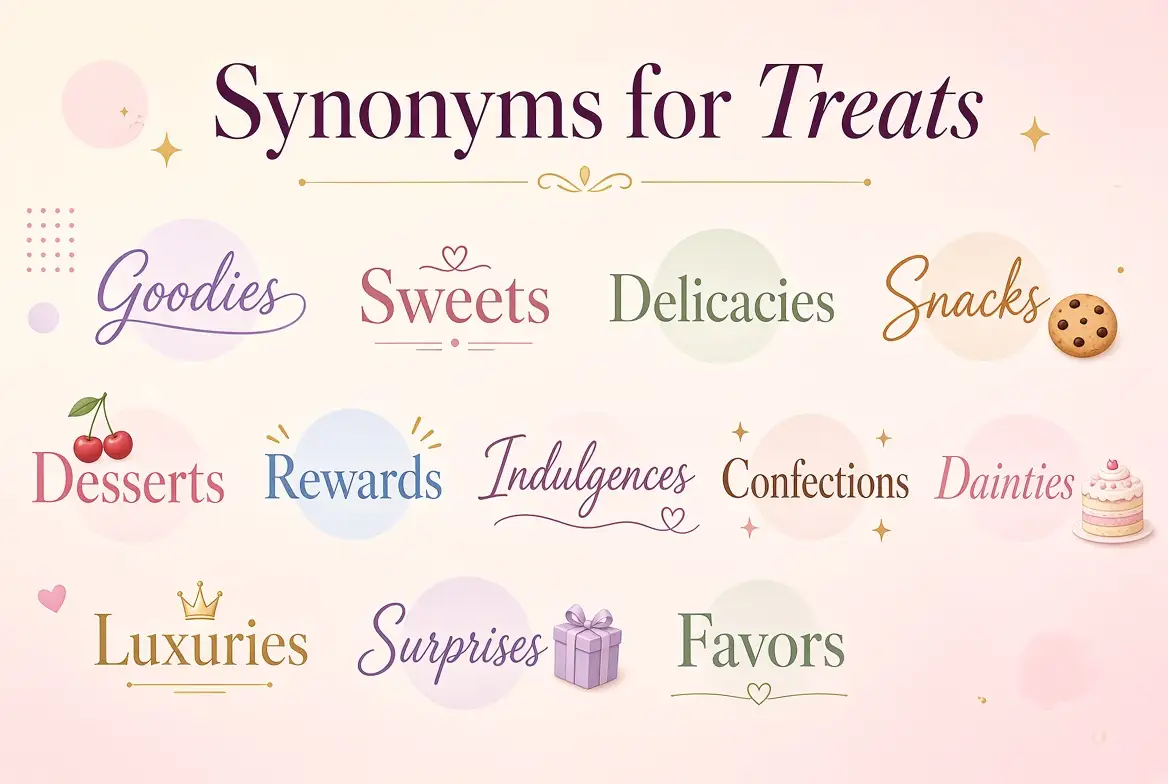
When “treats” means enjoyable things
Useful alternatives include:
- pleasures
- delights
- indulgences
- goodies
- special experiences
When “treats” means food
Useful alternatives include:
- sweets
- goodies
- snacks
- delicacies
- desserts
When “treats” means pet food
Useful alternatives include:
- rewards
- snacks
- goodies
- pet snacks
Do not automatically use desserts for all food treats. A treat can be a cookie, piece of chocolate, fruit, snack, or another special food.
Strongest Synonyms by Meaning
Instead of asking for one strongest synonym, use the group that matches your meaning.
For pleasure
delights → thrills → pleases
For amusement
entertains → amuses
For dealing with a problem
handles → manages → addresses
For discussing a subject
discusses → covers → examines
For medical care
cares for → medicates
For paying
pays for → takes out
For special comfort
indulges → pampers
Commonly Confused Words
| Word | Difference | Example |
| treat | Broad word with several meanings | The doctor treats the patient. |
| reward | Something given for achievement | The teacher rewarded her work. |
| indulge | Allow special pleasure | He indulged himself with cake. |
| pamper | Give extra comfort | The hotel pampers its guests. |
| entertain | Provide amusement | The singer entertained the crowd. |
Treat vs Reward
A treat is something enjoyable or special.
A reward is usually connected to an achievement or good action.
Ice cream is a treat.
The teacher gave him a reward for excellent work.
Treat vs Pamper
To treat someone well is a broad idea.
To pamper someone means giving them extra comfort, attention, or luxury.
Common Mistakes
Common Mistake Box 1
Mistake: The doctor delighted the patient for cancer.
Correction: The doctor treated the patient for cancer.
Explanation: Delight means to give pleasure. Treating can mean providing medical care. Cambridge specifically lists medical treatment as a separate sense.
Common Mistake Box 2
Mistake: Every synonym for treat can replace the word in every sentence.
Correction: Choose a synonym according to the exact meaning.
Explanation: Treat can describe behavior, medical care, payment, processing, and enjoyment.
Common Mistake Box 3
Mistake: “My treat” means “my gift.”
Better explanation: My treat normally means that the speaker will pay for something, such as food or entertainment.
You paid last time. This time, lunch is my treat.
Cambridge records this noun use as an occasion when one person buys or pays for something for another person.
American vs British English
Treats has the same spelling in American and British English.
The pronunciation is also essentially the same:
/triːts/
One useful British expression is:
It works as a treat.
This informal British expression means that something works very well. Cambridge marks this idiomatic use as UK informal.
American speakers are more likely to say:
It works really well.
Word Origin and Etymology
The verb treat entered English through French and ultimately comes from Latin tractare, associated with handling or managing something.
Its modern meanings developed over time. This helps explain why treat can refer to handling a subject, behaving toward a person, providing medical care, and doing something special for someone.
The noun later developed senses connected with special enjoyment and pleasurable experiences.
Because the word has developed several related senses, it is better to understand its meaning in context than to search for one universal replacement.
Frequency and CEFR Guide
CEFR levels are approximate and can vary between vocabulary systems.
| Word | CEFR | Frequency | Best Context |
| please | A2 | Very common | Daily English |
| pay for | A2 | Very common | Everyday speech |
| entertain | B1 | Very common | Shows, people, media |
| reward | B1 | Very common | Achievement |
| handle | B1 | Very common | Problems/work |
| manage | B1 | Very common | Work/problems |
| delight | B1 | Common | Pleasure |
| discuss | B1 | Very common | School/work |
| cover | B1 | Very common | Topics |
| care for | B1 | Common | People/animals |
| satisfy | B2 | Very common | Needs/desires |
| indulge | B2 | Common | Pleasure |
| pamper | B2 | Common | Luxury |
| regard | B2 | Common | Formal opinions |
| address | B2 | Common | Issues/problems |
| examine | B2 | Very common | Academic writing |
| process | B2 | Very common | Technical contexts |
| medicate | C1 | Uncommon | Medical contexts |
Register Guide
Everyday Spoken English
Use:
- please
- give
- pay for
- take out
- entertain
- reward
Academic English
Use:
- examine
- discuss
- address
- consider
- cover
Business English
Use:
- handle
- manage
- address
- process
- regard
Medical English
Use:
- treat
- care for
- medicate
Informal English
Use:
- take out
- pamper
- spoil
- indulge
Choosing a synonym with the right register can make your English sound much more natural.
Real-World Collocations
Native speakers often use treat with certain words and structures.
With people
- treat someone well
- treat someone badly
- treat someone fairly
- treat someone with respect
- treat someone like family
With topics
- treat a subject seriously
- treat an issue carefully
- treat a question separately
With medical conditions
- treat an illness
- treat a disease
- treat a symptom
- treat an injury
With payment
- treat someone to dinner
- treat yourself to something
- it’s my treat
With materials
- treat wood with chemicals
- treat metal with a coating
- treat material to prevent damage
These patterns are more useful for learners than simply memorizing a long list of isolated synonyms. Cambridge’s learner and business dictionaries also demonstrate structures such as treat someone as, treat someone with, treat something with, and treat someone to something.
Writing Tips
Essays
Instead of repeating treats, choose a precise academic verb.
The article examines the effects of social media.
The final section discusses possible solutions.
Emails
Use direct business vocabulary.
Our support team handles customer complaints.
Blog Posts
Use natural verbs that match the subject.
This guide covers the most common mistakes.
Stories
Use expressive vocabulary.
The surprise delighted the children.
Professional Communication
Choose words such as:
- handles
- manages
- addresses
- examines
- processes
Daily Conversation
Simple words are often better:
My brother paid for dinner.
My parents took us out for lunch.
Related Vocabulary
Antonyms
The opposite depends on the meaning.
For positive treatment:
- mistreat
- abuse
- neglect
- harm
For dealing with something:
- ignore
- neglect
- avoid
For enjoyment:
- disappoint
- upset
For providing care:
- neglect
- abandon
There is no single antonym for all uses of treat.
Related Expressions
- treat yourself
- treat someone to dinner
- special treat
- tasty treat
- sweet treats
- dog treats
- a rare treat
- my treat
- treat someone well
- treat someone badly
- treat something seriously
- treat something as important
Mini Practice Exercises
Fill in the Blanks
Choose the best word.
1. The comedian ______ the audience with jokes.
A. medicated
B. entertained
C. processed
D. coated
2. The manager ______ customer complaints professionally.
A. handles
B. thrills
C. pampers
D. pleases
3. The hospital ______ patients with serious injuries.
A. delights
B. entertains
C. treats
D. rewards
4. My sister ______ me to lunch yesterday.
A. examined
B. took
C. coated
D. regarded
5. The study ______ the effects of sleep deprivation.
A. pampers
B. examines
C. entertains
D. spoils
Answers
- B. entertained
- A. handles
- C. treats
- B. took
- B. examines
Sentence Rewriting Practice
Replace treats with a more precise word.
1.
The movie treats the audience to an exciting ending.
Possible answer:
The movie thrills the audience with an exciting ending.
2.
The report treats the issue in detail.
Possible answer:
The report examines the issue in detail.
3.
The manager treats customer complaints professionally.
Possible answer:
The manager handles customer complaints professionally.
4.
The hotel treats its guests to luxury services.
Possible answer:
The hotel pampers its guests with luxury services.
Matching Activity
Match each word with its best meaning.
| Word | Meaning |
| 1. delight | A. study carefully |
| 2. handle | B. give great pleasure |
| 3. examine | C. deal with |
| 4. reward | D. give something for achievement |
| 5. pamper | E. give extra comfort |
Answer Key:
1-B
2-C
3-A
4-D
5-E
FAQ: Synonyms for Treats
What is the best synonym for treats?
There is no single best synonym because treats has several meanings. Delights works for pleasure, handles works for dealing with something, cares for works for looking after someone, and takes out work when someone pays for an outing.
What are synonyms for treats meaning “gives pleasure”?
Useful choices include pleasures, delights, entertains, and thrills. Pleases is general, delights suggests strong pleasure, entertainment focuses on amusement, and thrills suggests excitement.
What is another word for treats in medical English?
Depending on the context, use cares for or medicates. Cares focus on looking after a patient, while medicates specifically involve giving medicine. Neither word replaces treats in every medical sentence.
What is a synonym for treats meaning “deals with”?
Common alternatives include handles, manages, addresses, and deals with. In academic writing, examine or discuss may work when the sentence means that a writer or study deals with a particular subject.
What is another word for treats meaning “pays for”?
The most natural choices are paid for and, in everyday contexts, takes out. For example, “She treats me to dinner” can mean “She pays for my dinner” or “She takes me out for dinner.”
What are synonyms for treats as a noun?
When treats mean enjoyable things, words such as pleasures, delights, and indulgences may work. When it means food, sweets, goodies, snacks, or delicacies may fit depending on the context.
Is “reward” a synonym for “treat”?
Sometimes, but they are not identical. A reward usually follows an achievement, good action, or effort. A treat is simply something special or enjoyable. For example, a cookie can be a treat even when nobody earned it.
Is “pamper” the same as “treat”?
Not exactly. Pamper means giving someone extra comfort, attention, or luxury. It can be a good replacement when treat suggests special care, but it cannot replace treat when the meaning involves medical treatment or discussing a subject.
Final Takeaway
The most important lesson about synonyms for treats is that context matters more than the number of words in a thesaurus. For pleasure, try pleases, delights, entertains, or thrills. For problems and subjects, use handles, manages, discusses, covers, or examines. For medical care, consider cares for or medicates. For payment, use pays for or takes out.
Do not replace treats simply because another word looks similar in a thesaurus. Choose the word that keeps the original meaning, tone, and grammar. That approach will make your essays, emails, conversations, and professional writing clearer and more natural.
References
- Cambridge Dictionary, Treat, including verb and noun meanings, pronunciation, grammar, and examples.
- Cambridge Learner’s Dictionary, Treat, including learner-focused meanings and usage patterns.
- Cambridge Thesaurus, Treat, including context-based related words and synonyms.
- YourDictionary, Treat Synonyms and Antonyms, including meaning-based synonym groups.
- Merriam-Webster Thesaurus, Treat, for synonym groupings such as handle, deal with, regard, and view.

Synonorm is a trusted English vocabulary resource created to help readers find the right words and understand the differences between similar terms. We provide clear explanations of synonyms, meanings, examples, usage, and alternatives. Our content makes vocabulary easier to learn and apply in everyday, academic, and professional English. Synonorm is designed for students, writers, ESL learners, professionals, and anyone who wants to improve their English vocabulary and communicate more clearly.