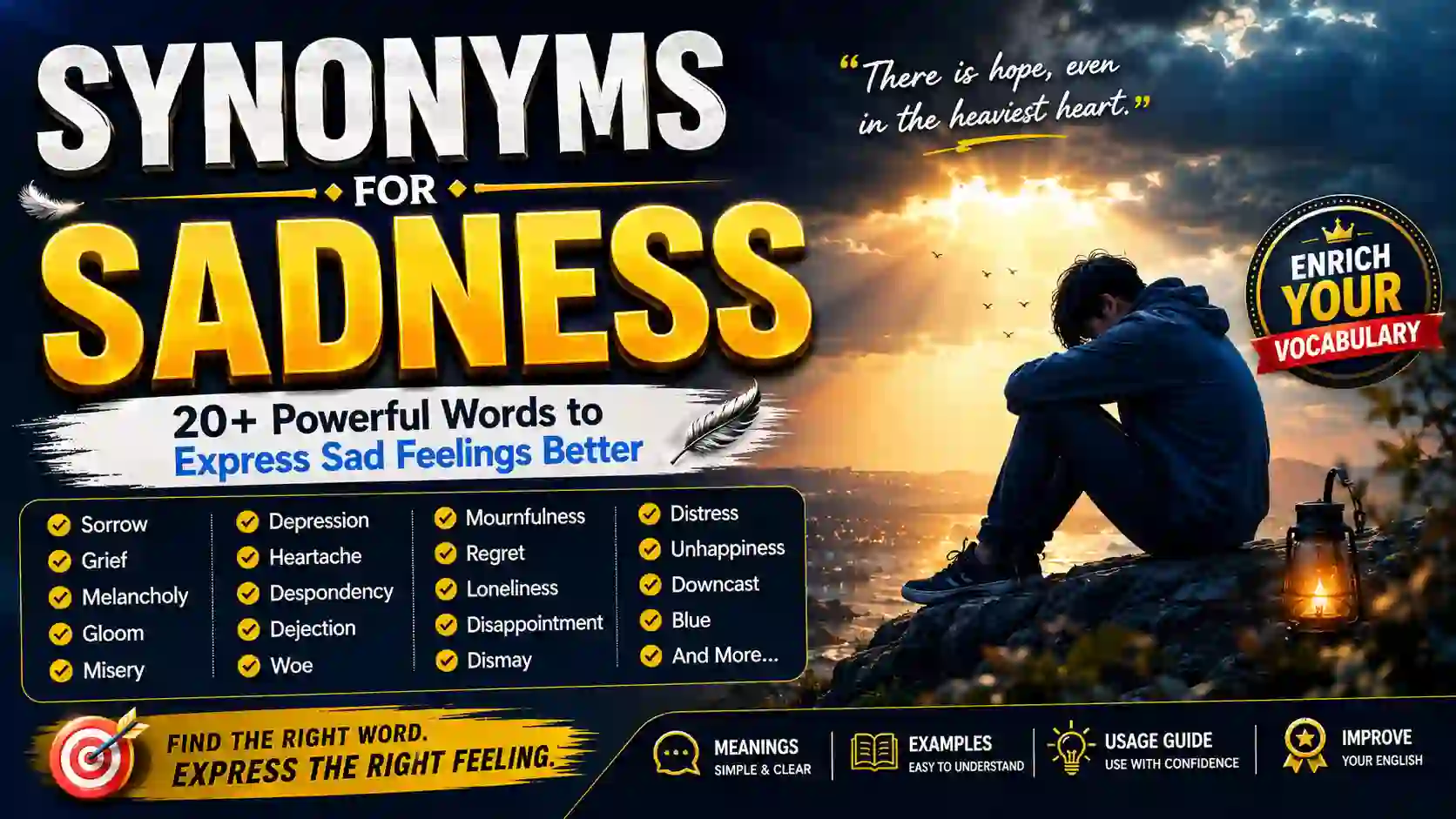
Have you ever written the word sadness several times and felt that your writing sounded repetitive? Or perhaps you wanted a stronger word for deep sadness, but were not sure whether sorrow, grief, melancholy, or despair was the right choice.
The good news is that English has many words connected with sadness, but they do not all mean exactly the same thing. Sorrow often describes deep sadness, grief usually relates to loss, melancholy suggests a quiet or thoughtful sadness, and despair adds a feeling of hopelessness.
This guide explains the most useful synonyms for sadness, including their meanings, strength, tone, CEFR level, common collocations, examples, and situations where you should or should not use them. It is designed for students, ESL learners, teachers, writers, bloggers, and anyone who wants more precise English.
Quick Answer
Common synonyms for sadness include sorrow, grief, melancholy, unhappiness, gloom, dejection, misery, anguish, despair, heartache, and distress. These words are not always interchangeable. The best choice depends on the cause, intensity, and context of the sadness.
Sadness: Pronunciation and Meaning
Word: sadness
IPA: /ˈsæd.nəs/
Pronunciation: SAD-nuhs
Part of speech: Noun
Simple meaning: Sadness is the feeling of being unhappy, upset, or emotionally low.
Examples
- She could not hide her sadness.
- His sadness was clear from his voice.
- The movie left me with a feeling of sadness.
Word Family
The main word forms related to sadness are:
| Word | Part of Speech | Example |
| sad | Adjective | She felt sad. |
| sadness | Noun | His sadness was obvious. |
| sadden | Verb | The news saddened her. |
| saddened | Past participle | He was saddened by the decision. |
| sadly | Adverb | Sadly, the story had a difficult ending. |
A useful grammar point
Sadness is normally an uncountable noun when you mean the general emotion.
Natural:
- She felt deep sadness.
- He was filled with sadness.
- I could hear sadness in her voice.
Less natural:
- She felt sad.
However, a sadness can be used when describing a particular quality or instance of sadness, especially in literary writing:
- There was a quiet sadness in his smile.
Synonyms for Sadness at a Glance
| Word | Main idea | Strength | Register | CEFR |
| Sorrow | Deep sadness | Strong | Neutral/Formal | B2 |
| Grief | Sadness after loss | Very strong | Neutral/Formal | B2 |
| Melancholy | Quiet, reflective sadness | Moderate | Literary | C1 |
| Unhappiness | General lack of happiness | Mild–Moderate | Neutral | B1 |
| Gloom | Dark or depressing mood | Moderate | Neutral | B2 |
| Dejection | Sadness after failure or disappointment | Strong | Formal | C1 |
| Despair | Sadness with loss of hope | Very strong | Neutral/Formal | C1 |
| Misery | Extreme unhappiness | Very strong | Neutral | B2 |
| Anguish | Severe emotional pain | Very strong | Formal/Literary | C1 |
| Distress | Serious emotional suffering | Strong | Neutral/Formal | B2 |
| Heartache | Emotional pain, often from love or loss | Strong | Neutral/Informal | B2 |
| Despondency | Low spirits and loss of confidence | Strong | Formal | C1 |
| Woe | Great sadness or trouble | Strong | Literary | C1 |
| Desolation | Sadness mixed with emptiness or isolation | Very strong | Literary | C1 |
| Mournfulness | Sadness associated with mourning | Strong | Literary | C1 |
Remember: A synonym is not automatically a perfect replacement. Always consider what caused the emotion and how intense it is.
The Most Useful Synonyms for Sadness
1. Sorrow
Meaning: Sorrow is deep sadness, often caused by loss, disappointment, or regret.
Example sentences:
- She felt deep sorrow after losing her father.
- His voice was filled with sorrow.
Best used when: You need a close and flexible synonym for serious sadness.
Tone: Neutral to formal
CEFR: B2
Frequency: Common
Common collocations:
- deep sorrow
- great sorrow
- sorrow and grief
When not to use it: Avoid sorrow for very small problems unless you are using an intentionally dramatic style.
Nuance: Sorrow is usually deeper than ordinary sadness, but it does not necessarily imply hopelessness.
2. Grief
Meaning: Grief is deep sadness caused by a major loss, especially the death of someone.
Example sentences:
- The family was overwhelmed by grief.
- Everyone deals with grief differently.
Best used when: Talking about bereavement or another profound loss.
Tone: Neutral/Formal
CEFR: B2
Frequency: Very common
Common collocations:
- deep grief
- grief after a loss
- process grief
When not to use it: Do not normally use grief for a minor disappointment.
Nuance: Grief is more specific than sadness. Someone can feel sad without experiencing grief.
3. Melancholy
Meaning: Melancholy is a quiet, thoughtful, or lingering feeling of sadness.
Example sentences:
- The old song filled her with melancholy.
- There was a touch of melancholy in his writing.
Best used when: You want to describe reflective or poetic sadness.
Tone: Literary
CEFR: C1
Frequency: Common in writing, less common in everyday speech
Common collocations:
- deep melancholy
- quiet melancholy
- sense of melancholy
When not to use it: Use sadness instead when writing for beginners or speaking in very simple everyday English.
Nuance: Melancholy can sound softer and more reflective than grief or anguish.
4. Unhappiness
Meaning: Unhappiness is a general state of not being happy or satisfied.
Example sentences:
- She could no longer hide her unhappiness at work.
- His unhappiness affected his relationships.
Best used when: Talking about general dissatisfaction or a continuing lack of happiness.
Tone: Neutral
CEFR: B1
Frequency: Common
Common collocations:
- personal unhappiness
- deep unhappiness
- cause of unhappiness
When not to use it: It is not as precise as grief when talking about a serious loss.
Nuance: Unhappiness is broad and often less intense than sorrow.
5. Gloom
Meaning: Gloom is a dark, unhappy, or depressing mood or atmosphere.
Example sentences:
- Gloom filled the house after the bad news.
- His silence added to the gloom.
Best used when: You are describing an atmosphere as well as a person’s mood.
Tone: Neutral/Literary
CEFR: B2
Frequency: Common
Common collocations:
- deep gloom
- atmosphere of gloom
- cloud of gloom
When not to use it: Do not use gloom when you specifically mean grief after a death.
Nuance: Gloom often describes the emotional atmosphere around people, places, or situations.
6. Dejection
Meaning: Dejection is a strong feeling of sadness and discouragement, usually after failure or disappointment.
Example sentences:
- His dejection was obvious after the interview.
- She tried to hide her dejection after losing the match.
Best used when: Someone has lost confidence or feels low after an unsuccessful result.
Tone: Formal
CEFR: C1
Frequency: Uncommon
Common collocations:
- deep dejection
- state of dejection
- feelings of dejection
When not to use it: It may sound too formal for casual conversation.
Nuance: Unlike general sadness, dejection often follows a setback.
7. Despair
Meaning: Despair is extreme sadness combined with a feeling that there is no hope.
Example sentences:
- After months of failure, he fell into despair.
- She refused to give in to despair.
Best used when: Sadness has become closely connected with hopelessness.
Tone: Neutral/Formal
CEFR: C1
Frequency: Common
Common collocations:
- deep despair
- fall into despair
- give in to despair
When not to use it: Do not use despair for ordinary sadness or a small setback.
Nuance: The key idea is loss of hope, not simply feeling unhappy.
8. Misery
Meaning: Misery is extreme unhappiness or suffering.
Example sentences:
- The long period of uncertainty caused great misery.
- He spent years living in misery.
Best used when: You want to emphasize severe unhappiness.
Tone: Neutral
CEFR: B2
Frequency: Common
Common collocations:
- deep misery
- live in misery
- cause misery
When not to use it: It is too strong for mild sadness.
Nuance: Misery often suggests that the person is suffering for an extended period.
9. Anguish
Meaning: Anguish is extreme emotional or mental pain.
Example sentences:
- She cried out in anguish after hearing the news.
- His face showed the anguish he was feeling.
Best used when: The emotional pain is severe.
Tone: Formal/Literary
CEFR: C1
Frequency: Common
Common collocations:
- deep anguish
- emotional anguish
- cry of anguish
When not to use it: Do not use it for ordinary disappointment.
Nuance: Anguish focuses more on intense pain than on sadness itself.
10. Distress
Meaning: Distress is serious emotional suffering, worry, or upset.
Example sentences:
- The news caused considerable distress.
- She was clearly in emotional distress.
Best used when: A situation causes serious emotional difficulty.
Tone: Neutral/Formal
CEFR: B2
Frequency: Common
Common collocations:
- emotional distress
- severe distress
- cause distress
When not to use it: Avoid it when you only mean that someone feels slightly sad.
Nuance: Distress can include fear, worry, upset, or emotional suffering, so it is broader than sadness.
11. Heartache
Meaning: Heartache is deep emotional pain, especially after romantic disappointment or loss.
Example sentences:
- The breakup caused months of heartache.
- The song describes the heartache of losing someone you love.
Best used when: The sadness is personal and strongly connected with love or relationships.
Tone: Neutral/Informal
CEFR: B2
Frequency: Common
Common collocations:
- emotional heartache
- years of heartache
- cause heartache
When not to use it: Avoid it in highly formal academic writing.
Nuance: Heartache is emotional rather than physical and often has a personal or romantic feeling.
12. Despondency
Meaning: Despondency is a state of low spirits, discouragement, and reduced hope.
Example sentences:
- Repeated rejection led to despondency.
- He struggled to overcome his despondency.
Best used when: Someone has become deeply discouraged over time.
Tone: Formal
CEFR: C1
Frequency: Uncommon
Common collocations:
- deep despondency
- state of despondency
- feelings of despondency
When not to use it: It can sound unnatural in casual conversation.
Nuance: Despondency focuses strongly on discouragement and loss of confidence.
13. Woe
Meaning: Woe means great sadness, trouble, or suffering.
Example sentences:
- The poem tells a story of love and woe.
- He spoke about his financial woes.
Best used when: Writing in a literary, dramatic, or slightly old-fashioned style.
Tone: Literary
CEFR: C1
Frequency: Uncommon
Common collocations:
- tales of woe
- personal woes
- great woe
When not to use it: Avoid it in normal professional communication.
Nuance: Woe can refer to both emotional sadness and serious trouble.
14. Desolation
Meaning: Desolation is a deep feeling of sadness, loneliness, and emptiness.
Example sentences:
- The empty house gave him a feeling of desolation.
- She felt a deep sense of desolation after leaving her family.
Best used when: Sadness is mixed with isolation or emotional emptiness.
Tone: Literary
CEFR: C1
Frequency: Uncommon
Common collocations:
- deep desolation
- sense of desolation
- feeling of desolation
When not to use it: It is far too strong for a small disappointment.
Nuance: Desolation combines sadness with a sense that something is empty, abandoned, or emotionally barren.
15. Mournfulness
Meaning: Mournfulness is a quality of being sad or expressing sorrow, especially after a loss.
Example sentences:
- There was mournfulness in her voice.
- The poem has a quiet sense of mournfulness.
Best used when: Describing the emotional quality of a voice, song, poem, or scene.
Tone: Literary
CEFR: C1
Frequency: Rare/Uncommon
Common collocations:
- quiet mournfulness
- air of mournfulness
- tone of mournfulness
When not to use it: Use sadness or sorrow in ordinary conversation.
Nuance: This word is more useful for description than everyday speech.
Direct Synonyms vs. Related Words
This distinction is important.
Some words are close synonyms of sadness, while others describe a particular reason, form, or result of sadness.
Close synonyms
- sorrow
- unhappiness
- melancholy
- gloom
- dejection
- misery
- distress
Related but more specific words
- grief → sadness caused by loss
- despair → sadness with hopelessness
- heartache → emotional pain, often related to love
- loneliness → sadness linked to isolation
- regret → sadness about a past choice or event
- disappointment → sadness caused by an unmet expectation
This distinction makes your writing more accurate.
Choose the Right Synonym for Sadness
| Situation | Best word | Why |
| General emotional sadness | Sadness | Broad and neutral |
| Deep sadness | Sorrow | Close and flexible |
| Death or major loss | Grief | Specifically connected with loss |
| Quiet, reflective sadness | Melancholy | Softer and literary |
| Failure or defeat | Dejection | Suggests discouragement |
| No hope | Despair | Adds hopelessness |
| Severe emotional pain | Anguish | Emphasizes intensity |
| Extreme unhappiness | Misery | Strong and emotional |
| Romantic emotional pain | Heartache | Often linked to love |
| Isolation | Loneliness | Focuses on lack of connection |
| Unmet expectations | Disappointment | Focuses on the result |
| Past mistake | Regret | Focuses on wishing things were different |
Commonly Confused Words
Sadness vs. Grief
Sadness is a broad emotion. Grief is a deeper form of sadness usually associated with significant loss.
- She felt sadness after moving away.
- He experienced grief after his mother’s death.
Sadness vs. Melancholy
Sadness is ordinary and direct. Melancholy often sounds quieter, more reflective, and more literary.
- I felt sadness after the argument.
- The music created a feeling of melancholy.
Sadness vs. Despair
Despair is much stronger because it includes a sense of hopelessness.
- She felt sadness after the rejection.
- He fell into despair after losing all hope.
Sadness vs. Disappointment
Disappointment usually comes from an expectation that was not fulfilled.
- She felt sadness after leaving her friends.
- She felt disappointment when she did not get the job.
Sadness vs. Loneliness
Loneliness focuses on a lack of meaningful social or emotional connection.
A person can be lonely without being completely sad, and a person can be sad while surrounded by people.
Common Mistakes to Avoid
Mistake 1
Wrong: I felt grief because I lost my favorite pen.
Better: I felt disappointed because I lost my favorite pen.
Why: Grief normally describes serious emotional loss.
Mistake 2
Wrong: The exam result caused me to fall into sorrow.
Better: The exam result caused disappointment.
Why: Sorrow is possible in some contexts, but disappointment sounds much more natural for an ordinary academic setback.
Mistake 3
Wrong: I am in melancholy.
Better: I am feeling melancholy.
Why: Melancholy is not normally used within this sentence.
Mistake 4
Wrong: She was in despair because her coffee was cold.
Better: She was annoyed because her coffee was cold.
Why: Despair is extremely strong and suggests hopelessness.
How to Use Sadness Synonyms in Different Types of Writing
In Essays
Use precise vocabulary instead of repeating sad and sadness.
Instead of:
The character is sad because he lost his family. His sadness continues throughout the story.
Try:
The character’s grief shapes his behavior throughout the story.
This is shorter and more precise.
In Stories
Literary words such as melancholy, desolation, and mournfulness can help create atmosphere.
A quiet melancholy followed her as she walked home.
In Emails
Simple vocabulary is usually best.
We received the news with great sadness.
This sounds more natural than using an unnecessarily dramatic word such as anguish.
In Professional Writing
Choose clear and respectful language:
- sadness
- sorrow
- disappointment
- distress
Avoid rare literary words unless the context requires them.
In Social Media
Informal expressions can work well:
- feeling down
- feeling low
- having the blues
- heartache
- feeling sad
American vs. British English
There is no major spelling difference between American and British English for the word sadness.
| Word | American English | British English |
| sadness | sadness | sadness |
| sorrow | sorrow | sorrow |
| grief | grief | grief |
| melancholy | melancholy | melancholy |
| despair | despair | despair |
| anguish | anguish | anguish |
Pronunciation can vary slightly because of regional accents, but the words and their core meanings are the same in both varieties.
The bigger difference is often register and frequency, not spelling. For example, words such as melancholy, woe, and mournfulness are more common in literary writing than in everyday conversation in both varieties of English.
Word Origin: Where Does “Sadness” Come From?
The modern meaning of sadness developed over a long period.
The word comes from Middle English sadnesse, formed from sad plus the noun-forming suffix -ness. Earlier forms of sad did not always mean simply “unhappy.” Historical meanings included ideas such as seriousness and firmness before the emotional sense became dominant.
This is a useful reminder for English learners: word meanings change over time. A word’s modern meaning may be very different from its earliest meaning.
First Known Use
Merriam-Webster records sadness in Middle English, while historical dictionaries trace related forms back to earlier stages of English.
Because dictionary sources can differ slightly in how they define “first known use,” it is safer to treat the date as an approximate historical point rather than an exact birth date for the word.
Related Vocabulary
Antonyms of Sadness
Common opposites include:
- happiness
- joy
- delight
- gladness
- cheerfulness
- pleasure
- contentment
- optimism
- hope
Common Expressions
Native speakers often use these expressions instead of simply saying sad:
- feel down
- feel low
- be in low spirits
- feel blue
- have the blues
- be heartbroken
- be heavy-hearted
- be down in the dumps
Example
Instead of:
I am sad today.
You might naturally say:
I am feeling a little down today.
Word Family
| Word | Meaning |
| Sad | Feeling unhappy |
| Sadness | The state or feeling of being sad |
| Sadden | To make someone sad |
| Saddened | Made sad |
| Sadly | In a sad manner |
Examples
- The news saddened everyone.
- She looked sad.
- His sadness was obvious.
- Sadly, the plan failed.
Mini Practice
Fill in the Blanks
Choose from: grief, melancholy, despair, disappointment, loneliness
- The death of her mother left her with deep ________.
- He felt great ________ when he did not get the job.
- The old photograph created a feeling of ________.
- Years without close friends increased his ________.
- After losing all hope, he fell into ________.
Answers
- grief
- disappointment
- melancholy
- loneliness
- despair
Rewrite the Sentence
Replace the general word sadness with a more precise word.
1. She felt sadness after her husband died.
Better: She felt grief after her husband died.
2. He felt sadness when his application was rejected.
Better: He felt disappointment when his application was rejected.
3. The song created a quiet feeling of sadness.
Better: The song created a quiet feeling of melancholy.
Match the Words
| Word | Meaning |
| 1. Grief | A. Loss of hope |
| 2. Despair | B. Sadness after loss |
| 3. Melancholy | C. Quiet, reflective sadness |
| 4. Disappointment | D. Sadness caused by an unmet expectation |
Answers: 1-B, 2-A, 3-C, 4-D.
Vocabulary Quiz
1. Which word is most appropriate after the death of a loved one?
A. Gloom
B. Grief
C. Disappointment
D. Unhappiness
2. Which word includes the idea of having no hope?
A. Melancholy
B. Despair
C. Loneliness
D. Regret
3. Which word best describes sadness caused by an unmet expectation?
A. Anguish
B. Disappointment
C. Grief
D. Desolation
4. Which word is especially associated with quiet, thoughtful sadness?
A. Melancholy
B. Misery
C. Distress
D. Despair
5. Which word is most strongly associated with severe emotional pain?
A. Anguish
B. Unhappiness
C. Gloom
D. Disappointment
Answer Key
- B. Grief
- B. Despair
- B. Disappointment
- A. Melancholy
- A. Anguish
FAQs About Synonyms for Sadness
What is the best synonym for sadness?
Sorrow is one of the closest general synonyms for sadness. However, there is no single best synonym for every situation. Use grief for major loss, melancholy for quiet reflective sadness, despair for sadness with hopelessness, and disappointment when an expectation has not been met.
What is a stronger word for sadness?
Strong words include sorrow, grief, misery, anguish, despair, and desolation. Each has a different nuance. Anguish emphasizes emotional pain, despair emphasizes hopelessness, and grief usually points to serious loss.
What is a poetic word for sadness?
Melancholy is one of the most useful poetic words for sadness. Other literary choices include woe, desolation, mournfulness, and heaviness. These words work particularly well in poetry, fiction, reflective writing, and descriptive passages.
Is grief a synonym for sadness?
Grief is closely related to sadness, but it is more specific. Grief is a deep emotional response to loss, especially the death of someone. Sadness is broader and can result from many everyday experiences, such as disappointment, loneliness, or separation.
Is melancholy the same as sadness?
Melancholy can mean sadness, but it has a special nuance. It often describes a quiet, thoughtful, or lingering mood rather than a sudden emotional reaction. It also has a more literary feel than the everyday word sadness.
What is the opposite of sadness?
Common opposites of sadness include happiness, joy, gladness, delight, cheerfulness, and contentment. The best antonym depends on the context. Joy suggests strong happiness, while contentment suggests peaceful satisfaction.
What is a synonym for sadness in formal writing?
Good choices include sorrow, grief, distress, dejection, and anguish, depending on the situation. However, formal writing does not always require difficult vocabulary. In many professional contexts, the simple word sadness is clearer and more appropriate.
Are loneliness and sadness synonyms?
Not exactly. Loneliness is a specific emotional experience connected with a lack of meaningful social or emotional connection. It can cause sadness, but the two words are not interchangeable. Someone can feel lonely without feeling deeply sad, and someone can feel sad without being lonely.
Final Takeaway
The best way to learn synonyms for sadness is to learn their differences, not simply memorize a long list. Use sorrow for deep sadness, grief for serious loss, melancholy for quiet or reflective sadness, despair when hope has disappeared, and disappointment when something fails to meet your expectations.
Good vocabulary is not about choosing the biggest or most advanced word. It is about choosing the right word for the exact meaning you want to express. Practice these words in essays, conversations, emails, stories, and everyday writing, and your English will become more natural and precise.
Trusted Reference Sources
- Merriam-Webster Dictionary and Thesaurus
- Cambridge Dictionary
- Oxford English Dictionary
- Collins Dictionary
- Etymonline

Synonorm is a trusted English vocabulary resource created to help readers find the right words and understand the differences between similar terms. We provide clear explanations of synonyms, meanings, examples, usage, and alternatives. Our content makes vocabulary easier to learn and apply in everyday, academic, and professional English. Synonorm is designed for students, writers, ESL learners, professionals, and anyone who wants to improve their English vocabulary and communicate more clearly.