Quick Answer
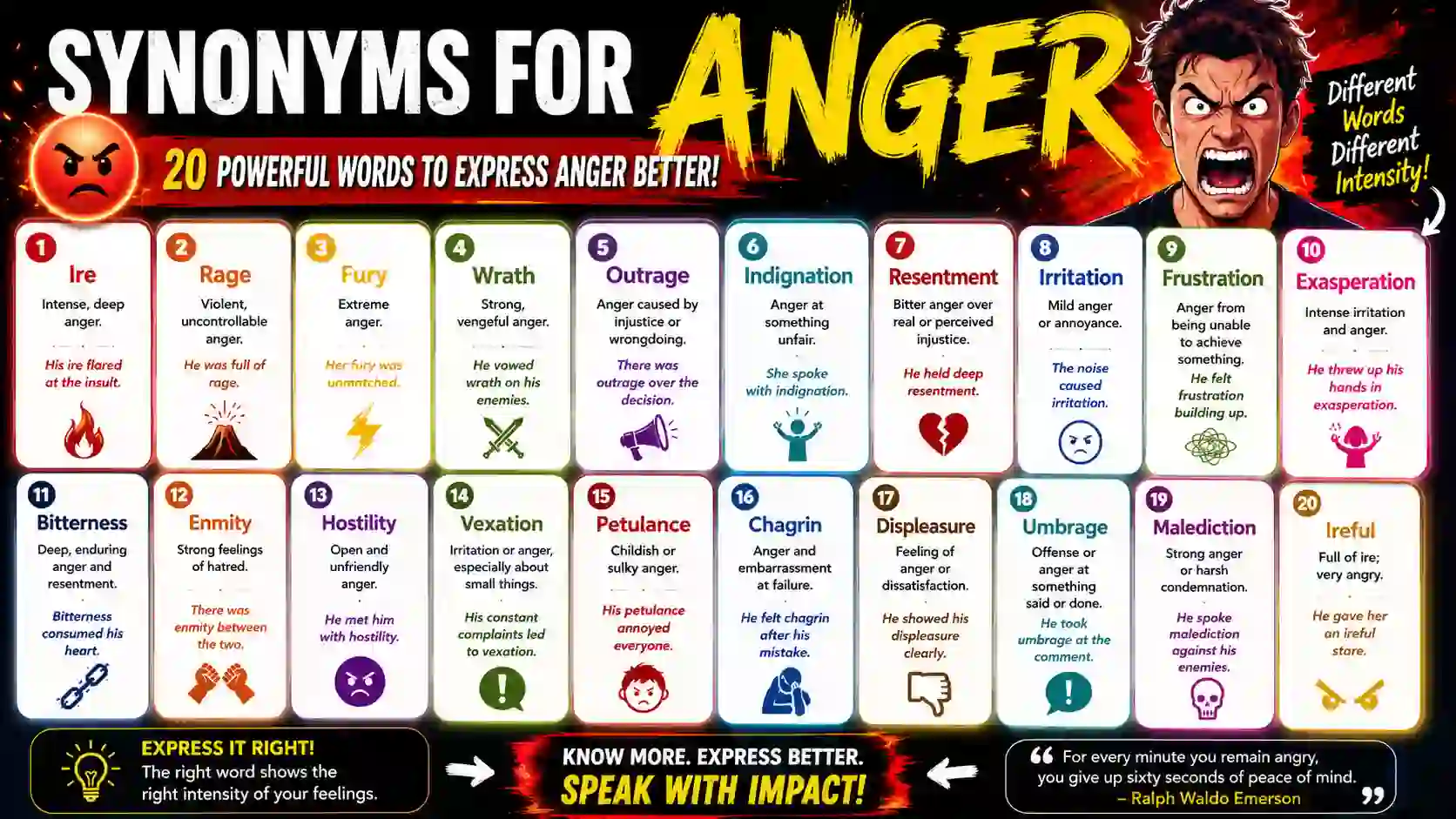
Common synonyms and close alternatives for anger include annoyance, irritation, resentment, indignation, outrage, fury, rage, wrath, ire, exasperation, and vexation. However, these words are not interchangeable in every sentence. Some describe mild irritation, while others suggest extreme emotion, lasting bitterness, moral outrage, or a formal literary tone. The best synonym depends on the intensity, cause, duration, and context of the anger.
What Are the Best Synonyms for Anger?
Imagine that someone keeps interrupting you during an important meeting. You might feel annoyed or irritated.
Now imagine that you have spent hours trying to solve a problem, but nothing works. You may feel frustration.
If someone treats you unfairly for years, you may develop resentment. If you see something deeply unjust, you might feel indignation. And if you become extremely angry and lose control, rage may be the right word.
This is why learning synonyms for anger is more than memorizing a list. Each word carries a slightly different meaning, emotional strength, and tone. Understanding those differences can help students write more precisely, professionals communicate more carefully, and English learners sound more natural.
Pronunciation of Anger
American English: /ˈæŋ.ɡɚ/
British English: /ˈæŋ.ɡə/
Pronounced: ANG-ger
CEFR level: B2
The spelling anger is the same in American and British English.
Part of Speech
Anger can be used as both a noun and a verb.
As a noun
She could not hide her anger.
Here, anger means the feeling of being angry.
As a verb
His careless remark angered her.
Here, angered means “made her angry.”
Related forms
- angry: adjective
- angrily: adverb
- angered: past tense and past participle
- anger: noun and verb
Grammar Usage of Anger
When anger means the general emotion, it is normally an uncountable noun.
Natural examples
- He struggled to control his anger.
- There was growing anger over the decision.
- She spoke in anger.
- His anger was difficult to hide.
Common prepositions
anger at
There was widespread anger at the decision.
anger over
Public anger over the new policy continued to grow.
anger about
She expressed her anger about the unfair treatment.
anger toward/towards
He still felt anger toward his former employer.
Both toward and towards are standard. Toward is particularly common in American English, while towards is very common in British English.
Common mistake
Incorrect: He is angry with his boss.
Better: He is angry with his boss.
Also correct: He feels anger toward his boss.
Quick Comparison: Synonyms for Anger
| Word | Strength | Register | Best Used For |
| Annoyance | Mild | Neutral | Small problems |
| Irritation | Mild | Neutral | Repeated bothers |
| Exasperation | Moderate–Strong | Neutral/Formal | Loss of patience |
| Vexation | Moderate | Formal/Literary | Annoying difficulties |
| Resentment | Moderate–Strong | Neutral | Lasting anger over wrongs |
| Indignation | Strong | Formal | Perceived injustice |
| Outrage | Strong | Neutral/Formal | Shocking or offensive events |
| Fury | Very strong | Neutral | Extreme emotional intensity |
| Rage | Very strong | Neutral | Extreme or uncontrolled anger |
| Wrath | Very strong | Literary/Formal | Dramatic or serious anger |
| Ire | Strong | Formal/Literary | Formal criticism or conflict |
| Choler | Strong | Literary/Old-fashioned | Historical or literary writing |
| Displeasure | Mild–Moderate | Formal | Restrained dissatisfaction |
| Pique | Mild–Moderate | Formal/Literary | Wounded pride |
| Resentment | Moderate–Strong | Neutral | Long-term anger |
| Bitterness | Moderate–Strong | Neutral | Lingering emotional hurt |
| Hostility | Strong | Formal | Unfriendly or aggressive attitude |
| Animosity | Strong | Formal | Deep mutual dislike |
| Acrimony | Strong | Formal | Bitter disagreement |
| Discontent | Mild–Moderate | Formal | General dissatisfaction |
Important: Not every word above is a perfect dictionary synonym of anger. Some are close alternatives or related emotional terms. That distinction matters when choosing precise vocabulary.
20 Synonyms and Close Alternatives for Anger
1. Annoyance
Meaning: Annoyance is a mild feeling of anger caused by something irritating or inconvenient.
Example:
The constant noise was a source of annoyance.
Best used when: Something bothers you, but your anger is relatively mild.
Tone: Neutral
CEFR: B1–B2
Frequency: Very common
Register: Everyday, spoken, professional
Common collocations:
- slight annoyance
- growing annoyance
- show annoyance
Nuance: Annoyance is usually weaker than anger.
When not to use it: Do not use it for extreme or uncontrolled anger.
2. Irritation
Meaning: Irritation is mild anger caused by something that repeatedly bothers you.
Examples:
His constant interruptions caused irritation.
She answered with a hint of irritation.
Best used when: A person or situation keeps testing your patience.
Tone: Neutral
CEFR: B2
Frequency: Very common
Register: Spoken, professional, academic
Common collocations:
- slight irritation
- growing irritation
- irritation with someone
Nuance: Irritation often suggests repeated disturbance, while annoyance can result from a single small problem.
When not to use it: Avoid it when describing extreme anger.
3. Exasperation
Meaning: Exasperation is strong annoyance caused by repeated problems or difficult behavior.
Example:
She sighed in exasperation after explaining the same rule three times.
Best used when: Something repeatedly tests your patience.
Tone: Moderate–strong
CEFR: C1
Frequency: Common
Register: Neutral, formal, professional
Common collocations:
- sigh in exasperation
- growing exasperation
- express exasperation
Nuance: It often combines anger with tiredness and impatience.
When not to use it: Do not use it when describing explosive anger.
4. Vexation
Meaning: Vexation is a feeling of annoyance or frustration caused by a difficult or troublesome situation.
Example:
The repeated delays were a source of considerable vexation.
Best used when: You want a more formal or literary alternative to annoyance.
Tone: Moderate
CEFR: C1–C2
Frequency: Uncommon
Register: Formal, literary
Common collocations:
- cause vexation
- source of vexation
- in vexation
Nuance: This word sounds less natural in everyday conversation than annoyance or irritation.
When not to use it: Avoid it in simple conversational English unless you intentionally want a formal style.
5. Resentment
Meaning: Resentment is a lasting feeling of anger caused by unfair treatment, disappointment, or a past wrong.
Example:
Years of unfair treatment created deep resentment among the workers.
Best used when: Anger remains long after the original event.
Tone: Moderate–strong
CEFR: B2–C1
Frequency: Common
Register: Everyday, academic, professional
Common collocations:
- deep resentment
- growing resentment
- harbor resentment
- feelings of resentment
Nuance: Resentment is usually quieter and longer-lasting than rage.
When not to use it: Do not use it for a sudden angry reaction.
6. Displeasure
Meaning: Displeasure is a feeling of unhappiness or dissatisfaction about something.
Example:
The manager expressed his displeasure with the poor service.
Best used when: You want a restrained and formal way to express dissatisfaction.
Tone: Mild–moderate
CEFR: B2
Frequency: Common
Register: Formal, business, professional
Common collocations:
- express displeasure
- show displeasure
- obvious displeasure
Nuance: Displeasure is often more controlled and polite than anger.
When not to use it: Do not use it when you specifically mean extreme fury.
7. Indignation
Meaning: Indignation is anger caused by something you believe is unfair, unjust, or morally wrong.
Example:
The unfair decision sparked widespread indignation.
Best used when: The anger is connected to justice, fairness, or morality.
Tone: Strong
CEFR: C1
Frequency: Common
Register: Formal, academic, journalism
Common collocations:
- public indignation
- moral indignation
- express indignation
Nuance: The important idea is perceived wrongdoing. It is not simply “very strong anger.”
When not to use it: Do not use indignation for everyday annoyances such as slow traffic.
8. Outrage
Meaning: Outrage is very strong anger caused by something shocking, offensive, or unacceptable.
Example:
The scandal caused widespread public outrage.
Best used when: An event produces a powerful personal or public reaction.
Tone: Strong
CEFR: B2–C1
Frequency: Very common
Register: Neutral, formal, journalism
Common collocations:
- public outrage
- widespread outrage
- express outrage
- provoke outrage
Nuance: Outrage is especially common when discussing controversial events or behavior.
When not to use it: Do not use it for a minor inconvenience.
9. Fury
Meaning: Fury is extremely intense anger.
Example:
She could barely hide her fury after hearing the accusation.
Best used when: You want to emphasize the extreme strength of an emotional reaction.
Tone: Very strong
CEFR: B2–C1
Frequency: Common
Register: Neutral, literary, journalism
Common collocations:
- blind fury
- white-hot fury
- unleash fury
Nuance: Fury emphasizes intensity. It does not always mean the person completely lost control.
When not to use it: Avoid it for mild irritation.
10. Rage
Meaning: Rage is extremely strong anger that may involve loss of emotional control.
Example:
He flew into a rage after hearing the accusation.
Best used when: Anger becomes explosive or difficult to control.
Tone: Very strong
CEFR: B2
Frequency: Common
Register: Neutral, spoken, literary, journalism
Common collocations:
- fit of rage
- blind rage
- fly into a rage
- road rage
Nuance: Rage often suggests uncontrolled anger more strongly than fury.
When not to use it: Do not use it simply because someone is mildly upset.
11. Wrath
Meaning: Wrath is very strong anger, usually with a serious, dramatic, or literary quality.
Example:
The rebels feared the king’s wrath.
Best used when: Writing fiction, history, religious texts, or dramatic prose.
Tone: Very strong
CEFR: C1–C2
Frequency: Uncommon
Register: Literary, formal
Common collocations:
- face someone’s wrath
- incur someone’s wrath
- divine wrath
Nuance: Wrath sounds much more dramatic than everyday anger.
When not to use it: Do not normally use it in casual conversation.
12. Ire
Meaning: Ire means strong anger, especially in formal or literary language.
Example:
The new policy drew the ire of local residents.
Best used when: Writing formal reports, journalism, or polished prose.
Tone: Strong
CEFR: C1–C2
Frequency: Uncommon
Register: Formal, literary
Common collocations:
- draw the ire of
- incur the ire of
- provoke the ire of
Nuance: Ire is much less common in everyday speech than anger.
When not to use it: Avoid it in casual conversation.
13. Hostility
Meaning: Hostility is an unfriendly, antagonistic, or aggressive attitude toward someone or something.
Example:
There was obvious hostility between the two groups.
Best used when: Anger has developed into an unfriendly attitude or behavior.
Tone: Strong
CEFR: B2–C1
Frequency: Common
Register: Formal, academic, professional
Common collocations:
- open hostility
- growing hostility
- show hostility
Nuance: Hostility is not the same as anger. A person can be angry without behaving in a hostile way.
When not to use it: Do not use it when you only mean that someone is temporarily angry.
14. Animosity
Meaning: Animosity is strong, lasting dislike or hostility between people or groups.
Example:
Years of conflict created deep animosity between the neighbors.
Best used when: Negative feelings have developed over time.
Tone: Strong
CEFR: C1
Frequency: Common
Register: Formal, academic
Common collocations:
- deep animosity
- mutual animosity
- personal animosity
Nuance: Animosity focuses on deep hostility rather than a single angry moment.
When not to use it: Do not use it for a brief disagreement.
15. Acrimony
Meaning: Acrimony is a bitter and harsh feeling during or after a disagreement.
Example:
The negotiations ended in considerable acrimony.
Best used when: A disagreement has become bitter and unpleasant.
Tone: Strong
CEFR: C2
Frequency: Uncommon
Register: Formal, literary, professional
Common collocations:
- political acrimony
- bitter acrimony
- years of acrimony
Nuance: It describes the bitter nature of a conflict more than a person’s basic emotion.
When not to use it: Avoid it in simple everyday conversation.
16. Bitterness
Meaning: Bitterness is a lasting feeling of anger, hurt, or resentment after disappointment or unfair treatment.
Example:
Years later, he still spoke with bitterness about the experience.
Best used when: Anger has remained and affected someone’s attitude.
Tone: Moderate–strong
CEFR: B2–C1
Frequency: Common
Register: Neutral, literary
Common collocations:
- deep bitterness
- lingering bitterness
- speak with bitterness
Nuance: It often combines anger with emotional hurt.
When not to use it: Do not use it for a sudden burst of anger.
17. Pique
Meaning: Pique is irritation caused by wounded pride or feeling offended.
Example:
He refused the offer out of pique after his suggestion was rejected.
Best used when: Someone becomes irritated because their pride has been hurt.
Tone: Mild–moderate
CEFR: C1–C2
Frequency: Uncommon
Register: Formal, literary
Common collocations:
- in a fit of pique
- out of pique
Nuance: Wounded pride is central to this word.
When not to use it: Do not use it as a general synonym for all kinds of anger.
18. Choler
Meaning: Choler is an old-fashioned word for anger or an easily angered temperament.
Example:
The impatient official was known for his quick choler.
Best used when: You are writing historical, literary, or deliberately old-fashioned prose.
Tone: Strong
CEFR: C2
Frequency: Rare
Register: Literary, historical
Common collocations:
- rise in choler
- provoke someone’s choler
Nuance: This word is not useful for most modern everyday English.
When not to use it: Avoid it in normal conversation, school essays, and professional emails unless the context specifically calls for an old-fashioned style.
19. Discontent
Meaning: Discontent is a feeling of dissatisfaction with a situation, person, or system.
Example:
Growing discontent among employees led to calls for change.
Best used when: A person or group is unhappy with an existing situation.
Tone: Mild–moderate
CEFR: B2–C1
Frequency: Common
Register: Formal, academic, journalism
Nuance: Discontent is related to anger but does not necessarily mean anger. It can simply mean dissatisfaction.
When not to use it: Do not use it when you specifically mean an explosive emotional reaction.
20. Vexation
Meaning: Vexation is annoyance or frustration caused by something troublesome.
Example:
He shook his head in vexation when the system failed again.
Best used when: You want a formal or literary way to describe annoyance.
Tone: Moderate
CEFR: C1–C2
Frequency: Uncommon
Register: Formal, literary
Common collocations:
- source of vexation
- cause vexation
- in vexation
Nuance: In modern everyday English, annoyance, irritation, or frustration is usually more natural.
When not to use it: Avoid it if your audience expects very simple everyday English.
The Most Important Distinction: Exact Synonyms vs. Related Words
One of the biggest vocabulary mistakes is assuming that every word in a thesaurus can replace another word.
For example:
She felt anger after the insult.
You cannot always replace anger with frustration, hostility, or discontent without changing the meaning.
Exact or very close alternatives
- fury
- rage
- wrath
- ire
- indignation
- resentment
- irritation
- annoyance
Related emotional words
- frustration
- displeasure
- bitterness
- pique
- vexation
- discontent
Words describing an attitude or relationship
- hostility
- animosity
- acrimony
This distinction makes your writing more accurate.
Choose the Right Synonym for Anger
| What do you want to express? | Best choice |
| A small irritation | Annoyance |
| Something repeatedly bothers you | Irritation |
| You are losing patience | Exasperation |
| A lasting feeling about unfair treatment | Resentment |
| Anger about injustice | Indignation |
| Strong reaction to something shocking | Outrage |
| Extremely intense anger | Fury |
| Explosive or uncontrolled anger | Rage |
| Dramatic or literary anger | Wrath |
| Formal anger | Ire |
| Wounded pride | Pique |
| Deep hostility | Animosity |
| Bitter disagreement | Acrimony |
| Lingering emotional hurt | Bitterness |
Remember: The best synonym is not necessarily the strongest word. It is the word that expresses your meaning most accurately.
Commonly Confused Words
| Word | What makes it different? | Example |
| Anger | General emotional response | His anger was obvious. |
| Annoyance | Mild irritation | The delay caused annoyance. |
| Frustration | Difficulty reaching a goal | The failed attempts caused frustration. |
| Resentment | Lasting anger over a perceived wrong | She felt resentment toward her former employer. |
| Indignation | Anger about something considered unjust | The unfair treatment caused indignation. |
| Outrage | Very strong reaction to something offensive | The decision caused public outrage. |
| Rage | Extreme, often uncontrolled anger | He acted in a fit of rage. |
| Hostility | Antagonistic attitude or behavior | The conversation was marked by hostility. |
Anger vs. Frustration
These two words are often confused.
Anger is a broad emotional response.
Frustration usually appears when something prevents you from reaching a goal.
Compare:
I felt angry when he insulted me.
I felt frustrated because the computer would not work.
You can experience both at the same time:
The repeated failures caused frustration, which eventually turned into anger.
Anger vs. Resentment
Anger can be sudden.
Resentment usually lasts.
Compare:
She felt angry when her colleague criticized her.
She developed resentment after years of being treated unfairly.
If the emotion remains long after the original event, resentment may be more precise.
Anger vs. Indignation
The main difference is justice.
He was angry because his friend forgot his birthday.
She felt indignation after workers were denied their legal rights.
The second example involves a sense that something is unfair or wrong.
Anger vs. Rage
Rage is much more intense.
He was angry about the decision.
He flew into a rage after hearing the decision.
The second sentence suggests a much stronger and potentially uncontrolled reaction.
American vs. British English
Most major anger-related vocabulary is used in both American and British English.
Mad
In American English, mad commonly means angry:
Are you mad at me?
It is informal.
In British English, mad can also mean angry, but it is also strongly associated with the meaning out of control or mentally unwell in some contexts. Because of this, anger is often clearer for learners.
Cross
Cross can mean angry and is especially common in British English:
Mum was cross with me.
It is less common in American English.
Sore
In informal American English, sore can mean angry or upset:
He was sore about losing the game.
This meaning is less common in standard British English.
Words used broadly in both varieties
These are widely understood in both American and British English:
- anger
- angry
- irritation
- annoyance
- frustration
- resentment
- fury
- rage
- outrage
- indignation
Common Mistakes
Common Mistake Box
Mistake 1
Incorrect: He is angry with his boss.
Correct: He is angry with his boss.
Also correct: He feels anger toward his boss.
Why: Anger is normally uncountable when referring to the emotion generally.
Mistake 2
Incorrect: I am angry.
Correct: I am furious.
Also correct: I am in a rage.
Why: Rage is normally a noun or verb. Furious is the adjective.
Mistake 3
Incorrect: She was irritated.
Correct: She was irritated.
Also correct: She felt irritation.
Why: Irritated describes the person’s state. Irritation names the feeling.
Mistake 4
Incorrect: The traffic made me indignant.
Correct: The traffic made me angry.
Why: Indignation is a noun. Also, ordinary traffic is usually a better context for anger, irritation, or frustration than indignation.
Mistake 5
Incorrect: His hostility was a sudden feeling of anger.
Better: His hostility showed that he had developed an unfriendly attitude toward them.
Why: Hostility describes antagonism or an unfriendly attitude, not simply temporary anger.
Writing Tips: Choosing Anger Synonyms Naturally
For Essays
Use precise words when the context supports them.
Instead of:
The decision caused a lot of anger.
You could write:
The decision caused widespread outrage.
If the issue involves unfairness:
The policy generated public indignation.
Do not use complicated words simply to sound academic.
For Professional Emails
Professional writing usually benefits from controlled language.
Instead of:
I am furious about this delay.
Try:
I am frustrated by the repeated delays.
Or:
I would like to express my displeasure with the way this matter was handled.
The second versions sound more measured.
For Stories
Strong vocabulary can help create emotion.
He clenched his fists in fury.
She stormed out in a fit of rage.
The king feared the wrath of his enemies.
These words create different emotional effects.
For Everyday Conversation
Simple vocabulary usually sounds most natural:
- angry
- annoyed
- irritated
- frustrated
- mad
- furious
You probably would not say:
I am filled with wrath because my internet is slow.
Unless you are intentionally being humorous.
Natural Collocations With Anger
Native speakers commonly use anger with combinations such as:
- growing anger
- public anger
- deep anger
- intense anger
- suppressed anger
- uncontrollable anger
- anger management
- anger issues
- express anger
- control anger
- contain anger
- channel anger
- anger toward someone
- anger over an issue
- anger at a decision
Useful collocations with synonyms
Annoyance
- slight annoyance
- growing annoyance
- show annoyance
Resentment
- deep resentment
- growing resentment
- harbor resentment
Outrage
- public outrage
- widespread outrage
- express outrage
Rage
- fit of rage
- blind rage
- fly into a rage
Ire
- draw the ire of
- incur the ire of
Indignation
- public indignation
- moral indignation
- express indignation
Learning collocations is often more useful than memorizing isolated synonyms because it shows how words naturally appear in real sentences.
Word Origin and Etymology of Anger
The word anger has a long history.
It comes through Middle English forms such as anger and angre and is related to Old Norse angr, associated with grief, distress, and vexation.
The word has been used in English since the Middle English period, with dictionary records placing its first known use in the 14th century.
Its history is interesting because the older meaning was connected not only with anger but also with emotional distress and pain.
The related adjective angry also has Middle English roots.
Word Family
| Word | Part of Speech | Example |
| anger | Noun/Verb | His anger was obvious. |
| angry | Adjective | She was angry with him. |
| angrily | Adverb | He spoke angrily. |
| angered | Verb form | The decision angered residents. |
Antonyms of Anger
Depending on the context, useful opposites include:
- calm
- peace
- composure
- patience
- tranquility
- friendliness
- goodwill
- contentment
- serenity
Not all of these are exact antonyms. For example, calm describes an emotional state, while patience describes the ability to remain calm when facing difficulty.
Mini Practice: Choose the Best Word
Choose from:
annoyance, frustration, resentment, outrage, rage
1.
The broken printer prevented her from finishing the report, causing great ______.
2.
Years of unfair treatment created deep ______ among the workers.
3.
The shocking decision caused public ______.
4.
He flew into a ______ after hearing the accusation.
5.
The constant buzzing noise was a source of ______.
Answers
- frustration
- resentment
- outrage
- rage
- annoyance
Notice why number one is frustration rather than annoyance. The broken printer is preventing the person from completing a goal.
Sentence Rewriting Practice
Replace anger with a more precise word.
1.
The unfair decision caused anger among the employees.
Possible answer:
The unfair decision caused indignation among the employees.
2.
She felt anger because the computer kept crashing.
Possible answer:
She felt frustrated because the computer kept crashing.
3.
He still felt anger about how his former employer treated him.
Possible answer:
He still felt resentment about how his former employer treated him.
4.
The scandal caused anger across the country.
Possible answer:
The scandal caused widespread outrage across the country.
Vocabulary Quiz
1. Which word usually describes mild anger?
A. Rage
B. Wrath
C. Annoyance
D. Fury
2. Which word is most closely associated with unfair treatment?
A. Indignation
B. Irritation
C. Annoyance
D. Temper
3. Which word suggests extreme and potentially uncontrolled anger?
A. Displeasure
B. Rage
C. Vexation
D. Pique
4. Which word describes lasting anger about a past wrong?
A. Resentment
B. Irritation
C. Annoyance
D. Displeasure
5. Which word is strongly associated with wounded pride?
A. Outrage
B. Pique
C. Wrath
D. Hostility
6. Which word is most suitable for a bitter disagreement?
A. Acrimony
B. Annoyance
C. Calm
D. Patience
Answer Key
- C. Annoyance
- A. Indignation
- B. Rage
- A. Resentment
- B. Pique
- A. Acrimony
Frequently Asked Questions
What is the best synonym for anger?
There is no single best synonym because each word carries a different nuance. Annoyance suggests mild anger, resentment suggests lasting anger, indignation suggests anger about injustice, outrage suggests strong reaction to something offensive, and rage suggests extreme anger.
What is a stronger word for anger?
Fury and rage are strong alternatives. Fury emphasizes extreme emotional intensity, while rage often suggests anger that is difficult to control. Wrath is also very strong, but it usually sounds more literary, dramatic, or formal.
What is the difference between anger and frustration?
Anger is a broad emotional response to something unpleasant, upsetting, unfair, or offensive. Frustration usually occurs when something prevents you from reaching a goal. A person can be frustrated without being angry, although frustration can eventually lead to anger.
What is the difference between anger and resentment?
Anger can be immediate and temporary, while resentment usually develops over time. Resentment often comes from feeling that you have been treated unfairly or wronged. Someone can continue to feel resentment long after the original event has ended.
What is the difference between rage and fury?
Both describe very strong anger. Rage more strongly suggests uncontrolled or explosive anger, while fury focuses on extreme intensity. In many contexts they can be used similarly, but rage is especially common in expressions such as fly into a rage and fit of rage.
Is “mad” a synonym for angry?
Yes. Mad commonly means angry in informal American English, as in Are you mad at me? However, it can also mean mentally disturbed or baffling in other contexts. For clear formal writing, anger is usually the safer choice.
What is a formal synonym for anger?
Depending on the meaning, formal alternatives include indignation, displeasure, resentment, outrage, ire, and exasperation. There is no universal formal replacement. Choose the word according to the exact reason and intensity of the emotion.
Is outrage stronger than anger?
Usually, outrage describes a very strong form of anger, especially when something is shocking, offensive, unjust, or unacceptable. It is often used for public reactions, such as public outrage or widespread outrage.
Final Takeaway
Learning synonyms for anger is not about replacing one word with a more complicated word. It is about choosing the word that gives your sentence the right meaning. Use annoyance for mild irritation, irritation for repeated bothers, exasperation when your patience is running out, resentment for lasting anger, indignation for perceived injustice, outrage for shocking events, fury for extreme intensity, and rage when anger becomes explosive or difficult to control.
For everyday English, simple words are often best. For essays, stories, professional writing, and academic work, more precise vocabulary can make your communication clearer and stronger. The goal is not to use the biggest word. The goal is to use the right word.
Trusted References
- Merriam-Webster Dictionary, Anger
- Cambridge Dictionary, Anger
- Cambridge Dictionary, Angry Thesaurus
- Merriam-Webster Dictionary, Indignation
- Etymonline, Anger

Synonorm is a trusted English vocabulary resource created to help readers find the right words and understand the differences between similar terms. We provide clear explanations of synonyms, meanings, examples, usage, and alternatives. Our content makes vocabulary easier to learn and apply in everyday, academic, and professional English. Synonorm is designed for students, writers, ESL learners, professionals, and anyone who wants to improve their English vocabulary and communicate more clearly.