Quick Answer
The best synonyms for slam depend on its meaning. Use bang for a loud closing, smash or crash for a forceful impact, hurl or fling for forceful throwing, and criticize, attack, blast, condemn, or denounce for harsh criticism. Not every synonym works in every sentence, so context matters.
Introduction
What is another word for slam?
The answer depends on what you mean. You can slam a door, slam a book onto a desk, slam into a wall, slam on the brakes, or slam a new policy. Although the same word appears in each sentence, the meaning changes with the context.
This is why choosing a synonym from a long thesaurus list can be difficult. Bang may work for a door, but it does not always replace slam when you mean harsh criticism. Condemn may work for strong public criticism, but it cannot replace slam in “The car slammed into the tree.”
This guide explains the most useful synonyms for slam by meaning, strength, tone, formality, and real-world use. It is designed for ESL learners, students, teachers, writers, bloggers, and professionals who want more accurate and natural English.
Pronunciation
IPA: /slæm/
Pronounced: slam
The standard pronunciation is the same in American and British English. Cambridge lists /slæm/ for the word.
What Does “Slam” Mean?
Slam is a strong verb that can describe forceful physical action or very strong criticism.
Common meanings include:
- To close something with force and usually noise.
- To hit or move something with great force.
- To crash into something forcefully.
- To put or throw something down forcefully.
- To criticize someone or something very harshly.
For example:
- She slammed the door.
- The truck slammed into the barrier.
- He slammed the book onto the desk.
- Critics slammed the movie.
Cambridge and Collins both distinguish these meanings rather than treating all synonyms as interchangeable.
Part of Speech
Verb
The most common use is as a verb.
- slam
- slams
- slammed
- slamming
Examples:
- She slams the door.
- He slammed the brakes.
- They are slamming the new policy.
Noun
Slam can also be a noun.
- We heard a loud slam.
- The door closed with a slam.
The noun can describe a loud impact or the act/sound of slamming.
Grammar Patterns
Slam + object
She slammed the door.
Slam + object + down
He slammed the phone down.
Slam + into + object
The car slammed into the wall.
Slam + on + brakes
She slammed on the brakes.
Slam + someone/something
This pattern is common with the criticism’s meaning.
Critics slammed the decision.
Slam + someone/something + as
The report was slammed as misleading.
Common learner mistake: Do not normally say “slam on the brakes” without the preposition on. The natural expression is “slam on the brakes.”
Quick Synonyms for Slam
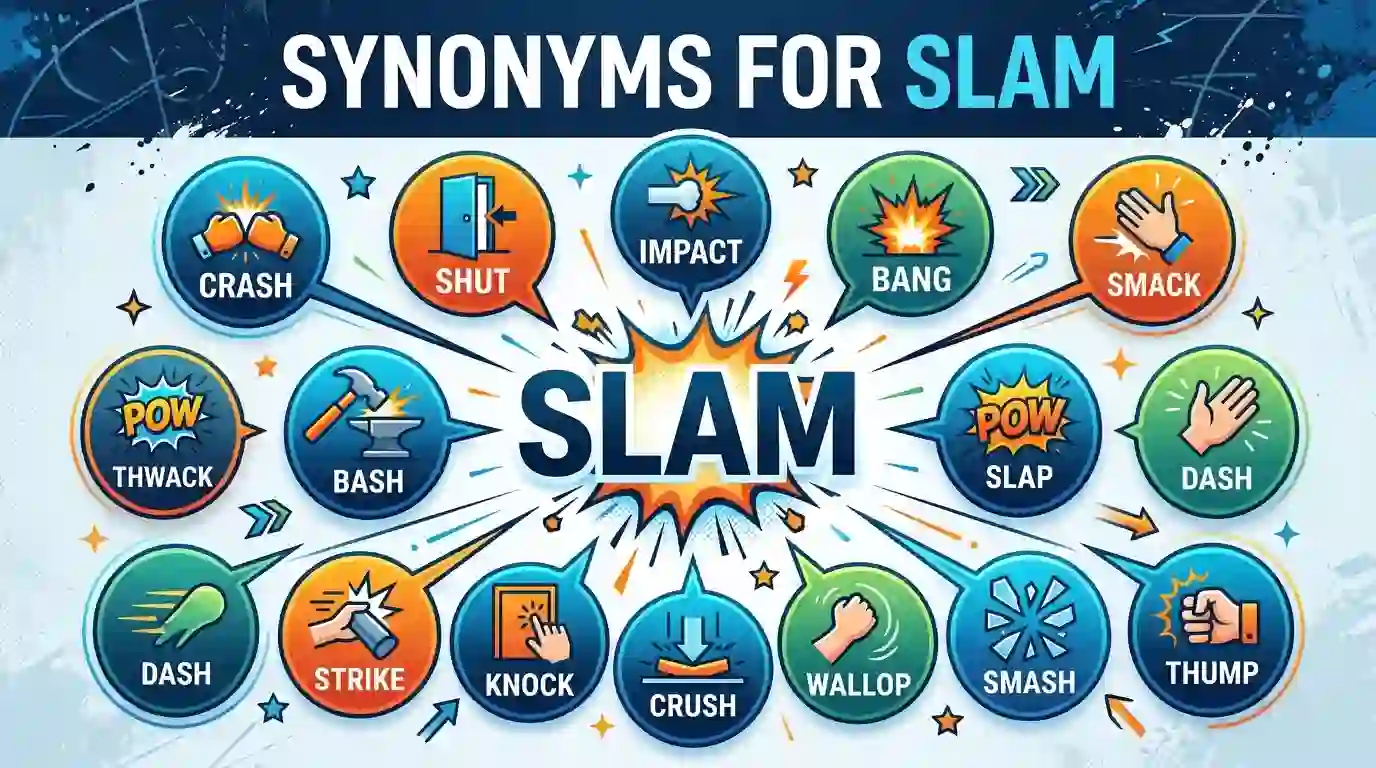
| Word | Main Meaning | Strength | Register | Frequency |
| Bang | Close or hit noisily | Strong | Neutral | Very common |
| Shut | Close | Related | Neutral | Very common |
| Crash | Hit violently | Strong | Neutral | Very common |
| Smash | Hit with great force | Very strong | Neutral | Very common |
| Thump | Hit with a dull sound | Strong | Neutral | Common |
| Hit | Make physical contact | General | Neutral | Very common |
| Strike | Hit forcefully | Strong | Neutral/Formal | Very common |
| Hurl | Throw with force | Strong | Neutral | Common |
| Fling | Throw suddenly | Strong | Neutral | Common |
| Dash | Throw or strike forcefully | Strong | Literary | Common |
| Criticize | Point out faults | Mild–Strong | Neutral | Very common |
| Attack | Criticize strongly | Strong | Neutral | Very common |
| Blast | Criticize severely | Strong | Informal | Common |
| Condemn | Express strong disapproval | Very strong | Formal | Common |
| Denounce | Publicly condemn | Very strong | Formal | Common |
| Censure | Formally disapprove | Strong | Formal | Uncommon |
| Castigate | Reprimand harshly | Very strong | Formal | Uncommon |
| Chastise | Reprimand strongly | Strong | Formal | Uncommon |
| Pan | Criticize a creative work | Strong | Informal | Common |
| Lambast | Criticize very harshly | Very strong | Informal/Journalistic | Uncommon |
| Excoriate | Criticize extremely harshly | Extreme | Formal/Literary | Rare |
| Decry | Publicly criticize | Strong | Formal | Uncommon |
| Revile | Attack with insulting language | Extreme | Formal/Literary | Uncommon |
| Vilify | Portray as very bad | Very strong | Formal | Uncommon |
| Smash | Destroy or hit hard | Very strong | Neutral | Very common |
Detailed Synonyms for Slam
1. Bang
Meaning: To make a loud noise by hitting or closing something.
Examples:
- She banged the door shut after the argument.
- The wind banged the window against the frame.
Best Used When: You want to emphasize the loud sound.
Tone: Neutral
Register: Spoken and general English
CEFR: B1
Frequency: Very common
Connotation: Noisy and sudden.
Common Collocations:
- bang the door
- bang shut
- bang against
When Not to Use This Word: Do not use bang if you want to emphasize severe criticism.
2. Shut
Meaning: To close something.
Examples:
- Please shut the door behind you.
- He shut the laptop and stood up.
Best Used When: You simply mean “close” without emphasizing force.
Tone: Neutral
Register: Everyday English
CEFR: A2
Frequency: Very common
Connotation: Usually neutral.
Common Collocations:
- shut the door
- shut the window
- shut the lid
When Not to Use This Word: Do not choose shut when the important idea is a violent or noisy closing.
3. Crash
Meaning: To hit something with a loud and forceful impact.
Examples:
- The car crashed into a concrete barrier.
- The box crashed onto the floor.
Best Used When: Something collides with another object forcefully.
Tone: Strong
Register: Neutral, news, descriptive
CEFR: B1–B2
Frequency: Very common
Connotation: Sudden and often damaging.
Common Collocations:
- crash into
- crash through
- crash down
When Not to Use This Word: Do not use crash for a simple quiet closing.
Oxford notes an important distinction: crash is especially common for vehicles and can stand alone in that sense, while slam and smash normally use a preposition in comparable impact constructions.
4. Smash
Meaning: To hit or break something with great force.
Examples:
- The ball smashed into the window.
- The waves smashed against the rocks.
Best Used When: The impact is extremely forceful or damaging.
Tone: Very strong
Register: Neutral
CEFR: B1–B2
Frequency: Very common
Connotation: Force, damage, or destruction.
Common Collocations:
- smash into
- smash through
- smash against
When Not to Use This Word: Avoid smash when nothing forceful or damaging happens.
5. Thump
Meaning: To hit something and make a deep, dull sound.
Examples:
- Someone thumped on the front door.
- The heavy bag thumped against the wall.
Best Used When: The sound is heavy and dull.
Tone: Neutral
Register: Spoken, descriptive
CEFR: B2
Frequency: Common
Connotation: Heavy rather than explosive.
Common Collocations:
- thump on
- thump against
- heavy thump
When Not to Use This Word: It is not the best choice for severe destruction.
6. Hit
Meaning: To make physical contact with someone or something.
Examples:
- The ball hit the wall.
- The stone hit the window.
Best Used When: You need a simple and general physical-impact word.
Tone: Neutral
Register: All-purpose
CEFR: A1–A2
Frequency: Very common
Connotation: Neutral.
Common Collocations:
- hit the wall
- hit the ground
- hit a target
When Not to Use This Word: Hit is usually less vivid than slam.
7. Strike
Meaning: To hit something, often with noticeable or deliberate force.
Examples:
- The ball struck the post.
- The falling branch struck the roof.
Best Used When: You want a more precise or formal alternative to hit.
Tone: Neutral to strong
Register: General, formal, literary
CEFR: B2
Frequency: Very common
Connotation: Deliberate, forceful, or precise.
Common Collocations:
- strike a target
- strike the ground
- strike against
When Not to Use This Word: Do not choose strike merely because it sounds more sophisticated.
8. Hurl
Meaning: To throw something with great force.
Examples:
- He hurled the ball across the field.
- She hurled the empty box into the trash.
Best Used When: Strong throwing is the main idea.
Tone: Strong
Register: Neutral, news, literary
CEFR: C1
Frequency: Common
Connotation: Anger, strength, or urgency may be implied.
Common Collocations:
- hurl a stone
- hurl an object
- hurl at someone
When Not to Use This Word: Do not use it for ordinary gentle throwing.
9. Fling
Meaning: To throw something suddenly or carelessly.
Examples:
- She flung her coat onto the chair.
- He flung the papers across the desk.
Best Used When: The throwing is sudden, careless, or emotional.
Tone: Strong
Register: Neutral
CEFR: B2
Frequency: Common
Connotation: Suddenness or lack of care.
Common Collocations:
- fling open
- fling onto
- fling aside
When Not to Use This Word: Do not use fling for careful or controlled throwing.
10. Dash
Meaning: To throw or strike something forcefully.
Examples:
- The waves dashed the boat against the rocks.
- He dashed the glass onto the floor.
Best Used When: The sentence has a literary or dramatic style.
Tone: Strong
Register: Literary/descriptive
CEFR: C1
Frequency: Common
Connotation: Dramatic and forceful.
Common Collocations:
- dash against
- dash to pieces
- dash down
When Not to Use This Word: It can sound unnatural in simple everyday conversation.
Synonyms for Slam When It Means “Criticize”
11. Criticize
Meaning: To point out problems or faults.
Examples:
- The reviewer criticized the film for its weak ending.
- Several customers criticized the company’s service.
Best Used When: You want a neutral alternative to slam.
Tone: Neutral
Register: Academic, professional, everyday
CEFR: B1
Frequency: Very common
Connotation: Usually less emotional than slam.
Common Collocations:
- criticize a decision
- criticize a policy
- criticize someone’s work
When Not to Use This Word: Do not use it when you specifically need to show extremely harsh criticism.
12. Attack
Meaning: To criticize someone or something strongly.
Examples:
- The article attacked the company’s policy.
- The speaker attacked the proposal during the debate.
Best Used When: The criticism is aggressive or strongly directed.
Tone: Strong
Register: General, journalism, political
CEFR: B2
Frequency: Very common
Connotation: Aggressive.
Common Collocations:
- attack an argument
- attack a policy
- attack someone’s reputation
When Not to Use This Word: Use criticize when you want a neutral description.
13. Blast
Meaning: To criticize someone or something very strongly.
Examples:
- The coach blasted the team for ignoring the rules.
- Customers blasted the company after the service failed.
Best Used When: You want a vivid, informal alternative to slam.
Tone: Strong
Register: Informal, journalism
CEFR: B2
Frequency: Common
Connotation: Sharp and emotional.
Common Collocations:
- blast a decision
- blast a company
- blast someone for something
When Not to Use This Word: Avoid it in formal academic writing when a neutral verb is enough.
14. Condemn
Meaning: To express strong disapproval of something.
Examples:
- The organization condemned the violence.
- Several leaders condemned the decision.
Best Used When: The criticism is serious and expresses clear disapproval.
Tone: Very strong
Register: Formal, academic, news
CEFR: B2
Frequency: Common
Connotation: Moral or public disapproval.
Common Collocations:
- condemn violence
- condemn an action
- strongly condemn
When Not to Use This Word: Do not use it for a minor mistake or small complaint.
15. Denounce
Meaning: To publicly criticize something as wrong or unacceptable.
Examples:
- The organization denounced the unfair treatment.
- The mayor denounced the attack.
Best Used When: The criticism is public, serious, and formal.
Tone: Very strong
Register: Formal, journalism, academic
CEFR: C1
Frequency: Common
Connotation: Public rejection.
Common Collocations:
- denounce violence
- publicly denounce
- denounce a policy
When Not to Use This Word: It is too strong for casual complaints.
16. Censure
Meaning: To formally express strong disapproval.
Examples:
- The committee censured the official.
- The board voted to censure the member.
Best Used When: An official body formally expresses disapproval.
Tone: Strong
Register: Formal, institutional, legal
CEFR: C1
Frequency: Uncommon
Connotation: Official and disciplinary.
Common Collocations:
- formally censure
- censure an official
- vote to censure
When Not to Use This Word: Do not use it as an everyday synonym for criticize.
17. Castigate
Meaning: To criticize or reprimand someone very harshly.
Examples:
- The manager castigated the team for ignoring safety rules.
- The article castigated the company for its repeated failures.
Best Used When: The criticism is severe and often directed at a person or organization.
Tone: Very strong
Register: Formal
CEFR: C1
Frequency: Uncommon
Connotation: Harsh reprimand.
Common Collocations:
- castigate someone for
- publicly castigate
- harshly castigate
When Not to Use This Word: Avoid it when a simple criticism is clearer.
18. Chastise
Meaning: To criticize or reprimand someone strongly.
Examples:
- The teacher chastised the students for damaging the equipment.
- The manager chastised him for ignoring the instructions.
Best Used When: Someone is being strongly rebuked for wrongdoing.
Tone: Strong
Register: Formal/literary
CEFR: C1
Frequency: Uncommon
Connotation: Reprimand and authority.
Common Collocations:
- chastise someone for
- publicly chastise
- harshly chastise
When Not to Use This Word: It can sound too formal in casual conversation.
19. Pan
Meaning: To criticize a movie, book, play, or other creative work very negatively.
Examples:
- Critics panned the new movie.
- Reviewers panned the album for its weak production.
Best Used When: You are discussing negative reviews of creative work.
Tone: Strong
Register: Informal, journalism
CEFR: C1
Frequency: Common
Connotation: Strongly negative review.
Common Collocations:
- pan a movie
- pan a book
- widely panned
When Not to Use This Word: Do not normally use pan for every kind of criticism.
20. Lambast
Meaning: To criticize someone or something very harshly.
Examples:
- The newspaper lambasted the company for poor service.
- Fans lambasted the team after the disappointing performance.
Best Used When: You need a vivid word for severe criticism.
Tone: Very strong
Register: Informal, journalism
CEFR: C1
Frequency: Uncommon
Connotation: Harsh and public.
Common Collocations:
- lambast a decision
- lambast a company
- publicly lambast
When Not to Use This Word: It is too dramatic for mild feedback.
21. Excoriate
Meaning: To criticize someone or something extremely severely.
Examples:
- The reviewer excoriated the book for its poor research.
- The report excoriated the company for repeated failures.
Best Used When: You need an extremely strong formal word.
Tone: Extreme
Register: Formal/literary
CEFR: C2
Frequency: Rare
Connotation: Extremely harsh criticism.
Common Collocations:
- excoriate a policy
- excoriate a company
- publicly excoriate
When Not to Use This Word: Do not use it simply to sound intelligent. It can make ordinary writing unnecessarily difficult.
22. Decry
Meaning: To publicly criticize something as bad or harmful.
Examples:
- Experts decried the lack of safety measures.
- Community groups decried the damage caused by the project.
Best Used When: The criticism is public and formal.
Tone: Strong
Register: Formal, academic, journalism
CEFR: C1
Frequency: Uncommon
Connotation: Public disapproval.
Common Collocations:
- decry violence
- decry a policy
- widely decried
When Not to Use This Word: Use criticize in normal conversation.
23. Revile
Meaning: To attack someone with extremely insulting or abusive language.
Examples:
- The public figure was reviled by some commentators.
- The two sides reviled each other during the bitter dispute.
Best Used When: The language is hostile and insulting, not merely critical.
Tone: Extreme
Register: Formal/literary
CEFR: C2
Frequency: Uncommon
Connotation: Hatred, abuse, and hostility.
Common Collocations:
- revile an opponent
- publicly revile
- reviled by critics
When Not to Use This Word: Do not use it for ordinary disagreement.
24. Vilify
Meaning: To describe or treat someone as extremely bad or worthless.
Examples:
- The campaign did not need to vilify its critics.
- The article vilified the manager instead of discussing the evidence.
Best Used When: Someone is being portrayed in an extremely negative way.
Tone: Very strong
Register: Formal, journalism
CEFR: C1
Frequency: Uncommon
Connotation: Personal or unfair demonization can be implied.
Common Collocations:
- vilify an opponent
- vilify a person
- publicly vilify
When Not to Use This Word: Do not use it simply because someone disagrees with you.
25. Damn
Meaning: To strongly condemn or criticize something.
Examples:
- The report damned the plan as unrealistic.
- The review damned the product with faint praise.
Best Used When: Strong condemnation is intended.
Tone: Strong
Register: Informal/literary
CEFR: B2–C1
Frequency: Common
Connotation: Strong and sometimes emotionally or religiously marked.
Common Collocations:
- damn as
- damn with faint praise
- damn the proposal
When Not to Use This Word: Avoid it in sensitive or highly formal contexts unless the expression is clearly appropriate.
Synonym Categories
Strongest Synonyms for Physical Force
Use these when the physical action is powerful:
- smash
- crash
- strike
- hurl
- dash
Strong Synonyms for Physical Action
- bang
- thump
- hit
- fling
Strongest Synonyms for Criticism
- excoriate
- lambast
- revile
- denounce
- vilify
Strong but More Common Criticism Words
- attack
- blast
- condemn
- criticize
- pan
Formal Criticism Words
- condemn
- denounce
- censure
- castigate
- chastise
- decry
- excoriate
Choose the Right Synonym
| Situation | Best Word | Why |
| Close a door loudly | bang | Focuses on the sound |
| Close a door forcefully | slam | Focuses on force |
| Close something quietly | shut | Neutral |
| Vehicle hits another vehicle | crash/collide | Natural collision language |
| Hit something very hard | smash | Strong impact |
| Hit something generally | hit | Broad and simple |
| Throw something forcefully | hurl | Strong throwing |
| Throw something suddenly | fling | Sudden/careless movement |
| Criticize neutrally | criticize | Most general |
| Criticize aggressively | attack | Stronger and more confrontational |
| Criticize severely | blast | Informal and vivid |
| Express formal disapproval | condemn | Formal and strong |
| Publicly reject something | denounce | Strong public criticism |
| Officially disapprove | censure | Institutional |
| Criticize a movie badly | pan | Common review vocabulary |
| Criticize extremely harshly | excoriate | Very strong and formal |
Commonly Confused Words
| Word | Main Difference | Example |
| Slam | Forceful action or harsh criticism | She slammed the door. |
| Bang | Loud impact or closing | She banged the door. |
| Shut | Simply close | She shut the door. |
| Crash | Forceful collision, especially involving vehicles | The car crashed into a tree. |
| Smash | Very forceful impact or destruction | The ball smashed into the window. |
Slam vs. Bang
Both can describe a loud door closing.
Slam emphasizes force or suddenness:
She slammed the door in anger.
Bang emphasizes the loud noise:
The wind banged the door against the frame.
Slam vs. Shut
Shut simply means close.
Please shut the door.
Slam suggests force.
He slammed the door.
Slam vs. Crash
Crash is especially natural for collisions.
The two cars crashed.
But:
The car slammed into the barrier.
Oxford notes that slam and smash normally take a preposition in this type of impact construction.
Slam vs. Criticize
Criticize is neutral.
The editor criticized the article.
Slam is much stronger.
The editor slammed the article.
Common Mistakes
Common Mistake Box
Mistake 1
Wrong: He slammed the door quietly.
Better: He closed the door quietly.
Why: Slam normally suggests force and often noise.
Mistake 2
Wrong: The cars slammed.
Better: The cars collided.
Also possible: The cars slammed into each other.
Why: Collide is the more direct verb when two moving things hit each other.
Mistake 3
Wrong: She slammed on the brakes suddenly.
This sentence is grammatically possible, but suddenly is often unnecessary because slamming on the brakes already suggests a sudden, forceful braking action.
Better: She slammed on the brakes.
Mistake 4
Wrong: The professor slammed my essay because it had two errors.
Better: The professor criticized my essay because it had two errors.
Why: Slam suggests much stronger criticism.
Mistake 5
Wrong: The committee slammed the official.
This can work in journalism, but if the committee formally issued disciplinary disapproval, censured may be more precise.
American vs. British English
The spelling of slam is the same in American and British English:
- slam
- slammed
- slamming
The standard pronunciation is also essentially the same.
The main differences appear in related criticism vocabulary. British English has informal expressions such as slate and slag off, while American English has expressions such as chew out in informal contexts. Collins identifies several of these regional or register-specific alternatives.
For international learners, however, common words such as criticize, attack, condemn, denounce, and blast are generally more useful than highly regional slang.
Word Origin and First Known Use
The history of slam is interesting because its physical and card-game senses have separate histories.
Etymonline dates the physical noun meaning “a severe blow” to the 1670s and says the word probably came from a Scandinavian source. The verb appears in the 1690s with a meaning related to beating or striking. Its sense of closing something forcefully developed later, while the criticism sense is recorded from 1916.
Dictionary.com similarly dates the word to the 1650s–1660s and describes a possible Scandinavian connection, including forms related to banging or slamming a door.
This historical development helps explain why the modern word can connect physical force with strong verbal criticism.
CEFR Guidance
CEFR levels for individual words are not absolute. Different learner dictionaries and vocabulary lists may classify words differently.
A practical guide is:
| Level | Useful Words |
| A1–A2 | hit, shut |
| B1 | bang, criticize |
| B2 | slam, crash, smash, attack, condemn |
| C1 | denounce, censure, castigate, decry |
| C2 | excoriate, revile |
Use these levels as learning guidance, not as official universal classifications.
Natural Collocations With Slam
Learning collocations can be more useful than memorizing isolated synonyms.
Common patterns include:
- slam the door
- slam the window shut
- slam the phone down
- slam the book down
- slam on the brakes
- slam into a wall
- slam into a tree
- slam against the barrier
- slam something onto the table
- slam a policy
- slam a decision
- slam a proposal
- slam someone for something
- slam something as unfair
Cambridge and Collins both give examples of these patterns, including slam the door, slam into, slam something down, and the criticism construction.
When Not to Use Slam
Do not use slam when:
- the action is gentle
- the object closes quietly
- the criticism is mild
- you need a highly neutral academic verb
- you are describing an ordinary collision without force
- a more precise formal word exists
For example:
Too strong:
The teacher slammed my suggestion.
Neutral:
The teacher criticized my suggestion.
More formal:
The committee condemned the proposal.
Writing Tips
For Essays
Use criticize, challenge, question, or condemn according to the exact meaning.
Researchers criticized the earlier method.
This sounds more neutral than:
Researchers slammed the earlier method.
For Professional Emails
Avoid dramatic criticism unless it is necessary.
Instead of:
The client slammed our proposal.
You could write:
The client strongly criticized several parts of our proposal.
For Blog Posts
Slam, blast, and pan can create a more energetic journalistic tone.
Critics slammed the new product.
For Stories
Physical verbs can create vivid scenes.
He slammed the door and walked away.
For Social Media
Informal vocabulary such as blast or slam may sound natural when the tone is intentionally strong.
Fans slammed the decision online.
Writing Tip: Strong vocabulary is useful only when the strength matches the situation.
Related Vocabulary
Antonyms
For the physical sense:
- open
- gently close
- handle carefully
For the criticism sense:
- praise
- approve
- support
- commend
- defend
Related Expressions
Slam the door in someone’s face
To reject someone abruptly or rudely.
Slam on the brakes
To brake suddenly and forcefully.
Slam into
To hit something with great force.
Slam down
To put something down forcefully.
Slam dunk
An expression that can refer literally to a basketball action or figuratively to something considered an easy or highly successful result.
Mini Practice Exercises
Fill in the Blanks
Choose the best word: bang, crash, criticize, hurl, censure
- The car began to ______ into the barrier.
- She ______ the door after the argument.
- The teacher did not ______ the student personally.
- He decided to ______ the ball across the field.
- The committee voted to ______ the official.
Answers
- crash
- banged
- criticize
- hurl
- censure
Rewrite the Sentence
Replace slam with a more precise word.
- The truck slammed into the wall.
- Critics slammed the movie.
- She slammed the door shut.
- The committee slammed the official.
- He slammed the ball across the field.
Possible Answers
- The truck crashed into the wall.
- Critics panned the movie.
- She banged the door shut.
- The committee censured the official.
- He hit or smacked the ball across the field, depending on the intended context.
FAQs About Synonyms for Slam
What are the best synonyms for slam?
The best synonym depends on the meaning. Bang works well for a noisy closing, crash for a forceful collision, smash for a very powerful impact, hurl for forceful throwing, and criticize or condemn for negative evaluation. No single synonym works naturally in every context.
What is a simple synonym for slam?
For physical impact, hit is the simplest general alternative. For a noisy closing, bang is simple and natural. For criticism, criticism is the safest everyday alternative because it does not automatically add the strong emotional force carried by slam.
What is a formal synonym for slam?
For the criticism meaning, formal alternatives include condemn, denounce, censure, decry, and castigate. Their meanings are not identical. Censure often suggests official disapproval, while denunciation usually suggests strong public rejection.
Is bang a synonym for slam?
Bang can be a synonym for slam when both describe a loud or forceful closing or impact. However, the words are not identical. Bang strongly emphasizes sound, while slam often emphasizes force, suddenness, or anger.
What is the strongest synonym for slam?
There is no single strongest synonym for every sense. For severe criticism, excoriate is extremely strong, while lambast, denounce, and revile are also powerful. For physical force, smash can suggest greater damage than ordinary slam.
What is a synonym for slam in academic writing?
For academic writing, criticize, challenge, question, or condemn may be more appropriate depending on the meaning. Slam can sound informal or journalistic when it means “criticize very harshly,” so a more precise formal verb is often better.
What is the difference between slam and criticize?
Criticize means to identify or express disapproval of faults or problems. Slam is much stronger and often suggests harsh, public, or emotional criticism. For example, “The reviewer criticized the book” sounds neutral, while “The reviewer slammed the book” sounds strongly negative.
What is the opposite of slam?
The opposite depends on the sense. For forceful closing, the opposite may be open or close gently. For criticism, opposites include praise, support, approve, commend, and defend.
Vocabulary Quiz
1. Which word best describes a car hitting a wall?
A. Censure
B. Crash
C. Praise
D. Shut
2. Which word is best for a formal official expression of disapproval?
A. Bang
B. Fling
C. Censure
D. Hit
3. Which word is commonly used for a very negative review of a movie?
A. Pan
B. Shut
C. Hurl
D. Strike
4. Which sentence uses “slam” naturally?
A. She slammed the door gently.
B. He slammed the phone down in anger.
C. She slammed the room quietly.
D. He slammed the idea politely.
5. Which word is the most neutral alternative for the criticism of “slam”?
A. Excoriate
B. Revile
C. Criticize
D. Lambast
Answer Key
- B. Crash
- C. Censure
- A. Pan
- B. He slammed the phone down in anger.
- C. Criticize
Conclusion
Learning synonyms for slam is not about replacing one word with another at random. Good vocabulary means choosing the word that matches the exact meaning, strength, tone, and situation.
Use bang for noisy impact, smash for powerful physical force, hurl for forceful throwing, and words such as criticize, condemn, denounce, or blast for different levels of criticism. Practice these words in essays, emails, stories, and conversations. With regular practice, your English will become more precise, natural, and expressive.
References
- Cambridge Dictionary and Cambridge Thesaurus, “slam.”
- Collins English Thesaurus, “slam.”
- Thesaurus.com, “slam synonyms and antonyms.”
- Oxford Learner’s Dictionaries, “slam” and related usage notes.
- Etymonline, “slam” etymology and historical development.

Synonorm is a trusted English vocabulary resource created to help readers find the right words and understand the differences between similar terms. We provide clear explanations of synonyms, meanings, examples, usage, and alternatives. Our content makes vocabulary easier to learn and apply in everyday, academic, and professional English. Synonorm is designed for students, writers, ESL learners, professionals, and anyone who wants to improve their English vocabulary and communicate more clearly.