Have you ever used the word types several times in one paragraph and felt that your writing sounded repetitive?
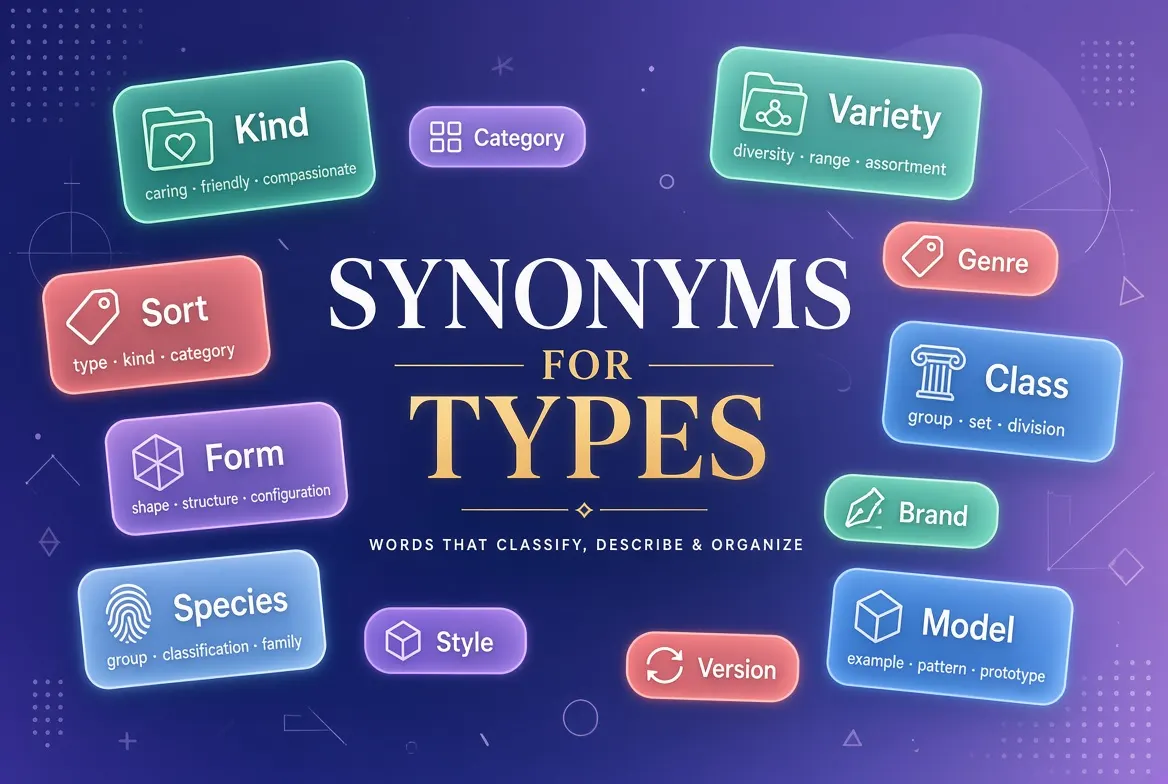
English gives you many alternatives, but they are not all interchangeable. Kind, sort, category, variety, class, form, and group can often replace type, while words such as genre, breed, species, model, and version have narrower meanings.
The key is to choose the word that matches your context.
For example:
What type of music do you like?
You can also say:
What kind of music do you like?
Both are natural. But you would normally say music genre when discussing a category such as jazz, rock, or classical music. You would not normally replace genre with breed or species.
This guide explains the most useful alternatives, their differences, common collocations, register, pronunciation, learner level, and situations where each word should be avoided.
Quick Answer: What Are the Best Synonyms for Types?
The closest everyday synonyms for types are kinds and sorts. Other useful alternatives include categories, varieties, classes, forms, groups, genres, styles, and versions. The right choice depends on context. Category suggests organized classification, variety suggests a different form or choice, and genre is mainly used for creative works.
What Does “Type” Mean?
As a noun, type means a group of people or things that share similar characteristics. Cambridge gives examples such as different types of cheese, types of insurance, and what type of job.
For example:
What type of car do you drive?
Here, type asks about the category or kind of car.
Type can also describe a person:
He is not my type.
In this expression, type means the kind of person someone finds attractive or suitable.
As a verb, type has a completely different meaning:
Please type your name here.
Here it means to write using a keyboard or typewriter.
Pronunciation
Type: /taɪp/
It is pronounced like “tīp.”
American and British English use essentially the same pronunciation and spelling.
Part of Speech
- Noun: a group or kind of person or thing
- Verb: to write using a keyboard
- Adjective: type is not normally used as an adjective by itself, although compounds such as student-type clothing occur
- Adverb: no standard adverb form of type
The Closest Synonyms at a Glance
| Word | How close to “type”? | Register | Best context |
| Kind | Very close | Neutral | Everyday English |
| Sort | Very close | Neutral/Informal | Conversation |
| Category | Close | Neutral/Formal | Organized groups |
| Variety | Close | Neutral | Different forms or choices |
| Class | Close | Formal/Academic | Systematic groups |
| Form | Close | Neutral/Formal | Different forms of something |
| Group | Related | Neutral | People or things together |
| Genre | Context-specific | Formal/Neutral | Art, books, music, film |
| Style | Context-specific | Neutral | Design or manner |
| Version | Context-specific | Neutral | Editions or updated forms |
| Model | Context-specific | Neutral | Products and designs |
| Species | Specialized | Scientific | Living organisms |
| Breed | Specialized | Neutral | Animals |
| Variant | Specialized | Formal | Modified forms |
| Classification | Related | Formal/Academic | Systems of grouping |
| Subtype | Specialized | Technical | A smaller type |
| Nature | Related | Neutral/Formal | Character or essential quality |
| Character | Related | Formal | Distinctive qualities |
| Ilk | Context-specific | Literary | People or things of a certain kind |
| Stripe | Context-specific | Informal/Idiomatic | People with similar qualities |
1. Kind
Kind is probably the most useful everyday alternative to type.
Meaning: A group of people or things that have similar characteristics.
CEFR: A2-level learner vocabulary
Frequency: Very common
Register: Neutral, everyday, spoken
Examples:
What kind of books do you enjoy?
She likes all kinds of music.
Best used when
Use kind when speaking naturally about people, objects, ideas, activities, or experiences.
Common collocations
- what kind of
- different kinds of
- all kinds of
- this kind of
Nuance
Kind often sounds slightly more conversational than type.
What kind of food do you like?
sounds very natural in everyday speech.
When not to use it
Do not assume that kind works in every fixed expression.
For example:
blood type
is standard, while blood kind is not.
2. Sort
Sort is another very close synonym for type.
Meaning: A group of people or things with similar characteristics.
CEFR: A2-B1
Frequency: Very common
Register: Neutral to informal, especially in conversation
Examples:
What sort of music do you listen to?
We sell several sorts of bread.
Best used when
Use sort in questions and everyday conversation.
Common collocations
- what sort of
- all sorts of
- different sorts of
Nuance
Sort and kind often sound more conversational than type.
Cambridge specifically explains that sort, type, and kind generally refer to groups of people or things that share characteristics.
When not to use it
Avoid sorting in highly technical classifications when a precise term such as category or class is needed.
3. Category
Category is one of the best alternatives when you are organizing information.
Meaning: A group within a system of classification.
CEFR: B2
Frequency: Very common
Register: Neutral, formal, academic, business
Examples:
The products are divided into three categories.
Students were placed into different categories based on their results.
Best used when
Use category when groups are deliberately organized according to shared features.
Cambridge defines a category as a type or group within a system for dividing things according to features such as appearance or quality.
Common collocations
- product category
- broad category
- major category
- customer category
- category of people
Nuance
Type can simply describe a kind. Category often suggests that someone has organized or classified the group.
4. Variety
Variety can mean a different type or form of something.
CEFR: B1
Frequency: Very common
Register: Neutral
Examples:
The store sells several varieties of rice.
This variety of apple grows well in cold weather.
Best used when
Use variety when the differences between forms matter or when you want to emphasize choice and diversity.
Cambridge lists variety as a noun meaning a different type of something.
Common collocations
- a wide variety of
- different varieties
- several varieties
- a variety of foods
Nuance
Compare:
There are several types of tea.
This simply identifies different categories.
The shop offers a wide variety of tea.
This emphasizes the range of choices.
5. Class
Class refers to a group formed according to shared characteristics.
CEFR: B1-B2
Frequency: Common
Register: Formal, academic, scientific
Examples:
The chemicals belong to different classes.
Scientists study several classes of materials.
Best used when
Use class when the grouping is systematic or technical.
Common collocations
- social class
- chemical class
- class of drugs
- class of objects
When not to use it
Do not replace every use of type with class. In everyday conversation, kind is usually more natural.
6. Form
Form means a particular way in which something exists or appears.
CEFR: B1
Frequency: Very common
Register: Neutral/Formal
Examples:
Exercise comes in many forms.
The information is available in digital form.
Best used when
Use form when you are focusing on the way something exists, appears, or is expressed.
Common collocations
- different forms
- various forms
- written form
- digital form
- physical form
Nuance
Type focuses more on classification. Form often focuses on manifestation.
7. Group
Group means people or things considered together.
CEFR: A1
Frequency: Extremely common
Register: Neutral
Examples:
The teacher divided the students into three groups.
These animals belong to the same group.
Best used when
Use a group when the important idea is that things are collected or considered together.
Nuance
A group does not always mean a formal type.
A group of friends
does not mean a type of friend. It simply means several friends considered together.
8. Genre
Genre is a specialized synonym.
Meaning: A category or style of creative work, especially literature, music, film, or art.
CEFR: B2
Frequency: Common
Register: Formal/Neutral
Examples:
What genre of music do you enjoy?
Mystery is one of my favorite book genres.
Cambridge defines genre as a style in the arts with a particular set of characteristics.
Common collocations
- music genre
- film genre
- literary genre
- genre fiction
When not to use it
Do not say:
three genres of coffee
unless you are using the word in an unusual metaphorical way.
For coffee, types, kinds, or varieties are more natural.
9. Style
Style refers to a particular way of doing, designing, writing, or presenting something.
CEFR: B1
Frequency: Very common
Register: Neutral
Examples:
She has a simple writing style.
The store sells several styles of furniture.
Best used when
The difference is mainly about appearance, manner, design, or expression.
Common collocations
- writing style
- fashion style
- communication style
- design style
When not to use it
A style is not always a category. Two products can have different styles while belonging to the same general type.
10. Version
Version means a particular form of something that has been changed, updated, adapted, or produced in more than one form.
CEFR: B1
Frequency: Very common
Register: Neutral, business, technology
Examples:
I downloaded the latest version of the app.
The director released a longer version of the film.
Common collocations
- latest version
- previous version
- updated version
- original version
- revised version
When not to use it
Do not use versions for unrelated categories.
A sedan and an SUV are different types of cars. They are not simply different versions of the same car.
11. Model
Model is useful when discussing products or designs.
CEFR: B1
Frequency: Very common
Register: Neutral, business, technical
Examples:
The company released two new phone models.
Which model of laptop do you use?
Best used when
Use a model for a particular product design or specification.
When not to use it
Do not use model as a general replacement for type.
12. Variant
Variant means a form that differs slightly from another form.
CEFR: C1
Frequency: Common in specialized writing
Register: Formal, academic, scientific
Examples:
Researchers tested a new variant of the design.
The software is available in several variants.
Nuance
A variant usually has a clear relationship with another form. It is not simply any unrelated category.
13. Species
Species is a scientific term for a biological group.
CEFR: B2
Frequency: Common
Register: Scientific
Examples:
Scientists discovered a new species of frog.
The forest is home to many species of birds.
When not to use it
Do not use species for ordinary products, services, or general ideas.
❌ different species of smartphones
✅ different types of smartphones
14. Breed
Breed is used mainly for groups of domesticated animals that share inherited characteristics.
CEFR: B1
Frequency: Common
Register: Everyday, agricultural, scientific
Examples:
Labrador Retrievers are a popular breed of dog.
The farmer raises several breeds of sheep.
When not to use it
Do not use breed for ordinary objects.
❌ several breeds of cars
✅ several types or models of cars
15. Nature
Nature can sometimes describe the basic character or quality of something.
CEFR: B1
Frequency: Very common
Register: Neutral/Formal
Examples:
We need to understand the nature of the problem.
The nature of the work makes remote communication difficult.
Nuance
Nature does not mean a simple category. It focuses on what something is like at a deeper or more essential level.
16. Character
Character can refer to the distinctive qualities of a person or thing.
CEFR: B2
Frequency: Common
Register: Neutral/Formal
Example:
The two materials differ in physical character.
It can sometimes overlap with type, but it is more about qualities than classification.
17. Classification
Classification refers to the system or process of putting things into groups.
CEFR: B2-C1
Frequency: Common in academic writing
Register: Academic, scientific, formal
Example:
The classification of plants has changed over time.
Important distinction
Type is a group.
Classification is the system or process used to organize groups.
18. Subtype
Subtype means a smaller type within a broader type.
CEFR: C1
Frequency: Uncommon outside technical contexts
Register: Technical, academic
Example:
The researchers identified a rare subtype.
Best used when
You are describing a hierarchy:
vehicle → car → electric car
Here, electric cars can be a subtype within the broader category of cars.
19. Ilk
Ilk means a particular kind or group.
CEFR: C2
Frequency: Rare
Register: Literary, formal, sometimes negative
Example:
Writers of that ilk often challenge traditional ideas.
When not to use it
Avoid ilk in basic ESL writing and ordinary conversation. It can sound old-fashioned or literary.
20. Stripe
Stripe can mean a particular kind of person, especially someone with certain qualities or behavior.
CEFR: C2
Frequency: Rare
Register: Idiomatic, informal/literary
Example:
I have never trusted people of that stripe.
When not to use it
Do not use stripes for ordinary product categories.
It is an idiomatic expression, not a general substitute for type.
Choosing the Right Word
The easiest way to choose is to ask what kind of difference you are describing.
| What are you describing? | Best word |
| Everyday group | kind |
| Conversational group | sort |
| Organized group | category |
| Different form or choice | variety |
| Scientific grouping | class |
| Way something exists | form |
| People or things together | group |
| Creative work | genre |
| Appearance or method | style |
| Updated or adapted form | version |
| Product design | model |
| Slight variation | variant |
| Biological group | species |
| Animal group | breed |
| Formal grouping system | classification |
| Smaller group inside a larger one | subtype |
Type vs. Kind vs. Sort
These three cause the most confusion.
Type
What type of car is it?
This can sound slightly more precise or neutral.
Kind
What kind of car is it?
This is extremely natural in everyday conversation.
Sort
What sort of car is it?
This is also natural, especially in British English and conversational questions.
Cambridge treats these three as closely related words for groups sharing characteristics.
A useful rule
If you are unsure, kind is often the safest conversational choice.
For formal or technical writing, type or category may be more appropriate when the classification is clearly defined.
Common Collocations
Learning words in combinations is often more useful than memorizing isolated synonyms.
With type
- different types of
- several types of
- a particular type of
- this type of
- the same type of
With kind
- all kinds of
- different kinds of
- what kind of
- this kind of
- one kind of
With category
- broad category
- product category
- major category
- category of customers
- fall into a category
With variety
- wide variety of
- different varieties
- several varieties
- a variety of foods
- local varieties
With genre
- music genre
- film genre
- literary genre
- popular genre
- genre of fiction
Common Mistakes
Mistake 1: Treating every synonym as interchangeable
Incorrect idea:
Type = species = genre = breed = model
Better understanding:
These words overlap with type in particular contexts, but they have their own meanings.
Mistake 2: Using difficult words unnecessarily
The website offers numerous categorizations of products.
This sounds unnecessarily complicated.
Better:
The website offers several product categories.
Mistake 3: Using “genre” for everything
What genre of food do you like?
This is not natural standard English.
Better:
What kind of food do you like?
Mistake 4: Using “species” for objects
There are many species of computers.
Better:
There are many types of computers.
Mistake 5: Assuming “variety” always means “type”
Sometimes variety emphasizes choice or diversity:
The restaurant offers a wide variety of dishes.
The focus is not simply on categories. It is on the range of choices.
American vs. British English
Type has the same spelling in American and British English:
- American: type
- British: type
Pronunciation is also essentially the same:
- American: /taɪp/
- British: /taɪp/
The same is generally true for kind, category, class, form, and group.
One useful regional point is that sort is particularly common in British conversational English, although American speakers also use it.
Etymology of “Type”
The English word type ultimately traces back through Latin typus to Greek typos, a word connected with an impression, mark, model, or pattern.
Over time, the idea of a model or pattern developed into the modern sense of a group sharing recognizable characteristics.
Merriam-Webster records type as a noun with senses connected to a group marked by common qualities and also lists kind, sort, genre, variety, and several other words in its synonym information.
The important lesson is that a dictionary thesaurus may show many related words, but a good writer still needs to check the exact context.
Mini Practice
Fill in the blanks
Choose from kind, category, genre, breed, version.
- What ___ of music do you enjoy?
- The products are divided into three prices ___.
- Jazz is popular music ___.
- Golden Retrievers are dogs ___.
- Please download the newest ___ of the software.
Answers
- kind
- categories
- genre
- breed
- version
Rewrite the Sentences
Replace type with a more suitable alternative.
- There are many types of tea.
- The files are available in different types.
- What type of movie do you like?
- The company sells several types of cars.
Possible Answers
- There are many varieties of tea.
- The files are available in different formats.
- What kind of movie do you like?
- The company sells several models of cars.
Notice that the best answer changes with the context.
Frequently Asked Questions
What is the most common synonym for types?
The most common everyday alternatives are kinds and sorts. They often work in sentences where type describes a group with shared characteristics. Category is also common, but it usually suggests a more organized system of classification.
What is a formal synonym for types?
Categories, classes, classifications, and variants can work in formal writing, depending on the meaning. However, formal does not always mean better. If types expresses your idea clearly, keeping it may be the strongest choice.
Is “kind” the same as “type”?
In many everyday sentences, yes. For example, What kind of food do you like? and What type of food do you like? are both natural. However, some fixed expressions strongly prefer one word. For example, we say blood type and one of a kind.
What is another word for different types?
Depending on context, you can use different kinds, various categories, several varieties, different forms, or multiple versions. The noun that follows should guide your choice.
What is a synonym for types in academic writing?
Academic alternatives include categories, classes, forms, variants, and classifications. Choose according to meaning rather than trying to make the sentence sound more complicated.
What is the difference between type and category?
A type is a kind or group sharing characteristics. A category is generally a group within an organized classification system. For example, “a type of vehicle” is broad, while “the luxury category” suggests a specific classification.
What is the difference between type and variety?
Type identifies a kind or group. Variety can identify a different form of something, but it can also emphasize diversity or choice. For example, a store may sell several types of tea and offer a wide variety of tea flavors.
What is the difference between type and genre?
Type is a broad word for a group or kind. Genre is specialized and usually refers to a style or category of art, literature, music, or film. You can have different types of books, but you can also discuss their literary genres.
Quick Vocabulary Quiz
1. Which word is best for everyday conversation?
A. Subtype
B. Kind
C. Classification
D. Designation
2. Which word suggests an organized system?
A. Category
B. Stripe
C. Breed
D. Ilk
3. Which word is mainly used for creative works?
A. Species
B. Genre
C. Model
D. Breed
4. Which word is best for different editions of software?
A. Version
B. Species
C. Class
D. Stripe
5. Which word is specifically associated with groups of animals?
A. Category
B. Genre
C. Breed
D. Format
Answer Key
- B. Kind
- A. Category
- B. Genre
- A. Version
- C. Breed
Final Takeaway
The best synonym for types depends on what you are trying to say. For everyday English, kind and sort are excellent choices. Use category for organized groups, variety for different forms or choices, class for systematic groups, and genre for creative works. More specialized words such as species, breed, model, version, and variant should be used only when their specific meaning fits.
Good vocabulary is not about using the biggest word you know. It is about choosing the right word for the right situation. Practice these alternatives in conversations, essays, emails, and everyday writing, and your English will become clearer, more natural, and more precise.
Trusted References
- Cambridge Dictionary: Type
- Cambridge Dictionary: Kind
- Cambridge Dictionary: Category
- Cambridge Dictionary: Variety
- Merriam-Webster: Type

Synonorm is a trusted English vocabulary resource created to help readers find the right words and understand the differences between similar terms. We provide clear explanations of synonyms, meanings, examples, usage, and alternatives. Our content makes vocabulary easier to learn and apply in everyday, academic, and professional English. Synonorm is designed for students, writers, ESL learners, professionals, and anyone who wants to improve their English vocabulary and communicate more clearly.