Quick Answer
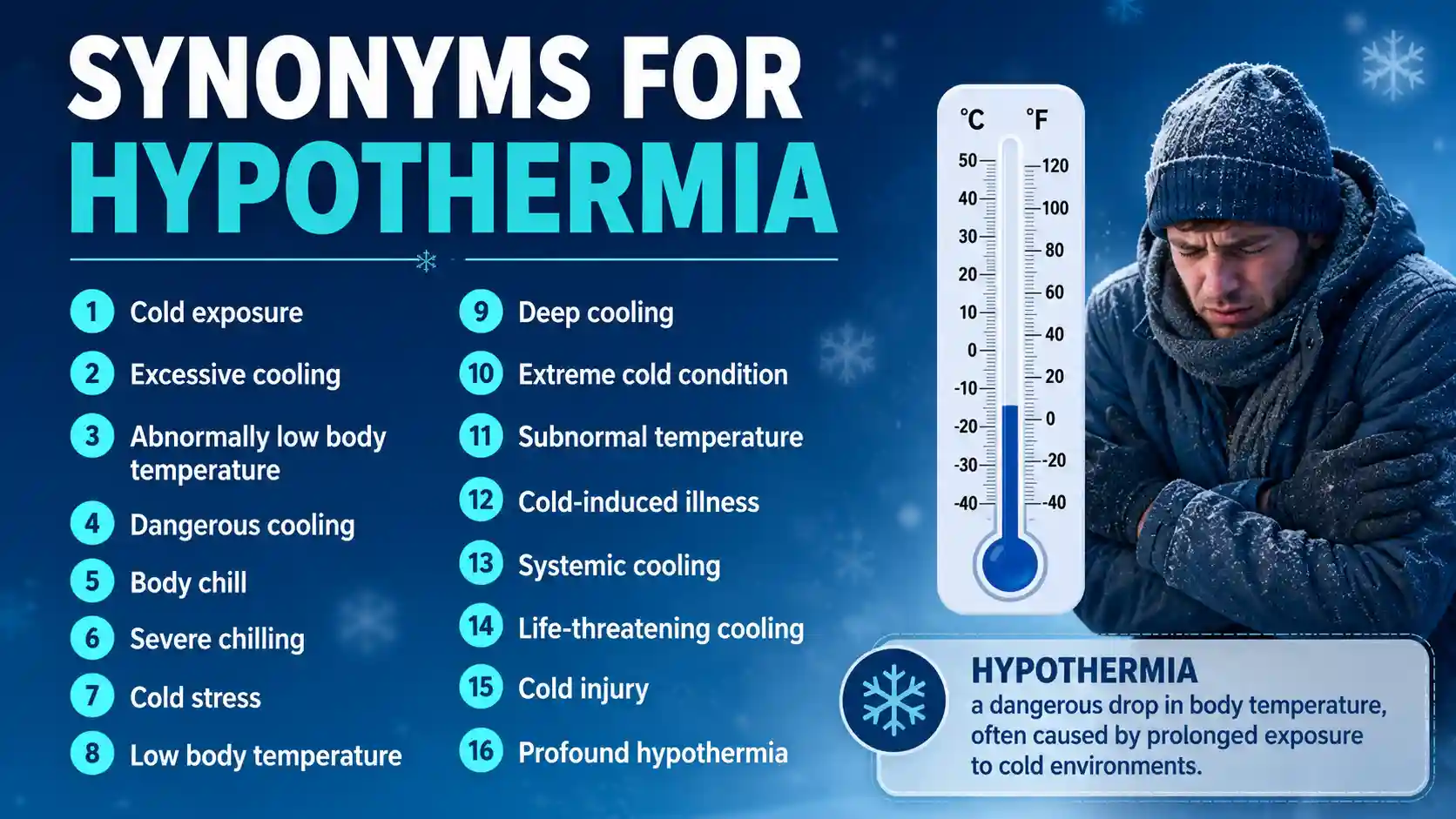
There are very few exact synonyms for hypothermia because it is a specific medical term for an abnormally low body temperature. Depending on context, related alternatives include exposure, cold exposure, extreme cold, chilling, overcooling, low body temperature, and cold-related illness. However, words such as frostbite and chills are related but do not mean the same thing.
Introduction
Have you ever needed another way to describe someone becoming dangerously cold without repeating the word hypothermia? This can be tricky because hypothermia is a precise medical term, not a word with dozens of perfect synonyms.
In everyday English, you may see expressions such as cold exposure, extreme cold, exposure, or low body temperature. These can work in certain situations, but they do not always have exactly the same meaning. Collins lists exposure and extreme cold as alternatives connected with hypothermia, while other dictionaries define hypothermia specifically as an abnormally or dangerously low body temperature.
This guide explains the closest alternatives, their differences, examples, formality, CEFR guidance, collocations, and common mistakes. It is useful for ESL learners, students, teachers, writers, bloggers, and professionals who want accurate English.
Pronunciation
Hypothermia
- American English: /ˌhaɪ.poʊˈθɝː.mi.ə/
- British English: /ˌhaɪ.pəˈθɜː.mi.ə/
A simple pronunciation guide is:
hy-poh-THER-mee-uh
Cambridge gives different American and British pronunciations, mainly because of differences in the vowel sounds.
Part of Speech
Hypothermia is a noun.
It is normally an uncountable noun:
- She was treated for hypothermia.
- The hikers were at risk of hypothermia.
The related adjective is hypothermic:
- The patient became hypothermic.
- The doctor monitored the hypothermic patient.
The word does not normally function as a verb or adverb.
Grammar Usage
The most common patterns are:
- have hypothermia
- develop hypothermia
- suffer from hypothermia
- die from hypothermia
- be at risk of hypothermia
- be treated for hypothermia
- signs/symptoms of hypothermia
Examples
- The swimmer developed hypothermia after remaining in the cold water.
- The campers were at risk of hypothermia.
- She was treated for hypothermia at the hospital.
Common preposition
of is common after verbs such as die:
- He died of hypothermia.
for is common with treatment:
- She received treatment for hypothermia.
Synonyms for Hypothermia: Quick Overview
| Alternative | Strength | Formality |
| Low body temperature | Strong | Neutral |
| Cold exposure | Strong | Neutral |
| Exposure | Related | Neutral |
| Extreme cold | Related | Neutral |
| Cold-related illness | Related | Neutral |
| Cold injury | Related | Medical |
| Cold stress | Related | Technical |
| Excessive cooling | Related | Formal |
| Overcooling | Related | Technical |
| Abnormally low temperature | Strong | Formal |
| Dangerously low body temperature | Strong | Neutral |
| Reduced body temperature | Strong | Formal |
| Chilling | Related | Neutral |
| Severe chilling | Related | Neutral |
| Becoming dangerously cold | Related | Informal |
| Cold-induced illness | Related | Formal |
| Environmental cold injury | Related | Medical |
| Cold exposure injury | Related | Medical |
| Freezing | Related | Informal |
| Frostbite | Not an exact synonym | Neutral |
Important: Most of these are alternatives or related expressions, not perfect dictionary synonyms. Hypothermia has a specific medical meaning, so replacing it with a loosely related word can change the meaning.
Detailed Synonyms and Related Alternatives
Low Body Temperature
Meaning: A body temperature that is below the normal range.
Examples:
- The nurse noticed that the patient had a low body temperature.
- Prolonged cold exposure can cause a dangerously low body temperature.
Best Used When: You want a simple explanation for a general audience.
Tone: Neutral
Register: Everyday, educational
CEFR: B1–B2
Frequency: Very common
Common Collocations:
- unusually low body temperature
- dangerously low body temperature
- low body temperature reading
When Not to Use This Word: Do not automatically use it as a medical synonym when a precise diagnosis of hypothermia is required.
Cold Exposure
Meaning: Contact with cold conditions for a period of time.
Examples:
- Long periods of cold exposure can put hikers at risk.
- The rescue team examined everyone after the cold exposure.
Best Used When: You are describing the cause or circumstance, rather than the medical condition itself.
Tone: Neutral
Register: Medical, outdoor, general
CEFR: B2
Frequency: Common
Common Collocations:
- prolonged cold exposure
- cold exposure injury
- prolonged exposure to cold
When Not to Use This Word: Cold exposure does not necessarily mean a person has hypothermia.
Exposure
Meaning: Being left without enough protection from severe weather or cold.
Examples:
- The climber was suffering from exposure after spending hours outside.
- Rescue workers warned about the danger of exposure overnight.
Best Used When: The context clearly involves dangerous environmental conditions.
Tone: Neutral
Register: General, medical, outdoor
CEFR: B2
Frequency: Very common
Collins specifically gives exposure as a synonym in the context of hypothermia.
When Not to Use This Word: Exposure is broader than hypothermia and can refer to environmental danger without a confirmed low body temperature.
Extreme Cold
Meaning: Very severe cold conditions.
Examples:
- The workers were told to remain indoors during the extreme cold.
- Extreme cold can make outdoor travel dangerous.
Best Used When: You are describing the environmental condition that may lead to hypothermia.
Tone: Neutral
Register: General, news, weather
CEFR: B1
Frequency: Very common
Common Collocations:
- extreme cold weather
- extreme cold conditions
- danger from extreme cold
When Not to Use This Word: Extreme cold describes the environment, not the body’s medical condition.
Cold-Related Illness
Meaning: An illness or health problem caused or influenced by cold conditions.
Examples:
- The shelter provided blankets to prevent cold-related illness.
- Older adults may face a higher risk of cold-related illness.
Best Used When: You want a broad term that can include several health problems.
Tone: Neutral
Register: Medical, educational
CEFR: B2–C1
Frequency: Common
When Not to Use This Word: Avoid it when you need to identify hypothermia specifically.
Cold Injury
Meaning: Physical harm caused by exposure to cold.
Examples:
- The doctor checked the skier for signs of cold injury.
- Proper clothing can reduce the risk of cold injury.
Best Used When: Discussing medical problems caused by cold more generally.
Tone: Neutral
Register: Medical
CEFR: B2–C1
Frequency: Uncommon
When Not to Use This Word: Cold injury can include conditions other than hypothermia, such as frostbite.
Cold Stress
Meaning: Physical strain placed on the body by cold conditions.
Examples:
- Workers can experience cold stress during long outdoor shifts.
- Protective clothing helps reduce cold stress.
Best Used When: Talking about workplace safety, outdoor activity, or physiological responses to cold.
Tone: Neutral
Register: Technical, occupational
CEFR: C1
Frequency: Uncommon
When Not to Use This Word: It is not a direct replacement for a medical diagnosis of hypothermia.
Excessive Cooling
Meaning: Cooling that goes beyond a normal or desired level.
Examples:
- Excessive cooling can affect the body’s normal functions.
- The equipment was adjusted to prevent excessive cooling.
Best Used When: Discussing processes, environments, or technical situations.
Tone: Formal
Register: Technical, academic
CEFR: C1
Frequency: Uncommon
When Not to Use This Word: It sounds less natural than hypothermia when describing a patient.
Overcooling
Meaning: Cooling something too much.
Examples:
- Overcooling can reduce the body’s ability to maintain normal temperature.
- The system was checked to prevent overcooling.
Best Used When: Discussing technical or scientific processes.
Tone: Neutral
Register: Technical
CEFR: C1
Frequency: Uncommon
When Not to Use This Word: Do not assume that overcooling always means clinical hypothermia.
Abnormally Low Temperature
Meaning: A temperature that is lower than expected or normal.
Examples:
- The thermometer showed an abnormally low temperature.
- An abnormally low body temperature can require medical attention.
Best Used When: Writing formal educational or medical content.
Tone: Formal
Register: Academic, medical
CEFR: B2–C1
Frequency: Common
Merriam-Webster defines hypothermia as a subnormal temperature of the body, which makes this phrase a useful explanatory alternative.
When Not to Use This Word: It can describe temperatures other than body temperature, so add body when precision matters.
Dangerously Low Body Temperature
Meaning: A body temperature that has fallen to a dangerous level.
Examples:
- The patient had a dangerously low body temperature.
- The rescue team monitored his dangerously low body temperature.
Best Used When: Explaining hypothermia in plain English.
Tone: Neutral
Register: Educational, medical
CEFR: B1–B2
Frequency: Common
Cambridge describes hypothermia as a dangerous condition involving an unusually low body temperature.
When Not to Use This Word: It is an explanatory phrase rather than a formal medical diagnosis.
Reduced Body Temperature
Meaning: A body temperature that has decreased from its normal level.
Examples:
- The patient showed reduced body temperature after prolonged exposure to cold.
- The medical team recorded reduced body temperature during the examination.
Best Used When: Writing formally about temperature changes.
Tone: Formal
Register: Academic, medical
CEFR: B2
Frequency: Common
When Not to Use This Word: It may describe a small temperature change, while hypothermia refers to a clinically significant condition.
Chilling
Meaning: Becoming very cold or making something cold.
Examples:
- The long swim left the athlete severely chilled.
- Chilling became a serious concern during the overnight expedition.
Best Used When: Describing the experience or process of becoming cold.
Tone: Neutral
Register: Everyday, descriptive
CEFR: B1
Frequency: Common
When Not to Use This Word: Chilling does not automatically mean hypothermia.
Severe Chilling
Meaning: An intense state of feeling or becoming cold.
Examples:
- Severe chilling made it difficult for the hikers to continue.
- The swimmers experienced severe chilling after the boat accident.
Best Used When: You want a descriptive phrase rather than a clinical diagnosis.
Tone: Neutral
Register: General
CEFR: B2
Frequency: Uncommon
When Not to Use This Word: Avoid using it as a medical label.
Becoming Dangerously Cold
Meaning: Reaching a level of cold that can seriously threaten the body.
Examples:
- The child was becoming dangerously cold after being outside.
- The rescue team acted quickly because the injured man was becoming dangerously cold.
Best Used When: Speaking to children, general readers, or people unfamiliar with medical vocabulary.
Tone: Informal to neutral
Register: Spoken, educational
CEFR: A2–B1
Frequency: Common
When Not to Use This Word: Use hypothermia in formal medical documentation.
Cold-Induced Illness
Meaning: An illness resulting from exposure to cold.
Examples:
- The article explains how cold-induced illness can affect vulnerable people.
- Emergency shelters help reduce the risk of cold-induced illness.
Best Used When: You need a broad formal phrase.
Tone: Formal
Register: Academic, medical
CEFR: C1
Frequency: Uncommon
When Not to Use This Word: It is too broad if you specifically mean hypothermia.
Environmental Cold Injury
Meaning: A health problem caused by exposure to cold environmental conditions.
Examples:
- The researchers studied environmental cold injuries among outdoor workers.
- Proper equipment can reduce environmental cold injury.
Best Used When: Discussing cold-related medical problems in professional or academic writing.
Tone: Formal
Register: Medical, academic
CEFR: C1–C2
Frequency: Rare
When Not to Use This Word: It is not a simple everyday substitute for hypothermia.
Cold Exposure Injury
Meaning: An injury or health problem resulting from significant exposure to cold.
Examples:
- The medical team treated several cold exposure injuries.
- The expedition leaders taught the group how to prevent cold exposure injuries.
Best Used When: Talking about cold-related injuries as a category.
Tone: Formal
Register: Medical, safety
CEFR: C1
Frequency: Uncommon
When Not to Use This Word: Do not use it when the exact condition is already known to be hypothermia.
Freezing
Meaning: Becoming extremely cold or feeling extremely cold.
Examples:
- We were freezing after waiting outside for an hour.
- The hikers were freezing by the time they reached the shelter.
Best Used When: Everyday conversations about feeling very cold.
Tone: Informal
Register: Spoken English
CEFR: A2
Frequency: Very common
When Not to Use This Word: Freezing does not mean a person has hypothermia.
Frostbite
Meaning: Tissue damage caused by freezing temperatures.
Examples:
- The climber developed frostbite in several fingers.
- Warm gloves can help protect against frostbite.
Best Used When: Talking specifically about cold damage to body tissues.
Tone: Neutral
Register: Medical, everyday
CEFR: B2
Frequency: Common
Important: Frostbite is not a synonym for hypothermia. Hypothermia affects the body’s overall temperature, while frostbite involves localized tissue damage.
When Not to Use This Word: Never replace hypothermia with frostbite simply because both are connected with extreme cold.
Synonym Categories
Strongest Synonyms
These are the safest plain-English alternatives when you need to explain the meaning:
- low body temperature
- dangerously low body temperature
- abnormally low body temperature
- reduced body temperature
These phrases preserve the central idea of hypothermia more accurately than broad words such as freezing or chilling.
Strong Related Alternatives
These work when discussing the circumstances or effects surrounding hypothermia:
- cold exposure
- exposure
- cold-related illness
- cold injury
- cold stress
- excessive cooling
- overcooling
Related Words
These are associated with cold but are not exact synonyms:
- extreme cold
- chilling
- severe chilling
- freezing
- frostbite
- cold-induced illness
Choose the Right Synonym
| If you mean… | Best choice | Why |
| The medical condition | Hypothermia | Most precise |
| Explain it simply | Low body temperature | Easy for learners |
| Describe the cause | Cold exposure | Focuses on environmental contact |
| Describe severe weather | Extreme cold | Focuses on conditions |
| Describe a general cold problem | Cold-related illness | Broad category |
| Describe tissue damage | Frostbite | Specific condition |
| Describe feeling very cold | Freezing | Natural everyday English |
| Write formally | Abnormally low body temperature | Precise explanatory phrase |
Best vocabulary tip: Do not replace a precise word simply because you want variety. In medical writing, accuracy is more important than avoiding repetition.
Commonly Confused Words
| Word | Difference | Example |
| Hypothermia | Abnormally low body temperature | The patient developed hypothermia. |
| Frostbite | Local tissue damage from freezing conditions | He suffered frostbite in his fingers. |
| Chills | A sensation or episode of shivering/coldness | She had chills during the illness. |
| Hyperthermia | Abnormally high body temperature | The patient was monitored for hyperthermia. |
| Exposure | Harmful contact with severe environmental conditions | The hiker suffered from exposure. |
Common Mistakes
Common Mistake Box
Mistake: Frostbite is another word for hypothermia.
Correction: Frostbite and hypothermia are different cold-related conditions.
Explanation: Frostbite mainly involves localized tissue injury, while hypothermia involves an abnormally low body temperature.
Mistake: Extreme cold means hypothermia.
Correction: Extreme cold can cause hypothermia.
Explanation: One describes the environment; the other describes a medical condition.
Mistake: Chills always mean hypothermia.
Correction: Chills can happen for several reasons.
Explanation: Feeling cold or shivering does not by itself establish hypothermia.
Mistake: Freezing is a medical synonym for hypothermia.
Correction: Use freezing for informal descriptions of extreme cold.
Explanation: It is much less precise.
Writing Tips: How to Use Alternatives Naturally
In Essays
Use abnormally low body temperature when defining the term for readers.
Example:
Hypothermia occurs when the body develops an abnormally low temperature.
In Emails
Keep the language simple:
Example:
Please remind outdoor staff about the risks of cold exposure.
In Blog Posts
You can alternate between the main term and explanatory phrases.
Example:
Hypothermia is a serious condition. In simple terms, it means a dangerously low body temperature.
In Stories
Descriptive language sounds more natural:
Example:
After hours in the snow, they were freezing and desperate to find shelter.
In Professional Communication
Prefer hypothermia, cold exposure, or cold injury depending on the exact meaning.
In Daily Conversation
Use simple expressions such as:
- I’m freezing.
- It’s extremely cold.
- He became dangerously cold.
- She was exposed to the cold for hours.
Word Origin and Etymology
Hypothermia comes from New Latin and ultimately contains Greek elements associated with below and heat. Oxford explains the word as coming from hypo-, meaning “below,” and Greek thermē, meaning “heat.”
Merriam-Webster gives the first known use as circa 1886.
The structure makes the meaning easy to remember:
hypo- = below
therm = heat
So, at its basic word-building level, hypothermia refers to temperature being below the normal level.
CEFR Level and Learner Guidance
Hypothermia is best treated as an advanced, specialized vocabulary item, roughly C1–C2 for general English learners because it belongs strongly to medical and health vocabulary.
Younger or lower-level learners can use simpler phrases such as:
- very low body temperature
- dangerously cold
- extremely cold
- cold exposure
More advanced learners can use:
- hypothermia
- hypothermic
- cold stress
- cold injury
- environmental cold injury
Remember: CEFR labels are useful learning guides, not official universal classifications for every word.
American vs. British English
The spelling hypothermia is the same in American and British English.
The main difference is pronunciation:
- American: /ˌhaɪ.poʊˈθɝː.mi.ə/
- British: /ˌhaɪ.pəˈθɜː.mi.ə/
Cambridge lists both varieties separately.
There is no major spelling difference comparable to pairs such as color/colour or center/centre.
Register, Connotation, and Frequency Guide
| Word | Register | Connotation | Frequency |
| Hypothermia | Medical | Serious, precise | Common |
| Low body temperature | General/medical | Neutral | Very common |
| Cold exposure | General/medical | Neutral | Common |
| Exposure | General/medical | Serious | Common |
| Extreme cold | General | Serious | Very common |
| Cold injury | Medical | Serious | Uncommon |
| Cold stress | Technical | Professional | Uncommon |
| Overcooling | Technical | Neutral | Uncommon |
| Chilling | General | Descriptive | Common |
| Freezing | Spoken | Informal | Very common |
| Frostbite | Medical/general | Serious | Common |
Real-World Collocations
Native speakers commonly use hypothermia with phrases such as:
- risk of hypothermia
- symptoms of hypothermia
- severe hypothermia
- mild hypothermia
- develop hypothermia
- treat hypothermia
- prevent hypothermia
- exposure to cold
- cold weather exposure
- low body temperature
Examples:
- The hikers were at risk of hypothermia.
- The emergency team treated severe hypothermia.
- Proper clothing can help prevent hypothermia.
- Prolonged exposure to cold can be dangerous.
These patterns are more natural than trying to substitute a different word every time.
Mini Practice Exercises
Fill in the Blanks
Choose the best word.
- The swimmer developed __________ after remaining in cold water.
- The workers were warned about prolonged __________ to cold weather.
- His fingers showed signs of __________ after the expedition.
- We were __________ after standing outside in the snow.
- The nurse recorded an unusually __________ body temperature.
Answers:
- hypothermia
- exposure
- frostbite
- freezing
- low
Sentence Rewriting
Rewrite each sentence using the word in parentheses.
- The patient had an abnormally low body temperature. (hypothermia)
- The hikers were exposed to severe cold for many hours. (cold exposure)
- We were extremely cold after waiting outside. (freezing)
Possible Answers
- The patient had hypothermia.
- The hikers experienced prolonged cold exposure.
- We were freezing after waiting outside.
Matching Activity
Match each word with its best meaning.
| Word | Meaning |
| 1. Hypothermia | A. Tissue damage from freezing |
| 2. Frostbite | B. Very cold weather |
| 3. Exposure | C. Abnormally low body temperature |
| 4. Extreme cold | D. Harmful contact with environmental conditions |
Answer: 1-C, 2-A, 3-D, 4-B
FAQ: Synonyms for Hypothermia
What is another word for hypothermia?
The closest plain-English alternative is low body temperature or dangerously low body temperature. Cold exposure and exposure are related alternatives, but they describe the circumstances that can cause hypothermia rather than the medical condition itself.
Is frostbite a synonym for hypothermia?
No. Frostbite is not a synonym for hypothermia. Frostbite refers to tissue damage caused by freezing conditions, while hypothermia refers to an abnormally low body temperature. A person can experience either condition, and in some situations both can occur.
What is a simple way to say hypothermia?
For a general audience, you can say dangerously low body temperature. This phrase explains the core meaning without using specialized medical vocabulary. In formal medical writing, however, hypothermia remains the more accurate term.
Can I use exposure instead of hypothermia?
Sometimes, but the meanings are not identical. Exposure can describe harm caused by being exposed to severe cold, while hypothermia identifies a specific condition involving unusually low body temperature. Use exposure when the environmental circumstances are the main focus.
What is the opposite of hypothermia?
The technical opposite is generally hyperthermia, meaning an abnormally high body temperature. However, hyperthermia is not simply “the opposite disease” in every medical context. The two terms describe opposite directions of abnormal temperature regulation.
Is chilling the same as hypothermia?
No. Chilling describes becoming or feeling cold, while hypothermia is a medical condition involving abnormally low body temperature. Someone can feel chilled without having hypothermia, so the words should not be treated as exact synonyms.
What is the informal word for hypothermia?
There is no perfect informal synonym. In everyday speech, people may say very cold, freezing, or dangerously cold, depending on the situation. These expressions are easier to understand but are less medically precise than hypothermia.
What is the best synonym for hypothermia in writing?
The best choice depends on your purpose. For accuracy, use hypothermia. For a simple explanation, use dangerously low body temperature. For this reason, use cold exposure. For environmental conditions, use extreme cold.
Vocabulary Quiz
1. Which word most precisely names the medical condition?
A. Freezing
B. Chilling
C. Hypothermia
D. Extreme cold
2. Which word refers specifically to localized tissue damage from freezing?
A. Exposure
B. Frostbite
C. Hypothermia
D. Cold stress
3. Which phrase is easiest for a beginner to understand?
A. Environmental cold injury
B. Cold-induced illness
C. Dangerously low body temperature
D. Hypothermia
4. Which expression focuses mainly on the environmental cause?
A. Cold exposure
B. Hypothermia
C. Frostbite
D. Chilling
5. Which word is most natural in casual speech?
A. Environmental cold injury
B. Overcooling
C. Freezing
D. Abnormally low body temperature
Answer Key
- C. Hypothermia
- B. Frostbite
- C. Dangerously low body temperature
- A. Cold exposure
- C. Freezing
Conclusion
Learning synonyms for hypothermia is useful, but accuracy matters more than simply collecting alternative words. Hypothermia is the precise medical term, while phrases such as low body temperature, cold exposure, and dangerously low body temperature can explain the idea in different contexts.
For everyday English, freezing and very cold may sound more natural. For professional writing, choose precise medical vocabulary. The best writers do not replace words randomly. They choose the word that matches the meaning, audience, tone, and situation. Keep practicing these alternatives in essays, emails, conversations, and educational writing. The more carefully you notice context, the stronger your vocabulary becomes.
Trusted References
- Merriam-Webster, Hypothermia definition, pronunciation, etymology, and first known use.
- Cambridge Dictionary, Hypothermia definition and American/British pronunciation.
- Oxford Advanced Learner’s Dictionary, Hypothermia definition, pronunciation, and word origin.
- Collins Dictionary, Hypothermia definition and thesaurus entries.

Synonorm is a trusted English vocabulary resource created to help readers find the right words and understand the differences between similar terms. We provide clear explanations of synonyms, meanings, examples, usage, and alternatives. Our content makes vocabulary easier to learn and apply in everyday, academic, and professional English. Synonorm is designed for students, writers, ESL learners, professionals, and anyone who wants to improve their English vocabulary and communicate more clearly.