Quick Answer:
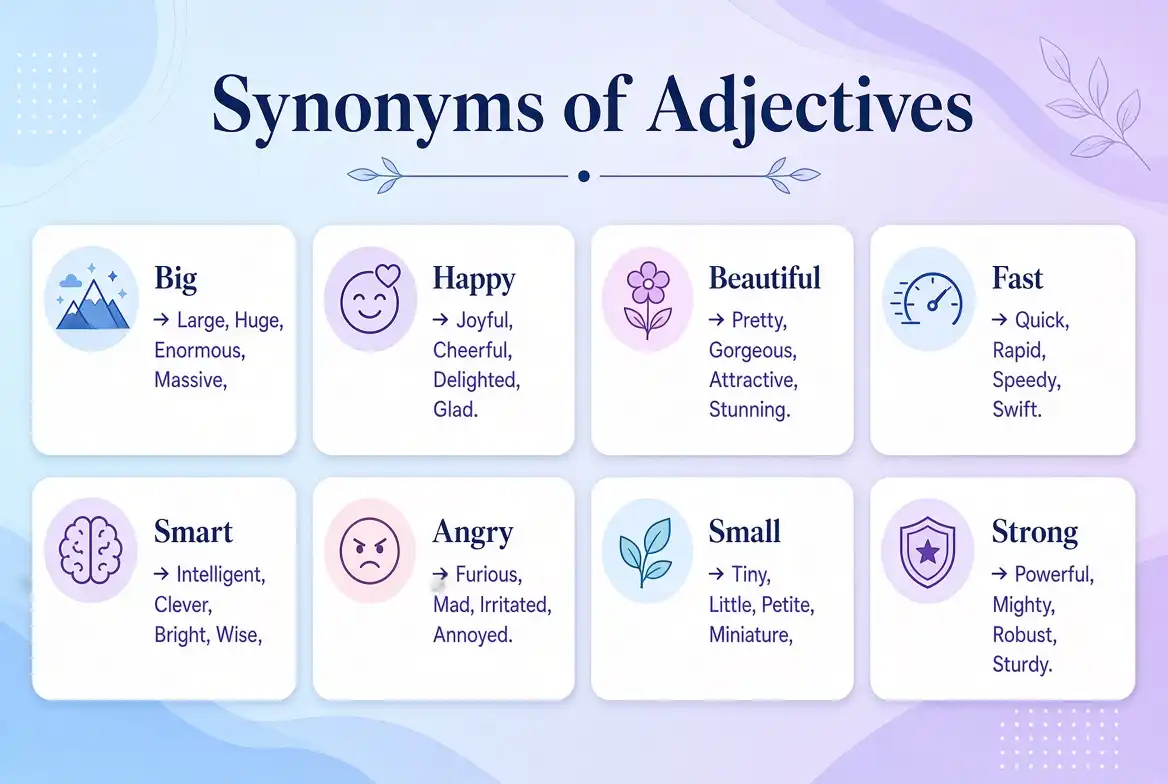
Synonyms of adjectives are words that have the same or nearly the same meaning as another adjective. For example, big can be replaced by large, happy by glad, and beautiful by lovely. However, synonyms are not always exact matches. Some are stronger, more formal, more positive, or better suited to a specific context.
What Are Synonyms of Adjectives?
Have you ever used the word good several times in one paragraph and felt that your writing sounded boring?
That is where adjective synonyms can help.
An adjective describes a person, place, thing, or idea. Words such as big, happy, beautiful, difficult, smart, fast, angry, and small are common adjectives. A synonym is a word with the same or nearly the same meaning.
For example:
- big → large
- happy → glad
- beautiful → lovely
- smart → clever
- sad → unhappy
- fast → quick
- difficult → hard
But there is an important rule: do not treat every synonym as an exact replacement. Huge is stronger than big. Slim can sound more positive than thin. Ancient usually describes something much older than simply old.
This guide gives you common adjective synonyms with meaning, examples, CEFR guidance, register, strength, nuance, collocations, and usage warnings.
Quick List of Common Adjective Synonyms
| Adjective | Common Synonyms | Strength |
| Big | large, huge, enormous, massive | Huge = stronger |
| Small | little, tiny, miniature, petite | Tiny = stronger |
| Happy | glad, joyful, cheerful, delighted | Delighted = stronger |
| Sad | unhappy, unhappy, miserable, gloomy | Miserable = stronger |
| Beautiful | pretty, lovely, attractive, gorgeous | Gorgeous = stronger |
| Smart | clever, intelligent, bright, brilliant | Brilliant = stronger |
| Good | great, excellent, fine, wonderful | Excellent = stronger |
| Bad | poor, awful, terrible, dreadful | Terrible = stronger |
| Fast | quick, rapid, speedy, swift | Rapid = more formal |
| Slow | unhurried, sluggish, leisurely | Sluggish can be negative |
| Angry | mad, annoyed, irritated, furious | Furious = much stronger |
| Brave | bold, courageous, fearless, heroic | Fearless = stronger |
| Afraid | scared, frightened, fearful, terrified | Terrified = much stronger |
| Easy | simple, straightforward, effortless | Effortless = stronger |
| Difficult | hard, challenging, demanding, tough | Challenging can be neutral |
| Funny | amusing, humorous, comical, hilarious | Hilarious = stronger |
| Tired | weary, exhausted, drained, sleepy | Exhausted = stronger |
| Rich | wealthy, affluent, prosperous | Affluent = formal |
| Poor | needy, impoverished, deprived | Impoverished = formal |
| Clean | tidy, neat, spotless, immaculate | Spotless = stronger |
| Dirty | messy, untidy, filthy, grimy | Filthy = stronger |
| Strong | powerful, sturdy, robust, forceful | Powerful = common |
| Weak | feeble, fragile, frail, powerless | Feeble = stronger |
| Important | significant, major, vital, crucial | Crucial = strong |
1. Big
Meaning: Large in size, amount, degree, or importance.
Common synonyms: large, huge, enormous, massive, great
Examples:
- They live in a big house.
- The company made a big investment.
Best synonym: large for neutral writing.
Strength:
large < big < huge/enormous/massive
CEFR: A1–A2
Register: Neutral, spoken, general writing
Frequency: Very common
Collocations:
- big problem
- big house
- big difference
When Not to Use
Do not replace every use of big with huge. Huge adds strong emphasis.
2. Small
Meaning: Not large in size, amount, or degree.
Synonyms: little, tiny, miniature, petite
Examples:
- She bought a small bag.
- We live in a small town.
Nuance:
Tiny means very small. Petite often describes a person’s small and delicate body shape. Miniature often describes a small version of something.
CEFR: A1
Register: Neutral
Frequency: Very common
Collocations:
- small amount
- small room
- small business
3. Happy
Meaning: Feeling pleasure, joy, or satisfaction.
Synonyms: glad, joyful, cheerful, pleased, delighted, content
Examples:
- She felt happy after receiving the news.
- I am glad that you came.
Strength:
glad → happy → joyful/delighted
Nuance:
Glad is very common in everyday speech. Delightedness is stronger. Content means satisfied and peaceful rather than excited.
CEFR: A1
Register: Neutral, spoken
Frequency: Very common
Collocations:
- happy person
- happy ending
- happy to help
When Not to Use
Do not use delighted when you only mean mildly pleased. It can sound too strong.
4. Sad
Meaning: Feeling unhappy or showing unhappiness.
Synonyms: unhappy, sorrowful, miserable, gloomy, downhearted
Examples:
- He felt sad after his friend moved away.
- She looked unhappy during the meeting.
Nuance:
Unhappy is a direct everyday alternative. Miserable is much stronger. Gloomy can describe a mood, atmosphere, or outlook.
CEFR: A1
Register: Neutral
Frequency: Very common
Collocations:
- sad story
- sad face
- sad news
5. Beautiful
Meaning: Very pleasing to look at or experience.
Synonyms: pretty, lovely, attractive, gorgeous, stunning
Examples:
- She wore a beautiful dress.
- We watched a stunning sunset.
Strength:
pretty/lovely → beautiful → gorgeous/stunning
Nuance:
Pretty is often lighter and less intense. Gorgeous is informal and strongly positive. Attractive is more neutral and can describe people, objects, or features.
CEFR: A1–A2
Register: Neutral
Frequency: Very common
Collocations:
- beautiful view
- beautiful woman
- beautiful place
When Not to Use
Do not use gorgeous in a formal report unless the tone allows strong personal evaluation.
6. Smart
Meaning: Intelligent or able to learn and understand things quickly.
Synonyms: clever, intelligent, bright, sharp, brilliant
Examples:
- Maya is a smart student.
- He is very clever at solving problems.
Nuance:
Intelligence is neutral and common in academic writing. Clever can describe intelligence or skill. Brilliant is much stronger and can also mean excellent.
CEFR: A2
Register: Neutral, spoken
Frequency: Very common
Collocations:
- smart student
- smart decision
- smart solution
7. Good
Meaning: Having a positive quality or being satisfactory or successful.
Synonyms: great, excellent, fine, wonderful, superb
Examples:
- She did a good job.
- He gave an excellent presentation.
Strength:
fine → good → great → excellent/superb
CEFR: A1
Register: Neutral
Frequency: Extremely common
Important Nuance:
Good has many meanings. A synonym that works for one meaning may not work for another.
For example:
- good person → kind person
- good food → tasty food
- good result → successful result
This is one reason context matters when choosing synonyms.
8. Bad
Meaning: Not good or not acceptable.
Synonyms: poor, awful, terrible, dreadful, unpleasant
Examples:
- The weather was bad.
- We had a terrible experience.
Nuance:
Poor people can sound less emotional. Terrible and awful are much stronger.
CEFR: A1
Frequency: Very common
Collocations:
- bad habit
- bad decision
- bad weather
9. Fast
Meaning: Moving or happening quickly.
Synonyms: quick, rapid, speedy, swift
Examples:
- That is a fast car.
- We need a quick answer.
Nuance:
Quick is very common in everyday English. Rapid is more common in formal or academic writing. Swift can sound literary or formal.
CEFR: A1
Register: Neutral
Frequency: Very common
Collocations:
- fast car
- fast learner
- fast growth
10. Difficult
Meaning: Not easy to do, understand, or solve.
Synonyms: hard, challenging, tough, demanding, complicated
Examples:
- This exam is difficult.
- The project was challenging but rewarding.
Nuance:
Hard is common in conversation. Challenging often sounds more positive because it suggests an opportunity to develop a skill.
CEFR: A2
Register: Neutral
Frequency: Very common
Collocations:
- difficult task
- difficult question
- difficult decision
11. Angry
Meaning: Feeling strong annoyance or displeasure.
Synonyms: mad, annoyed, irritated, furious, enraged
Examples:
- She was angry about the mistake.
- His father became furious when he heard the news.
Strength:
annoyed → irritated → angry → furious/enraged
CEFR: A2
Register: Neutral
Frequency: Very common
When Not to Use
Furious means extremely angry. Do not use it for a small annoyance.
12. Brave
Meaning: Willing to face danger, difficulty, or fear.
Synonyms: courageous, bold, fearless, heroic, valiant
Examples:
- The brave firefighter entered the building.
- She made a courageous decision.
Nuance:
Courageous is common in formal writing. Fearless suggests a lack of fear. Bold can also mean confident or willing to take risks.
CEFR: B1
Frequency: Common
13. Afraid
Meaning: Feeling fear or worry about something.
Synonyms: scared, frightened, fearful, terrified, nervous
Examples:
- The child was afraid of the dark.
- She was terrified by the sudden noise.
Strength:
nervous → afraid/scared → frightened → terrified
CEFR: A2
Register: Neutral
Frequency: Very common
14. Easy
Meaning: Not difficult to do, understand, or use.
Synonyms: simple, straightforward, effortless, uncomplicated
Examples:
- The instructions are easy to follow.
- The process is straightforward.
Nuance:
Simple often means easy to understand. Effortless means requiring almost no effort.
CEFR: A1
Frequency: Very common
15. Funny
Meaning: Causing laughter or amusement.
Synonyms: amusing, humorous, comical, hilarious, entertaining
Examples:
- He told a funny story.
- The movie was hilarious.
Nuance:
Hilarious means extremely funny. Humorous is more neutral and works well in writing.
CEFR: A2
Frequency: Very common
16. Tired
Meaning: Needing rest because of physical or mental effort.
Synonyms: weary, exhausted, drained, sleepy, fatigued
Examples:
- I felt tired after work.
- She was exhausted after the long journey.
Nuance:
Sleepy means ready to sleep. Exhausted means extremely tired. Fatigued is more formal.
CEFR: A2
Frequency: Very common
17. Rich
Meaning: Having a lot of money or valuable resources.
Synonyms: wealthy, affluent, prosperous, well-off
Examples:
- He comes from a wealthy family.
- The region became more prosperous over time.
Nuance:
Wealthy is neutral. Affluent is more formal. Well-off is common in conversation.
CEFR: A2–B1
Register: Neutral/Formal
18. Poor
Meaning: Having little money or few resources.
Synonyms: needy, impoverished, deprived, disadvantaged
Examples:
- The charity helps poor families.
- The program supports disadvantaged children.
Nuance:
Poor is broad. Impoverished is formal and strongly emphasizes lack of money or resources. Disadvantaged can refer to social or economic difficulties without directly labeling someone as poor.
CEFR: A2
Register: Neutral/Formal
19. Clean
Meaning: Free from dirt, marks, or unwanted material.
Synonyms: tidy, neat, spotless, immaculate, hygienic
Examples:
- Keep your room clean.
- The kitchen was spotless.
Nuance:
Tidy often means organized rather than simply free from dirt. Spotless means completely clean.
CEFR: A1
Frequency: Very common
20. Dirty
Meaning: Covered with dirt or not clean.
Synonyms: messy, untidy, filthy, grimy, muddy
Examples:
- His shoes were dirty.
- The old floor was grimy.
Nuance:
Messy often means untidy rather than physically dirty. Filthy is much stronger.
21. Strong
Meaning: Having physical power, force, or a high degree of something.
Synonyms: powerful, sturdy, robust, forceful, tough
Examples:
- He is physically strong.
- The company has a strong brand.
Nuance:
Sturdy is often used for objects. Powerful can describe people, machines, arguments, emotions, or organizations.
22. Weak
Meaning: Not physically or emotionally strong.
Synonyms: feeble, fragile, frail, powerless, delicate
Examples:
- The patient felt weak.
- The old bridge looked fragile.
Nuance:
Fragile often means easily damaged. Frail commonly describes a physically weak person, especially an older person.
23. Important
Meaning: Having great value, effect, or influence.
Synonyms: significant, major, vital, crucial, essential
Examples:
- Education plays an important role.
- This is a crucial part of the plan.
Strength:
important → significant → vital/crucial
CEFR: A2–B1
Register: Neutral/Formal
Frequency: Very common
24. Nice
Meaning: Pleasant, enjoyable, kind, or satisfactory.
Synonyms: pleasant, lovely, enjoyable, kind, agreeable
Examples:
- We had a nice evening.
- She is very kind to everyone.
Important:
Nice has many meanings. Kind works when describing behavior or personality, but not every meaning of nice.
For example:
She has a nice car.
Here, attractive or beautiful may work better than kind.
25. Old
Meaning: Having existed for a long time.
Synonyms: aged, ancient, older people, antique, longtime
Examples:
- They live in an old house.
- We visited an ancient city.
Nuance:
Ancient normally means extremely old, especially from a distant historical period. Older people usually describe people. Antique often describes valuable old objects.
When Not to Use
Do not use ancient for everything that is simply old.
26. New
Meaning: Recently made, discovered, obtained, or introduced.
Synonyms: recent, modern, fresh, novel, latest
Examples:
- She bought a new laptop.
- Scientists developed a novel method.
Nuance:
Modern does not always mean recently made. It can mean something related to the present era. Novel means new or original, especially an idea or method.
27. Quiet
Meaning: Making little or no noise.
Synonyms: silent, peaceful, calm, still, hushed
Examples:
- The library is quiet.
- The village became peaceful after sunset.
Nuance:
Silent means no sound. Peaceful describes a calm atmosphere and does not necessarily mean complete silence.
28. Loud
Meaning: Making a lot of noise.
Synonyms: noisy, deafening, booming, thunderous, clamorous
Examples:
- The music is too loud.
- The crowd became noisy.
Nuance:
Deafening is much stronger. Booming often describes a deep, powerful sound.
29. Kind
Meaning: Caring about other people and treating them well.
Synonyms: caring, thoughtful, considerate, compassionate, generous
Examples:
- She is a kind teacher.
- It was thoughtful of him to call.
Nuance:
Generous focuses on giving. Compassionate focuses on concern for someone who is suffering. Thoughtful often means showing care through actions.
30. Important Rule: Synonyms Are Not Always Interchangeable
This is one of the biggest lessons for English learners.
Consider:
The house is big.
You can say:
The house is large.
But:
The house is enormous.
adds much more emphasis.
Similarly:
She is thin.
and
She is slim.
may describe a similar body shape, but slim often has a more positive or complimentary tone.
Another example:
The old building
is not always the same as
The ancient building.
Ancient suggests a very distant historical age.
So, before replacing an adjective, ask:
- Does the synonym have the same basic meaning?
- Is it stronger or weaker?
- Does it sound positive or negative?
- Is it formal or informal?
- Does it naturally fit the noun?
- Would a native speaker normally use it in this context?
Strong, Neutral, and Related Synonyms
Stronger Synonyms
These add more intensity:
- big → huge
- happy → delighted
- angry → furious
- funny → hilarious
- tired → exhausted
- beautiful → stunning
- dirty → filthy
- important → crucial
Neutral Synonyms
These usually work well in everyday English:
- big → large
- happy → glad
- sad → unhappy
- fast → quick
- difficult → hard
- smart → clever
- beautiful → lovely
Related but Not Exact Synonyms
These need more care:
- thin → slim
- old → ancient
- good → kind
- nice → pleasant
- quiet → peaceful
- clean → tidy
- poor → disadvantaged
How to Choose the Right Synonym
| Situation | Better Choice | Why |
| Everyday conversation | big | Natural and common |
| Formal report | large | Neutral |
| Strong emphasis | enormous | Very strong |
| Academic writing | significant | Formal |
| Friendly conversation | glad | Natural |
| Professional praise | excellent | Strong positive meaning |
| Casual humor | funny | Natural |
| Formal humor discussion | humorous | More formal |
Remember: The best synonym is not always the most advanced word. It is the word that gives the exact meaning you need.
Common Mistakes With Adjective Synonyms
Mistake 1: Using a stronger word by accident
Wrong idea:
The small problem was enormous.
If the problem is genuinely small, enormous changes in meaning.
Mistake 2: Treating near synonyms as exact synonyms
Thin and slim can overlap, but they can have different connotations.
Mistake 3: Choosing a formal synonym in casual speech
I am extremely fatigued.
This is grammatically correct, but:
I’m really tired.
sounds much more natural in everyday conversation.
Mistake 4: Changing the part of speech
Synonyms should normally belong to the same grammatical category when you replace them.
happy → joyful ✓
happy → happily ✗
The first two are adjectives. Happily is an adverb.
Adjective Synonyms in American and British English
Most common adjective synonyms work in both American and British English.
Some vocabulary choices can differ by region:
- American: mad can commonly mean angry
- British: mad can also mean wild or mentally ill in older/general usage
- American: favorite
- British: favourite
The main meaning of common adjective pairs such as big/large and happy/glad remains widely understood in both varieties.
Adjective Synonym Register Guide
| Register | Useful Choices |
| Spoken English | big, nice, happy, funny, tired |
| General writing | large, pleasant, joyful, amusing |
| Academic | significant, challenging, substantial |
| Business | effective, efficient, substantial, crucial |
| Literary | gloomy, radiant, magnificent, sorrowful |
| Informal | huge, awesome, mad, hilarious |
Adjective Synonyms for Better Writing
Instead of “Good”
Weak:
She gave a good answer.
More precise:
She gave an accurate answer.
Professional:
She gave an effective answer.
Instead of “Bad”
Weak:
The service was bad.
More precise:
The service was poor.
Stronger:
The service was terrible.
Instead of “Big”
Basic:
It was a big problem.
More precise:
It was a major problem.
Stronger:
It was a serious problem.
The lesson is to choose the synonym based on what you actually mean.
Collocations: How Native Speakers Naturally Use Adjectives
Learning a synonym alone is not enough. Learn the words that commonly appear with it.
Big
- big decision
- big mistake
- big difference
Happy
- happy customer
- happy ending
- happy childhood
Strong
- strong argument
- strong coffee
- strong evidence
Difficult
- difficult decision
- difficult question
- difficult situation
Important
- important issue
- important role
- important decision
This approach helps ESL learners produce natural English rather than simply memorizing word lists.
Mini Practice: Fill in the Blanks
Choose the best synonym.
- The test was very ________.
A. difficult
B. tiny
C. cheerful - Sarah was ________ when she heard the good news.
A. furious
B. delighted
C. gloomy - We stayed in a ________ hotel near the beach.
A. beautiful
B. furious
C. difficult - The box was ________, so I could not lift it.
A. enormous
B. quiet
C. cheerful - The old bridge looked ________.
A. fragile
B. hilarious
C. wealthy
Answers
- A
- B
- A
- A
- A
Rewrite the Sentence
Replace the basic adjective with a more precise synonym.
1.
The movie was good.
Possible answer:
The movie was excellent.
2.
He was angry.
Possible answer:
He was furious.
3.
The room was clean.
Possible answer:
The room was spotless.
4.
The journey was difficult.
Possible answer:
The journey was challenging.
There may be more than one correct answer because synonym choice depends on context.
Matching Practice
Match each adjective with the best synonym.
| Adjective | Synonym |
| 1. Happy | A. Huge |
| 2. Big | B. Clever |
| 3. Smart | C. Glad |
| 4. Angry | D. Quick |
| 5. Fast | E. Furious |
Answers:
1-C, 2-A, 3-B, 4-E, 5-D.
FAQs About Synonyms of Adjectives
What are synonyms of adjectives?
Synonyms of adjectives are words that have the same or nearly the same meaning as another adjective. Examples include big/large, happy/glad, beautiful/lovely, and fast/quick. However, many synonyms have different levels of strength, formality, or emotional meaning.
What are 10 examples of adjective synonyms?
Ten common pairs are big/large, small/little, happy/glad, sad/unhappy, beautiful/lovely, smart/clever, fast/quick, difficult/hard, angry/mad, and strong/powerful. These pairs are useful for everyday English, school writing, conversations, and vocabulary practice.
What is a synonym for happy?
Common synonyms for happy include glad, joyful, cheerful, pleased, delighted, and content. They are not identical in every situation. Glad is common in everyday speech, while delighted expresses a stronger feeling of pleasure.
What is a synonym for big?
Common synonyms for big include large, huge, enormous, massive, and great. Large is usually the safest direct replacement. Huge and enormous are stronger, while massive often emphasizes physical size or scale.
What is a synonym for beautiful?
Common synonyms for beautiful include pretty, lovely, attractive, gorgeous, and stunning. Pretty can sound lighter, while gorgeous and stunning express stronger admiration. Attractive is more neutral and can describe people, objects, or features.
Are synonyms exactly the same?
Usually not. Most synonyms share a core meaning but differ in intensity, tone, register, or context. For example, big, huge, and enormous all describe size, but the latter two express much greater size. Good synonym use requires attention to context.
Why should students learn adjective synonyms?
Adjective synonyms help students avoid repetition, expand vocabulary, improve descriptive writing, and express ideas more precisely. They are useful in essays, school assignments, emails, stories, conversations, and professional writing.
How can I learn adjective synonyms quickly?
Start with common words such as big, happy, sad, good, bad, beautiful, difficult, easy, fast, and angry. Learn two or three natural alternatives for each word, then practice them in original sentences. Focus on meaning and context instead of memorizing long lists.
Final Takeaway
Learning synonyms of adjectives can make your English more varied and precise, but memorizing long lists is not enough. The real skill is knowing which synonym fits the context. Start with common pairs such as big/large, happy/glad, beautiful/lovely, smart/clever, difficult/hard, and fast/quick. Then learn stronger and more specific choices such as enormous, delighted, stunning, brilliant, challenging, and rapid.
Use these words in your essays, emails, conversations, stories, and everyday writing. With regular practice, you will build a richer vocabulary and communicate your ideas with greater accuracy and confidence.

Synonorm is a trusted English vocabulary resource created to help readers find the right words and understand the differences between similar terms. We provide clear explanations of synonyms, meanings, examples, usage, and alternatives. Our content makes vocabulary easier to learn and apply in everyday, academic, and professional English. Synonorm is designed for students, writers, ESL learners, professionals, and anyone who wants to improve their English vocabulary and communicate more clearly.