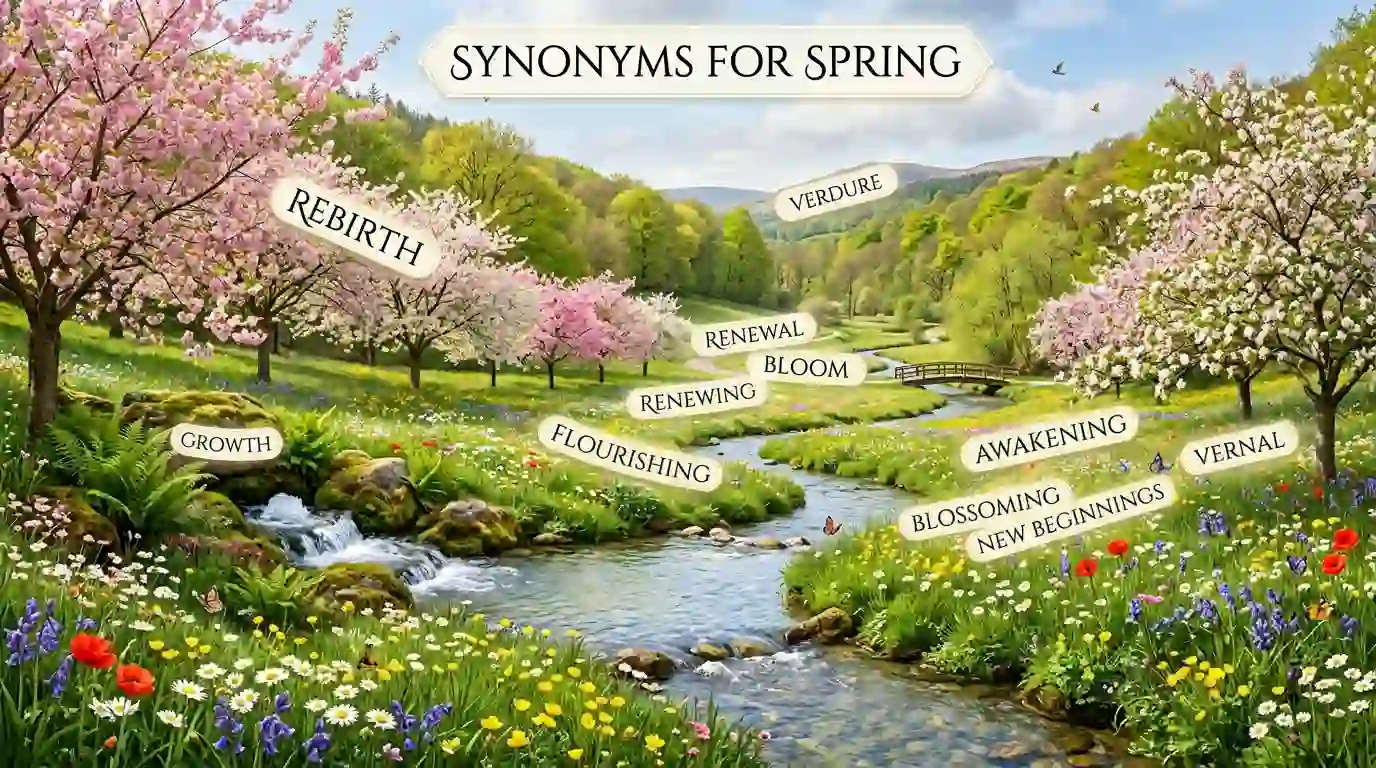
What are the best synonyms for spring? The answer depends on what spring means in your sentence. If you mean a sudden jump, use words such as leap, jump, bound, hop, or vault. If you mean the season, springtime is the closest everyday alternative. If you mean something that comes from a source, words such as arise, emerge, originate, stem, and derive may work. For the water-source sense, fountain, fountain, and wellspring can sometimes fit, but they are not exact replacements in every context.
What Does Spring Mean?
Spring is a versatile English word with several different meanings. As a noun, it can mean the season after winter, a natural source of water, a coiled piece of metal, or a sudden jump. As a verb, it can mean to move suddenly, appear suddenly, originate from something, or trigger something.
This makes spring an interesting vocabulary word but also a tricky one for English learners.
Consider these sentences:
- Spring is my favorite season.
- The cat sprang onto the table.
- We found a cold spring in the mountains.
- The problem springs from poor planning.
- The trap was sprung when the animal touched it.
Each sentence uses the same basic word in a different sense.
So, instead of memorizing a long list of words, learn which synonym belongs to which meaning.
Spring Pronunciation
IPA: /sprɪŋ/
Pronunciation: spring
American and British English use essentially the same pronunciation. Cambridge gives /sprɪŋ/ for both varieties.
The final sound is /ŋ/, as in:
- sing
- bring
- thing
- wing
Part of Speech
Spring works mainly as a noun and verb.
Spring as a noun
- Season: Spring comes after winter.
- Natural water source: We drank water from a mountain spring.
- Jump: The dancer made a powerful spring.
- Elastic device: The broken spring needs replacing.
- Energy or resilience: There was still some spring in his step.
Spring as a verb
- Move suddenly: The cat sprang onto the sofa.
- Suddenly: New businesses sprang up around the station.
- Come from: The custom springs from an old tradition.
- Trigger or release: The mechanism sprang the trap.
Cambridge records these major noun and verb senses separately, including the movement and sudden-appearance uses.
Spring Grammar and Word Forms
The verb has irregular forms:
| Form | Word |
| Base form | spring |
| Past tense | sprang |
| Past participle | sprung |
| -ing form | springing |
| Third person | springs |
Examples
- I spring out of bed early.
- She sprang to her feet.
- The trap has sprung shut.
- New flowers are springing up.
- Ideas spring from experience.
Common patterns
spring from + noun
The idea sprang from a classroom discussion.
spring up
New cafés have sprung up near the station.
spring into action
The team sprang into action after the alarm.
spring to mind
One example immediately sprang to mind.
spring something on someone
He suddenly sprang a difficult question on me.
Cambridge specifically records these phrasal and idiomatic patterns.
Quick Synonym Guide
| Meaning of spring | Best alternatives | Accuracy |
| Jump suddenly | leap, jump, bound | Very close |
| Make a small jump | hop | Close |
| Jump over something | vault | Context-specific |
| Move quickly | dart, bolt, rush | Related |
| Move backward suddenly | recoil | Context-specific |
| Season | springtime | Very close |
| Natural water source | fount, fountain, wellspring | Context-specific |
| Source/origin | source, wellspring, fountainhead | Context-specific |
| Appear suddenly | emerge, arise, appear | Close |
| Come from | stem, originate, derive | Close |
| Begin | start, begin, commence | Related |
| Trigger/release | trigger, release | Close in specific construction |
Thesaurus.com and Cambridge both organize spring by meaning rather than treating every listed word as interchangeable. That distinction is essential for accurate writing.
30 Useful Synonyms and Related Alternatives for Spring
1. Leap
Meaning: To jump high, far, or with energy.
Example 1: The deer leaped over the fence.
Example 2: She leaped across the narrow stream.
Best used when: You want to emphasize a strong or noticeable jump.
Register: Neutral
CEFR: B1
Frequency: Very common
Connotation: Energetic, powerful movement
Common collocations:
- leap over a fence
- leap into action
- giant leap
When not to use it: Do not use leap to mean the season or a natural water source.
2. Jump
Meaning: To push yourself off a surface and move into the air.
Example 1: The boy jumped over the puddle.
Example 2: The dog jumped onto the chair.
Best used when: You need the simplest everyday word for physical jumping.
Register: Neutral, spoken
CEFR: A1
Frequency: Very common
Connotation: General and neutral
Common collocations:
- jump over
- jump up
- jump across
When not to use it: Jump does not carry the same energetic or sudden nuance as spring in every sentence.
3. Bound
Meaning: To move forward with energetic jumps.
Example 1: The puppy bounded across the garden.
Example 2: She bounded up the stairs.
Best used when: A person or animal moves energetically and often happily.
Register: Neutral
CEFR: B2
Frequency: Common
Connotation: Lively, energetic
Common collocations:
- bound across
- bound forward
- bound up the stairs
When not to use it: It sounds unnatural for a tiny, careful movement.
4. Hop
Meaning: To make a small jump, often on one foot.
Example 1: The child hopped over the line.
Example 2: The rabbit hopped along the path.
Best used when: The movement is small or light.
Register: Neutral
CEFR: A2
Frequency: Common
Connotation: Light, playful
Common collocations:
- hop over
- hop along
- hop on one foot
5. Vault
Meaning: To jump over something, often using your hands or momentum.
Example 1: The athlete vaulted over the barrier.
Example 2: She vaulted across the low wall.
Best used when: Someone clears an obstacle with a jump.
Register: Neutral
CEFR: B2
Frequency: Uncommon
Connotation: Athletic
When not to use it: Do not use the vault for an ordinary small jump.
6. Bounce
Meaning: To move upward or away after hitting a surface, or to move repeatedly up and down.
Example 1: The ball bounced across the floor.
Example 2: The children bounced on the mattress.
Best used when: The movement involves repeated or elastic motion.
Register: Neutral
CEFR: A2
Frequency: Very common
Nuance: Bounce focuses on repeated or elastic movement, not simply one sudden jump.
7. Dart
Meaning: To move suddenly and quickly.
Example 1: The mouse darted under the table.
Example 2: She darted across the room.
Best used when: Speed and sudden movement matter more than the physical jump.
Register: Neutral
CEFR: B2
Frequency: Common
Common collocations:
- dart across
- dart away
- dart into
8. Bolt
Meaning: To run away suddenly and quickly.
Example 1: The frightened horse bolted from the field.
Example 2: The child bolted toward the open door.
Best used when: The movement is sudden and fast, especially because of fear or excitement.
Register: Neutral
CEFR: B2
Frequency: Common
When not to use it: Bolt does not simply mean any type of jump.
9. Lunge
Meaning: To move suddenly and strongly forward.
Example 1: The dog lunged toward the ball.
Example 2: The player lunged forward to catch it.
Best used when: Movement is forceful and directed toward something.
Register: Neutral
CEFR: B2
Frequency: Common
Nuance: Lunge suggests force and direction rather than a simple jump.
10. Recoil
Meaning: To move backward suddenly because of shock, pain, fear, or force.
Example 1: She recoiled from the hot pan.
Example 2: He recoiled when the snake moved.
Best used when: The movement goes backward as a reaction.
Register: Neutral/Formal
CEFR: C1
Frequency: Common
When not to use it: Do not use it for a normal forward jump.
Synonyms for Spring Meaning the Season
11. Springtime
Meaning: The season between winter and summer.
Example 1: The park becomes colorful in springtime.
Example 2: Many birds return during springtime.
Best used when: You want a direct and natural alternative to spring.
Register: Neutral
CEFR: B1
Frequency: Common
Important: This is the closest everyday alternative to the seasonal meaning.
12. Springtide
Meaning: A literary or old-fashioned word for spring.
Example 1: The poem celebrates the arrival of springtide.
Example 2: Springtide brought flowers to the valley.
Best used when: Writing poetry or literary prose.
Register: Literary
CEFR: C2
Frequency: Rare
When not to use it: Avoid it in normal conversation and business writing.
13. Seedtime
Meaning: A traditional term for a period when seeds are planted.
Example 1: Farmers prepared the fields at seedtime.
Example 2: The old poem connects seedtime with new growth.
Best used when: Discussing farming, history, or literature.
Register: Literary/Traditional
CEFR: C2
Frequency: Rare
Important: Seedtime is not an exact synonym for modern spring. It refers specifically to planting time.
14. Vernal Season
Meaning: A formal expression referring to spring.
Example 1: The plants become active during the vernal season.
Example 2: The report examined temperatures during the vernal season.
Best used when: You need formal or scientific wording.
Register: Formal/Academic
CEFR: C2
Frequency: Uncommon
When not to use it: Spring is much more natural in everyday English.
Synonyms Related to Spring as a Water Source
15. Fount
Meaning: A source of water or, figuratively, a source of something.
Example 1: The travelers found a cool fountain in the valley.
Example 2: Her curiosity became a fount of new ideas.
Register: Literary
CEFR: C1
Frequency: Uncommon
Nuance: Fount often sounds more literary than spring.
16. Fountain
Meaning: A source or stream of water, often artificial, but sometimes used for a natural source.
Example 1: Water flowed from the stone fountain.
Example 2: The poet described the river as a fountain of life.
Register: Neutral/Literary
CEFR: B1
Frequency: Common
When not to use it: Do not automatically replace spring with fountain. A fountain is often a constructed feature, while a natural spring is water emerging naturally from the ground.
17. Wellspring
Meaning: A source of water or a rich source of something.
Example 1: The mountain was a natural wellspring of fresh water.
Example 2: Books can become a wellspring of ideas.
Register: Literary/Neutral
CEFR: C1
Frequency: Uncommon
Nuance: Wellspring is especially useful in figurative writing.
18. Well
Meaning: A constructed place used to obtain groundwater.
Example 1: The village relies on a deep well.
Example 2: They drew water from the old well.
Register: Neutral
CEFR: A1
Frequency: Very common
Important: A well and a natural spring are not the same physical feature.
Synonyms for Spring Meaning “Appear” or “Come Into Existence”
19. Emerge
Meaning: To appear or become known.
Example 1: A clear pattern emerged from the research.
Example 2: Several problems emerged during testing.
Register: Neutral/Academic
CEFR: B2
Frequency: Very common
Common collocations:
- emerge from
- emerge as
- emerge gradually
Best used when: Something becomes visible, known, or established.
20. Arise
Meaning: To begin to exist or happen.
Example 1: Several questions arose during the meeting.
Example 2: Problems may arise without careful planning.
Register: Formal/Neutral
CEFR: B2
Frequency: Common
Common collocations:
- problems arise
- questions arise
- opportunities arise
21. Originate
Meaning: To begin or come from a particular source.
Example 1: The tradition originated in a small village.
Example 2: The idea originated with a group of students.
Register: Academic/Formal
CEFR: B2
Frequency: Common
Common collocations:
- originate from
- originate in
- originate with
22. Stem
Meaning: To come from a particular source or cause.
Example 1: The problem stems from poor communication.
Example 2: Her interest in science stems from childhood.
Register: Neutral/Academic
CEFR: B2
Frequency: Common
Key pattern: stem from
This is one of the most useful alternatives when spring means “come from.”
23. Derive
Meaning: To come from a particular source.
Example 1: The English word derives from an older Germanic form.
Example 2: The company derives most of its income from exports.
Register: Formal/Academic
CEFR: B2
Frequency: Common
Key pattern: derive from
24. Arise From
Meaning: To develop or result from something.
Example 1: The disagreement arose from a simple misunderstanding.
Example 2: New opportunities can arise from difficult situations.
Register: Formal/Neutral
CEFR: B2
Frequency: Common
Nuance: This construction focuses on a result or development.
25. Appear
Meaning: To become visible or come into existence.
Example 1: New shops appeared along the road.
Example 2: A strange mark appeared on the wall.
Register: Neutral
CEFR: A2
Frequency: Very common
Nuance: Appear is broader and simpler than spring. It does not necessarily suggest suddenness.
26. Begin
Meaning: To start.
Example 1: The project began in May.
Example 2: The flowers began to appear after the rain.
Register: Neutral
CEFR: A1
Frequency: Very common
When not to use it: Do not use begin when you specifically need the sudden or energetic sense of spring.
Synonyms for Spring Meaning “Trigger” or “Release”
27. Trigger
Meaning: To cause something to happen or activate a mechanism.
Example 1: The pressure triggered the alarm.
Example 2: Touching the wire triggered the device.
Best used when: Spring means to activate something.
Register: Neutral/Technical
CEFR: B2
Frequency: Very common
28. Release
Meaning: To let something go or allow it to move freely.
Example 1: Pressing the button released the mechanism.
Example 2: The device released the stored energy.
Register: Neutral/Formal
CEFR: B1
Frequency: Very common
Nuance: Release is broader than spring and works best when something is physically or mechanically freed.
Strongest, Strong, and Related Synonyms
Strongest Direct Alternatives
These are the closest choices for common senses:
Movement:
- jump
- leap
- bound
- hop
Season:
- springtime
Origin:
- stem
- originate
- derive
Sudden appearance:
- emerge
- arise
- appear
Strong Contextual Alternatives
- vault
- dart
- bolt
- lunge
- recoil
- fount
- wellspring
- trigger
- release
Related Words, Not Exact Synonyms
- seedtime
- vernal
- well
- fountain
- begin
- start
- springtide
This distinction matters because a thesaurus can list related words that do not work as direct replacements. Thesaurus.com, for example, separates its results into senses such as jump/skip, season, origin, rushing waters, and different verb meanings.
Choose the Right Synonym for Spring
| Original sentence | Better replacement | Why |
| The cat sprang onto the sofa. | The cat leaped onto the sofa. | Physical jump |
| The rabbit sprang across the path. | The rabbit bounded across the path. | Energetic movement |
| She sprang over the wall. | She vaulted over the wall. | Clears an obstacle |
| New shops sprang up. | New shops emerged. | Sudden appearance |
| The problem sprang from confusion. | The problem stemmed from confusion. | Source or cause |
| The tradition sprang from religion. | The tradition originated in religion. | Historical source |
| We visited a mountain spring. | We visited a natural fount. | Water-source context, but literary |
| Spring is warm here. | Springtime is warm here. | Seasonal sense |
The safest decision rule
Ask these three questions:
- Does spring mean a jump?
Try jump, leap, bound, hop, or vault. - Does spring mean the season?
Try springtime. - Does spring mean “come from” or “appear”?
Try stem, originate, derive, emerge, or arise.
This approach is more reliable than choosing a synonym from a long alphabetical list.
Commonly Confused Words
| Word | Difference | Example |
| Spring | Natural water emerging from the ground | We found a spring in the hills. |
| Well | Usually a constructed source of groundwater | The farm has a deep well. |
| Fountain | Usually a structure or source from which water flows | The children played near the fountain. |
| Jump | General physical movement into the air | He jumped over the puddle. |
| Leap | A larger, stronger, or more energetic jump | The horse leaped over the fence. |
Cambridge defines a spring in the water sense as a place where water naturally flows out from the ground.
Common Mistakes
Common Mistake Box
Mistake 1
Wrong: The company jumped up from an old tradition.
Better: The company sprang from an old tradition.
Why: Spring from can express origin. Jump from normally describes physical movement.
Mistake 2
Wrong: New cafés leaped up around the university.
Better: New cafés sprang up around the university.
Why: Spring up commonly describes something appearing or developing suddenly.
Mistake 3
Wrong: The cat springed onto the table.
Better: The cat sprang onto the table.
Why: The standard simple past form is sprang. Sprung is normally the past participle. Cambridge lists sprang and sprung as the relevant forms.
Mistake 4
Wrong: We found a well flowing naturally from the mountain.
Better: We found a spring flowing naturally from the mountain.
Why: A natural spring and a constructed well are different things.
Mistake 5
Wrong: Springtide is my favorite season in everyday conversation.
Better: Spring is my favorite season.
Why: Springtide is literary and uncommon. It can sound unnatural in ordinary conversation.
Spring in Native, Like Collocations
Learning collocations can make your English sound more natural.
Movement
- spring to your feet
- spring into action
- spring out of bed
- spring forward
- spring back
Appearance
- spring up
- spring suddenly into view
- spring to life
Origin
- spring from an idea
- spring from a tradition
- spring from experience
Thinking
- spring to mind
Surprise
- spring a surprise on someone
- spring a question on someone
Cambridge lists several of these as established phrasal verbs and idiomatic expressions, including spring up, spring from, spring to mind, and spring to life.
Real, World Usage Patterns
Dictionary examples and corpus-style material show that spring is especially productive in combinations rather than only as a standalone word. For example, Cambridge includes patterns such as spring into action, spring to one’s feet, spring up, and spring from.
Thesaurus.com also separates examples according to meanings such as sudden movement, sudden appearance, origin, and water. Its current results show constructions such as springing up, sprang from, and sprang into action in contemporary published material.
This gives learners an important lesson:
Learning “spring + common word” combinations is often more useful than memorizing isolated synonyms.
American vs. British English
The word spring has the same spelling in American and British English.
UK: /sprɪŋ/
US: /sprɪŋ/
The main verb forms can vary slightly in American usage. Cambridge lists:
British: sprang → sprung
American: sprang, with sprung also used as a past form in some contexts.
For learners, the safest standard pattern is:
spring → sprang → sprung
Example:
Yesterday, the dog sprang over the gate.
The dog has sprung over the gate.
Word Origin and Etymology
The history of spring helps explain why the word has so many related meanings.
The verb developed from Old English springan, meaning to leap, jump, or burst forth. The idea of something rising or bursting out later connects naturally with meanings involving plants, water, movement, and beginnings.
The seasonal meaning developed from the idea of vegetation springing up after winter.
This historical connection helps explain expressions such as:
- spring from
- spring up
- spring to life
- spring forth
The modern word therefore carries an underlying idea of rising, emerging, or moving suddenly, even though its modern meanings have become distinct.
CEFR and Frequency Guide
The following levels are approximate learner guidance, not official CEFR ratings for every individual sense.
| Word | Approx. CEFR | Frequency | Register |
| spring | A2–C2 | Very common | Neutral |
| jump | A1 | Very common | Spoken/Neutral |
| hop | A2 | Common | Neutral |
| bounce | A2 | Very common | Neutral |
| leap | B1 | Very common | Neutral |
| begin | A1 | Very common | Neutral |
| appear | A2 | Very common | Neutral |
| bound | B2 | Common | Neutral |
| emerge | B2 | Very common | Academic/Neutral |
| arise | B2 | Common | Formal/Neutral |
| originate | B2 | Common | Academic |
| stem | B2 | Common | Academic/Business |
| derive | B2 | Common | Academic |
| vault | B2 | Uncommon | Neutral |
| dart | B2 | Common | Neutral |
| lunge | B2 | Common | Neutral |
| recoil | C1 | Common | Formal/Neutral |
| wellspring | C1 | Uncommon | Literary |
| fount | C1 | Uncommon | Literary |
| springtide | C2 | Rare | Literary |
| seedtime | C2 | Rare | Traditional/Literary |
Antonyms of Spring
There is no single opposite for every meaning of spring.
For sudden upward movement
- fall
- drop
- land
- crawl
- creep
For beginning or appearing
- disappear
- end
- cease
- decline
- die out
For elasticity
- rigidity
- inflexibility
The correct antonym depends on the sense you are using.
Word Family
Useful words related to spring include:
- spring
- springing
- sprang
- sprung
- springy
- springiness
- springtime
- springlike
- springboard
- spring-loaded
Examples
springy: The mattress feels springy.
springiness: The material has good springiness.
spring-loaded: The door has a spring-loaded mechanism.
Mini Practice Exercises
Fill in the Blanks
Choose from:
leap, stem, springtime, emerge, vault
- The horse had to ______ over the fence.
- New problems may ______ during the project.
- Many flowers bloom in ______.
- The disagreement may ______ from a misunderstanding.
- The athlete managed to ______ over the barrier.
Answers
- leap
- emerge
- springtime
- stem
- vault
Rewrite the Sentences
Replace spring with the best alternative.
- The deer sprang over the stream.
- The problem sprang from poor planning.
- New businesses sprang up in the town.
- The children enjoy playing outside in spring.
- The athlete sprang over the barrier.
Possible Answers
- The deer leaped over the stream.
- The problem stemmed from poor planning.
- New businesses emerged in the town.
- The children enjoy playing outside in springtime.
- The athlete vaulted over the barrier.
Matching Exercise
Match each word with its closest meaning.
A. Leap
B. Hop
C. Emerge
D. Stem
E. Recoil
F. Springtime
- Move backward suddenly
- Season after winter
- Come from a source
- Make a small jump
- Make a strong jump
- Become visible
Answers
- E
- F
- D
- B
- A
- C
Vocabulary Quiz
1. Which word is closest to spring in “The cat sprang onto the table”?
A. Originate
B. Leap
C. Emerge
D. Stem
2. Which word best describes a small jump?
A. Hop
B. Derive
C. Recoil
D. Arise
3. Which phrase correctly describes the source of a problem?
A. The problem jumps from poor planning.
B. The problem vaults from poor planning.
C. The problem stems from poor planning.
D. The problem hops from poor planning.
4. Which is the closest everyday synonym for the seasonal meaning of spring?
A. Springtime
B. Springtide
C. Seedtime
D. Fount
5. Which word best describes a sudden backward movement caused by shock?
A. Bound
B. Recoil
C. Vault
D. Emerge
Answer Key
- B
- A
- C
- A
- B
Frequently Asked Questions
What is the best synonym for spring?
There is no single synonym that works for every meaning of spring. Leap and jump work for physical movement, springtime works for the season, emerge can work for sudden appearance, and stem or originate can work when spring means “come from.”
What are synonyms for spring meaning jump?
Common choices include jump, leap, bound, hop, vault, bounce, and lunge. Choose according to the movement. Hop suggests a small jump, vault suggests clearing an obstacle, and leap often suggests a larger or more energetic jump.
What is another word for the spring season?
Springtime is the most natural direct alternative. Springtide is an old-fashioned or literary term, while vernal season is formal. In everyday English, spring remains the most natural word.
What is a synonym for spring meaning originate?
Useful choices include originate, stem, derive, arise, and come from. Originate focuses on the beginning or source, while stem from is especially common when explaining the cause of a problem, idea, or situation.
What is a synonym for spring up?
Depending on the sentence, use appear, emerge, arise, develop, grow, or crop up. For example, “New stores sprang up” can become “New stores appeared” or “New stores emerged.”
Are spring and jump exact synonyms?
No. They overlap when spring describes sudden movement, but spring can suggest a quick, energetic movement or movement from a compressed position. Jump is broader and more general. Spring also has several noun meanings that jump does not share.
Is spring a noun or verb?
It can be both. As a noun, spring can refer to a season, natural water source, metal device, or jump. As a verb, it can describe sudden movement, sudden appearance, origin, or the activation of a mechanism.
What is the past tense of spring?
The standard past tense is sprang. The past participle is sprung. For example: “The dog sprang over the fence” and “The dog has sprung over the fence.” Cambridge records these forms in its dictionary entry.
Final Takeaway
The most important thing to remember about synonyms for spring is that spring has several meanings, so no long synonym list can replace context.
For a jump, think leap, jump, bound, hop, or vault. For the season, choose springtime. For sudden appearance, consider emerge or arise. For origin, use stem, originate, or derive. For a water source, be careful with fount, fountain, wellspring, and well, because these words describe related but different things. Good vocabulary is not about using the fanciest word. It is about choosing the most accurate word for your meaning.
References
- Cambridge Dictionary, Spring, including noun and verb meanings, pronunciation, grammar, and phrasal uses.
- Cambridge Thesaurus, Spring Synonyms and Antonyms, organized by individual meanings.
- Thesaurus.com, Spring Synonyms & Antonyms, including separate noun and verb senses.
- WordHippo, Another Word for Spring, for related words and word-family information.

Synonorm is a trusted English vocabulary resource created to help readers find the right words and understand the differences between similar terms. We provide clear explanations of synonyms, meanings, examples, usage, and alternatives. Our content makes vocabulary easier to learn and apply in everyday, academic, and professional English. Synonorm is designed for students, writers, ESL learners, professionals, and anyone who wants to improve their English vocabulary and communicate more clearly.