Quick Answer
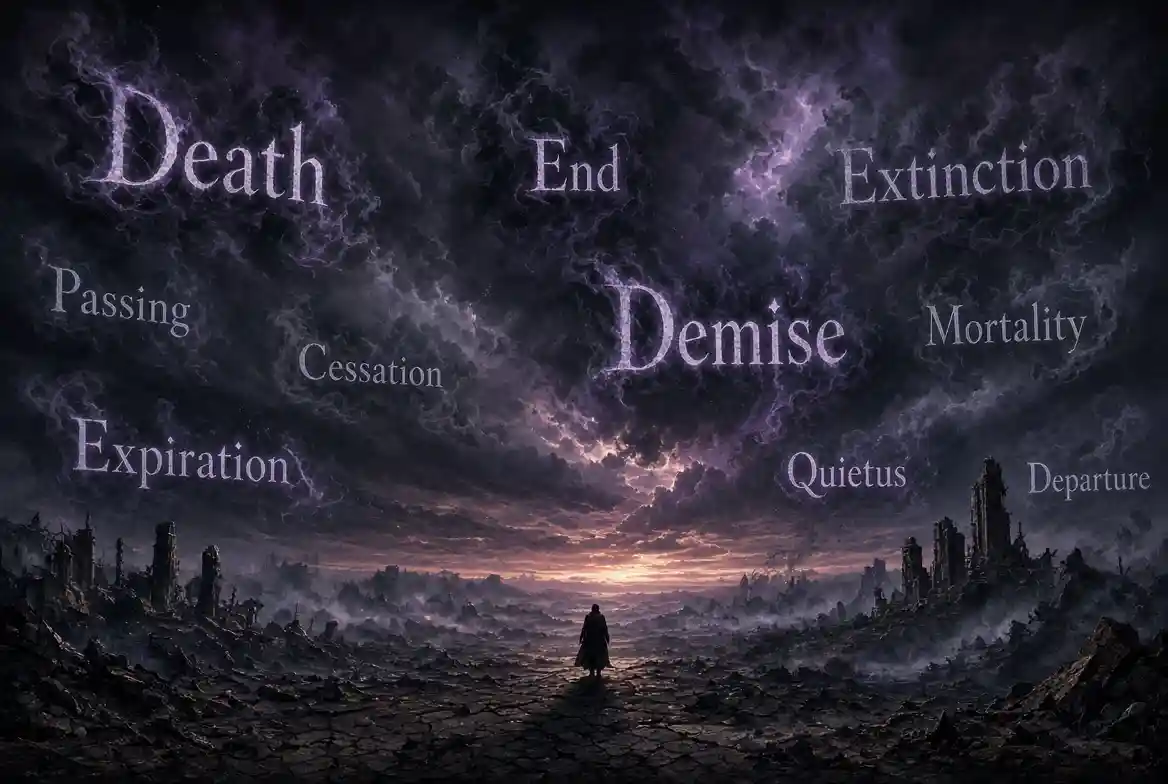
The best synonyms of demise depend on its meaning. For a person’s death, use death, passing, decease, or passing away. For the end or failure of something, use end, failure, collapse, downfall, fall, termination, dissolution, or extinction. Some words are only contextually related, so they cannot replace demise in every sentence.
What Does “Demise” Mean?
Have you ever seen the word demise in an article and wondered whether it simply means “death”?
Sometimes it does. But demise has more than one important meaning.
In formal English, demise can mean the death of a person. It can also mean the end or failure of something, especially a business, industry, system, movement, or institution. Cambridge gives these two major modern meanings directly, while Collins also records specialized legal meanings.
For example:
The family was devastated by his demise.
Here, demise means death.
But:
The decline in demand contributed to the demise of the company.
Here, demise means the company’s end or failure.
This difference matters when choosing among the synonyms of demise. You should not automatically replace demise with death, collapse, downfall, or termination. Each word carries its own meaning and tone.
This guide explains the closest synonyms, their differences, natural collocations, register, learner level, and situations where you should avoid them.
Demise Pronunciation
IPA: /dɪˈmaɪz/
Pronounced: dih-MYZE
The word rhymes approximately with size.
American and British English
The standard pronunciation is essentially the same in American and British English:
/dɪˈmaɪz/
Cambridge gives this pronunciation for both varieties.
There is no major American/British spelling difference. Both use:
demise
Part of Speech
Noun
The most common modern use is as a noun.
The demise of the company surprised investors.
His sudden demise shocked his friends.
Verb
Demise also exists as a verb, but this use is mainly legal and should not be confused with the everyday noun.
In property law, it can mean to grant or transfer property for a period of time, such as through a lease. Cambridge specifically records this property-law use.
The property was demolished under a long lease.
Adjective and Adverb
Demise is not normally used as an adjective or adverb.
Grammar and Common Patterns
The most useful structure for learners is:
the demise of + noun
The demise of the industry happened gradually.
New technology accelerated the demise of the old system.
You can also use:
someone’s demise
His untimely demise shocked the community.
cause the demise of
Poor management caused the demise of the business.
contribute to the demise of
Falling demand contributed to the demise of the product.
lead to the demise of
The new technology led to the demise of several older services.
Natural collocations include:
- sudden demise
- tragic demise
- untimely demise
- early demise
- eventual demise
- premature demise
- demise of a company
- demise of an industry
- demise of an empire
- demise of a system
Collins also records common patterns such as early demise and eventual demise.
Synonyms of Demise at a Glance
| Synonym | Main Sense | Register | Strength of Match |
| Death | Person’s life ends | Neutral | Exact |
| Passing | Person’s death | Polite | Close |
| Decease | Person’s death | Formal | Close |
| Passing away | Person’s death | Polite | Close |
| End | Something finishes | Neutral | Close |
| Failure | Something does not succeed | Neutral | Contextual |
| Collapse | Sudden failure | Neutral/Formal | Contextual |
| Downfall | Loss of power/success | Neutral/Formal | Contextual |
| Fall | Decline or loss of power | Neutral | Contextual |
| Termination | Formal ending | Formal | Contextual |
| Cessation | Stopping | Formal | Contextual |
| Dissolution | Formal breaking up | Formal | Contextual |
| Extinction | Complete disappearance | Formal/Academic | Contextual |
| Ruin | Severe destruction or failure | Neutral | Contextual |
| Destruction | Complete damaging | Neutral/Formal | Contextual |
| Disintegration | Breaking apart | Formal/Academic | Contextual |
| Defeat | Loss in conflict | Neutral | Contextual |
| Overthrow | Removal from power | Formal | Contextual |
| Expiration | End of validity/period | Formal | Limited |
| Departure | Leaving or euphemistic death | Literary/Formal | Limited |
The Best Synonyms of Demise
1. Death
Meaning: The end of a person’s life.
CEFR guidance: A2–B1
Frequency: Very common
Register: Neutral, everyday, academic
Connotation: Direct and clear
Examples:
- The family struggled to accept his sudden death.
- The report examined the possible cause of the patient’s death.
Best used when: You want the clearest word for the end of a person’s life.
Common collocations:
- sudden death
- cause of death
- accidental death
When not to use: Do not use death for the failure of a company or system.
Why it differs from demise: Death is direct. Demise is more formal and can also describe the end of something nonliving.
2. Passing
Meaning: A polite or gentle reference to someone’s death.
CEFR guidance: B1
Frequency: Common
Register: Polite, formal, spoken
Connotation: Softer than death
Examples:
- We were saddened by the passing of her father.
- His passing was deeply mourned by the community.
Best used when: You want a respectful alternative to death.
Collocations:
- recent passing
- peaceful passing
- mourn someone’s passing
When not to use: Do not use it to describe a company’s failure.
3. Decease
Meaning: A formal word for death.
CEFR guidance: C1
Frequency: Uncommon
Register: Legal, formal, administrative
Connotation: Technical and impersonal
Examples:
- The document was updated after the owner’s death.
- The legal record included the date of his death.
Best used when: You are dealing with formal or legal language.
Collocations:
- date of decease
- upon decease
- after the decease
When not to use: Avoid it in normal conversation because death sounds much more natural.
4. Passing Away
Meaning: A polite phrase meaning to die.
CEFR guidance: B1
Frequency: Common
Register: Polite, spoken, respectful
Connotation: Gentle
Examples:
- Her grandfather passed away peacefully.
- We were sorry to hear that his uncle had passed away.
Best used when: Speaking sensitively about someone’s death.
When not to use: Do not use it for the end of a business or institution.
5. End
Meaning: The point at which something stops or finishes.
CEFR guidance: A1
Frequency: Very common
Register: Neutral
Connotation: Simple and direct
Examples:
- The scandal marked the end of his career.
- The project came to an end after several problems.
Best used when: You need a simple alternative to demise.
Collocations:
- sudden end
- eventual end
- bring to an end
When not to use: End is too general if you need to communicate death, failure, or destruction specifically.
6. Failure
Meaning: The lack of success or the inability of something to work.
CEFR guidance: B1
Frequency: Very common
Register: Neutral, business, academic
Connotation: Focuses on unsuccessful results
Examples:
- The project’s failure surprised the entire team.
- Poor planning contributed to the failure of the campaign.
Best used when: The important idea is that something did not succeed.
Collocations:
- complete failure
- business failure
- failure of a plan
When not to use: Do not use failure when you simply mean that something ended.
7. Collapse
Meaning: A sudden failure or breakdown.
CEFR guidance: B2
Frequency: Very common
Register: Neutral, business, academic
Connotation: Sudden and serious
Examples:
- The bank’s collapse caused widespread concern.
- The old system eventually suffered a complete collapse.
Best used when: Something suddenly stops functioning successfully.
Collocations:
- economic collapse
- sudden collapse
- complete collapse
When not to use: A person’s death is not normally called a collapse.
8. Downfall
Meaning: A loss of power, success, position, or status.
CEFR guidance: B2
Frequency: Common
Register: Neutral, formal
Connotation: Often suggests that mistakes or weaknesses caused the decline
Examples:
- Corruption contributed to the leader’s downfall.
- Poor decisions became the company’s downfall.
Best used when: Something or someone loses power, influence, or success.
Collocations:
- political downfall
- cause someone’s downfall
- eventual downfall
When not to use: Downfall does not simply mean death.
9. Fall
Meaning: A decline or loss of power, position, or strength.
CEFR guidance: A2–B1
Frequency: Very common
Register: Neutral, historical, academic
Connotation: Decline from a previous position
Examples:
- Historians still discuss the fall of the empire.
- His fall from power happened surprisingly quickly.
Best used when: Something loses its former power or position.
Collocations:
- fall of an empire
- fall from power
- sudden fall
When not to use: Do not use fall when you mean physical destruction specifically.
10. Termination
Meaning: The formal ending of something.
CEFR guidance: B2–C1
Frequency: Common
Register: Formal, business, legal
Connotation: Official and procedural
Examples:
- The contract allowed early termination.
- The company announced the termination of the service.
Best used when: Discussing contracts, employment, services, or formal agreements.
Collocations:
- contract termination
- termination of employment
- early termination
When not to use: It sounds too technical for most personal discussions about death.
11. Cessation
Meaning: The stopping of an activity or process.
CEFR guidance: C1
Frequency: Uncommon
Register: Formal, academic, legal
Connotation: Official and technical
Examples:
- The agreement called for the cessation of hostilities.
- The treatment resulted in the cessation of symptoms.
Best used when: Something stops, especially an activity or process.
Collocations:
- cessation of hostilities
- cessation of activity
- complete cessation
When not to use: It is not a normal substitute for someone’s death.
12. Dissolution
Meaning: The formal ending or breaking up of an organization, group, or arrangement.
CEFR guidance: C1
Frequency: Common in formal contexts
Register: Legal, business, academic
Connotation: Formal separation or ending
Examples:
- The board approved the dissolution of the organization.
- The agreement provided for the dissolution of the partnership.
Best used when: A formal group or legal arrangement ends.
Collocations:
- dissolution of a company
- dissolution of a partnership
- formal dissolution
When not to use: Do not use it as a simple synonym for death.
13. Extinction
Meaning: The complete disappearance of a species, tradition, practice, or other thing.
CEFR guidance: B2
Frequency: Common
Register: Academic, scientific, formal
Connotation: Complete disappearance
Examples:
- Habitat loss has increased the risk of extinction.
- The tradition is slowly moving toward extinction.
Best used when: Something disappears completely.
Collocations:
- risk of extinction
- species extinction
- mass extinction
When not to use: It is too strong for an ordinary temporary failure.
14. Ruin
Meaning: Severe damage, destruction, or loss of success.
CEFR guidance: B2
Frequency: Common
Register: Neutral, literary
Connotation: Serious damage or devastation
Examples:
- Years of neglect left the building in ruin.
- The scandal brought the business to financial ruin.
Best used when: The result is severe damage or loss.
Collocations:
- financial ruin
- fall into ruin
- bring to ruin
When not to use: Do not use it when something merely stops operating.
15. Destruction
Meaning: The act or result of destroying something.
CEFR guidance: B2
Frequency: Common
Register: Neutral, formal, academic
Connotation: Very strong
Examples:
- The fire caused the destruction of several buildings.
- The storm left a trail of destruction.
Best used when: Something has been seriously damaged or destroyed.
When not to use: It is much stronger than a simple ending.
16. Disintegration
Meaning: The process of breaking apart or losing unity.
CEFR guidance: C1
Frequency: Uncommon
Register: Academic, formal
Connotation: Gradual breakdown
Examples:
- Internal conflict accelerated the group’s disintegration.
- The empire’s disintegration took several decades.
Best used when: Something gradually breaks into separate parts.
When not to use: Do not use it for every type of ending.
17. Defeat
Meaning: The loss of a contest, struggle, battle, or attempt.
CEFR guidance: B1
Frequency: Very common
Register: Neutral, academic, sports
Connotation: Losing to an opponent or force
Examples:
- The army suffered a major defeat.
- The team’s final defeat ended its championship hopes.
Best used when: An ending happens because someone loses a struggle.
When not to use: Defeat does not mean death or simple termination.
18. Overthrow
Meaning: The removal of a ruler, government, or powerful authority.
CEFR guidance: C1
Frequency: Common
Register: Historical, political, formal
Connotation: Forceful removal from power
Examples:
- The revolution led to the overthrow of the government.
- The ruler’s overthrow changed the country’s political structure.
Best used when: A powerful person or government is removed.
When not to use: It does not mean an ordinary ending.
19. Expiration
Meaning: The end of a period of validity or, in certain formal contexts, the end of life.
CEFR guidance: B2
Frequency: Common
Register: Business, legal, medical/formal
Connotation: Usually connected with a time limit
Examples:
- Check the expiration date before using the product.
- The agreement ended upon the expiration of the contract.
Best used when: Something reaches the end of its valid period.
When not to use: For everyday human death, death or passing is usually much more natural.
20. Departure
Meaning: The act of leaving; in literary or euphemistic language, it can refer to death.
CEFR guidance: B1
Frequency: Very common overall
Register: Neutral for travel; literary/formal for death
Connotation: Indirect
Examples:
- The train’s departure was delayed.
- The poem describes death as a final departure.
Best used when: You deliberately want an indirect or literary expression.
When not to use: Avoid using departure as a direct replacement for death in ordinary writing.
21. Ending
Meaning: The point or process at which something finishes.
CEFR guidance: A2
Frequency: Very common
Register: Neutral
Connotation: Broad and simple
Examples:
- The film has a surprising ending.
- The partnership came to an unexpected ending.
Best used when: You need simple everyday English.
When not to use: It lacks the formal or solemn tone of demise.
22. Passing On
Meaning: A euphemistic expression for death.
CEFR guidance: B1–B2
Frequency: Common
Register: Polite, informal/formal depending on context
Connotation: Gentle and indirect
Examples:
- The family announced his passing on.
- She wrote about her grandmother’s passing on with great affection.
Best used when: A gentle reference to death is appropriate.
When not to use: It is less direct and can sound less natural than passed away in many situations.
23. Annihilation
Meaning: Complete destruction or elimination.
CEFR guidance: C1
Frequency: Uncommon
Register: Formal, literary, academic
Connotation: Extremely strong
Examples:
- The story describes the annihilation of the entire civilization.
- The weapon threatened the annihilation of the settlement.
Best used when: Complete destruction is the central idea.
When not to use: It is far too strong for an ordinary business ending.
24. Quietus
Meaning: A formal or literary word for death or final release.
CEFR guidance: C2
Frequency: Rare
Register: Literary, archaic/formal
Connotation: Old-fashioned and solemn
Examples:
- The novel describes death as a final quietus.
- The poet used quietus to suggest release from suffering.
Best used when: Writing literary or historical prose.
When not to use: Avoid it in ordinary conversation and basic ESL writing.
25. Foundering
Meaning: The process of failing or becoming unable to continue successfully.
CEFR guidance: C1
Frequency: Uncommon
Register: Formal, journalistic
Connotation: Gradual failure
Examples:
- The founding company struggled to attract new investors.
- The project was founded because of poor planning.
Best used when: A project, organization, or plan is failing and struggling to continue.
When not to use: Do not use it for someone’s death.
Strongest, Strong, and Related Synonyms
Strongest Synonyms
These are the closest replacements when the meaning matches:
- death
- passing
- decease
- passing away
- end
Strong Synonyms
These are strong choices when demise refers to an ending or failure:
- failure
- collapse
- downfall
- fall
- termination
- dissolution
- extinction
- ruin
Related Words
These overlap only in specific situations:
- defeat
- overthrow
- departure
- expiration
- disintegration
- annihilation
- quietus
- foundering
This distinction is important because Collins groups demise under different senses, including failure and death, rather than treating every listed word as an interchangeable substitute.
Which Synonym Should You Choose?
| Situation | Better choice | Why |
| A person died | death | Direct |
| A respectful reference to death | passing | Gentle |
| A legal record of death | decease | Formal |
| A company stopped succeeding | failure | Focuses on unsuccessful results |
| A company suddenly failed | collapse | Emphasizes sudden breakdown |
| A leader lost power | downfall | Emphasizes loss of status |
| An empire lost power | fall | Historical decline |
| A contract formally ended | termination | Legal/business precision |
| An organization formally ended | dissolution | Formal organizational ending |
| A species disappeared | extinction | Complete disappearance |
| Something was destroyed | destruction | Physical or figurative destruction |
| A group broke apart | disintegration | Loss of unity |
| A government was removed | overthrow | Forceful removal |
| Someone lost a battle | defeat | Loss in conflict |
Quick rule
Person → death / passing
Company → failure / collapse
Power → downfall / fall
Contract → termination
Organization → dissolution
Species → extinction
Physical damage → destruction
Commonly Confused Words
| Word | Main Meaning | Example |
| Demise | Formal death or ending | The demise of the company was unexpected. |
| Death | End of life | His death shocked the town. |
| Downfall | Loss of power or success | Corruption caused his downfall. |
| Collapse | Sudden failure | The company suffered a collapse. |
| Termination | Formal ending | The contract faced early termination. |
Demise vs. Death
Death is direct and common.
Demise is more formal and can also refer to the end of a nonliving thing.
His death was unexpected.
His demise was unexpected.
Both can work, but the second sounds more formal.
Demise vs. Downfall
A downfall is a decline in power, reputation, or success.
A demise can mean a final ending.
The scandal caused his downfall.
This does not necessarily mean he died.
Demise vs. Collapse
Collapse emphasizes sudden failure or breakdown.
The company’s collapse happened within months.
Demise is broader.
Demise vs. Termination
Termination emphasizes an official or deliberate ending.
The company announced the termination of the contract.
Demise sounds more like an eventual end or failure.
Common Mistakes
Common Mistake Box
Mistake 1
Wrong idea: Every synonym of demise means death.
Correction: Some describe failure, decline, destruction, or formal ending.
Why: Demise has multiple senses. Cambridge explicitly separates death from the ending of something powerful or established.
Mistake 2
Wrong: The contract suffered a death.
Better: The contract reached its termination.
Mistake 3
Wrong: The species collapsed into extinction.
Better: The species faced extinction.
Mistake 4
Wrong: His downfall means he died.
Better: His downfall means he lost power, status, or success.
Mistake 5
Wrong: Use decease in everyday conversation.
Better: Use death or passing.
Word Origin and Etymology
The history of demise is more interesting than its modern use suggests.
Collins traces the word to the 16th century, from Old French demis, related to demettre, meaning “to send away,” and ultimately to Latin dīmittere. Collins also records an English history reaching back to the late Middle English period in its American dictionary material.
The word developed important legal meanings involving the transfer of property and later the transfer of sovereignty. Modern English then developed the familiar sense of death or the end of something.
This explains why demise can still appear in legal phrases that have nothing to do with ordinary death.
Good to Know: The legal sense of demise is older and more specialized than the everyday sense most learners encounter.
The Legal Meaning of Demise
This is one of the most useful gaps to understand.
In property law, demise can refer to property that is granted or transferred for a period, particularly through a lease. Cambridge gives demise as a business/property-law noun and verb.
You may encounter:
demised premises
This means premises that have been legally leased or granted to someone.
The verb can also appear in legal language:
The landlord demised the premises to the tenant.
This is not normal everyday English. Most learners can safely recognize it as a legal/property term rather than trying to use it in ordinary conversation.
American vs. British English
There is no major spelling difference:
American: demise
British: demise
Both varieties use the word for formal death and for the end of something.
There is, however, an interesting difference in dictionary presentation. Cambridge records the property-law sense in its Business English material, while Collins gives extensive British and American legal senses.
For ordinary learners, the most useful distinction is not American vs. British. It is:
everyday vs. formal
For example:
He died yesterday.
is natural everyday English.
His demise was unexpected.
is more formal.
Register and Tone Guide
| Word | Register | Tone |
| death | Everyday | Direct |
| passing | Polite | Gentle |
| passing away | Everyday/Polite | Gentle |
| demise | Formal | Serious |
| decease | Legal/Formal | Technical |
| end | Everyday | Neutral |
| failure | Business/Everyday | Neutral |
| collapse | Business/News | Strong |
| downfall | Formal/News | Serious |
| termination | Legal/Business | Official |
| cessation | Academic/Formal | Technical |
| dissolution | Legal/Business | Formal |
| extinction | Scientific/Academic | Strong |
| quietus | Literary | Archaic |
| annihilation | Literary/Formal | Extremely strong |
Frequency Guide for Learners
These labels describe practical usefulness, not a formal frequency database.
Very Common
- death
- end
- ending
- failure
- collapse
- fall
- defeat
Common
- passing
- passing away
- downfall
- destruction
- ruin
- termination
- extinction
Uncommon
- decease
- cessation
- dissolution
- disintegration
- departure as a death euphemism
- foundering
Rare
- quietus
For most ESL learners, learning death, end, failure, collapse, downfall, passing, termination, and extinction will provide more practical value than memorizing rare literary alternatives.
How Native Speakers Commonly Use “Demise”
The most natural pattern is often:
the demise of + noun
Examples:
the demise of the industry
the demise of the empire
the demise of the old system
the demise of the company
For people, possessive structures are common:
his demise
her demise
their untimely demise
Cambridge examples also show common combinations such as sad demise, untimely demise, tragic demise, and sudden demise.
Writing Tips
In Essays
Use demise when discussing historical or institutional endings.
The economic crisis contributed to the demise of the industry.
For beginner writing, end or failure may be clearer.
In Academic Writing
Choose the more precise word.
Use:
- extinction for species
- termination for formal agreements
- collapse for sudden breakdown
- downfall for loss of power
This gives your writing more precision than repeatedly using demise.
In Business Writing
Demise can work in analysis:
Several factors contributed to the demise of the company.
But use termination for a formal contract or service decision.
In Emails
Avoid unnecessarily dramatic wording.
Instead of:
We regret the demise of the service.
Prefer:
We regret the discontinuation of the service.
In Stories
Demise can create a serious or dramatic tone.
The kingdom slowly moved toward its demise.
In Everyday Conversation
Use death, died, passed away, end, or failed when they communicate your meaning more naturally.
Antonyms of Demise
The opposite depends on the sense.
If demise means death:
- life
- birth
- survival
If demise means ending:
- beginning
- start
- continuation
- continuation of existence
If demise means failure:
- success
- achievement
- growth
- recovery
If demise means decline:
- rise
- development
- expansion
- revival
There is no single antonym that fits every use.
Related Expressions
Useful expressions include:
- come to an end
- cease to exist
- pass away
- die out
- fall from power
- break down
- fall into ruin
- go into decline
- cease operation
- bring something to an end
These expressions are often more natural for ESL learners than rare thesaurus alternatives.
Mini Practice: Fill in the Blanks
Choose from:
death, collapse, downfall, termination, extinction
- The company’s sudden ______ shocked investors.
- The contract allowed early ______.
- Scientists are trying to prevent the species’ ______.
- Corruption contributed to the politician’s ______.
- The family was devastated by his sudden ______.
Answers
- collapse
- termination
- extinction
- downfall
- death
Sentence Rewriting Practice
Replace demise with the most precise word.
1. The demise of the company shocked investors.
Possible answer:
The collapse of the company shocked investors.
2. Her demise was deeply mourned.
Possible answer:
Her death was deeply mourned.
3. The demise of the species became a serious concern.
Possible answer:
The extinction of the species became a serious concern.
4. The demise of the partnership was legally documented.
Possible answer:
The dissolution of the partnership was legally documented.
Matching Exercise
Match the word to the situation.
| Word | Situation |
| 1. Extinction | A. Formal contract ending |
| 2. Termination | B. Species disappearing |
| 3. Downfall | C. Loss of power |
| 4. Passing | D. Death |
| 5. Collapse | E. Sudden failure |
Answers:
1-B
2-A
3-C
4-D
5-E
FAQ: Synonyms of Demise
What is the closest synonym of demise?
The closest synonym depends on context. For a person, death is the clearest equivalent. For something that ends or fails, end, failure, collapse, or downfall may be more accurate. Cambridge and Collins both separate these senses rather than treating them as identical.
What is a simple synonym for demise?
Death is the simplest synonym when talking about a person. End is a simple alternative when talking about an event, organization, system, or period. These words are much more common in everyday English than demise.
Is demise a formal word?
Yes. Demise is generally a formal word. Cambridge labels it formal and uses it for both a person’s death and the end of something powerful or established.
Is demise a synonym for death?
Yes, in one important sense. Demise can mean the death of a person. However, it can also mean the end or failure of something, so death is not a complete replacement in every sentence.
What is the difference between demise and downfall?
Demise can mean a final end or death. Downfall specifically emphasizes a decline in power, success, reputation, or status. A person’s downfall does not necessarily mean that the person died.
What is the difference between demise and collapse?
Collapse usually emphasizes sudden failure or breakdown. Demise is broader and can describe a gradual or eventual end. For example, a company’s collapse may happen suddenly, while its demise may refer to the whole process or eventual end.
Can demise describe a company?
Yes. Demise commonly describes the end or failure of a company, business, industry, system, or institution. Cambridge gives the example of a company’s demise and describes this sense as the end of something previously considered powerful.
What is the opposite of demise?
There is no single opposite in every context. For death, the opposite is life or birth. For an ending, it can be beginning or continuation. For failure, it can be success. The correct antonym depends on the sentence.
Vocabulary Quiz
1. Which word is the clearest synonym for demise when talking about a person?
A. Collapse
B. Death
C. Downfall
D. Dissolution
2. Which word best fits a formal contract?
A. Passing
B. Termination
C. Downfall
D. Extinction
3. Which word describes the disappearance of a species?
A. Defeat
B. Departure
C. Extinction
D. Termination
4. Which sentence uses “downfall” correctly?
A. His downfall means that he died.
B. The scandal contributed to his downfall.
C. Her downfall was recorded on her death certificate.
D. His downfall was a peaceful passing.
5. Which word is most appropriate for a gentle reference to someone’s death?
A. Collapse
B. Passing
C. Destruction
D. Termination
Answer Key
- B — Death
- B — Termination
- C — Extinction
- B — The scandal contributed to his downfall.
- B — Passing
Conclusion
The best way to learn the synonyms of demise is to learn their differences, not simply memorize a long list. Use death for a person’s life ending, passing for a gentler expression, collapse for sudden failure, downfall for loss of power, termination for formal endings, and extinction for complete disappearance.
When you choose words according to meaning, tone, and context, your essays, emails, articles, and conversations become clearer and more natural. Practice these words in real sentences, and your vocabulary will become more precise.
References
- Cambridge Dictionary, demise and related usage.
- Collins English Dictionary, demise definition, etymology, and legal senses.
- Collins English Thesaurus, demise synonyms by sense.
- Cambridge English Thesaurus, demise synonyms and antonyms.
- Thesaurus.com, demise synonyms and antonyms.

Synonorm is a trusted English vocabulary resource created to help readers find the right words and understand the differences between similar terms. We provide clear explanations of synonyms, meanings, examples, usage, and alternatives. Our content makes vocabulary easier to learn and apply in everyday, academic, and professional English. Synonorm is designed for students, writers, ESL learners, professionals, and anyone who wants to improve their English vocabulary and communicate more clearly.