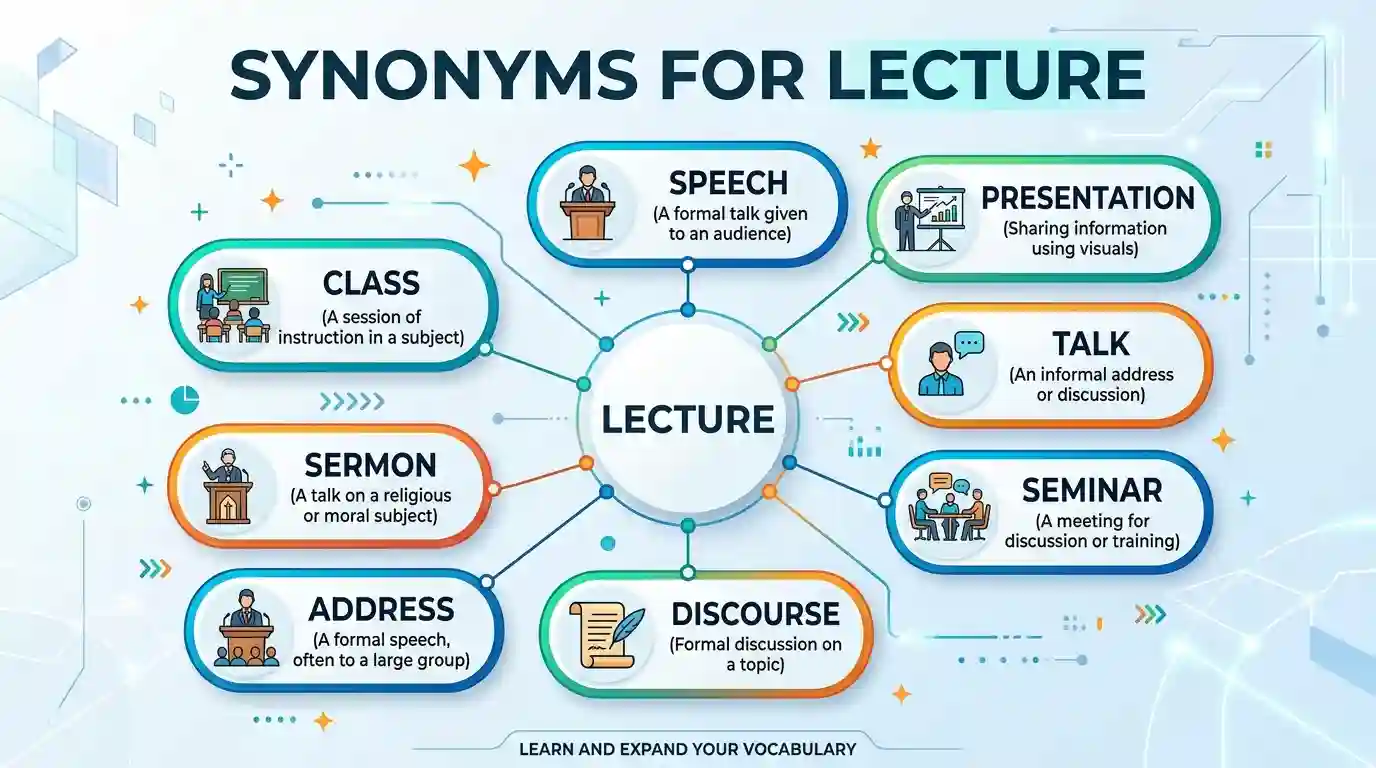
Quick Answer
The best synonyms for lecture depend on the meaning. For an educational talk, common alternatives include talk, presentation, speech, address, discourse, and lesson. For a serious talk that criticizes someone, useful alternatives include rebuke, reprimand, scolding, admonition, and telling-off. Words such as seminar, tutorial, and workshop are related, but they are not exact replacements in every sentence.
What Does Lecture Mean?
Have you ever written the word lecture several times and wanted a more natural alternative? The answer is not simply to choose another word from a thesaurus.
Lecture has two main meanings.
First, it can mean a formal talk given to a group, especially students, to teach them about a subject. For example:
The professor gave a lecture on modern history.
Second, it can mean a serious or angry talk intended to criticize someone’s behavior:
My father gave me a lecture about being late.
Cambridge lists both meanings and also separates the educational and criticism uses of the verb lecture.
That distinction matters because presentation can replace lecture in some educational settings, but it cannot replace lecture when someone is being criticized.
Lecture Pronunciation
UK: /ˈlek.tʃə/
US: /ˈlek.tʃɚ/
Pronounced: LEK-chuh in British English and approximately LEK-chur in American English.
The spelling is the same in American and British English. The main pronunciation difference is the final vowel/r sound.
Part of Speech
Lecture works mainly as both a noun and a verb.
Noun
We attended a lecture on psychology.
Verb
She lectures on environmental science.
The verb also has a criticism meaning:
Stop lecturing me about my spending.
Cambridge gives the educational verb sense at C2 and the noun’s educational meaning at B1.
Common Grammar Patterns
Educational meaning
Use:
- give a lecture
- deliver a lecture
- attend a lecture
- listen to a lecture
- a lecture on something
- lecture in a subject
Examples:
She gave a lecture on artificial intelligence.
He lectures in economics.
Criticism meaning
Common patterns include:
- give someone a lecture
- lecture someone about something
- lecture someone on something
Examples:
My mother gave me a lecture about wasting food.
He lectured his son on responsibility.
Quick Tip
Do not confuse lecture on a subject with lecture someone about a problem.
The first normally means teach. The second often means to criticize or advise.
Best Synonyms for Lecture at a Glance
| Word | Main Meaning | Register | Frequency | Exact Substitute? |
| Talk | General presentation | Neutral | Very common | Often |
| Presentation | Organized explanation | Neutral/Formal | Very common | Often |
| Speech | Public spoken message | Neutral/Formal | Very common | Sometimes |
| Address | Formal public speech | Formal | Common | Sometimes |
| Discourse | Extended formal treatment | Academic/Formal | Common | Sometimes |
| Lesson | Teaching session | Neutral | Very common | Sometimes |
| Instruction | Teaching/guidance | Formal | Common | Context-dependent |
| Seminar | Interactive study session | Academic | Common | No |
| Tutorial | Guided learning session | Academic | Common | No |
| Workshop | Practical learning session | Professional | Common | No |
| Webinar | Online presentation/session | Professional | Common | No |
| Exposition | Detailed explanation | Academic | Uncommon | Rarely |
| Oration | Formal public speech | Formal/Literary | Uncommon | Rarely |
| Sermon | Religious teaching speech | Religious | Common | No |
| Homily | Religious/moral talk | Religious/Formal | Uncommon | No |
| Rebuke | Strong criticism | Formal | Common | Criticism sense |
| Reprimand | Official criticism | Formal/Business | Common | Criticism sense |
| Scolding | Angry criticism | Neutral/Spoken | Common | Criticism sense |
| Admonition | Serious warning/advice | Formal | Uncommon | Criticism sense |
| Reproof | Formal criticism | Literary/Formal | Uncommon | Criticism sense |
| Chiding | Mild criticism | Literary/Formal | Uncommon | Criticism sense |
| Telling-off | Serious criticism | Informal | Common in UK | Criticism sense |
| Talking-to | Serious corrective talk | Informal | Common | Criticism sense |
| Dressing-down | Strong criticism | Informal | Uncommon | Criticism sense |
1. Talk
Meaning: A talk is a spoken presentation about a subject.
Example 1:
The scientist gave a talk about climate change.
Example 2:
I attended an interesting talk on photography.
Register: Neutral
CEFR guidance: A2
Frequency: Very common
Common collocations: give a talk, short talk, public talk
Nuance: Talk is broader and usually less formal than lecture.
When not to use it: Do not use it if you need to stress that the event was a formal university lecture.
2. Presentation
Meaning: A presentation is an organized explanation given to an audience.
Example 1:
Maria gave a presentation about online marketing.
Example 2:
His presentation included three useful charts.
Register: Neutral/Formal
CEFR guidance: B1
Frequency: Very common
Common collocations: give a presentation, business presentation, presentation slides
Nuance: It often suggests prepared material, slides, charts, or visual support.
When not to use it: A presentation does not necessarily involve teaching.
3. Speech
Meaning: A speech is a spoken message given to an audience.
Example 1:
The professor gave a speech at the graduation ceremony.
Example 2:
Her speech focused on the future of education.
Register: Neutral/Formal
CEFR guidance: A2-B1
Frequency: Very common
Common collocations: give a speech, opening speech, graduation speech
Nuance: A speech can entertain, persuade, celebrate, or inform. A lecture usually has a stronger teaching purpose.
4. Address
Meaning: An address is a formal speech given to an audience.
Example 1:
The university president delivered an address to the new students.
Example 2:
The director gave a short address at the ceremony.
Register: Formal
CEFR guidance: B2
Frequency: Common
Common collocations: deliver an address, formal address, public address
When not to use it: It can sound unnecessarily formal in everyday conversation.
5. Discourse
Meaning: Discourse is a formal, extended treatment of a subject in speech or writing.
Example 1:
The professor delivered a discourse on social change.
Example 2:
Her discourse examined the history of the English language.
Register: Academic/Formal
CEFR guidance: C1
Frequency: Common in academic contexts
Nuance: It sounds much more formal and abstract than talk.
When not to use it: Avoid it when a simple word such as talk or presentation would be clearer.
6. Lesson
Meaning: A lesson is a period of teaching or learning.
Example 1:
Today’s lesson focused on pronunciation.
Example 2:
The teacher gave us a useful lesson in grammar.
Register: Neutral
CEFR guidance: A1
Frequency: Very common
Common collocations: English lesson, history lesson, lesson plan
Nuance: A lesson often involves teaching and learning rather than simply listening to a speaker.
When not to use it: A public expert talk is not automatically a lesson.
7. Instruction
Meaning: Instruction means teaching, training, or guidance.
Example 1:
The course provides instruction in basic computer skills.
Example 2:
Students received detailed instruction before the experiment.
Register: Formal/Academic
CEFR guidance: B1-B2
Frequency: Common
Common collocations: classroom instruction, formal instruction, practical instruction
Nuance: It focuses on the teaching process rather than the speech itself.
8. Seminar
Meaning: A seminar is a learning session that usually involves discussion or participation.
Example 1:
We attended a seminar on academic writing.
Example 2:
The seminar gave students a chance to discuss the research.
Register: Academic/Professional
CEFR guidance: B2
Frequency: Common
Important difference: A lecture is often mainly delivered by a speaker. A seminar normally allows more interaction.
Cambridge notes that seminars are generally used for smaller groups, while lectures are commonly associated with larger university groups.
When not to use it: Do not call a purely one-way lecture a seminar simply because it takes place at a university.
9. Tutorial
Meaning: A tutorial is a guided learning session, often with a small group or individual learner.
Example 1:
I attended a tutorial after the main lecture.
Example 2:
This online tutorial explains how to use the software.
Register: Academic/Neutral
CEFR guidance: B1-B2
Frequency: Common
Nuance: A tutorial usually provides more direct guidance or practice.
10. Workshop
Meaning: A workshop is a learning session where participants actively practice or create something.
Example 1:
She joined a creative writing workshop.
Example 2:
The workshop helped employees improve their communication skills.
Register: Professional/Academic
CEFR guidance: B1
Frequency: Common
When not to use it: A speaker talking for an hour without participant activity is normally not a workshop.
11. Webinar
Meaning: A webinar is an online presentation, lesson, or discussion.
Example 1:
I joined a webinar about search engine optimization.
Example 2:
The company hosted a free webinar for new employees.
Register: Neutral/Professional
CEFR guidance: B2
Frequency: Common
Nuance: Webinar describes the online format, not necessarily the teaching style.
12. Exposition
Meaning: Exposition is a detailed and clear explanation of an idea or subject.
Example 1:
The book contains a clear exposition of the theory.
Example 2:
Her exposition of the problem helped the students understand it.
Register: Academic/Formal
CEFR guidance: C1
Frequency: Uncommon
When not to use it: It is not a natural everyday replacement for lectures.
13. Oration
Meaning: An oration is a formal and carefully prepared public speech.
Example 1:
The ceremony included a formal oration.
Example 2:
The historian delivered an impressive oration.
Register: Formal/Literary
CEFR guidance: C1
Frequency: Uncommon
Nuance: It often sounds ceremonial or dramatic.
14. Sermon
Meaning: A sermon is a religious speech that teaches or explains a moral or spiritual idea.
Example 1:
The pastor gave a sermon about forgiveness.
Example 2:
The sermon focused on compassion.
Register: Religious/Formal
CEFR guidance: B2
Frequency: Common
When not to use it: Do not use sermons for an ordinary academic lecture.
15. Homily
Meaning: A homily is a religious talk that explains a moral or spiritual lesson.
Example 1:
The priest gave a short homily after the reading.
Example 2:
His homily focused on patience and kindness.
Register: Religious/Formal
CEFR guidance: C1
Frequency: Uncommon
Nuance: It is much more specific than lecture.
Synonyms for Lecture Meaning “Scolding”
The second meaning of the lecture is very different. It describes a serious or angry talk meant to criticize someone’s behavior. Cambridge and Collins both distinguish this sense from the educational meaning.
16. Rebuke
Meaning: A rebuke is strong criticism of someone’s behavior.
Example 1:
The manager issued a sharp rebuke after the mistake.
Example 2:
She received a public rebuke for ignoring the rules.
Register: Formal
CEFR guidance: C1
Frequency: Common
Nuance: Strong and clearly negative.
When not to use it: Do not use it for a normal teaching lecture.
17. Reprimand
Meaning: A reprimand is a serious or official expression of disapproval.
Example 1:
The employee received a formal reprimand.
Example 2:
The manager reprimanded him for ignoring the safety rules.
Register: Formal/Business
CEFR guidance: B2
Frequency: Common
Nuance: It often involves authority, rules, or workplace discipline.
18. Scolding
Meaning: Scolding is angry or serious criticism of someone’s behavior.
Example 1:
The child received a scolding for breaking the window.
Example 2:
His mother scolded him for coming home late.
Register: Neutral/Spoken
CEFR guidance: B1
Frequency: Common
Nuance: More emotional and everyday than reprimand.
19. Admonition
Meaning: An admonition is a serious warning or piece of advice about someone’s behavior.
Example 1:
The coach gave the players an admonition about discipline.
Example 2:
Her father’s admonition made her think carefully.
Register: Formal
CEFR guidance: C1
Frequency: Uncommon
Nuance: It can combine warning, advice, and criticism.
20. Reproof
Meaning: Reproof is criticism intended to show that someone has done something wrong.
Example 1:
His mother’s quiet reproof changed his attitude.
Example 2:
The article contains a gentle reproof of careless spending.
Register: Formal/Literary
CEFR guidance: C1
Frequency: Uncommon
21. Chiding
Meaning: Chiding is mild criticism or correction.
Example 1:
Her gentle chiding reminded me to be more careful.
Example 2:
The teacher’s chiding was firm but fair.
Register: Literary/Formal
CEFR guidance: C1
Frequency: Uncommon
Nuance: Usually milder than rebuke or castigation.
22. Telling off
Meaning: A telling-off is a serious criticism of someone’s behavior.
Example 1:
He got a telling-off for arriving late.
Example 2:
She gave her brother a telling-off after he broke the phone.
Register: Informal/Spoken
CEFR guidance: B2
Frequency: Common in British English
UK/US note: This expression is especially associated with British English. American speakers may prefer scolding, talking-to, or reprimand depending on the context. Collins labels telling-off as informal.
23. Talking to
Meaning: A talking-to is a serious conversation intended to correct someone’s behavior.
Example 1:
The teenager got a talking-to after missing curfew.
Example 2:
My manager gave me a talking-to about missed deadlines.
Register: Informal/Spoken
CEFR guidance: B2
Frequency: Common
24. Dressing down
Meaning: A dressing-down is a strong verbal criticism.
Example 1:
The coach gave the team a dressing-down after the poor performance.
Example 2:
The employee received a dressing-down from his supervisor.
Register: Informal
CEFR guidance: C1
Frequency: Uncommon
When not to use it: Avoid it in formal academic writing.
25. Castigation
Meaning: Castigation means very strong criticism or punishment for wrongdoing.
Example 1:
The report received harsh criticism from several critics.
Example 2:
His public castigation of the policy attracted attention.
Register: Formal/Literary
CEFR guidance: C2
Frequency: Rare/Uncommon
Nuance: Much stronger than an ordinary lecture.
When not to use it: Do not use it for mild advice or normal classroom teaching.
Which Synonym Should You Choose?
Use this simple guide:
| If you mean… | Best choice |
| General educational talk | Lecture |
| Simple alternative | Talk |
| Slides and organized information | Presentation |
| Public formal speaking | Speech |
| Official formal speech | Address |
| Academic discussion | Seminar |
| Small guided learning session | Tutorial |
| Hands-on learning | Workshop |
| Online educational event | Webinar |
| Religious teaching | Sermon |
| Strong criticism | Rebuke |
| Official criticism | Reprimand |
| Angry everyday criticism | Scolding |
| Serious warning/advice | Admonition |
| Mild correction | Chiding |
| Informal British criticism | Telling-off |
Remember
Do not choose a synonym only because it appears in a thesaurus. Choose it because it describes the same situation.
American vs British English
The word lecture itself is spelled the same in both varieties.
The pronunciation differs:
- British: /ˈlek.tʃə/
- American: /ˈlek.tʃɚ/
University vocabulary can also vary.
In British English, a large university teaching session may take place in a lecture theatre. In American English, lecture hall is common. Cambridge also notes that UK university staff who teach lectures may be called lecturers, while US usage more often uses professor or teacher depending on the institution and role.
Some criticism expressions also have regional preferences:
- British: telling-off
- American: talking-to
- American/Canadian informal: chew out
- British informal: tear someone off a strip
Collins identifies several of these expressions by region and register.
Word Origin and Etymology
The history of lecture is interesting because its earliest meaning was connected to reading.
The noun comes from Medieval Latin lectura, meaning “a reading,” from Latin legere, meaning “to read.” Etymonline dates the English noun to around 1300, originally referring to written works or literature. The sense of reading aloud developed in the early 15th century.
The modern sense of a discourse delivered to an audience for instruction developed in the 1530s. The meaning of an admonitory speech intended to correct someone appeared around 1600. The verb lecture developed in the 16th century, with the teaching sense appearing later and the severe-address sense by the early 18th century.
Collins gives a different historical dating convention, listing the English word under 1375–1425, which shows why historical dictionary dates can vary according to the sense and evidence being dated.
Common Mistakes With Lecture Synonyms
Common Mistake Box
Mistake 1
The professor gave a seminar, but he did all the talking.
Better:
The professor gave a lecture, and he did most of the talking.
Why?
A seminar normally allows more discussion or participation.
Mistake 2
My teacher gave me a presentation because I was late.
Better:
My teacher gave me a lecture because I was late.
Why?
Here lecture means serious criticism. Presentation does not carry that meaning.
Mistake 3
The manager gave the employee a sermon for missing the deadline.
Better:
The manager gave the employee a reprimand.
Why?
A sermon normally has a religious meaning. Reprimand fits formal workplace criticism.
Mistake 4
The professor gave a workshop about ancient history.
Better:
The professor gave a lecture about ancient history.
Why?
If students mainly listened to the professor, lecture is more precise. A workshop usually includes active participation.
Real World Collocations
Native speakers frequently use lecture in patterns such as:
- give a lecture
- deliver a lecture
- attend a lecture
- attend lectures
- lecture on history
- lecture on science
- lecture at a university
- lecture hall
- lecture theatre
- guest lecture
- public lecture
- lecture series
- lecture notes
- lecture course
Cambridge’s corpus examples also show lectures in university teaching, public lectures, and the pattern lecture on a subject.
How to Use Synonyms Naturally
In an Essay
Instead of repeating lecture:
The lecture explained the effects of pollution.
You might write:
The presentation explained the effects of pollution.
Only change the word when the new word still matches the context.
In an Email
Thank you for the informative talk.
This sounds more natural than forcing a rare synonym such as disquisition.
In Professional Writing
The company hosted a webinar for new employees.
This is more precise than simply calling every online event a lecture.
In Stories
His father gave him a serious talking-to.
This sounds natural in informal dialogue.
In Academic Writing
The professor’s discourse examined the relationship between language and identity.
Here discourse works because the style is formal and academic.
Writing Tip: Good vocabulary is not about using the hardest word. It is about choosing the most accurate word.
Antonyms and Related Vocabulary
There is no single perfect antonym for lecture because the word has two main meanings.
For the educational sense, contrasting activities can include:
- discussion
- conversation
- dialogue
- interaction
For the criticism sense, possible contrasts include:
- praise
- compliment
- encouragement
- commendation
Related vocabulary includes:
- lecturer
- lecture hall
- lecture theatre
- lecture notes
- lecture series
- guest lecture
- public lecture
- keynote speech
- presentation
- seminar
- tutorial
- workshop
Mini Practice
Fill in the Blanks
Choose from lecture, seminar, presentation, reprimand, workshop.
- The professor gave a two-hour ______ on biology.
- The students joined a writing ______ with group activities.
- The manager issued a formal ______.
- She gave a business ______ with several charts.
- We attended a research ______ where students discussed their findings.
Answers:
- lecture
- workshop
- reprimand
- presentation
- seminar
Rewrite the Sentences
Replace lecture with a more precise word.
- The students worked together and practiced writing during the lecture.
- The manager officially criticized the employee.
- The speaker gave a formal speech at the ceremony.
Possible answers:
- The students worked together and practiced writing during the workshop.
- The manager gave the employee a reprimand.
- The speaker delivered an address at the ceremony.
Match the Words
| Word | Meaning |
| 1. Seminar | A. Official criticism |
| 2. Reprimand | B. Interactive academic session |
| 3. Tutorial | C. Guided learning session |
| 4. Address | D. Formal public speech |
Answer:
1-B, 2-A, 3-C, 4-D
FAQ: Synonyms for Lecture
What is the best synonym for lecture?
The best synonym depends on context. Talk is a simple general alternative, while presentation works well for organized information. Speech and address fit public speaking. If lecture means criticism, rebuke, reprimand, or scolding may be better choices.
What is a simple synonym for lecture?
Talk is one of the simplest alternatives. For example, “The professor gave a lecture on history” can become “The professor gave a talk on history.” However, talk is broader and less formal than lecture.
Is seminar a synonym for lecture?
A seminar is a related word, but it is not always an exact synonym. A lecture is often mainly a presentation from a speaker to an audience. A seminar usually includes discussion, questions, or participation.
What is a synonym for lecture meaning scolding?
Useful alternatives include rebuke, reprimand, scolding, admonition, reproof, talking-to, and telling-off. The choice depends on how formal and strong the criticism is. Collins separates these criticism-related senses from the educational meaning.
What is a formal synonym for lecture?
Depending on the context, address, discourse, exposition, or oration can work. They are not identical, however. Address usually means a formal public speech, while discourse suggests an extended formal treatment of a subject.
What is the difference between a lecture and a presentation?
A lecture normally has a teaching or explanatory purpose, especially in an academic setting. A presentation is broader and can be used for business reports, school projects, sales information, or professional meetings. A presentation may use slides or other visual material.
What is the difference between a lecture and a speech?
A lecture usually teaches or explains a subject. A speech is a broader form of public speaking and can inform, persuade, entertain, celebrate, or inspire. Therefore, every lecture can be a type of speech, but not every speech is a lecture.
What is the opposite of lecture?
There is no exact opposite. For the educational meaning, discussion or conversation can contrast with a one-way lecture. For the criticism meaning, praise, compliment, or encouragement can provide a contrast.
Vocabulary Quiz
1. Which word usually describes an interactive academic session?
A. Rebuke
B. Seminar
C. Reproof
D. Address
2. Which word best fits formal workplace criticism?
A. Tutorial
B. Presentation
C. Reprimand
D. Webinar
3. Which word is especially associated with informal British criticism?
A. Discourse
B. Telling-off
C. Oration
D. Exposition
4. Which word usually involves practical participation?
A. Workshop
B. Speech
C. Address
D. Sermon
5. Which word is the simplest general alternative to lecture?
A. Castigation
B. Disquisition
C. Talk
D. Admonition
Answer Key
- B. Seminar
- C. Reprimand
- B. Telling-off
- A. Workshop
- C. Talk
Conclusion
Learning synonyms for lecture is useful because different words show different levels of formality, purpose, and emotion. Use talk for a simple alternative, presentation for organized information, seminar for interactive academic learning, and workshop for practical training.
When lecture means criticism, choose words such as rebuke, reprimand, scolding, or admonition based on the situation. Good vocabulary is not about using difficult words. It is about choosing the word that says exactly what you mean.
Trusted References
- Cambridge Dictionary and Thesaurus
- Collins English Thesaurus
- Thesaurus.com
- Etymonline
- Cambridge Dictionary Blog

Synonorm is a trusted English vocabulary resource created to help readers find the right words and understand the differences between similar terms. We provide clear explanations of synonyms, meanings, examples, usage, and alternatives. Our content makes vocabulary easier to learn and apply in everyday, academic, and professional English. Synonorm is designed for students, writers, ESL learners, professionals, and anyone who wants to improve their English vocabulary and communicate more clearly.