
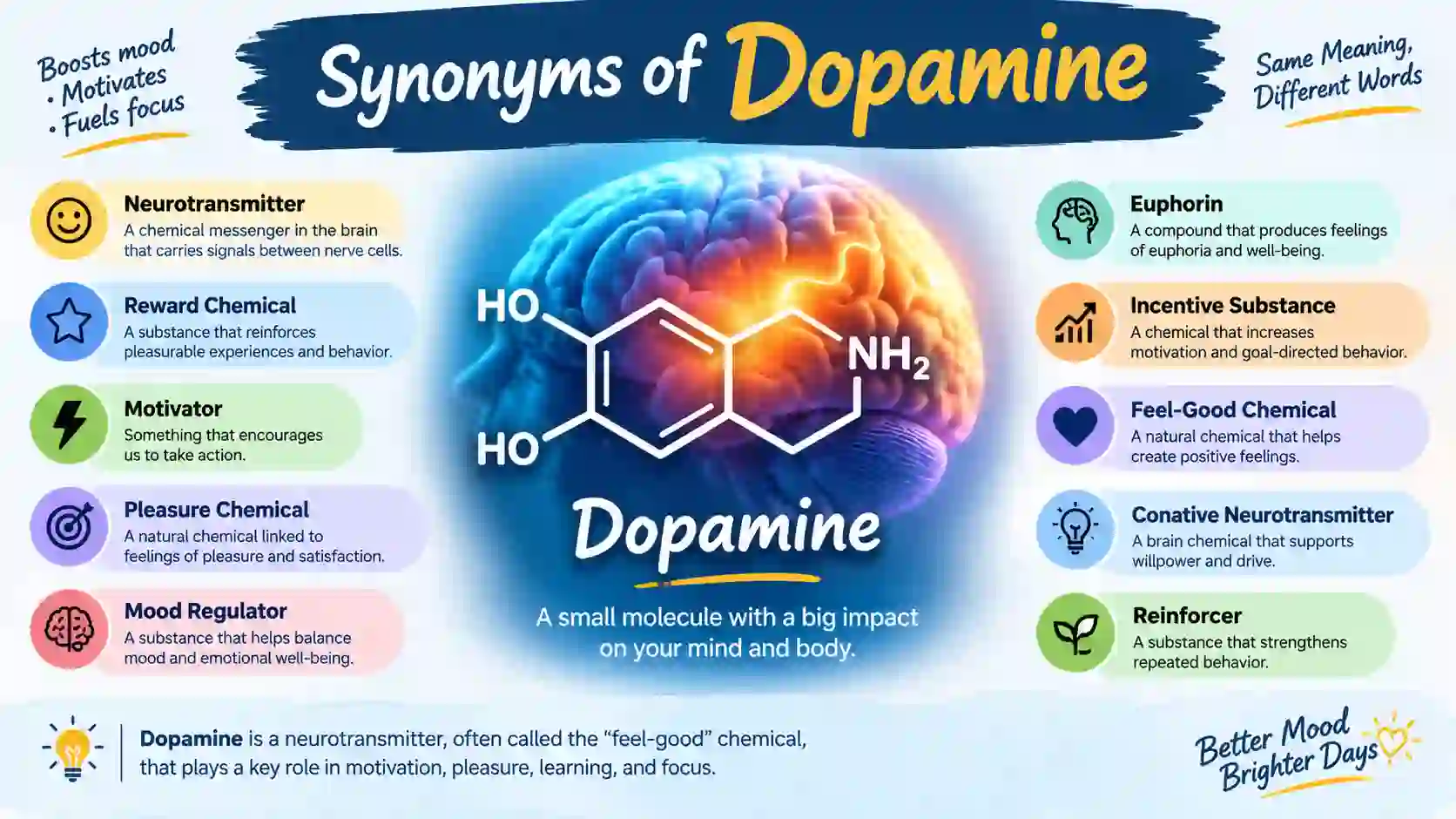
Quick Answer: What Are the Synonyms of Dopamine?
The synonyms of dopamine include 3-hydroxytyramine, oxytyramine, and 4-(2-aminoethyl)benzene-1,2-diol, which are recognized alternative chemical names. Other useful terms include neurotransmitter, neurochemical, and chemical messenger, but these describe dopamine’s category or function rather than naming the exact same compound. The informal phrase feel-good chemical is popular but scientifically incomplete.
Have you ever searched for another word for dopamine while writing an essay, science assignment, or blog post? You may have found words such as neurotransmitter, brain chemical, and feel-good chemical. Although these expressions relate to dopamine, they do not all mean exactly the same thing.
Dopamine is a chemical found in the body that acts as a neurotransmitter and plays a role in movement, motivation, learning, and reward-related processes. Its scientific name and descriptive alternatives serve different purposes.
This guide explains the most useful synonyms of dopamine, their meanings, and how to use them naturally. You will also learn the difference between exact chemical names, scientific classifications, and informal expressions. These distinctions will help you choose accurate words for schoolwork, professional writing, and everyday conversations.
Pronunciation of Dopamine
- American English IPA: /ˈdoʊ.pə.miːn/
- British English IPA: /ˈdəʊ.pə.miːn/
- Simple pronunciation: DOH-puh-meen
- Part of speech: Noun
- Word type: Usually an uncountable noun in scientific writing.
American and British English use different vowel sounds in the first syllable. However, both varieties use the same spelling: dopamine.
What Does Dopamine Mean?
Dopamine is a chemical messenger that helps cells communicate. In the nervous system, it participates in processes related to movement, motivation, attention, learning, and reward.
People often call dopamine the “feel-good chemical.” This nickname can be misleading because dopamine does much more than produce pleasurable feelings. Its effects depend on the brain circuit, the receptors involved, and the situation.
Synonyms of Dopamine: Quick Comparison Table
| Synonym or related term | Type | Formality |
| 3-hydroxytyramine | Alternative chemical name | Technical |
| Oxytyramine | Alternative chemical name | Technical |
| 4-(2-aminoethyl)benzene-1,2-diol | Systematic chemical name | Highly technical |
| Neurotransmitter | Scientific category | Academic |
| Neurochemical | Broad scientific term | Formal |
| Chemical messenger | Descriptive alternative | Neutral |
| Brain chemical | General description | Informal |
| Catecholamine | Chemical classification | Technical |
| Monoamine | Chemical classification | Technical |
| Neuromodulator | Functional description | Academic |
| Signaling molecule | Broader scientific description | Academic |
| Feel-good chemical | Popular nickname | Informal |
Important: The first three entries are alternative names for dopamine. Most of the remaining entries describe a category, role, or popular interpretation. They are not exact synonyms in every sentence.
1. 3-Hydroxytyramine
Meaning: An alternative chemical name for dopamine.
Examples:
- The reference identified 3-hydroxytyramine as another name for dopamine.
- The researcher checked the chemical identity before recording the compound.
Best used when: Writing technical notes or consulting chemical databases.
Tone: Technical.
Common collocations: 3-hydroxytyramine structure, chemical identity, compound identification.
When not to use it: Avoid this term in basic writing when the familiar name dopamine is clearer.
2. Oxytyramine
Meaning: A recognized alternative name for dopamine.
Examples:
- The database listed oxytyramine among the compound’s alternative names.
- The student compared oxytyramine with the more familiar term dopamine.
Best used when: Checking chemical references or alternative compound names.
Tone: Technical.
Common collocations: alternative chemical name, chemical reference, compound identification.
When not to use it: Do not assume readers will recognize this less familiar name.
3. 4-(2-Aminoethyl)benzene-1,2-diol
Meaning: The systematic chemical name for dopamine.
Examples:
- The chemistry report gave the systematic name 4-(2-aminoethyl)benzene-1,2-diol.
- The researcher used the compound’s systematic name to identify its molecular structure.
Best used when: Writing chemistry reports or identifying a compound precisely.
Tone: Highly technical.
Common collocations: systematic chemical name, molecular structure, chemical formula.
When not to use it: Avoid this long name in general-interest articles unless the chemical structure is relevant.
4. Neurotransmitter
Meaning: A chemical that helps nerve cells communicate with other cells.
Examples:
- Dopamine is a neurotransmitter involved in several brain functions.
- The biology lesson explained how a neurotransmitter carries chemical signals.
Best used when: Writing about neuroscience, biology, or the nervous system.
Tone: Academic.
Common collocations: neurotransmitter release, neurotransmitter activity, neurotransmitter system.
Nuance: A neurotransmitter is a category, not another unique name for dopamine.
5. Neurochemical
Meaning: A chemical involved in the activity of the nervous system.
Examples:
- Dopamine is an important neurochemical.
- The research examined changes in neurochemical activity.
Best used when: Discussing brain chemistry in a broad scientific context.
Tone: Formal.
Common collocations: neurochemical activity, neurochemical changes, neurochemical processes.
Nuance: This term covers many chemicals, so it is less specific than dopamine.
6. Chemical Messenger
Meaning: A chemical that carries signals between cells.
Examples:
- Dopamine acts as a chemical messenger in the nervous system.
- The teacher explained how chemical messengers support communication between cells.
Best used when: Explaining the subject to beginners.
Tone: Neutral.
Common collocations: chemical messenger, cellular communication, chemical signaling.
Nuance: This is a clear description of dopamine’s role, not an exact alternative chemical name.
7. Brain Chemical
Meaning: An informal term for a chemical involved in brain activity.
Examples:
- The article described dopamine as a brain chemical involved in motivation.
- The teacher used the phrase brain chemical to make the lesson easier to understand.
Best used when: Writing for a general audience or young learners.
Tone: Informal.
Common collocations: brain chemical, brain chemistry, chemical activity.
When not to use it: Use a more precise term in scientific or medical writing.
8. Catecholamine
Meaning: A member of a chemical family that includes dopamine, epinephrine, and norepinephrine.
Examples:
- Dopamine belongs to the catecholamine family.
- The chemistry class compared three catecholamines.
Best used when: Explaining chemical classification.
Tone: Technical.
Common collocations: catecholamine synthesis, catecholamine levels, catecholamine metabolism.
Nuance: A catecholamine is a class of compounds, not a synonym unique to dopamine.
9. Monoamine
Meaning: A type of chemical compound that includes dopamine and several other important neurotransmitters.
Examples:
- Dopamine is classified as a monoamine.
- The textbook introduced monoamines and their roles in the nervous system.
Best used when: Discussing chemical structure or neurotransmitter families.
Tone: Technical.
Common collocations: monoamine neurotransmitter, monoamine metabolism, monoamine system.
When not to use it: Do not substitute monoamine for dopamine if you need to identify the exact compound.
10. Neuromodulator
Meaning: A substance that changes how nerve cells or neural circuits respond.
Examples:
- Dopamine can act as a neuromodulator in certain neural circuits.
- The study examined how neuromodulators influence neural activity.
Best used when: Explaining how chemical signals affect neural circuits.
Tone: Academic.
Common collocations: neuromodulatory effect, neural circuits, neuromodulator activity.
Nuance: This term describes a functional role rather than the chemical’s unique identity.
11. Signaling Molecule
Meaning: A molecule that helps transmit information or regulate activity in a biological system.
Examples:
- Dopamine acts as a signaling molecule in the nervous system.
- The researchers examined signaling molecules involved in cellular communication.
Best used when: Writing about cellular biology or chemical communication.
Tone: Academic.
Common collocations: signaling molecule, signaling pathway, cellular signaling.
When not to use it: Prefer dopamine when the identity of the compound matters.
12. Feel-Good Chemical
Meaning: An informal expression for a chemical associated with pleasurable or rewarding experiences.
Examples:
- The magazine called dopamine a feel-good chemical.
- The article explained why the phrase feel-good chemical does not fully describe dopamine.
Best used when: Discussing popular science or everyday descriptions of brain chemistry.
Tone: Informal.
Common collocations: feel-good chemical, pleasurable experience, reward system.
Nuance: This is a nickname, not a scientific synonym. Dopamine is involved in more than pleasure.
Other Related Terms Worth Knowing
These expressions can improve your vocabulary, but writers should not present them as exact synonyms.
| Term | Meaning | Best context |
| Reward-related chemical | A descriptive phrase for a chemical involved in reward processes | Popular science |
| Motivation-related chemical | A phrase highlighting dopamine’s role in motivation | Educational writing |
| Chemical signal | A chemical cue that carries information | Cell biology |
| Reward signal | Information or activity related to reward processing | Neuroscience |
| Dopaminergic substance | A substance that acts on or affects dopamine-related pathways or receptors, depending on context | Technical writing |
| Dopamine-related neurochemical | A broad description of a neurochemical connected with dopamine-related processes | Research summaries |
The key distinction is simple: dopamine is a chemical, while expressions such as reward signal can refer to information or activity associated with a biological process.
Choose the Right Synonym
The best word depends on your audience and purpose.
| Original sentence | Better version | Why it works |
| Dopamine helps cells communicate. | Dopamine acts as a chemical messenger. | Easy to understand. |
| Dopamine is important in neuroscience. | Dopamine is an important neurotransmitter. | More specific scientific wording. |
| Dopamine belongs to a chemical family. | Dopamine is a catecholamine. | Identifies its chemical classification. |
| Dopamine makes people happy. | Dopamine participates in reward and motivation. | Avoids oversimplifying its role. |
| The database lists another name for dopamine. | The database lists 3-hydroxytyramine. | Gives a specific alternative chemical name. |
Which Word Should You Choose?
- For a school essay: Use dopamine and explain that it is a neurotransmitter.
- For a scientific paper: Use dopamine, catecholamine, or dopaminergic signaling when the context supports them.
- For a beginner’s guide: Use chemical messenger or brain chemical.
- For a chemistry assignment: Use the systematic chemical name if required.
- For social media: You may use feel-good chemicals informally, but avoid presenting it as a complete scientific definition.
Word Origin and Etymology
The word dopamine dates from the 1950s. Oxford explains that it combines elements of dopa and amine.
The compound was described earlier, in 1910, but researchers later established its important role as a neurotransmitter. Research in the 1950s helped change scientific understanding of dopamine in the brain.
- Word: Dopamine
- Origin: Scientific terminology
- Word formation: Blend of dopa and amine
- First known use: The 1950s
- American and British spelling: Dopamine in both varieties
Commonly Confused Words
| Word | Difference | Example |
| Serotonin | A different chemical with its own biological functions | Serotonin is not another name for dopamine. |
| Endorphin | A peptide involved in pain regulation and other processes | Endorphins act on opioid receptors. |
| Norepinephrine | A catecholamine also known as noradrenaline | Norepinephrine helps regulate alertness. |
| Epinephrine | A catecholamine also known as adrenaline | Epinephrine helps the body respond to danger. |
| Oxytocin | A hormone and neuropeptide with several biological roles | Oxytocin plays a role in childbirth and lactation. |
These substances are related to biological signaling, but their names cannot replace dopamine.
Common Mistakes
Mistake: Serotonin is a synonym for dopamine.
Correction: Serotonin is a different chemical.
Explanation: Both participate in biological signaling, but they have different identities and functions.
Mistake: Dopamine is only a pleasure chemical.
Correction: Dopamine contributes to movement, motivation, learning, and reward-related processes.
Explanation: The popular nickname does not describe all its roles.
Mistake: Every neurochemical is dopamine.
Correction: Dopamine is one of many neurochemicals.
Explanation: A broad category includes different substances.
Mistake: Reward signal means dopamine.
Correction: A reward signal may refer to neural activity or information about rewards.
Explanation: A chemical and a signaling process are not the same thing.
Grammar and Writing Tips
Dopamine is normally used as an uncountable noun in general scientific writing.
Correct:
- Dopamine plays a role in movement.
- The study examined dopamine levels.
- Researchers investigated dopamine signaling.
Avoid:
- Many dopamines affect the brain.
- The neurotransmitter dopamine is important.
Use dopaminergic as an adjective when describing something related to dopamine.
Example: “The researchers examined dopaminergic pathways.”
Do not add a synonym merely to avoid repeating a technical word. In scientific writing, repeating dopamine is often more accurate than using a broad or misleading alternative.
Related Vocabulary and Word Family
Related Expressions
- Dopamine release: The release of dopamine from cells.
- Dopamine levels: The amount or concentration measured in a particular context.
- Dopamine receptor: A protein that responds to dopamine.
- Dopamine signaling: Communication processes involving dopamine.
- Dopamine pathway: A neural pathway associated with dopamine.
- Dopamine agonist: A substance that activates dopamine receptors.
- Dopamine antagonist: A substance that blocks dopamine receptors.
Word Family
| Word | Part of speech | Meaning |
| Dopamine | Noun | A specific chemical |
| Dopaminergic | Adjective | Relating to dopamine |
| Neurotransmitter | Noun | A chemical involved in cell signaling |
| Neurotransmission | Noun | The process of transmitting signals between nerve cells |
| Neurochemical | Noun or adjective | A chemical related to the nervous system |
Antonyms of Dopamine
Dopamine has no direct antonym because it names a chemical rather than a quality. Words such as apathy and demotivation may contrast with motivation in certain contexts, but they are not antonyms of dopamine.
Frequently Asked Questions
1. What is the best synonym for dopamine?
The best alternative depends on your meaning. Neurotransmitter describes dopamine’s role, while chemical messenger is easier for beginners to understand. For an exact chemical-name alternative, use a recognized name such as 3-hydroxytyramine.
2. What is the scientific name for dopamine?
Dopamine is the common scientific name. Its systematic chemical name is 4-(2-aminoethyl)benzene-1,2-diol. Other recognized alternative names include 3-hydroxytyramine and oxytyramine. These names identify the same compound rather than broader categories.
3. Is neurochemical another word for dopamine?
Not exactly. Neurochemical is a broad term for a chemical involved in nervous system activity. Dopamine is one neurochemical, but many other substances also belong to this broad group. Use dopamine when you mean the specific compound.
4. Is dopamine the same as serotonin?
No. Dopamine and serotonin are separate chemicals with different structures and functions. Both participate in biological signaling, but one cannot replace the other in scientific writing. Use the correct chemical name when describing a particular experiment or biological process.
5. Why is dopamine called the feel-good chemical?
Dopamine is sometimes called the feel-good chemical because it participates in reward-related processes and can be associated with pleasurable experiences. However, the nickname is incomplete. Dopamine also plays important roles in movement, learning, motivation, and other functions.
6. Does dopamine have an antonym?
No direct antonym exists for dopamine. It is the name of a chemical, not a descriptive quality with an opposite. Words such as apathy and demotivation may contrast with motivation in some contexts, but they are not chemical antonyms.
7. What is the easiest way to explain dopamine?
You can describe dopamine as a chemical messenger that helps cells communicate and supports several brain functions. For a beginner, this explanation is clearer than a long technical definition. Introduce the term neurotransmitter when the reader needs more scientific detail.
8. How can I use dopamine synonyms in an essay?
Use dopamine when discussing the specific chemical, neurotransmitter when describing its role, and chemical messenger when simplifying the explanation. Avoid using feel-good chemicals as a scientific definition. Accuracy matters more than avoiding repeated words.
Vocabulary Quiz
1. Which is a recognized alternative chemical name for dopamine?
A. Serotonin
B. 3-hydroxytyramine
C. Oxytocin
D. Endorphin
2. What does neurotransmitter mean?
A. A type of chemical messenger
B. A synonym for happiness
C. An antonym for motivation
D. A type of emotion
3. Which expression is an informal nickname rather than an exact chemical name?
A. Oxytyramine
B. Dopamine
C. Feel-good chemical
D. 3-hydroxytyramine
4. Which sentence is more scientifically accurate?
A. Dopamine only produces happiness.
B. Dopamine is involved in reward and motivation.
C. Serotonin is another name for dopamine.
D. Every neurochemical is dopamine.
5. Which word identifies dopamine’s chemical family?
A. Catecholamine
B. Apathy
C. Oxytocin
D. Happiness
Answer Key
- B. 3-hydroxytyramine
- A. A type of chemical messenger
- C. Feel-good chemical
- B. Dopamine is involved in reward and motivation.
- A. Catecholamine
Conclusion
Learning the synonyms of dopamine helps you choose more accurate words for essays, science assignments, blog posts, and everyday conversations.
Remember that chemical names such as 3-hydroxytyramine differ from broader terms such as neurotransmitter and informal phrases such as feel-good chemical.
Understanding these differences improves vocabulary and scientific communication. Practice choosing the right term in your writing, and your explanations will become clearer, more natural, and more trustworthy.
References
- PubChem, National Library of Medicine: Dopamine, chemical names and identifiers. https://pubchem.ncbi.nlm.nih.gov/compound/681
- Oxford Learner’s Dictionaries: Dopamine, definition, pronunciation, and word origin. https://www.oxfordlearnersdictionaries.com/definition/english/dopamine
- American Psychological Association: Dopamine, Dictionary of Psychology. https://dictionary.apa.org/dopamine
- International Union of Pure and Applied Chemistry: Dopamine, Gold Book. https://goldbook.iupac.org/terms/view/11723
- Cleveland Clinic: Dopamine, its functions and role in the body. https://my.clevelandclinic.org/health/articles/22581-dopamine

Synonorm is a trusted English vocabulary resource created to help readers find the right words and understand the differences between similar terms. We provide clear explanations of synonyms, meanings, examples, usage, and alternatives. Our content makes vocabulary easier to learn and apply in everyday, academic, and professional English. Synonorm is designed for students, writers, ESL learners, professionals, and anyone who wants to improve their English vocabulary and communicate more clearly.