Quick Answer
The closest synonyms of grudgingly are reluctantly, unwillingly, and begrudgingly. They describe doing, accepting, giving, or admitting something without wanting to. However, grudgingly can also suggest resistance or a negative attitude. Words such as hesitantly, unenthusiastically, resentfully, and under protest overlap with the meaning but add different shades.
What Does “Grudgingly” Mean?
Have you ever agreed to something even though you really did not want to?
Maybe your friend asked you to help with a task, your teacher asked you to admit a mistake, or your manager gave you a duty you did not like. You finally agreed, but you were not happy about it.
You did it grudgingly.
Grudgingly is an adverb meaning in an unwilling way. It often describes an action that a person accepts or performs without enthusiasm. It can also suggest resistance or a feeling that the person does not want to give something, admit something, or accept a situation. Cambridge gives unwillingly as its direct definition, while Oxford gives reluctantly as its synonym.
For example:
She grudgingly admitted that her brother was right.
She admitted the truth, but she did not want to admit it.
This small difference matters when choosing a synonym. Reluctantly usually focuses on unwillingness, while grudgingly can make the person’s resistance or negative attitude more noticeable.
Grudgingly at a Glance
| Feature | Information |
| Word | Grudgingly |
| Part of speech | Adverb |
| Basic meaning | Unwillingly |
| Pronunciation | /ˈɡrʌdʒɪŋli/ |
| Main idea | Doing something without wanting to |
| Common tone | Negative or resistant |
| Common register | Neutral |
| American spelling | grudgingly |
| British spelling | grudgingly |
| Closest synonym | reluctantly |
| Other close synonyms | unwillingly, begrudgingly |
Cambridge gives the pronunciation /ˈɡrʌdʒ.ɪŋ.li/ and uses examples such as grudgingly admitted and grudgingly accepted.
Pronunciation of Grudgingly
IPA: /ˈɡrʌdʒɪŋli/
Say it like: GRUJ-ing-lee
The pronunciation is essentially the same in American and British English. There is also no American/British spelling difference in grudgingly.
Part of Speech
Grudgingly is an adverb.
It tells us how someone does something.
Examples
- He grudgingly agreed to help.
- She grudgingly accepted the decision.
- Tom grudgingly admitted that he was wrong.
- They grudgingly gave him permission.
Word family
| Word | Part of speech | Meaning |
| Grudge | Noun / verb | Resentment; to resent something |
| Grudging | Adjective | Unwilling or reluctant |
| Grudgingly | Adverb | In an unwilling way |
| Begrudge | Verb | To resent giving or allowing something |
| Begrudging | Adjective | Showing reluctance or resentment |
| Begrudgingly | Adverb | In a reluctant or resentful way |
Cambridge defines grudging as an action or feeling that is done or experienced unwillingly.
How to Use “Grudgingly” in a Sentence
The most natural pattern is:
Subject + grudgingly + verb
Examples:
- She grudgingly agreed.
- He grudgingly accepted the offer.
- The manager grudgingly approved the request.
You can also put the adverb after the verb:
- She agreed grudgingly.
- He accepted the decision grudgingly.
Common collocations
Native English usage commonly places grudgingly with verbs such as:
- grudgingly accept
- grudgingly agree
- grudgingly admit
- grudgingly acknowledge
- grudgingly accept responsibility
- grudgingly give
- grudgingly allow
- grudgingly pay
- grudgingly concede
Cambridge’s corpus examples include combinations such as grudgingly admitted, grudgingly accepted, grudgingly agreed, and grudgingly acknowledged.
Good to know: Grudgingly normally describes an action that actually happens. It does not simply mean “refusing.”
The Closest Synonyms of Grudgingly
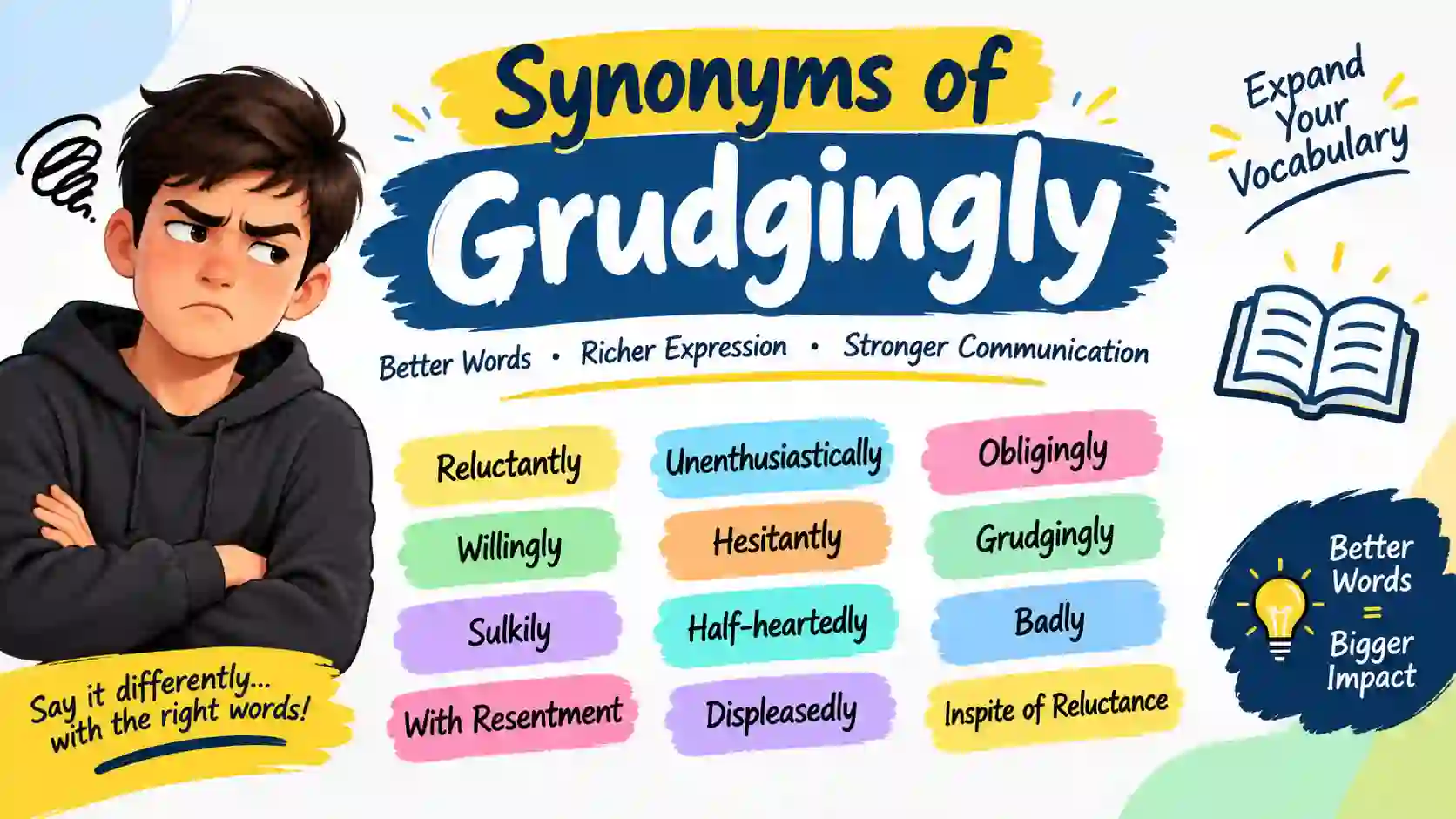
The three most important alternatives are:
- Reluctantly
- Unwillingly
- Begrudgingly
These are the words learners should learn first.
Oxford specifically defines grudgingly as something done or given unwillingly and gives reluctantly as its synonym. It also lists begrudgingly as a related form, while noting that it is less frequent than grudgingly.
1. Reluctantly
Meaning: Doing something even though you do not want to do it.
Example 1:
She reluctantly accepted the new position.
Example 2:
He reluctantly agreed to apologize.
Best used when: You want the most natural everyday alternative to grudgingly.
Tone: Neutral to slightly negative
Register: Spoken, general, academic, professional
Frequency: Very common
CEFR: Advanced learner vocabulary
Important nuance
She reluctantly agreed.
This tells us she did not want to agree.
She grudgingly agreed.
This can suggest stronger resistance or an attitude of “I do not want to give in.”
When not to use: Do not use reluctantly if you specifically need to show bitterness or resentment.
2. Unwillingly
Meaning: Doing something without wanting to do it.
Example 1:
He unwillingly accepted the assignment.
Example 2:
The child unwillingly left the playground.
Best used when: You want to state simple lack of willingness.
Tone: Neutral to negative
Register: General English
Frequency: Very common
Nuance
Unwillingly is more direct and literal than grudgingly. It tells the reader that the person did not want to do something, but it does not necessarily suggest resentment.
When not to use: Choose grudgingly instead if you want the person’s attitude to feel more resistant.
3. Begrudgingly
Meaning: Doing something unwillingly, often with a feeling of resentment.
Example 1:
He begrudgingly shared the credit.
Example 2:
She begrudgingly admitted that her rival had been right.
Best used when: The person seems unwilling and emotionally resistant.
Tone: Negative
Register: General and written English
Frequency: Common, but less frequent than grudgingly according to Oxford.
Nuance
Begrudgingly is extremely close to grudgingly. However, learners should not assume that every dictionary synonym has exactly the same frequency or naturalness.
When not to use: Do not use it when someone is simply uncertain or nervous.
Other Useful Synonyms and Near, Synonyms
4. Unenthusiastically
Meaning: Without excitement, interest, or energy.
Examples:
- The students unenthusiastically joined the activity.
- She unenthusiastically supported the proposal.
Best used when: The main idea is a lack of enthusiasm.
Tone: Mildly negative
Register: Neutral
Frequency: Common
Not the same as grudgingly: Someone can be unenthusiastic without actively resisting.
5. Hesitantly
Meaning: In an uncertain or doubtful way.
Examples:
- She hesitantly opened the door.
- He hesitantly answered the question.
Best used when: The person is unsure or nervous.
Tone: Neutral
Register: General English
Frequency: Common
Not the same as grudgingly: Hesitation can come from fear or uncertainty. Grudging usually involves unwillingness.
6. Resentfully
Meaning: In a way that shows anger or bitterness about something.
Examples:
- He resentfully handed over the keys.
- She resentfully accepted the criticism.
Best used when: Strong negative emotion is important.
Tone: Strongly negative
Register: General/written
Frequency: Common
Not the same as grudgingly: Resentfully is often stronger. A reluctant person is not necessarily resentful.
7. Half-Heartedly
Meaning: Without much effort, interest, or enthusiasm.
Examples:
- He half-heartedly apologized.
- She half-heartedly joined the discussion.
Best used when: Someone participates but does not put real energy into it.
Tone: Mildly negative
Register: Neutral/informal
Frequency: Common
Not the same as grudgingly: It focuses on weak effort or enthusiasm rather than unwillingness.
8. Under Protest
Meaning: While openly showing disagreement.
Examples:
- He signed the agreement under protest.
- The company paid the charge under protest.
Best used when: Someone complies but clearly objects.
Tone: Formal
Register: Legal, business, formal writing
Frequency: Common
Not the same as grudgingly: Under protest makes the objection explicit.
9. With Reluctance
Meaning: In an unwilling way.
Examples:
- She accepted the role with reluctance.
- He gave his approval with reluctance.
Best used when: You want a noun phrase rather than an adverb.
Tone: Neutral
Register: General/formal
Compare
- He grudgingly agreed.
- He agreed with reluctance.
Both express unwillingness, but the second sounds slightly more formal.
10. Without Enthusiasm
Meaning: Without showing excitement or strong interest.
Examples:
- They welcomed the news without enthusiasm.
- He accepted the invitation without enthusiasm.
Best used when: Lack of excitement is more important than resistance.
11. Against One’s Better Judgment
Meaning: Doing something despite believing it is not sensible.
Examples:
- I agreed against my better judgment.
- She accepted the offer against her better judgment.
Best used when: The person believes the decision is probably unwise.
Not the same as grudgingly: A person can act against their better judgment while still being willing to do it.
12. With Reservations
Meaning: Accepting something while still having doubts or concerns.
Examples:
- The committee approved the plan with reservations.
- She accepted the offer with reservations.
Best used when: Doubt or concern matters more than unwillingness.
13. Not Willingly
Meaning: Not by choice or not with willingness.
Examples:
- He left, but not willingly.
- She gave up the position, though not willingly.
Best used when: You want a simple phrase that most learners can understand.
14. Involuntarily
Meaning: Without conscious choice or voluntary control.
Example:
- His hand moved involuntarily.
Important: This is a near-synonym, not an exact synonym.
Someone who acts involuntarily may have no control over the action at all. Someone who acts grudgingly chooses to do it but does not want to.
Compare:
He grudgingly apologized.
He chose to apologize but did not want to.
He involuntarily apologized.
This suggests the apology happened without conscious voluntary control.
15. Tentatively
Meaning: In an uncertain or cautious way.
Example:
- She tentatively accepted the proposal.
Best used when: The person is unsure.
Do not use it when the only idea is unwillingness.
16. Cautiously
Meaning: Carefully because there may be danger or risk.
Example:
- He cautiously accepted the offer.
Important: Cautiously describes careful behavior, not unwillingness.
It is therefore a contextual alternative, not a direct synonym.
17. Protestingly
Meaning: In a way that expresses objection or protest.
Example:
- “But I never agreed to this,” she said protestingly.
This is uncommon in everyday English. In most situations, under protest or in protest sounds more natural.
Synonym Strength Guide
| Category | Words |
| Closest | reluctantly, unwillingly |
| Very close | begrudgingly |
| Strong emotional overlap | resentfully |
| Lack of enthusiasm | unenthusiastically, half-heartedly |
| Uncertainty | hesitantly, tentatively |
| Open objection | under protest |
| Doubt | with reservations |
| Poor voluntary control | involuntarily |
| Cautious action | cautiously |
This distinction is one of the main areas where generic thesaurus lists can mislead learners. Thesaurus.com groups reluctantly, unwillingly, and involuntarily within its results, but its own grouping shows different strengths and related meanings rather than proving that every listed word can replace grudgingly in every sentence.
Choose the Right Synonym
The easiest way to choose the right word is to ask:
What exactly does the sentence want to show?
| If you want to show… | Choose… | Example |
| Simple unwillingness | Reluctantly | She reluctantly agreed. |
| No willingness | Unwillingly | He unwillingly participated. |
| Unwillingness plus resistance | Grudgingly | He grudgingly accepted. |
| Unwillingness plus resentment | Begrudgingly | She begrudgingly helped. |
| Lack of excitement | Unenthusiastically | They unenthusiastically joined. |
| Uncertainty | Hesitantly | He hesitantly answered. |
| Strong bitterness | Resentfully | She resentfully complied. |
| Open disagreement | Under protest | He signed under protest. |
| Doubt | With reservations | They agreed with reservations. |
| No conscious control | Involuntarily | He moved involuntarily. |
The four-word test
Compare these:
Reluctantly:
I reluctantly agreed.
“I did not want to.”
Grudgingly:
I grudgingly agreed.
“I did not want to, and I was resistant to it.”
Hesitantly:
I hesitantly agreed.
“I was uncertain.”
Resentfully:
I resentfully agreed.
“I agreed while feeling bitter or angry.”
That is the key semantic difference.
Common Collocations With Grudgingly
Natural combinations are useful because they show how native speakers actually use a word.
Very common patterns
- grudgingly admit
- grudgingly accept
- grudgingly agree
- grudgingly acknowledge
- grudgingly concede
- grudgingly give
- grudgingly allow
- grudgingly pay
- grudgingly accept responsibility
Example sentences
- She grudgingly admitted her mistake.
- He grudgingly accepted the result.
- They grudgingly agreed to the change.
- The manager grudgingly acknowledged the problem.
- He grudgingly conceded that his opponent had a point.
Cambridge’s corpus examples show particularly strong usage with admit, accept, agree, and acknowledge.
Common Mistakes With “Grudgingly”
Common Mistake Box
Mistake 1: Treating “grudgingly” as “refusing”
Incorrect idea:
He grudgingly refused to help.
This can be grammatical, but it creates a different and potentially confusing meaning because grudgingly describes the manner of the refusal.
If you mean he agreed unwillingly, say:
He grudgingly agreed to help.
Mistake 2: Using “hesitantly” for every reluctant action
Wrong choice:
She hesitantly admitted that she was wrong.
This means she was uncertain or hesitant.
If she knew she was wrong but hated admitting it:
She grudgingly admitted that she was wrong.
Mistake 3: Using “involuntarily” for reluctance
He involuntarily accepted the job.
This suggests a lack of voluntary control.
For normal unwilling acceptance:
He reluctantly accepted the job.
Mistake 4: Using “grudgingly” for positive willingness
Do not write:
She grudgingly volunteered because she loved helping everyone.
The two ideas conflict unless you are intentionally creating irony.
Grudgingly in Different Types of Writing
Academic Writing
Use grudgingly when describing reluctant acceptance or acknowledgment.
The critics grudgingly acknowledged the value of the research.
For formal academic writing, reluctantly may sound more neutral.
Business Writing
Use the word carefully because it can sound negative.
Instead of:
We grudgingly accept your proposal.
You might write:
We accept the proposal with some reservations.
This sounds more professional if you are communicating with a client or colleague.
Creative Writing
Grudgingly is especially useful because it shows attitude without directly explaining it.
Daniel grudgingly handed her the keys.
The reader can infer that Daniel does not want to give them up.
Everyday Conversation
Reluctantly is often the easier choice:
I reluctantly agreed to go.
But grudgingly works when you want a stronger emotional shade:
I grudgingly admit that you were right.
American vs. British English
There is no spelling difference between American and British English:
- American: grudgingly
- British: grudgingly
The pronunciation is also essentially the same.
The word is used naturally in both varieties. Cambridge provides US and UK pronunciation information for the word.
Word Origin and Etymology
Grudgingly comes from the word family built around grudge.
The modern meaning connects the word with unwillingness and resentment. This explains why grudgingly can express more than simple hesitation.
The word is especially useful when someone gives, accepts, admits, or agrees to something that they would rather not give, accept, admit, or agree to.
A simple word-family chain is:
grudge → grudging → grudgingly
The related verb begrudge adds another useful idea: resenting the fact that someone has, receives, or gets something.
Grudgingly vs. Begrudgingly
These words are extremely close.
| Word | Main idea | Typical effect |
| Grudgingly | Unwillingly | Resistance |
| Begrudgingly | Unwillingly, often resentfully | Stronger negative feeling |
Oxford lists begrudgingly as a less frequent form compared with grudgingly.
So if you are writing for general readers, grudgingly is usually the safer and more familiar choice.
Antonyms of Grudgingly
The opposite of grudgingly is willingness or enthusiasm.
Useful antonyms include:
- willingly
- gladly
- readily
- enthusiastically
- happily
- freely
- eagerly
- voluntarily
- generously
Compare:
He grudgingly shared the information.
He willingly shared the information.
The first sentence shows reluctance. The second shows willingness.
A Simple Memory Trick
Remember:
GRUDGINGLY = “I will do it, but I do not really want to.”
Imagine someone saying:
“Fine. I’ll do it.”
That attitude is often grudging.
But remember that the word does not always mean anger. The basic dictionary meaning is unwillingly, while the context can add resistance or resentment. Cambridge and Oxford both support this core meaning.
Mini Practice
Fill in the blanks
Choose from:
grudgingly · reluctantly · hesitantly · resentfully · involuntarily
- She ______ admitted that her brother was right.
- He ______ accepted the invitation because he did not want to go.
- The nervous student ______ answered the teacher’s question.
- She ______ handed over the money, feeling that the situation was unfair.
- His eyes closed ______ when the bright light appeared.
Answers
- grudgingly
- reluctantly
- hesitantly
- resentfully
- involuntarily
Sentence Rewriting Practice
Replace the underlined idea with a more precise word.
1.
He agreed, but he did not want to.
Answer: He reluctantly agreed.
2.
She admitted the truth even though she disliked doing so.
Answer: She grudgingly admitted the truth.
3.
He answered because he was uncertain.
Answer: He hesitantly answered.
4.
They accepted the decision while feeling bitter.
Answer: They resentfully accepted the decision.
Match the Meaning
Match each word with the correct meaning.
| Word | Meaning |
| 1. Reluctantly | A. Without conscious control |
| 2. Hesitantly | B. Without enthusiasm |
| 3. Involuntarily | C. Unwillingly |
| 4. Unenthusiastically | D. With uncertainty |
Answer
1 → C
2 → D
3 → A
4 → B
Frequently Asked Questions
What is the closest synonym of grudgingly?
The closest everyday synonym is reluctantly. Both words describe doing something without wanting to do it. Unwillingly is another close alternative. Grudgingly can add a stronger sense of resistance, especially when someone accepts, gives, or admits something they would rather not. Oxford specifically gives reluctantly as a synonym.
Is reluctantly the same as grudgingly?
They are very close, but they are not identical in every context. Reluctantly mainly means unwillingly. Grudgingly can also suggest resistance or a negative attitude. For example, “She reluctantly agreed” focuses on unwillingness, while “She grudgingly agreed” can sound more resistant.
What is another word for grudgingly agreeing?
Good alternatives include reluctantly agreeing, unwillingly agreeing, and begrudgingly agreeing. If the person openly objects while complying, agreeing under protest may be more precise. The best choice depends on whether the sentence focuses on reluctance, resentment, or disagreement.
What is the difference between grudgingly and hesitantly?
Grudgingly means doing something unwillingly. Hesitantly means doing something with uncertainty or doubt. A person can hesitate because they are nervous or unsure. A person can act grudgingly because they dislike what they have agreed to do.
Is begrudgingly a synonym for grudgingly?
Yes, the two words are very close. Both describe something done unwillingly. However, Oxford identifies begrudgingly as less frequent than grudgingly, so grudgingly is generally the more familiar choice for learners and general writing.
What is the opposite of grudgingly?
Common opposites include willingly, gladly, readily, enthusiastically, eagerly, and freely. The most direct opposite is usually willingly, because it directly contrasts unwilling action with willing action.
Can grudgingly mean angrily?
Not exactly. Grudgingly primarily means unwillingly. However, it can suggest resentment or a negative attitude depending on context. If you specifically mean that someone acts with anger or bitterness, resentfully may be a more precise word.
Is grudgingly a formal word?
Grudgingly is a neutral English adverb. You can use it in conversation, essays, journalism, stories, and professional writing. However, it can sound negative, so writers should consider whether they really want to communicate reluctance or resistance.
Vocabulary Quiz
1. Which word is the closest general synonym for “grudgingly”?
A. Eagerly
B. Reluctantly
C. Happily
D. Freely
2. Which word best describes uncertainty?
A. Hesitantly
B. Gladly
C. Begrudgingly
D. Willingly
3. Which sentence best uses “grudgingly”?
A. She grudgingly admitted that she was wrong.
B. She grudgingly became hungry.
C. He grudgingly sneezed because of dust.
D. They grudgingly slept for eight hours.
4. Which word means “without conscious control”?
A. Reluctantly
B. Involuntarily
C. Unenthusiastically
D. Resentfully
5. Which expression suggests open disagreement?
A. With pleasure
B. Under protest
C. With excitement
D. Willingly
Answer Key
- B. Reluctantly
- A. Hesitantly
- A. She grudgingly admitted that she was wrong.
- B. Involuntarily
- B. Under protest
Final Takeaway
The most important thing to remember is that not every related word is an exact synonym of grudgingly. If you mean simple unwillingness, choose reluctantly or unwillingly. If you want stronger resistance, grudgingly or begrudgingly may fit better. If you mean uncertainty, use hesitantly. If you mean bitterness, choose resentfully. If someone openly objects while complying, under protest is more precise.
Learning these small differences will make your essays, emails, stories, conversations, and professional writing sound more natural and accurate.
References
- Cambridge Dictionary, Grudgingly.
- Oxford Advanced Learner’s Dictionary, Grudgingly.
- Cambridge Dictionary, Grudging.
- Collins English Dictionary, Grudgingly.
- Thesaurus.com, Grudgingly Synonyms & Antonyms.

Synonorm is a trusted English vocabulary resource created to help readers find the right words and understand the differences between similar terms. We provide clear explanations of synonyms, meanings, examples, usage, and alternatives. Our content makes vocabulary easier to learn and apply in everyday, academic, and professional English. Synonorm is designed for students, writers, ESL learners, professionals, and anyone who wants to improve their English vocabulary and communicate more clearly.