Quick Answer
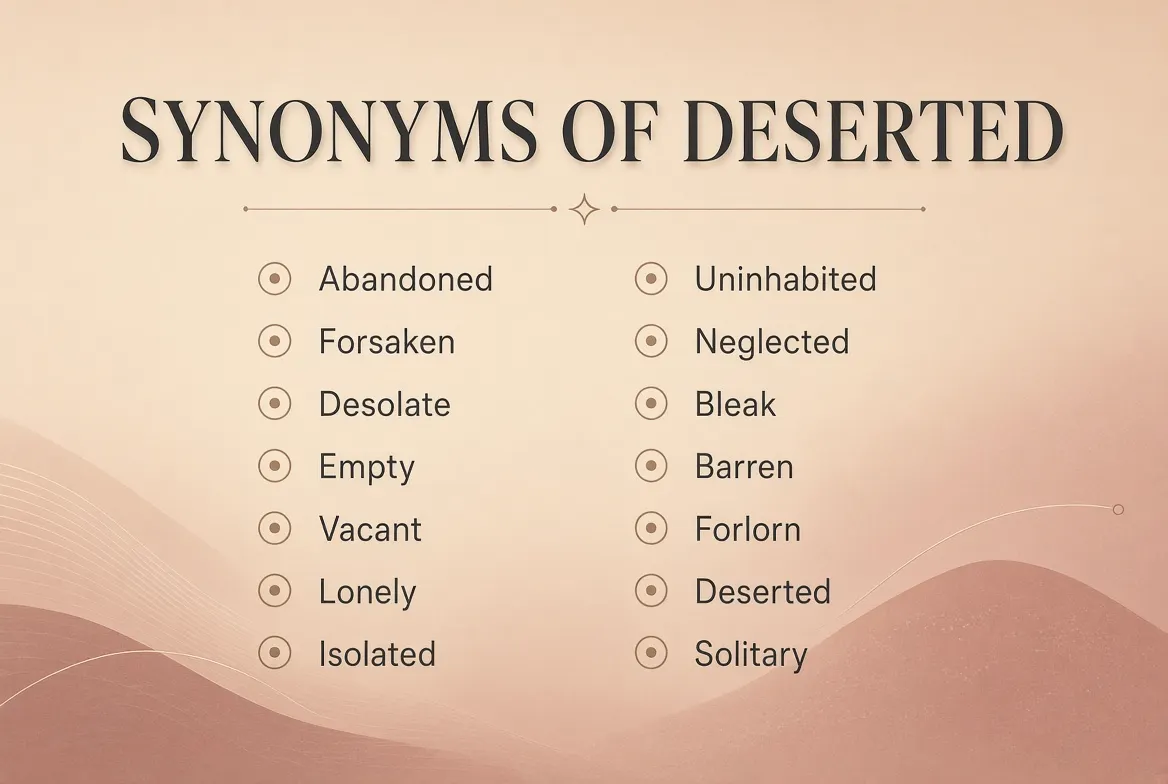
The most useful synonyms of deserted are empty, abandoned, desolate, uninhabited, unoccupied, vacant, neglected, derelict, forsaken, forlorn, lonely, barren, unfrequented, and bare. The best choice depends on the meaning. Empty means no people or things are present, while abandoned suggests that someone has left and no longer uses or cares for something.
What Does “Deserted” Mean?
Deserted has two closely related uses.
First, it can describe a place with no people in it:
The streets were deserted after midnight.
Second, it can describe a person who has been left alone, especially in a difficult situation:
She felt deserted by her friends.
Cambridge classifies deserted as a C1 adjective and separates these two main meanings: “empty” and “left behind.”
This distinction matters when choosing a synonym. For example, empty works well for a room, but forsaken may better describe someone who feels deeply abandoned.
Pronunciation
Deserted
- British English: /dɪˈzɜː.tɪd/
- American English: /dɪˈzɝː.t̬ɪd/
- Easy pronunciation: dih-ZUR-tid
The spelling is the same in American and British English. The main pronunciation difference comes from the vowel and pronunciation of r in the stressed syllable.
Part of Speech
Deserted is mainly an adjective when it means empty or abandoned.
Adjective
- a deserted street
- a deserted building
- a deserted beach
Verb form
Desert is also a verb meaning to leave someone or something behind.
- The soldiers deserted their post.
- He deserted his family.
Related forms
- desert — verb
- deserted — adjective/past participle
- desertion — noun
- deserter — noun
- deserting — present participle
Do not confuse the verb desert with the noun desert, meaning a dry region.
Grammar and Common Patterns
The adjective deserted commonly appears before nouns.
Common patterns
- a deserted street
- a deserted house
- a deserted village
- a deserted beach
- a deserted island
- a deserted road
- a deserted building
- a deserted parking lot
You can also use degree adverbs:
- completely deserted
- almost deserted
- largely deserted
- totally deserted
- virtually deserted
Examples
The beach was almost deserted on Monday morning.
The town becomes largely deserted during the winter.
Synonyms of Deserted: Quick Comparison
| Synonym | Core meaning | Register | Approx. CEFR |
| Empty | No people or things present | Neutral | A1 |
| Abandoned | Left behind and no longer cared for | Neutral | B1–B2 |
| Desolate | Empty, bleak, and lonely | Neutral/Literary | B2–C1 |
| Uninhabited | Nobody lives there | Neutral/Academic | B2 |
| Unoccupied | Not being used or occupied | Neutral/Formal | B2 |
| Vacant | Empty or available for use | Neutral/Business | B2 |
| Neglected | Not given proper care | Neutral | B2 |
| Derelict | Abandoned and falling into poor condition | Formal/Literary | C1 |
| Forsaken | Completely abandoned | Literary | C1 |
| Forlorn | Lonely, sad, and abandoned-looking | Literary | C1 |
| Lonely | Alone or emotionally isolated | Neutral | A2 |
| Barren | Empty of life or growth | Neutral/Literary | B2 |
| Bare | Empty, uncovered, or lacking contents | Neutral | B1 |
| Unfrequented | Rarely visited | Formal/Literary | C1 |
| Depopulated | Having lost much of its population | Formal/Academic | C1 |
| Isolated | Separated from other people or places | Neutral/Formal | B2 |
| Bleak | Empty, harsh, and depressing | Neutral/Literary | B2–C1 |
| Solitary | Alone or separate from others | Neutral/Literary | B2 |
| Godforsaken | Extremely remote or unpleasant | Informal | C1 |
| Cast off | Rejected or thrown aside | Neutral | C1 |
Important: These are not interchangeable in every sentence. Major dictionaries and thesauruses group deserted with words such as empty, abandoned, desolate, uninhabited, unoccupied, vacant, derelict, and forsaken, but their definitions show important differences.
1. Empty
Meaning: Having no people or things inside or around it.
CEFR: A1
Register: Neutral
Frequency: Very common
Tone: Plain and factual
Examples
- The classroom was empty after the final bell.
- We found an empty parking lot near the station.
Common collocations
- empty room
- empty street
- empty building
Best used when
You simply want to say that nobody or nothing is present.
When not to use it
Do not use empty when you need to show permanent abandonment.
Compare:
The house is empty.
Nobody is inside now.
The house is abandoned.
People left it and no longer care for it.
2. Abandoned
Meaning: Left behind and no longer used, supported, or cared for.
CEFR: B1–B2
Register: Neutral
Frequency: Very common
Tone: Stronger than empty
Examples
- They discovered an abandoned farmhouse outside the town.
- The abandoned factory has been closed for years.
Common collocations
- abandoned house
- abandoned building
- abandoned vehicle
Best used when
Someone has clearly left something behind.
When not to use it
Do not use it for a place that is merely empty for a short time.
3. Desolate
Meaning: Empty and bleak, often creating a feeling of sadness or loneliness.
CEFR: B2–C1
Register: Neutral/Literary
Frequency: Common
Examples
- The village looked desolate after the storm.
- We drove through a desolate landscape.
Common collocations
- desolate landscape
- desolate town
- desolate place
Best used when
You want to describe both physical emptiness and a bleak atmosphere.
When not to use it
Do not use desolate for every empty room. It usually adds an emotional or atmospheric meaning.
Cambridge also connects desolate with empty places and with feelings of sadness and being alone.
4. Uninhabited
Meaning: Having no people living there.
CEFR: B2
Register: Neutral/Academic
Frequency: Common
Examples
- The scientists reached an uninhabited island.
- Much of the region remains uninhabited.
Common collocations
- uninhabited island
- uninhabited region
- uninhabited area
Best used when
You are specifically talking about whether people live somewhere.
When not to use it
Do not use it for a room that is temporarily empty.
The office is uninhabited. ❌
The office is unoccupied. ✓
5. Unoccupied
Meaning: Not being used or not containing anyone.
CEFR: B2
Register: Neutral/Formal
Frequency: Common
Examples
- The apartment remained unoccupied for several months.
- Please use the unoccupied desk near the window.
Common collocations
- unoccupied room
- unoccupied house
- unoccupied seat
Best used when
You are writing about property, rooms, seats, or spaces.
When not to use it
In casual conversation, empty often sounds more natural.
6. Vacant
Meaning: Empty and available, or not currently occupied.
CEFR: B2
Register: Neutral/Business
Frequency: Common
Examples
- The company has three vacant offices.
- There is a vacant apartment above the store.
Common collocations
- vacant apartment
- vacant office
- vacant position
Best used when
Talking about property, jobs, seats, rooms, or positions.
When not to use it
Do not use vacant when you specifically want to say that something has been permanently abandoned.
7. Neglected
Meaning: Not receiving the care or attention it needs.
CEFR: B2
Register: Neutral
Frequency: Common
Examples
- The neglected garden was covered with weeds.
- The old building became neglected after its owner moved away.
Common collocations
- neglected garden
- neglected property
- neglected building
Best used when
Lack of care is the important idea.
When not to use it
A place can be deserted without being neglected.
8. Derelict
Meaning: Abandoned or unused and in very poor condition.
CEFR: C1
Register: Formal/Literary
Frequency: Uncommon
Examples
- The city plans to renovate the derelict warehouse.
- A derelict factory stood beside the railway.
Common collocations
- derelict building
- derelict factory
- derelict property
Best used when
Something is abandoned and badly damaged or neglected.
When not to use it
Do not call a clean, recently unused office derelict.
Collins specifically defines derelict in this context as abandoned or unused and falling into ruins.
9. Forsaken
Meaning: Completely abandoned or left without help.
CEFR: C1
Register: Literary/Formal
Frequency: Uncommon
Examples
- The travelers came across a forsaken village.
- He felt forsaken after everyone left him.
Common collocations
- forsaken village
- forsaken place
- forsaken soul
Best used when
You want a strong emotional or literary sense of abandonment.
When not to use it
Use abandoned in ordinary conversation unless the stronger literary tone is useful.
10. Forlorn
Meaning: Lonely, sad, or abandoned-looking.
CEFR: C1
Register: Literary
Frequency: Uncommon
Examples
- A forlorn cottage stood beside the frozen lake.
- The dog gave a forlorn look when its owner walked away.
Common collocations
- forlorn figure
- forlorn cottage
- forlorn expression
Best used when
You want to combine loneliness with sadness.
When not to use it
Do not use it as a basic replacement for empty.
11. Lonely
Meaning: Alone, or unhappy because of being alone.
CEFR: A2
Register: Neutral
Frequency: Very common
Examples
- A lonely house stood at the end of the road.
- She felt lonely after moving away from her family.
Best used when
The emotional experience of being alone matters.
When not to use it
A deserted street is not necessarily emotionally lonely.
12. Barren
Meaning: Empty of plants, life, or growth.
CEFR: B2
Register: Neutral/Literary
Frequency: Common
Examples
- The explorers crossed a barren landscape.
- Years without rain left the land barren.
Common collocations
- barren land
- barren landscape
- barren soil
Best used when
You want to emphasize a lack of natural life or growth.
When not to use it
Do not use barren simply because a room has no people.
13. Bare
Meaning: Empty, uncovered, or containing very little.
CEFR: B1
Register: Neutral
Frequency: Common
Examples
- The room had bare walls and almost no furniture.
- The shelves were completely bare.
Best used when
The lack of objects, furniture, decoration, or covering matters.
When not to use it
Bare does not automatically mean abandoned.
14. Unfrequented
Meaning: Not often visited by people.
CEFR: C1
Register: Formal/Literary
Frequency: Uncommon
Examples
- The hikers followed an unfrequented forest trail.
- The photographer searched for unfrequented beaches.
Best used when
A place receives few visitors.
When not to use it
It does not necessarily mean that nobody ever goes there.
Collins includes infrequency among words related to the “desolate” sense of deserted.
15. Depopulated
Meaning: Having lost many of its people.
CEFR: C1
Register: Academic/Formal
Frequency: Uncommon
Examples
- The region became heavily depopulated after the drought.
- Several rural communities are now largely depopulated.
Best used when
The population has decreased significantly.
When not to use it
Do not use depopulated for a street that is simply quiet for one evening.
Cambridge includes depopulated among the vocabulary associated with places lacking people.
16. Isolated
Meaning: Separated from other people or places.
CEFR: B2
Register: Neutral/Formal
Frequency: Very common
Examples
- They lived in an isolated mountain village.
- The cabin was isolated from the nearest road.
Best used when
Physical or social separation is the main idea.
When not to use it
An isolated place may still have many people living there.
17. Bleak
Meaning: Empty, harsh, or lacking hope.
CEFR: B2–C1
Register: Neutral/Literary
Frequency: Common
Examples
- The town looked bleak on the cold winter morning.
- The landscape became bleak as the temperature dropped.
Best used when
You want to create a negative or depressing atmosphere.
When not to use it
Do not use bleak when you only mean that no one is present.
18. Solitary
Meaning: Alone or separate from others.
CEFR: B2
Register: Neutral/Literary
Frequency: Common
Examples
- A solitary cabin stood beside the lake.
- He lived a solitary life in the countryside.
Best used when
One person or thing stands alone.
When not to use it
Solitary does not necessarily mean abandoned.
19. Godforsaken
Meaning: Extremely remote, unpleasant, or neglected.
CEFR: C1
Register: Informal/Literary
Frequency: Uncommon
Examples
- They were stuck in a godforsaken town during the storm.
- He complained about working in a godforsaken corner of the country.
Best used when
A speaker strongly dislikes a place.
When not to use it
Avoid it in formal academic and professional writing.
20. Cast Off
Meaning: Rejected, discarded, or no longer wanted.
CEFR: C1
Register: Neutral/Literary
Frequency: Uncommon
Examples
- The charity helps abandoned and cast-off animals.
- The artist created a sculpture from cast-off materials.
Best used when
Something or someone has been rejected or discarded.
When not to use it
Do not use cast off as a direct synonym for an empty street or building.
This is an important correction from the earlier article: cast off belongs to the “left or rejected” idea, not the basic “no people present” meaning. Collins lists it under the abandoned-person sense of deserted.
Strongest Synonyms vs. Closest Everyday Alternatives
Closest everyday alternatives
If you want simple English, choose:
- empty
- abandoned
- unoccupied
- vacant
Stronger descriptive alternatives
For atmosphere or stronger imagery:
- desolate
- derelict
- forsaken
- forlorn
- bleak
Technical or specific alternatives
For precise situations:
- uninhabited = nobody lives there
- depopulated = many people have left an area
- unfrequented = few people visit
- isolated = separated from others
- barren = little or no natural life or growth
Choose the Right Synonym
| Situation | Best choice | Why |
| No people are in a room | empty | Simple absence |
| Nobody uses a building anymore | abandoned | Suggests it was left |
| An empty place feels bleak | desolate | Adds atmosphere |
| Nobody lives on an island | uninhabited | Focuses on residence |
| A property is not currently occupied | unoccupied | Neutral and precise |
| A property is available | vacant | Common property usage |
| A building is abandoned and damaged | derelict | Includes poor condition |
| A place receives few visitors | unfrequented | Focuses on visits |
| An area lost much of its population | depopulated | Focuses on population |
| Someone feels deeply abandoned | forsaken | Emotional meaning |
| A person or place looks sad and lonely | forlorn | Emotional atmosphere |
Quick Rule: Ask yourself, “What exactly do I want to say?” If the answer is no people, choose empty. If it is left behind, choose abandoned. If it is empty and bleak, choose desolate. If it is damaged and abandoned, choose derelict.
Commonly Confused Words
| Word | Main idea | Example |
| Deserted | No people or left alone | The street was deserted. |
| Empty | Nothing or nobody is present | The room was empty. |
| Abandoned | Left behind | They found an abandoned house. |
| Vacant | Empty or available | The apartment is vacant. |
| Uninhabited | Nobody lives there | The island is uninhabited. |
Deserted vs. Empty
These are close, but deserted can suggest an unusual or striking absence of people.
The restaurant was empty.
This is a simple fact.
The restaurant was deserted.
This can suggest that it was strangely or completely without customers.
Deserted vs. Abandoned
Abandoned usually carries a stronger idea that someone has left something behind.
The beach was deserted at sunrise.
This may be temporary.
The house was abandoned years ago.
This suggests long-term departure.
Deserted vs. Vacant
Vacant often appears in property and business contexts.
There are two vacant offices upstairs.
Deserted sounds more descriptive.
The office building was deserted after the company closed.
Deserted vs. Uninhabited
Uninhabited specifically means people do not live there.
The island is uninhabited.
Deserted can describe temporary emptiness.
The island was deserted during the winter.
Common Mistakes
Common Mistake Box
Mistake 1
Wrong: The room was abandoned because nobody was there for an hour.
Better: The room was empty because nobody was there for an hour.
Why: Abandoned suggests leaving something behind. A temporary absence does not normally mean abandonment.
Mistake 2
Wrong: The uninhabited office was empty after lunch.
Better: The unoccupied office was empty after lunch.
Why: Uninhabited is normally used for places where people do not live.
Mistake 3
Wrong: The vacant factory was falling apart, so it was derelict.
Better: The derelict factory was falling apart.
Why: Derelict already includes the idea of abandonment or disuse plus poor condition.
Mistake 4
Wrong: The island was deserted because it was far away.
Better: The island was remote because it was far away.
Why: Remote means far away or difficult to reach. It does not automatically mean empty.
Mistake 5
Wrong: The street was friendless.
Better: The street was deserted.
Why: Friendless normally describes a person who has no friends. It is not a normal synonym for an empty place.
How Native Speakers Use “Deserted”
Some natural collocations are especially useful for learners:
- deserted street
- deserted road
- deserted beach
- deserted island
- deserted village
- deserted town
- deserted house
- deserted building
- deserted parking lot
- deserted area
- deserted square
- deserted station
Corpus-style sentence patterns
The streets were largely deserted after midnight.
The beach was almost completely deserted.
The village looked deserted after the evacuation.
They found themselves walking along a deserted road.
These patterns show why degree words such as almost, largely, completely, and virtually work naturally with deserted. Current dictionary examples also show common combinations such as deserted street, deserted building, deserted village, and deserted beach.
American vs. British English
There is no major spelling difference:
British: deserted
American: deserted
Pronunciation:
- British: /dɪˈzɜː.tɪd/
- American: /dɪˈzɝː.t̬ɪd/
The core meaning is also the same.
One useful regional note is lonesome, which is especially associated with US usage, while lonely is much more common across varieties of English. Cambridge also marks lonesome as US in its related vocabulary.
Word Origin and First Known Use
The adjective deserted comes from the verb desert, meaning to leave or abandon.
Collins dates the word deserted to approximately 1620–1630, formed from desert + -ed.
The verb has a much older history and entered English through French from Latin forms connected with the idea of leaving or abandoning.
This history also helps explain why deserted developed both of its main modern meanings:
- a place that has been left without people
- a person who has been left behind
Cambridge’s linguistic discussion of desert and related words also traces the historical relationship between this vocabulary and older Latin forms.
Word Family
| Word | Part of speech | Meaning |
| desert | Verb | Leave or abandon |
| deserted | Adjective | Empty or abandoned |
| desertion | Noun | The act of leaving or abandoning |
| deserter | Noun | Someone who abandons a duty or post |
| deserting | Verb form | Leaving or abandoning |
Antonyms of Deserted
The opposite depends on the context.
For an empty place
- occupied
- crowded
- busy
- bustling
- populated
- inhabited
- full
Examples
a deserted street → a busy street
a deserted beach → a crowded beach
an uninhabited island → an inhabited island
Cambridge lists crowded, busy, bustling, inhabited, and occupied among contrasting terms for deserted.
Related Vocabulary
Useful related words include:
- abandonment
- isolation
- loneliness
- neglect
- emptiness
- solitude
- desolation
- ruin
- remoteness
- abandonment
- population decline
Useful phrases
- left behind
- left alone
- no one around
- without inhabitants
- cut off from others
- out of the way
- off the beaten track
Writing Tips
For essays
Use abandoned, uninhabited, depopulated, or isolated when you need precise academic description.
The region became increasingly depopulated after local industries closed.
For stories
Use desolate, forlorn, derelict, or forsaken when creating atmosphere.
A forlorn house stood beneath the darkening sky.
For business writing
Prefer unoccupied or vacant.
Several vacant offices are available on the third floor.
For everyday conversation
Use simple words such as empty and abandoned.
The parking lot was completely empty.
For professional content
Do not choose a difficult synonym just to sound intelligent. Precision is more valuable than complexity.
Mini Practice
Exercise 1: Fill in the blanks
Choose from:
empty, abandoned, uninhabited, derelict, vacant
- The room was completely ________ after the furniture was removed.
- Nobody has lived on the island for decades, so it is ________.
- The old factory was ________ and covered in graffiti.
- The house had been ________ by its owners years earlier.
- The company has one ________ office available.
Answers
- empty
- uninhabited
- derelict
- abandoned
- vacant
Exercise 2: Choose the Best Word
1. A house is old, abandoned, and falling apart.
A. Empty
B. Derelict
C. Remote
D. Lonely
Answer: B. Derelict
2. Nobody lives on the island.
A. Uninhabited
B. Vacant
C. Neglected
D. Bare
Answer: A. Uninhabited
3. A room contains no furniture.
A. Forsaken
B. Empty
C. Depopulated
D. Isolated
Answer: B. Empty
4. A village has lost most of its population.
A. Depopulated
B. Bare
C. Vacant
D. Solitary
Answer: A. Depopulated
5. A place feels empty, bleak, and depressing.
A. Desolate
B. Occupied
C. Populated
D. Furnished
Answer: A. Desolate
Exercise 3: Rewrite the Sentence
Replace deserted with the most precise alternative.
- The deserted house was covered in broken windows.
- The deserted island had no permanent residents.
- The deserted classroom contained no desks.
- The deserted village had lost most of its population.
- The deserted garden had received no care for years.
Suggested answers
- The derelict house was covered in broken windows.
- The uninhabited island had no permanent residents.
- The empty classroom contained no desks.
- The depopulated village had lost most of its population.
- The neglected garden had received no care for years.
FAQ: Synonyms of Deserted
What is the closest synonym of deserted?
Abandoned is often the closest synonym when deserted means left behind. However, empty may be better when you only mean that nobody is present. Desolate, uninhabited, unoccupied, vacant, and derelict each add a more specific meaning.
What is a simple synonym for deserted?
Empty is the easiest everyday synonym. It works when there are no people or things in a place. However, it does not necessarily suggest that the place has been permanently left behind. For permanent abandonment, abandoned is usually more accurate.
What is the difference between deserted and abandoned?
Deserted can describe a place that is temporarily or permanently without people. Abandoned usually suggests that someone has left it behind and no longer uses or cares for it. For example, a beach can be deserted at night, while an abandoned house may have been empty for years.
What is the difference between deserted and desolate?
Deserted mainly emphasizes the absence of people. Desolate often adds a feeling of bleakness, loneliness, or sadness. A shopping mall may be deserted after closing, while a ruined village can look desolate because it appears empty and bleak.
What is the opposite of deserted?
Common opposites include occupied, crowded, busy, populated, inhabited, and bustling. The best antonym depends on context. The opposite of a deserted street may be a busy street, while the opposite of an uninhabited island is an inhabited island.
Is deserted a formal word?
No. Deserted is a standard neutral English word. It works in conversations, essays, journalism, stories, and professional writing. Words such as forsaken and unfrequented usually sound more literary or formal.
What is the difference between deserted and uninhabited?
Uninhabited specifically means that nobody lives in a place. Deserted is broader and can mean that nobody is present. An island can be uninhabited for years, while a normally busy street can be deserted for one night.
Can deserted describe a person?
Yes. Deserted can describe someone who has been left alone, especially in a difficult situation. For example, “She felt deserted by her friends.” In this emotional sense, abandoned, forsaken, or left alone may also fit.
Vocabulary Quiz
1. Which word best describes an abandoned building that is falling apart?
A. Empty
B. Derelict
C. Vacant
D. Remote
2. Which word means that nobody lives in a place?
A. Uninhabited
B. Lonely
C. Bare
D. Neglected
3. Which word adds a bleak and depressing feeling?
A. Desolate
B. Vacant
C. Occupied
D. Empty
4. Which word best describes a property that is available and not currently occupied?
A. Forsaken
B. Vacant
C. Barren
D. Forlorn
5. Which word means that an area has lost much of its population?
A. Bare
B. Depopulated
C. Solitary
D. Empty
Answer Key
- B. Derelict
- A. Uninhabited
- A. Desolate
- B. Vacant
- B. Depopulated
Competitor Gap Analysis
1. Cambridge English
Cambridge provides a strong sense-based structure. It separates deserted under “not having any things or people in it” and gives related terms such as empty, uninhabited, unoccupied, desolate, and vacant. It also recognizes the separate “left behind” sense.
What it does well
- Clear definitions
- Natural example sentences
- Strong distinction between meanings
- Useful antonyms
- Learner-friendly dictionary format
Gap filled here
This article adds:
- CEFR guidance
- Register labels
- Frequency guidance
- Connotation and nuance
- “When not to use”
- Side-by-side synonym selection
- Grammar patterns
- Common collocations
- American/British comparison
- Writing guidance
- Practice exercises
- A more detailed synonym decision framework
2. Collins English Thesaurus
Collins does a particularly useful job of dividing the word into different senses. It separates the “empty” meaning from the “abandoned” meaning and also connects deserted with derelict, desolate, forlorn, and other related words.
What it does well
- Excellent sense separation
- Strong synonym examples
- British and American thesaurus coverage
- Useful distinctions around derelict and desolate
Gap filled here
The new article turns those distinctions into an actual learning system. Instead of merely seeing a synonym, the reader learns:
meaning → register → CEFR → frequency → nuance → collocations → example → when not to use
That makes the information more useful for ESL learners and writers.
3. Thesaurus.com
Thesaurus.com provides a broad list of alternatives, including barren, derelict, desolate, empty, forlorn, isolated, lonely, neglected, uninhabited, vacant, forsaken, and others. It also separates words into strength groups.
What it does well
- Large synonym coverage
- Strong alternative-word discovery
- Useful antonym lists
- Current real-world example snippets
Gap filled here
A large synonym list can create a problem for learners because related words are not necessarily interchangeable. This article filters those words by actual semantic function.
For example:
- remote = far away
- isolated = separated
- uninhabited = nobody lives there
- derelict = abandoned and deteriorating
- barren = lacking natural growth
- desolate = empty and bleak
This distinction is one of the main improvements over a simple thesaurus list.
What Makes These Synonyms Different?
The easiest way to remember them is to focus on the extra meaning each word adds:
| Word | Extra meaning |
| Empty | Nothing or nobody is present |
| Abandoned | Someone left it behind |
| Desolate | Empty + bleak |
| Uninhabited | Nobody lives there |
| Unoccupied | Not currently occupied |
| Vacant | Empty/available |
| Neglected | Not properly cared for |
| Derelict | Abandoned + deteriorating |
| Forsaken | Deep abandonment |
| Forlorn | Lonely + sad |
| Barren | Lacking natural life |
| Unfrequented | Rarely visited |
| Depopulated | Population has fallen |
| Isolated | Separated from others |
| Bare | Lacking contents or covering |
| Bleak | Harsh or depressing |
| Solitary | Alone |
| Godforsaken | Extremely remote/unpleasant |
This is the key to using synonyms naturally. You are not simply replacing one word with another. You are choosing the word that expresses the exact situation.
Final Takeaway
The best synonym for deserted depends on what you want the reader to notice. Choose empty when nobody or nothing is present. Choose abandoned when something has been left behind. Choose desolate when the emptiness feels bleak. Choose uninhabited when nobody lives there, vacant when something is available or unoccupied, and derelict when an abandoned place has fallen into poor condition.
The goal of learning synonyms is not to use the hardest word. It is to choose the most accurate word for your meaning. Practice these distinctions in essays, emails, stories, and everyday conversations, and your English will become clearer, richer, and more natural.
Trusted References
- Cambridge Dictionary and Cambridge English Thesaurus for definitions, pronunciation, CEFR information, synonyms, antonyms, and usage examples.
- Collins English Dictionary and Thesaurus for sense-based synonyms, examples, word origin, and British/American usage.
- Thesaurus.com for broader synonym and antonym coverage and contemporary example usage.
- Cambridge University Press, English Today, for historical discussion of desert and related vocabulary.

Synonorm is a trusted English vocabulary resource created to help readers find the right words and understand the differences between similar terms. We provide clear explanations of synonyms, meanings, examples, usage, and alternatives. Our content makes vocabulary easier to learn and apply in everyday, academic, and professional English. Synonorm is designed for students, writers, ESL learners, professionals, and anyone who wants to improve their English vocabulary and communicate more clearly.