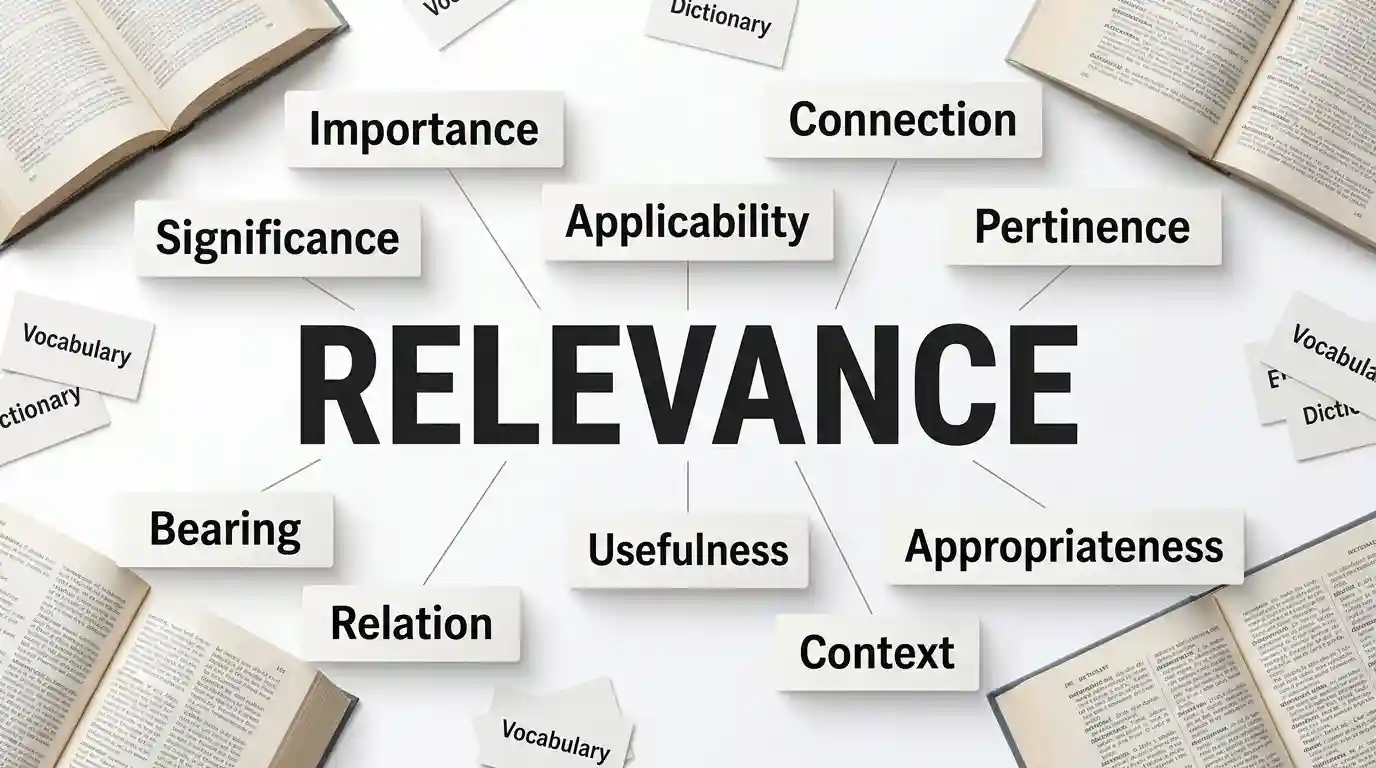
Quick Answer: What Are the Best Synonyms of Relevance?
The closest synonyms of relevance are pertinence, bearing, applicability, connection, significance, importance, relevancy, appropriateness, suitability, and appositeness. However, these words are not always interchangeable. Pertinence stresses direct connection, bearing suggests influence, applicability focuses on practical use, and significance emphasizes importance.
What Does Relevance Mean?
Have you ever written the same word several times and wanted a better alternative? If so, learning the synonyms of relevance can help you make your writing more varied and precise.
Relevance means the quality of being connected to a particular subject, question, situation, or purpose. It can also describe how useful something is in that context. Merriam-Webster defines it as a relation to the matter at hand and also connects the word with practical or social applicability.
For example:
The research has great relevance to modern education.
Here, the research is connected to modern education and has value in that area.
The important point is that relevance does not always mean importance. Something can be relevant because it relates directly to a question, even if it is not especially important.
This distinction matters in essays, academic writing, business communication, legal writing, blogs, emails, and everyday English.
Relevance: Pronunciation and Grammar
Pronunciation
IPA: /ˈrel.ə.vəns/
Say it: REL-uh-vuhns
The pronunciation is essentially the same in standard American and British English.
Part of Speech
Relevance is a noun.
Its main related forms are:
- relevance: noun
- relevant: adjective
- irrelevant: adjective
- irrelevance: noun
- relevancy: alternative noun
Example
This information is relevant to the discussion.
The relevance of this information is clear.
How to Use Relevance Correctly
The most common structure is:
relevance to
The report has relevance to current social issues.
Another common structure is:
the relevance of + noun
We discussed the relevance of the evidence.
You can also use:
of relevance to
The findings are of particular relevance to teachers.
Common Collocations
Native speakers commonly use combinations such as:
- direct relevance
- practical relevance
- particular relevance
- contemporary relevance
- historical relevance
- cultural relevance
- relevance to education
- relevance to the issue
- relevance of the evidence
- have relevance to
Collocations are important because a synonym can be grammatically possible but still sound unnatural in a particular phrase.
Synonyms of Relevance: Quick Comparison
| Word | Main Idea | Register | Frequency |
| Relevance | Connection to a matter | Neutral | Very common |
| Pertinence | Direct connection | Formal | Common in formal writing |
| Bearing | Connection or influence | Neutral | Common |
| Applicability | Practical ability to be used | Formal | Common |
| Connection | Relationship between things | Neutral | Very common |
| Significance | Importance or meaning | Neutral/Formal | Very common |
| Importance | Value or significance | Neutral | Very common |
| Relevancy | Same basic meaning | Formal | Less common |
| Appropriateness | Suitability for a situation | Formal | Common |
| Suitability | Fitness for a purpose | Neutral/Formal | Common |
| Appositeness | Very precise appropriateness | Formal | Rare |
| Aptness | Being a good fit | Formal | Uncommon |
| Materiality | Importance to a legal/financial matter | Specialist | Uncommon |
| Germaneness | Direct relevance | Legal/Formal | Rare |
| Usefulness | Practical value | Neutral | Common |
| Association | Recognized connection | Academic/Neutral | Common |
| Relation | Connection | Neutral/Formal | Common |
| Application | Practical use | Formal | Common |
| Appropriacy | Suitability in context | Academic | Uncommon |
| Import | Importance or significance | Literary/Formal | Rare |
Major thesauruses support many of these words, but they do not all represent exactly the same sense of relevance. Cambridge, for example, groups its alternatives under meanings such as significance, bearing, cogency, and application.
The Best Synonyms of Relevance
1. Pertinence
Meaning: Pertinence means direct relevance or a close connection to a particular matter.
Example 1:
The lawyer questioned the pertinence of the evidence.
Example 2:
Her comment had little pertinence to the discussion.
Best used when: You need a precise, formal word for direct relevance.
Register: Formal, academic, legal
Frequency: Common in formal contexts
Approximate CEFR: C1-C2
Collocations:
- pertinence to the case
- pertinence of the evidence
- direct pertinence
When not to use it: Avoid it in casual conversation when relevance or connection would sound more natural.
2. Bearing
Meaning: Bearing means the connection or influence something has on a matter.
Example 1:
The new evidence may have a bearing on the decision.
Example 2:
His previous experience has little bearing on the issue.
Best used when: Something affects or has a connection with an outcome.
Register: Neutral, professional
Frequency: Common
Approximate CEFR: C1
Common collocations:
- have a bearing on
- direct bearing
- little bearing
Important nuance: You normally use this in the phrase have a bearing on, rather than simply replacing every occurrence of relevance with bearing.
3. Applicability
Meaning: Applicability describes how well a rule, idea, method, or principle can be used in a particular situation.
Example 1:
The researchers questioned the applicability of the old method.
Example 2:
We need to consider the applicability of this rule.
Best used when: You mean practical relevance or ability to be applied.
Register: Academic, professional
Frequency: Common
Approximate CEFR: C1
Collocations:
- practical applicability
- applicability of a rule
- wider applicability
When not to use it: Do not use it when you only mean that two things are connected.
4. Connection
Meaning: Connection means a relationship or link between two or more things.
Example 1:
Researchers found a connection between sleep and memory.
Example 2:
I cannot see the connection between these two arguments.
Best used when: You want a simple, everyday word for a relationship.
Register: Neutral, spoken, general
Frequency: Very common
Approximate CEFR: B1
Collocations:
- direct connection
- strong connection
- connection between
Nuance: A connection does not necessarily mean something is important or useful.
5. Significance
Meaning: Significance means importance, meaning, or value.
Example 1:
The discovery has great significance for medical research.
Example 2:
The teacher explained the historical significance of the event.
Best used when: You want to emphasize importance rather than simple connection.
Register: Neutral, academic
Frequency: Very common
Approximate CEFR: B2
Collocations:
- historical significance
- cultural significance
- practical significance
Key difference:
Relevance = how closely something relates.
Significance = how important or meaningful it is.
6. Importance
Meaning: Importance means the quality of being valuable or significant.
Example 1:
The report highlights the importance of accurate data.
Example 2:
Students should understand the importance of regular practice.
Best used when: You are talking about value or priority.
Register: Neutral
Frequency: Very common
Approximate CEFR: B1
When not to use it: Do not use importance when the main idea is simply connection.
7. Relevancy
Meaning: Relevancy has essentially the same basic meaning as relevance.
Example 1:
The judge considered the relevancy of the evidence.
Example 2:
The committee questioned the relevancy of the information.
Best used when: You need an alternative noun, especially in legal or formal contexts.
Register: Formal
Frequency: Less common than relevance
Approximate CEFR: C1
Important: Relevance is normally the safer choice in general English. Merriam-Webster treats relevancy as a synonym, while Collins identifies it as an alternative form.
8. Appropriateness
Meaning: Appropriateness means being suitable or proper for a particular situation.
Example 1:
The manager questioned the appropriateness of the remark.
Example 2:
We discussed the cultural appropriateness of the advertisement.
Best used when: You mean something is suitable, proper, or acceptable.
Register: Formal, professional
Frequency: Common
Approximate CEFR: B2-C1
Important nuance: Something can be relevant without being appropriate.
9. Suitability
Meaning: Suitability means how well something fits a particular purpose.
Example 1:
The company tested the suitability of the material.
Example 2:
We need to assess the candidate’s suitability for the role.
Best used when: Talking about whether something is fit for a particular purpose.
Register: Neutral, professional
Frequency: Common
Approximate CEFR: B2
10. Usefulness
Meaning: Usefulness means practical value or the ability to help.
Example 1:
Students quickly recognized the usefulness of the new tool.
Example 2:
The usefulness of the guide depends on its accuracy.
Best used when: The context focuses on practical value.
Register: Neutral
Frequency: Common
Approximate CEFR: B1-B2
Important nuance: Something can be relevant without being useful.
11. Aptness
Meaning: Aptness means the quality of being particularly suitable or fitting.
Example 1:
The aptness of the comparison was immediately clear.
Example 2:
Her example demonstrated the aptness of the metaphor.
Best used when: Something fits an idea, situation, or purpose very well.
Register: Formal, literary
Frequency: Uncommon
Approximate CEFR: C1-C2
12. Appositeness
Meaning: Appositeness means being especially appropriate or directly relevant.
Example 1:
The appositeness of his example made the argument stronger.
Example 2:
Her question showed remarkable appositeness.
Best used when: You need a highly formal word for precise relevance.
Register: Formal, literary
Frequency: Rare
Approximate CEFR: C2
When not to use it: Avoid it in everyday speech. Relevance is much clearer.
13. Materiality
Meaning: Materiality describes the importance of something to a particular matter, especially in law, accounting, or finance.
Example 1:
The auditor considered the materiality of the error.
Example 2:
The court examined the materiality of the evidence.
Best used when: Writing about financial, legal, or specialist matters.
Register: Legal, accounting, business
Frequency: Uncommon outside specialist fields
Approximate CEFR: C2
14. Germaneness
Meaning: Germaneness means direct relevance to the matter being discussed.
Example 1:
The judge questioned the germaneness of the evidence.
Example 2:
The committee debated the germaneness of the proposal.
Best used when: Writing in legal or highly formal contexts.
Register: Legal, formal
Frequency: Rare
Approximate CEFR: C2
When not to use it: Do not use it just to sound sophisticated. Relevance is usually clearer.
15. Association
Meaning: Association means a connection between people, ideas, events, or things.
Example 1:
Researchers found an association between stress and poor sleep.
Example 2:
The color has a strong association with the brand.
Best used when: You want to describe a recognized connection.
Register: Neutral, academic
Frequency: Common
Approximate CEFR: B2
Important: An association does not automatically prove that one thing causes another.
16. Relation
Meaning: Relation means a connection or relationship between things.
Example 1:
The study examines the relation between diet and health.
Example 2:
His comment had no relation to the question.
Best used when: You want a general word for connection.
Register: Neutral, formal
Frequency: Common
Approximate CEFR: B1-B2
17. Relationship
Meaning: Relationship describes the way two things are connected.
Example 1:
The study examines the relationship between price and demand.
Example 2:
Researchers are exploring the relationship between exercise and sleep.
Best used when: The connection itself is the focus.
Register: Neutral
Frequency: Very common
Approximate CEFR: B1
18. Application
Meaning: Application can mean the practical use of an idea, method, or theory.
Example 1:
The research has practical application in education.
Example 2:
The professor explained the application of the theory.
Best used when: Relevance means practical use.
Register: Academic, professional
Frequency: Common
Approximate CEFR: B2
When not to use it: Do not use it simply to mean “connection.”
19. Import
Meaning: Import can mean importance or significance.
Example 1:
The discovery was of great import to the scientific community.
Example 2:
The decision was of considerable import.
Best used when: You want a formal or literary style.
Register: Literary, formal
Frequency: Rare in everyday English
Approximate CEFR: C2
20. Appropriacy
Meaning: Appropriacy means suitability for a particular situation or context.
Example 1:
The teacher discussed the appropriacy of the expression.
Example 2:
The study examines linguistic appropriacy in professional communication.
Best used when: Talking about whether language or behavior fits a specific context.
Register: Academic
Frequency: Uncommon
Approximate CEFR: C1-C2
Strongest Synonyms vs Related Words
A major problem with many synonym lists is treating every related word as an exact substitute. The following distinction is safer.
Closest Synonyms
- pertinence
- relevancy
- bearing
- applicability
- connection
Synonyms in Specific Senses
- significance
- importance
- appropriateness
- suitability
- appositeness
- germaneness
- materiality
Related Words, Not Universal Replacements
- usefulness
- association
- relationship
- relation
- application
- timeliness
- correctness
Merriam-Webster’s synonym list itself contains both close alternatives and words whose meanings overlap with relevance only in particular contexts.
Choose the Right Synonym
| What you want to say | Best choice | Why |
| Directly related | Pertinence | Strong focus on direct connection |
| Has an effect | Bearing | Shows influence |
| Can be practically used | Applicability | Focuses on practical use |
| Simply related | Connection | Natural everyday word |
| Important or meaningful | Significance | Adds importance |
| Valuable | Importance | Focuses on value |
| Suitable | Appropriateness | Focuses on properness |
| Fit for a purpose | Suitability | Focuses on fitness |
| Practical value | Usefulness | Focuses on helpfulness |
| Legally relevant | Germaneness | Formal legal usage |
| Financial/legal importance | Materiality | Specialist meaning |
Relevance vs Importance vs Significance
These three words cause many learner problems.
Relevance
Focuses on connection.
This information is relevant to the case.
Importance
Focuses on value or priority.
This issue is important to the company.
Significance
Focuses on meaning or importance.
The discovery has scientific significance.
Easy Rule
Ask yourself:
“Does it relate?” → relevance
“Does it matter a lot?” → importance
“Does it have special meaning or importance?” → significance
Relevance vs Applicability
These words are close but not identical.
Relevance: Is it connected to the issue?
Applicability: Can it actually be used in this situation?
Example:
The theory is relevant to education.
This means the theory relates to education.
The theory has limited applicability in primary schools.
This means it may not work well or be usable in that setting.
This distinction is supported by dictionary treatment that places applicability among the close semantic alternatives to relevance but gives it a more application-focused sense.
Relevance vs Pertinence
Relevance is the everyday and general term.
Pertinence is more formal and emphasizes direct connection to the matter.
Compare:
The information has relevance to the discussion.
The information has direct pertinence to the case.
Both work, but the second sounds more formal and precise.
Common Mistakes
Mistake 1
❌ This information has relevance with the topic.
✅ This information has relevance to the topic.
Why: The normal construction is relevance to.
Mistake 2
❌ This information is relevance to the issue.
✅ This information is relevant to the issue.
Why: Relevant is the adjective.
Mistake 3
❌ The relevance of the subject is very important.
✅ The importance of the subject is clear.
Why: Avoid unnecessary repetition when the intended meaning is important.
Mistake 4
❌ Applicability means exactly the same thing as relevance.
✅ Applicability is a more specific idea involving whether something can be applied or used.
Mistake 5
❌ Every synonym can replace relevance in every sentence.
✅ Choose a synonym according to its exact meaning and register.
American vs British English
There is no major spelling difference between American and British English for relevance.
Both use:
relevance
Both also use:
relevant
and
irrelevant
The noun relevancy exists as an alternative, but relevance is the more straightforward choice for general writing. Collins lists relevancy as an alternative form in its British English treatment.
So, for international readers, relevance is the safest word.
Word Origin and First Known Use
Relevance comes from relevant, which ultimately traces back through French to Latin roots associated with relevare, meaning to raise or lighten.
Merriam-Webster records a first known use of relevance in 1787.
Historical dictionaries may show earlier related forms or uses, so “first known use” should not be treated as the absolute moment the word first existed in English.
CEFR and Frequency Guide
CEFR levels below are approximate learner guidance rather than official universal classifications.
| Word | Approx. CEFR | Frequency | Register |
| connection | B1 | Very common | General |
| importance | B1 | Very common | General |
| relationship | B1 | Very common | General |
| relevance | B1-B2 | Very common | General/Academic |
| significance | B2 | Very common | Academic/General |
| suitability | B2 | Common | Professional |
| association | B2 | Common | Academic |
| applicability | C1 | Common | Academic |
| bearing | C1 | Common | Formal/General |
| pertinence | C1-C2 | Uncommon | Formal |
| appropriateness | B2-C1 | Common | Formal |
| aptness | C1-C2 | Uncommon | Formal |
| materiality | C2 | Uncommon | Specialist |
| appositeness | C2 | Rare | Formal/Literary |
| germaneness | C2 | Rare | Legal |
Natural Collocations With Relevance
Learning collocations can help you sound more natural than simply memorizing isolated synonyms.
Very common patterns
- highly relevant
- directly relevant
- particularly relevant
- relevant information
- relevant evidence
- relevant experience
- relevant research
- relevant details
- relevance to the topic
- relevance to the issue
- relevance to society
- practical relevance
- historical relevance
- cultural relevance
- contemporary relevance
Natural sentence patterns
The findings are highly relevant to modern education.
The evidence has little relevance to the case.
This research has practical relevance for teachers.
The historical relevance of the building is widely recognized.
How to Use These Synonyms in Writing
In Essays
Instead of repeating:
This issue has relevance to education. Its relevance is also important…
Try:
This issue has significance for education. Its practical applicability is also worth considering.
In Academic Writing
Prefer precise terms:
- relevance
- pertinence
- applicability
- significance
- materiality
Do not choose a rare word simply because it sounds more advanced.
In Business Writing
Useful choices include:
- relevance
- importance
- applicability
- suitability
- significance
Example:
We should consider the relevance of this proposal to our current strategy.
In Emails
Keep your wording simple.
I don’t think this information is relevant to the current project.
This is usually better than:
I do not believe this information possesses sufficient pertinence to the present undertaking.
The second sentence is grammatically possible but unnecessarily complicated.
In Everyday Conversation
Use:
- relevant
- related
- connected
- important
Example:
That’s not really relevant to what we’re discussing.
This sounds more natural than a rare formal synonym.
Antonyms of Relevance
The main antonyms are:
- irrelevance
- irrelevancy
Other context-dependent opposites include:
- inapplicability
- insignificance
- unsuitability
- inappropriateness
- unrelatedness
Merriam-Webster specifically lists irrelevance and irrelevancy as antonyms or near-antonyms.
Word Family
| Word | Part of Speech | Meaning |
| relevant | Adjective | connected or applicable |
| relevance | Noun | connection or applicability |
| relevancy | Noun | alternative form |
| irrelevant | Adjective | not connected |
| irrelevance | Noun | lack of relevance |
| relevantly | Adverb | in a relevant manner |
Mini Practice
Fill in the Blanks
Choose from relevance, pertinence, applicability, significance, and connection.
- The study has great ______ to modern healthcare.
- The lawyer questioned the ______ of the evidence.
- We need to test the ______ of this rule.
- There is a clear ______ between exercise and health.
- The discovery has enormous scientific ______.
Answers
- relevance
- pertinence
- applicability
- connection
- significance
Rewrite Practice
Replace the repeated word with a more precise alternative.
Sentence 1
The information has relevance to the case.
Possible answer:
The information has pertinence to the case.
Sentence 2
The theory has relevance to real-world teaching.
Possible answer:
The theory has practical applicability in real-world teaching.
Sentence 3
The discovery has relevance for science.
Possible answer:
The discovery has scientific significance.
Notice that the replacement changes the nuance. That is exactly why synonym selection matters.
Vocabulary Quiz
1. Which word best emphasizes direct connection?
A. Importance
B. Pertinence
C. Usefulness
D. Timeliness
2. Which word focuses on practical use?
A. Applicability
B. Relationship
C. Significance
D. Association
3. Which word mainly means importance or meaning?
A. Bearing
B. Link
C. Significance
D. Connection
4. Which sentence is correct?
A. The information is relevant to the case.
B. The information is relevant to the case.
C. The information is relevant to the case.
D. The information is relevant with the case.
5. Which word is most suitable for everyday English?
A. Germaneness
B. Appositeness
C. Relevance
D. Materiality
Answer Key
- B. Pertinence
- A. Applicability
- C. Significance
- B. The information is relevant to the case.
- C. Relevance
FAQs About Synonyms of Relevance
What is the best synonym for relevance?
The best synonym depends on the intended meaning. Pertinence is excellent for direct connection, bearing for influence, applicability for practical use, and significance for importance. If you are unsure, relevance is usually the clearest and safest choice.
What is another word for relevance in an essay?
Useful alternatives include pertinence, significance, applicability, importance, bearing, and connection. Choose based on your meaning. For example, use significance when you mean importance and applicability when you mean practical use.
Is relevancy the same as relevance?
Yes. Relevancy is an accepted noun meaning essentially the same thing as relevance. However, relevance is generally the more familiar choice in modern general English. Merriam-Webster lists relevancy as a synonym of relevance.
What is the difference between relevance and pertinence?
Both describe a connection to a matter. Relevance is the common general word, while pertinence sounds more formal and often emphasizes a direct or close connection. This makes pertinence especially useful in formal, academic, and legal writing.
What is the difference between relevance and significance?
Relevance focuses on connection to a subject or situation. Significance focuses on importance or meaning. An item can be relevant to a discussion without being particularly significant.
What is the difference between relevance and applicability?
Relevance means that something relates to a subject or problem. Applicability asks whether that thing can actually be applied or used in a particular situation. Therefore, something can be relevant but have limited applicability.
What is the opposite of relevance?
The main opposite of relevance is irrelevance. It means that something has little or no connection to the matter being discussed. Irrelevancy is another accepted form.
What is the most common synonym for relevance?
There is no single synonym that works in every sentence. Connection and importance are common everyday alternatives in some contexts, while pertinence, bearing, and applicability are more precise choices in formal writing.
Conclusion
The best synonyms of relevance depend on the exact idea you want to express. Use pertinence for direct connection, bearing for influence, applicability for practical use, significance for importance, and connection for a simple relationship.
Good vocabulary is not about replacing every common word with a difficult one. It is about choosing the word that communicates your meaning most accurately. Practice these alternatives in essays, emails, articles, professional writing, and conversations, and your English will become clearer and more precise.
Trusted References
- Merriam-Webster, Relevance: Definition & Meaning and Thesaurus.
- Cambridge Dictionary, Relevance: Synonyms and Antonyms.
- Collins English Dictionary, Relevance Definition and Thesaurus.
- Thesaurus.com, Relevance Synonyms & Antonyms.

Synonorm is a trusted English vocabulary resource created to help readers find the right words and understand the differences between similar terms. We provide clear explanations of synonyms, meanings, examples, usage, and alternatives. Our content makes vocabulary easier to learn and apply in everyday, academic, and professional English. Synonorm is designed for students, writers, ESL learners, professionals, and anyone who wants to improve their English vocabulary and communicate more clearly.