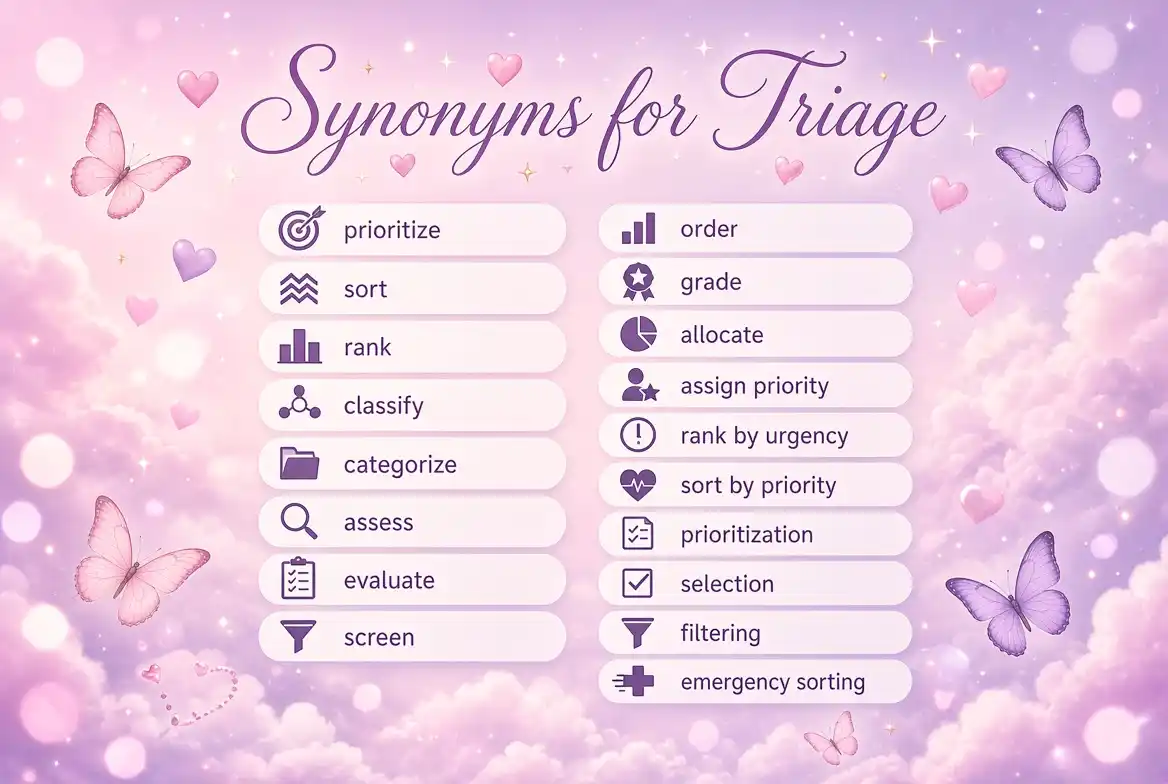
Looking for the best synonyms of triage? The closest alternatives include prioritize, prioritization, sort, screening, assess, classify, rank, evaluate, and categorize. However, these words are not all exact replacements. Triage combines the ideas of examining a situation, deciding what is most urgent, and directing attention or resources accordingly.
For example, a hospital may triage patients to decide who needs treatment first. A company may triage support requests to identify the most urgent problems. In both cases, the key idea is examining needs and setting priorities.
This guide explains the best synonyms of triage, their differences, examples, register, frequency, CEFR guidance, collocations, and situations where you should not use each word.
Quick Answer: The closest general synonym for triage is prioritize when the main idea is deciding what should receive attention first. Screen, assess, sort, classify, rank, and evaluate are related alternatives, but each emphasizes a different part of the triage process.
What Does Triage Mean?
Triage is the process of quickly examining people, problems, or requests and deciding which ones need attention first.
In healthcare, triage involves assessing patients according to the urgency of their condition. In business, technology, and other fields, it can mean examining problems and deciding which ones are most serious or should be handled first. Cambridge Dictionary recognizes both the medical and broader problem-solving uses.
Examples
- Nurses triage patients when many people need medical attention.
- The IT team triaged the support tickets by urgency.
- The manager triaged the incoming requests before assigning them to staff.
The important idea is not simply sorting. Triage normally involves assessment plus prioritization.
Triage Pronunciation
IPA: /ˈtriː.ɑːʒ/
Simple pronunciation: TREE-ahzh
Cambridge gives essentially the same IPA pronunciation for both UK and US English. Collins records additional pronunciation variants, so small regional differences can occur.
American English: usually “TREE-ahzh”
British English: usually “TREE-ahzh,” with some dictionary-listed variants.
Is Triage a Noun or a Verb?
Triage works mainly as both a noun and a verb.
As a noun
The nurse performed triage.
Here, triage names the process.
As a verb
The nurse triaged the patients.
Here, triage describes the action.
Common forms
- triage
- triages
- triaged
- triaging
A separate everyday adjective or adverb form is not normally used. Phrases such as triage nurse and triage process use triage before another noun.
Synonyms of Triage at a Glance
| Word | How close is it? | Main idea | Register |
| Prioritize | Very close | Decide what comes first | Neutral |
| Prioritization | Very close | Setting priorities | Business/academic |
| Sort | Close | Put into an order or group | Neutral |
| Screen | Close in some contexts | Check and identify | Professional |
| Assess | Related | Examine and judge | Formal/neutral |
| Rank | Close in some contexts | Put in order of importance | Neutral |
| Classify | Related | Put into categories | Formal |
| Categorize | Related | Group by type | Formal/neutral |
| Evaluate | Related | Judge value or condition | Formal |
| Filter | Related | Remove or separate | Technical/neutral |
| Select | Related | Choose | Neutral |
| Allocate | Related | Distribute resources | Formal/business |
| Organize | Related | Put into useful order | Neutral |
| Review | Related | Examine information | Neutral |
| Route | Related | Direct to the right place | Business/technical |
Important: A thesaurus may label many of these words as synonyms, but natural English does not allow them to replace triage in every sentence.
The Best Synonyms of Triage
1. Prioritize
Meaning: To decide what needs attention first.
Example 1:
We need to prioritize the most urgent customer complaints.
Example 2:
The doctor had to prioritize patients with serious injuries.
Best used when: The main idea is deciding what comes first.
Tone: Neutral, professional, academic
Frequency: Very common
CEFR: B1–B2
Common collocations:
- prioritize tasks
- prioritize patients
- prioritize urgent requests
When not to use it: Do not prioritize when you specifically need to emphasize the examination or classification stage.
2. Prioritization
Meaning: The process of deciding what should receive attention first.
Example 1:
Good prioritization helped the team manage the crisis.
Example 2:
Patient prioritization is important when resources are limited.
Best used when: You need a noun for the priority-setting part of triage.
Tone: Business, academic, professional
Frequency: Common
CEFR: B2–C1
Common collocations:
- task prioritization
- priority setting
- resource prioritization
When not to use it: It does not automatically include screening or medical assessment.
3. Sort
Meaning: To separate or arrange things according to a particular feature.
Example 1:
The assistant sorted the requests by urgency.
Example 2:
The team sorted the cases into urgent and routine groups.
Best used when: You want a simple everyday alternative.
Tone: Neutral, spoken
Frequency: Very common
CEFR: A2
When not to use it: Sort can sound too general in formal medical writing.
4. Screening
Meaning: Checking people or cases to identify those that may need further attention.
Example 1:
The clinic performed initial screening before treatment.
Example 2:
The first stage involved screening the applications for urgent cases.
Best used when: You mean an initial check.
Tone: Medical, formal, professional
Frequency: Very common
CEFR: B2
Common collocations:
- initial screening
- patient screening
- screening process
When not to use it: Screening does not necessarily mean deciding the final priority.
5. Assess
Meaning: To examine something and make a judgment about it.
Example 1:
Doctors assessed the patient’s condition immediately.
Example 2:
The support team assessed each problem before assigning a priority.
Best used when: Examination is the main idea.
Tone: Neutral/formal
Frequency: Very common
CEFR: B2
When not to use it: Assessment alone does not necessarily mean sorting cases by urgency.
6. Rank
Meaning: To put people, tasks, or things in an order of importance.
Example 1:
The manager ranked the projects by urgency.
Example 2:
The team ranked the reported bugs according to their severity.
Best used when: You need a clear order from high to low priority.
Tone: Neutral, academic, business
Frequency: Very common
CEFR: B1
When not to use it: Ranking does not necessarily involve an initial assessment.
7. Classify
Meaning: To put people or things into groups according to their characteristics.
Example 1:
The nurse classified the cases according to urgency.
Example 2:
The software classified incoming reports by severity.
Best used when: Categories are more important than exact ranking.
Tone: Formal, academic, technical
Frequency: Common
CEFR: B2
When not to use it: Do not use it as a full replacement for triage when the key idea is immediate action.
8. Categorize
Meaning: To place things into particular groups.
Example 1:
The team categorized the complaints as urgent or routine.
Example 2:
We categorized the requests before assigning them to specialists.
Best used when: You want to emphasize grouping.
Tone: Neutral/formal
Frequency: Common
CEFR: B2
When not to use it: Categorization alone does not necessarily establish which case deserves attention first.
9. Evaluate
Meaning: To examine something and judge its quality, importance, or condition.
Example 1:
The doctors evaluated the patients before treatment.
Example 2:
The company evaluated each request before deciding how quickly to respond.
Best used when: Careful judgment is the main focus.
Tone: Formal, academic
Frequency: Very common
CEFR: B2
10. Filter
Meaning: To separate useful or important items from less relevant ones.
Example 1:
The system filtered low-priority support requests.
Example 2:
We need to filter the incoming reports before reviewing them.
Best used when: You are narrowing a large group.
Tone: Technical, business, neutral
Frequency: Very common
CEFR: B1
When not to use it: Filtering does not necessarily mean assessing the seriousness of every item.
11. Select
Meaning: To choose someone or something from a group.
Example 1:
The team selected the cases that required immediate attention.
Example 2:
The doctor selected the patients who needed urgent treatment.
Best used when: The focus is on choosing.
Tone: Neutral/formal
Frequency: Very common
CEFR: B1
12. Allocate
Meaning: To distribute limited resources for particular purposes.
Example 1:
The hospital allocated more staff to the emergency unit.
Example 2:
The manager allocated resources to the most urgent projects.
Best used when: Money, staff, time, equipment, or other resources are being distributed.
Tone: Formal, business, academic
Frequency: Common
CEFR: C1
Important nuance: Allocation can be a result of triage, but it is not a complete synonym.
13. Organize
Meaning: To arrange things into a useful order.
Example 1:
The assistant organized the requests by urgency.
Example 2:
Better organization helped the team handle the workload.
Best used when: You want a simple alternative for arranging information.
Tone: Neutral
Frequency: Very common
CEFR: A2–B1
When not to use it: It is too broad when the important idea is urgency.
14. Review
Meaning: To examine something carefully.
Example 1:
The supervisor reviewed the urgent cases.
Example 2:
The team reviewed every request before assigning it.
Best used when: You mean careful examination.
Tone: Neutral, professional
Frequency: Very common
CEFR: B1
15. Route
Meaning: To direct a person, request, or problem to the appropriate place or person.
Example 1:
The help desk routed urgent tickets to the security team.
Example 2:
The system automatically routes serious cases to a specialist.
Best used when: The important action is directing a case after identifying its destination.
Tone: Business, technical
Frequency: Common
CEFR: B2
When not to use it: Routing does not itself mean assessing urgency.
Synonyms by Meaning
If you mean “decide what comes first”
Use:
- prioritize
- rank
- prioritization
- order
If you mean “check or examine”
Use:
- screen
- assess
- evaluate
- review
If you mean “put into groups”
Use:
- sort
- classify
- categorize
- group
If you mean “direct resources or cases”
Use:
- allocate
- route
- assign
- dispatch
This is more useful than memorizing a long thesaurus list because it lets you choose a word according to the exact meaning you want.
Triage vs. Prioritize vs. Screen vs. Assess
| Word | Main action | Includes priority? | Typical context |
| Triage | Examine + prioritize | Yes | Medical, emergency, business |
| Prioritize | Decide what comes first | Yes | Work, business, everyday |
| Screen | Check and identify | Sometimes | Medical, hiring, security |
| Assess | Examine and judge | Not always | Medical, academic, professional |
| Sort | Arrange/group | Not always | Everyday, data, work |
| Rank | Put in order | Yes | Business, academic |
| Classify | Put into categories | Not necessarily | Academic, technical |
The simplest rule
Triage = assess + classify/sort + prioritize.
Not every use contains every step explicitly, but the idea of determining urgency or priority is central.
Strongest Synonyms vs. Related Words
Closest alternatives
- Prioritize
- Prioritization
- Sort
- Screen
- Assess
Strong contextual alternatives
- Rank
- Classify
- Categorize
- Evaluate
- Filter
Related words
- Select
- Allocate
- Organize
- Review
- Route
- Assign
- Dispatch
- Group
- Separate
- Schedule
The last group should not normally be presented as exact synonyms.
Commonly Confused Words
Triage vs. Prioritization
Triage involves examining cases and deciding their urgency.
Prioritization focuses mainly on deciding what comes first.
The nurse triaged the patients.
The manager prioritized the urgent tasks.
Triage vs. Screening
Screening identifies people or cases that may need attention.
Triage determines relative urgency.
The clinic screened the patients for symptoms.
The emergency department triaged them according to urgency.
Triage vs. Assessment
Assessment means examining and judging a condition.
Triage adds the question: Who or what needs attention first?
Triage vs. Classification
Classification puts things into categories.
Triage uses categories or assessments to help determine priority.
Triage vs. Allocation
Allocation means distributing limited resources.
Triage can help determine where those resources should go, but the two words do not mean exactly the same thing.
Common Mistakes
Common Mistake Box
Mistake
The teacher triaged the students into three groups.
Better
The teacher classified the students into three groups.
Why?
If the teacher only creates groups, classification is more precise. If the teacher examines which students need help first, triage may be appropriate.
Mistake
I triaged my clothes by color.
Better
I sorted my clothes by color.
Why?
There is no urgency or priority. Sort is the natural choice.
Mistake
The company triaged the budget across departments.
Better
The company allocated the budget across departments.
Why?
The sentence describes distributing money rather than assessing and prioritizing cases.
Natural Collocations with Triage
Native speakers commonly use triage with words connected to patients, problems, urgency, and limited resources.
Medical collocations
- triage nurse
- triage process
- emergency triage
- patient triage
- triage assessment
- triage category
Business and technology collocations
- triage requests
- triage tickets
- triage bugs
- triage incidents
- triage problems
- triage complaints
- triage cases
- triage reports
Common patterns
triage + noun
triage patients
triage requests
triage incidents
perform/conduct + triage
perform triage
conduct triage
triage + according to
triage patients according to urgency
These patterns reflect actual dictionary and corpus-style usage. Cambridge, for example, gives examples involving funding requests, burglary reports, and patients.
Triage in Different Contexts
Healthcare
This is the word’s best-known use.
Nurses triage patients according to the urgency of their conditions.
Emergency situations
Triage can help determine who needs immediate treatment when many people require care.
Technology
The security team triaged the reported vulnerabilities.
Here, the team identifies which problems require the fastest response.
Customer service
Support staff triaged the incoming tickets.
The staff decide which complaints or technical issues need immediate attention.
Project management
The team triaged the backlog before the next release.
This means they reviewed the backlog and decided which items deserved priority.
Word Origin and First Known Use
Triage comes from French triage, meaning sorting or sifting, from trier, meaning “to sort.” Oxford dates the word’s origin to the early 18th century in the sense of sorting items according to quality. Oxford also says its modern medical sense developed from military systems for assessing wounded people in the 1930s.
Merriam-Webster gives 1918 as the first known English use of triage in the modern sense it defines.
So these dates are not necessarily contradictory:
- Early 18th century: the French-derived word existed in English with a sorting-related meaning.
- 1918: Merriam-Webster records the first known use of the modern sense.
- 1930s: Oxford dates the development of the modern medical sense to military practice.
CEFR Level
Oxford Learner’s Dictionaries lists triage in the Oxford 3000 at A2, while its healthcare topic classification is marked C2.
For learners, this means the basic word is worth recognizing early, but its specialized medical use may require more advanced vocabulary.
Easier alternatives
For beginner and intermediate learners:
- sort
- choose
- rank
- check
- assess
- prioritize
More advanced alternatives
- classification
- categorization
- allocation
- prioritization
- evaluation
American vs. British English
The spelling triage is the same in American and British English.
Cambridge lists /ˈtriː.ɑːʒ/ for both UK and US English.
Collins also records pronunciation variants in both varieties, showing that some speakers may use different stress patterns.
There is therefore no American/British spelling difference such as organize/organise.
Frequency and Register Guide
| Word | Frequency | Register |
| Triage | Common | Medical/professional |
| Prioritize | Very common | Neutral/business |
| Sort | Very common | Everyday |
| Screen | Very common | Medical/professional |
| Assess | Very common | Professional/academic |
| Rank | Very common | Neutral/business |
| Classify | Common | Academic/technical |
| Categorize | Common | Formal/neutral |
| Evaluate | Very common | Academic/professional |
| Filter | Very common | Technical/neutral |
| Allocate | Common | Business/academic |
| Route | Common | Technical/business |
| Sift | Common | Neutral/literary |
| Marshall | Uncommon | Formal |
| Shunt | Uncommon | Specialized |
Connotation and Nuance
Triage can carry a sense of limited time, competing needs, and difficult priorities.
Compare:
We organized the requests.
This sounds routine.
We triaged the requests.
This suggests that the requests needed to be assessed and prioritized, possibly because there were too many to handle equally or immediately.
That nuance makes triage particularly useful in emergency medicine, crisis management, customer support, cybersecurity, and project management.
When Not to Use Triage
Do not use triage simply because you are:
- organizing files
- arranging clothes
- making a calendar
- alphabetizing names
- grouping colors
- reviewing a document
- scheduling meetings
Use a more precise word.
Instead of:
I triaged my files alphabetically.
Say:
I sorted my files alphabetically.
Instead of:
She triaged the meeting for Friday.
Say:
She scheduled the meeting for Friday.
Instead of:
We triaged the budget between departments.
Say:
We allocated the budget between departments.
Writing Tips
In an academic essay
Use prioritization, assessment, or classification when discussing the process formally.
Effective prioritization can improve the use of limited resources.
In a business email
Triage is useful when your workplace already uses the term.
Please triage the incoming support tickets and flag the urgent ones.
For a general audience, a simpler version may be clearer:
Please review the incoming support tickets and flag the urgent ones.
In a blog post
Use triage when discussing workflows, healthcare, cybersecurity, customer support, or project management.
In everyday conversation
Prefer sort, prioritize, or deal with first if the audience may not know the technical term.
Related Vocabulary
Similar words
- prioritize
- assess
- screen
- sort
- rank
- classify
- categorize
- evaluate
- filter
- select
Related expressions
- set priorities
- identify urgent cases
- assess severity
- determine urgency
- assign priority
- allocate resources
- handle urgent requests
- separate critical cases
Word forms
- triage
- triages
- triaged
- triaging
Practice Exercises
Fill in the blanks
Choose triage, prioritize, screen, classify, or allocate.
- The emergency department must ______ patients according to urgency.
- We need to ______ the most important tasks.
- The clinic will ______ patients before the full examination.
- The software can ______ incoming reports by type.
- The hospital must ______ additional staff to the emergency unit.
Answers
- triage
- prioritize
- screen
- classify
- allocate
Rewrite Practice
Replace the bold word with a more precise alternative.
1.
The manager triaged the files alphabetically.
Better: The manager sorted the files alphabetically.
2.
The hospital organized patients according to urgency.
Better: The hospital triaged the patients according to urgency.
3.
The company triaged money among departments.
Better: The company allocated money among departments.
Vocabulary Quiz
1. What is the closest general alternative to triage when the focus is priority?
A. Organize
B. Prioritize
C. Schedule
D. Review
2. Which word focuses on an initial check?
A. Screening
B. Allocation
C. Ranking
D. Dispatching
3. Which word means putting things into categories?
A. Prioritize
B. Classify
C. Route
D. Assess
4. Which sentence uses triage correctly?
A. I triaged my shoes by color.
B. She triaged the emergency patients.
C. He triaged the meeting for Tuesday.
D. We triaged the alphabet.
5. What does allocation mainly involve?
A. Examining a patient
B. Sorting alphabetically
C. Distributing resources
D. Checking spelling
Answers
- B. Prioritize
- A. Screening
- B. Classify
- B. She triaged the emergency patients.
- C. Distributing resources
Frequently Asked Questions
What is the closest synonym for triage?
Prioritize is usually the closest simple synonym when the main idea is deciding what needs attention first. However, triage can also involve examining and categorizing cases, so prioritize does not always reproduce the full meaning of triage.
What are the best synonyms of triage?
Useful alternatives include prioritize, prioritization, sort, screen, assess, rank, classify, categorize, evaluate, and filter. The best choice depends on context. For example, screen emphasizes checking, while prioritize emphasizes deciding what should receive attention first.
Is prioritizing the same as triage?
Not exactly. Prioritizing means deciding what should be handled first. Triage usually involves examining a group of patients, problems, or requests and then determining their relative urgency. Therefore, prioritization is an important part of triage but does not always cover the whole process.
Is screening a synonym for triage?
Screening is a related term rather than a perfect synonym. Screening usually means checking people or cases to identify possible problems or needs. Triage goes further by determining relative urgency and deciding who or what should receive attention first.
What is the opposite of triage?
There is no single perfect opposite of triage. Conceptually, the opposite would be handling cases without assigning different priorities. Depending on context, phrases such as treating everything equally, ignoring priorities, or random handling may express the contrast.
Can triage be used outside medicine?
Yes. Modern English uses triage for many non-medical situations. People commonly triage support tickets, software bugs, funding requests, complaints, incidents, reports, and projects. Cambridge specifically records the broader use of examining problems and deciding which ones are most serious.
Is triage a noun or verb?
Triage can be both a noun and a verb. As a noun, it names the process: “The nurse performed triage.” As a verb, it describes the action: “The nurse triaged the patients.” Merriam-Webster and Cambridge both recognize the verb use.
What is the easiest synonym for triage?
For beginners, sort and prioritize are usually the easiest alternatives. Use sort when you mean putting things into groups or order. Use prioritize when you mean deciding which things should receive attention first.
Conclusion
The best synonyms of triage depend on the exact meaning you want. Use prioritize for setting priorities, screen for initial checking, assess for examination, sort for arranging, classify for grouping, and allocate for distributing limited resources.
Learning these differences will make your English more precise. Instead of choosing a synonym simply because a thesaurus lists it, choose the word that matches the action you actually mean. Practice these words in emails, essays, workplace communication, and everyday conversations to build stronger vocabulary.

Synonorm is a trusted English vocabulary resource created to help readers find the right words and understand the differences between similar terms. We provide clear explanations of synonyms, meanings, examples, usage, and alternatives. Our content makes vocabulary easier to learn and apply in everyday, academic, and professional English. Synonorm is designed for students, writers, ESL learners, professionals, and anyone who wants to improve their English vocabulary and communicate more clearly.