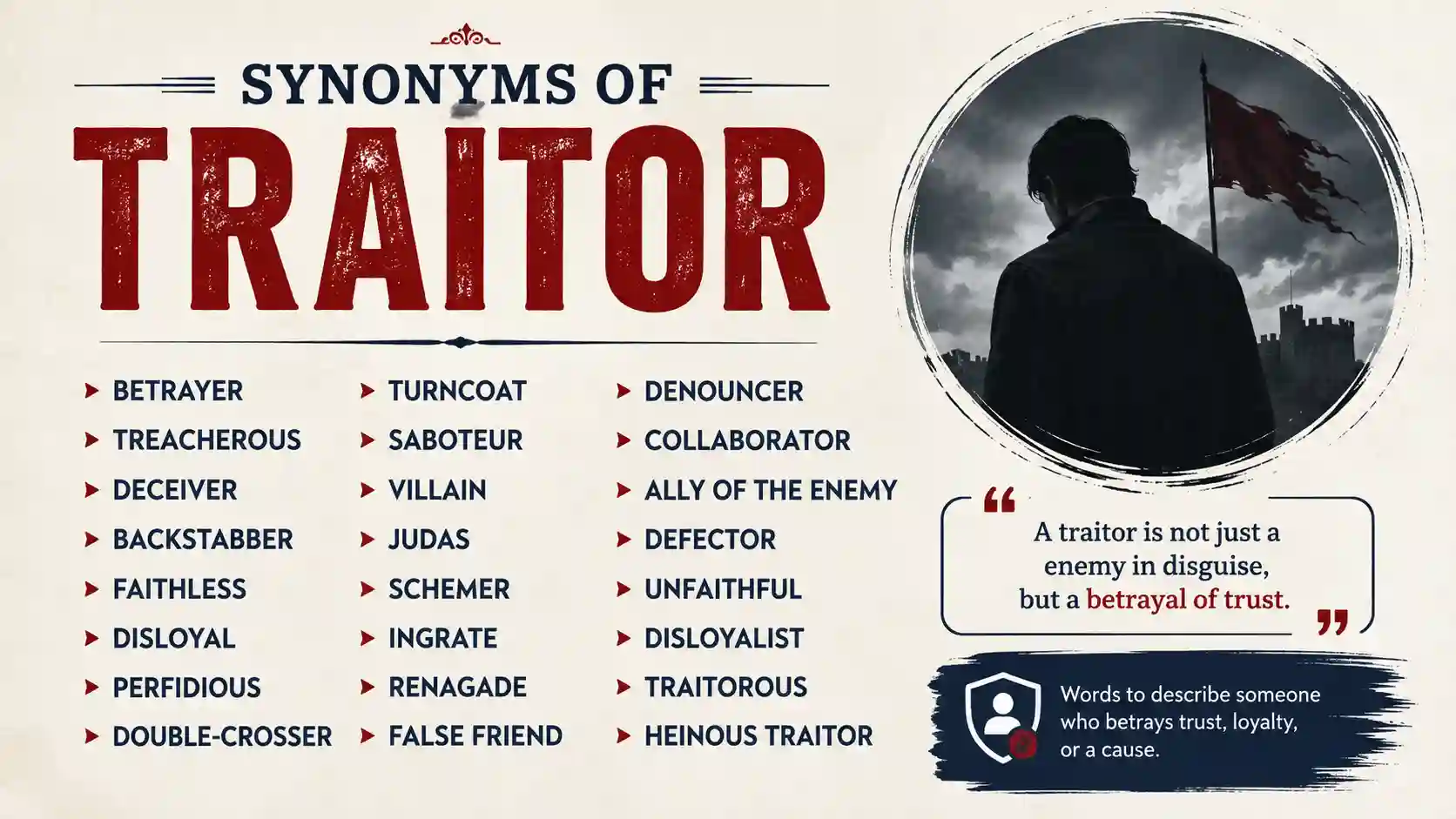
Have you ever wanted to describe someone as a traitor but needed a more precise word? English has several choices, but they do not all mean exactly the same thing. Betrayer is a broad choice, turncoat suggests someone who changes sides, defector describes someone who leaves one side for another, and backstabber is more informal and personal.
The right word depends on what was betrayed, how the betrayal happened, and the tone you want. This guide explains the most useful alternatives with simple meanings, examples, pronunciation, formality, nuance, collocations, and learner tips.
Quick Answer
The closest general synonym for traitor is betrayer. Other useful alternatives include turncoat, defector, renegade, backstabber, sellout, deserter, Judas, quisling, and double-crosser. However, these words have different meanings. For example, a defector changes allegiance, while a backstabber secretly betrays someone they know.
What Does Traitor Mean?
A traitor is a person who is not loyal to a country, group, belief, cause, or person and betrays that loyalty.
For example:
The soldier was accused of being a traitor to his country.
The word can describe serious political or national betrayal, but it can also be used more broadly for someone who betrays a group, belief, or relationship. Cambridge and Collins both recognize these broader uses.
Part of speech: Noun
Plural: traitors
Tone: Usually strongly negative
Register: Neutral to formal, depending on context
Pronunciation of Traitor
IPA:
- British English: /ˈtreɪ.tər/
- American English: /ˈtreɪ.t̬ɚ/
Pronounced: TRAY-ter
The spelling is the same in American and British English, although the final r is more clearly pronounced in most American speech. Cambridge gives both pronunciation forms.
Grammar and Word Forms
Traitor is a countable noun.
Common patterns
- a traitor
- the traitor
- several traitors
- a traitor to the country
- a traitor to the cause
- accused of being a traitor
Related forms
- traitor — noun
- traitorous — adjective
- traitorously — adverb
- betray — verb
- betrayal — noun
- betrayer — noun
For example:
His actions were considered traitorous.
Cambridge classifies traitorous as a formal, disapproving adjective meaning not loyal to one’s country, social group, or beliefs.
Quick Comparison of the Best Alternatives
| Word | Main Idea | Tone | Register | Frequency |
| Betrayer | Breaks someone’s trust or loyalty | Strong | Neutral | Common |
| Turncoat | Changes sides | Strong | Neutral | Common |
| Defector | Leaves one side for another | Strong | Formal | Common |
| Backstabber | Secretly hurts someone who trusts them | Strong | Informal | Common |
| Renegade | Abandons a group or cause | Strong | Neutral/Formal | Common |
| Sellout | Abandons principles for gain | Negative | Informal | Common |
| Deserter | Abandons military duty | Negative | Formal/Neutral | Common |
| Double-crosser | Deceives an apparent ally | Negative | Informal | Uncommon |
| Judas | Betrayer, especially in a literary or cultural sense | Very strong | Literary | Common |
| Quisling | Helps an occupying enemy | Very strong | Formal/Literary | Uncommon |
Important: These are not interchangeable in every sentence. A good synonym should preserve the original meaning, not merely sound similar.
1. Betrayer
Meaning: A betrayer is someone who breaks another person’s trust, loyalty, or confidence.
CEFR: Approximately B2
Frequency: Common
Register: Neutral
Tone: Strong and negative
Examples
- Everyone was shocked when the trusted adviser became a betrayer.
- She felt deeply hurt by the friend who became her betrayer.
Best used when
You want the safest broad alternative for someone who breaks trust or loyalty.
Common collocations
- trusted betrayer
- act of betrayal
- personal betrayer
Nuance
Betrayer is usually the closest general alternative to traitor. It does not necessarily involve a country or a political cause.
When not to use it
Do not use betrayer when someone simply changes an opinion without breaking a relationship, promise, or allegiance.
2. Turncoat
Meaning: A turncoat is someone who changes sides and supports the opposing side.
CEFR: Approximately C1
Frequency: Common
Register: Neutral
Tone: Strongly negative
Examples
- The politician was criticized as a turncoat after joining his former rival.
- The soldiers viewed the officer as a turncoat.
Best used when
Someone switches political, military, organizational, or ideological allegiance.
Common collocations
- political turncoat
- branded a turncoat
- former turncoat
Nuance
The key idea is changing sides.
When not to use it
Do not use it for someone who betrays a friend but stays on the same side.
3. Defector
Meaning: A defector is someone who leaves one country, organization, military force, or political side and joins another.
CEFR: Approximately B2–C1
Frequency: Common
Register: Formal
Tone: Neutral to negative
Examples
- The military defector gave investigators important information.
- The former official became a defector and moved abroad.
Best used when
The person’s departure from one side is an important fact.
Common collocations
- military defector
- political defector
- high-profile defector
Nuance
A defector may be described as a traitor by the side they left, but defector itself is more descriptive and less emotionally loaded.
When not to use it
Do not call someone a defector just because they betrayed a friend.
4. Backstabber
Meaning: A backstabber is someone who secretly harms or betrays a person who trusts them.
CEFR: Approximately B2
Frequency: Common
Register: Informal
Tone: Very negative
Examples
- He discovered that his closest colleague was a backstabber.
- Nobody wanted to share confidential plans with the backstabber.
Best used when
The betrayal is personal, secret, and often unexpected.
Common collocations
- workplace backstabber
- trusted backstabber
- secret backstabber
Nuance
The word creates a strong image of someone pretending to be friendly while secretly acting against you.
When not to use it
Avoid it in formal academic or professional writing unless you are deliberately discussing informal language.
5. Renegade
Meaning: A renegade is someone who abandons a group, belief, cause, or established position.
CEFR: Approximately C1
Frequency: Common
Register: Neutral/Formal
Tone: Strong, sometimes dramatic
Examples
- The renegade officer refused to follow the new orders.
- The movement described him as a renegade after he rejected its principles.
Best used when
Someone breaks away from a group, movement, cause, or accepted position.
Common collocations
- renegade soldier
- renegade member
- political renegade
Nuance
A renegade can be a rebel or outsider without necessarily committing literal treason.
When not to use it
Do not use it simply for someone who has a different personal opinion.
6. Sellout
Meaning: A sellout is someone who appears to abandon their principles or loyalty for money, popularity, or another personal benefit.
CEFR: Approximately B2
Frequency: Common
Register: Informal
Tone: Strongly negative
Examples
- Some fans called the musician a sellout after the commercial deal.
- His former supporters accused him of becoming a sellout.
Best used when
Personal gain appears to be the reason for abandoning principles.
Common collocations
- political sellout
- complete sellout
- call someone a sellout
Nuance
This word focuses on compromising principles for advantage.
When not to use it
Do not use it simply because someone changes jobs, opinions, or political positions.
7. Deserter
Meaning: A deserter is someone who abandons military service or duty without permission.
CEFR: Approximately B2
Frequency: Common
Register: Formal/Neutral
Tone: Negative
Examples
- The army searched for the deserter.
- The soldier was punished for abandoning his unit.
Best used when
Military service or a serious duty has been abandoned.
Common collocations
- army deserter
- military deserter
- accused deserter
Nuance
A deserter may also be called a traitor in some situations, but the words are not identical.
When not to use it
Do not use deserter for someone who betrays a friend or changes political parties.
8. Double-Crosser
Meaning: A double-crosser is someone who deceives another person after pretending to cooperate with them.
CEFR: Approximately C1
Frequency: Uncommon
Register: Informal
Tone: Negative
Examples
- The double-crosser secretly passed the plan to the rival team.
- They realized too late that their supposed ally was a double-crosser.
Best used when
Someone secretly turns against an apparent ally.
Common collocations
- notorious double-crosser
- suspected double-crosser
- double-cross an ally
Nuance
This word focuses on deception within an apparent alliance.
When not to use it
Do not use it for ordinary dishonesty.
9. Judas
Meaning: Judas can describe a person who betrays someone they trusted or supported.
CEFR: Approximately C1
Frequency: Common in cultural and literary contexts
Register: Literary/Neutral
Tone: Very strong
Examples
- The betrayed leader called his former adviser a Judas.
- The novel presents the character as a Judas figure.
Best used when
You want a strong cultural or literary reference to betrayal.
Common collocations
- a Judas
- Judas figure
- Judas kiss
Nuance
The word comes from Judas Iscariot, traditionally associated with the betrayal of Jesus. Because of that history, it carries strong cultural and religious associations.
When not to use it
Avoid it in ordinary professional writing unless the reference is intentional.
10. Quisling
Meaning: A quisling is someone who helps an occupying enemy force in their own country.
CEFR: Approximately C2
Frequency: Uncommon
Register: Formal/Literary
Tone: Extremely negative
Examples
- The resistance accused the official of being a quisling.
- The historical account describes him as a quisling who aided the occupying force.
Best used when
Someone cooperates with an enemy occupying their country.
Common collocations
- political quisling
- wartime quisling
- alleged quisling
Nuance
This is not a general replacement for traitor. Its meaning is much narrower. Collins specifically includes quisling among words for a traitor who aids an occupying enemy.
When not to use it
Do not use quisling for a friend who breaks your trust or a coworker who reports you.
Which Word Should You Choose?
Here is a simple way to decide:
| If you mean… | Choose… |
| Someone who breaks your trust | Betrayer |
| Someone who secretly betrays a friend | Backstabber |
| Someone who changes political sides | Turncoat |
| Someone who leaves one organization for another | Defector |
| Someone who abandons a cause | Renegade |
| Someone who sacrifices principles for gain | Sellout |
| Someone who abandons military service | Deserter |
| Someone who deceives an apparent ally | Double-crosser |
| A strong literary reference to betrayal | Judas |
| Someone helping an occupying enemy | Quisling |
This is why a thesaurus list alone is not enough. Context determines which word sounds natural.
Related Words That Are Not Exact Synonyms
Some words are connected to betrayal but should not be treated as direct replacements.
Informer
An informer gives information to an authority, often secretly.
The police received information from an informer.
An informer may be disliked, but that does not automatically make the person a traitor.
Snitch
Snitch is informal and usually negative. It describes someone who tells an authority about another person’s wrongdoing.
The students called him a snitch.
It is much more casual than traitor.
Dissident
A dissident openly disagrees with an established political or social system.
The dissident criticized the government’s policy.
A dissident is not automatically a traitor. The distinction is important in careful writing.
Rebel
A rebel resists an authority or established system.
The rebels refused to accept the new government.
A rebel may be called a traitor by the authorities, but the words are not interchangeable.
Conspirator
A conspirator secretly plans something with other people, often something illegal or harmful.
The conspirators met in secret.
A conspirator may be a traitor, but conspiracy and betrayal are different concepts.
Strongest vs. Most Natural Alternatives
If you want a strong word, choose according to context rather than emotional intensity.
Most natural everyday choices
- Betrayer
- Turncoat
- Backstabber
- Defector
- Sellout
More formal choices
- Defector
- Renegade
- Deserter
- Dissident, when political opposition is meant
Literary or historical choices
- Judas
- Quisling
- Oathbreaker
Informal choices
- Backstabber
- Sellout
- Double-crosser
- Snitch
- Rat
Words such as rat and snake are insults rather than precise dictionary equivalents, so they are better kept outside the main synonym list.
Common Mistakes Learners Make
Common Mistake Box
Mistake 1
He is a traitor because he disagrees with me.
Better
He disagrees with me.
If the person has not actually betrayed loyalty or trust, the traitor may be too strong.
Mistake 2
She defected to her friend.
Better
She betrayed her friend.
Defect normally means leaving one side, organization, or country for another.
Mistake 3
He is a quisling because he betrayed his friend.
Better
He is a betrayer because he betrayed his friend.
Quisling has a specific enemy-collaboration meaning.
Mistake 4
The dissident is a traitor.
Better
Use traitor only if there is actual betrayal. If the person simply opposes the government, dissident may be more accurate.
Word Origin of Traitor
Traitor entered English through Middle English and Anglo-French forms related to Latin traditor, meaning someone who hands over or betrays. It is related to the Latin verb tradere, meaning to hand over or deliver.
Merriam-Webster gives the first known use of traitor in English as the 13th century. The history of the word helps explain its connection with the idea of handing someone or something over to an enemy.
CEFR Guidance for English Learners
CEFR levels are best treated as approximate guidance here rather than official classifications for every synonym.
Around B1–B2
- traitor
- rebel
- informer
- deserter
- sellout
Around B2–C1
- betrayer
- defector
- backstabber
- turncoat
- renegade
- double-crosser
Around C1–C2
- Judas
- quisling
- apostate
- oathbreaker
For everyday English, learners should first master traitor, betrayer, turncoat, defector, and backstabber. These give you enough range for most common situations.
American vs. British English
The spelling traitor is the same in American and British English.
The main pronunciation difference is the final r:
- American: /ˈtreɪ.t̬ɚ/
- British: /ˈtreɪ.tər/
Cambridge lists both forms.
There is no important American-British spelling difference for this word.
Some related informal words can vary more across English-speaking regions, so learners should avoid assuming that every slang synonym is equally natural everywhere.
Register and Tone Guide
| Word | Register | Tone |
| Betrayer | Neutral | Strong |
| Turncoat | Neutral | Negative |
| Defector | Formal | Neutral/Negative |
| Renegade | Formal/Neutral | Negative |
| Deserter | Formal/Neutral | Negative |
| Backstabber | Informal | Very negative |
| Sellout | Informal | Very negative |
| Double-crosser | Informal | Negative |
| Judas | Literary | Very strong |
| Quisling | Formal/Literary | Extremely negative |
A useful rule is simple: the more specific the word, the more carefully you should check the context.
Natural Collocations
Instead of memorizing isolated words, learn the combinations native speakers commonly use.
With traitor
- accused of being a traitor
- called a traitor
- branded a traitor
- traitor to the country
- traitor to the cause
- traitor among us
With betrayal
- betray someone’s trust
- betray a friend
- betray an ally
- act of betrayal
- painful betrayal
- complete betrayal
With turncoat
- political turncoat
- branded a turncoat
- accused of being a turncoat
With defector
- military defector
- political defector
- high-profile defector
With backstabber
- workplace backstabber
- trusted backstabber
- secret backstabber
These patterns are more useful for learners than simply memorizing a thesaurus list. Cambridge’s corpus examples also show traitor in contexts involving countries, causes, beliefs, and political loyalty.
When Not to Use These Words
Be careful with emotionally loaded vocabulary.
Do not use traitor simply because someone disagrees with you.
Do not use a turncoat unless someone has changed sides.
Do not use defector unless someone has actually left one side or organization.
Do not use backstabber in a formal report unless you are discussing informal language.
Do not use quisling without an enemy-occupation context.
Do not use dissident as a synonym for betrayal.
Do not use snitch when you simply mean someone who gives useful information.
Precision makes your English sound more educated and fair.
Practice Exercise 1: Fill in the Blanks
Choose from:
betrayer | turncoat | defector | backstabber | quisling
- The politician changed parties and was called a ________.
- The soldier left his country and joined the opposing side as a ________.
- Her closest friend secretly worked against her, so she called him a ________.
- The historical figure was accused of helping an occupying army and was labeled a ________.
- The person who broke everyone’s trust was remembered as a ________.
Answers
- turncoat
- defector
- backstabber
- quisling
- betrayer
Practice Exercise 2: Choose the Best Word
1. Someone secretly hurts a trusted friend.
A. Defector
B. Backstabber
C. Dissident
D. Deserter
Answer: B. Backstabber
2. Someone leaves one political organization and joins its rival.
A. Turncoat
B. Informer
C. Rebel
D. Conspirator
Answer: A. Turncoat
3. Someone openly opposes an established government.
A. Quisling
B. Dissident
C. Sellout
D. Deserter
Answer: B. Dissident
4. Someone abandons military service.
A. Deserter
B. Judas
C. Backstabber
D. Sellout
Answer: A. Deserter
5. Someone helps an occupying enemy.
A. Defector
B. Quisling
C. Snitch
D. Rebel
Answer: B. Quisling
Practice Exercise 3: Rewrite the Sentence
Replace traitor with the most precise word.
Sentence 1
The politician left his party and joined its rival.
Better: The politician became a turncoat.
Sentence 2
The soldier abandoned his military unit.
Better: The soldier became a deserter.
Sentence 3
The employee secretly harmed her trusted colleague.
Better: The employee was a backstabber.
Sentence 4
The former official left his government and joined the opposing side.
Better: The former official became a defector.
FAQ
What is the closest synonym for traitor?
Betrayer is usually the closest broad synonym. It describes someone who breaks trust, loyalty, or allegiance. However, turncoat is more precise when someone changes sides, while defector is better when someone leaves one organization, country, or political side for another.
What is a strong word for traitor?
Turncoat, Judas, and quisling can sound very strong, but each has a different meaning. Turncoat suggests changing sides, Judas has a strong cultural and literary association with betrayal, and quisling specifically refers to someone who helps an occupying enemy.
What is a synonym for a traitor in friendship?
Betrayer is the safest general choice. Backstabber is more informal and suggests that the person secretly harmed someone who trusted them. In a sentence about friendship, betrayer usually sounds more natural and precise than military or political words such as defector.
Is turncoat the same as traitor?
Not exactly. A turncoat is a person who changes sides or allegiance. A traitor has a broader meaning and can betray a country, group, belief, cause, or person. Therefore, every turncoat may be described as a traitor in some contexts, but the words are not always interchangeable.
Is dissident another word for traitor?
No. A dissident is someone who disagrees with an established political or social system. A traitor betrays loyalty or trust. A person can be a dissident without betraying anyone, so using traitor in that situation may incorrectly add a strong accusation.
What is the opposite of traitor?
Common opposites include loyalist, supporter, defender, ally, and patriot. The best choice depends on context. Loyalist emphasizes loyalty, while ally emphasizes support and cooperation.
What is a slang word for traitor?
Informal words include backstabber, rat, snake, sellout, and snitch, but they do not have exactly the same meaning. Backstabber focuses on personal betrayal, sellout suggests abandoning principles for gain, and snitch focuses on reporting someone to an authority.
Final Takeaway
There is no single replacement for traitor that works in every sentence. The best choice depends on the type of betrayal. Use betrayer for a broad meaning, turncoat for someone who changes sides, defector for someone who leaves one side for another, backstabber for secret personal betrayal, and sellout when personal gain is involved. Save words such as quisling and Judas for contexts where their special meanings or cultural associations fit.
Learning these differences will make your English more precise. Instead of choosing the strongest word, choose the right word. That small change can make essays, stories, conversations, and professional writing sound much more natural.
Trusted References
- Cambridge Dictionary, Traitor.
- Collins English Dictionary, Traitor.
- Collins English Thesaurus, Traitor and related terms.
- Merriam-Webster, Traitor and related vocabulary.

Synonorm is a trusted English vocabulary resource created to help readers find the right words and understand the differences between similar terms. We provide clear explanations of synonyms, meanings, examples, usage, and alternatives. Our content makes vocabulary easier to learn and apply in everyday, academic, and professional English. Synonorm is designed for students, writers, ESL learners, professionals, and anyone who wants to improve their English vocabulary and communicate more clearly.