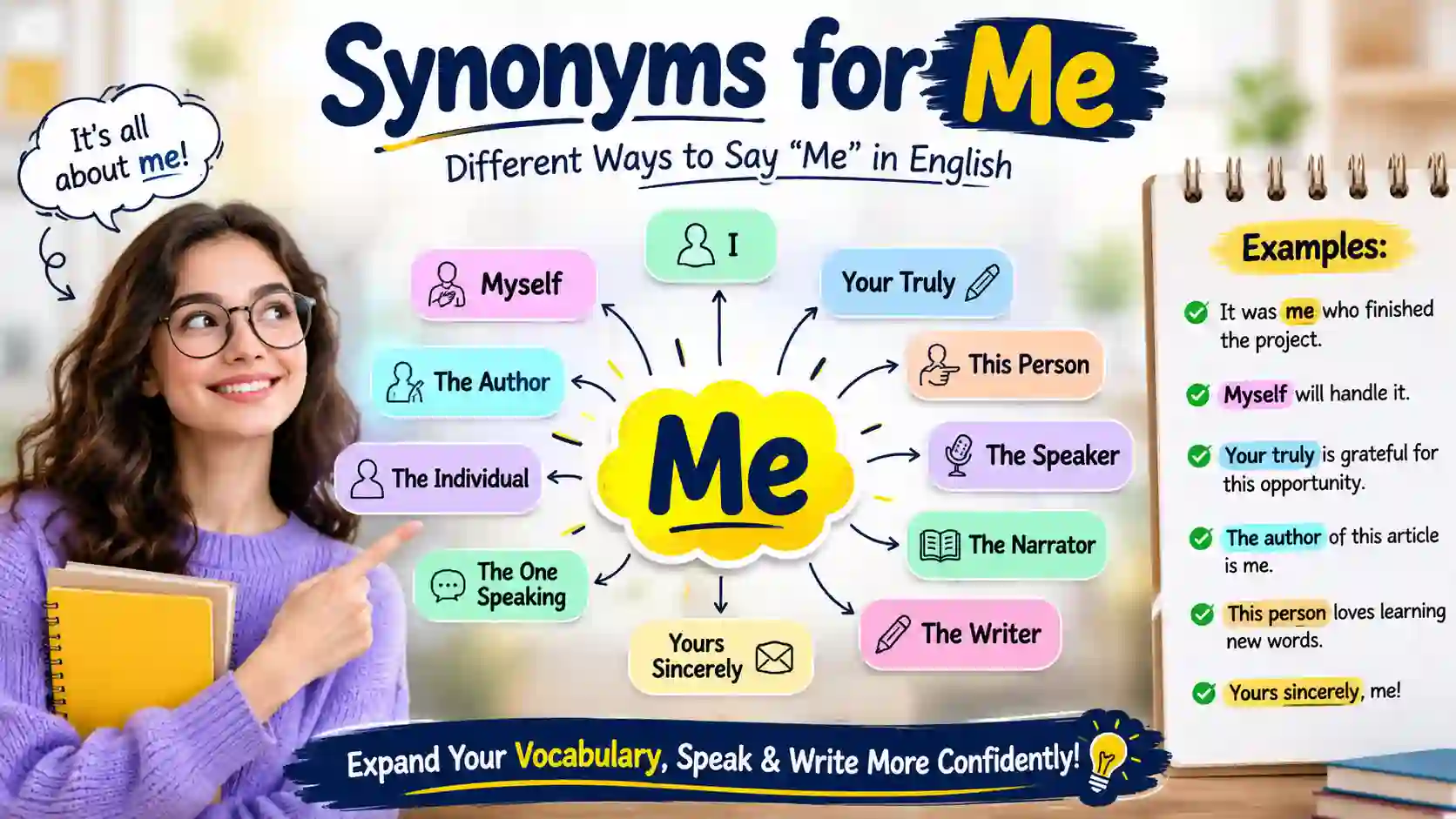
Have you ever typed a sentence and wondered if there is a better word than me? You may be looking for a synonym because you want to avoid repetition, sound more formal, or improve your English.
The answer is a little different from what you might expect. Me does not have many exact synonyms. It is the objective form of the first-person pronoun I. In some contexts, you can use words or phrases such as myself, personally, yours truly, the speaker, the writer, or the author, but these are not interchangeable in every sentence.
The best choice depends on the grammar and meaning of your sentence. This guide shows you which alternatives are natural, which ones are formal or informal, and when you should simply keep me.
Quick Answer: What Is Another Word for Me?
The closest alternatives to me are myself and, in some grammatical contexts, I. Other expressions such as personally, yours truly, the speaker, the writer, and the author can refer to the same person in specific situations. However, none can replace me in every sentence.
For example:
- She called me.
- I did it myself.
- Personally, I prefer the first option.
- The writer explains the idea clearly.
Notice that each expression performs a different job.
What Does “Me” Mean?
Me is a first-person singular object pronoun. It refers to the person who is speaking or writing.
It is usually used as the object of a verb or after a preposition.
Examples
- She invited me.
- Please help me.
- He gave me a book.
- Come with me.
- This gift is for me.
The subject form is I:
- I invited her.
- I helped him.
- I gave him a book.
A simple rule is:
I usually does the action. Me usually receives the action.
Pronunciation
IPA: /miː/
Pronunciation: mee
The pronunciation is the same in standard American and British English. Cambridge lists /miː/ for both varieties.
Part of Speech
Me is a pronoun.
More specifically, it is a first-person singular objective pronoun.
It can function as:
Direct Object
- She called me.
Indirect Object
- He sent me an email.
Object of a Preposition
- Sit beside me.
- This is important to me.
After a Linking Verb
Modern English commonly uses me in sentences such as:
- It’s me.
- That’s me.
- It was me.
This is natural modern English, although the older formal construction It is I can still be found.
The Best Alternatives to “Me”
Because me is a pronoun, it is better to think about contextual alternatives rather than a long list of exact synonyms.
1. Myself
Meaning: Refers back to the speaker or emphasizes that the speaker personally did something.
CEFR: A2
Register: Neutral
Frequency: Very common
Pronunciation: /maɪˈself/
Examples
- I made the dinner myself.
- I taught myself how to edit videos.
Best used when
Use myself when the action comes back to the speaker or when you want to add emphasis.
Common collocations
- by myself
- teach myself
- introduce myself
- remind myself
When not to use it
Do not use myself simply because you think it sounds more professional.
❌ Please contact myself.
✅ Please contact me.
This is one of the most common mistakes in business English.
2. I
Meaning: The subject form of the first-person singular pronoun.
CEFR: A1
Register: Neutral
Frequency: Very common
Examples
- I wrote the email.
- I called the office.
Best used when
Use I when you are the subject of the sentence.
Compare:
- I called Sarah.
- Sarah called me.
Important
I and me are not interchangeable.
❌ Me went to the store.
✅ I went to the store.
3. Personally
Meaning: From your own opinion, experience, or involvement.
CEFR: B1
Register: Neutral/Formal
Frequency: Very common
Examples
- Personally, I prefer the second design.
- I personally checked the figures.
Best used when
Use personally when you want to emphasize that something is your own opinion or that you were directly involved.
Common collocations
- personally believe
- personally prefer
- personally checked
- personally experienced
When not to use it
Personally cannot normally replace me as an object.
❌ She called personally.
✅ She called me personally.
4. I Personally
Meaning: A stronger way of emphasizing your own opinion or action.
Register: Neutral
Frequency: Common
Examples
- I personally disagree with the decision.
- I personally checked every document.
Best used when
Use it when you want to make it clear that you, rather than another person, hold an opinion or performed an action.
Nuance
Compare:
I checked the report.
This simply states what happened.
I personally checked the report.
This stresses that you checked it yourself.
5. Me Personally
Meaning: Refers specifically to your own experience, opinion, or situation.
Register: Informal to neutral
Frequency: Common in speech
Examples
- The criticism did not bother me personally.
- Me personally, I would choose the cheaper option.
Best used when
Use it in conversation when distinguishing your view from someone else’s.
Writing advice
It can sound conversational, so in my view or personally may be smoother in formal writing.
6. In My View
Meaning: According to my opinion.
CEFR: B1
Register: Neutral/Formal
Frequency: Common
Examples
- In my view, the first option is better.
- In my view, the problem needs more attention.
Best used when
Use this expression in essays, discussions, reviews, and professional writing when giving an opinion.
Important
It does not replace me grammatically.
You can say:
She asked me.
But not:
She asked in my view.
The meaning is different.
7. From My Perspective
Meaning: According to your personal experience or point of view.
CEFR: B1–B2
Register: Neutral/Formal
Frequency: Common
Examples
- From my perspective, the project was successful.
- From my perspective, communication is the main issue.
Best used when
Use it when you want to present an opinion while making it clear that it is your perspective.
Nuance
This phrase often sounds more analytical than I think.
8. For My Part
Meaning: As far as my position or opinion is concerned.
CEFR: B2
Register: Formal/Neutral
Frequency: Uncommon
Examples
- For my part, I have no objections.
- For my part, I am satisfied with the result.
Best used when
Use it when discussing different people’s positions or opinions.
When not to use it
It is not a direct replacement for me.
9. As for Me
Meaning: Used to introduce your own opinion or situation.
CEFR: B1
Register: Neutral
Frequency: Common
Examples
- As for me, I would rather stay home.
- As for me, the second option looks better.
Best used when
Use it when contrasting your opinion with another person’s.
For example:
James wants to leave early. As for me, I’d rather stay.
10. Yours Truly
Meaning: A playful or old-fashioned way of referring to yourself.
CEFR: B2
Register: Informal/Literary
Frequency: Uncommon
Examples
- Guess who won the competition? Yours truly.
- There was only one person brave enough to volunteer: yours truly.
Best used when
Use it for humor, personality, or a deliberately playful tone.
When not to use it
Avoid it in serious academic or professional writing.
11. The Speaker
Meaning: The person who is speaking.
CEFR: B1
Register: Formal/Academic
Frequency: Common
Examples
- The speaker described his experience.
- The speaker emphasized the importance of education.
Best used when
Use it when discussing a speech, conversation, presentation, or spoken statement objectively.
Example
Instead of:
I explained the problem.
An analyst might write:
The speaker explained the problem.
This creates distance from the speaker.
12. The Writer
Meaning: The person who wrote a text.
CEFR: A2–B1
Register: Formal/Academic
Frequency: Common
Examples
- The writer argues that education should be free.
- The writer describes the experience in detail.
Best used when
Use it when analyzing an article, essay, story, or other written work.
13. The Author
Meaning: The person who created a book, article, or other written work.
CEFR: B1
Register: Formal/Academic
Frequency: Common
Examples
- The author presents a different argument.
- The author uses personal experience to support the idea.
Best used when
You are discussing a published work or its creator.
Nuance
Author is more specific than writer in many contexts. Someone can be a writer without being the author of a particular published book.
14. The Undersigned
Meaning: The person whose name appears at the end of a formal document.
CEFR: C1
Register: Very formal/Legal
Frequency: Uncommon
Example
- The undersigned agrees to the terms stated above.
Best used when
Use it in contracts, declarations, legal documents, and official forms.
When not to use it
It sounds extremely formal in everyday English.
You would normally write:
I agree to the terms.
not:
The undersigned agrees to the terms.
Quick Comparison Table
| Alternative | Main Use | Register | Frequency |
|---|---|---|---|
| me | Object pronoun | Neutral | Very common |
| I | Subject pronoun | Neutral | Very common |
| myself | Reflexive/emphasis | Neutral | Very common |
| personally | Personal opinion/involvement | Neutral/Formal | Very common |
| I personally | Strong emphasis | Neutral | Common |
| me personally | Personal distinction | Informal/Neutral | Common |
| in my view | Opinion | Neutral/Formal | Common |
| from my perspective | Personal viewpoint | Neutral/Formal | Common |
| for my part | Personal position | Formal | Uncommon |
| as for me | Contrast/opinion | Neutral | Common |
| yours truly | Playful self-reference | Informal/Literary | Uncommon |
| the speaker | Spoken self-reference | Academic/Formal | Common |
| the writer | Written self-reference | Academic/Formal | Common |
| the author | Creator of a work | Academic/Formal | Common |
| the undersigned | Official documents | Legal/Formal | Uncommon |
Choose the Right Word
This is the most important part of learning alternatives to me.
| What you want to say | Natural choice | Example |
| The action happens to you | me | She called me. |
| You perform the action | I | I called her. |
| You did something yourself | myself | I did it myself. |
| You want to stress your opinion | personally | Personally, I disagree. |
| You want to state an opinion | in my view | In my view, it is better. |
| You want to explain your viewpoint | from my perspective | From my perspective, it worked. |
| You are analyzing a speech | the speaker | The speaker argues that… |
| You are analyzing a text | the writer | The writer suggests that… |
| You are discussing a published work | the author | The author explains… |
| You are signing an official document | the undersigned | The undersigned agrees… |
Remember: The goal is not to replace me every time you see it. The goal is to choose the correct expression for the meaning you want.
Me vs. I vs. Myself
English learners often struggle with these three words.
Me
Use me when you are the object.
- She helped me.
- They invited me.
- Give me the book.
I
Use I when you are the subject.
- I helped her.
- I invited them.
- I gave him the book.
Myself
Use myself when the action refers back to you or when you want emphasis.
- I hurt myself.
- I made it myself.
- I myself checked the document.
Easy Test
Remove the other person from the sentence.
Sarah and I went home.
Remove Sarah:
I went home.
So I is correct.
Now:
Sarah gave the book to John and me.
Remove John:
Sarah gave the book to me.
So me is correct.
Common Mistakes
Mistake 1: Using “Myself” Instead of “Me”
❌ Please contact myself.
✅ Please contact me.
Why?
Myself is reflexive or emphatic. It is not simply a more formal version of me.
Mistake 2: Using “Me” as the Subject
❌ Me and Ahmed went to the market.
✅ Ahmed and I went to the market.
In casual speech, me and… is common, but standard formal English uses I when the phrase is the subject. Thesaurus.com also notes that this informal construction is common in speech but traditionally considered grammatically nonstandard.
Mistake 3: Using “Myself” After “and”
❌ She spoke to Ali and myself.
✅ She spoke to Ali and me.
The presence of another person does not automatically require myself.
Mistake 4: Thinking “I” Is Always More Formal
❌ The manager spoke to I.
✅ The manager spoke to me.
I is not a formal version of me. They perform different grammatical roles.
Mistake 5: Replacing Every “Me”
You do not need to rewrite:
She gave me the report.
There is nothing wrong with me. In fact, replacing it with a longer phrase would probably make the sentence worse.
When Should You Keep “Me”?
Sometimes me is clearly the best choice.
Keep “me” after a verb
- Please help me.
- She called me.
- They invited me.
Keep “me” after a preposition
- Come with me.
- This belongs to me.
- She sat beside me.
Keep “me” in common expressions
- Excuse me.
- Believe me.
- Me too.
- Me neither.
Trying to replace these expressions with complicated vocabulary usually makes your English less natural.
Formal and Informal Alternatives
For Everyday Conversation
Use:
- me
- myself
- personally
- me personally
- as for me
- yours truly
Example
Personally, I think this is the better choice.
For Academic Writing
Depending on the context, use:
- I
- me
- personally
- in my view
- from my perspective
- the writer
- the author
Do not avoid first-person pronouns simply because you think academic writing must never use them. The appropriate choice depends on the discipline and assignment.
For Business Writing
Prefer clear expressions:
- me
- I
- myself
- personally
- in my view
Example:
Please contact me if you need further information.
This is better than:
Please contact myself if you need further information.
For Legal or Official Writing
You may encounter:
- the undersigned
- the applicant
- the signatory
- the declarant
These are specialized terms rather than ordinary synonyms for me.
American vs. British English
There is no meaningful spelling difference between American and British English:
American: me
British: me
The pronunciation is also essentially the same:
/miː/
The major differences you may notice are related to style or regional preferences, not the basic word itself.
For example:
It’s me.
is natural in both American and British English.
Word Origin and Etymology
Me is one of the oldest basic pronouns in English.
It comes from Old English mē, the object form related to the first-person pronoun I. The word has very old Germanic roots and is related to similar first-person forms found in other Indo-European languages.
Dictionary sources trace the English form back to Old English, and Dictionary.com records its use from before 900.
Word: me
Origin: Old English mē
First known use: Before 900
Word type: First-person singular object pronoun
CEFR Level
Me is an A1-level English word because it is one of the basic personal pronouns learners meet at the beginning of English study.
| Word | Approximate Level |
| me | A1 |
| I | A1 |
| myself | A2 |
| personally | B1 |
| perspective | B1 |
| yours truly | B2 |
| undersigned | C1 |
CEFR levels are useful guidelines rather than absolute classifications. Different learning resources may assign slightly different levels.
Natural Collocations With “Me”
Because me is extremely common, it appears in many everyday combinations.
Verb + Me
- help me
- tell me
- call me
- ask me
- invite me
- remind me
- teach me
- show me
- give me
- send me
Preposition + Me
- with me
- for me
- to me
- about me
- beside me
- behind me
- near me
- between you and me
Common Expressions
- excuse me
- believe me
- trust me
- me too
- me neither
- leave me alone
- look at me
- come with me
These patterns are a good reminder that me is already a natural and useful word. You do not need to replace it simply to make your English sound advanced.
Synonyms for “Me” in Different Contexts
If You Mean “Myself”
Use:
- myself
- personally
- I personally
Example:
I completed the project myself.
If You Mean “My Opinion”
Use:
- in my view
- from my perspective
- personally
- for my part
Example:
In my view, the second plan is stronger.
If You Mean “The Person Speaking”
Use:
- the speaker
- I
- myself
Example:
The speaker described the experience.
If You Mean “The Person Writing”
Use:
- the writer
- the author
- I
Example:
The writer presents a strong argument.
If You Mean “A Person in an Official Document”
Use:
- the undersigned
- the applicant
- the signatory
The exact term depends on the document.
Mini Practice
Fill in the Blank
Choose I, me, myself, or personally.
- Sarah called ___ yesterday.
- ___ finished the assignment.
- I made the meal ___.
- ___, I would choose the first option.
- Please send the email to ___.
Answers
- me
- I
- myself
- Personally
- me
Rewrite the Sentence
Make each sentence more natural.
1.
❌ Please contact myself tomorrow.
✅ Please contact me tomorrow.
2.
❌ Me and John completed the work.
✅ John and I completed the work.
3.
❌ She gave the document to John and myself.
✅ She gave the document to John and me.
4.
Basic:
I think the plan is useful.
Alternative:
In my view, the plan is useful.
5.
Basic:
I checked the numbers.
Emphatic:
I personally checked the numbers.
Vocabulary Quiz
1. Which word is normally used as the object of a verb?
A. I
B. Me
C. My
D. Mine
2. Which sentence is correct?
A. Me went home.
B. She called I.
C. She called me.
D. She called myself.
3. Which word is normally used for a reflexive action?
A. Me
B. I
C. Myself
D. Mine
4. Which phrase is best for introducing your personal opinion?
A. In my view
B. To myself
C. The undersigned
D. The writer
5. Which expression is especially suitable for a formal document?
A. Moi
B. Yours truly
C. The undersigned
D. Me personally
Answer Key
- B. Me
- C. She called me.
- C. Myself
- A. In my view
- C. The undersigned
FAQs
What is another word for “me”?
There is no single exact synonym for me. Depending on the sentence, you may use myself, personally, I personally, yours truly, the speaker, the writer, or the author. However, each has a different grammatical or contextual function, so you should not substitute them automatically.
Is “myself” a synonym for “me”?
Myself is closely related to me, but it is not interchangeable with it in every sentence. Use me as the normal object pronoun and myself for reflexive or emphatic meaning. For example, She called me is correct, while I called myself has a different meaning.
What is a professional way to say “me”?
In most professional writing, the best choice is simply me. For example, Please contact me is natural and professional. If you are expressing an opinion, you can use in my view, personally, or from my perspective when appropriate.
What is the difference between “I” and “me”?
I is normally used as the subject, while me is normally used as the object. Compare I called Sarah with Sarah called me. Choosing between them depends on the grammatical role they play in the sentence.
Can I use “myself” instead of “me”?
Not usually. Myself should not be used simply to sound formal. For example, Please send the email to me is correct, while Please send the email to myself is generally incorrect in standard English.
What can I use instead of “me” in an essay?
You can often use I, me, personally, in my view, or from my perspective, depending on the sentence. If you are analyzing a text rather than speaking personally, the writer or the author may be appropriate.
What is a formal synonym for “me”?
There is no universal formal synonym. In specific contexts, the undersigned can refer to the person signing an official document, while the writer or the author can work in academic analysis. In ordinary professional English, me is perfectly acceptable.
Is “it is me” grammatically correct?
Yes. It’s me is a normal and widely accepted modern English construction. Although It is I appears in older or very formal grammar traditions, it often sounds unusually formal in modern everyday English.
Final Takeaway
The smartest way to learn alternatives to me is not to memorize a huge synonym list. First understand the grammar. Use me when you are the object, I when you are the subject, and myself when the action refers back to you or you want emphasis. When expressing an opinion, phrases such as personally, in my view, and from my perspective can add variety. In academic or analytical writing, the writer and the author may sometimes be more appropriate.
Most importantly, do not replace me just for the sake of using a “bigger” word. Natural English is usually clear, simple, and precise.
Trusted References
- Cambridge Dictionary, me, for definition, pronunciation, grammar, and learner information.
- Merriam-Webster Dictionary, me, for dictionary and usage information.
- Oxford English Dictionary / Oxford Learner’s Dictionaries, for historical and modern usage.
- Thesaurus.com, me, for synonym and usage comparisons.
- WordHippo, another word for me, for contextual alternatives and related expressions.

Synonorm is a trusted English vocabulary resource created to help readers find the right words and understand the differences between similar terms. We provide clear explanations of synonyms, meanings, examples, usage, and alternatives. Our content makes vocabulary easier to learn and apply in everyday, academic, and professional English. Synonorm is designed for students, writers, ESL learners, professionals, and anyone who wants to improve their English vocabulary and communicate more clearly.