Quick Answer
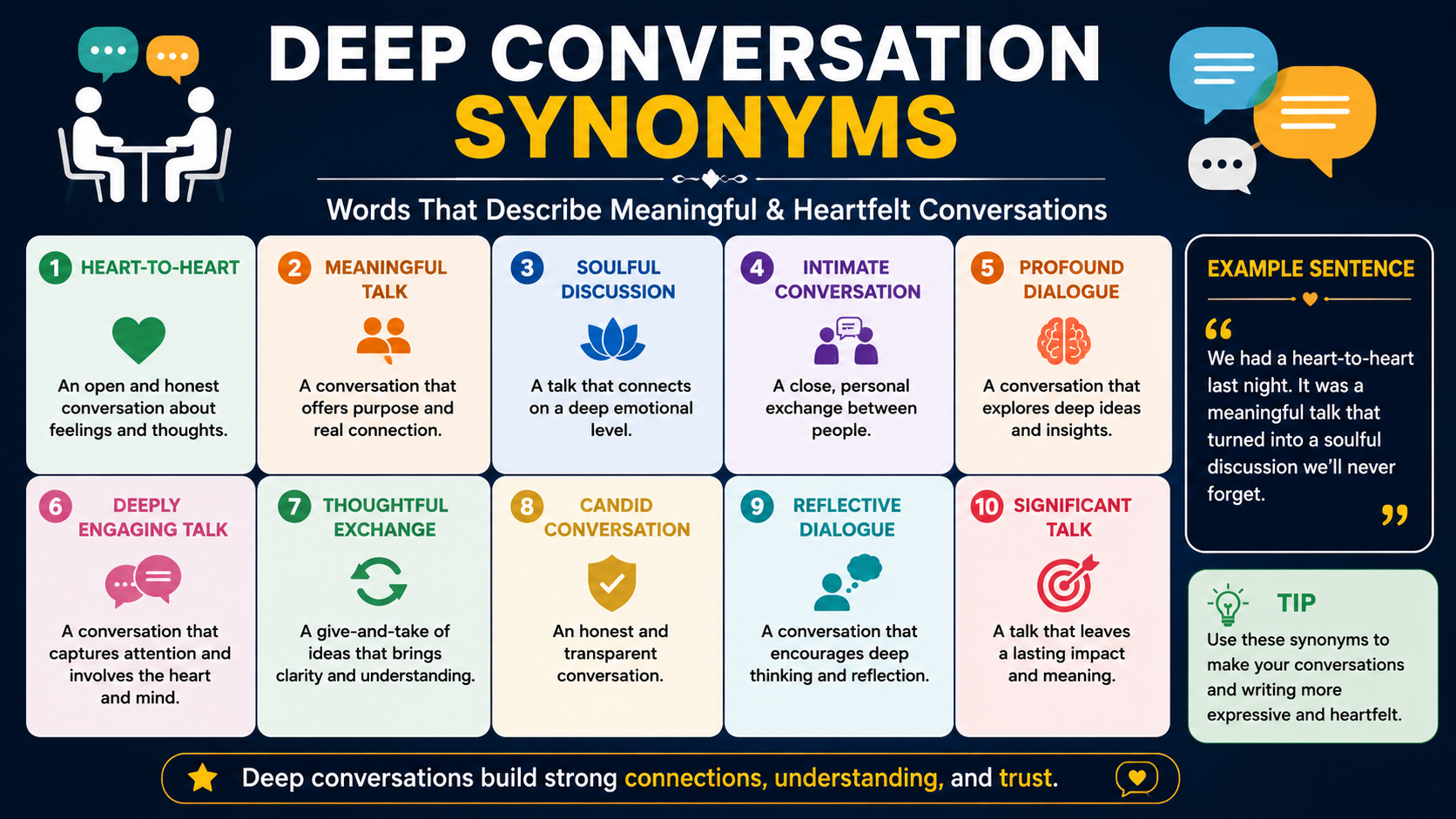
The best synonyms for deep conversation include meaningful conversation, profound discussion, serious talk, heart-to-heart, in-depth discussion, thoughtful dialogue, intimate conversation, philosophical discussion, and substantial discussion. The right choice depends on whether you mean emotional honesty, serious ideas, detailed discussion, or personal connection.
Introduction
Have you ever finished talking with someone and thought, “That was more than just small talk”? You may call it a deep conversation.
A deep conversation usually goes beyond simple facts or casual subjects. People may discuss feelings, beliefs, relationships, dreams, fears, values, life experiences, or difficult questions. Cambridge notes that deep can describe something that needs serious thought or is difficult to understand.
If you are searching for deep conversation synonyms, the best replacement depends on what you want to express. Meaningful conversation focuses on importance and personal value, while heart-to-heart suggests honest emotional sharing. In-depth discussion highlights detail and careful examination.
These distinctions matter for ESL learners, students, bloggers, writers, and professionals because using the right expression makes communication more natural and precise.
Pronunciation
Deep conversation
- US: /diːp ˌkɑːnvərˈseɪʃən/
- UK: /diːp ˌkɒnvəˈseɪʃən/
Pronounced as: deep kon-vur-SAY-shun
The word deep has the same pronunciation in American and British English. The main pronunciation difference appears in conversation, especially in the vowel sound in the first syllable.
Part of Speech
Deep conversation is a noun phrase.
- Deep = adjective
- Conversation = noun
Example:
We had a deep conversation about our future.
Useful related forms include:
- deepen — verb
- deeply — adverb
- converse — verb
- conversation — noun
- conversational — adjective
The phrase does not normally function as a verb or adverb by itself.
Grammar Usage
Common patterns include:
- have a deep conversation
- have deep conversations
- get into a deep conversation
- start a deep conversation
- lead to a deep conversation
- a deep conversation about something
- a deep conversation with someone
Examples
- We had a deep conversation about our goals.
- She got into a deep conversation with her brother.
- The movie led to a deep conversation about friendship.
Common grammar mistake
Do not normally say:
We had a deep conversation.
Say:
We had a deep conversation.
Having a conversation is the natural English expression.
Synonyms Overview
| Synonym | Strength | Formality |
| Meaningful conversation | Strongest | Neutral |
| Profound discussion | Strongest | Formal |
| Heart-to-heart | Strong | Informal |
| In-depth discussion | Strong | Formal |
| Serious talk | Strong | Neutral |
| Thoughtful dialogue | Strong | Formal |
| Intimate conversation | Strong | Neutral |
| Philosophical discussion | Strong | Academic |
| Substantial discussion | Strong | Formal |
| Insightful discussion | Strong | Formal |
| Personal conversation | Related | Neutral |
| Emotional conversation | Related | Neutral |
| Honest conversation | Related | Neutral |
| Reflective conversation | Related | Formal |
| Open conversation | Related | Neutral |
| Serious discussion | Strong | Neutral |
| Meaningful dialogue | Strong | Formal |
| Soul-searching conversation | Strong | Literary |
| Candid conversation | Strong | Formal |
| Detailed discussion | Related | Neutral |
| Thought-provoking discussion | Strong | Formal |
| Engaging dialogue | Related | Neutral |
| Personal talk | Related | Informal |
| Heart-to-heart talk | Strong | Informal |
| Substantive discussion | Strong | Academic |
Remember: These expressions are not perfect substitutes in every sentence. A heart-to-heart is usually emotional and personal, while an in-depth discussion is more focused on detail.
Detailed Deep Conversation Synonyms
1. Meaningful Conversation
Meaning: A conversation that has importance, value, or personal meaning.
Examples:
- We had a meaningful conversation about what we wanted from life.
- Her advice came from a meaningful conversation we shared years ago.
Best Used When: You want to emphasize value, importance, or connection.
Tone: Neutral, warm
CEFR: B1
Frequency: Very common
Collocations: meaningful conversation, meaningful relationship, meaningful exchange
When not to use: Do not use it simply because a conversation was long.
Merriam-Webster defines meaning as having meaning or purpose and also as being full of meaning or significance.
2. Profound Discussion
Meaning: A very serious discussion involving deep ideas or strong insight.
Examples:
- The students had a profound discussion about human freedom.
- Her question started a profound discussion about responsibility.
Best Used When: The subject involves major ideas, beliefs, or serious intellectual thought.
Tone: Formal, academic
CEFR: C1
Frequency: Common
Collocations: profound discussion, profound insight, profound question
When not to use: Avoid it for an ordinary chat about weekend plans.
Profound can describe intellectual depth, strong feelings, and something very significant.
3. Heart-to-Heart
Meaning: An honest and serious talk about feelings, usually between people who are close.
Examples:
- I had a heart-to-heart with my sister last night.
- They finally had a heart-to-heart about their relationship.
Best Used When: Someone openly discusses personal feelings.
Tone: Informal, emotional
CEFR: B2
Frequency: Common
Collocations: have a heart-to-heart, heart-to-heart talk, heart-to-heart conversation
Cambridge defines heart-to-heart as a serious conversation in which people honestly discuss their feelings.
When not to use: It sounds unusual for a formal business meeting.
4. In-Depth Discussion
Meaning: A detailed discussion that examines a subject carefully.
Examples:
- The professor led an in-depth discussion of the research.
- We had an in-depth discussion about the company’s future.
Best Used When: You want to stress detail rather than emotional closeness.
Tone: Formal, academic, business
CEFR: B2
Frequency: Very common
Collocations: in-depth discussion, in-depth analysis, in-depth interview
Cambridge describes in depth as doing something in a serious and detailed way, while in-depth works as an adjective before a noun.
When not to use: Do not choose it when the main idea is emotional openness.
5. Serious Talk
Meaning: A conversation about an important or difficult subject.
Examples:
- We need to have a serious talk about money.
- Her parents had a serious talk with her about school.
Best Used When: The situation requires attention or honesty.
Tone: Neutral, spoken
CEFR: A2–B1
Frequency: Very common
Collocations: have a serious talk, serious talk about, need a serious talk
When not to use: It may sound too strong for a friendly philosophical chat.
6. Thoughtful Dialogue
Meaning: A conversation in which people carefully consider ideas and feelings.
Examples:
- The book encouraged thoughtful dialogue about identity.
- Their thoughtful dialogue helped both sides understand the problem.
Best Used When: You want to highlight careful thinking and respectful exchange.
Tone: Formal, academic
CEFR: C1
Frequency: Common
Collocations: thoughtful dialogue, thoughtful discussion, thoughtful response
When not to use: Avoid it for very casual spoken English unless the context supports it.
7. Intimate Conversation
Meaning: A private and personal conversation involving feelings, experiences, or close relationships.
Examples:
- They had an intimate conversation about their fears.
- The quiet setting made an intimate conversation easier.
Best Used When: The conversation reveals private thoughts or emotions.
Tone: Neutral, personal
CEFR: B2
Frequency: Common
Collocations: intimate conversation, intimate details, intimate relationship
When not to use: Be careful because intimate can also have romantic or sexual meanings.
8. Philosophical Discussion
Meaning: A discussion about big questions concerning life, truth, morality, knowledge, or existence.
Examples:
- Our dinner turned into a philosophical discussion about happiness.
- He enjoys philosophical discussions about human nature.
Best Used When: The conversation explores abstract or fundamental questions.
Tone: Academic, neutral
CEFR: B2
Frequency: Common
Collocations: philosophical discussion, philosophical question, philosophical ideas
When not to use: Not every personal conversation is philosophical.
9. Substantial Discussion
Meaning: A serious discussion containing useful or important ideas.
Examples:
- The meeting finally produced a substantial discussion about the proposal.
- We need a substantial discussion before making a decision.
Best Used When: Writing professionally or academically.
Tone: Formal, business
CEFR: C1
Frequency: Common
Collocations: substantial discussion, substantial evidence, substantial change
When not to use: It sounds too formal for casual conversation.
10. Insightful Discussion
Meaning: A discussion that provides useful understanding or new ideas.
Examples:
- The workshop led to an insightful discussion about leadership.
- Her comments created an insightful discussion among the students.
Best Used When: People gain a new understanding from the conversation.
Tone: Formal, academic
CEFR: B2–C1
Frequency: Common
Collocations: insightful discussion, insightful comment, insightful question
When not to use: Avoid it if the conversation contains no useful ideas.
11. Personal Conversation
Meaning: A conversation about someone’s private life, experiences, or feelings.
Examples:
- We had a personal conversation about family.
- The interview became more personal after lunch.
Best Used When: The topic moves from general information to someone’s life.
Tone: Neutral
CEFR: B1
Frequency: Very common
Collocations: personal conversation, personal experience, personal question
When not to use: A personal conversation is not always deep.
12. Emotional Conversation
Meaning: A conversation involving strong feelings.
Examples:
- Their emotional conversation ended with an apology.
- She became quiet during the emotional conversation.
Best Used When: Feelings are a major part of the exchange.
Tone: Neutral
CEFR: B1
Frequency: Common
Collocations: emotional conversation, emotional response, emotional moment
When not to use: Do not assume that every deep conversation is emotional.
13. Honest Conversation
Meaning: A conversation in which people speak openly and truthfully.
Examples:
- We need an honest conversation about what happened.
- An honest conversation helped them rebuild trust.
Best Used When: Truth, openness, and direct communication matter.
Tone: Neutral
CEFR: B1
Frequency: Very common
Collocations: honest conversation, honest answer, honest discussion
When not to use: It does not necessarily suggest philosophical depth.
14. Reflective Conversation
Meaning: A conversation involving careful thought about experiences, choices, or feelings.
Examples:
- The walk gave us time for a reflective conversation.
- Their reflective conversation focused on lessons from the past.
Best Used When: People think about experiences and what they mean.
Tone: Formal, literary
CEFR: C1
Frequency: Uncommon
Collocations: reflective conversation, reflective mood, reflective writing
When not to use: It may sound unnatural in casual everyday speech.
15. Open Conversation
Meaning: A conversation in which people feel free to share ideas or concerns.
Examples:
- We had an open conversation about the team’s problems.
- An open conversation can prevent small issues from becoming bigger ones.
Best Used When: Openness and freedom to speak are important.
Tone: Neutral, business
CEFR: B1
Frequency: Very common
Collocations: open conversation, open discussion, open communication
When not to use: Openness alone does not mean the conversation is deep.
16. Serious Discussion
Meaning: A discussion focused on an important issue.
Examples:
- The committee held a serious discussion about safety.
- Their serious discussion lasted almost two hours.
Best Used When: You want a neutral alternative to deep conversation.
Tone: Neutral, formal
CEFR: B1
Frequency: Very common
Collocations: serious discussion, serious issue, serious matter
When not to use: It may suggest importance without emotional depth.
17. Meaningful Dialogue
Meaning: An exchange of ideas that has value, purpose, or importance.
Examples:
- The event created meaningful dialogue between students and teachers.
- They wanted meaningful dialogue instead of another argument.
Best Used When: Several people exchange ideas respectfully.
Tone: Formal, academic, business
CEFR: B2
Frequency: Common
Collocations: meaningful dialogue, constructive dialogue, public dialogue
When not to use: Dialogue can sound formal in ordinary personal speech.
18. Soul-Searching Conversation
Meaning: A conversation that makes someone examine their beliefs, choices, or feelings.
Examples:
- The experience led to a soul-searching conversation.
- We had a soul-searching talk about what we really wanted.
Best Used When: People are questioning themselves or their life choices.
Tone: Literary, emotional
CEFR: C1
Frequency: Uncommon
Collocations: soul-searching conversation, soul-searching questions, soul-searching exercise
When not to use: It is too dramatic for a simple discussion.
19. Candid Conversation
Meaning: A very honest and direct conversation.
Examples:
- The manager had a candid conversation with the employee.
- A candid conversation helped us understand the real problem.
Best Used When: Someone speaks frankly without hiding their opinion.
Tone: Formal, business
CEFR: C1
Frequency: Common
Collocations: candid conversation, candid discussion, candid response
When not to use: Do not use it when you only mean friendly or emotional.
20. Detailed Discussion
Meaning: A discussion that covers many facts, points, or parts of a subject.
Examples:
- We had a detailed discussion about the project.
- The teacher gave us a detailed discussion of the results.
Best Used When: Accuracy and completeness matter.
Tone: Neutral, academic
CEFR: B1–B2
Frequency: Very common
Collocations: detailed discussion, detailed explanation, detailed report
When not to use: A detailed discussion is not necessarily personal or emotional.
21. Thought-Provoking Discussion
Meaning: A discussion that makes people think deeply or question their ideas.
Examples:
- The documentary started a thought-provoking discussion.
- Her question led to a thought-provoking discussion about technology.
Best Used When: The conversation challenges people’s thinking.
Tone: Neutral, formal
CEFR: B2
Frequency: Common
Collocations: thought-provoking discussion, thought-provoking question, thought-provoking idea
When not to use: Avoid it when the discussion is simple and factual.
22. Engaging Dialogue
Meaning: A lively and interesting exchange that keeps people involved.
Examples:
- The class encouraged engaging dialogue between students.
- Their engaging dialogue made the interview enjoyable.
Best Used When: You want to stress interest and participation.
Tone: Neutral, formal
CEFR: B2
Frequency: Common
Collocations: engaging dialogue, engaging discussion, engaging conversation
When not to use: Engaging means interesting, not necessarily deep.
23. Personal Talk
Meaning: Informal speech about someone’s private life or feelings.
Examples:
- We had a little personal talk after dinner.
- She wanted a personal talk with her friend.
Best Used When: Speaking casually about private matters.
Tone: Informal, spoken
CEFR: A2–B1
Frequency: Common
Collocations: personal talk, private talk, little talk
When not to use: In professional writing, personal conversation is usually more natural.
24. Heart-to-Heart Talk
Meaning: An honest, emotional talk between people who trust each other.
Examples:
- I think we need a heart-to-heart talk.
- Their heart-to-heart talk cleared up several misunderstandings.
Best Used When: You want a warm, natural phrase for emotional honesty.
Tone: Informal, spoken
CEFR: B2
Frequency: Common
Collocations: have a heart-to-heart talk, honest heart-to-heart, heart-to-heart chat
When not to use: It is not suitable for formal reports or academic essays.
25. Substantive Discussion
Meaning: A serious discussion that deals with important content rather than surface-level points.
Examples:
- The committee finally had a substantive discussion about the policy.
- We need a substantive discussion before changing the rules.
Best Used When: Writing about serious professional, political, academic, or organizational matters.
Tone: Formal, academic, business
CEFR: C1
Frequency: Common in formal writing
Collocations: substantive discussion, substantive issue, substantive change
When not to use: It sounds unnatural in relaxed personal conversation.
Synonym Categories
Strongest Synonyms
These come closest to the core idea of deep conversation:
- Meaningful conversation
- Profound discussion
- Heart-to-heart
- In-depth discussion
- Thoughtful dialogue
- Intimate conversation
- Philosophical discussion
Strong Synonyms
These work well when the context emphasizes seriousness, honesty, or insight:
- Serious talk
- Insightful discussion
- Meaningful dialogue
- Candid conversation
- Thought-provoking discussion
- Substantial discussion
- Substantive discussion
Related Words
These share part of the meaning but are not exact replacements:
- Personal conversation
- Emotional conversation
- Open conversation
- Detailed discussion
- Engaging dialogue
- Personal talk
Choose the Right Synonym
| If you mean… | Best choice | Why |
| Emotional honesty | Heart-to-heart | Focuses on feelings |
| Important personal value | Meaningful conversation | Focuses on significance |
| Big intellectual ideas | Profound discussion | Suggests intellectual depth |
| Careful detail | In-depth discussion | Emphasizes thoroughness |
| Important problem | Serious discussion | Clear and natural |
| Honest directness | Candid conversation | Highlights frank speech |
| Self-reflection | Soul-searching conversation | Suggests personal examination |
| Formal idea exchange | Meaningful dialogue | Works well in academic settings |
| Interesting ideas | Thought-provoking discussion | Encourages deeper thinking |
| Private feelings | Intimate conversation | Suggests personal closeness |
Quick Tip: If you are unsure, meaningful conversation is one of the safest general choices. It sounds natural in everyday English and does not force a particular emotional or academic meaning.
American vs. British English
There is no major US/UK vocabulary difference in the phrase deep conversation.
The spelling conversation is the same in both varieties.
Dialogue is more interesting. Cambridge lists dialogue as the standard form and notes that dialog is also used in American English.
| Expression | American English | British English |
| deep conversation | Common | Common |
| meaningful conversation | Common | Common |
| heart-to-heart | Common | Common |
| in-depth discussion | Common | Common |
| dialogue | Common | Common |
| dialog | Also used, especially in technical contexts | Less common |
Pronunciation can differ slightly, but the expressions remain easily understood in both varieties.
Commonly Confused Words
| Word | Difference | Example |
| Deep | Serious or emotionally/intellectually significant | We had a deep conversation. |
| Meaningful | Important or valuable | We had a meaningful conversation. |
| Profound | Very deep, significant, or intellectually powerful | She made a profound observation. |
| Intense | Very strong emotionally or physically | It was an intense conversation. |
| Detailed | Containing many specific points | We had a detailed discussion. |
The important distinction is that deep does not always mean detailed. A five-minute conversation can be deep if it explores a powerful idea or personal feeling.
Common Mistakes
Common Mistake Box
Mistake: We made a deep conversation.
Correction: We had a deep conversation.
Explanation: English normally uses have a conversation, not make a conversation.
Mistake: We had a deep conversation about the weather.
Correction: We had a detailed discussion about tomorrow’s weather.
Explanation: Deep usually suggests serious thought, emotion, meaning, or complexity.
Mistake: The meeting was a heart-to-heart.
Correction: The manager had a heart-to-heart with the employee.
Explanation: Heart-to-heart normally refers to an honest personal talk, often between people who are close.
Writing Tips
Essays
Use profound discussion, in-depth discussion, or substantive discussion when your essay is formal.
Emails
Use meaningful discussion, detailed discussion, or open conversation.
Example:
I appreciate the open conversation we had about the project.
Blog Posts
Meaningful conversation and thought-provoking discussion sound natural and reader-friendly.
Stories
Use heart-to-heart, intimate conversation, or soul-searching conversation to create emotional depth.
Social Media
Natural expressions include:
- deep conversation
- meaningful conversation
- heart-to-heart
- real talk
Professional Communication
Choose:
- candid conversation
- substantive discussion
- in-depth discussion
- meaningful dialogue
Avoid overly emotional phrases such as soul-searching conversation in formal business writing.
Related Vocabulary
Antonyms
- Small talk
- Casual chat
- Light conversation
- Superficial conversation
- Idle talk
- Surface-level conversation
Related Expressions
- Get to know someone
- Open up to someone
- Talk things through
- Speak from the heart
- Share your thoughts
- Discuss your feelings
- Have a serious talk
- Go beyond small talk
Word Family
Deep
- depth
- deeply
- deepen
- deepening
Converse
- converse
- conversation
- conversational
- conversationally
Etymology and Word Origin
Deep comes from Old English dēop, originally referring to physical depth. Over time, English extended the word to ideas such as strong feelings, serious thought, and complexity. Cambridge records this modern figurative sense for things that require serious thought or are difficult to understand.
Conversation comes through Middle English and Anglo-French from Latin roots connected with living or associating with others. The modern word refers to spoken exchange between people.
For individual related words, their histories can differ considerably. For example, Merriam-Webster gives profound as coming through Middle English and Anglo-French from Latin profundus, meaning deep, and records its first known use in the 14th century.
Merriam-Webster records meaningful with a first known use in 1852.
CEFR Guide for Learners
| Expression | Approx. CEFR | Learning Note |
| Serious talk | A2–B1 | Easy and common |
| Personal conversation | B1 | Useful everyday phrase |
| Meaningful conversation | B1 | Excellent general choice |
| Open conversation | B1 | Useful in daily and work English |
| Detailed discussion | B1–B2 | Useful for study |
| Heart-to-heart | B2 | Learn as an idiomatic phrase |
| In-depth discussion | B2 | Useful in academic and professional English |
| Philosophical discussion | B2 | Useful for abstract topics |
| Thoughtful dialogue | B2–C1 | More formal |
| Profound discussion | C1 | Advanced vocabulary |
| Candid conversation | C1 | Useful for professional writing |
| Substantive discussion | C1 | Formal academic/business vocabulary |
| Soul-searching conversation | C1 | Literary and expressive |
Mini Practice Exercises
Fill in the Blank
Choose the best word.
- We had a ________ about our future and our goals.
a) heart-to-heart
b) noisy
c) tiny
d) ordinary - The researchers held an ________ discussion of the findings.
a) heart-to-heart
b) in-depth
c) sleepy
d) casual - Her question created a ________ discussion about happiness.
a) thought-provoking
b) shallow
c) empty
d) brief
Sentence Rewriting
Replace deep conversation with a more precise expression.
4. We had a deep conversation about our relationship.
Possible answer: We had a heart-to-heart about our relationship.
5. The team had a deep conversation about the research.
Possible answer: The team had an in-depth discussion about the research.
Vocabulary Matching Activity
Match each expression with its main meaning.
- Heart-to-heart
- In-depth discussion
- Profound discussion
- Candid conversation
- Meaningful conversation
A. Honest and direct
B. Important and valuable
C. Very serious or intellectually deep
D. Emotional talk between close people
E. Detailed examination of a subject
Answers:
1-D, 2-E, 3-C, 4-A, 5-B
Vocabulary Quiz
1. Which expression is most strongly connected with emotional honesty?
A. Detailed discussion
B. Heart-to-heart
C. Substantive discussion
D. Engaging dialogue
2. Which expression is best for a detailed academic discussion?
A. Heart-to-heart
B. Personal talk
C. In-depth discussion
D. Casual chat
3. Which word suggests very great intellectual or emotional depth?
A. Profound
B. Casual
C. Brief
D. Ordinary
4. Which phrase is most suitable for a business context?
A. Soul-searching talk
B. Heart-to-heart chat
C. Substantive discussion
D. Personal talk
5. Which expression focuses mainly on importance or value?
A. Meaningful conversation
B. Noisy conversation
C. Casual chat
D. Small talk
Answer Key
- B
- C
- A
- C
- A
FAQ: Deep Conversation Synonyms
What is another word for deep conversation?
The best general alternatives are meaningful conversation, serious discussion, and thoughtful dialogue. For emotional honesty, heart-to-heart is more precise. For detailed examination of a topic, in-depth discussion is usually the better choice.
What is a synonym for deep talk?
Common alternatives include meaningful talk, serious talk, heart-to-heart, personal conversation, and thoughtful conversation. The best choice depends on context. Heart-to-heart suggests emotional honesty, while serious talk simply indicates that the subject is important.
What is a formal word for deep conversation?
Formal alternatives include profound discussion, in-depth discussion, substantive discussion, meaningful dialogue, and thoughtful dialogue. In academic writing, in-depth discussion is especially useful when you want to emphasize careful examination of a subject.
Is “meaningful conversation” the same as “deep conversation”?
They are closely related but not identical. Deep conversation often suggests serious thought, personal feelings, or complex ideas. Meaningful conversation focuses more on importance and value. A conversation can be meaningful without being highly emotional or intellectually complex.
Is “heart-to-heart” a synonym for deep conversation?
Yes, in some contexts. Heart-to-heart specifically describes an honest and serious conversation about feelings, usually between people who are close. It is more emotional and personal than the broader phrase deep conversation. Cambridge supports this emotional and interpersonal meaning.
What is the opposite of a deep conversation?
Common opposites include small talk, casual chat, light conversation, and superficial conversation. However, small talk is not bad English or bad communication. It often helps people become comfortable before they move into more personal or serious topics.
What is the difference between deep and in-depth conversation?
A deep conversation can involve feelings, beliefs, values, experiences, or complex ideas. An in-depth conversation mainly emphasizes careful and detailed examination of a subject. Cambridge specifically associates in depth with serious and detailed treatment.
Can I use “dialogue” instead of “conversation”?
Sometimes. Dialogue is often more formal and can describe an exchange of ideas between groups. It is also commonly used for spoken lines in books, films, and plays. For everyday personal speech, conversation usually sounds more natural.
Conclusion
Learning deep conversation synonyms helps you express exactly what you mean. Use meaningful conversation for value and importance, heart-to-heart for emotional honesty, profound discussion for intellectual depth, and in-depth discussion for careful detail.
The goal is not to replace every familiar word with a difficult one. Good vocabulary means choosing the word that fits the situation. Practice these expressions in emails, essays, schoolwork, professional communication, and everyday conversations. With regular practice, your English will become clearer, more natural, and more precise.
References
- Cambridge Dictionary: Deep
- Cambridge Dictionary: Conversation
- Cambridge Dictionary: Heart-to-Heart
- Cambridge Dictionary: In Depth
- Merriam-Webster: Meaningful
- Merriam-Webster: Profound

Synonorm is a trusted English vocabulary resource created to help readers find the right words and understand the differences between similar terms. We provide clear explanations of synonyms, meanings, examples, usage, and alternatives. Our content makes vocabulary easier to learn and apply in everyday, academic, and professional English. Synonorm is designed for students, writers, ESL learners, professionals, and anyone who wants to improve their English vocabulary and communicate more clearly.