Quick Answer
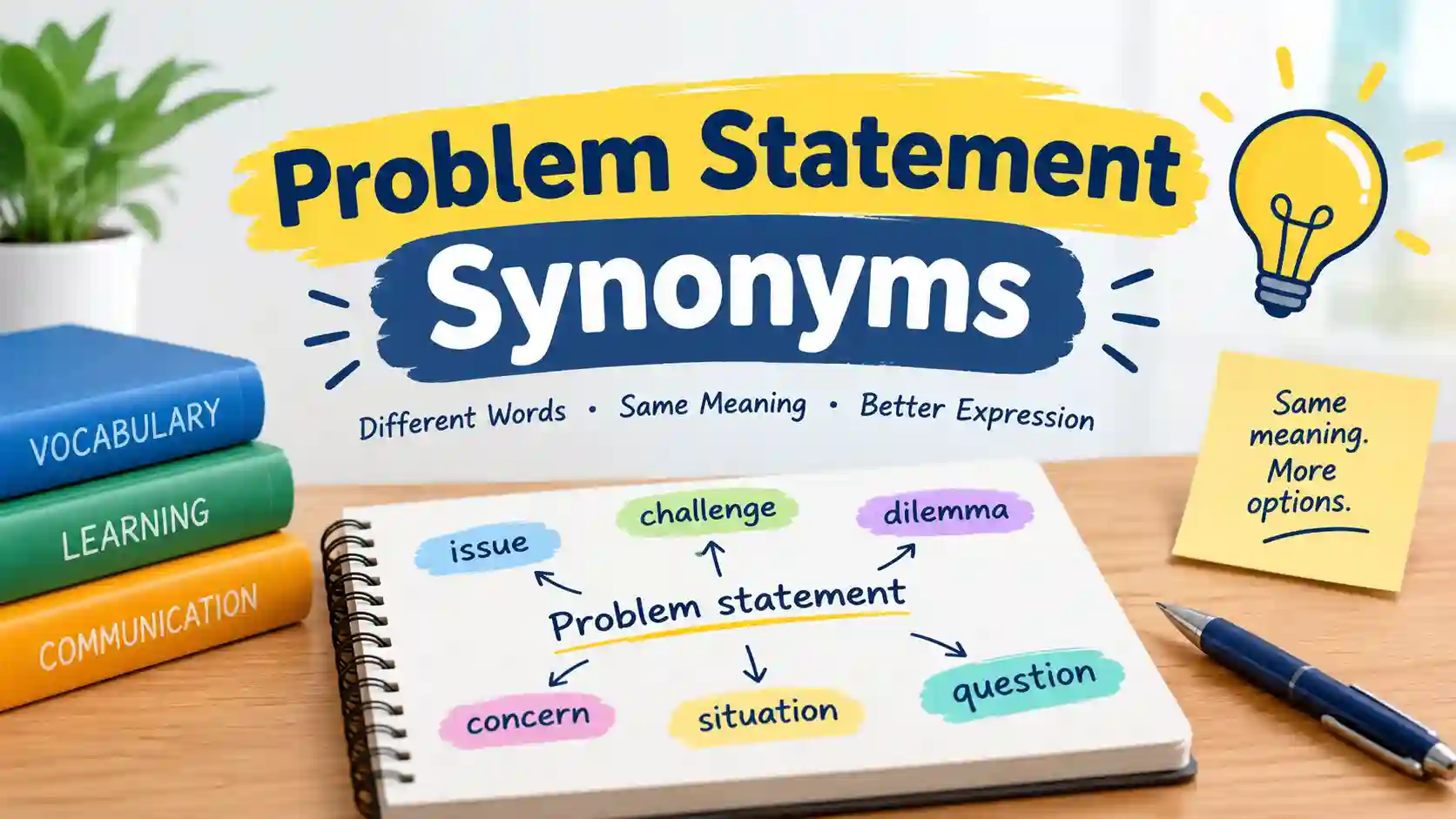
The best synonyms for problem statement include statement of the problem, problem description, problem definition, and issue statement. These phrases describe an issue that needs attention or investigation. Use statement of the problem in academic writing, problem description in reports, and problem definition when clarifying an issue’s exact scope.
Do you need another way to say a problem statement in an essay, research paper, project report, or business email? The right phrase can make your writing clearer and help you avoid unnecessary repetition.
A problem statement describes a specific issue and explains why it needs attention. For example, a school report might say, “The problem statement identifies the growing number of students who miss classes.”
Some alternatives have almost the same meaning, but others serve a different purpose. Problem description explains an issue, while a research question asks something a study aims to answer. Choosing between them requires more than finding a similar-looking phrase.
This guide covers useful problem statement synonyms, their meanings, examples, grammar, pronunciation, and context. It also explains which expressions work best in academic, professional, and everyday English.
Pronunciation
- Phrase: Problem statement
- American IPA: /ˈprɑːbləm ˈsteɪtmənt/
- British IPA: /ˈprɒbləm ˈsteɪtmənt/
- Simple pronunciation: PROB-ləm STATE-mənt
The main difference lies in the vowel sound in question. American English typically uses the vowel /ɑː/ or /ɑ/, depending on the transcription system, while British English commonly uses /ɒ/. Pronunciation varies across regional accents.
Part of Speech
Problem statement is a noun phrase.
- Problem (noun): A difficulty that needs attention or a solution.
- Statement (noun): Something expressed in words.
Examples:
- The researcher revised the problem statement.
- Our report contains a clear problem description.
- The team needs a better definition of the issue.
There is no standard verb or adverb form of the complete phrase. Instead, writers use related expressions such as define the problem, describe the issue, and state the problem clearly.
Grammar and Common Sentence Patterns
Use problem statement as a singular noun phrase. Its plural form is problem statements.
| Pattern | Example |
| Write a problem statement | We need to write a problem statement before planning the study. |
| A problem statement about | The report contains a problem statement about staff shortages. |
| A problem statement for | She prepared a problem statement for the project. |
| Define the problem | The team must define the problem before testing solutions. |
| Address the problem | The new policy aims to address the problem. |
Grammar tip: Use a problem statement when introducing one statement for the first time. Use the problem statement when referring to a specific statement that readers already know about.
Synonyms Overview Table
| Alternative | Meaning match | Best context |
| Statement of the problem | Very close | Academic writing |
| Problem description | Very close | General and technical writing |
| Problem definition | Very close in some contexts | Research and planning |
| Issue statement | Close, context-dependent | Professional writing |
| Description of the problem | Very close | Reports and essays |
| Problem summary | Partial match | Brief overviews |
| Issue description | Close | Technical and workplace reports |
| Problem outline | Partial match | Planning |
| Problem formulation | Close in research contexts | Academic and technical writing |
| Research problem | Related, often close | Research |
| Central problem | Related | Essays and analysis |
| Main issue | Related | Everyday and professional English |
| Core issue | Related | Business and discussion |
| Key concern | Related | Reports and meetings |
| Area of concern | Related | Formal reporting |
| Project challenge | Related | Project management |
| Business problem | Related | Business reports |
| Issue overview | Partial match | Briefings |
| Research question | Different function | Academic research |
| Gap analysis | Different function | Business and performance analysis |
The phrase you choose should preserve the intended meaning. The last two entries, for example, are related to problem analysis but are not exact substitutes.
Detailed Problem Statement Synonyms
1. Statement of the Problem
Meaning: A formal explanation of the issue that a study or project addresses.
Example: The statement of the problem explains why rural students have limited access to digital learning.
Best used when: Writing a thesis, dissertation, or research proposal.
Tone: Formal, academic.
Common collocations: statement of the problem, research proposal, thesis section.
2. Problem Description
Meaning: An explanation of what is wrong and how the issue appears.
Example: The problem description identifies the delays in the company’s delivery process.
Best used when: Explaining a technical fault, workplace issue, or project concern.
Tone: Neutral, professional.
Common collocations: brief problem description, detailed problem description, technical problem description.
3. Problem Definition
Meaning: A clear explanation of what a problem includes and what it does not include.
Example: A precise problem definition helped the team focus on late deliveries rather than unrelated customer complaints.
Best used when: Setting the boundaries of a problem before investigating it.
Tone: Formal, academic, business.
Common collocations: clear problem definition, define the problem, problem definition stage.
4. Issue Statement
Meaning: A statement that identifies a particular concern or issue.
Example: The issue statement highlights the shortage of trained employees.
Best used when: Presenting a concern in a business report or project document.
Tone: Formal, professional.
Common collocations: concise issue statement, project issue statement, issue statement template.
5. Description of the Problem
Meaning: A written explanation of a difficulty and its main features.
Example: The description of the problem explains why customers cannot complete their online orders.
Best used when: Writing a report for readers who need a direct explanation.
Tone: Neutral, formal.
Common collocations: clear description of the problem, detailed description, describe the problem.
6. Problem Summary
Meaning: A short account of the main points about a problem.
Example: The problem summary highlights three reasons for the increase in operating costs.
Best used when: Giving readers a quick overview before a detailed analysis.
Tone: Neutral, professional.
Common collocations: brief problem summary, summarize the problem, executive summary.
7. Issue Description
Meaning: An explanation of an issue, including what is happening and who or what it affects.
Example: The issue description explains why the software stops responding during login.
Best used when: Reporting a technical fault or customer service concern.
Tone: Neutral, technical.
Common collocations: technical issue description, brief issue description, provide an issue description.
8. Problem Outline
Meaning: A brief plan or overview of the main parts of a problem.
Example: The student created a problem outline before writing the full research paper.
Best used when: Organizing ideas before writing a complete explanation.
Tone: Neutral, academic.
Common collocations: initial problem outline, outline the problem, project outline.
9. Problem Formulation
Meaning: The process of expressing a problem in a clear, focused way.
Example: Careful problem formulation helped the researchers develop a focused study.
Best used when: Discussing how a researcher or team frames a problem.
Tone: Academic, technical.
Common collocations: problem formulation process, formulate the problem, mathematical problem formulation.
10. Research Problem
Meaning: An issue, uncertainty, or gap that a study seeks to investigate.
Example: The research problem concerns unequal access to public transport in rural areas.
Best used when: Explaining the central concern behind a research project.
Tone: Academic, formal.
Common collocations: identify a research problem, define a research problem, research problem statement.
11. Central Problem
Meaning: The main difficulty at the heart of a situation.
Example: The central problem is the lack of affordable housing for local families.
Best used when: Separating the main difficulty from smaller issues.
Tone: Neutral, academic.
Common collocations: central problem, address the central problem, central problem facing.
12. Main Issue
Meaning: The most important matter that needs attention.
Example: The main issue is the delay in receiving the supplier’s documents.
Best used when: Writing emails, meeting notes, or everyday explanations.
Tone: Neutral, conversational.
Common collocations: main issue, resolve the issue, discuss the issue.
13. Core Issue
Meaning: The underlying or central concern in a situation.
Example: The core issue is the lack of communication between the two departments.
Best used when: Emphasizing the main concern rather than its smaller symptoms.
Tone: Neutral, professional.
Common collocations: identify the core issue, address the core issue, underlying issue.
14. Key Concern
Meaning: An important matter that requires attention or careful thought.
Example: Data privacy remains a key concern for the company.
Best used when: Highlighting an important risk or worry in a report or discussion.
Tone: Professional, formal.
Common collocations: key concern, major concern, address a concern.
15. Area of Concern
Meaning: A subject or part of a process that may need attention.
Example: Staff training is an area of concern for the new manager.
Best used when: Reporting possible weaknesses or risks without presenting every concern as a confirmed problem.
Tone: Formal, professional.
Common collocations: key area of concern, identify an area of concern, major area of concern.
16. Project Challenge
Meaning: A difficulty that may prevent a project from reaching its goal.
Example: Our main project challenge is completing the work within the available budget.
Best used when: Discussing deadlines, resources, or project obstacles.
Tone: Business, neutral.
Common collocations: major project challenge, key challenge, overcome a challenge.
17. Business Problem
Meaning: A difficulty that affects an organization’s operations, customers, costs, or performance.
Example: The business problem is the steady decline in repeat purchases.
Best used when: Writing a business case, consulting report, or process improvement plan.
Tone: Professional, business.
Common collocations: solve a business problem, identify a business problem, business problem analysis.
18. Issue Overview
Meaning: A short introduction to an issue and its main features.
Example: The issue overview describes the shortage of affordable childcare in the region.
Best used when: Introducing a concern in a report or presentation.
Tone: Neutral, professional.
Common collocations: brief issue overview, issue overview section, provide an overview.
19. Research Question
Meaning: A focused question that a study aims to answer.
Example: Why do some students miss classes more often than others?
Best used when: Stating the question that guides a research project.
Tone: Academic.
Common collocations: formulate a research question, answer a research question, primary research question.
Important distinction: This is not an exact synonym. A problem statement describes the concern; a research question asks what the study will investigate.
Augustus C. Long Health Sciences Library
+1
20. Gap Analysis
Meaning: A comparison between the current state and a desired state to identify what is missing.
Example: The gap analysis showed that the company had fewer trained employees than its target required.
Best used when: Comparing performance with goals or standards.
Tone: Business, technical.
Common collocations: conduct a gap analysis, skills gap analysis, performance gap analysis.
Important distinction: A gap analysis is a method of examining a difference. It does not mean the same thing as a problem statement.
21. Needs Assessment
Meaning: A process for identifying what a person, group, or organization needs.
Example: The needs assessment revealed a demand for evening classes.
Best used when: Planning training, public services, or community programs.
Tone: Formal, professional.
Common collocations: conduct a needs assessment, training needs assessment, community needs assessment.
Important distinction: This term describes an evaluation of needs, not simply a written description of a problem.
22. Situation Analysis
Meaning: An examination of the wider conditions surrounding an issue.
Example: The situation analysis considered staffing levels, operating costs, and customer demand.
Best used when: Studying the context before making a decision.
Tone: Formal, academic, business.
Common collocations: conduct a situation analysis, market situation analysis, current situation analysis.
Important distinction: A situation analysis is usually broader than a problem statement.
23. Description of the Issue
Meaning: An explanation of a concern and its main details.
Example: The description of the issue explains why customers face long waiting times.
Best used when: Writing clear reports for a general audience.
Tone: Neutral, professional.
Common collocations: clear description of the issue, detailed description, describe the issue.
24. Challenge Description
Meaning: An explanation of a difficulty that a team or person must overcome.
Example: The challenge description explains why the team cannot meet the original deadline.
Best used when: Preparing a project proposal or planning document.
Tone: Neutral, business.
Common collocations: describe the challenge, key challenge, project challenge description.
Important distinction: Challenge can make a difficulty sound more manageable or constructive than a problem. Do not use it if that change would hide the seriousness of the issue.
25. Issue Definition
Meaning: A clear explanation of an issue’s meaning and boundaries.
Example: The committee agreed on the issue definition before discussing possible actions.
Best used when: Clarifying the scope of a concern.
Tone: Formal, professional.
Common collocations: define the issue, clear issue definition, issue definition stage.
Important distinction: Problem definition is generally the more established choice when the focus is specifically on defining a problem.
Choose the Right Synonym
The easiest way to select an alternative is to identify what your sentence needs to do.
| Your purpose | Recommended phrase | Example |
| Introduce a research issue | Statement of the problem | The statement of the problem identifies unequal access to education. |
| Explain what is going wrong | Problem description | The problem description covers repeated delivery delays. |
| Set the boundaries of an issue | Problem definition | The problem definition limits the study to late deliveries. |
| Present the issue behind a study | Research problem | The research problem concerns low reading confidence. |
| Ask what the study will investigate | Research question | Which teaching methods improve reading confidence? |
| Identify a shortfall | Gap analysis | The gap analysis compares current and target performance. |
| Explain a work-related obstacle | Project challenge | The project challenge is the short deadline. |
| Discuss the wider context | Situation analysis | The situation analysis examines staffing and costs. |
One Problem, Five Different Expressions
Suppose a school has noticed that many students miss classes.
- Problem statement: Student absences have increased, reducing learning time.
- Problem description: More students miss classes, particularly on Mondays.
- Problem definition: The issue concerns repeated unexcused absences among students in grades six through eight.
- Research question: What factors contribute to repeated student absences?
- Gap analysis: The school compares its current attendance rate with its target to identify the shortfall.
Each example focuses on a different aspect. This comparison helps learners see why a related phrase may not work as an exact replacement.
Commonly Confused Terms
| Term | What it does | Example |
| Problem statement | Describes the issue that needs attention. | Student absences have increased. |
| Research question | Asks what the study seeks to discover. | Why have student absences increased? |
| Hypothesis | Proposes a testable explanation or prediction. | Students with longer commutes may miss more classes. |
| Root cause analysis | Investigates the underlying reasons for a problem. | The school examines transport, health, and scheduling records. |
| Solution statement | Describes a proposed response. | The school proposes a new transport service. |
Remember: State the problem first. Then frame your research question, test any hypothesis, investigate causes, and consider solutions as appropriate.
Word Origin and Etymology
The phrase problem statement combines two English words with different histories.
- Problem: Comes through Latin from Greek problēma, referring to something put forward as a question or challenge.
- Statement: Comes from state, meaning to express or set something out, with the noun-forming suffix -ment.
Together, the words describe an expression of a problem that needs attention or investigation.
I could not verify a reliable first-known-use date for the exact phrase problem statement from the sources reviewed. Therefore, this guide does not assign it an unsupported date. The historical entries in the Oxford English Dictionary can be consulted for more detailed evidence.
American vs. British English
The main phrase and its standard alternatives use the same spelling in American and British English.
| Feature | American English | British English |
| Standard phrase | Problem statement | Problem statement |
| Common alternative | Problem description | Problem description |
| Academic phrase | Statement of the problem | Statement of the problem |
| General vocabulary | Issue, concern | Issue, concern |
| Pronunciation of problem | /ˈprɑːbləm/ | /ˈprɒbləm/ |
Both varieties use problem statements in academic and professional writing. Pronunciation varies by accent, and organizations may prefer different headings. Follow your university’s or employer’s style guide when one applies.
Register, Frequency, and Learner Guidance
A phrase’s register tells you where it sounds appropriate. Frequency labels below are practical editorial guidance, not counts from a verified language corpus.
| Phrase | Register | Usage guidance |
| Problem statement | Academic, business | Very common in research and planning |
| Problem description | Neutral, technical | Common in reports and support documents |
| Problem definition | Formal, professional | Common in analysis and planning |
| Research question | Academic | Very common in research |
| Main issue | Spoken, professional | Common in everyday communication |
| Gap analysis | Business, technical | Common in specialist contexts |
| Needs assessment | Professional, academic | Common in planning contexts |
| Problem formulation | Academic, technical | More specialized |
CEFR levels describe overall language proficiency, from A1 beginner to C2 proficient. They do not automatically establish an official difficulty rating for every phrase. For that reason, this article prioritizes clear definitions and realistic examples instead of assigning unverified CEFR scores to each alternative.
Writing Tips: Use Alternatives Naturally
Essays and research papers
Use a statement of the problem when referring to a formal section. Use research problems when discussing the issue behind the study, and research questions when presenting the question you aim to answer.
Example:
“The research problem concerns low reading confidence among middle-school students. This study asks which classroom activities may improve that confidence.”
Emails and business reports
Use the main issue, problem description, or key concern when you want direct professional language.
Example:
“Our main issue is the delay in receiving the supplier’s files. Could you confirm when we can expect them?”
Blog posts and articles
Use problem, challenge, or issue when a formal phrase would make your writing sound stiff.
Example:
“Many small businesses struggle to attract repeat customers. This article explores the causes and practical ways to improve customer retention.”
Stories and daily conversation
Use natural expressions such as the real issue, the main problem, or what went wrong.
Example:
“The real issue wasn’t the cost. It was that nobody explained the extra fees.”
Quick writing checklist
Before replacing problem statement, ask:
- Am I describing an issue, asking a question, or proposing a solution?
- Who will read this sentence?
- Does my alternative preserve the original meaning?
- Is the phrase natural in this context?
If the replacement changes your meaning, keep the original phrase or rewrite the sentence.
Related Vocabulary
Contrasting expressions
The problem statement has no single, exact antonym. These expressions focus on different parts of the problem-solving process.
- Solution statement: Describes a proposed response.
- Desired outcome: Describes the result someone wants.
- Success criteria: Defines the conditions for success.
- Opportunity statement: Describes an opportunity for improvement.
- Strengths statement: Describes positive qualities or advantages.
These terms are not direct opposites. They simply shift attention from a problem to a response, goal, opportunity, or strength.
Related expressions
| Expression | Meaning |
| Define the problem | Explain exactly what is wrong. |
| Identify the issue | Recognize a concern. |
| Frame the problem | Present the issue in a useful way. |
| Clarify the scope | Set the limits of a project or issue. |
| Analyze the root cause | Investigate why a problem occurs. |
| Propose a solution | Suggest a way to address the problem. |
| Address the concern | Take action on an issue. |
Word family
- Problem (noun): A difficulty that needs attention.
- Problematic (adjective): Causing difficulty or concern.
- Problematically (adverb): In a way that creates difficulty or concern.
- State (verb): Express something clearly.
- Statement (noun): Something expressed in words.
Examples:
- The new process has a problematic delay.
- Please state the issue clearly.
- Her statement helped the team understand the concern.
Common Mistakes to Avoid
Mistake 1: Treating related concepts as exact synonyms
Incorrect: The research question describes the problem in detail.
Correct: The problem statement describes the issue, while the research question asks what the study will investigate.
Why: These terms serve different purposes.
Mistake 2: Presenting a solution as the problem
Incorrect: Our problem statement is to install new computers.
Correct: Our problem statement identifies the lack of reliable computers in the classroom.
Why: Identify the difficulty before proposing a response.
Mistake 3: Using overly technical language
Incorrect: The problem formulation of my simple email concerns a late meeting.
Better: The main issue is that the meeting starts late.
Why: Choose language that suits your audience.
Mistake 4: Replacing a term just to avoid repetition
Incorrect: The report has a problem statement, a gap analysis, and a needs assessment that all repeat the same information.
Better: Use one clear problem statement, then add a separate analysis only when it provides useful new information.
Why: Vocabulary variety should improve clarity, not create unnecessary sections.
FAQ: Problem Statement Synonyms
1. What is another word for a problem statement?
Common alternatives include statements of the problem, problem description, and problem definition. The best choice depends on your purpose. Use statements of the problem in academic writing, problem description to explain an issue, and problem definition to clarify its scope.
2. What is a formal synonym for a problem statement?
Statement of the problem is a common formal alternative, especially in research papers and dissertations. Problem definition also works when you need to explain the exact boundaries of an issue. Follow your institution’s terminology if it requires a particular heading.
3. What can I use instead of a problem statement in an essay?
You can use research problems, central problems, or main issues, depending on your sentence. Use research problems to identify the concern behind a study. Use a central problem to emphasize the main difficulty in an argument. Keep the original phrase when it names a formal section.
4. Is a research question a synonym for a problem statement?
No. A problem statement describes an issue that needs attention, while a research question asks what the study aims to discover. For example, “Student absences have increased” describes a problem, while “Why have student absences increased?” asks a research question.
5. What is a synonym for a problem statement in business?
Useful alternatives include problem description, issue statement, business problem, and core issue. Use business problems when the issue affects organizational performance. Use core issues to emphasize the central concern. Choose the phrase that best matches the document and audience.
6. What is the difference between problem definition and problem description?
A problem definition clarifies exactly what an issue includes and where its boundaries lie. A problem description explains what is happening and how it affects people or processes. Writers may use both during planning, but each phrase emphasizes a different part of understanding the problem.
7. What is the opposite of a problem statement?
There is no single exact opposite of the problem statement. Depending on your meaning, you might use a solution statement, desired outcome, or success criteria. A solution statement describes a proposed response, while a desired outcome describes the result someone hopes to achieve.
8. How can I avoid repeating problem statements in academic writing?
Use the original phrase when referring to a specific section of your paper. Elsewhere, choose accurate alternatives such as research problems, central issues, or problem descriptions. You can also rewrite sentences to remove unnecessary repetition. Never replace a technical term if the new wording changes its meaning.
Vocabulary Practice
Try these three exercises to check whether you can choose the correct expression.
1. The study aims to answer this question: Why do some students miss classes?
Research question
Problem summary
Gap analysis
2. The team compares its current performance with its target.
Issue statement
Gap analysis
Research problem
3. The report explains exactly what is going wrong with the payment system.
Problem description
Desired outcome
Research question
Check answers
Conclusion
Learning problem statement synonyms can improve your essays, reports, emails, and everyday communication. Choose a statement of the problem for formal research, a problem description for a direct explanation, and a problem definition when you need to clarify an issue’s scope. Remember that related terms do not always have the same meaning. Practice choosing precise words in your writing, and your vocabulary will become clearer, more natural, and more effective.
References
- Cambridge Dictionary: Problem definition and usage.
- Oxford English Dictionary: Historical definitions and etymology.
- Merriam-Webster: English dictionary and word history.
- Rochester Institute of Technology: Problem Statement Research Guide.
- University of California, San Francisco: Problem Statement Product Toolkit.

Synonorm is a trusted English vocabulary resource created to help readers find the right words and understand the differences between similar terms. We provide clear explanations of synonyms, meanings, examples, usage, and alternatives. Our content makes vocabulary easier to learn and apply in everyday, academic, and professional English. Synonorm is designed for students, writers, ESL learners, professionals, and anyone who wants to improve their English vocabulary and communicate more clearly.