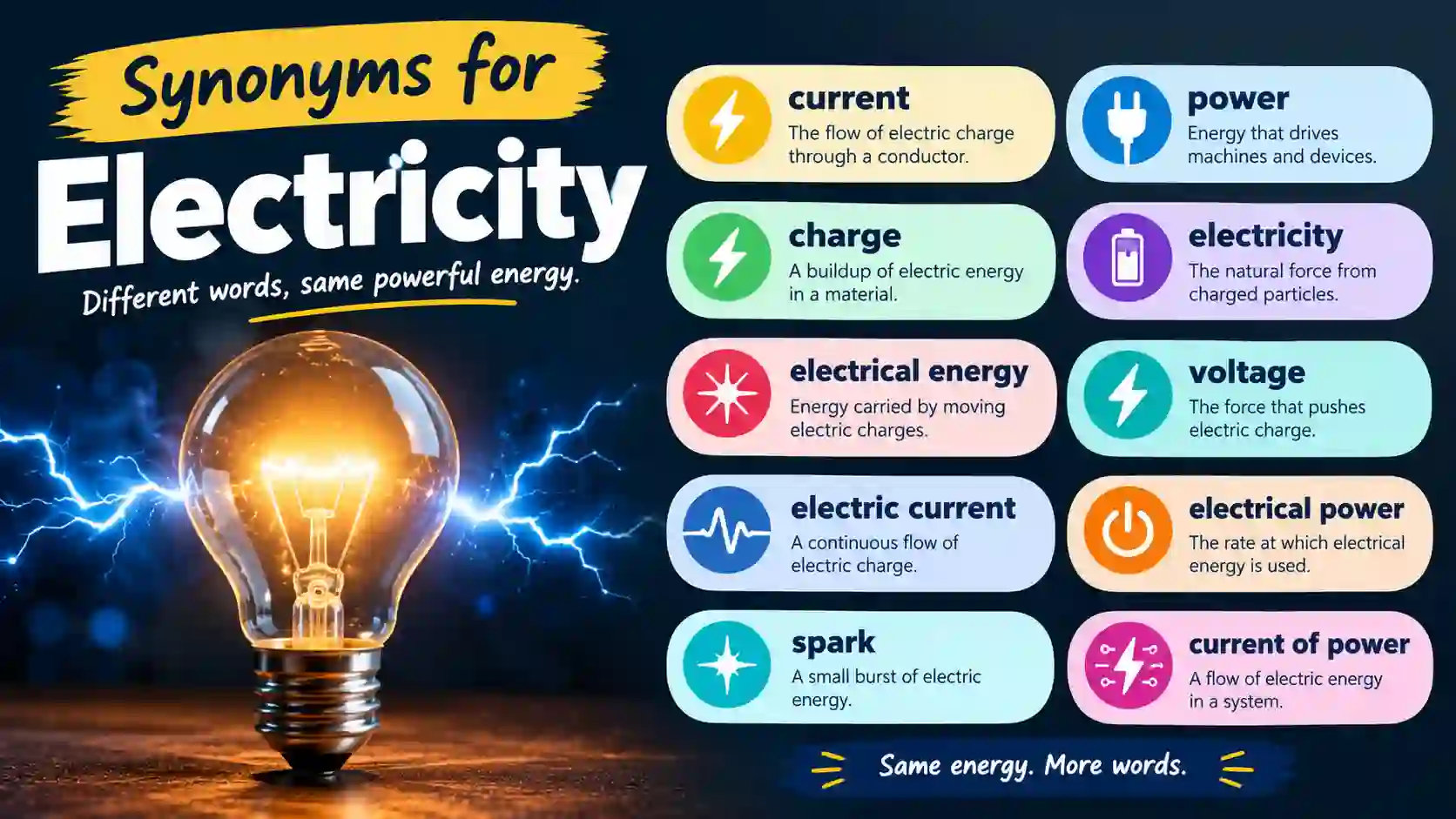
Quick Answer
The best synonyms for electricity include electric power, electrical energy, power, and electricity supply. These words work in different contexts. Use power when discussing an outage, electrical energy in science writing, and electricity supply when talking about the service that delivers electricity to a home or building.
Have you ever repeated the word electricity several times in an essay or blog post? Choosing a suitable alternative can make your writing clearer, but not every related word means the same thing.
Electricity powers our lights, phones, computers, and household appliances. In everyday English, people often use power and electricity in similar ways. In science, however, current, voltage, and electrical energy describe different concepts.
This guide covers synonyms for electricity, their meanings, natural examples, and common mistakes. It also explains formal and informal expressions, American and British usage, and the differences between close synonyms and technical terms. By the end, you will know which word fits your sentence instead of simply replacing one word with another.
Pronunciation and Part of Speech
- Word: Electricity
- American IPA: /ɪˌlekˈtrɪs.ə.t̬i/
- British IPA: /ˌel.ɪkˈtrɪs.ə.ti/
- Part of speech: Noun
- Countability: Uncountable
- Learner level: A2 in the Cambridge English Dictionary.
definition in the Cambridge English Dictionary
+1
What Does Electricity Mean?
Electricity refers to physical phenomena involving electric charges. In everyday English, it commonly means the power supply that operates lights, appliances, and machines.
Examples:
- We lost electricity during the storm.
- The factory uses electricity to run its machines.
- Solar panels generate electricity from sunlight.
Word Origin and Etymology
Electricity entered English in the 1640s. Its history connects to the word electric, which comes from Latin electrum and Greek ēlektron, meaning amber. Early experiments with rubbed amber helped people study static electrical effects.
Etymology, Origin & Meaning
+1
Best Synonyms for Electricity: Overview Table
| Synonym | Meaning in context | Register |
| Electric power | Electricity used to operate equipment | Neutral |
| Electrical energy | Energy in electrical form | Academic |
| Power | Everyday electricity supply | Neutral |
| Electricity supply | Provision of electricity | Neutral/formal |
| Electric supply | Electricity made available to a system | Formal |
| Power supply | Source or equipment providing power | Technical |
| Grid power | Electricity from an interconnected grid | Technical |
| Mains electricity | Electricity from the public supply network | British English |
| Utility power | Electricity supplied by a utility company | Professional |
| Electric service | Provision of electricity to a property | Business |
| Current | Flow of electric charge | Technical |
| Voltage | Electric potential difference | Technical |
| Static electricity | Accumulated electric charge | Scientific |
| Electrical charge | Property responsible for electrical forces | Scientific |
| Energy | Capacity to do work or cause change | General |
| Solar power | Energy obtained from sunlight | General/technical |
| Juice | Informal term for available power | Informal |
| Spark | Brief flash from an electrical discharge | General |
| Lightning | Natural atmospheric electrical discharge | General/scientific |
| Electromagnetism | Interaction involving electric and magnetic fields | Academic |
Usage note: The first ten entries can work as alternatives in specific contexts. The remaining entries are related terms, not universal substitutes.
20 Synonyms and Related Terms Explained
1. Electric Power
Meaning: Electric power is the rate at which electrical energy transfers or gets used, although everyday English also uses the phrase for electricity supplied to equipment.
Examples:
- The plant needs more electric power to run its new machines.
- The backup generator restored electric power to the building.
Best used when: Discussing power generation, equipment, or electrical systems.
Tone: Neutral and technical. Frequency: Very common. Collocations: electric power grid, electric power generation, electric power system.
When not to use it: Use electrical energy when you specifically mean an amount of energy rather than its rate of transfer.
2. Electrical Energy
Meaning: Electrical energy is energy in electrical form.
Examples:
- The solar cell converts sunlight into electrical energy.
- The speaker converts electrical energy into sound.
Best used when: Explaining energy conversion, storage, or consumption.
Tone: Academic and formal. Frequency: Common in science. Collocations: electrical energy storage, electrical energy consumption, electrical energy conversion.
When not to use it: In ordinary conversation about a bill, electricity usually sounds more natural.
3. Power
Meaning: Power can mean the electricity supply available to a home or device.
Examples:
- The storm knocked out power across the town.
- Please turn off the power before the technician inspects the machine.
Best used when: Talking about outages, electrical connections, or equipment.
Tone: Neutral. Frequency: Very common. Collocations: power outage, power supply, power line.
When not to use it: In scientific writing, make sure the reader can tell whether you mean electrical power, physical strength, or authority.
4. Electricity Supply
Meaning: Electricity supply refers to electricity made available to consumers or equipment.
Examples:
- The hospital needs a reliable electricity supply.
- Repairs restored the electricity supply to the village.
Best used when: Describing availability, reliability, or delivery of electricity.
Tone: Neutral and formal. Frequency: Common. Collocations: reliable electricity supply, electricity supply network, electricity supply interruption.
When not to use it: Use current when you specifically mean the flow of charge.
5. Electric Supply
Meaning: Electric supply refers to electricity provided to a building or system.
Examples:
- The engineer checked the electric supply before starting the equipment.
- The cabin has no electric supply during the winter months.
Best used when: Discussing electrical provision in a practical or technical setting.
Tone: Formal. Frequency: Common in specialized contexts. Collocations: electric supply cable, electric supply network, electric supply failure.
When not to use it: In general writing, electricity supply often sounds more natural.
6. Power Supply
Meaning: A power supply is a source or piece of equipment that provides electrical power.
Examples:
- The computer stopped working because its power supply failed.
- The laboratory installed a backup power supply.
Best used when: Discussing computers, electrical equipment, and backup systems.
Tone: Technical and neutral. Frequency: Very common. Collocations: backup power supply, power supply unit, external power supply.
When not to use it: Remember that a power supply can be a physical device, not just the electricity itself.
7. Grid Power
Meaning: Grid power is electricity delivered through an interconnected power network.
Examples:
- The office uses grid power when its batteries run low.
- The farm relies on grid power during cloudy weather.
Best used when: Comparing public electricity networks with independent generators or solar systems.
Tone: Technical and professional. Frequency: Common. Collocations: grid power supply, grid connection, grid power demand.
When not to use it: Avoid this term when you mean electricity generated and used independently of the grid.
8. Mains Electricity
Meaning: Mains electricity is electricity supplied through the public electrical network.
Examples:
- The appliance connects directly to mains electricity.
- The workshop uses mains electricity to operate its larger machines.
Best used when: Distinguishing wall-socket electricity from batteries.
Tone: Neutral and technical. Frequency: Common in British English. Collocations: mains electricity supply, mains voltage, mains-powered equipment.
When not to use it: American readers may find household electricity or grid power more familiar.
9. Utility Power
Meaning: Utility power is electricity provided by an electric utility company.
Examples:
- The generator starts automatically when utility power fails.
- The facility normally operates using utility power.
Best used when: Discussing backup systems, industrial sites, or commercial buildings.
Tone: Professional. Frequency: Common in technical contexts. Collocations: utility power failure, utility power source, utility power connection.
When not to use it: Do not use it if you specifically mean power generated locally by a private system.
10. Electric Service
Meaning: Electric service refers to the provision of electricity to a property or customer.
Examples:
- The landlord arranged electric service for the apartment.
- The utility company restored electric service after the repairs.
Best used when: Discussing customer accounts, property connections, or service interruptions.
Tone: Business and administrative. Frequency: Common in American English. Collocations: electric service connection, electric service provider, electric service interruption.
When not to use it: It does not describe a physical electrical property such as current or voltage.
11. Electric Current
Meaning: Electric current is the flow of electric charge through a medium.
Examples:
- The sensor measures the current in the circuit.
- The engineer reduced the current to protect the component.
Best used when: Discussing circuits, wires, and electrical measurements.
Tone: Technical. Frequency: Very common in physics. Collocations: electric current flow, current measurement, alternating current.
When not to use it: Do not use current as a replacement for a household electricity supply.
12. Voltage
Meaning: Voltage is the electric potential difference between two points.
Examples:
- The technician measured the voltage across the battery.
- This device requires a particular voltage to operate.
Best used when: Discussing electrical measurements or equipment requirements.
Tone: Technical. Frequency: Very common in electrical work. Collocations: voltage drop, voltage level, high voltage.
When not to use it: Voltage is one electrical quantity, not another name for electricity as a whole.
13. Static Electricity
Meaning: Static electricity involves accumulated electric charge on an object.
Examples:
- Static electricity made the balloon stick to the wall.
- She felt a small shock after walking across the carpet.
Best used when: Describing charge buildup and small electrical discharges.
Tone: Scientific and everyday. Frequency: Common. Collocations: static electricity buildup, static discharge, static electricity shock.
When not to use it: It does not describe the continuous supply used to power household appliances.
14. Electric Charge
Meaning: Electric charge is a physical property that causes electrical forces.
Examples:
- The experiment showed how electric charge builds up on plastic.
- A charged object attracted tiny pieces of paper.
Best used when: Explaining particles, static effects, or electrical forces.
Tone: Scientific. Frequency: Common in physics. Collocations: electric charge transfer, positive charge, negative charge.
When not to use it: Charge is a property of matter, not a synonym for electricity supply.
15. Energy
Meaning: Energy is the capacity to do work or bring about change.
Examples:
- The battery stores energy for later use.
- The machine converts electrical energy into heat.
Best used when: Discussing different energy sources or explaining energy conversion.
Tone: Neutral and academic. Frequency: Very common. Collocations: energy consumption, energy supply, energy efficiency.
When not to use it: Energy includes many forms beyond electricity, such as chemical and thermal energy.
16. Solar Power
Meaning: Solar power is useful energy obtained from sunlight, often converted into electricity.
Examples:
- The school uses solar power to reduce its electricity costs.
- Solar power helps the family run its lights during the day.
Best used when: Discussing renewable energy and solar systems.
Tone: Neutral and technical. Frequency: Very common. Collocations: solar power system, solar power generation, solar power plant.
When not to use it: Solar power describes a source of energy, not all electricity.
17. Juice
Meaning: Juice is an informal expression for the available power in a battery or device.
Examples:
- My phone is running out of juice.
- The old battery still has enough juice to start the engine.
Best used when: Speaking casually about phones, batteries, and portable devices.
Tone: Informal. Frequency: Common in casual speech. Collocations: run out of juice, low on juice, enough juice.
When not to use it: Avoid it in formal essays, engineering reports, and technical instructions.
18. Spark
Meaning: A spark is a brief flash caused by an electrical discharge or another source.
Examples:
- A spark appeared near the damaged plug.
- The loose connection produced a tiny spark.
Best used when: Describing a visible electrical discharge or a sudden start to something figurative.
Tone: Neutral or literary. Frequency: Very common. Collocations: electrical spark, spark of inspiration, spark a debate.
When not to use it: A spark is a specific event, not electricity as a whole.
19. Lightning
Meaning: Lightning is a powerful electrical discharge in the atmosphere.
Examples:
- Lightning lit up the sky above the village.
- The storm produced several flashes of lightning.
Best used when: Discussing storms and natural electrical phenomena.
Tone: Neutral and scientific. Frequency: Very common. Collocations: lightning strike, lightning flash, lightning bolt.
When not to use it: Lightning is not a substitute for the electricity supplied to homes.
20. Electromagnetism
Meaning: Electromagnetism describes the physical interaction involving electric and magnetic fields.
Examples:
- The class studied electromagnetism during its physics lesson.
- Electromagnetism helps explain how electric motors work.
Best used when: Explaining the relationship between electricity and magnetism.
Tone: Academic and scientific. Frequency: Common in physics. Collocations: theory of electromagnetism, electromagnetic field, principles of electromagnetism.
When not to use it: It describes a physical interaction or field of study, not a household electricity supply.
Strongest Synonyms
Choose these first when the sentence refers to electricity as usable power or energy:
- Electric power
- Electrical energy
- Power
- Electricity supply
- Electric supply
Strong Synonyms
Use these when the sentence specifically concerns the delivery or source of electricity:
- Power supply
- Grid power
- Mains electricity
- Utility power
- Electric service
Related Words
Use these for technical explanations, energy sources, or informal speech:
- Current
- Voltage
- Static electricity
- Electric charge
- Energy
- Solar power
- Juice
- Spark
- Lightning
- Electromagnetism
Commonly Confused Words
| Word | Key difference | Example |
| Electricity | Broad phenomenon or everyday power supply | The house has electricity. |
| Electrical energy | Energy in electrical form | The panel produces electrical energy. |
| Power | Rate of energy transfer; also everyday term for supply | The storm knocked out power. |
| Current | Flow of electric charge | The current is too high. |
| Voltage | Electric potential difference | The technician checked the voltage. |
Common Mistakes to Avoid
Mistake: The technician measured the electricity in volts.
Correction: The technician measured the voltage in volts.
Explanation: Volts measure voltage, not electricity as a whole.
Mistake: Our home needs more electricity.
Correction: Our home needs more electricity.
Explanation: Electricity is normally uncountable. Say different sources of electricity when counting sources.
Mistake: The appliance uses 500 watts of energy.
Correction: The appliance uses 500 watts of power.
Explanation: Watts measure power. Kilowatt-hours and joules measure energy.
Mistake: The laboratory needs more juice.
Correction: The laboratory needs a reliable electricity supply.
Explanation: Juice suits casual conversation, not formal technical writing.
Writing Tips for Students and Professionals
- Essays: Use electrical energy for scientific explanations.
- Emails: Use electricity supply when reporting an interruption.
- Blog posts: Use power outage or electricity supply where appropriate.
- Stories: Use spark or lightning when describing specific events.
- Social media: Use juice for a phone battery in casual posts.
- Professional reports: Choose current, voltage, or electrical power according to the actual measurement or concept.
- Daily conversation: Say the power went out or we lost electricity.
Writing tip: Do not change a correct word simply to avoid repetition. A precise repeated word is better than an inaccurate synonym.
Related Vocabulary and Contrasting Expressions
Electricity has no single direct antonym. However, these expressions describe a lack or interruption of electrical supply:
- Power outage: A period when electrical power is unavailable.
- Blackout: A complete loss of power in an area or system.
- Power failure: A failure that interrupts electrical operation.
- Unpowered: Not receiving electrical power.
- Non-electrical: Not involving or using electricity.
Useful related expressions include:
- Generate electricity
- Supply electricity
- Consume electricity
- Save electricity
- Electricity bill
- Electrical fault
- Power grid
- Renewable electricity
Word Family
| Word | Meaning |
| Electric | Powered by or related to electricity |
| Electrical | Related to electrical systems |
| Electrify | Supply with electricity or excite strongly |
| Electrified | Supplied with electricity or intensely excited |
| Electrification | The process of introducing electrical power |
| Electrically | In a way involving electricity |
Frequently Asked Questions
1. What is the best synonym for electricity?
Electric power is often the best alternative when you mean electricity used to operate equipment or buildings. Electrical energy works well in science writing, while power is common in everyday expressions about outages and supply. The best choice depends on your sentence.
2. Is power another word for electricity?
Yes, in everyday English, power often means the electricity supply to a home, business, or machine. For example, “The storm knocked out power” means the electrical supply stopped. In physics, however, power has a more precise meaning: the rate of energy transfer.
3. Is current a synonym for electricity?
Current is a related technical term, not a perfect synonym. It describes the flow of electric charge. Use current when discussing circuits, wires, or measurements. Use electricity when you mean the general phenomenon or the supply that runs household appliances.
4. What is a formal word for electricity?
Electrical energy and electric power are useful formal alternatives. Use electrical energy to discuss energy conversion and storage. Use electric power to discuss electrical systems and equipment. For technical writing, select the term that describes the actual concept rather than choosing a word simply because it sounds formal.
5. What is an informal word for electricity?
Juice is a common informal expression for available battery power. For example, “My phone has run out of juice” sounds natural in casual conversation. However, the word is unsuitable for most scientific reports, formal essays, and professional electrical instructions.
6. What is the difference between electricity and electrical energy?
Electricity is a broad term for phenomena involving electric charges, and everyday English also uses it for a power supply. Electrical energy specifically means energy in electrical form. The expressions often overlap in daily conversation, but technical writing benefits from the more precise term.
7. What is the difference between electric and electrical?
Both words relate to electricity. Electric often describes something powered by electricity, as in electric car or electric kettle. Electrical commonly describes systems, equipment, and technical fields, as in electrical wiring and electrical engineering. Some expressions allow either adjective, so learn common combinations.
8. Can I use electricity synonyms in academic writing?
Yes, but use them carefully. Electrical energy, electric power, current, and voltage all have valid roles in academic writing. However, current and voltage are specific technical quantities. Avoid informal expressions such as juice and never substitute a technical term if it changes your meaning.
Vocabulary Quiz
1. Which phrase best describes electricity used to run a factory?
A. Electric charge B. Electric power C. Lightning D. Static electricity
2. Which term describes the flow of electric charge?
A. Voltage B. Energy C. Electric current D. Electric field
3. Which expression suits a casual conversation about a phone battery?
A. Electromagnetism B. Electric potential C. Electrical energy conversion D. Juice
4. Which unit measures electrical power?
A. Watt B. Volt C. Meter D. Second
5. Which sentence uses voltage correctly?
A. The voltage flowed through the wire. B. We paid the voltage bill. C. The technician measured the voltage. D. The house needs three voltages of electricity.
Answer Key
- B. Electric power
- C. Electric current
- D. Juice
- A. Watt
- C. The technician measured the voltage.
Conclusion
Learning synonyms for electricity helps you improve your vocabulary, write clear essays, and communicate more accurately. Electric power, electrical energy, and power are useful alternatives in the right context, while current and voltage describe specific electrical concepts.
Practice these distinctions in emails, schoolwork, blog posts, and everyday conversations. Choose words for their meaning, not just their variety, and your English will become clearer and more confident.
References
- Cambridge Dictionary: Electricity definition and pronunciation.
- Cambridge Dictionary: Synonyms for electricity.
- Collins Dictionary: Electricity thesaurus and usage.
- Etymonline: Electricity etymology and word history.
- Cambridge Dictionary: Electrical energy definition.

Synonorm is a trusted English vocabulary resource created to help readers find the right words and understand the differences between similar terms. We provide clear explanations of synonyms, meanings, examples, usage, and alternatives. Our content makes vocabulary easier to learn and apply in everyday, academic, and professional English. Synonorm is designed for students, writers, ESL learners, professionals, and anyone who wants to improve their English vocabulary and communicate more clearly.